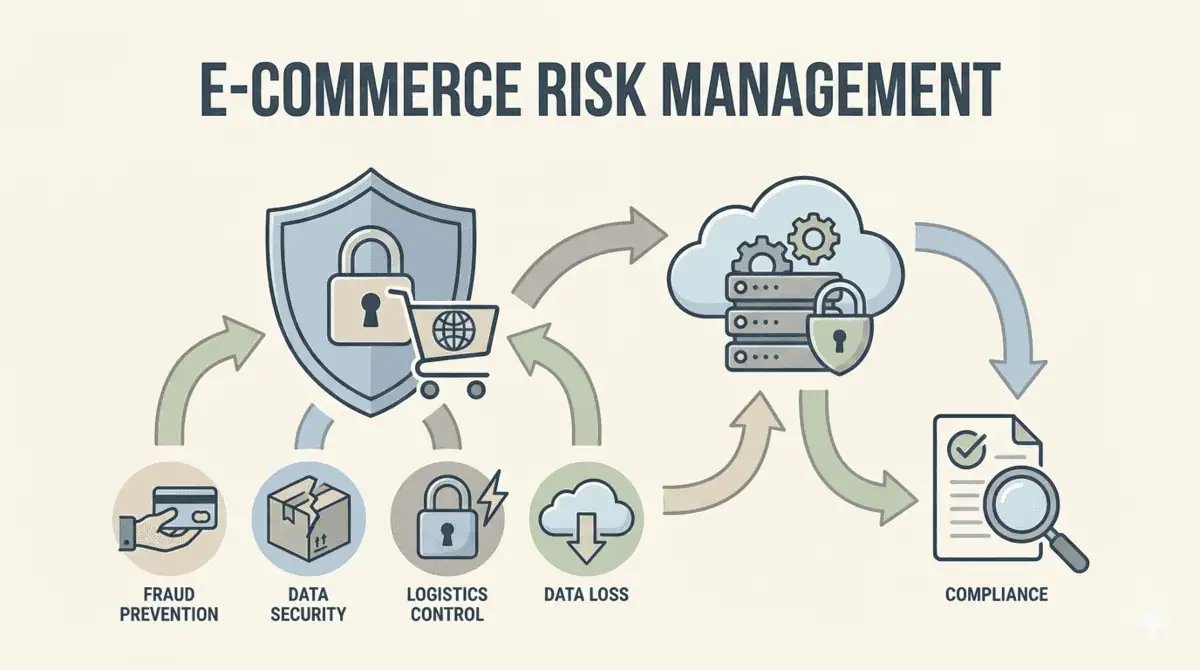
E-commerce is growing fast, but so are the risks that come with it. Online fraud alone is expected to double in the next few years, jumping from $44.3 billion in 2024 to $107 billion by 2029. And for most online businesses, fraud is only the beginning of the problem.
Today’s e-commerce risks go far beyond stolen credit cards. A single system outage can bring sales to a halt during peak hours. A weak plugin can expose customer data. Supply chain delays can leave you with empty shelves, while missed compliance rules can lead to heavy fines.
E-commerce risk management is no longer just about protecting payments. It’s about protecting your entire business, from your website and vendors to your customers, data, and reputation.
Types of Risks Faced by E-commerce Businesses
Running an online store means juggling risks that span way beyond the checkout page. You’re dealing with financial threats, operational headaches, technical vulnerabilities, and regulatory minefields all at once.
Here’s what each of these risk categories actually looks like in practice.
1. Financial Risks
Payment fraud hits hard, but chargebacks might be costing you even more. Chargeback rates jumped 222% from 0.15% in Q1 2023 to 0.47% in Q1 2024.
What makes this worse? Most chargebacks aren’t even real fraud. 75% of chargebacks are friendly fraud, where customers dispute legitimate purchases.
Returns abuse is spiraling too. Customers buying items, using them, then returning them. Or claiming packages never arrived when they did. These first-party misuse tactics drain profits faster than most merchants realise.
2. Operational Risks
Your supply chain is more fragile than you think. One vendor delay or shipping disruption can cascade into inventory shortages, missed delivery windows, and angry customers.
30% of global supply chain activities are affected by tariffs right now. That means unpredictable costs and delays you can’t always plan around.
Fulfillment errors add another layer. Wrong items shipped, damaged packaging, lost orders. Each mistake chips away at customer trust and eats into your margins with replacement costs and refunds.
3. Technical and Platform Risks
Your store runs on interconnected systems. When one breaks, it all breaks. System downtime means lost sales. Payment gateway failures mean abandoned carts. Platform vulnerabilities mean breaches.
Third-party apps create hidden exposure points. The Consentik Shopify app breach exposed over 4,180 stores to potential attacks. This wasn’t even a payment app. It was a cookie consent tool that leaked store admin tokens and advertising credentials.
Payment infrastructure adds its own complexity. Payment systems involve multiple integration points, and each connection is another potential failure point. Gateway outages, API changes, authentication issues. Any of these can halt transactions instantly.
4. Compliance and Regulatory Risks
You’re not just following one set of rules. You’re navigating a maze of overlapping regulations that change by region and keep getting updated.
Multi-jurisdictional requirements like GDPR, CPRA, DSA, and PCI DSS v4.0 all demand different compliance measures. Miss one, and you’re facing fines that can cripple your business.
EU customs reforms are adding product safety liability to the mix. You’re now responsible for ensuring products meet safety standards, not just shipping them. Tax compliance varies by state and country. Data privacy laws keep evolving with stricter penalties for violations.
5. Reputational Risks
One data breach can destroy years of trust-building. When customer information leaks, they don’t just stop buying from you. They tell everyone else to avoid you too.
Poor security practices become public fast. Review sites, social media, news coverage. Your reputation spreads beyond your control. Negative reviews about security issues or mishandled data stick around long after you’ve fixed the problem.
That’s exactly why reputational damage often outlasts the initial incident. You might recover financially, but winning back customer confidence takes years.
How to Manage E-commerce Risks
Effective risk management requires both proactive prevention and reactive response strategies. Here’s how you can protect your business from the threats we just covered.
- Implement layered security controls: Use SSL/TLS encryption, enable two-factor authentication for admin and customer accounts, rely on secure payment gateways, and run regular security audits.
- Monitor transactions in real time: Use fraud detection tools to flag suspicious behaviour such as failed payment attempts, mismatched addresses, or unusually large orders before transactions are completed.
- Establish clear policies and documentation: Publish transparent refund, shipping, and return policies so customers know what to expect and disputes are reduced.
- Report extortion attempts immediately: If you receive threats demanding payment to avoid mass chargebacks, fake reviews, or DDoS attacks, document everything and file a merchant extortion report form with your payment processor and local authorities.
- Conduct regular risk assessments: Review systems, workflows, and vendor relationships quarterly or semi-annually to identify vulnerabilities early.
- Train your team on security protocols: Ensure staff can recognise phishing attempts, handle customer data correctly, and respond quickly to incidents.
- Build vendor and third-party oversight: Review app permissions, vet vendor security practices, and monitor supply chain partners to reduce external risk.
Tools That Help Identify and Reduce Risk
The strategies we talked about work best when they’re backed by the right technology. Modern risk management tools combine automation with real-time monitoring and analytics to catch threats before they turn into financial losses.
You’re no longer manually reviewing every transaction or policy violation. Instead, these platforms process thousands of data points in seconds, flagging unusual patterns and helping you respond faster.
1. Fraud Detection and Prevention Tools
Platforms like Sift, Signifyd, and Riskified use machine learning to spot payment fraud, account takeover attempts, and policy abuse as they happen. These tools analyse buyer behavior, device fingerprints, and transaction history to assign risk scores in real-time. That means you can block suspicious orders before they ship while letting legitimate customers check out without friction.
2. Chargeback Management Software
Solutions like Chargeflow and Chargeback Gurus automate the entire dispute process, from evidence collection to submission.
Here’s what matters: merchants using automation report a 75% chargeback win rate compared to the 12% industry average for manual disputes. The software pulls transaction data, customer communication, and delivery confirmations to build your case without you lifting a finger.
3. Governance, Risk, and Compliance (GRC) Platforms
Enterprise tools like Archer, OneTrust, and Navex handle compliance tracking across multiple frameworks while managing third-party risk assessments. These platforms now include AI governance modules that help you track how algorithms make decisions and ensure they align with regulatory requirements. They’re built for businesses juggling multiple compliance standards at once.
4. Cybersecurity and Monitoring Tools
Specialised e-commerce security platforms provide SSL certificate monitoring, vulnerability scanning, DDoS protection, and threat intelligence feeds. These tools run continuous checks on your infrastructure and alert you the moment something looks off. They integrate with your existing systems to close security gaps before attackers find them.
5. Payment Security Solutions
PCI DSS-compliant payment processors work alongside tokenisation services and 3D Secure authentication tools to protect transaction data. Tokenisation replaces card numbers with random identifiers, so even if your database gets breached, the stolen data is useless. 3D Secure adds an extra authentication layer that shifts liability for fraudulent transactions away from your business.
6. Risk Assessment and Analytics Software
Tools like LogicGate Risk Cloud offer automated risk scoring that updates as your business changes. The platform includes workflow management and continuous control monitoring that tracks whether your security measures are actually working. You get dashboards showing which risks need immediate attention and which ones you’ve successfully mitigated.
Practical Risk Management Tips for Online Sellers
You’ve seen the risks and the tools. Now here are 10 vendor-neutral steps you can take today to protect your e-commerce business, regardless of what platform you sell on or how big your operation is.
- Enable multi-factor authentication everywhere: Turn on MFA for admin panels, payment processors, hosting accounts, and third-party tools that access customer data.
- Keep software and plugins updated: Regular updates fix known vulnerabilities and reduce the risk of attacks that target outdated systems.
- Use AVS and CVV checks: Require address verification and card security codes to block many fraudulent card transactions early.
- Set transaction velocity limits: Limit how many purchases a customer can make in a short period to prevent card testing and abuse.
- Maintain detailed transaction records: Save order details, shipping proofs, customer communication, and IP logs to support chargeback disputes.
- Review third-party app permissions regularly: Check which apps have access to store data and remove permissions for tools you no longer need.
Real World Examples of E-commerce Risk Management
Theory only takes you so far. Let’s look at actual incidents that shaped how businesses approach risk today.
The Consentik Shopify App Breach
In what became one of Shopify’s most sobering third-party security incidents, the Consentik app exposed over 4,180 stores to potential attacks. The app, ironically designed to help merchants comply with privacy regulations, ran an unsecured server that leaked Shopify personal access tokens and Facebook ad credentials.
What made this particularly damaging was the token access. Attackers could gain full administrative control over stores, manipulate customer data, inject malicious code, or launch fraudulent ad campaigns charged to the merchant’s account. The app had a 4.9-star rating and Shopify’s “Made for Shopify” badge, which shows that reputation alone doesn’t guarantee security.
The lesson here is clear: vet every third-party integration beyond surface-level reviews. Check security practices, audit access permissions regularly, and rotate tokens whenever you remove or change apps. Your store’s security is only as strong as the weakest plugin you’ve installed.
Amazon Seller Account Compromises
Amazon sellers face a different beast entirely. Seller account hacks have become a recurring pattern, with attackers targeting high-volume merchants to redirect funds or hijack product listings. One documented campaign hit 100 seller accounts over six months, siphoning funds before merchants even realised what happened.
What’s tricky about these attacks is they exploit platform-specific vulnerabilities. Standard consumer security like basic two-factor authentication often isn’t enough when you’re managing inventory worth thousands. Attackers use credential stuffing from previous breaches or phishing emails that look identical to Amazon’s official communications.
The takeaway: platform-specific threats need platform-specific defences. Use dedicated email addresses for seller accounts, enable all available security features Amazon offers, and monitor account activity daily. What protects your personal email won’t necessarily protect your business on a marketplace.
Chargeback Automation Success
Here’s a more optimistic example. Merchants using automated chargeback management systems achieve 75% win rates compared to the 12% average for those handling disputes manually. That’s not a small improvement, it’s the difference between losing money and protecting your margins.
The gap comes down to response time and evidence quality. Automated systems submit disputes within minutes with properly formatted documentation, while manual processes often miss deadlines or submit incomplete evidence. One mid-sized retailer recovered an additional $47,000 in a single quarter after implementing automation.
What this proves: specialized tools deliver measurable ROI when they address specific pain points. The upfront cost of automation pays for itself quickly when you’re dealing with high transaction volumes.
How to Build a Long-Term Risk Management Strategy
Risk management is not a one-time task. It needs to evolve as your business grows, fraud tactics change, and new vulnerabilities appear. A strong long-term strategy focuses on consistency, ownership, and regular improvement.
- Conduct a risk audit: Review your payment flows, systems, and processes to identify vulnerabilities and establish a clear baseline.
- Define risk tolerance levels: Decide which risks must be eliminated and which can be monitored based on business impact and customer experience.
- Assign clear ownership: Assign responsibility for financial, operational, technical, compliance, and reputational risks so issues are not overlooked.
- Implement controls and monitoring: Deploy fraud tools, security controls, and real-time alerts to catch threats at different stages.
- Create standard procedures: Document how your team should respond to incidents like fraud spikes, breaches, or downtime.
- Review and update regularly: Run quarterly reviews to assess incidents, tool performance, and new risk patterns.
- Train teams continuously: Provide regular training on emerging threats, phishing attempts, and security best practices.
- Work with security partners: Maintain relationships with payment providers, vendors, and industry groups for early threat insights.
- Test response plans: Run simulations for breaches, outages, and dispute spikes to ensure teams are prepared.
- Track and report key metrics: Monitor fraud rates, chargebacks, false positives, and response times to measure effectiveness.

A startup consultant, digital marketer, traveller, and philomath. Aashish has worked with over 20 startups and successfully helped them ideate, raise money, and succeed. When not working, he can be found hiking, camping, and stargazing.