[Reader Disclosure]Our content is reader-supported. This means we may earn a commission if you click on some of our links.
When you hire someone full-time, you’re signing up for a lot more than just their salary. There’s health insurance, taxes, office space, equipment, training, and whatnot.
For small businesses and startups, this traditional hiring model can drain resources fast.
Employee outsourcing changes this. With it, you can bring in skilled professionals without the baggage of full-time employment. An outside provider handles all the employment stuff while you focus on actually running your business.
Let’s get into the details of what employee outsourcing really is and how it can help you grow.
Employee outsourcing means hiring talent through third-party providers instead of bringing them onto your direct payroll. You get the work done without handling recruitment, benefits, or HR paperwork.
How is it different from traditional employment? When you hire an employee directly, you’re responsible for everything: from healthcare to tax withholdings to office space. With outsourcing, an external company employs the worker. You define the work, they deliver results, and the provider handles the employment logistics.
This approach has become massive. The BPO market is projected to reach $347.95 billion in 2025, and approximately 300,000 jobs are outsourced annually from the US. Companies aren’t just doing this to save money anymore. They’re accessing specialised skills, scaling faster, and staying flexible in unpredictable markets.
How Employee Outsourcing Works
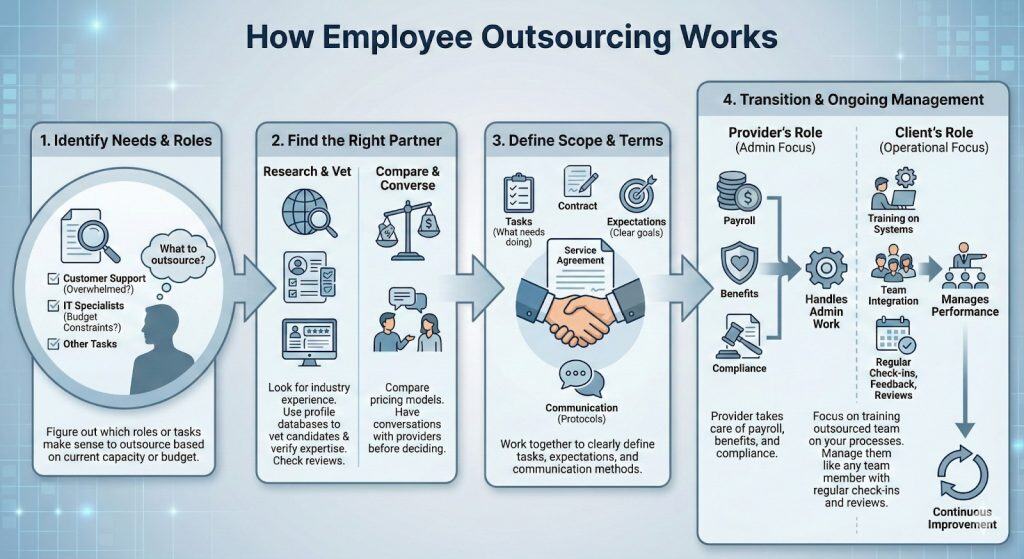
Getting started with employee outsourcing is pretty simple once you know what you need. First, you figure out which roles or tasks make sense to outsource. Maybe your customer support is overwhelmed, or you need IT specialists but can’t afford full-time salaries.
Once you know what you need, the next step is finding the right outsourcing partner. Look for companies with solid experience in your industry. Use a profile database to vet potential candidates and verify their expertise. Check reviews, compare pricing models, and have conversations with a few providers before making a decision.
When you’ve chosen a partner, you’ll work together to define the scope clearly, what tasks need doing, what your expectations are, and how you’ll communicate.
After that, the provider handles most of the work. They take care of payroll, benefits, and compliance while you focus on training the outsourced team on your systems and processes. You manage them like any other team member with regular check-ins, feedback sessions, and performance reviews.
Why Companies Outsource Employees
Companies aren’t outsourcing just because it’s trendy. There are real, measurable reasons why this approach makes sense. Let’s break down the main motivations.
1. To cut costs
Hiring full-time employees comes with salaries, benefits, office space, equipment, and training costs. Outsourcing cuts through that. According to recent data, companies report a 32% reduction in labour costs and 25% improvement in efficiency when they outsource. That’s not pocket change.
2. Access talent you can’t find locally
Maybe you need a specialised developer or a bilingual customer service rep. Your local hiring pool might come up empty. Outsourcing opens the door to global talent without relocating anyone or sponsoring visas.
3. Freedom to focus on what matters
Administrative tasks and support functions eat up time. When you outsource those roles, your core team can zero in on product development, sales, or strategy, the stuff that actually grows your business.
4. Flexibility to scale up or down
Seasonal spikes? New project launching? You can bring on outsourced employees quickly and scale back when things slow down. No awkward layoffs or hiring freezes needed.
Benefits of Employee Outsourcing
You know outsourcing can shave off 32% of your costs and give you access to global talent. But that’s just scratching the surface. When you dig deeper, the advantages stack up in ways that touch nearly every part of your operations.
Here’s what outsourcing actually does for your business:
Predictable spending: Companies spend an average of $115.46 per employee on outsourcing, which gives you clear, fixed costs instead of the unpredictable expenses that come with full-time hires.
Skip the recruitment marathon: You sidestep weeks of posting jobs, screening resumes, and conducting interviews. The outsourcing partner handles all that legwork.
Instant expertise: Need a cybersecurity specialist or a data analyst right now? Outsourcing plugs that skills gap immediately instead of spending months training someone.
Round-the-clock coverage: Teams across different time zones mean your customer support or IT monitoring never sleeps, even when your office does.
Zero infrastructure headaches: You don’t buy extra office space, computers, software licenses, or equipment. The outsourcing provider covers all that.
Types of Employee Outsourcing
Outsourcing isn’t one-size-fits-all. The type you pick depends on what you need, where you need it, and how hands-on you want to be. Let’s break down your options.
Based on Location
Onshore outsourcing: You hire teams within your own country. Same time zones, same language, similar work culture. It’s pricier than other options, but communication flows smoothly and you avoid cultural mismatches.
Nearshore outsourcing: Your outsourced team sits in a nearby country, usually with just a few hours of time difference. Think a U.S. company working with teams in Mexico or Canada. You get cost savings without sacrificing easy collaboration.
Offshore outsourcing: This is when you partner with teams halfway across the world, like hiring developers in India or customer service reps in the Philippines. The cost savings here are massive, but you’ll deal with bigger time gaps and need solid communication systems.
IT Outsourcing (ITO): Everything tech-related: software development, network management, cybersecurity, cloud services, and technical support.
Human Resources Outsourcing (HRO): Outsource recruiting, employee onboarding, benefits administration, and compliance management to HR specialists.
Knowledge Process Outsourcing (KPO): This is the high-level stuff that requires real expertise, market research, financial analysis, legal services, or medical diagnostics.
Based on Engagement Model
Project-based: You hire an outsourced team for a specific project with a clear start and end date. Perfect for launching a new app, running a marketing campaign, or handling a one-time data migration.
Staff augmentation: You temporarily add outsourced professionals to your existing team. They work alongside your in-house staff but remain employed by the outsourcing provider. Great when you need extra hands for a few months.
Managed services: The outsourcing partner takes full ownership of an entire function, like your IT infrastructure or customer support. They manage it end-to-end while you focus on everything else.
Employee Outsourcing Examples
Companies outsource all kinds of roles depending on what they need. Here are some common examples you’ll see across industries:
1. Customer Support – Many businesses outsource their call centres and live chat support. Instead of hiring a full in-house team, they partner with specialised support providers who handle customer inquiries, complaints, and technical questions.
2. Payroll and Accounting – Processing payroll, managing invoices, and bookkeeping are perfect for outsourcing. External firms handle tax calculations, payments, and financial reporting while you focus on running the business.
3. IT Management – Companies outsource everything from network maintenance to software development. Need someone to manage your servers, fix technical issues, or build a mobile app? Outsourced IT teams handle it.
4. Human Resources – Recruiting, onboarding new employees, managing benefits, and handling compliance paperwork all get outsourced. HR firms take care of the administrative burden while you manage your actual team.
5. Digital Marketing – Content creation, social media management, SEO, and paid advertising campaigns are frequently outsourced to specialised marketing agencies who know the ins and outs of online promotion.
6. Data Entry and Administrative Tasks – Repetitive tasks like updating databases, processing documents, and managing schedules eat up time. Outsourcing these functions frees your team for more important work.
The pattern is simple: if it’s not core to your business but still needs doing, it’s probably something you can outsource.
Employee Outsourcing vs Traditional Hiring
So, how do you decide between building an in-house team or outsourcing? Let’s break down what each approach really means for your business.
Cost structure
Traditional hiring comes with salary, benefits, office space, equipment, and taxes, everything bundled into one employee. Outsourcing flips this. You pay for the work you need when you need it. No long-term overhead piling up during slow months.
Hiring speed
Finding the right full-time employee takes weeks, sometimes months. You post jobs, screen resumes, conduct interviews, and negotiate offers. With outsourcing, you can have specialists working on your project within days. The talent pool is already vetted and ready.
Commitment level
Hiring someone full-time is a serious commitment. You’re planning for years, not months. Outsourcing gives you flexibility. Scale up for a big project, scale down when it wraps. No awkward conversations about letting people go.
Control and communication
In-house teams sit right next to you. You can walk over and ask questions anytime. Outsourced teams require more structured communication, regular check-ins, clear documentation, and project management tools. But with the right setup, this actually forces better processes.
When Should a Company Consider Outsourcing?
Not every business needs to jump into outsourcing right away. The timing matters. Some companies rush into it without thinking through whether it actually solves their problems. Others wait too long and miss chances to grow faster or save money.
Here are situations where outsourcing makes the most sense:
You lack specialised skills in-house. If you need a data scientist but don’t have the budget to hire one full-time, outsourcing gives you access without the hefty salary commitment.
You’re trying to cut costs without sacrificing quality. Hiring locally might stretch your budget thin. Outsourcing to regions with lower labour costs can help you stay competitive.
You need to scale rapidly. Your startup just landed a big client and you need five developers yesterday. Building an in-house team takes months. Outsourcing can fill that gap fast.
Non-core functions are eating up time. Your team spends hours on payroll, IT support, or customer service when they should focus on product development. Let someone else handle the routine stuff.
You have temporary or project-based needs. You need a team for a six-month app redesign. Once it’s done, you won’t need them anymore. Outsourcing avoids the awkwardness of layoffs.
Risks and Challenges of Employee Outsourcing
Outsourcing sounds great on paper, but it’s not all smooth sailing. Companies run into problems they didn’t see coming. Being aware of these challenges helps you plan better and avoid nasty surprises down the road.
Here’s what can go wrong:
Data security concerns. You’re handing sensitive information to an outside company. If they don’t have strong security measures, your customer data or intellectual property could be at risk.
According to recent research, 29% of companies report financial damage from third-party cybersecurity incidents, with reputational damage close behind at 26%.
Loss of direct control. You can’t walk over to their desk and check on progress. Managing remote teams requires different skills and more structured processes.
Communication barriers. Time zones, language differences, and cultural nuances can create misunderstandings. What seems like a clear instruction to you might be interpreted differently halfway across the world.
Quality control issues. Not every outsourcing provider delivers the same standard of work. Without proper vetting, you might end up with mediocre results that need expensive fixes.
Compliance and legal complications. Different countries have different labour laws, tax regulations, and data protection rules. Staying compliant gets tricky when your team is spread across multiple jurisdictions.
How to Choose the Right Outsourcing Partner
Picking the wrong outsourcing partner costs more than money. It wastes time, damages morale, and can set your projects back by months. The right partner, though, feels like an extension of your own team. They get your vision, deliver quality work, and make your life easier instead of more complicated.
Here’s what to look for when evaluating potential partners:
1. Define your goals first. Before talking to any provider, get crystal clear on what you need. Are you looking for cost savings, specialised expertise, faster delivery, or all three? Your goals shape which partner fits best.
2. Evaluate their experience and track record. How long have they been in business? Do they have experience in your industry? A partner who’s worked with similar companies understands your challenges better.
3. Review their portfolio and case studies. Don’t just take their word for it. Look at actual work they’ve delivered. Ask specific questions about projects similar to yours.
4. Assess technical capabilities. Make sure they’re using current technologies and methodologies. If they’re stuck with outdated tools, that’s a red flag.
5. Check their financial stability. A partner struggling financially might cut corners or disappear mid-project. Look for established companies with solid reputations.
6. Verify compliance and security measures. Ask about their data protection policies, security certifications, and how they handle confidential information. This isn’t negotiable.
7. Test communication and cultural fit. Have detailed conversations before committing. Do they respond quickly? Do they ask smart questions? Can you see yourself working with them long-term?
8. Compare pricing models. Understand exactly what you’re paying for. Fixed-price, hourly, or dedicated team models each have pros and cons depending on your needs.
9. Request client references. Talk to their current or past clients. Ask about reliability, quality, communication, and how they handle problems.
10. Start with a pilot project. Don’t commit to a massive engagement right away. Test them on a smaller project first. You’ll learn how they work, spot potential issues, and make a more informed decision about scaling up.
The right partner doesn’t just complete tasks. They bring insights, suggest improvements, and care about your success as much as you do. Take your time with this decision. Rushing it leads to headaches you don’t need.
A startup consultant, digital marketer, traveller, and philomath. Aashish has worked with over 20 startups and successfully helped them ideate, raise money, and succeed. When not working, he can be found hiking, camping, and stargazing.
Each week I share research backed AI oriented content in my newsletter.
There are AI ideas, AI trends, tutorials, and guides.
24k entrepreneurs read it. I'd love you to join.