OpenAI just crossed 800 million weekly active users in 2025. That’s roughly 10% of the entire planet using ChatGPT at least once a week. But user growth is just the surface.
The company raised $40 billion in the largest private funding round in history, hit a $300 billion valuation, and is now processing 2.5 billion queries every single day. If you’re trying to understand where AI is actually heading, these numbers tell the story better than any prediction.
Here’s what the data shows.
OpenAI Key Statistics Overview
Let’s start with the headline numbers that define OpenAI’s position:
- 800 million weekly active users globally
- $13 billion in annual revenue for 2025, with annualised revenue exceeding $20 billion by late year
- $300 billion post-money valuation after March 2025 funding round
- $40 billion raised in March 2025, the largest private funding round in history
- $57.9 billion in total funding raised across 11 rounds as of May 2025
- 1 million business customers worldwide using OpenAI products
- 2.5 billion daily queries processed globally across all ChatGPT users
- 36.5% of U.S. businesses adopted OpenAI services by July 2025
- 45.3% market share among daily U.S. mobile app users as of early 2026
- 330 million daily queries from U.S. users alone
- 49% of U.S. companies report using ChatGPT regularly in their workflows
- Growth rates in lowest income countries 4x higher than in highest income countries by May 2025
These numbers show OpenAI isn’t just leading the AI race. It’s operating at a scale that no other AI company has touched. The jump from 500 million to 800 million weekly users in just a few months shows momentum that’s still accelerating.
What’s interesting is how that growth is happening everywhere, not just in tech hubs. Low-income countries are actually adopting ChatGPT faster than wealthy ones, which suggests this isn’t just a tool for early adopters anymore.
OpenAI Revenue & Financial Statistics
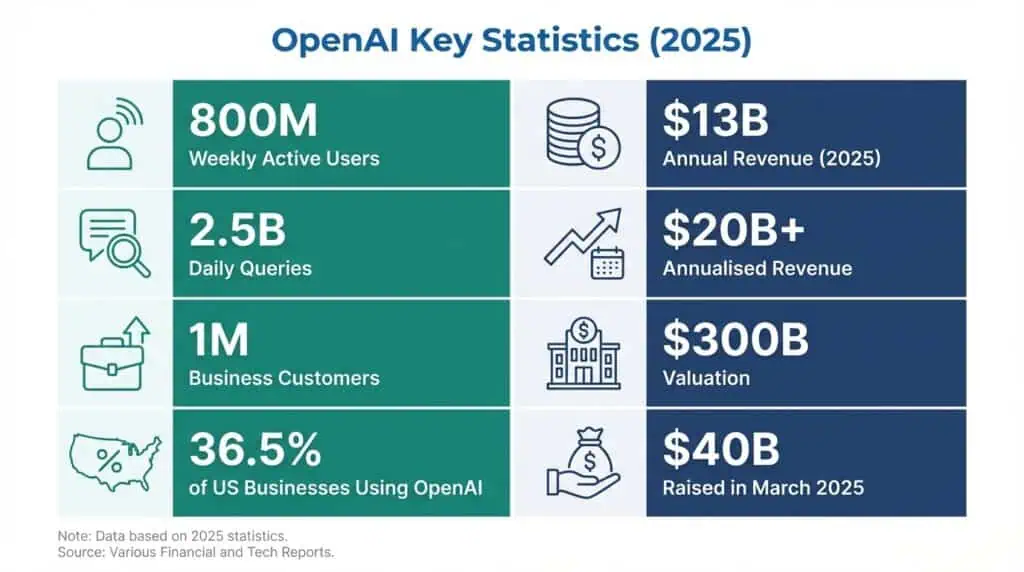
- OpenAI generated $3.7 billion in annual revenue in 2024, up from around $1 billion in 2023
- The company is on track to hit approximately $13 billion in total revenue for 2025
- Annual recurring revenue (ARR) topped $20 billion by late 2025, tripling from $6 billion in 2024
- Revenue grew 3.2x year-over-year since 2024, making it one of the fastest-growing tech companies in history
- In the first half of 2025 alone, OpenAI pulled in $4.3 billion in revenue
- The company projects revenue to more than double again in 2026, potentially reaching $29.4 billion
- ChatGPT accounts for roughly 70% of OpenAI’s revenue, with the remaining 30% coming from enterprise solutions
- Despite strong revenue growth, OpenAI reported a $5 billion loss in 2024 due to massive compute and infrastructure costs
That revenue trajectory is wild. Going from $1 billion to $13 billion in just two years shows how quickly AI adoption is accelerating. The thing is, OpenAI is spending even faster than it’s earning. Computing power and talent aren’t cheap when you’re trying to build AGI.
OpenAI Valuation & Funding Statistics
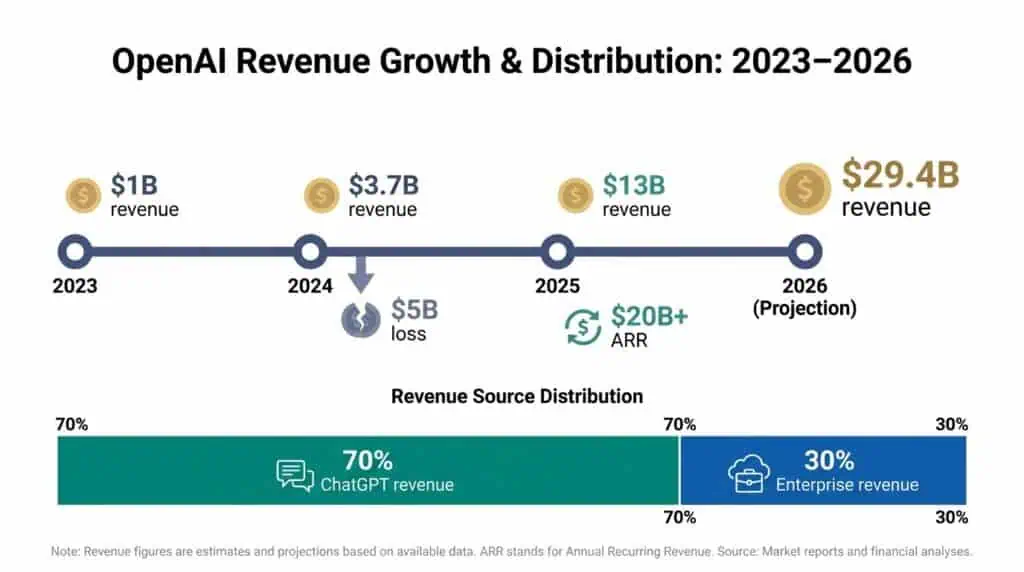
- OpenAI’s valuation hit $300 billion in March 2025 following its latest funding round
- The company raised $40 billion in March 2025, led by SoftBank, marking the largest private funding round in history
- OpenAI has raised a total of $57.9 billion across 11 funding rounds since its founding
- The March 2025 valuation nearly doubled from the $157 billion valuation set just six months earlier in October 2024
- Previous valuations show rapid appreciation: $29 billion in 2023, $80 billion in early 2024, then $157 billion by fall 2024
- Major investors include Microsoft (which has invested over $13 billion), Thrive Capital, SoftBank, Dragoneer Investment Group, Blackstone, and TPG
- The $300 billion post-money valuation makes OpenAI the second most valuable private company globally, behind only SpaceX
- Despite the sky-high valuation, OpenAI expects cumulative losses of $44 billion through 2028 as it invests in compute infrastructure
The funding numbers are staggering. Raising $40 billion in a single round broke every record in venture capital history. What this tells you is that investors are betting big on AGI, even knowing OpenAI won’t be profitable anytime soon. The valuation jumped from $29 billion to $300 billion in just two years, which is basically unheard of for a company still losing billions annually.
OpenAI User Growth Statistics
The platform’s user base expansion tells a story of rapid AI adoption. Here’s what the numbers show:
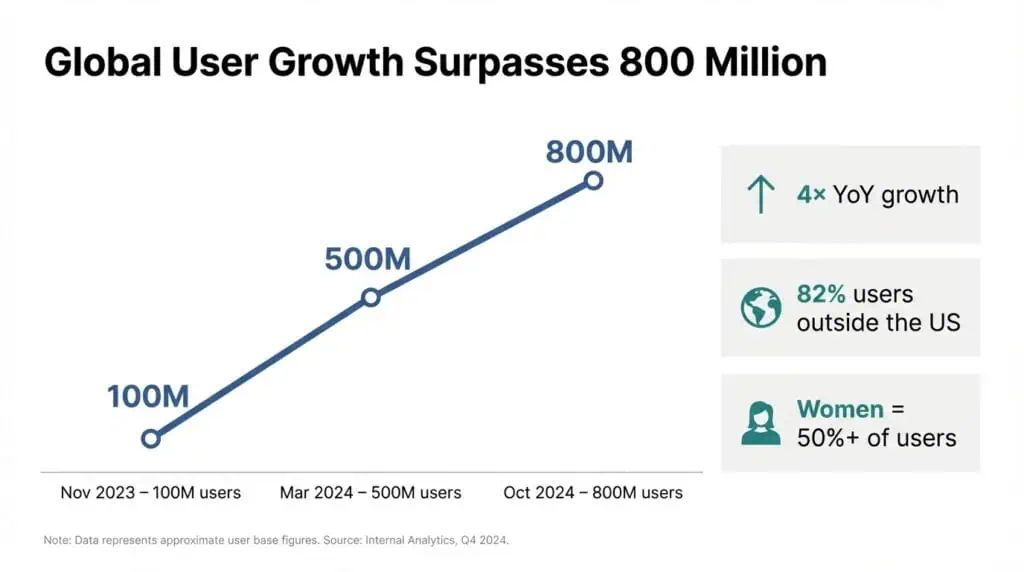
- ChatGPT now serves over 800 million people each week, making it one of the fastest-growing consumer applications in tech history
- The jump from 500 million weekly users in March 2024 to 800 million by October 2024 represents a 60% increase in just seven months
- Year-over-year growth stands at 4x, with usage patterns showing no signs of slowing down
- Low and middle-income countries are adopting ChatGPT 4x faster than high-income nations, indicating the tool’s accessibility across economic boundaries
- The US accounts for roughly 18% of the total user base, with the remaining 82% distributed across international markets
- OpenAI’s paying business user count reached 5 million by August 2024, up from 3 million just two months earlier
- The platform hit the 100 million weekly user mark in November 2023, which means it took less than a year to reach 800 million
- Women now make up more than half of identified users, showing the platform’s expanding demographic reach
What’s interesting here is the acceleration pattern. The platform isn’t just growing, it’s growing faster. That 4x growth in lower-income countries suggests AI tools are filling real gaps in access to information and productivity resources. The speed from 100 million to 800 million users in under a year outpaces most tech platforms we’ve seen, including early social media adoption curves.
ChatGPT Usage Statistics
Beyond how many people use ChatGPT, understanding how they use it reveals the platform’s real impact. The daily activity numbers paint a clear picture:
OpenAI Traffic Metrics
Metric | Value (Apr–Jun 2025) |
Unique Monthly Visitors | 237.7 million |
Monthly Visits | 663.6 million |
Visits per Visitor | 2.79 |
Avg. Visit Duration | 2 minutes |
Pages per Visit | 2.11 |
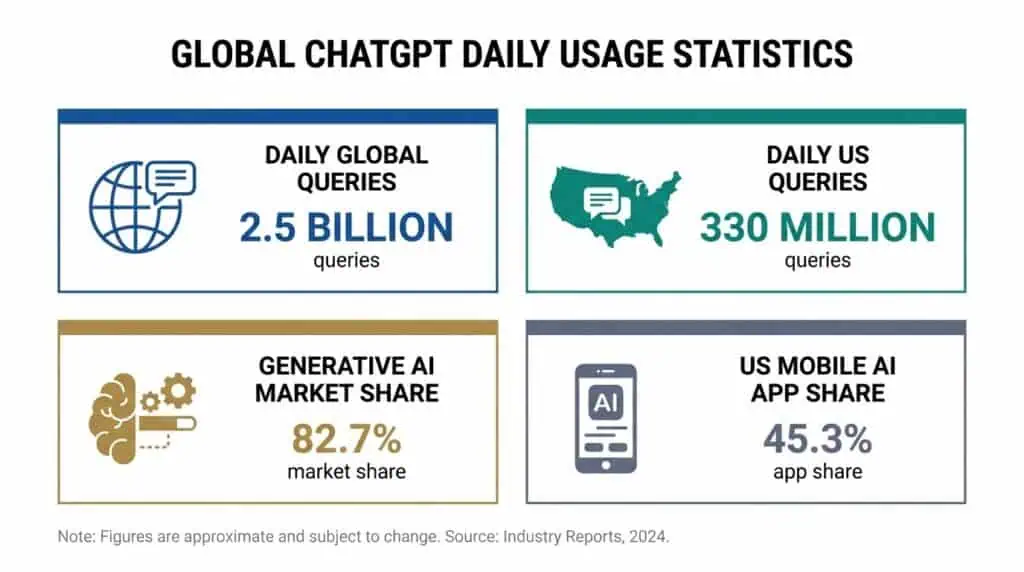
- ChatGPT processes 2.5 billion queries every single day across its global user base
- US users contribute approximately 330 million of those daily queries, representing about 13% of global activity
OpenAI Users Demographics
Category | Top Segments |
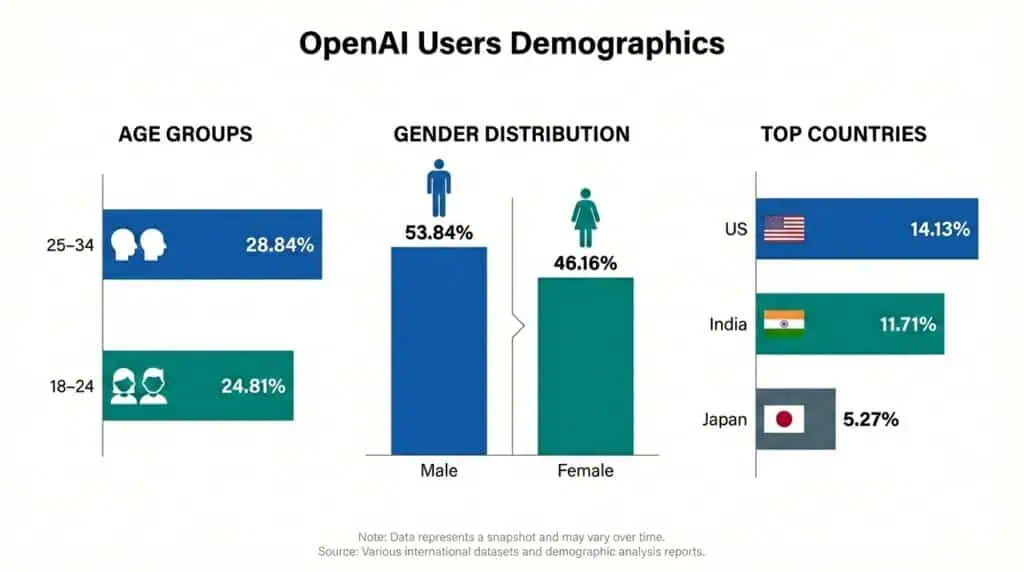
Age | 25–34 (28.84%), 18–24 (24.81%) |
Gender | Male (53.84%), Female (46.16%) |
Top Countries | US (14.13%), India (11.71%), Japan (5.27%) |
- The platform holds an 82.7% market share in the generative AI space, dwarfing competitors by a significant margin
- Among daily US mobile app users in the AI category, ChatGPT commands 45.3% market share
Business Usage
Breakdown | Leaders |
By Industry | IT Services (1,171 companies), Computer Software (1,070), Higher Education (401) |
By Company Size | 10–50 employees (1,400+), 50–200 (1,275), 10,000+ (900+) |
By Revenue | $1–10M (1,643), $10–50M (1,300+), $1B+ (1,232) |
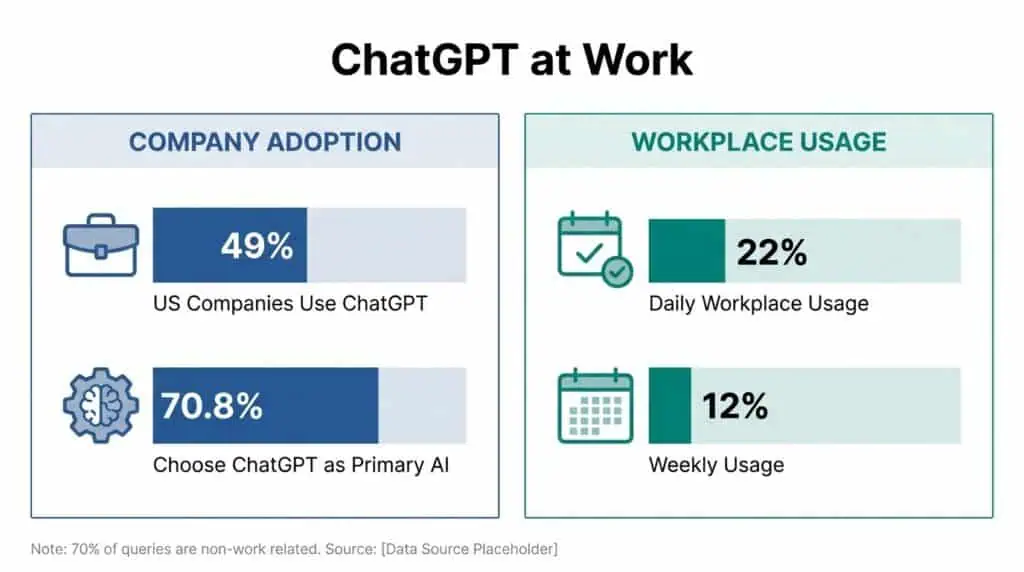
- 49% of US companies now use ChatGPT regularly for business operations
- At work, 70.8% of employees who use AI tools have chosen ChatGPT as their primary platform
- The mobile app has been downloaded 64.27 million times from the App Store and Google Play combined
- 22% of workplace users interact with ChatGPT daily, with another 12% using it weekly
- About 70% of all ChatGPT queries are unrelated to work, showing the platform’s versatility beyond professional tasks
- 10 million users globally pay for ChatGPT Plus, with subscription tiers ranging from the Plus plan to the new $200/month Pro tier launched in December 2024
The split between work and personal use is telling. While workplace adoption gets most of the headlines, the fact that 70% of usage happens outside work contexts shows people find value in ChatGPT for everyday life.
That 2.5 billion daily query volume puts the platform in competition with traditional search engines for certain types of information seeking. And with workplace AI users overwhelmingly choosing ChatGPT over alternatives, the platform has established itself as the default AI assistant for millions.
OpenAI Product and Cost Stats
ChatGPT drove explosive growth, with 5.4 billion monthly visits by June 2025 (up 3,433% from launch). GPT-5 tokens cost $1.25/million input (standard) or $0.125/million (cached) as of August 2025; ChatGPT operations projected high losses (~$5B in 2024, ongoing in 2025).
Traffic Sources
YouTube topped social referrals at 42.18% (desktop), followed by X (13.95%) and LinkedIn (11.66%). ChatGPT countries mirrored overall: US (15%), India (9.02%). OpenAI Five (Dota 2 AI) peaked with 2019 esports wins but lacks 2025-specific updates.
GPT-5 Performance & Adoption Statistics
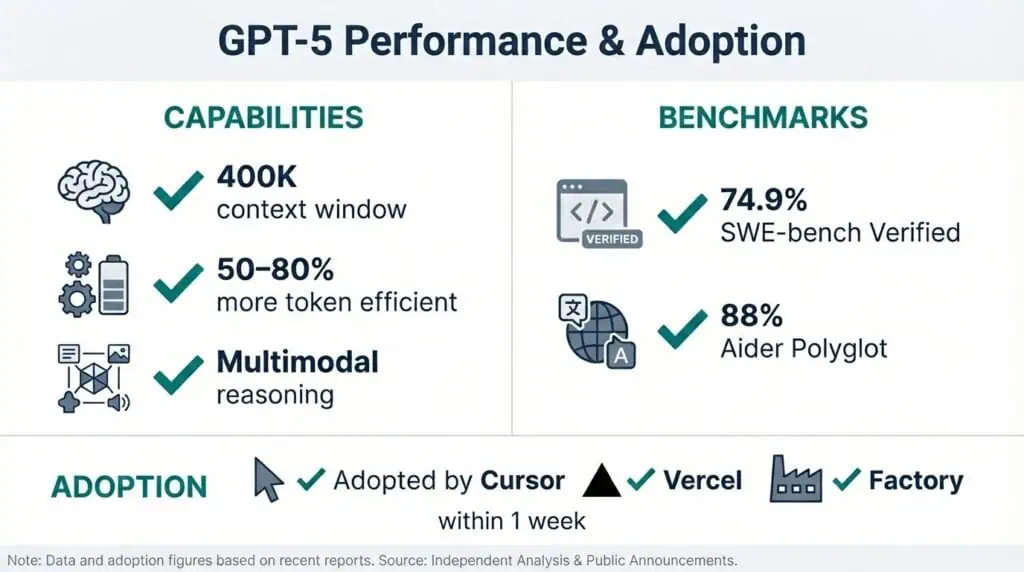
OpenAI launched GPT-5 on August 7, 2025, marking their most significant model release since GPT-4. The new model brought together enhanced reasoning capabilities with multimodal features in a single unified system. Here’s what the numbers tell us about GPT-5’s performance and early adoption:
- 400K total context window (272K input tokens + 128K output tokens), far exceeding GPT-4’s capacity
- 50-80% more token-efficient than OpenAI’s o3 model across visual reasoning, coding, and scientific problem-solving tasks
- 74.9% score on SWE-bench Verified and 88% on Aider Polyglot benchmarks, demonstrating substantial coding improvements
- Three pricing tiers: GPT-5 ($1.25/$10.00 per 1M tokens), GPT-5 Mini ($0.25/$2.00), and GPT-5 Nano ($0.05/$0.40)
- Immediate enterprise adoption by major platforms like Cursor, Vercel, and Factory, with several making it their default model within one week
- Roughly equivalent performance gains to the GPT-4 jump over GPT-3, based on benchmark data from Epoch AI
- 54% of enterprise coding usage now on models with GPT-5 level capabilities, showing strong developer preference
GPT-5’s launch faced mixed initial reactions from consumers, but enterprise uptake has been strong. Companies reported that the model matches or beats competitors like Claude on code generation and interface design, areas where Anthropic previously dominated. The efficiency improvements mean faster results at lower costs, which matters more to businesses than benchmark numbers.
OpenAI’s market position remains dominant in consumer AI, but the competitive landscape is shifting rapidly. The company faces increasing pressure from both Anthropic and Google across different market segments. Here’s where things stand:
- 61.3% of the AI search market by December 2025, according to First Page Sage data, with Google Gemini at 13.4%
- 45.3% daily US mobile app market share as of January 2026, down from 69.1% just one year earlier
- 27% enterprise LLM market share in 2025, dropping from 50% in 2023 as Anthropic captured the top spot
- Anthropic leads enterprises with 32%, particularly dominating coding use cases with 54% versus OpenAI’s 21%
- Google Gemini grew from 7% to 21% in enterprise market share between 2023 and 2025
- $500 billion valuation being discussed in secondary stock sales, making OpenAI one of the most valuable private companies
- 800 million weekly active users across all OpenAI products, maintaining massive consumer reach despite enterprise challenges
The market share data reveals two different stories. OpenAI dominates consumer AI usage, with ChatGPT remaining the go-to tool for everyday users. But in enterprise environments where coding and complex technical tasks matter most, Anthropic’s Claude has gained significant ground. This split suggests the AI market isn’t winner-take-all. Different models are winning different segments based on specific strengths and use cases.
OpenAI API Usage Statistics
OpenAI’s developer ecosystem has become the backbone of thousands of AI-powered applications. Here’s what the numbers look like:
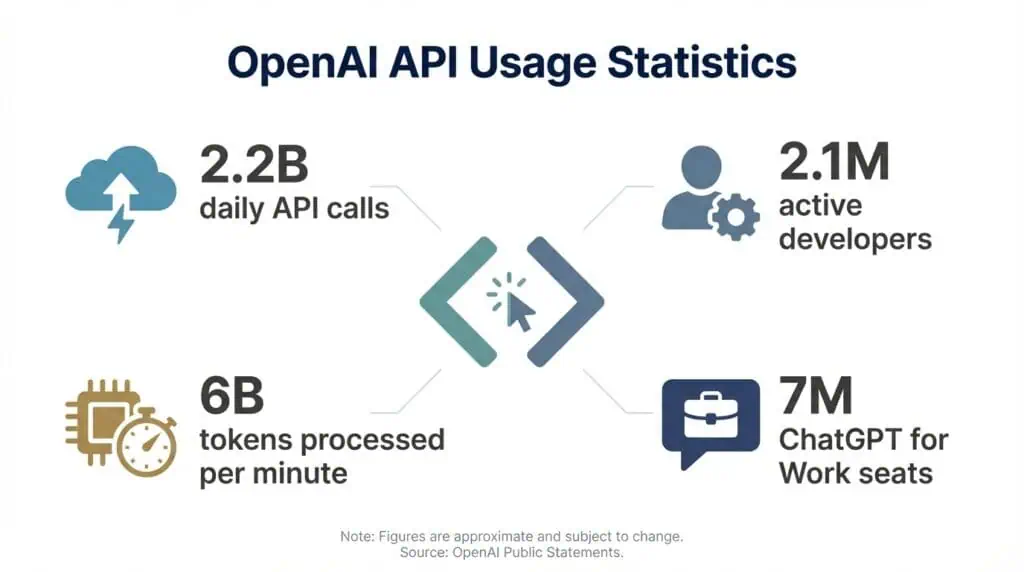
- 2.2 billion+ daily API calls processed in 2025, up from 1.3 billion in 2024, showing a 69% year-over-year increase in developer demand
- 2.1 million+ active developers building on the OpenAI platform, making it one of the largest AI developer communities globally
- 6 billion tokens processed per minute through the API, a 20x jump from 300 million tokens per minute in 2023
- Usage-based pricing model that charges per token, with costs varying by model (GPT-4 is more expensive than GPT-3.5, and reasoning models have different input/output rates)
- 7 million ChatGPT for Work seats deployed across business users, representing a 40% increase in just two months
- Developer platform expansion now includes fine-tuning capabilities, custom GPTs, and agentic workflow tools that let developers create specialised AI applications
The scale of API adoption shows how OpenAI has moved beyond consumer chatbots into serious infrastructure territory. That 20x increase in token processing tells you developers aren’t just experimenting anymore. They’re building production systems that handle millions of requests daily.
Enterprise & Business Adoption Statistics
OpenAI’s enterprise push has paid off faster than most SaaS companies dream of. The B2B numbers are pretty wild:
- 1 million+ business customers globally as of November 2025, cementing OpenAI’s position as the enterprise AI leader
- 92% of Fortune 500 companies using ChatGPT products, with widespread adoption across industries from finance to healthcare
- 80% of Fortune 500 adopted ChatGPT within just nine months of its launch, one of the fastest enterprise software adoption rates ever recorded
- 8x year-over-year growth in ChatGPT Enterprise message volume, signaling deepening usage beyond initial experimentation
- 320x increase in reasoning token consumption by organizations, showing businesses are tackling complex problem-solving tasks rather than simple queries
- 143%+ growth in international markets like Australia, Brazil, Netherlands, and France, with enterprise adoption accelerating globally
- 40-60 minutes saved daily reported by workers using ChatGPT Enterprise, with measurable productivity gains across coding, writing, and analysis tasks
What’s striking here isn’t just the customer count. It’s how fast these businesses moved from testing AI to embedding it in daily workflows. That 320x jump in reasoning tokens tells you enterprises aren’t using ChatGPT for basic stuff anymore.
They’re pushing it to handle strategic planning, complex data analysis, and decision support work that used to require specialized consultants.
OpenAI Computing Infrastructure Statistics
Behind all those ChatGPT conversations sits an absolutely massive computing operation. OpenAI’s infrastructure stats reveal just how much power AI requires:
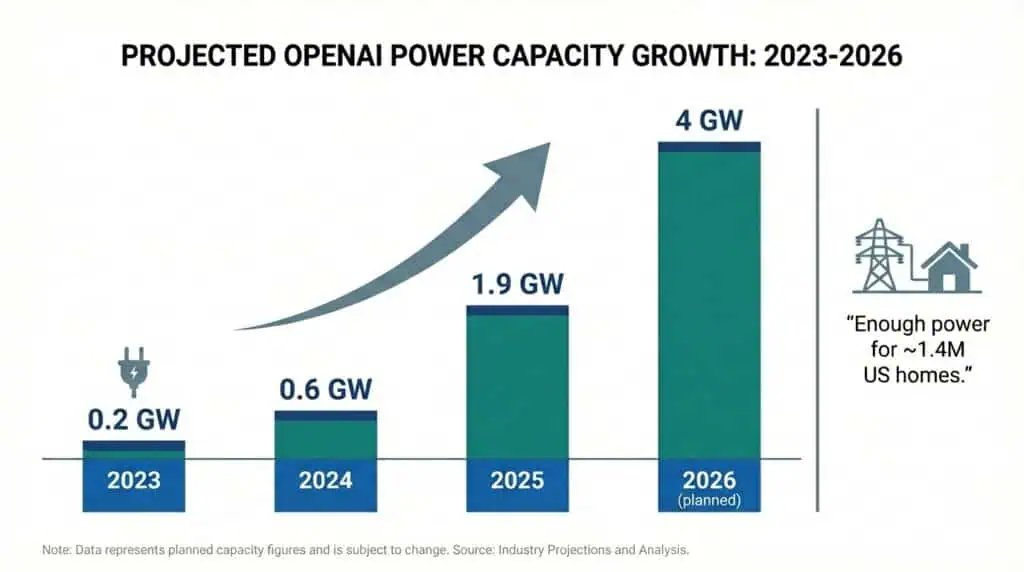
- 1.9 GW of compute capacity consumed in 2025, enough electricity to power roughly 1.4 million average U.S. homes
- 0.6 GW capacity in 2024 and 0.2 GW in 2023, showing a 3x year-over-year infrastructure expansion and 9.5x growth from 2023 to 2025
- 4 GW capacity planned for 2026 according to industry estimates, which would bring OpenAI’s total infrastructure to around 6 GW
- Global data center footprint that expanded from 200 megawatts to 1,900 megawatts in just two years
- Partnership-based model with cloud providers and data center operators rather than building owned facilities, allowing faster scaling
- Energy consumption growth that outpaces revenue growth, highlighting the infrastructure challenge facing AI companies as they scale
That triple-digit growth in power consumption explains why data center deals have become strategic priorities for AI companies. You’re seeing OpenAI and competitors racing to lock down gigawatts of capacity because compute is the actual constraint on growth. When your infrastructure needs triple year-over-year and you’re planning to double again next year, securing power and cooling becomes just as important as building better models.
OpenAI’s Website Traffic & Engagement Statistics
OpenAI’s website has become one of the most visited destinations on the internet. Here’s what the traffic numbers look like:
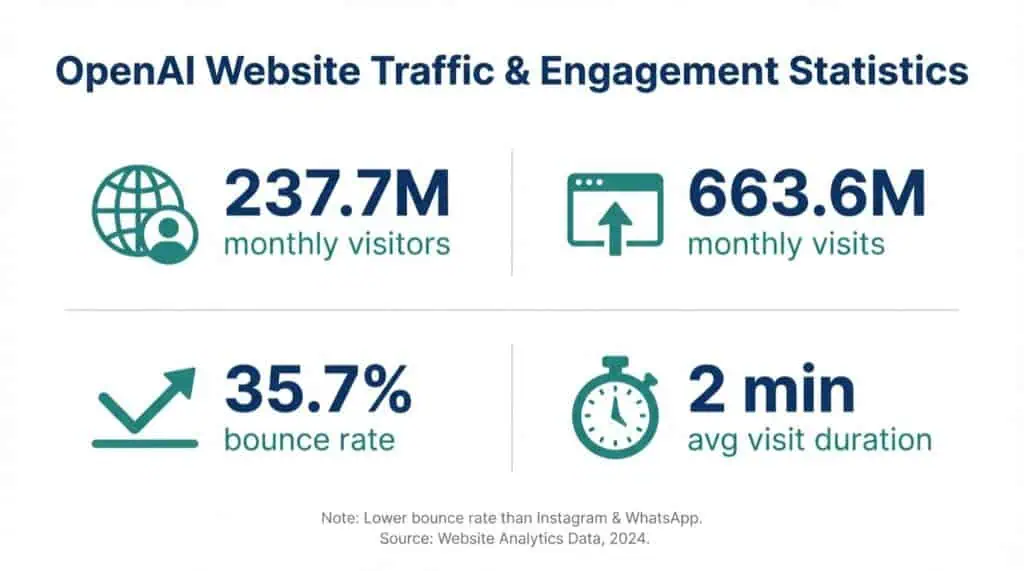
- 237.7 million unique monthly visitors access OpenAI’s platforms, generating approximately 663.6 million total visits per month
- 1.6 billion visits in January 2024, with peak traffic reaching 1.7 billion visitors in July 2024
- 35.7% bounce rate, meaning nearly two-thirds of visitors engage beyond the landing page (lower than major platforms like Wikipedia at 59.69%)
- 55.22% male and 44.78% female users, showing relatively balanced gender distribution across the platform
- YouTube and social media represent significant traffic sources, driving substantial referral visits to OpenAI’s products
- Global reach spans multiple continents, with strong engagement across North America, Europe, and Asia
The bounce rate sits around 3% lower than Instagram and 7% lower than WhatsApp. This tells us people aren’t just landing on the site and leaving. They’re sticking around, which makes sense when you consider how interactive AI tools naturally encourage engagement as users refine prompts and explore different outputs.
Microsoft Partnership With OpenAI Statistics
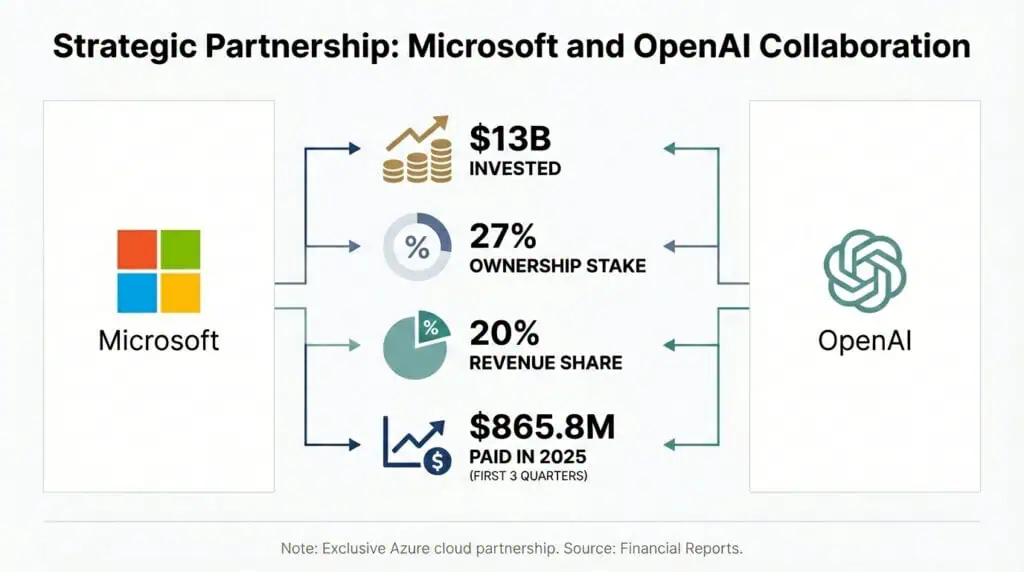
Microsoft’s investment in OpenAI represents one of the biggest tech partnerships in recent history. The numbers show just how deep this relationship goes:
- $13 billion total investment from Microsoft ($11.6 billion actually funded to date), making it OpenAI’s largest backer
- 27% stake in OpenAI Group PBC on an as-converted diluted basis, valued at approximately $135 billion at the 2024 restructuring
- 20% revenue share agreement with Microsoft receiving a portion of OpenAI’s revenues until AGI is confirmed
- $493.8 million paid to Microsoft in revenue share during 2024 alone, with $865.8 million in the first three quarters of 2025
- Exclusive Azure cloud partnership for OpenAI’s API products, though OpenAI can now build additional capacity for research and training
- Rights to OpenAI’s models through 2032 (excluding consumer hardware), giving Microsoft access to intellectual property for products like Copilot
- Revenue sharing arrangements flow both ways, with both companies benefiting from increased use of models across platforms
What’s interesting here is how the partnership has evolved over time. Microsoft no longer holds the right of first refusal as OpenAI’s cloud provider, and the revenue share agreement ends once AGI is verified by an expert panel. That’s a big shift from the original terms.
OpenAI Employee & Workforce Statistics
OpenAI’s headcount has exploded as the company scales its operations. The growth rate rivals some of the fastest-expanding tech companies:
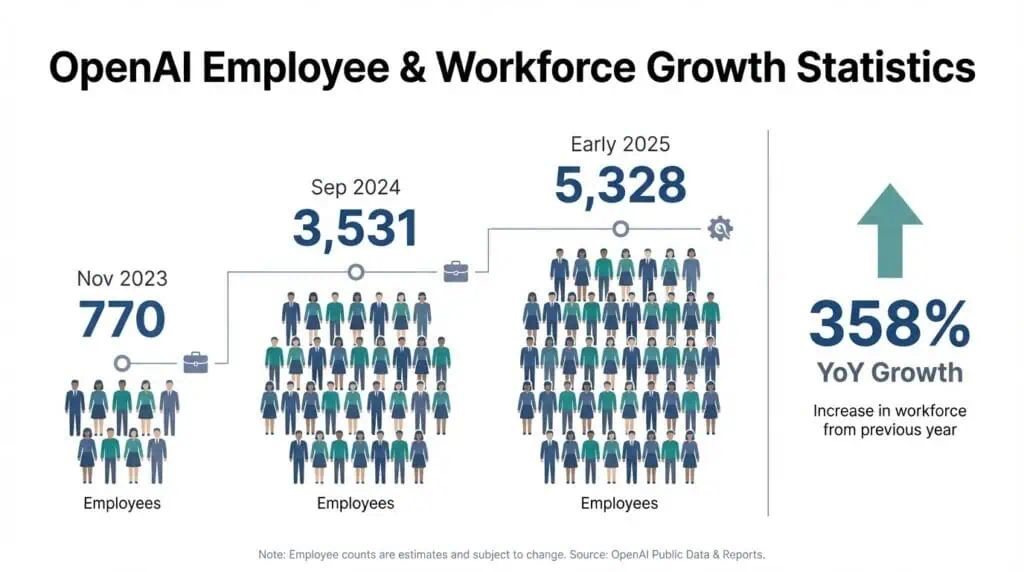
- 3,531 employees as of September 2024, representing a nearly 5x increase from just 770 employees in November 2023
- 5,328 employees reached by early 2025, with aggressive hiring continuing across technical and operational roles
- 358% year-over-year growth rate in workforce size, reflecting rapid scaling to meet product demand
- Expanded beyond 1,000 employees in late 2024, with the majority holding technical positions in AI research and engineering
- Diverse educational backgrounds from top universities, with concentrations from Stanford, MIT, Berkeley, and other leading research institutions
The jump from 770 to over 5,000 employees in roughly a year tells you something about the operational pressure OpenAI faces. You can’t serve hundreds of millions of users with a small team. Plus, developing next-generation models like GPT-5 requires serious technical talent, which means pulling from the best AI research programs globally.
OpenAI Profit & Loss Statistics
Despite massive revenue growth, OpenAI is burning through billions. The financial picture shows why the company keeps raising capital:
- $5 billion loss in 2024 on $3.7 billion in revenue, not including equity-based compensation costs
- $44 billion cumulative losses projected between 2023 and 2028, with profitability not expected until 2029
- $14 billion in losses anticipated for 2026 alone, as compute costs and operational expenses continue climbing
- $2 billion annual compute costs for running models, plus billions more in employee salaries, office rent, and infrastructure
- Monthly losses exceed $400 million on average, driven by the computational demands of serving millions of daily users
- No path to near-term profitability despite revenue projections of $11.6 billion for next year and beyond
Here’s the thing that surprised a lot of people. OpenAI generated $300 million in revenue in a single month by late 2024, yet still lost billions for the year. That’s because running AI models at scale is phenomenally expensive. Every ChatGPT query costs money in compute power. Multiply that by billions of interactions, and you see why the losses pile up so quickly.
Future Projections & Growth Forecasts
Here’s where things get interesting. OpenAI isn’t just planning for next year. They’re mapping out a path that, if it works, would make them one of the fastest-growing companies in tech history.
The numbers they’re targeting are massive:
- $29.4 billion in revenue by 2026, up from the current $4 billion annual run rate. That’s more than a 7x jump in less than two years.
- $125 billion revenue target by 2029. According to Yahoo Finance, internal forecasts show OpenAI expects to hit $100 billion by 2029, with just over 50% coming from ChatGPT subscriptions, 20% from API sales, and another 20% from new products like video generation and AI research assistants.
- Profitability expected in 2029. After burning through $115 billion between now and then, the company forecasts turning a $14 billion profit once it hits that $100 billion+ revenue mark.
- User growth continuing at pace. With 500 million weekly active users already, the company is betting on expansion into enterprise markets and new product categories to keep adding users.
- Market expansion through agents and automation. A significant chunk of future revenue is expected to come from AI agents that can complete tasks autonomously, though this market barely exists right now.
- Global AI market reaching $3.68 trillion by 2034. The broader industry context matters here. The global AI market is projected to grow from $638 billion in 2025 to over $3.6 trillion by 2034, giving OpenAI plenty of room to expand.
Hitting these targets would require growth that’s never really been seen before. You’re talking about going from $4 billion to $125 billion in four years while simultaneously trying to become profitable. That’s a tough balance.
The company needs to keep investing heavily in compute and research while also figuring out how to make the unit economics work at scale. Whether they pull it off depends on things that are hard to predict right now. Can they maintain their technology lead as Google, Anthropic, and others catch up? Will the AI agent market develop as quickly as they’re betting it will? And can they actually reach profitability while spending over $100 billion on infrastructure and operations? Those are the questions that will determine if these projections become reality or just ambitious targets that needed adjustment along the way.
Sources
- https://epoch.ai/data-insights/openai-revenue
- https://openai.com/index/march-funding-updates/
- https://ai-stack.ai/en/chatgpt-report-2025
- https://www.demandsage.com/chatgpt-statistics/
- https://zapier.com/blog/chatgpt-statistics/
- https://epoch.ai/data-insights/gpt-capabilities-progress
- https://www.tipranks.com/news/chatgpt-holds-61-of-ai-search-as-google-and-anthropic-gain-ground-in-2025
- https://openai.com/index/introducing-chatgpt-enterprise/
- https://siliconangle.com/2026/01/19/openai-reveals-data-center-capacity-tripled-1-9gw-2025/
- https://elfsight.com/blog/chatgpt-usage-statistics/
- https://blogs.microsoft.com/blog/2025/01/21/microsoft-and-openai-evolve-partnership-to-drive-the-next-phase-of-ai/
- https://seo.ai/blog/how-many-people-work-at-openai
- https://www.cnbc.com/2024/09/27/openai-sees-5-billion-loss-this-year-on-3point7-billion-in-revenue.html
- https://finance.yahoo.com/news/openais-own-forecast-predicts-14-150445813.html

A startup consultant, digital marketer, traveller, and philomath. Aashish has worked with over 20 startups and successfully helped them ideate, raise money, and succeed. When not working, he can be found hiking, camping, and stargazing.