
Here’s something you might not have considered: the ecommerce platform market is now worth over $9.2 billion and growing fast. That growth means more options than ever before, which sounds great until you actually have to choose one.
The thing is, what works for a massive enterprise selling thousands of products won’t work for an artist selling handmade crafts. A platform perfect for digital creators could be overkill for someone just adding a store to their existing blog.
You’re looking at dozens of platforms, each promising to be the “best” solution. But the truth is, there’s no single best platform, only the best platform for your specific situation.
That’s why we’ve sorted through the noise and organised 9 top platforms by what they actually do well. Whether you’re starting from scratch, adding ecommerce to an existing site, or scaling a growing business, you’ll find your match here.
Rundown
- Complete All-in-One Ecommerce Solution: Shopify, “The market-leading ecommerce platform offering comprehensive features, beautiful themes, and beginner-friendly tools that scale from startups to enterprise-level businesses.”
- To Customise Your Store Without Limits Using WordPress: WooCommerce, “A powerful free WordPress plugin providing unlimited customisation, complete data control, and strong SEO capabilities for those comfortable with technical setup.”
- Enterprise-Grade Platform for Scaling Without Transaction Fees: BigCommerce, “A robust ecommerce solution featuring enterprise-level tools, no transaction fees, and excellent scalability for growing businesses with complex needs.”
- To Add Ecommerce to Any Existing Website Without Rebuilding: Ecwid, “A straightforward solution that seamlessly embeds shopping functionality into any website, offering a free plan and easy integration for businesses with established sites.”
- Simplified Platform for Micro-Businesses and Independent Artists: Big Cartel, “An affordable, user-friendly ecommerce platform with a completely free tier, perfect for artists and small businesses with limited product inventories.”
- All-in-One Platform for Digital Creators Selling Courses and Products: Kajabi, “A comprehensive business operating system specifically designed for creators to sell courses, memberships, digital downloads, and build communities.”
- Specialised Platform for Digital Products and Print-on-Demand: Sellfy, “A beginner-friendly ecommerce solution optimised for selling digital products, subscriptions, and print-on-demand items with simple setup and affordable pricing.”
- Open-Source Enterprise Solution for Large-Scale Businesses: Adobe Commerce (Magento), “A powerful open-source ecommerce platform offering extensive customisation and enterprise features for large businesses with development resources.”
- Flexible Open-Source Alternative Between WooCommerce and Magento: PrestaShop, “A customisable open-source ecommerce solution providing moderate complexity and strong European market presence for growing businesses.”
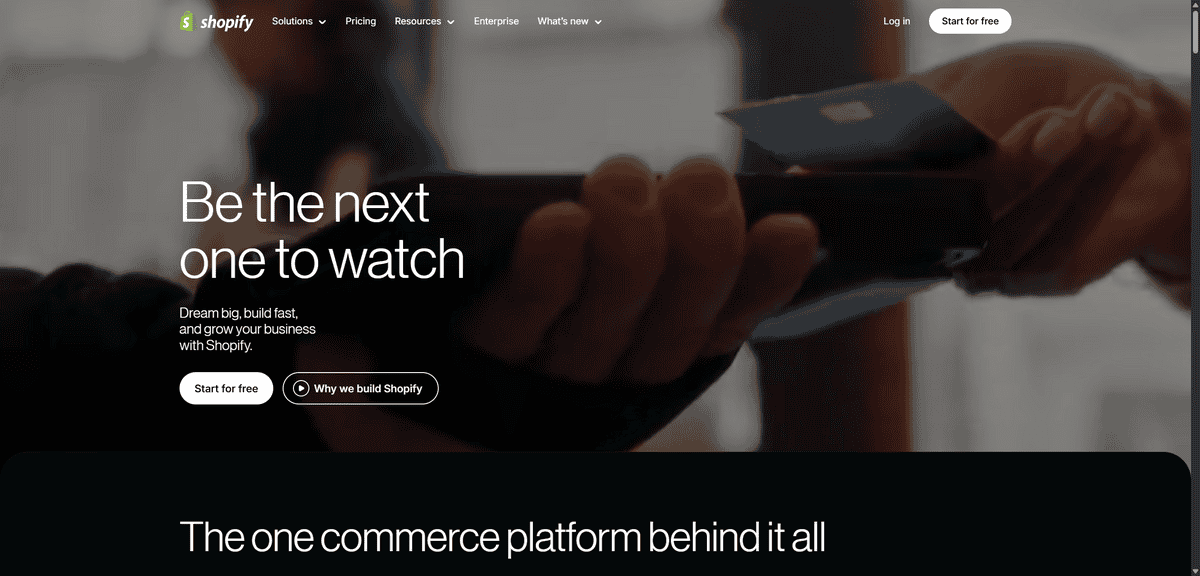
COMPLETE ALL-IN-ONE ECOMMERCE SOLUTION
Shopify
Feature | Details |
|---|---|
Best For | Businesses of all sizes looking for an all-in-one solution |
Pricing | Starts at $29/month (Basic plan) |
Free Trial | 3 days free trial + 1 month for $1 |
Transaction Fees | 2.9% + 30¢ per transaction (using Shopify Payments) |
Key Features | Beautiful themes, app store, 24/7 support, dropshipping integration |
When you think about ecommerce platforms, Shopify probably comes to mind first. That’s because it powers over 2.4 million active stores worldwide and holds about 26% of the ecommerce platform market. The platform’s popularity isn’t just hype, it’s built on being genuinely easy to use while still packing enough power for serious businesses.
What makes Shopify stand out is how it handles everything from hosting and security to payment processing in one package. You don’t need to worry about technical details like SSL certificates or server maintenance. This all-in-one approach means you can focus on selling rather than managing infrastructure.
But that’s not all, there’s more:
- You can choose from hundreds of professionally designed themes that look great on any device, with many being free or reasonably priced.
- The Shopify App Store gives you access to over 8,000 apps that add features like email marketing, inventory management, or customer reviews.
- Shopify Payments handles credit card processing directly, avoiding the need for third-party gateways and their extra fees.
- Built-in tools for dropshipping make it easy to connect with suppliers and automate order fulfilment.
- 24/7 customer support means help is available whenever you need it, which is rare for platforms at this price point.
The platform scales surprisingly well too. While Basic Shopify starts at $29/month for new businesses, Shopify Plus handles enterprise-level stores with custom pricing starting around $2,300/month. This progression means you can start small and grow without switching platforms.
While Shopify works for most businesses, it has some limitations. The transaction fees add up if you don’t use Shopify Payments, and customisation beyond the theme editor requires learning Liquid (Shopify’s templating language) or hiring a developer. Some store owners find the monthly costs plus app subscriptions become expensive as their business grows.
Shopify is perfect if you want a complete solution that works out of the box. It’s less ideal if you need deep customisation without coding or if you’re on an extremely tight budget where every transaction fee matters.
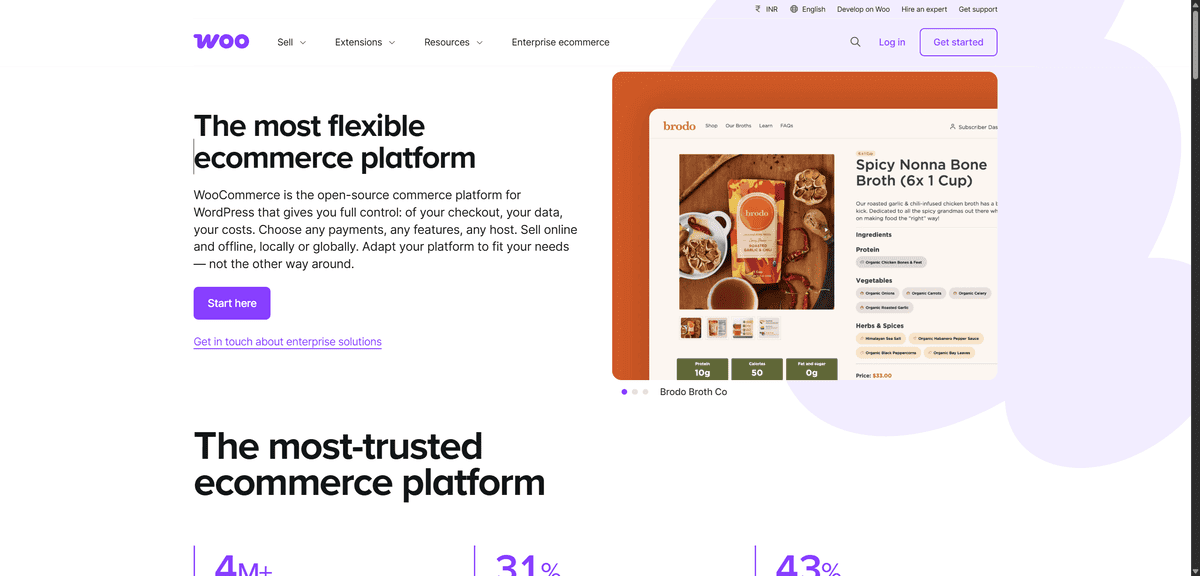
TO CUSTOMISE YOUR STORE WITHOUT LIMITS USING WORDPRESS
WooCommerce
Feature | Details |
|---|---|
Best For | WordPress users who want complete control and customisation |
Pricing | Free plugin, but requires hosting ($5-30/month) and domain ($10-15/year) |
Free Trial | N/A (plugin is always free) |
Transaction Fees | Depends on payment gateway (typically 2.9% + 30¢ for Stripe/PayPal) |
Key Features | Unlimited customisation, complete data ownership, strong SEO, WordPress integration |
If you already use WordPress for your website and want to add ecommerce without losing control, WooCommerce is what you’re looking for. It’s a free plugin that turns any WordPress site into a full-featured online store. What’s interesting is that despite being free, it powers about 18.2% of all ecommerce websites among the top 1 million sites, making it the second most popular platform after Shopify.
The real advantage of WooCommerce comes from its flexibility. Since it’s built on WordPress, you can customise literally every aspect of your store. You’re not limited to pre-made themes or features, if you can imagine it, you can probably build it with the right combination of plugins and custom code.
But that’s not all, there’s more:
- You can choose from thousands of free and premium themes specifically designed for WooCommerce stores.
- The plugin ecosystem includes over 50,000 extensions that add features like subscriptions, memberships, or advanced shipping rules.
- Complete data ownership means you control your customer information, product data, and store analytics.
- Built-in SEO benefits from WordPress’s strong search engine optimisation capabilities.
- No platform lock-in, you can move your store to different hosting or make major changes without permission.
What makes WooCommerce unique is how it handles costs. The plugin itself is completely free, but you’ll need to pay for web hosting (typically $5-30/month), a domain name ($10-15/year), and any premium themes or extensions you want. This à la carte approach means you only pay for what you actually use.
While WooCommerce offers incredible freedom, it comes with a learning curve. You’ll need to handle technical aspects like hosting setup, security updates, and performance optimisation. If something breaks, you’re responsible for fixing it or finding help. The platform also requires regular maintenance, WordPress and plugin updates need to be managed to keep your store secure.
WooCommerce works best if you’re comfortable with technology or have a developer you can work with. It’s perfect for businesses that want complete control over their online presence and don’t mind handling the technical details. It’s less ideal if you want a hands-off solution where everything just works without any setup or maintenance.
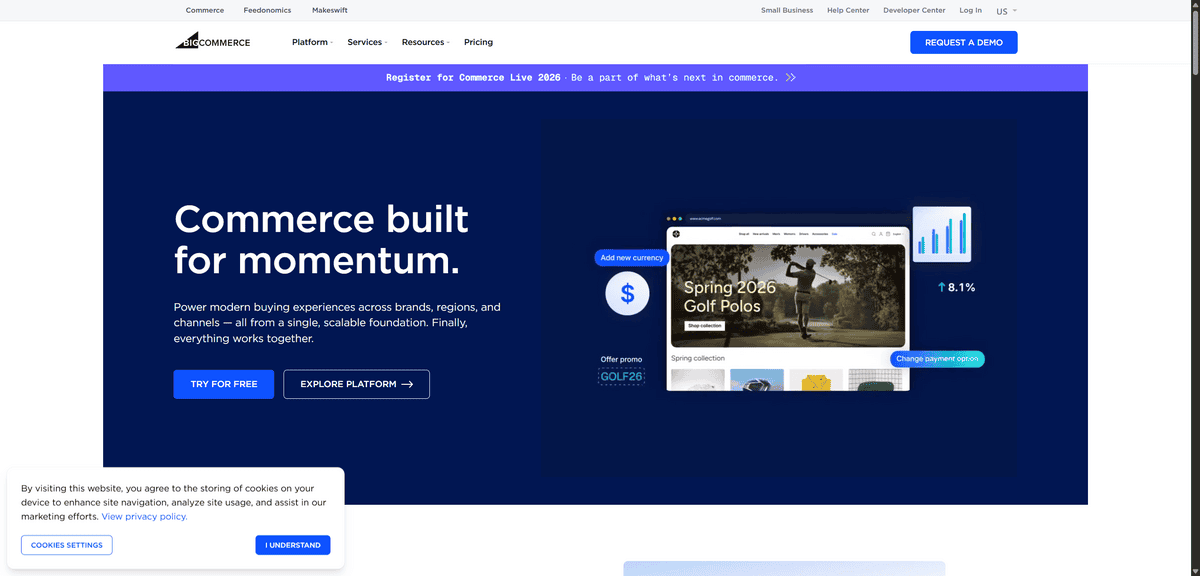
ENTERPRISE-GRADE PLATFORM FOR SCALING WITHOUT TRANSACTION FEES
BigCommerce
Feature | Details |
|---|---|
Best For | Growing businesses with complex needs and no transaction fees |
Pricing | Starts at $39/month (Standard plan) |
Free Trial | 15-day free trial |
Transaction Fees | No transaction fees on any plan |
Key Features | Enterprise tools, multi-channel selling, built-in features, excellent APIs |
If your business is growing fast and you’re hitting limits with simpler platforms, BigCommerce might be what you need. It’s designed for businesses that have outgrown basic solutions and need more power without the complexity of full enterprise systems. What sets it apart is how it handles transaction fees, or rather, doesn’t handle them at all.
BigCommerce doesn’t charge transaction fees on any of its plans. That’s different from platforms like Shopify, where you pay extra unless you use their specific payment processor. This no-fee approach means more of your revenue stays with you as your sales volume increases.
But that’s not all, there’s more:
- You can sell across multiple channels like Amazon, eBay, Facebook, and Instagram directly from one dashboard.
- Built-in features mean you need fewer third-party apps compared to other platforms.
- Excellent APIs make it easy to connect with custom systems or enterprise software.
- Advanced shipping rules handle complex scenarios like international shipping or weight-based pricing.
- Unlimited staff accounts let your whole team access what they need without extra costs.
The platform really shines for businesses with complex needs. Think about stores selling products with multiple variants, businesses needing advanced inventory management, or companies selling internationally with different tax rules. BigCommerce handles these situations better than most mid-tier platforms.
What’s interesting is how BigCommerce balances power with usability. While it’s not as simple as Shopify for complete beginners, it’s also not as complex as Adobe Commerce (Magento). You get enterprise-level features without needing a full development team to manage them.
While BigCommerce offers excellent value for growing businesses, it has some limitations. The starting price of $39/month is higher than some competitors, which might be tough for very small businesses. The interface, while powerful, isn’t as intuitive as Shopify’s for complete beginners. Some users find the theme selection more limited compared to other platforms.
BigCommerce works best if you’re already doing decent sales volume and need to scale efficiently. It’s perfect for businesses that have outgrown simpler platforms and want enterprise features without enterprise complexity. It’s less ideal if you’re just starting out with a tight budget or if you want the absolute simplest setup possible.
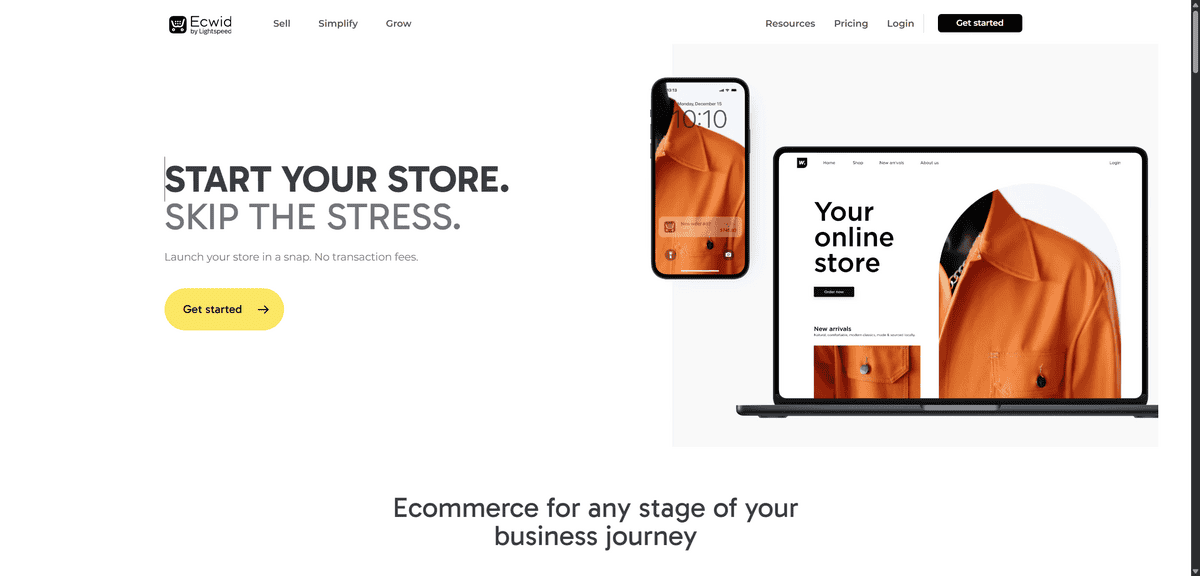
TO ADD ECOMMERCE TO ANY EXISTING WEBSITE WITHOUT REBUILDING
Ecwid
Feature | Details |
|---|---|
Best For | Adding ecommerce to existing websites without rebuilding |
Pricing | Free plan available, paid plans start at $19/month |
Free Trial | Free forever plan with limited features |
Transaction Fees | 2.9% + 30¢ on free plan, no fees on paid plans |
Key Features | Easy integration, works with any website, mobile app, inventory sync |
If you already have a website and just want to add shopping functionality without starting over, Ecwid is built for exactly that situation. It’s different from other platforms because you don’t build a whole new store, you add ecommerce to what you already have. This approach saves you time and keeps your existing design intact.
Ecwid works by embedding a shopping cart into your current website. You can add it to WordPress, Wix, Squarespace, or even custom-built sites. The integration happens through simple plugins or a few lines of code. Your store appears as part of your existing pages rather than as a separate section.
But that’s not all, there’s more:
- You can use the free forever plan to test ecommerce without any upfront costs.
- The platform syncs inventory across all your sales channels automatically.
- Mobile apps let you manage orders and products from your phone.
- Built-in payment processing works with major gateways like Stripe and PayPal.
- Multi-language support helps you sell to customers in different countries.
What makes Ecwid stand out is how it handles the technical side. Since it’s a hosted solution, you don’t need to worry about server maintenance or security updates. The shopping cart loads quickly because it’s served from Ecwid’s servers, not your website’s hosting. This means your site performance stays good even with a full store added.
The pricing structure is straightforward too. The free plan lets you list up to 10 products and includes basic features. Paid plans start at $19/month and remove transaction fees while adding more products and features. This gradual approach means you can start small and upgrade as your business grows.
While Ecwid is great for adding ecommerce to existing sites, it has some limitations. The free plan includes transaction fees that can add up quickly if you’re making sales. The store design options are more limited compared to full ecommerce platforms since it needs to work within your existing site design. Some advanced features like abandoned cart recovery only come with higher-tier plans.
Ecwid works best if you have an established website and want to add products without rebuilding everything. It’s perfect for bloggers, service businesses adding physical products, or anyone with a site they’re happy with. It’s less ideal if you want complete design control or if you’re building a store from scratch without an existing website.
SIMPLIFIED PLATFORM FOR MICRO-BUSINESSES AND INDEPENDENT ARTISTS
Big Cartel
Feature | Details |
|---|---|
Best For | Artists and micro-businesses with limited product inventories |
Pricing | Free for 5 products, paid plans start at $9.99/month |
Free Trial | Free forever plan (5 products) |
Transaction Fees | No transaction fees on any plan |
Key Features | Completely free tier, artist-focused, simple interface, no coding needed |
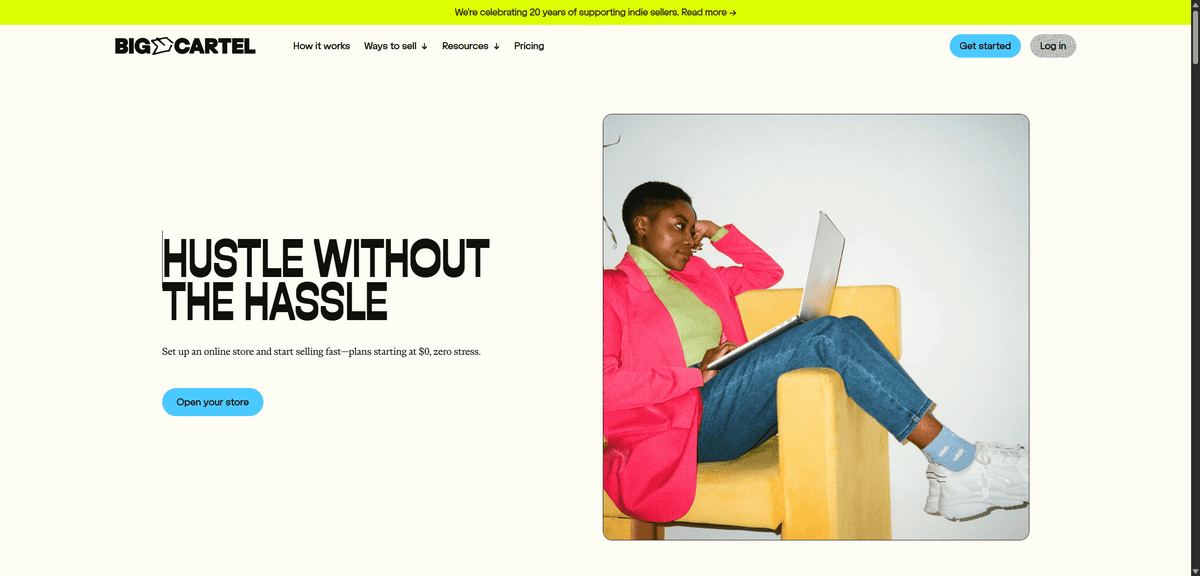
If you’re an artist, crafter, or someone running a very small business with just a handful of products, Big Cartel is built specifically for you. It’s different from other platforms because it doesn’t try to be everything to everyone, it focuses on making ecommerce simple and affordable for creative businesses.
What makes Big Cartel stand out is its completely free Gold plan. You can list up to five products without paying anything, and there are no transaction fees on any plan. This approach means you can test selling online without any financial risk. The platform has been around for 20 years supporting indie sellers, which shows they understand the needs of small creative businesses.
But that’s not all, there’s more:
- You can use the free forever plan to sell up to five products with basic ecommerce features.
- The platform accepts cards, PayPal, Afterpay, and other payment methods without extra fees.
- Mobile apps for iOS and Android let you manage your store from anywhere.
- You can import products from Etsy, Squarespace, and Shopify if you’re switching platforms.
- Built-in tools help you sell in person and take payments directly from your phone.
The simplicity is what really matters here. You don’t need coding skills or technical knowledge to set up your store. The interface is straightforward, and the templates are designed to look good without much customisation. This lets you focus on creating and selling rather than figuring out complex software.
Paid plans start at $9.99/month for the Platinum plan, which lets you list up to 50 products. The Diamond plan at $19.99/month supports up to 500 products. Both paid plans include features like discount codes, more product images per listing, and better analytics. The pricing stays affordable even as you grow.
While Big Cartel is great for very small businesses, it has some limitations. The free plan restricts you to just one product photo per item, and even paid plans only allow up to five images per product. There’s a product cap of 500 items maximum, so it’s not ideal for businesses with large or rapidly growing inventories.
The platform also lacks built-in blogging, email marketing, and advanced SEO controls. Free stores don’t get discount codes either, so you can’t run promotions without manually changing prices. Some design customisation options are limited compared to more powerful platforms.
Big Cartel works best if you’re an artist, crafter, or micro-business with a small product line. It’s perfect for testing ecommerce without investment or for businesses that will never need more than 500 products. It’s less ideal if you plan to scale quickly, need advanced marketing tools, or want unlimited product listings.

ALL-IN-ONE PLATFORM FOR DIGITAL CREATORS SELLING COURSES AND PRODUCTS
Kajabi
Feature | Details |
|---|---|
Best For | Digital creators selling courses, memberships, and digital products |
Pricing | Starts at $119/month (Basic plan) |
Free Trial | 14-day free trial |
Transaction Fees | No transaction fees on any plan |
Key Features | Course builder, membership sites, email marketing, website builder, community features |
If you’re a creator selling courses, coaching, or digital products, Kajabi positions itself as your complete business operating system. It’s different from general ecommerce platforms because it’s built specifically for knowledge entrepreneurs. The platform combines everything you need to create, market, and sell digital products in one place.
What makes Kajabi stand out is its all-in-one approach. Instead of using separate tools for your website, email marketing, course hosting, and payment processing, Kajabi handles it all. This integration means your students can sign up, pay, and access content without leaving your ecosystem. The platform is designed around the creator’s workflow rather than trying to be everything to everyone.
But that’s not all, there’s more:
- You can build and host online courses with drip content, quizzes, and completion certificates.
- Membership sites let you create subscription-based communities with exclusive content.
- Built-in email marketing tools handle sequences, broadcasts, and automations without third-party services.
- The website builder includes templates optimised for course sales and lead generation.
- Community features help you build engagement around your content and keep students coming back.
The platform really shines for digital product creators. You can sell courses, coaching packages, digital downloads, and memberships all from the same dashboard. Everything integrates seamlessly, when someone purchases a course, they’re automatically added to the right email sequence and given access to the content. This automation saves you hours of manual work.
Kajabi’s pricing reflects its specialised nature. The Basic plan starts at $119/month when billed annually, which is higher than general ecommerce platforms. But you’re paying for an integrated system that replaces multiple separate subscriptions. The platform doesn’t charge transaction fees on any plan, so you keep more of your revenue as you scale.
While Kajabi excels for digital creators, it has some limitations. The platform isn’t designed for physical products, features like inventory management, shipping calculations, and product variants work better elsewhere. The higher price point makes it overkill if you’re just selling a few digital downloads without courses or memberships.
Kajabi works best if you’re serious about building a digital product business with courses, memberships, or coaching. It’s perfect for creators who want everything integrated and are willing to pay for that convenience. It’s less ideal if you mainly sell physical products, have a tight budget, or just need basic ecommerce without the educational features.
SPECIALISED PLATFORM FOR DIGITAL PRODUCTS AND PRINT-ON-DEMAND
Sellfy
Feature | Details |
|---|---|
Best For | Digital products, subscriptions, and print-on-demand items |
Pricing | Starts at $19/month (Starter plan) |
Free Trial | 14-day free trial |
Transaction Fees | No transaction fees on paid plans |
Key Features | Digital product delivery, subscription management, print-on-demand, simple store builder |
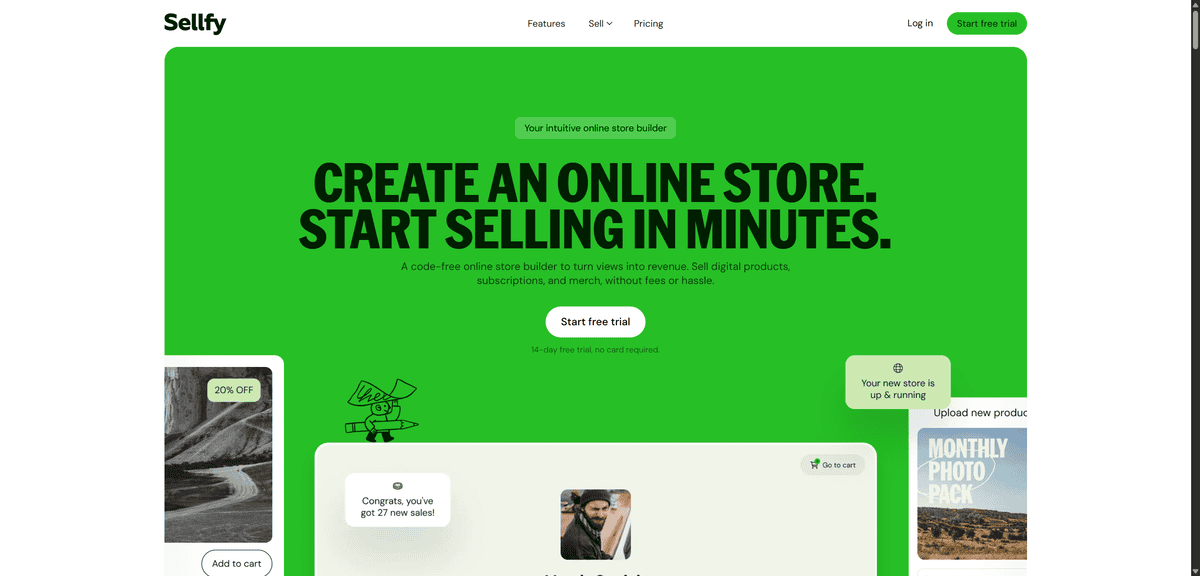
If you’re selling digital products like ebooks, software, or design files, Sellfy gives you a straightforward way to get started. The platform focuses specifically on digital goods, subscriptions, and print-on-demand items rather than trying to handle everything. This specialisation means it’s optimised for what digital creators actually need.
What makes Sellfy different is how simple it is to set up. You can create a store in minutes without any coding knowledge. The platform handles all the technical details like secure file hosting, instant delivery, and payment processing. This lets you focus on creating products rather than managing infrastructure.
But that’s not all, there’s more:
- You can deliver digital products instantly after purchase with secure download links and file protection.
- Subscription management lets you charge customers weekly, monthly, or yearly for recurring access.
- Print-on-demand integration handles physical products like t-shirts and mugs without inventory.
- Built-in marketing tools include email collection, discount codes, and upselling features.
- The store builder uses a simple drag-and-drop interface that anyone can understand.
The pricing structure makes sense for digital sellers too. The Starter plan at $19/month includes everything you need to begin selling, with no transaction fees on paid plans. Higher tiers add features like advanced analytics, more product variants, and priority support. This gradual approach means you can start small and upgrade as your business grows.
What’s interesting is how Sellfy handles digital product delivery. Files are hosted securely on their servers with download limits and expiration dates to prevent unauthorised sharing. Customers get instant access after payment, which reduces support requests and improves the buying experience. The platform also handles VAT and sales tax calculations automatically for different regions.
While Sellfy excels at digital products, it has some limitations. The platform isn’t designed for complex physical product stores with large inventories or advanced shipping needs. Design customisation options are more limited compared to platforms like Shopify or WooCommerce. The app ecosystem is smaller too, so you might not find every integration you want.
Sellfy works best if you’re selling digital goods, subscriptions, or print-on-demand items. It’s perfect for creators who want a simple setup without technical headaches. It’s less ideal if you need advanced ecommerce features, sell many physical products, or want deep customisation options beyond the basics.
OPEN-SOURCE ENTERPRISE SOLUTION FOR LARGE-SCALE BUSINESSES
Adobe Commerce (Magento)
Feature | Details |
|---|---|
Best For | Large enterprises with development resources and complex needs |
Pricing | Open source: Free, Adobe Commerce: Custom enterprise pricing |
Free Trial | Open source version is always free to download |
Transaction Fees | No platform transaction fees |
Key Features | Extensive customisation, enterprise scalability, open-source flexibility, advanced B2B features |
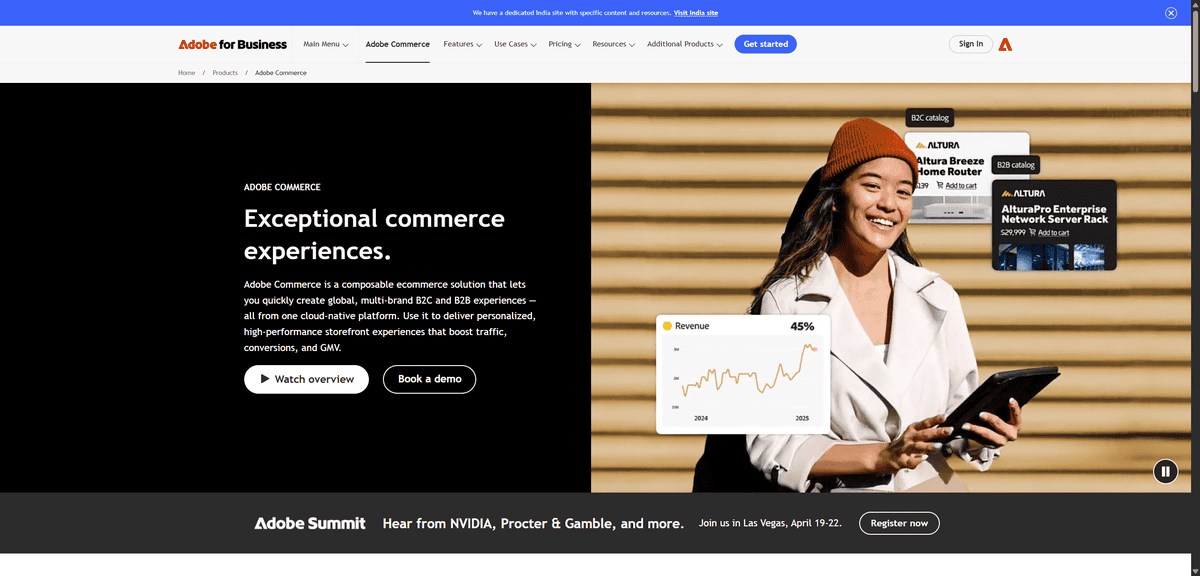
If you’re running a large enterprise with complex ecommerce needs and have development resources available, Adobe Commerce (formerly Magento) is built for exactly that situation. Adobe acquired Magento in 2018 and rebranded it to integrate with their broader ecosystem, but the core remains a powerful open-source platform for serious businesses.
What makes Adobe Commerce different is its enterprise focus. While the open-source version is free to download, you’ll need significant development expertise to make it work. The platform gives you complete control over every aspect of your store, but that freedom comes with responsibility for setup, maintenance, and security.
But that’s not all, there’s more:
- You can choose between the free open-source version or Adobe Commerce with enterprise features and support.
- The platform handles complex B2B scenarios like custom pricing, company accounts, and bulk ordering.
- Extensive customisation options mean you can build exactly what your business needs without limitations.
- Enterprise scalability supports high traffic volumes and large product catalogues without performance issues.
- Integration with Adobe’s marketing tools creates a complete digital experience ecosystem.
What’s interesting about Adobe Commerce is how it handles pricing. The open-source version is completely free to download and use, but you’ll need to handle hosting, security, and development yourself. Adobe Commerce starts at around $22,000 per year for on-premises use, with cloud versions starting even higher. This pricing reflects its enterprise positioning, you’re paying for features and support that large businesses actually need.
The platform really shines for businesses with specific requirements that off-the-shelf solutions can’t handle. Think about companies needing custom checkout flows, complex inventory management across multiple warehouses, or advanced B2B features like quote management and custom catalogues. Adobe Commerce handles these situations better than most platforms because you can build exactly what you need.
While Adobe Commerce offers incredible power, it has some significant limitations. The learning curve is steep, you’ll need experienced developers who understand the platform’s architecture. The costs add up quickly between development, hosting, and ongoing maintenance. For smaller businesses, the complexity and expense are often overkill compared to simpler solutions.
Adobe Commerce works best if you’re a large enterprise with development resources and complex ecommerce needs. It’s perfect for businesses that have outgrown other platforms and need complete control over their online presence. It’s less ideal if you’re just starting out, have a limited budget, or want a solution that works out of the box without technical expertise.
FLEXIBLE OPEN-SOURCE ALTERNATIVE BETWEEN WOOCOMMERCE AND MAGENTO
PrestaShop
Feature | Details |
|---|---|
Best For | Growing businesses wanting open-source flexibility between WooCommerce and Magento |
Pricing | Open source: Free, PrestaShop Ready: Starts at €24.90/month |
Free Trial | Open source version is always free to download |
Transaction Fees | No platform transaction fees |
Key Features | Open-source flexibility, strong European focus, moderate complexity, good module ecosystem |
If you’re looking for an open-source ecommerce solution that sits between WooCommerce’s simplicity and Adobe Commerce’s complexity, PrestaShop might be what you need. It’s a European-born platform that’s particularly popular in France, Spain, and other European markets, where it powers over 300,000 online stores. What makes it interesting is how it balances customisation with approachability.
PrestaShop gives you two main options: the free open-source version you download and install yourself, or PrestaShop Ready, their hosted solution starting at €24.90/month. This choice means you can start with the hosted version for simplicity, then move to self-hosted as your technical skills grow. The platform’s European roots show in features like built-in VAT handling and multi-language support that works well across different European markets.
But that’s not all, there’s more:
- You can customise nearly every aspect of your store through modules and themes without the extreme complexity of larger platforms.
- The module marketplace includes over 5,000 add-ons for features like payment processing, shipping, and marketing.
- Built-in features handle European requirements like VAT calculations and multi-currency pricing out of the box.
- The admin interface is more approachable than Adobe Commerce while still offering serious customisation options.
- Regular updates and an active community mean you can find help and resources when you need them.
What’s interesting about PrestaShop is its positioning. It’s more powerful than WooCommerce in some ways, better built for serious ecommerce from the start, but less overwhelming than Adobe Commerce. You get features like advanced product management, customer segmentation, and detailed analytics without needing enterprise-level development resources. The platform handles medium-sized stores particularly well, where you need more than basic features but don’t require full enterprise solutions.
The European focus is both a strength and a consideration. If you’re selling primarily in European markets, PrestaShop’s built-in features for VAT, multiple languages, and local payment methods work beautifully. The platform understands European ecommerce regulations and consumer expectations. But if you’re focused on North American or Asian markets, you might find some features less optimised for those regions.
While PrestaShop offers good flexibility, it has some limitations. The learning curve is steeper than platforms like Shopify or BigCommerce, especially if you choose the self-hosted version. You’ll need some technical knowledge for setup, maintenance, and troubleshooting. The theme and module quality varies more than with larger platforms, some are excellent, while others feel outdated or poorly supported.
PrestaShop works best if you’re a growing business that needs more than WooCommerce but isn’t ready for Adobe Commerce’s complexity. It’s perfect for European-focused stores or businesses that want open-source flexibility without extreme technical requirements. It’s less ideal if you want a completely hands-off solution or if you’re selling primarily in markets where PrestaShop has less presence and support.
