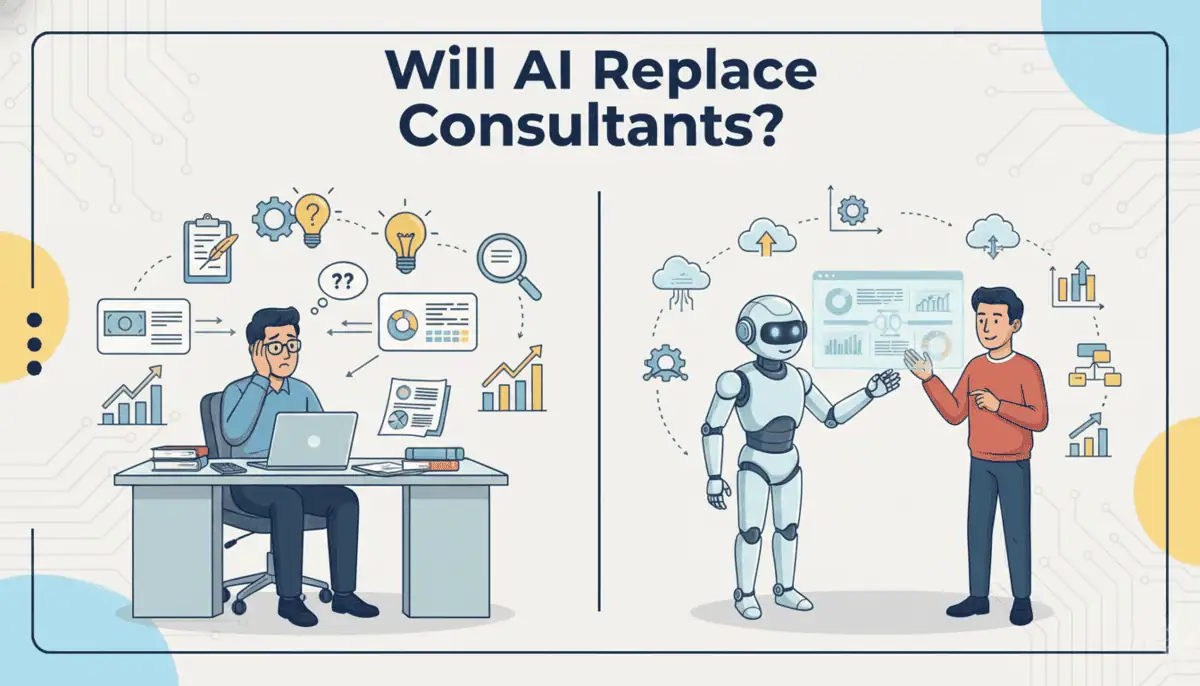
AI is already inside consulting firms. 72% of organisations now use AI in at least one business function, a sharp increase from 32% just two years ago.
Generative AI tools are drafting reports, analysing data sets, and building financial models that once took consultants days to complete.
This raises the question directly: will AI replace consultants? The answer isn’t simple, and it’s not the same for every type of consulting work.
Some tasks are already being automated. Others remain firmly in human territory. This article examines where AI is taking over, where it’s failing, and what consultants need to do to stay relevant.
How AI Has Already Changed Consulting Work
By 2025, PwC, Deloitte, EY, and KPMG each launched multi-agent AI platforms that work like digital teammates. These platforms don’t just assist with tasks. They complete them.
The technology handles everything from data processing to client documentation without requiring human oversight for routine work.
What AI Now Handles Automatically
- Data analysis: AI processes datasets in minutes that used to take analysts days to clean and interpret
- Research synthesis: Tools pull insights from client reports and historical data without human intervention
- Meeting documentation: AI transcribes calls and generates action items automatically
- Slide formatting: Platforms like Google Duet and Notion AI convert raw research into polished presentations
- Project scoping: AI reviews past engagements to define project parameters and timelines
The Direct Link to Workforce Cuts
This automation created immediate consequences. PwC cut 5,600 positions in FY2025, while KPMG eliminated overtime pay for junior auditors. The firms aren’t replacing these roles. AI now performs the routine tasks these employees once handled, from drafting reports to running initial analyses.
The shift happened fast. What consultants spent 60% of their time on two years ago now takes 15% because AI does the groundwork. That efficiency came at the cost of entry-level jobs that used to be the training ground for future partners.
What Consultants Are Worried About
Half of workers report concerns about AI’s effect on job security. For consultants, the worry isn’t just about losing a job. It’s about the entire structure of the profession changing.
The traditional consulting pyramid is breaking down. For decades, firms had many junior analysts at the bottom doing research and data work, feeding up to a smaller group of senior partners. AI now handles those entry-level tasks, creating what industry insiders call an “obelisk” structure instead.
This obelisk model is tall and narrow. Firms need fewer people overall, and most of them are senior. The roles that used to train fresh graduates, positions focused on building models, researching competitors, and creating slide decks, are disappearing. That means fewer entry points into the profession and a harder path to becoming a partner.
Consulting Tasks AI Has Replaced
AI tools now handle work that used to occupy entire teams of junior consultants. What took hours or days can now happen in minutes.
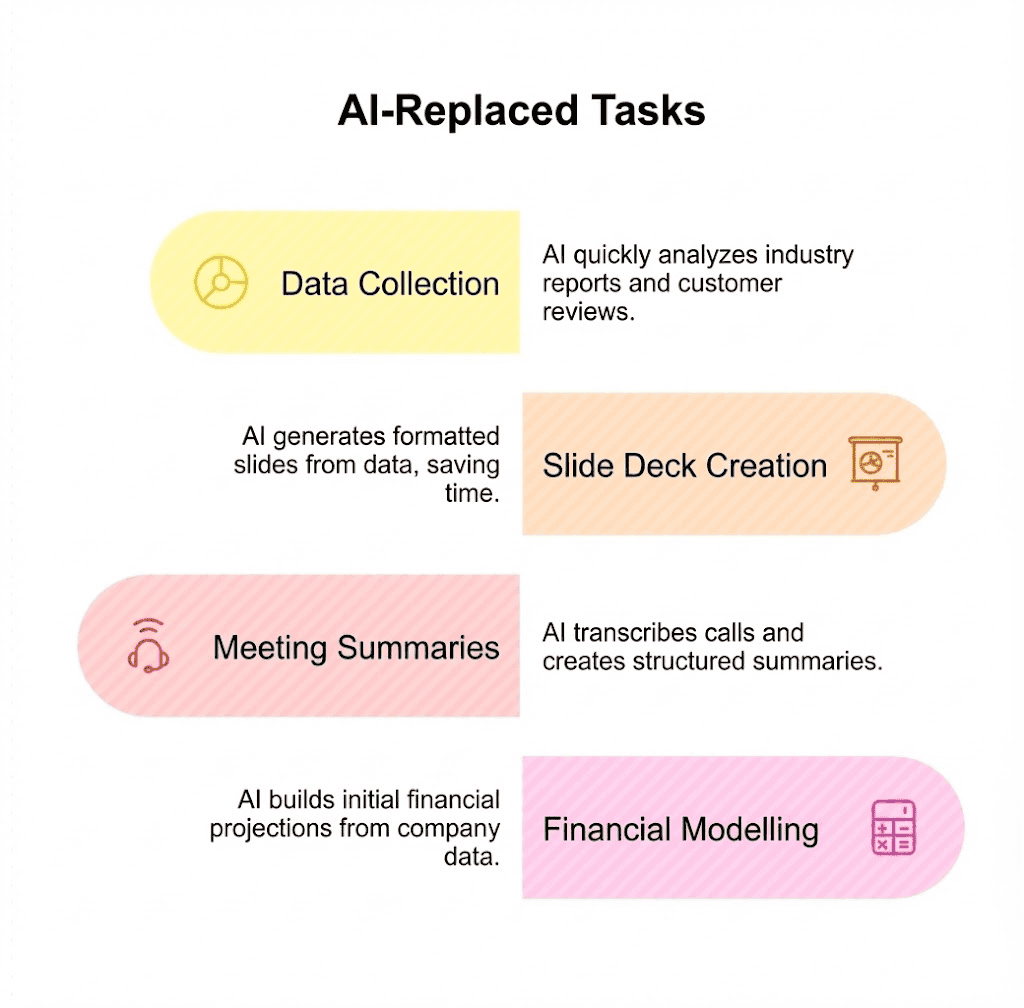
- Data collection and analysis: AI processes hundreds of industry reports, regulatory filings, and customer reviews in minutes. It pulls relevant insights without human analysts spending days reading through documents.
- Slide deck creation: Formatting presentations used to consume 30-40% of a junior consultant’s time. AI tools now generate formatted slides from raw data and notes, matching brand guidelines automatically.
- Meeting summaries and documentation: Recording tools transcribe client calls and produce structured summaries with action items. No more junior consultant typing notes while trying to follow the conversation.
- Basic financial modelling: AI builds initial financial projections and scenario analyses from company data. It creates working models that senior consultants can review and refine, rather than building them from scratch.
Tasks AI Will Replace Soon
We’re two years into what McKinsey predicted back in 2023. They stated that automation could replace up to 30% of consulting tasks within five years. That timeline puts most of the shift happening between now and 2026.
Status updates and progress reports are moving to automated systems. Junior-level client communication, like responding to standard queries or updating project timelines, no longer needs human involvement for most routine exchanges. The AI reads project management data and communicates changes directly.
By 2028, 15% of routine work decisions will be made autonomously by AI, up from essentially 0% in 2024. This includes decisions about resource allocation on projects, timeline adjustments based on bottlenecks, and flagging risks that match predefined patterns. The shift from zero to 15% in four years shows how fast this technology is scaling in practical business settings.
Tasks AI Cannot Replace
Some consulting work requires capabilities that AI systems don’t have. These aren’t skills that will be automated in five or ten years. They’re fundamentally human:
1. Complex stakeholder management: Reading organisational politics, sensing tension in executive meetings, and knowing when someone’s silence means disagreement.
2. Change management: Understanding why employees resist new processes even when data says they’re better. Recognising cultural nuances that make the same strategy work in one office and fail in another.
3. High-stakes strategic decisions: Making calls when data points in multiple directions. Reading competitive moves that haven’t shown up in reports yet. Using judgement when the stakes involve company survival or major pivots. These decisions need context that lives outside spreadsheets.
4. Client trust and relationship building: Creating the personal connection that makes a CEO call you instead of a competitor. Building a reputation over years of delivery. Being the consultant someone trusts with their career-defining project.
5. Ethical and contextual judgement: Deciding how to handle recommendations that could eliminate 500 jobs. Understanding community impact beyond financial metrics. Navigating situations where the right business decision conflicts with company culture or values.
What Consultants Should Focus On
If you’re a consultant right now, your survival depends on becoming irreplaceable in ways AI can’t match.
Start with AI fluency. Learn prompt engineering, not as a novelty but as a core skill. You need to direct AI agents, integrate multiple tools into your workflow, and know which platform works best for each task.
According to recent data, 79% of professionals use generative AI to improve customer experience and 67% to optimise processes. Consultants who use AI will replace consultants who don’t. It’s that simple.
But tools alone won’t save you. You need to develop deep industry expertise that AI can’t extract from documents. Context matters. Sector dynamics, unwritten rules, and political undercurrents in organisations. These come from years of immersion, not data scraping.
Focus on these capabilities:
- Strategic synthesis: Taking AI-generated analysis and turning it into business judgement
- Storytelling: Transforming data insights into persuasive narratives that drive decisions
- Change management: Helping organisations implement recommendations, not just delivering them
- Ethical judgement: Navigating grey areas where AI offers efficiency but humans must weigh consequences
The consultants who thrive will be those who use AI to do the work of three analysts while focusing their own energy on client relationships and strategic thinking. Everyone else is competing with software that works 24/7 and doesn’t need a salary.
Will AI Replace Consultants?
No. But it will replace a lot of consulting jobs.
The traditional consulting career path is dead. Junior analysts who spent two years building Excel models and formatting slides are already being cut. PwC didn’t eliminate 5,600 jobs because business was slow. They eliminated them because AI does that work faster and cheaper.
If your job is primarily data analysis, research, or document creation, you’re at immediate risk. Those tasks are already being automated. If you’re a consultant who spends most of your time on deliverables rather than clients, you’re competing with software. And you’ll lose that competition.
But consultants who combine AI proficiency with judgement, relationships, and strategic thinking remain irreplaceable. The ones who can direct AI agents to do the grunt work while they focus on stakeholder management and high-stakes decisions. The ones clients trust to navigate sensitive situations and make calls that have real consequences.
For aspiring consultants, the traditional entry path is gone. The barrier to entry just got much steeper.
Over the next three years, expect smaller teams doing higher-value work. Fewer people per project, more senior-heavy structures, and zero tolerance for consultants who can’t leverage AI. The job isn’t disappearing. But most of the jobs are.

A startup consultant, digital marketer, traveller, and philomath. Aashish has worked with over 20 startups and successfully helped them ideate, raise money, and succeed. When not working, he can be found hiking, camping, and stargazing.