[Reader Disclosure]Our content is reader-supported. This means we may earn a commission if you click on some of our links.
AI is everywhere in marketing now. It writes ads, sends personalised emails, and creates social media posts.
Three out of four marketers now use AI tools in their daily work. They’re not experimenting anymore. They’re actually relying on it. AI handles tasks that used to take hours. It writes copy, analyzes data, and runs campaigns.
So what happens to marketers? If AI does the writing, the testing, and the number-crunching, what’s the actual job? Are we slowly becoming unnecessary, or is the role just changing into something else?
Back then, digital marketing relied on pure manual labor. Everything took time and someone had to actually do it.
SEO meant spending days researching keywords one by one and building backlinks by manually reaching out to websites
Every blog post, social caption, and email was written from scratch with no AI assistance
Running ads meant constantly checking dashboards to adjust bids, pause campaigns, and shift budgets by hand
Data lived in different places – Google Analytics, Facebook Ads, email platforms – and you had to export and analyse it all yourself
A/B testing was slow. You’d create two versions, wait weeks for results, then manually figure out which one won
Personalisation was basic. At best, you could segment your email list into a few groups
That’s why marketing teams were large and campaigns were expensive. Every single task required human hours to complete.
AI’s Takeover of Marketing Tools
AI stopped being experimental around 2022 and 2023. That’s when it moved from “nice to have” to “we need this now.” ChatGPT’s public launch in late 2022 flipped a switch.
Suddenly, 88% of companies were using AI in at least one function by 2025, according to McKinsey. Marketing teams didn’t wait around. They grabbed whatever AI tools they could find and started testing, raising new questions like will AI replace digital marketers as these tools rapidly reshaped daily workflows.
Here’s where AI took over:
Content generation tools: These write blog posts, social captions, and email copy in seconds. Tools like Jasper and Copy.ai turned what used to take hours into a five-minute task.
Ad platforms with AI: Facebook, Google, and LinkedIn now optimise your ad spend automatically. The AI decides who sees your ads and when, based on who’s most likely to click.
Analytics and prediction tools: Platforms like HubSpot and Google Analytics use AI to predict customer behaviour. They tell you which leads are hot before you even talk to them.
Email automation: AI personalises subject lines, send times, and content for each subscriber. Mailchimp and ActiveCampaign handle this without you lifting a finger.
SEO tools: Surfer SEO and Clearscope analyse top-ranking pages and tell you exactly what to write. They even suggest keywords you’re missing.
Social media schedulers: Tools like Buffer and Hootsuite now use AI to pick the best times to post and suggest content ideas based on what’s trending.
This entire shift happened in roughly two years. What used to be cutting-edge in 2022 became table stakes by 2024.
What AI Does in Digital Marketing Now
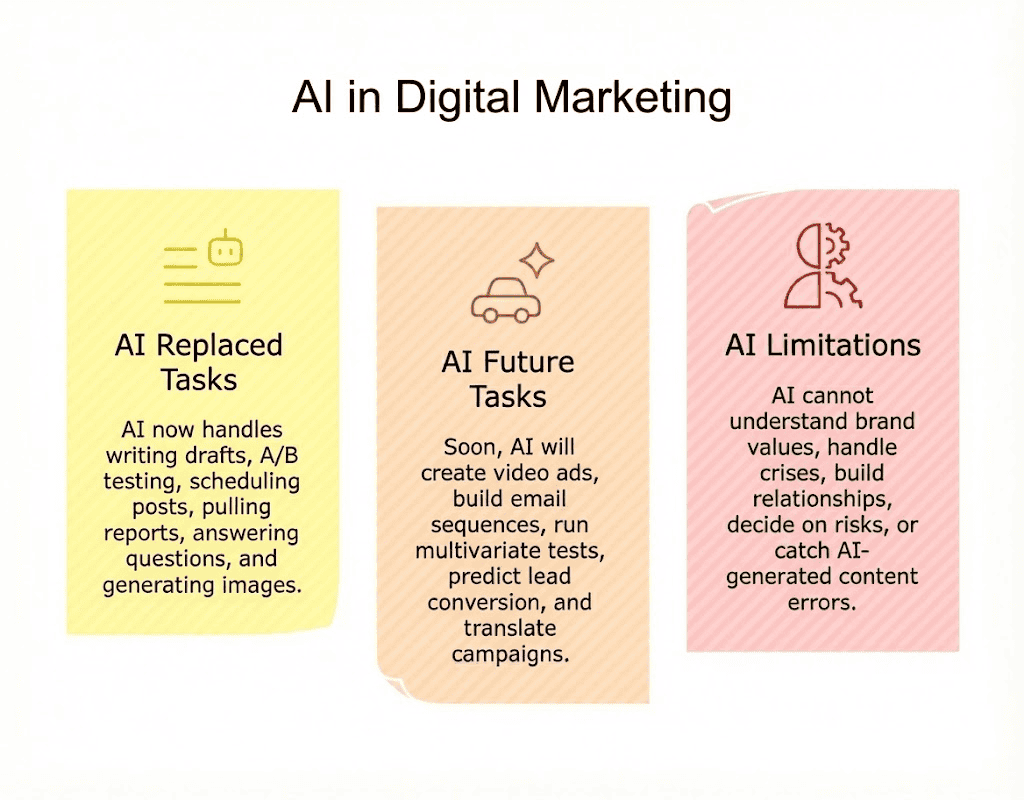
Let’s get specific about what AI handles versus what still needs your brain. The lines aren’t as clear as most people think.
Tasks AI Has Replaced
Writing first drafts for blog posts, social captions, and email copy
A/B testing headlines and ad variations without manual setup
Scheduling social posts based on when your audience is most active
Pulling basic performance reports and dashboards
Answering routine customer questions through chatbots
Generating image variations and resizing graphics for different platforms
Tasks AI Will Replace Soon
Creating entire video ads from text prompts
Building full email sequences that adjust based on recipient behaviour
Running multivariate tests across dozens of campaign elements at once
Predicting which leads will convert before you even reach out
Translating campaigns into multiple languages while keeping cultural context intact
Tasks AI Cannot Replace
Understanding what your brand actually stands for and why it matters
Reading the room during a client crisis or PR situation
Building genuine relationships with partners and influencers
Deciding which creative risks are worth taking
Catching when AI-generated content sounds off or misses the mark (which matters because 52% of consumers are less engaged when they detect AI content)
AI Adoption in Digital Marketing
The numbers tell a clear story about where marketing stands with AI right now.
83% of employees using AI report productivity improvements.According to Deloitte, generative AI is making a measurable difference in how quickly work gets done. Companies are seeing faster turnarounds on campaigns and content.
75% of employees say their company actively promotes AI use. Organisations aren’t just allowing AI tools, they’re encouraging teams to adopt them. This shift shows leadership recognises the competitive edge AI brings.
The vast majority of marketers still edit AI-generated content.HubSpot’s research shows that marketers aren’t publishing AI output as-is. They’re using it as a starting point, then refining it to match brand voice and accuracy standards.
32% of companies expect workforce reductions, while 13% expect increases. The workforce impact varies widely. Some organisations are cutting back on roles, but others are hiring to manage and maximise AI tools.
What Digital Marketers Think About AI
Some are optimistic about the time they’re saving. Others worry they’re training their own replacement.
On one side, you’ve got marketers who see AI as the productivity boost they’ve been waiting for. They’re using it to knock out first drafts faster, analyse data without pulling their hair out, and finally tackle those tasks that always got pushed to the bottom of the list. The efficiency gains are real.
But flip through marketing forums and you’ll see the other side too. People questioning whether their skills still matter. Concerns about companies cutting teams because “AI can do it now.” Frustration with clients who expect the same quality work at half the price because “you’re just using AI, right?
What most working marketers agree on is this. AI handles the grunt work, but you still need human judge ment to make it actually good. The tool speeds things up, but it doesn’t replace the strategic thinking or the understanding of what your audience actually cares about.
AI’s Impact on Digital Marketing Jobs and Hiring
According to research compiled by Invoca, AI is expected to displace 85 million jobs globally by 2025 but create 97 million new ones. That’s a net gain of 12 million jobs. But those aren’t the same jobs going to the same people.
What’s actually changing? Companies need AI prompt engineers, automation specialists, and data analysts who can make sense of AI outputs. Traditional copywriting roles are shrinking while “AI content strategist” positions are popping up. The shift isn’t just about job titles. It’s about what you can do with the tools.
Here’s what hiring managers are prioritising now:
AI tool fluency across multiple platforms
Critical thinking to edit and improve AI outputs
Data interpretation skills
Strategic planning that humans still do better
The gap between marketers who adapt and those who don’t is widening fast. You’re not competing with AI. You’re competing with marketers who know how to use it.
New Skills Digital Marketers Need to Learn
If you want to stay relevant, you need to adapt. Here are the skills that matter now:
Learn to use AI: Learn how to use ChatGPT, Jasper, Midjourney, Sora and other AI platforms. Know which tool works best for what task.
Prompt engineering: Writing the right prompts gets you better AI outputs. This is now a skill worth learning properly. You can take help of tools like an AI prompt generator for this as well.
Data interpretation: AI can pull numbers, but you need to understand what they actually mean and what actions to take.
Strategic thinking: AI can’t decide your brand positioning or long-term strategy. That’s still on you.
Content editing and quality control: AI writes the first draft. You need to make it sound human, on-brand, and actually good.
Automation workflow design: Know how to connect different tools and create automated systems that save time without breaking things.
The marketers who’ll survive aren’t the ones fighting AI. They’re the ones learning how to use it better than everyone else.
So, Will AI Replace Digital Marketers?
AI won’t replace digital marketers, but digital marketers who use AI will replace those who don’t.
You’re not competing with AI. You’re competing with marketers who’ve figured out how to make AI work for them. The ones who’ll struggle are those clinging to manual processes while others automate reporting, scale content, and personalise campaigns at speeds humans alone can’t match.
Your job isn’t disappearing. It’s evolving into something that demands both technical skills and the creative thinking AI still can’t touch.
A startup consultant, digital marketer, traveller, and philomath. Aashish has worked with over 20 startups and successfully helped them ideate, raise money, and succeed. When not working, he can be found hiking, camping, and stargazing.
Each week I share research backed AI oriented content in my newsletter.
There are AI ideas, AI trends, tutorials, and guides.
24k entrepreneurs read it. I'd love you to join.