Companies everywhere are bringing AI into the workplace. Marketing teams use it to write ad copy. Developers use it to generate code. Customer service runs on AI chatbots. Design teams create logos with it. Even HR departments use AI to screen applications.
No industry is untouched. No job role is completely the same as it was two years ago.
So it’s only natural to wonder: will AI replace human jobs?
It’s not paranoia. According to data, 30% of U.S. jobs could be automated by 2030. That’s just five years away.
Some roles are already seeing massive changes. Others remain mostly untouched. The difference comes down to what your job actually requires.
This guide breaks down exactly where your job stands. We’ll look at creative fields, tech roles, marketing positions, and professional services. You’ll see which jobs face the highest risk, which ones are practically AI-proof, and most importantly, what you can do about it.
What AI Is Capable Of Now
Before you panic about job loss, let’s look at what AI actually does today:
- Generate content from scratch: Write blog posts, create images in any style, produce videos, and compose music, all from simple text prompts
- Process and understand information: Analyse documents, extract key insights, summarise lengthy reports, and answer complex questions about your data
- Automate entire workflows: AI agents can now chain together multiple tasks. Researching a topic, writing a report, sending emails, and scheduling follow-ups without human intervention
- Connect systems through APIs: AI tools can call external services, pull data from multiple sources, update databases, and trigger actions across different platforms automatically
- Handle real-time interactions: Power chatbots that understand context, translate conversations between languages instantly, and provide 24/7 customer support
- Create sophisticated visual content: Generate professional-quality images, edit videos with natural language commands, and even create animations or 3D models
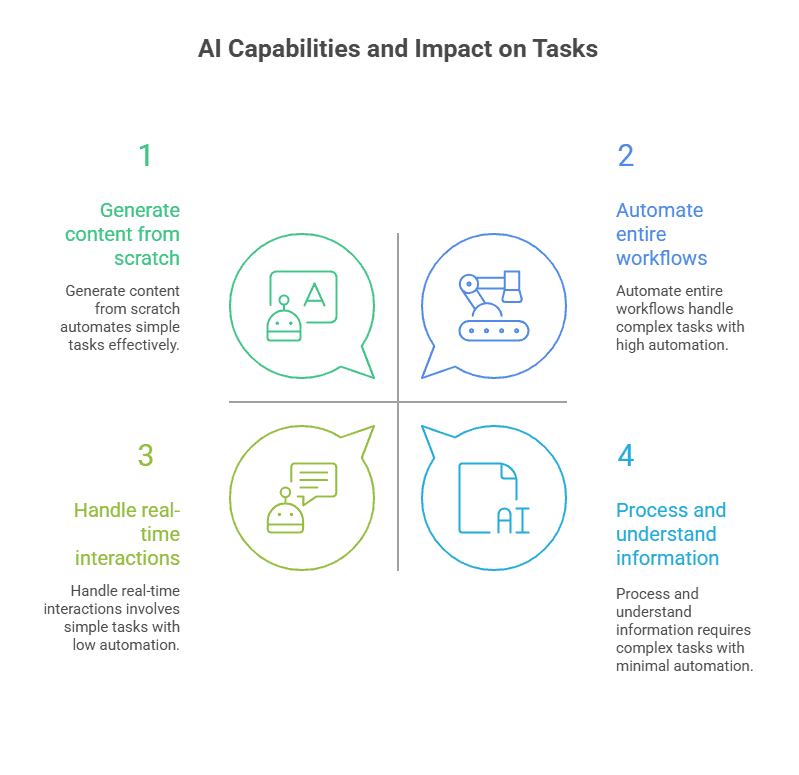
According to the World Economic Forum, by 2030, 34% of tasks will be completed by technology (up from 21% now), with work split equally between human-only, tech-only, and hybrid approaches.
Current AI Adoption Rates
About 78% of companies globally now use AI in at least one part of their business. That’s roughly 280 million organisations out of 359 million worldwide.
Here’s where things stand right now:
- Generative AI has taken over workplaces. 82% of big companies use it weekly, and 46% use it every single day. Small businesses are even further ahead, 89% use AI in their daily operations
- Adoption happened incredibly fast. 71% of organisations now use generative AI regularly, making it one of the fastest-adopted technologies in business history
- IT and telecom companies lead everyone else. 38% have deep AI integration, and the sector is expected to generate $4.7 trillion in value by 2035. Healthcare, manufacturing, finance, and retail are all racing to catch up
- Company size matters a lot. In the U.S., half of all companies with 5,000+ employees use AI regularly. For companies over 10,000 employees, that jumps to 60%
- Only 30% of advanced tech companies have AI everywhere. Most organisations are still struggling to scale it across their entire operation
AI in Creative & Content Jobs
Creative work sits in an interesting spot. AI can now generate images, edit videos, and write blog posts in seconds. But here’s what the data shows: creativity isn’t just about production speed. It’s about understanding what moves people, what a brand stands for, and why one message lands while another falls flat.
1. Content Writing
AI handles most of the repetitive work that used to take up content writers’ time. First drafts of product descriptions get done in minutes. SEO optimisation happens automatically with keyword suggestions, meta descriptions, and heading restructures.
Template content like email newsletters, social media captions, and basic how-to articles gets produced faster than manual writing.
According to SurveyMonkey’s 2025 research, 51% of marketing teams now use AI to optimise content, and 40% use it for research.
But AI trips up when things get nuanced. It struggles to capture a brand’s actual voice. The subtle tone that makes one company sound playful while another sounds authoritative.
AI Adoption Rates in Content Writing
Content writers aren’t ignoring AI, they’re using it heavily:
- 90% of marketers use AI for text-based tasks in their workflows
- Idea generation leads at 90%, followed by draft creation at 89% and headline writing at 86%
- ChatGPT holds 82.7% market share among AI writing tools
What AI Can Do in Content Writing
- First drafts with basic structure and flow
- Research summaries from multiple sources
- Multiple headline variations for A/B testing
- Meta descriptions and SEO-focused snippets
- Content outlines with logical topic progression
What AI Struggles with
- Understanding subtle brand personality nuances that develop over years
- Matching tone consistency across 50+ pieces of existing content
- Knowing when to break grammar rules for effect (like starting sentences with “But”)
- Catching cultural references that resonate with specific audiences
- Adjusting voice for different customer journey stages
Will AI Replace Content Writers?
So,will AI replace content writers? The honest answer is: some of them, yes. Writers who only handle routine, template-based content, product descriptions, basic blog posts, and generic social media updates are seeing their work get automated.
But writers who think strategically, who can nail brand voice, and who create content that actually connects with people? They’re not getting replaced.
They’re getting more efficient. The real shift is that it’s becoming writers WITH AI versus writers WITHOUT AI. The ones who learn to use these tools for research, first drafts, and optimisation while bringing their own creativity and strategic thinking to the final product? Those writers are producing better work, faster.
2. Copywriting
AI tools are now handling a lot of copywriting work. Companies use them to generate email subject lines, product descriptions, and ad variations for testing.
The technology works well with template-heavy content like CTAs and social media captions. The difference shows up in persuasion. AI can follow formulas and create variations quickly, but it doesn’t understand why someone hesitates before buying. It misses the emotional journey of a purchase decision and the “why” behind objections that stop conversions.
AI Adoption Rates in Copywriting
The numbers show copywriters are already using AI heavily in their daily work. Most of this adoption happens in areas where copy follows predictable patterns.
- 51% use AI for email marketing and SEO copywriting tasks
- 76% of marketers use AI to generate copy for various campaigns
- Most adoption happens in template-heavy work like subject lines and CTAs
AI’s Impact on Copywriting Tasks
When it comes to routine copy that follows standard formats, AI performs well. These are the areas where copywriters spend less time now than they did two years ago.
- Email subject lines get generated in bulk for testing
- Product descriptions follow formulas AI executes well
- Social media captions with standard CTAs get automated
- Ad variations multiply quickly for A/B testing
What AI Cannot Do in Copywriting
But persuasive copywriting requires understanding human psychology in ways AI consistently misses. These are the gaps that keep experienced copywriters valuable.
- AI doesn’t understand the emotional journey of a purchase decision
- It misses the “why” behind objections that stop conversions
- Humor, when AI attempts it, often falls flat or feels forced
- Strategic word choice based on customer psychology requires human insight
- Knowing when to use scarcity vs. social proof vs. authority depends on context AI can’t fully grasp
Will AI Replace Copywriters?
So, will AI replace copywriters? The field’s splitting. Template copywriters who write standard product descriptions and basic email sequences face real pressure. But copywriters who craft campaign strategies, understand audience psychology, and create messaging that actually converts? They’re still in demand. AI gives you 100 variations. Experienced copywriters know which one will work and why.
3. Writers
This broader category includes technical writers, ghostwriters, journalists, and authors. The work varies wildly, from instruction manuals to investigative journalism to novels. What they share is the need to communicate complex ideas clearly.
AI is helping writers with research, drafting, and structure. Tools can summarise research papers, create outlines from notes, and suggest improvements to existing work. Companies are using AI to speed up the early stages of writing projects. About 60% of companies use generative AI to support their writing processes, and 87% of marketers use AI to assist in content development.
The craft itself still needs humans. Original analysis, authentic storytelling, and voice-driven work require someone who’s actually lived and thought deeply about the subject. AI can help you start, but it can’t replace the thinking that makes writing worth reading.
AI Adoption Statistics for Writers
Writers across different specialisations are experimenting with AI tools. The adoption varies based on what type of writing they do, but the overall trend is clear.
- 60% of companies use generative AI to support their writing processes
- 87% of marketers use AI to assist in content development
- 68% use it specifically for content ideation
How AI Helps with Writing
AI tools handle the grunt work that used to eat up hours of a writer’s day. These capabilities make the research and early drafting phases faster.
- Summarising long research papers into key points
- Creating first-draft outlines from scattered notes
- Suggesting structural improvements to existing work
- Generating multiple angles on the same topic quickly
- Catching inconsistencies in long-form work
Where Human Writers Still Dominate
Certain types of writing require judgment, experience, and authenticity that AI can’t fake. These are the areas where writers remain essential.
- Investigative journalism that requires source verification and ethical judgment
- Storytelling with authentic human experience and emotion
- Technical writing that requires deep subject matter expertise
- Original analysis and argumentation that challenges existing thinking
- Voice-driven work where personality is the product
Can Writers Get Replaced?
So will AI replace writers? Risk Level: Medium
The collaboration model is taking hold. Writers use AI for research, outlining, and overcoming blank-page paralysis. But the actual craft, the voice, the argument, the structure that makes complex ideas accessible, still requires human judgment. Think of AI as a research assistant who never sleeps but still needs an editor who knows what matters.
4. Video Editors
AI is now handling tasks that used to take editors hours. Tools built into Adobe Premiere and DaVinci Resolve can auto-cut silences, match colour across different cameras, and generate captions automatically.
Social media content creators use AI editing tools heavily for quick turnarounds. The technology speeds up the mechanical parts of editing, which is genuinely useful on tight deadlines.
Emotional pacing is where AI falls short. Knowing when to hold on a character’s face for impact, building tension through cut timing, or recognising which takes have the subtle performance qualities that matter, these decisions require human intuition. AI might cut together a coherent video, but an experienced editor makes you feel something.
AI Adoption Rates in Video Editing
Video editing is seeing rapid AI integration, though adoption patterns vary widely based on project type. YouTube editors lean on AI tools more than documentary filmmakers.
- AI video editing tool market is growing fast as more editors experiment with automation
- Major editing software like Adobe Premiere and DaVinci Resolve have built AI features directly into their platforms
- Social media content creators use AI editing tools more heavily than traditional film editors
- Marketing teams increasingly rely on AI for quick turnaround video content
What AI Can Do in Video Editing
AI tools now handle several technical tasks that used to eat up editing time. These features are particularly useful when you’re working on tight deadlines.
- Auto-cutting removes silences, filler words, and awkward pauses from interviews
- Colour correction matches footage from different cameras automatically
- Audio balancing adjusts volume levels across multiple clips
- Caption generation transcribes dialogue and syncs text to video
- Scene detection identifies shot changes for easier organisation
What AI Struggles With in Video Editing
But AI consistently misses the human elements that make editing an art form. These are the skills that separate decent editing from work that actually engages an audience.
- Knowing when to hold on a character’s face just a beat longer for emotional impact
- Building tension through cut timing and music selection
- Understanding narrative flow across a full story arc
- Recognising which takes have the subtle performance qualities that matter
- Making creative choices that break conventional patterns when the story demands it
Will AI Replace Video Editors?
So will AI replace video editors? Basic editing work for corporate videos, social media clips, and automated content is at risk. Companies will use AI tools instead of hiring editors for simple projects.
Editors who specialise in narrative storytelling, commercial work, or any project where emotional impact matters will remain in demand.
But they’ll need to embrace AI tools for the technical grunt work while focusing their human skills on the creative decisions that algorithms can’t make. The editors who resist learning these tools might find themselves at a disadvantage against those who use AI to work faster.
5. Graphic Designers
AI image generators have exploded in the last two years. Tools can now create logos, suggest layouts, generate colour palettes, and produce images for backgrounds and concepts.
Designers who used to spend hours creating variations of a social media campaign can now do it in thirty minutes. That productivity boost is rea,l and companies are noticing.
Strategic design is where AI struggles. Understanding why certain design choices resonate with a specific audience, navigating vague client feedback, or creating visual systems that work across dozens of applications these require judgment that AI doesn’t have. AI generates options. Designers make strategic choices about which options solve the actual problem.
AI Adoption in Graphic Design
The numbers show designers aren’t rejecting AI, they’re figuring out how to use it without losing what makes their work valuable.
- According to Adobe’s global survey, 83% of creative professionals now use generative AI in their work
- Use of AI-powered design tools rose 55% in the past year
- 78% of creative professionals use AI for visual content generation
- 20% of designers report their employers now require AI tool usage
- Digital-focused designers show the highest adoption rates at 74%
AI’s Capabilities in Design
AI tools have gotten seriously capable for certain design tasks. These are the areas where AI saves designers significant time.
- Logo generation based on brand keywords and industry
- Layout suggestions for posters, social media graphics, and presentations
- Colour palette creation that matches mood or brand guidelines
- Image generation for backgrounds, textures, and concept mockups
- Automated resizing of designs across multiple platforms
What AI Misses in Strategic Design
But AI consistently fails at the strategic thinking that makes design valuable. These gaps are significant and protect experienced designers from automation.
- Understanding why certain design choices will resonate with a specific audience
- Navigating client feedback that’s vague or contradictory
- Creating visual systems that work across dozens of applications
- Balancing brand consistency with the need for fresh, attention-grabbing work
- Reading cultural moments and adapting design language accordingly
Will AI Replace Graphic Designers?
So will AI replace graphic designers? Risk Level: Medium
Junior designers and those doing repetitive production work face real pressure. Companies will use AI for simple graphics instead of hiring entry-level designers. That’s already happening. Experienced designers who understand brand strategy, user psychology, and creative problem-solving will adapt.
They’ll use AI to handle the tedious parts while focusing on the strategic thinking that clients actually pay for. The role is shifting, not disappearing. But it’s shifting fast enough that designers need to stay ahead of the tools.
AI in Tech and Engineering Jobs
If any industry should be comfortable with automation replacing human work, it’s tech. Software engineers and data scientists build the AI systems threatening jobs across other fields. The irony isn’t lost on anyone.
Tech roles are experiencing AI disruption firsthand. Some positions face serious pressure. Others are becoming more valuable as AI expands. The difference often comes down to how much of the job involves repetitive patterns versus complex problem-solving.
Programmers
Programming in 2025 looks completely different from what it did a few years ago. Over 90% of developers are now using AI tools for things like generating code, fixing bugs, and automating boring tasks. On average, these tools are creating about 28% of the code in projects.
GitHub Copilot is dominating with 42% of developers using it. After that, you’ve got Google’s Gemini Code Assist, Amazon Q, Cursor, and ChatGPT all fighting for attention. Most of these plug right into IDEs like VS Code, giving you suggestions while you’re actually typing.
AI Coding Assistants Commonly Used
- GitHub Copilot leads at 42% usage, tops surveys for autocomplete, context-aware code, and debugging across languages. Free tier boosts efficiency.
- ChatGPT generates and explains code from prompts, aids learning and prototyping. Free and versatile for newcomers and experts.
- Tabnine and Cursor work natively in IDEs for personalised suggestions, refactoring, and style adaptation. Cursor combines VS Code-like UI with chat.
- Amazon Q focuses on AWS development workflows.
- Replit Ghostwriter enables collaborative coding.
- Blackbox AI translates natural language into actual code.
How Programmers Are Using These
About 48% of developers are using multiple AI tools at once, mixing and matching based on what they need. The top priorities are productivity (84% mention this), speed (77%), and quality.
The results speak for themselves. 82% are seeing at least 20% productivity gains, and a quarter are getting over 50% improvements. Almost half of developers (49%) have been using these tools for a while now, so they’re not experimenting anymore, they’re actually good at it.
But there are real challenges. Privacy is a concern for 47% of people, and there’s a skills gap that companies are trying to figure out.
What This Means for Programming Jobs
AI is taking care of the repetitive stuff, which means programmers are moving into higher-level work. System architecture, oversight, innovation. That’s where the job is heading.
So, will AI replace programmers? Nobody’s getting mass replaced, but you do need to know how to work with AI now. It’s becoming a required skill. About 76% of developers expect their roles to keep growing and changing as AI gets better.
The key thing is: AI is a tool, not a replacement. The programmers who are thriving are the ones who learned how to use it effectively.
Software Engineers
Software engineering has basically gone all-in on AI. We’re talking 97.5% of companies using it in 2025, up from 90.9% just last year. Engineers are using it for everything from generating code to writing documentation, reviewing other people’s work, testing, and squashing bugs.
The productivity gains are legit. About 82% of companies say they’re seeing at least a 20% boost, and a quarter of them are getting over 50% better results. AI is becoming as normal as opening your IDE in the morning.
How Companies Are Using It
Here’s what’s interesting: 59.5% of companies now have their own in-house AI specialists building custom tools. Only 17.7% are just using off-the-shelf products. That’s a big shift toward making AI work for your specific needs instead of using generic solutions.
Why are companies doing this? 84% want productivity gains and cost savings. About 78% are after faster delivery times. More than half are focused on better quality and fewer errors.
Stack Overflow’s data backs this up. 84% of developers are either using AI or planning to, and almost half (49.4%) have been using it for over a year. This isn’t a trend anymore, it’s just how things work now.
What Software Engineers Are Actually Doing
AI handles the repetitive grunt work, which means engineers get to focus on the interesting stuff. Strategic planning, making big decisions, solving complex problems. That’s where humans are spending their time now.
About 76.5% of engineers think AI’s role is going to get way bigger over the next 3 to 5 years, especially with agentic systems that can handle DevOps and planning tasks.
But it’s not all smooth sailing. Privacy concerns are the biggest issue (47.5% mention it), and there’s a real skills gap. Companies are dealing with this by building their own expertise internally, which has gone up dramatically.
Where This Is All Going
The consensus is clear: AI is going to keep growing. But the focus is shifting to doing it ethically and making sure the ROI is actually there. Companies that are crushing it with AI are the ones investing in MLOps and training their people properly.
DORA reports show that AI is definitely making things faster, but quality is kind of hit or miss. The teams getting elite results are the ones that figured out how to make humans and AI work together effectively, not just throwing AI at everything and hoping for the best.
Can Software Engineers Get Replaced?
So, will AI replace software engineers? Not really.
Software engineers are among the safest tech positions from AI replacement. The complexity of system design, the need for strategic technical decisions, and the requirement to understand business context all protect this role.
Engineers who learn to use AI tools effectively will have an edge. But the core skills of software engineering, problem decomposition, system thinking, and technical leadership, remain firmly in human territory.
Web Developers
Web developers have jumped on the AI bandwagon in a big way. Between 84% and 91% are now using these tools in 2025, and about half of them use AI every single day. On average, AI is writing around 28% of the code that ends up in projects.
Companies are a bit slower to adopt, with 45% integrating AI into their processes. But when they do, it’s speeding up development cycles and letting them build things like personalised user experiences and chatbots. The interesting part? Most developers (60%) are keeping AI’s contribution under 25% of their total code, so humans are still very much in charge.
What Developers Are Doing With AI
- 91% are using it for code generation, which is by far the most popular use case.
- Learning new things and doing research comes in second, while text generation is also popular.
- Image generation is lagging behind at just 38% adoption.
- Stack Overflow’s survey shows 84% either using AI or planning to, up from 76% the year before.
- About 45% of companies have AI baked into their workflows, and that number’s expected to grow as no-code tools get better.
Commonly Used AI Tools in Web Development
GitHub Copilot is leading the pack for code help. It autocompletes code, helps with debugging, and most developers using it say it’s responsible for about 28% of their code output.
Wix ADI and Builder.io are making waves in the no-code space. They let you build entire websites just by answering questions or picking templates. Great for small businesses that need something fast with built-in SEO and mobile features.
Uizard and Figma AI are handling the design side, turning rough sketches into actual UX prototypes. Google Analytics 4 and Hotjar are using AI to figure out how users behave and what needs fixing.
Developers are starting small, testing these tools on smaller projects first before rolling them out everywhere. The big wins are in automation (saving time and money), security improvements, and personalisation.
What This Means for Web Developer Jobs
AI is taking over the boring stuff like repetitive coding and testing. That frees developers to focus on bigger picture things like system architecture and coming up with new ideas. Projects are moving faster, and there are fewer bugs.
But here’s the thing: nobody’s getting fully replaced. Jobs are just changing. Now you need to know how to work with AI tools and oversee what they’re doing. The main headaches are privacy concerns, costs, and making sure everyone knows how to use these tools properly.
Will AI Replace Web Developers?
So, will AI replace web developers? Risk Level: Medium
Basic website development work is moving to AI and no-code tools. Small businesses that used to hire developers for simple sites now use AI website builders. That’s eating into the entry-level market.
Developers with strong JavaScript skills, experience with modern frameworks, and the ability to solve complex technical problems will continue finding work. But the profession is splitting into two tiers, commodity work that AI can handle and specialised work that requires expertise. The middle is getting squeezed.
Data Scientists
AI is now deeply embedded in data science workflows. Data scientists are using AI to build, automate, and sometimes replace parts of their own pipelines. The role has shifted from “model builder” to “AI-augmented decision and product designer.”
AI Adoption and Usage in Data Science
- Around 78% of organisations report using AI somewhere in their analytics or data stack in 2025.
- Data teams are typically among the heaviest internal users of AI.
- Daily AI use has nearly tripled in five years.
- Many data scientists now rely on AI for code generation, feature engineering, and experimentation setup.
- Generative AI is responsible for a rapidly growing share of all data produced and transformed, including synthetic data to augment or replace real-world datasets.
What This Means for Data Science Jobs
AI automates a huge fraction of repetitive work like data cleaning, boilerplate modelling, and documentation. Advanced users are seeing productivity gains between 25-50%.
The demand is shifting away from purely technical skills. Now it’s about problem framing, domain expertise, evaluation, and governance. Why? Because many baseline models and code snippets can be generated automatically now.
At the macro level, AI is both destroying and creating roles. Forecasts talk about tens of millions of jobs displaced, but an even larger number created in new AI-centric and data-centric positions. The net effect is actually positive, just disruptive.
The Bottom Line
So, will AI replace data scientists? The risk level is low as of now. The job isn’t disappearing, it’s evolving faster than almost any other role. Data scientists who adapt to being AI orchestrators rather than just model builders are the ones who’ll thrive.
The irony isn’t lost on anyone: the people building AI are the first ones whose jobs are being transformed by it. But the ones who embrace that change are becoming more valuable, not less.
Data Analysts
AI adoption among data analysts has shot past 78% in organisations during 2025. Daily usage has tripled since 2020, reaching 314 million users worldwide. Analysts are mainly using AI for automating data cleaning, building visualisations, and generating predictive insights.
Tools like Tableau, Power BI, and Julius AI can now handle complex analysis through natural language queries. You just ask questions in plain English. Productivity is jumping between 25-50% for most users, though 45% are concerned about data bias issues.
The analysts crushing it are the ones integrating MLOps properly. These high performers are seeing major returns on investment. The role itself is shifting from routine number crunching to strategic oversight.
Key Adoption Stats
- 78% of organisations are using AI for data analysis work.
- Daily AI use has tripled since 2020, hitting 314 million users globally.
- 77% of companies prioritise AI compliance in their analytics.
- 35% have fully deployed AI, while 42% are running pilots in their analytics stacks.
- Data teams lead internal AI usage across companies.
- 71% of firms are embedding generative AI for forecasting and market analysis.
- 95% of professionals use AI at work or home.
- Only 6% of organisations are “high performers” seeing real earnings impact.
Popular Tools and Usage
Powerdrill Bloom, Tableau, and Power BI offer AI-powered visualisation, automatic modelling, and secure dashboard integrations.
Julius AI and Polymer provide intuitive analysis of spreadsheets and databases without needing coding skills. Analysts are using these for machine learning builds, data filtering, and pulling real-time insights from multiple sources.
What This Means for Data Analyst Jobs
AI is taking over the repetitive work, which enables 37% productivity gains on average. Analysts are now focusing on governance, compliance, and domain expertise instead of manual data processing.
New roles are being created. The job market is actually net positive with 97 million jobs created versus 85 million lost to automation.
Skills gaps are still a problem. But the dominant trend is augmentation, not replacement. Analysts who learn to work with AI are becoming more valuable, not less.
Can Data Analysts Get Replaced?
So, will AI replace data analysts? The short answer is no, not really. The data shows augmentation is winning over replacement. While AI automates the grunt work, it creates demand for analysts who can interpret results, ensure data quality, and make strategic decisions.
The job market backs this up with 97 million new jobs created compared to 85 million lost. Analysts aren’t disappearing, they’re evolving into roles that require higher-level thinking and AI oversight.
AI in Marketing and Business Jobs
Marketing and business roles are riding a strange wave right now. AI handles the grunt work, data crunching, basic content, and scheduling, but the human touch still drives the strategy. You’re seeing a shift, not a shutdown.
What’s interesting here is that these jobs aren’t disappearing. They’re splitting. The repetitive stuff gets automated. The creative, strategic thinking stays human. Some roles adapt faster than others.
Digital Marketers
Digital marketing has gone completely AI-powered in 2025. About 88% of marketers are using AI tools, and 88% are using them daily. That’s basically everyone.
The sector’s AI market hit $47.32 billion this year and is projected to exceed $107 billion by 2028. That’s a 36.6% growth rate annually.
Marketers are mainly using AI for content generation (93% faster output), insights (81%), and decision-making (90%). And get this: 92% of businesses plan to invest even more. The results are showing 81% gains in brand awareness and sales, plus 75% cost savings. Though 49.5% are dealing with privacy concerns.
Key Adoption Stats
- 83% of marketers gain time for strategic work thanks to AI.
- 51% are optimising website and social content with AI tools.
- 74% report higher job enjoyment and are exceeding their targets.
- 69% are excited about how AI is elevating their roles.
- Fortune 1000 firms are boosting AI spend at nearly 90%.
- 75% of staff have shifted from production work to strategy.
What This Means for Digital Marketing Jobs
AI is automating the routine tasks, which enhances personalisation and customer experiences. About 41% say that’s the top benefit. But it’s raising ethics and data issues that demand constant upskilling to maintain an edge.
Marketers are pivoting to oversight and creativity. Tools like chatbots enable 24/7 customer support, and predictive analytics are building loyalty. Overall, AI is amplifying marketing roles, not replacing them. The growth is explosive, but the focus is on augmentation.
Where This Is Headed
So, will AI replace digital marketers? Not entirely, but it’s changing what “digital marketer” means. Junior roles focused on execution, posting content, pulling basic reports, are shrinking.
The shift is real: marketers who used to spend 80% of their time on execution are now spending 80% on strategy. That’s a complete flip in just a couple of years.
If you’re in marketing and not using AI for the grunt work, you’re literally working harder than you need to while your competitors work smarter.
SEO Specialists
SEO has basically been taken over by AI in 2025. About 86% of SEO specialists are now using AI tools for keyword research, content optimisation, and on-page improvements. These tools are automating between 37-75% of repetitive tasks.
The results speak for themselves. Businesses using AI in their SEO strategies are seeing 30% better search rankings within six months, 45% higher organic traffic, and 38% more conversions. AI is making personalisation and efficiency way better.
What AI Does in SEO
AI tools automate the technical and research-heavy parts of SEO. These capabilities have made SEO work much faster.
- Crawls thousands of pages for technical errors
- Identifies keyword gaps and opportunities
- Suggests content improvements for target keywords
- Analyses SERP features and predicts ranking potential
- Drafts meta descriptions and title tags
- Optimises existing content for better rankings
Where Humans are Still Needed
SEO specialists bring strategic thinking and understanding of user behaviour. These skills keep specialists essential despite AI automation.
- Understanding search intent behind keywords
- Building content strategies that serve users, not just algorithms
- Navigating algorithm updates and adapting quickly
- Knowing why Google suddenly deprioritised a site
- Combining technical knowledge with content expertise
- Making strategic decisions about which opportunities to pursue
Key AI Adoption Statistics in SEO
- 86.07% of SEO pros are using AI in their strategies.
- 67% cite automation of tasks like meta-tags as the top benefit.
- 52% note performance gains specifically in on-page SEO.
- 65% of firms see overall improvements in their results.
- 82% of enterprise specialists plan to invest more in AI.
- 64% prioritize tool accuracy when choosing what to use.
What This Means for SEO Jobs
SEO work is shifting from manual labour to strategic oversight. Content output is up 42%, and rankings are improving by up to 49% for companies using AI effectively.
But specialists need to watch out for biases and adapt to the fact that 19% of Google results are now AI-generated content. That’s a big deal.
The role is evolving. You need AI fluency now. Tools like ChatGPT (used by 69% of SEO pros) handle drafting work, which frees up time for analytics and newer tactics like GEO (Generative Engine Optimisation) and AEO (Answer Engine Optimisation).
Where This Is Headed
About 19% of top-ranking Google content is AI-generated now, and that’s up significantly from before. Sites using AI are growing 5% faster than those that don’t.
Marketers are planning broader AI search integration. AI Overviews are appearing in 26.6% of financial queries, which is changing how SEO works fundamentally.
The future is hybrid human-AI workflows. Pure AI content doesn’t cut it, and pure human content is too slow. The specialists who figure out the right balance are the ones who’ll stay competitive.
Bottom line: if you’re in SEO and not using AI, you’re already behind.
Will AI Replace SEO Specialists?
So, will AI replace SEO specialists? The technical grunt work is automated, yes. But SEO is part strategy, part psychology, part keeping up with Google’s mood swings. AI handles the repetitive stuff. Specialists who combine technical knowledge with strategic thinking and content expertise are still essential. The role is evolving, not evaporating.
Business Analysts
About 78% of organisations are using AI for business analysis work in 2025. Analysts themselves are using AI to automate between 40-50% of the routine stuff like crunching numbers and building reports.
This lets them focus on what actually matters: strategic insights and decision-making. Productivity gains are hitting 37% on average. AI’s handling predictive modelling and visualisation, though 42% are running into challenges like data bias and skill gaps.
What AI Does for Business Analysis
AI handles the computational heavy lifting in business analysis. These capabilities speed up data processing dramatically.
- Crunches numbers and processes massive datasets
- Builds predictive models automatically
- Generates basic reports and visualisations
- Identifies trends in customer behaviour
- Forecasts sales and revenue patterns
- Flags anomalies and unusual patterns in data
What Business Analysts Do
Business analysts bring context and strategic thinking that AI lacks. These skills make analysts valuable even as AI handles more data processing.
- Interpret what the data actually means for the business
- Ask the right questions in the first place
- Investigate why trends appear, not just that they exist
- Translate insights into actionable recommendations
- Understand organisational dynamics and priorities
- Navigate stakeholder meetings and competing interests
AI Adoption Statistics in Business Analysis
- 71% of firms have deployed generative AI in their operations.
- Business analysts lead at 60% efficiency in forecasting and trend analysis.
- 92% of top companies have integrated AI strategies.
- They’re prioritising business intelligence tools for real-time analytics.
- Daily AI use has tripled since 2020.
- Analysts are allocating 3.32% of budgets to AI, especially in retail and consumer sectors.
What This Means for Business Analyst Jobs
AI is cutting manual work significantly. Companies are seeing productivity boosts between 26-55% and getting $3.70 back for every dollar invested in AI.
But here’s the reality: you need to upskill. Only 6% of organisations are “AI high performers” seeing major impact on earnings. The rest are struggling.
Analysts are evolving into AI overseers, managing custom models and governance. This reduces the need for entry-level positions but creates huge demand for expertise. The failure rate is brutal too: 70-85% of AI projects fail without proper training.
Where This Is Headed
Nearly 50% of tech leaders have embedded AI in their strategies. Business analysts are driving enterprise-wide access through natural language querying, which is at 20% adoption now.
By 2026, workforce access to AI analytics is expected to triple. Compliance is becoming a huge priority, with 77% of companies focused on it.
The bottom line? Business analysts who learn to work with AI are going to be fine. The ones who don’t are going to struggle to stay relevant. The role is fundamentally changing from data processor to strategic AI orchestrator.
Will Business Analysts Get Replaced?
So will AI replace business analysts? The risk level right now is low-medium.
The data processing part, yes. But analysis requires business context, industry knowledge, and understanding organisational dynamics. AI can’t attend stakeholder meetings or negotiate between departments with competing priorities. Analysts who focus on strategic interpretation rather than just data processing remain valuable.
Consultants
AI adoption in consulting has hit 72% across firms in 2025. The market’s valued at $11.07 billion and growing at 26.2% annually, with projections showing $90.99 billion by 2035.
Big players like BCG, Accenture, and EY are leading the charge, integrating AI into strategy work and analytics. The traditional consulting model is being completely rethought because of this technology.
AI is automating between 40-50% of routine tasks and boosting productivity by 37%. Consultants are shifting from doing grunt work to focusing on insights and strategic advice.
What AI Does in Consulting
AI automates the research and analysis work that junior consultants used to handle. This changes how consulting firms structure their teams.
- Compiles industry research and market data
- Analyses competitor strategies and benchmarks
- Drafts initial frameworks and recommendations
- Processes client data and identifies patterns
- Generates preliminary reports and presentations
- Creates slide decks with basic insights
Where AI Struggles
Senior consulting work relies on skills that AI can’t replicate. These are the capabilities that keep experienced consultants in demand.
- Building relationships with clients and earning trust
- Understanding unspoken organisational dynamics
- Reading between the lines during meetings
- Catching what clients mean versus what they say
- Tailoring recommendations to company culture
- Managing change and navigating political realities
Key AI Adoption Statistics in Consulting
- 72% of consulting firms are actively using AI in their operations.
- 75% of executives plan AI investments, restructuring their traditional pyramid models.
- The consulting AI market is valued at $11.07 billion in 2025.
- Expected to reach $90.99 billion by 2035, growing at 26.2% annually.
- AI is automating 40-50% of routine consulting tasks.
- Productivity gains are hitting 37% on average.
What This Means for Consulting Jobs
The big shift is in how consulting firms are structured. The traditional model had tons of junior consultants doing research and analysis, with senior partners overseeing everything. AI is changing that pyramid.
Junior consultants are being augmented with AI, which means fewer people can do more work. That’s changing the economics of consulting firms pretty dramatically. Instead of hiring armies of analysts, firms are investing in AI tools and smaller teams of people who know how to use them.
But here’s the thing: this isn’t about replacement. It’s about elevation. Consultants who used to spend 80% of their time gathering data and building slides are now spending that time on strategy and client relationships. The work is getting more interesting, not less.
Can Consultants Get Replaced?
So, will AI replace consultants? The risk is low, but it’s still there. Senior consultants are safe. The relationship-building, strategic thinking, and change management aspects remain deeply human. But the career path is changing. Firms hire fewer junior consultants since AI does the groundwork. If you’re entering consulting, you’ll need to demonstrate strategic thinking earlier in your career.
Recruiters
AI adoption in recruiting has exploded in 2025. Between 43-67% of organisations globally are now using AI tools, up from just 26% in 2024. US firms are leading the charge at 76% usage for things like sourcing candidates, screening resumes, and reducing bias.
Enterprise companies are even further ahead at 78% integration. That’s 189% growth since 2022. About 41% of recruiters are using AI daily for candidate matching, and these systems are hitting 89-94% accuracy on resume parsing.
The time and cost savings are legit. Projections show 80% of HR will have AI integrated by the end of the year, with $1.2 trillion in global savings.
Key Adoption Stats
- 51% of firms use AI in hiring right now, expected to hit 68% by December 2025.
- Tech sectors lead at 89% adoption.
- 75% of HR professionals are prioritising AI investments.
- 54% are planning to increase spending by 40% or more.
- 60% are automating end-to-end hiring processes.
- AI is reducing bias by 50% and boosting candidate satisfaction by 52% through transparency.
What This Means for Recruiting Jobs
AI handles about 40% of repetitive tasks. Initial screening is a big one, with 40% of applications getting filtered before a human ever sees them. This frees recruiters to focus on relationship-building and strategy.
The role is evolving toward AI oversight. There are trust gaps though. Only 26% of applicants trust that AI will evaluate them fairly. That’s creating demand for specialists who can manage these systems properly. About 49% of organisations are hiring for these roles.
The net effect? Faster hiring without mass displacement. Though regulations are slowing things down in Europe, where adoption sits at 36%.
Where This Is Headed
GenAI experimentation has hit 37% globally. Chatbots and predictive analytics are becoming standard. Gartner predicts 81% adoption by 2027.
Younger candidates are driving this too. Gen Z and Millennials accept AI tools 34% more than older generations. That’s signalling sustained growth in personalised, efficient hiring pipelines.
The recruiting function is fundamentally changing. It’s less about manually sifting through resumes and more about managing AI systems that do the first pass, then focusing human attention where it actually matters.
Can Recruiters Get Replaced?
Will AI replace recruiters? Not really. AI is handling the grunt work like initial resume screening and scheduling, but the human element remains critical for relationship building, cultural fit assessment, and candidate experience.
The demand is actually growing for recruiters who know how to work with AI. About 49% of organisations are actively hiring specialists who can manage these systems. The job isn’t disappearing, it’s upgrading to focus on strategy and human connection instead of administrative tasks.
Project Managers
Project management has seen a huge uptick in AI adoption. About 70% of organisations are now using AI tools in 2025, and another 29% are planning to implement them. That’s nearly double what we saw two years ago when it was just 36%.
The market hit $3.58 billion this year, up from $3.08 billion in 2024. That’s a 16.3% growth rate. Projections show it hitting $7.4 billion by 2029.
Project managers are using AI mainly for predictive analytics, risk assessment, and automation. The results are impressive: project success rates are up 25% and productivity is up 20%.
What AI Does for Project Management
AI handles the administrative and tracking aspects of project management. These features make PMs more efficient at logistics.
- Tracks task completion and progress automatically
- Flags potential delays before they become critical
- Optimises schedules based on team capacity and availability
- Predicts project risks by analysing historical data
- Sends automated status updates to stakeholders
- Suggests resource reallocation when bottlenecks appear
What AI Still Cannot Do in Project Management
Project management is fundamentally about managing people, not just tasks. These human skills keep PMs essential.
- Handling team dynamics and interpersonal conflicts
- Managing stakeholder expectations and communication
- Mediating when team members clash
- Negotiating boundaries when scope creeps
- Motivating teams through difficult project phases
- Making judgment calls when plans need to change
How Project Managers Are Using It
- 22% of project managers report active AI deployment in their work.
- Tech sector leads at 34% adoption, followed by finance.
- Only 12% see substantial use right now, mainly due to resource gaps.
- 82% are using AI more frequently than they expected five years ago.
- 62% view recent AI advancements as very positive for their sector.
- 75% of experts note improved delivery in complex projects.
- 85% support on-the-job training for AI skills.
What This Means for Project Management Jobs
AI is set to automate about 80% of routine tasks by 2030. That shifts project managers toward strategic decisions, resource optimisation, and leadership roles instead of admin work.
Projects are hitting their timelines and budgets better. But there are real challenges: trust issues, skills gaps (29% feel unprepared), and data governance concerns.
Jobs are evolving, not disappearing. You need to know how to work with AI to stay competitive. The managers who get this are the ones who’ll thrive.
Where This Is Headed
Growth to $5.7 billion by 2028 signals we’re hitting a tipping point. Healthcare and construction are piloting AI for risk mitigation.
Tech-forward firms are leading the pack. Companies that lag behind risk project delays and inefficiency. Overall, AI is freeing up time for innovation, which is perfect timing given the rise of hybrid methodologies and remote work trends.
The key takeaway? AI is becoming essential infrastructure for project management, not a nice-to-have feature.
Can Project Managers Get Replaced?
So, will ai replace project managers? The administrative tracking, sure. But project management is fundamentally about people, not tasks.
You navigate personalities, manage expectations, and make strategic trade-offs between speed, quality, and resources. AI optimises logistics. Humans manage the messy reality of getting people to work together effectively.
AI in Professional Services
Professional services, law, medicine, accounting are facing a different kind of AI disruption. These fields built their value on specialised knowledge and years of training. AI now accesses that same knowledge base instantly.
But here’s the thing: knowledge alone isn’t expertise. Applying it in context, with judgment and empathy, still requires humans. The gap between what AI knows and what professionals do is narrower than it used to be, but it’s still there.
Lawyers
The legal sector is catching up with AI in 2025, though it’s happening in a pretty uneven way. About 38% of corporate legal departments are using AI tools, and another 50% are exploring implementation. Mostly for contract drafting and research.
Here’s what’s wild: individual lawyers are way ahead of their firms. 85% of them are using generative AI daily or weekly, while firms are stuck at just 21-27% adoption. Civil litigation leads at 27%, and personal injury is at 20%.
Bigger firms are doing better. If you’ve got 51 or more lawyers, you’re looking at 39% adoption versus 20% in smaller firms. A lot of this is happening through integrations with existing software rather than standalone tools.
What AI Does in Legal Work
AI automates research and document review tasks that used to take junior associates hours or days. These capabilities speed up the mechanical parts of legal work significantly.
- Reviews contracts for specific clauses and potential issues
- Summarises case law and legal precedents
- Flags potential legal issues in documents
- Conducts discovery by searching thousands of documents
- Drafts basic legal documents using templates
- Analyses past case outcomes for patterns
What AI Struggles With
Legal practice requires strategic thinking and human judgment that AI can’t replicate. These are the skills that keep lawyers essential.
- Building legal strategy and deciding how to proceed
- Negotiating with opposing counsel
- Reading judges’ tendencies and jury psychology
- Making judgment calls on complex situations
- Advising clients considering business goals and risk tolerance
- Arguing cases in court where persuasion matters
- Understanding practical implications beyond legal correctness
How Lawyers Are Using It
- 31% of individual lawyers and 21% of firms are using generative AI.
- 82% report efficiency gains for tasks like drafting (54%), research, and data analysis (14%).
- Thomson Reuters found active integration rising from 14% in 2024 to 26% in 2025.
- 45% of firms are planning to make AI central to their practice within a year.
- Immigration lawyers top individual usage at 47%, while firms lag due to trust, ethics, and privacy concerns.
What This Means for Legal Jobs
AI is handling a lot of the administrative burden, which lets lawyers focus on strategy and actually talking to clients. But getting firms to roll this out widely is tough. ROI concerns, training needs, and governance issues are all in the way.
The good news? Jobs aren’t disappearing. AI is augmenting what lawyers do, not replacing them. But there’s a growing need for lawyers who actually know how to use these tools. The gap is huge right now. Individual lawyers are experimenting freely while firms are stuck writing policies.
Productivity boosts are real and measurable. But success really depends on education and building ethical frameworks around AI use.
Can Lawyers Get Replaced?
The answer to will AI replace lawyers is simple: No. Risk Level: Low-Medium
Not the litigators or strategists. But the career path is shifting. Junior associates used to spend years doing document review and research. AI handles that now. New lawyers need to develop strategic skills earlier. The profession isn’t disappearing, but it’s being reshaped. Lawyers who audit AI outputs and focus on strategy will thrive.
Accountants
Something crazy happened in accounting this year. AI usage jumped from just 9% in 2024 to 41% across firms worldwide in 2025. About 35% of accountants are now using AI every single day.
The market’s reflecting this shift too. It hit $6.68 billion this year, which is a 70.4% jump from last year. Small and medium-sized firms are leading the charge, making up 68% of the market. And get this: 77% of firms are planning to spend even more on AI.
The results? About 73% of accountants say AI is working better than they expected, especially for efficiency and client service. But here’s the weird part: only 37% are actually investing in training their teams, even though 85% are optimistic about AI.
How Accountants Are Using AI
- 46% of accountants use AI daily, nearly double the rate in small businesses.
- Main uses are task automation (41%), research (40%), and advisory work (93%).
- 72% of firms use AI at least weekly, and 64% are planning upgrades.
- The Big Four accounting firms are committing billions to AI.
- 61% see AI as a way to cut mundane tasks, with 95% getting 98% accuracy gains from automation.
What This Means for Accounting Jobs
People who really know how to use AI are saving about 79 minutes every day. That’s translating into 39% higher revenue per employee. Instead of doing routine work, accountants are moving into more strategic roles.
Some firms are automating over 80% of their tax preparation work. Same with reconciliation tasks. This is actually helping with the shortage problem, since 75% of CPAs are retiring.
But here’s the thing: you need accountants who actually understand AI. The fear of job loss is there, but what’s actually happening is jobs are changing, not disappearing. Some projections say AI could save the accounting industry $1 trillion by 2030.
Where This Is Headed
The sector is eyeing $37.6 billion by 2030. Real-time analytics and predictive tools are driving this growth.
Small and medium businesses are leading the way, with 44% going digital and 38% using AI for things like multi-currency handling. This creates a productivity flywheel. Firms that prioritise AI training and integration are getting a real competitive edge in client value.
Will AI Replace Accountants?
So, will AI replace accountants? For basic bookkeeping and tax prep, yes. But strategic accountants who advise on financial decisions, navigate complex regulations, and build client relationships remain essential.
The profession is splitting into automated transaction processing and high-value advisory. If you’re in accounting, move toward the advisory side.
Doctors
Healthcare is going through a pretty massive shift with AI, and the numbers tell an interesting story. The market sits at around $37.98 billion today, but experts think it’ll hit $674.19 billion by 2034. That’s a 37.66% jump every year.
What’s really changed is how doctors themselves are using these tools. By the end of 2024, 66% of physicians had started working with AI in some form. That’s up 78% from just a year earlier. Most big hospitals have either started testing AI systems or already put them to work by mid-2025.
The generative AI piece alone is worth $3.3 billion this year. And here’s the thing: it’s not about replacing people. It’s about helping overworked staff do their jobs better during a time when hospitals can’t find enough workers.
AI Usage In Healthcare
- When COVID hit, 94% of healthcare executives started spending more on AI. Now 92% say they need it to deal with staffing problems.
- About two out of three doctors use AI for everyday things like reading through patient notes or spotting warning signs before something goes wrong.
- The FDA has approved over 950 AI medical devices, but insurance only covers 23 of them. So adoption is slower than you’d think.
What This Means for Doctors and Nurses
AI diagnostic tools can catch heart attacks with 99.6% accuracy. That kind of precision is helping cut hospital stays by 20% and saving about $40 billion a year in surgery costs.
Nurses are spending 20% less time on repetitive tasks, which saves another $20 billion. That means doctors get more time to handle the really complicated cases that need human judgment. We’re also seeing totally new jobs pop up, like people who manage AI systems in hospitals or chief medical officers who actually understand how this tech works.
Sure, some people worry about losing their jobs. But what’s actually happening is doctors are making better decisions and burning out less.
Where This is All Headed
Generative AI in healthcare is expected to grow 146% between 2025 and 2028. By 2030, it should be worth over $10 billion.
Just in the US, the market could reach $102.2 billion by 2030, growing at 36.1% annually. Hospitals might save $13 billion in costs this year alone. Right now, most hospitals are focused on getting AI systems that actually work together smoothly to help with patient flow and take pressure off their clinical teams.
Can Doctors Be Replaced?
Medicine isn’t just diagnosis. It’s communication, empathy, and shared decision-making with patients. So the answer to will AI replace doctors is no.
AI is becoming an incredibly useful diagnostic assistant, especially in radiology and pathology. But the human relationship between doctor and patient remains central to care. Patients trust people, not algorithms, with their health decisions.
Teachers
AI has become a major tool for improving teaching efficiency in 2025. About 60% of teachers now use AI as part of their regular work routines, particularly for tasks like creating lesson plans and developing teaching materials. This technology helps save 44% of the time teachers previously spent on administrative tasks.
The global market for AI in education has grown to $7.57 billion this year, marking a 46% increase from 2024. Education organisations are leading AI adoption, with 86% now using generative AI tools, which is the highest rate among all industries.
While roughly one-third of experts express concerns about potential job displacement in the long run, AI is currently being used to support teachers rather than replace them, especially in areas facing teacher shortages.
How Teachers Are Using AI
- 60% of teachers regularly incorporate AI into their work, mostly for research purposes (44%), creating lesson plans (38%), and generating summaries (38%).
- 86% of education organisations have implemented generative AI tools, leading all other sectors in adoption rates.
- Teachers typically spend close to 10 hours each week on planning and grading activities, areas where AI helps create initial outputs that teachers then review and refine.
Effects on Teaching and Learning
AI gives teachers more time to interact directly with students, which helps reduce burnout and improve retention rates in regions struggling with teacher shortages.
Students in programs that use AI support show impressive results. They score 54% higher on assessments, demonstrate 10 times greater engagement levels, and have 70% better course completion rates compared to those in traditional learning environments. Market analysts predict the sector will reach $112 billion by 2034, indicating that AI will continue supporting and enhancing teaching roles.
Industry Growth
The overall educational technology market is approaching $404 billion by the end of this year, with AI contributing to a 16.3% compound annual growth rate since 2019.
AI-powered tutoring systems have reduced student dropout rates by 20% through personalised learning approaches. A large majority of business leaders (92%) are planning to increase their AI investments, with a focus on developing AI literacy as an essential skill for future educators.
Will AI Replace Teachers?
Teaching is relationship-based. Students need human connection, encouragement, and someone who believes in them. So the answer to will AI replace teachers is no. AI can personalise content delivery and handle administrative grading. But the mentorship, inspiration, and social-emotional aspects of teaching remain deeply human. Good teachers use AI as a tool, not a replacement.
Therapists
AI mental health chatbots are growing in popularity, especially for preliminary support and between-session check-ins.
But they’re used as supplements, not replacements. AI chatbots provide basic cognitive behavioural therapy techniques, offer mood tracking, and suggest coping strategies. They’re available 24/7 for check-ins and can flag concerning patterns to human providers.
Building trust and providing nuanced support requires human connection. Therapists read body language and tone that reveal what clients can’t articulate. You adapt therapeutic approaches based on individual needs and cultural backgrounds. When a client is in crisis, you make judgment calls about safety and intervention that AI can’t handle.
Current Adoption of AI in Mental Health Support
The use of artificial intelligence for mental health purposes has grown significantly in 2025. More than half of people (53%) now turn to AI tools when dealing with stress, anxiety, or similar concerns.
This number jumps even higher for younger adults aged 25-34, where over 80% report using these technologies. The industry itself is valued at approximately $1.8 billion this year and is expected to expand at rates between 24-40% annually through 2032.
Among young people in the United States, roughly 13.1% (around 5.4 million individuals) have sought mental health guidance from generative AI, with that figure climbing to 22% for those 18 and above.
Usage Patterns
- Just over half (53.6%) of surveyed individuals use AI for mental health assistance, with 15% engaging with these tools every day.
- Nearly one-third (32%) say they would be interested in receiving therapy from AI instead of human professionals, though the majority (68%) still prefer working with people.
- Among teenagers and young adults, between 17-24% show signs of depending on AI tools, which researchers have connected to increased risks of social anxiety and depression.
How Well AI Works
Chatbots designed for therapy have shown the ability to reduce depression symptoms by 64% compared to groups without intervention. Prediction systems have demonstrated 92% accuracy in identifying suicide risk within a seven-day window.
A model developed at Vanderbilt achieves 80% accuracy in predicting suicide risk by analysing hospital records. Data from OpenAI indicates that roughly 0.15% of users who engage with their systems weekly display signals of elevated mental health distress.
Industry Expansion
The AI mental health field is experiencing rapid growth, with forecasts showing an increase of $3.13 billion between 2025-2029, representing a 30.9% compound annual growth rate. This expansion is fueled by improved personalisation capabilities and the need to bridge gaps in mental health care access.
The United States is leading in adoption, with the market expected to reach $3.3 billion by 2032, driven partly by high rates of mental health conditions.
Will AI Replace Therapists?
So, will AI replace therapists? Risk Level: Very Low
Absolutely not. Therapy is fundamentally about human connection and trust. AI chatbots might help with basic support or between sessions, but they can’t replicate empathy, clinical judgment, or the therapeutic relationship. Mental healthcare requires human understanding in ways that AI simply can’t provide. The human element isn’t just helpful, it’s the entire point.
The Verdict: Job-By-Job Risk Breakdown
So where does your job actually stand? Let’s organise everything we’ve covered into a clear snapshot based on risk level.
- Low Risk: Consultants, doctors, lawyers, project managers, software engineers, teachers, therapists, and data scientists. These roles lean heavily on expertise, judgment, and human connection that AI struggles to replicate.
- Medium Risk: Accountants, business analysts, content writers, copywriters, digital marketers, graphic designers, recruiters, SEO specialists, video editors, web developers, writers, and data analysts. Expect significant workflow changes with AI handling routine tasks while humans focus on strategy and creativity.
- High Risk: Programmers face the most disruption as AI tools increasingly generate functional code. That said, it’s still about transformation rather than replacement.
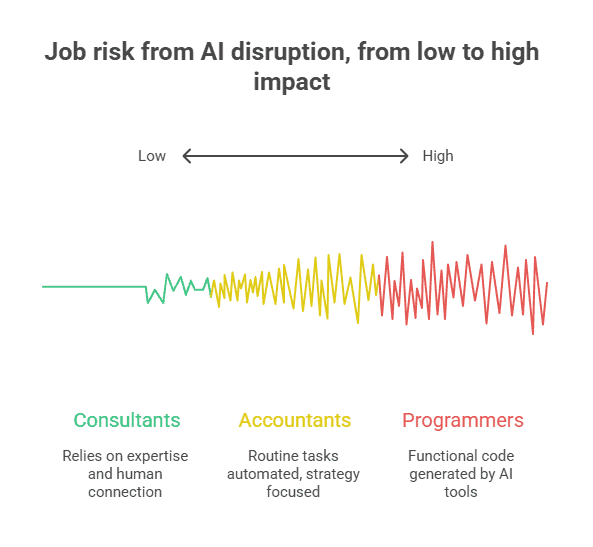
Each job has its own detailed breakdown linked in the sections above if you want to understand the specific factors shaping your role.
Jobs AI Will Create
By 2030, AI will generate 170 million new jobs. Yes, 92 million jobs will be displaced. But that leaves a net gain of 78 million brand new positions that didn’t exist before.
This isn’t a prediction anymore. It’s actively happening.
In Q1 2025 alone, there were 35,445 AI job postings in the U.S. That’s 25% more than the same time last year. And the median salary for these roles? $156,998. These are well-paid, in-demand positions.
The New Roles Showing Up
- Prompt Engineers: Specialists who know exactly how to communicate with AI to get the best results. They understand both the technology and the business well enough to bridge that gap
- AI Ethics Officers: Someone needs to ensure AI systems aren’t making biased or unfair decisions. These people set the rules and audit the outcomes
- AI Trainers: Industry experts teaching AI systems the specific knowledge and context they need. Think doctors training AI on medical imaging or lawyers training AI on case law
- AI Auditors: Quality control for algorithms. They check AI outputs, hunt for errors and biases, and make sure systems actually work as promised
- Data Scientists: Demand is growing 10% year-over-year. Someone has to analyse and interpret all the data AI systems generate
- AI Architects: Engineers who build and connect complex AI systems across entire organisations
What You Should Focus On
Here’s the thing about AI disruption. It’s not about choosing between learning AI or losing your job. It’s about understanding how to work alongside these tools in a way that makes you more valuable, not less.
83% of workers and employers agree that everyone needs AI upskilling. That’s not a warning. That’s a roadmap.
Skills to Learn
- AI literacy: You don’t need to build AI systems, but you should know how to use them effectively. Think of it like learning Excel in the 1990s. It became table stakes.
- Critical thinking and analytical skills: AI generates outputs. You need to evaluate whether those outputs make sense, catch errors, and determine what’s actually useful.
- Creative problem-solving: AI works from patterns in existing data. When you’re facing novel challenges or need truly original approaches, that’s still human territory.
- Emotional intelligence and interpersonal skills: Understanding people, reading the room, managing relationships, these remain distinctly human advantages.
- Adaptability and continuous learning mindset: The AI landscape shifts constantly. Being comfortable with change and willing to learn new tools becomes more valuable than mastering any single technology.
- Domain expertise in your field: Deep knowledge of your industry, clients, or specialisation is what turns you from an AI user into someone who gets exceptional results from AI.
How to Adapt
Start treating AI as your assistant, not your competition. The World Economic Forum projects 30% of the workforce will be upskilled in current roles by 2030. That’s millions of people learning to work differently, not finding entirely new careers.
Look at your daily work and identify which tasks are repetitive or follow clear patterns. Those are prime candidates for AI automation. Then ask yourself what happens when those tasks take 20% of the time they used to.
What high-value work could you focus on instead? Maybe you’re a writer who can finally spend more time on research and interviews instead of formatting. Or a developer who can architect complex systems instead of debugging basic syntax errors.
If you’re thinking about a career pivot, don’t panic and jump ship entirely. Instead, look at adjacent roles that use your existing expertise.

A startup consultant, digital marketer, traveller, and philomath. Aashish has worked with over 20 startups and successfully helped them ideate, raise money, and succeed. When not working, he can be found hiking, camping, and stargazing.