[Reader Disclosure]Our content is reader-supported. This means we may earn a commission if you click on some of our links.
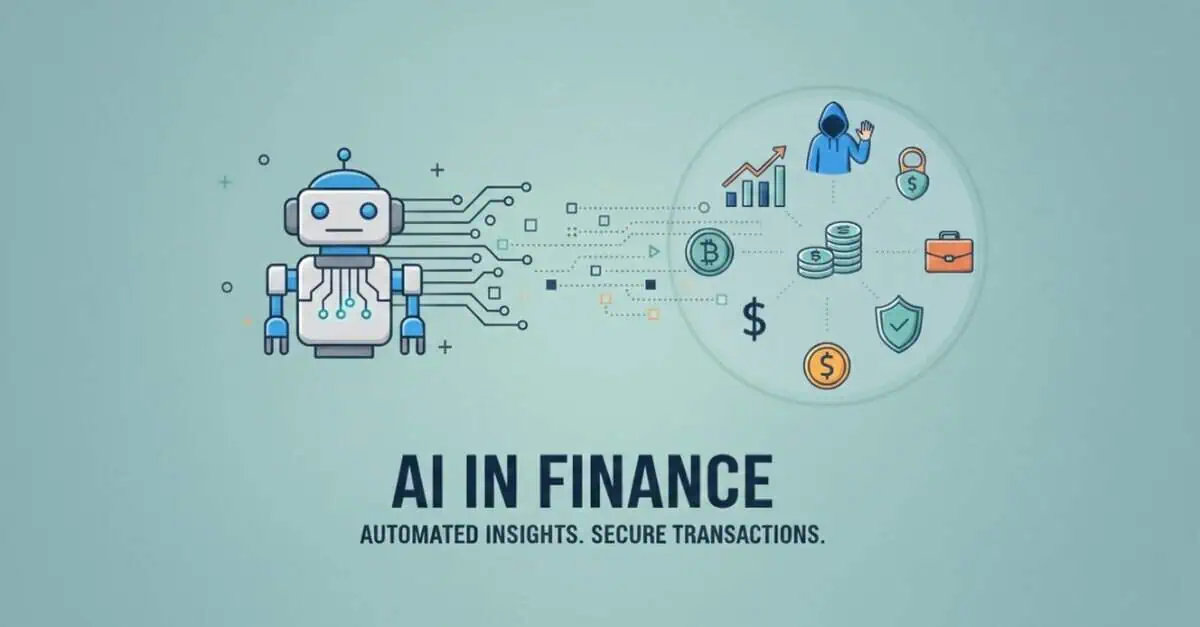
AI is changing how finance departments work. Not in some far-off future, but right now. Companies are using it to automate grunt work, catch fraud faster, and make smarter decisions with their money.
Your finance team spends hours each day doing work AI could finish in minutes. Scanning invoices. Flagging suspicious transactions. Predicting cash flow. Answering the same customer questions over and over.
This article breaks down what AI actually does in finance, how it works, and where you can use it in your operations.
AI in finance means using software that learns and adapts to handle financial tasks. Instead of following rigid rules you programmed, these systems spot patterns in your data and get better over time.
Here’s what makes it different from regular software. Your accounting system follows steps you built in: if X happens, do Y. AI tools actually study your historical data and figure out the patterns themselves. They notice that customers who buy product A usually buy product B within 30 days. Or that expense reports submitted on Fridays have more errors. Things you might never catch manually.
The practical side? AI handles three big jobs in finance. It automates repetitive work like data entry and report generation. It analyses massive amounts of information to predict trends or risks. And it makes decisions in real-time, like approving loans or blocking fraudulent payments. What used to take your team days now happens in seconds. That’s the shift happening across financial operations right now.
How AI Works in Finance
AI in finance isn’t one single technology. It’s actually four different types working together or separately, depending on what you need. Each handles specific jobs in your operations. Let’s break down how each one actually works.
Machine Learning in Financial Operations
Machine learning is AI that teaches itself by studying examples. You feed it data, and it finds patterns without you spelling out every rule. In finance, this is huge because your data is messy and full of exceptions that break simple rules.
Here’s how it works in practice. Say you want to predict which invoices will be paid late. You give the ML system your past five years of invoice data: payment dates, customer info, amounts, industries, everything. The system studies thousands of invoices and spots patterns. Maybe customers in retail pay faster in Q4. Or invoices over $25,000 take 15 days longer on average. It learns what signals actually matter.
Natural Language Processing for Data Analysis
While ML works great with numbers, finance teams deal with tons of text. Emails from vendors. Contract terms. Customer complaints. Regulatory filings.
That’s where Natural Language Processing comes in.
NLP teaches computers to read and understand human language. Not just matching keywords, but actually grasping context and meaning.
An NLP system can scan all 50 contracts in minutes. It pulls out every payment term, flags unusual clauses, and highlights contracts with unfavourable conditions. One company using this approach cut their contract review time by 60%.
Deep Learning for Pattern Recognition
Taking this further, deep learning works like stacked layers in your brain.
Regular ML looks at data in one pass. Deep learning examines it through multiple layers, with each layer catching more complex patterns. The first layer might spot simple things. Deeper layers connect those simple patterns into sophisticated insights.
Financial institutions using deep learning for fraud detection report false positive reductions of up to 70%. That means fewer legitimate transactions get blocked while actual fraud gets caught faster.
What makes deep learning powerful is it doesn’t need you to tell it which patterns matter. It figures that out by analysing millions of transactions.
Generative AI for Finance Tasks
Everything we’ve covered so far analyses existing information. Generative AI creates new content.
You feed it data, and it writes reports. Drafts emails. Builds financial summaries. Generates forecasts with explanations.
Generative AI reads your financial data and writes that narrative. “Revenue in the Northeast region decreased 12% month-over-month, primarily driven by delayed enterprise contract renewals. Operating expenses increased due to the Q3 marketing campaign launch, consistent with budget projections.”
It’s not just summarising. It’s connecting dots and explaining relationships between numbers.
AI vs Traditional Finance Software
So what does this mean for your finance operations? If you’re evaluating tools right now, you’re probably wondering whether you actually need AI or if your current setup works fine.
Let’s break down how these approaches handle real finance work differently.
Aspect
Traditional Finance Software
AI-Powered Finance Software
Handling exceptions
Stops on unknown formats; needs manual fixes
Handles new formats using learned patterns
Learning over time
No learning; behaviour stays the same
Improves accuracy with more usage
Setup effort
Rule-based setup for each scenario
Trained on historical data
Adapting to change
Manual rule updates required
Adapts through new examples
Accuracy pattern
Perfect for known cases only
Improves over time, needs monitoring
Top AI Applications in Finance
Now let’s look at where finance teams actually put it to use. These aren’t future predictions, they’re tools working right now.
Fraud Detection and Prevention
AI watches every transaction that flows through a bank’s system and flags the suspicious ones before money leaves an account.
Payment fraud hit €4.2 billion in losses across Europe in 2024, up from €3.5 billion the year before. Traditional rule-based systems would miss these patterns because fraudsters constantly change their tactics. AI adapts as it sees new fraud attempts, learning what the latest scams look like without anyone reprogramming it.
What makes AI different here is pattern recognition at scale. It’s analysing millions of transactions simultaneously, spotting connections between seemingly unrelated purchases that signal identity theft or account takeover.
Credit Scoring and Risk Assessment
Banks traditionally look at your credit score, income, and debt when deciding whether to approve your loan. AI digs deeper into data points that traditional systems ignore.
Let’s say you’re a freelancer with irregular income. A traditional credit model might reject your application because you don’t have steady paychecks. But AI can analyse your bank transaction history and see that you consistently earn $5,000 monthly, it just comes from different clients at different times. It can also look at your utility payment history, rental payments, even your education level.
This helps both sides. You get approved for a loan you can actually afford. The bank reduces risk by understanding your real financial behaviour, not just a three-digit score. According to a 2024 survey, 86% of lenders now feel confident using alternative data for credit risk assessment.
Process Automation and Workflow Optimisation
AI tackles repetitive finance tasks that used to eat up hours of manual work. Invoice processing becomes automatic as systems extract vendor details, match purchase orders, and flag discrepancies.
What’s more interesting is how AI agents for finance teams handle entire workflows without constant supervision. These aren’t just scripts running on autopilot. They manage multi-step processes like procure-to-pay, where they verify budget availability, route approvals to the right people, update inventory systems, and schedule payments.
This kind of automation adapts to changes in your processes without needing someone to reprogram it every time a rule shifts.
Customer Service Automation
Banks and financial firms now rely on AI-powered chatbots to handle thousands of customer interactions daily. These virtual assistants answer common questions about account balances, transaction history, password resets, and fee structures without needing a human agent.
Nearly 89% of contact centres already use AI for digital chatbots, and it’s easy to see why.
The AI handles routine queries while humans tackle complex problems. This split keeps wait times short and lets customer service teams focus on issues that actually need their expertise.
Regulatory Compliance and Monitoring
AI systems now monitor transactions continuously against Anti-Money Laundering (AML) and Know Your Customer (KYC) requirements. Financial institutions are shifting toward real-time monitoring powered by AI to catch suspicious patterns as they happen rather than weeks later during manual reviews.
Predictive Analytics and Forecasting
AI doesn’t just tell you what happened. It predicts what’s coming next based on patterns in your historical data. This is where those machine learning concepts we covered earlier really shine.
Take cash flow forecasting. Traditionally, your team looks at last year’s numbers and makes educated guesses about next quarter. AI examines years of data, seasonal patterns, customer payment behaviour, vendor terms, economic indicators, and projects your cash position weeks or months ahead. It notices that enterprise clients pay 8 days slower in December, or that certain vendors always invoice early in the month.
One manufacturing company used AI forecasting to predict cash shortfalls three months out. They adjusted payment schedules and avoided expensive short-term loans. The system spotted patterns their finance team couldn’t see buried in spreadsheets.
The accuracy improves over time too. As the AI sees actual outcomes versus its predictions, it adjusts. Your Q4 forecast becomes more reliable because the system learned from Q1, Q2, and Q3 data. That’s ML getting smarter with experience.
Portfolio Management and Robo-Advisors
Robo-advisors are AI-powered investment platforms that build and manage portfolios without human financial advisors making every decision. You tell them your goals and risk tolerance. They handle the rest.
These tools cost less than traditional advisors, usually 0.25% of assets versus 1% for human management. They work 24/7, executing trades at optimal times based on market conditions. But they’re not perfect for complex situations. If you’re navigating estate planning or tax-loss harvesting across multiple accounts, you might still need human expertise.
The sweet spot? Robo-advisors handle routine portfolio management while human advisors focus on strategic planning and life changes. Many firms now blend both approaches.
Key Benefits of AI in Finance
You’ve seen what AI can do in specific use cases. At a department level, here’s where it delivers real, measurable impact.
Enhanced Efficiency & Automation: Automates data entry, invoice matching, and repetitive workflows so your team spends less time processing and more time on strategic work.
Improved Accuracy & Fewer Errors: Maintains consistent accuracy at scale by catching duplicates, mismatches, and calculation errors that humans often miss under pressure.
Cost Reduction: Lowers operational costs by reducing manual labour, preventing overpayments, avoiding penalties, and scaling instantly during peak workloads.
Better Decision-Making with Data Insights: Analyses large volumes of financial data to surface spending patterns, risks, and forecasts that support smarter, faster decisions.
Enhanced Customer Experience: Speeds up responses, approvals, and fraud detection, giving customers quicker resolutions without increasing support staff.
Real-Time Processing & 24/7 Operations: Monitors transactions, flags risks, and processes payments around the clock, keeping finance operations running beyond business hours.
Real-World Examples of AI in Finance
Theory’s great, but let’s look at companies actually using this stuff. These aren’t carefully curated success stories from vendor marketing materials. They’re real implementations with measurable outcomes that show what AI can actually do when you put it to work in finance operations.
JPMorgan Chase: Contract Intelligence Platform
JPMorgan Chase built COiN, Contract Intelligence, to handle commercial loan agreements. Their legal team used to spend 360,000 hours annually reviewing these contracts. That’s basically 173 full-time employees doing nothing but reading loan documents.
COiN uses machine learning to extract key data points, clauses, and obligations from loan agreements in seconds. The system now reviews documents in seconds that took lawyers 36 hours to process manually.
The bank redeployed those employees to higher-value work like complex negotiations and regulatory strategy. What’s interesting here isn’t just the time savings, it’s that error rates dropped because the system catches clause variations humans miss after reading their 50th contract of the day.
PayPal: Fraud Detection at Scale
PayPal processes over 20 million transactions daily across 200 markets. Traditional rule-based fraud systems couldn’t keep up with how quickly fraud patterns evolved. They implemented deep learning models that analyse hundreds of variables per transaction, device fingerprints, location data, purchase patterns, account history, and behavioural signals.
PayPal’s AI-powered fraud detection now catches fraudulent transactions with 97% accuracy while reducing false declines that frustrate legitimate customers. The system blocked $1.8 billion in fraud losses in a single year. That’s money that would’ve disappeared before human reviewers could’ve flagged the patterns.
Betterment: Automated Portfolio Management
Betterment pioneered robo-advisory services by using AI to manage investment portfolios for over 800,000 customers. Their algorithms build diversified portfolios based on individual risk tolerance and goals, then automatically rebalance holdings as markets shift.
The platform handles tax-loss harvesting, monitors asset allocation, and adjusts strategies as customers age or their circumstances change. What makes this work is the scale, managing 800,000 unique portfolios would require thousands of human advisors.
Betterment charges 0.25% annually compared to 1% for traditional advisors, making professional portfolio management accessible to people with smaller account balances. The AI executes these adjustments continuously based on market conditions rather than waiting for quarterly reviews.
Kabbage: AI-Powered Small Business Lending
Kabbage changed small business lending by using AI to evaluate creditworthiness beyond traditional credit scores. Their system analyses real-time business data, bank account transactions, accounting software records, payment processor volumes, even social media activity, to assess risk.
Kabbage had extended over $9 billion in loans to 350,000 small businesses. The AI made lending decisions faster and with better risk assessment than human underwriters reviewing tax returns and balance sheets.
Mastercard: Decision Intelligence
Mastercard’s Decision Intelligence platform uses AI to evaluate transactions in real-time across their global network. The system examines billions of data points to calculate fraud probability scores for each transaction as it happens.
What’s different here is context, the AI knows your typical spending patterns, compares them to fraud trends globally, and makes approval decisions in milliseconds. Mastercard reports their AI reduced false declines by 40% while improving fraud detection accuracy. That means fewer legitimate purchases getting blocked at checkout, which used to frustrate customers and cost merchants sales. The system processes the equivalent of 140 million complex calculations per second across their network. No human team could operate at that speed or scale.
Best AI Tools For Finance
Here are some of the best AI tools for finance, depending on what you need, whether that’s smarter investing, faster modelling, cleaner audits, or better trading decisions:
Kavout: Uses machine learning to score and rank stocks by combining fundamental, technical, and alternative data. Great for portfolio optimisation and backtesting.
AlphaSense: An AI-powered research platform that lets you search and analyse financial documents, earnings calls, SEC filings, and news all in one place.
Claude Enterprise: Strong at financial reasoning, dataset analysis, and generating Excel models and reports with source attribution. Popular with banks and financial advisors.
Shortcut: Builds integrated three-statement financial models directly from SEC filings. Particularly well-regarded for investment banking workflows.
DataSnipper: Works inside Excel to help audit teams automate reconciliations, extract data, and verify evidence without switching between tools.
Xero Analytics Plus: Surfaces AI-generated insights from your financial data, flagging trends, anomalies, and recommendations to support better advisory decisions.
Trade Ideas: Scans markets in real time to identify trading opportunities using technical indicators, sentiment, and volume analysis.
Zest AI: Builds fairer, more accurate credit models using machine learning, analysing thousands of variables to reduce bias in lending decisions.
Future of AI in Finance
AI is already part of finance teams, but it will soon run more work on its own. Agentic AI will manage full processes like invoice handling, cash flow checks, and month-end close. It will fix common issues, follow set rules, and ask humans only when needed. Finance teams will supervise, not manually manage every step.
Generative AI will move beyond reports. It will help build budgets, test scenarios, and suggest next steps based on real data. Instead of weeks of back-and-forth, teams will review AI-generated options and make decisions faster. Planning becomes quicker and less manual.
By 2025–2026, finance will be more real-time. Data will update throughout the day, not just at month-end. AI will flag risks early and handle routine messages with vendors and customers. These changes aren’t dramatic, they’re just AI becoming reliable enough to handle everyday finance work.
A startup consultant, digital marketer, traveller, and philomath. Aashish has worked with over 20 startups and successfully helped them ideate, raise money, and succeed. When not working, he can be found hiking, camping, and stargazing.
Each week I share research backed AI oriented content in my newsletter.
There are AI ideas, AI trends, tutorials, and guides.
24k entrepreneurs read it. I'd love you to join.