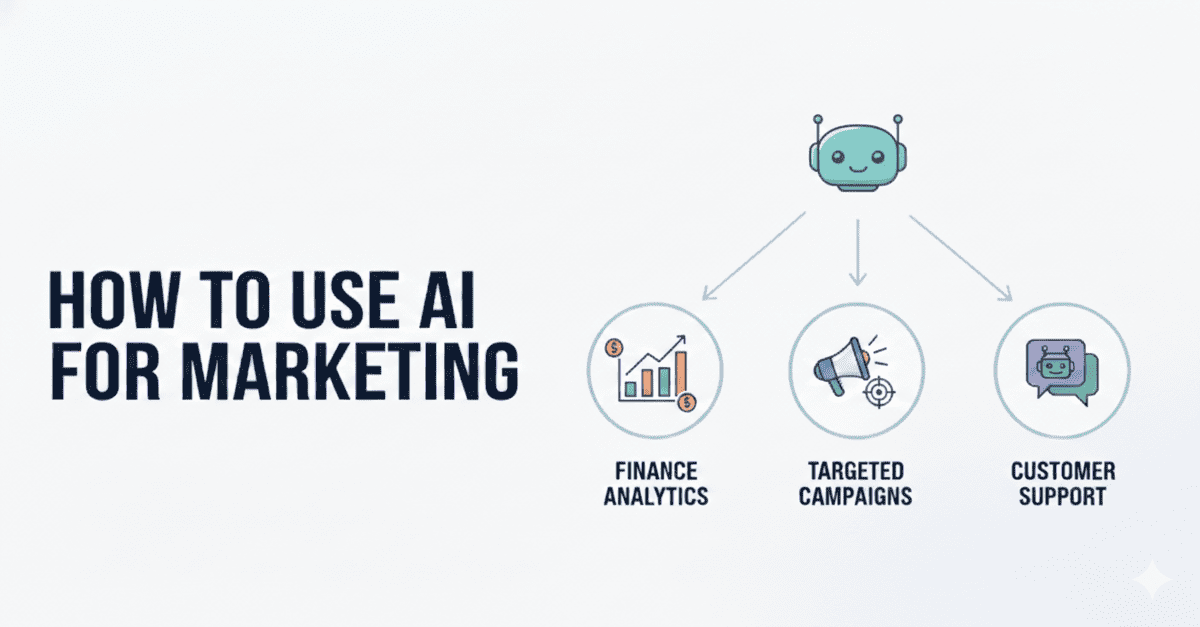
Right now, 78% of organisations use AI in at least one business function. But here’s what’s interesting – most marketers are still figuring out how to use AI for marketing effectively.
AI is changing marketing because it can do things humans can’t. It analyses data faster, spots patterns we’d miss, and personalises content at scale. Think about how Netflix recommends shows you’ll actually watch – that’s AI understanding your preferences better than any human could.
By 2026, this transformation accelerates. AI won’t just be a tool you use occasionally. It will become your marketing partner, handling routine tasks while you focus on strategy and creativity.
That’s why learning how to use AI for marketing matters now. In this article, we’ll cover practical ways to integrate AI for marketing success, from content creation to customer insights.
What Is AI Marketing?
AI marketing uses artificial intelligence to handle marketing tasks that normally need human thinking. It analyses data, spots patterns, and makes decisions faster than people can. Think of it like having a super-smart assistant who never sleeps and can process millions of data points in seconds.
This technology helps marketers understand customers better and deliver personalised experiences at scale. Instead of guessing what customers want, AI uses actual behaviour data to predict needs and preferences. The result is marketing that feels more relevant to each person.
Key Characteristics of AI Marketing
- Data-driven decisions: AI analyses customer behaviour, purchase history, and engagement patterns to guide marketing choices
- Automated personalisation: It tailors content, offers, and recommendations to individual preferences automatically
- Predictive capabilities: AI forecasts future trends, customer behaviour, and campaign performance
- Real-time optimisation: Marketing adjusts instantly based on current data and performance metrics
Examples of Artificial Intelligence in Marketing
Product recommendation engines like Amazon’s “customers who bought this also bought” section use AI to analyse purchase patterns and suggest relevant items.
Dynamic pricing algorithms change prices based on demand, competition, and customer behaviour. Airlines and ride-sharing services use this approach – prices adjust automatically when demand spikes or inventory changes.
Chatbots handle customer inquiries 24/7, learning from each interaction to provide better answers over time. Email marketing platforms use AI to determine the best send times for each recipient based on their opening patterns.
Social media algorithms that decide what content appears in your feed are another example. They analyse your engagement history to show you posts you’re most likely to interact with.
Benefits of Using AI in Marketing
AI gives marketers a strategic edge by handling repetitive tasks and uncovering insights humans might miss. This frees you to focus on creative strategy while AI manages the heavy lifting of data analysis and optimisation.
- Hyper-personalisation: AI analyses individual customer behaviour to deliver tailored content, offers, and recommendations that feel relevant to each person.
- Efficiency boost: It automates routine tasks like email scheduling, social media posting, and basic content creation, saving you hours each week.
- Data-driven decisions: Instead of guessing what works, AI uses real customer data to guide your marketing choices and predict what will perform best.
- Scalability: You can personalise experiences for thousands of customers simultaneously, something impossible to do manually.
- Better ROI: Marketing teams using AI report an average 300% ROI through improved targeting and reduced wasted spend.
- 24/7 optimisation: AI continuously monitors campaign performance and makes adjustments in real-time, even when you’re not working.
How to Use AI for Marketing
Now that you understand AI marketing’s benefits, let’s explore practical applications. We’ll cover specific ways to use AI across different marketing functions, starting with content creation.
AI for Content Creation
AI transforms how you create marketing content by handling writing, ideation, and visual assets. Tools like Jasper help marketers generate blog posts, social media captions, and email campaigns quickly. You give it a topic and tone, and it produces draft content you can refine.
For visual content, tools like Midjourney create images from text descriptions. Need a product photo or social media graphic? Describe what you want, and AI generates options. This approach saves hours on content production while maintaining quality.
AI also handles tasks that used to require brainstorming sessions, a name generation tool can produce hundreds of product names, campaign titles, or brand names in seconds, which you then refine based on your strategy.
The key is using AI as your creative assistant, not a replacement. You provide strategy and brand voice while AI handles the heavy lifting of initial drafts and variations.
SEO with AI
AI SEO tools like Surfer SEO handle keyword clustering, content gap analysis, and technical audits automatically.
For marketers launching new brands or product lines, combining SEO research with a name generation tool helps find business names that are both brandable and search-friendly, checking domain availability and keyword potential at the same time.
These AI tools analyse top-ranking pages to suggest optimal content structure, word count, and internal linking patterns.
AI also helps in performing technical SEO audits, spotting issues like slow page speed or broken links that hurt rankings. This saves hours of manual analysis while improving search performance.
AI in Email Marketing
AI changes email marketing by optimising every element for better performance. Tools like Bloomreach analyse historical data to generate subject lines that increase open rates. The AI studies which words and phrases worked best with your audience before.
These platforms also predict the best send times for each subscriber based on their past engagement patterns. Dynamic content blocks automatically adjust email content based on individual preferences and behaviour. This means two people receive the same email campaign but see different product recommendations or offers.
The result is emails that feel personally crafted rather than mass-sent. You get higher open rates, better engagement, and more conversions without manual guesswork.
AI for Social Media Scheduling & Optimisation
AI-powered social media tools like Blink AI analyse when your audience is most active and likely to engage. Instead of guessing posting times, the AI studies historical performance data to schedule content when it will perform best.
These tools forecast which content types will resonate with your specific followers. They suggest relevant hashtags based on trending topics and your audience’s interests. The AI even predicts engagement rates before you post, helping you refine content for better results.
This approach moves beyond simple scheduling to intelligent optimisation. Your social media strategy becomes data-driven rather than based on intuition alone.
Chatbots & Conversational AI
AI chatbots provide 24/7 customer service without human intervention. Tools like Intercom handle common questions, freeing your team for complex issues. The chatbots learn from each interaction, improving their responses over time.
These systems qualify leads by asking relevant questions and scoring prospects based on their responses. For e-commerce, conversational AI acts as personalized shopping assistant, recommending products based on customer preferences and browsing history.
The chatbots integrate with your CRM to provide context-aware support. They remember previous conversations and customer preferences, creating seamless experiences across multiple touchpoints.
AI for Audience Segmentation
AI transforms audience segmentation by using machine learning to identify micro-segments you’d miss manually. Tools like Madgicx analyse real-time behavioural patterns to create hundreds of dynamic customer groups.
The AI studies purchase intent, engagement signals, and browsing behaviour to predict what customers will do next. Instead of broad categories like “women aged 25-35,” you get specific segments like “mobile users who abandoned carts after viewing product videos.”
This approach lets you personalise marketing at scale. You can target each micro-segment with messages that match their exact interests and behaviour patterns.
AI for Sentiment Analysis & Brand Monitoring
AI tracks brand health across social media and review sites in real-time. Tools like Sprinklr use natural language processing to analyse whether mentions are positive, negative, or neutral.
The AI monitors conversations 24/7, alerting you to potential crises before they escalate. It identifies trending topics and sentiment shifts around your brand, products, or industry.
This gives you immediate feedback on marketing campaigns and product launches. You can see how customers really feel rather than relying on surveys or guesswork.
AI in Market Research & Competitive Intelligence
AI analyses competitor content automatically to spot trends and extract consumer insights. Tools like Klue scan social media, websites, and marketing materials to identify what competitors are doing. The AI looks for patterns in messaging, product features, and pricing strategies.
These tools track consumer conversations across platforms to understand what people really want. Instead of manual research, AI processes thousands of data points in minutes. You get real-time alerts when competitors launch new campaigns or change strategies.
AI for Predictive Analytics & Forecasting
AI predicts future sales, customer lifetime value, and campaign ROI before you spend money. Tools like Hurree analyse historical data to forecast which marketing efforts will perform best. The AI studies past customer behaviour to predict future purchases.
These systems calculate customer lifetime value by analysing purchase patterns and engagement. They forecast campaign ROI by comparing similar past campaigns. This helps you allocate budget to the highest-performing channels and strategies.
AI for Influencer Marketing
AI identifies authentic influencers and predicts campaign success while detecting fake followers. Tools like VerifyCreator analyse follower quality and engagement patterns to spot fraud. The AI checks for bot activity and fake engagement.
These platforms predict which influencers will deliver the best ROI for your specific audience. They analyse past campaign performance and audience overlap to make accurate forecasts. This prevents wasted spending on influencers with fake followers or poor engagement.
Best AI Marketing Tools
Choosing the right AI marketing tools matters because specialised tools beat generic platforms every time. Different tools excel at specific tasks, from content creation to customer insights.
Here are some of the best AI marketing tools that focus on particular marketing functions:
Tool Name | What It Does | Pricing |
Gumloop | Automates complex marketing workflows by connecting AI models (GPT-4, Claude) to your existing tools without code, builds sentiment monitoring, lead scoring, and content distribution agents. | Free (2,000 credits), Solo $37/mo, Team $244/mo |
Browse AI | Web scraper that extracts competitor pricing, product reviews, and market data automatically, trains custom bots to monitor any website and populate spreadsheets. | Free tier, paid from $49/mo |
AdCreative.ai | Generates conversion-optimised ad creatives with 90%+ performance prediction accuracy trained on 450M+ ads to know which visuals will convert before you spend. | From $29/mo (Startup), $141/mo (Professional) |
Phrasee | AI copywriter specialised in email subject lines and marketing copy using natural language generation, optimises for open rates and brand voice consistency. | Business and Enterprise (custom pricing) |
Triple Whale | Ecommerce analytics platform for Shopify with real-time profit tracking calculates true ROAS by factoring in COGS, shipping, and attribution gaps from iOS updates. | From $129/mo |
Madgicx | Facebook and Instagram ad optimiser that creates dynamic audience micro-segments based on real-time behaviour and automatically adjusts budgets to top performers. | From $29/mo |
Surfer SEO | Content optimiser that analyses top-ranking pages and provides real-time SEO scoring as you write handles keyword clustering and content gap analysis. | From $89/mo (Essential) |
Klue | Competitive intelligence tool that tracks competitor content, pricing changes, and product launches automatically—delivers real-time alerts when rivals make moves. | Custom pricing (Enterprise) |
Prompt Engineering for Marketers
Getting AI to give you what you want comes down to how you ask. Precise prompts matter because vague questions get vague answers. Think of it like giving directions – “go somewhere nice” versus “find a quiet coffee shop with outdoor seating near the park.” The better your instructions, the better your results.
Here are 7 actionable prompts you can use right now:
- Email subject line generator: “Create 10 email subject lines for a [product/service] launch targeting [audience]. Make them curiosity-driven and include power words. Keep each under 50 characters.”
This gives you tested subject line formulas that boost open rates. - Social media post creator: “Write 5 Instagram captions for [topic] aimed at [demographic]. Include 3 relevant hashtags and a call-to-action. Use [tone: casual/professional/inspirational] voice.”
Creates platform-specific content that matches your brand voice. - Blog outline builder: “Generate a detailed outline for a 1,500-word blog post about [topic]. Include H2 and H3 headings, key points for each section, and 5 target keywords to include naturally.”
Structures long-form content with SEO optimisation built in. - Customer persona developer: “Create a detailed customer persona for someone who buys [product]. Include demographics, pain points, goals, preferred communication channels, and objections they might have.”
Helps you understand and target your ideal customers better. - Ad copy variations: “Write 3 different versions of Facebook ad copy for [product]. Version 1: benefit-focused. Version 2: problem-solution. Version 3: social proof. Include headlines and primary text for each.”
Provides A/B testing options to find what converts best. - Content repurposer: “Take this [blog post/article text] and turn it into: 1) 5 tweet threads, 2) 3 LinkedIn posts, 3) an email newsletter summary, 4) 10 Instagram story ideas.”
Maximises your content investment across multiple channels. - Competitor analysis prompt: “Analyse [competitor’s website/social media] and identify: 1) Their top 3 content themes, 2) Engagement patterns, 3) Gaps in their content strategy, 4) 5 content ideas we could create that they’re missing.”
Turns competitive research into actionable insights.
What’s interesting about these prompts is that they’re specific enough to get useful results but flexible enough to adapt to your needs. The prompt engineering market is growing at 32.8% annually, showing how valuable this skill has become. Good prompts save time and improve quality – you get marketing assets that actually work instead of generic content.
Challenges & What No One Is Telling You
AI marketing tools depend completely on your data quality. If your customer data has gaps or errors, the AI makes decisions based on bad information.
These tools often work like “black boxes” – you see the recommendations but not how they got there. When AI suggests a marketing strategy, you can’t always trace the logic behind it. This makes it hard to explain decisions to your team or adjust when things go wrong.
Integration costs add up quickly too. You might pay for the AI tool, then discover you need expensive connectors to your existing systems.
Plus, when everyone uses similar AI tools, marketing content starts looking the same across different brands. A study found that generative AI can lead to content homogenization, where different brands end up with similar-sounding marketing messages.
What Marketers Need to Learn
Marketing is changing fast, and your skills need to keep up. AI isn’t just another tool – it’s reshaping what marketing work looks like. The marketers who succeed will be those who blend traditional creativity with new technical abilities.
- Data literacy: You need to understand what the numbers mean. AI gives you tons of data, but you have to spot patterns and make smart decisions from it. This means knowing which metrics matter and how to interpret results.
- Strategic AI implementation: It’s not about using every AI tool available. You need to pick the right tools for your specific goals and integrate them into your workflow. Think about what problems you’re solving, then choose AI solutions that actually help.
- Ethical AI oversight: As AI handles more marketing tasks, you become responsible for ensuring it’s used responsibly. This includes checking for bias in algorithms, protecting customer privacy, and maintaining brand voice consistency.
- Human-AI collaboration: The best results come from combining AI efficiency with human creativity. Learn when to let AI handle routine tasks and when to step in with strategic thinking and emotional intelligence.
- Continuous learning: AI tools evolve quickly. You need to stay updated on new capabilities and best practices. This means regularly testing new approaches and adapting your strategies as technology improves.
These skills aren’t about replacing what you already know. They’re about building on your marketing foundation with new capabilities that make you more effective in an AI-driven world.

A startup consultant, digital marketer, traveller, and philomath. Aashish has worked with over 20 startups and successfully helped them ideate, raise money, and succeed. When not working, he can be found hiking, camping, and stargazing.