[Reader Disclosure]Our content is reader-supported. This means we may earn a commission if you click on some of our links.
Right now, 56% of marketers are using generative AI for their SEO workflows. That number was close to zero just two years ago. Tools that write meta descriptions, analyse keywords, and even draft entire blog posts are becoming standard in marketing teams.
If you’re an SEO specialist, you’ve probably wondered where this leaves you. Will AI Replace SEO Specialists? Can AI actually do your job? Should you be worried about your role shrinking, or is this just another tool you need to master?
The answer isn’t simple. Some SEO tasks are already being automated. Others still need human judgement. Let’s look at what’s actually changing and what that means for your career.
Before AI tools took over, SEO specialists spent most of their time on repetitive, manual tasks. Keyword research meant opening dozens of tabs, copying data from tools like Google Keyword Planner or SEMrush, and organising everything into spreadsheets by hand.
Content optimisation involved checking each page for keyword density. Manually adjusting meta descriptions, and cross-referencing competitor pages one by one.
The skill set was different too. You needed patience for tedious work, sharp analytical thinking to spot patterns in data dumps, and the ability to juggle multiple tools that didn’t talk to each other. According to SeoProfy, specialists would spend hours on tasks that AI now handles in minutes. That’s not an exaggeration. It was genuinely time-consuming work.
How AI Has Changed SEO Work
Tasks that used to eat up a lot of time, like analysing competitor content or identifying technical SEO issues, happen automatically. SEO platforms scan thousands of pages, spot ranking opportunities, and flag problems before you even open your laptop.
The shift isn’t just about speed. Your role as an SEO specialist has moved from doing the work to directing it. You’re setting parameters, reviewing what AI generates, and making strategic decisions based on patterns the tools surface.
93% of marketers edit AI-generated content before publishing, which shows the new workflow: AI drafts, you refine and approve.
AI handles the repetitive stuff like keyword clustering, content outline generation, and performance tracking. You focus on understanding user intent, crafting brand voice, and deciding which opportunities are actually worth pursuing.
SEO Tasks AI Has Fully Taken Over
Some SEO tasks don’t need much human brainpower anymore. 78% of marketing teams use AI for content creation, SEO, and optimisation, and it makes sense when you look at what AI can handle on its own. These are the grunt-work tasks that used to eat up hours of your day.
Basic keyword research
Meta description generation
Schema markup implementation
Competitor analysis reports
Technical audits
Content outline creation
SEO Tasks AI Will Likely Automate Soon
Link building outreach is the next domino to fall. Tools are already using AI to find prospects, personalise emails at scale, and handle follow-ups without you lifting a finger. According to recent data, 19% of marketers plan to add AI in search to their SEO strategy in 2025.
What’s right behind that? Real-time SEO adjustments and predictive analytics that spot ranking opportunities before your competitors even notice them.
AI will test different title tags, meta descriptions, and internal links on the fly, then automatically apply whatever performs best. Whether this feels like handing over the keys or finally getting a co-pilot who never sleeps depends on how you adapt.
What AI Still Cannot Do in SEO
AI handles the technical grunt work, but it can’t read the room. Some SEO responsibilities still demand the kind of judgement that only comes from years of navigating messy business realities.
Strategic direction and goal setting: AI can’t decide whether your business should prioritise local rankings over national visibility or balance brand awareness with lead generation. Those decisions require understanding company priorities that change based on quarterly targets and market conditions.
Brand voice development: Tools can mimic your tone, but they can’t create it from scratch. Building a distinctive voice means understanding your audience’s frustrations, your competitors’ blind spots, and what makes your brand worth caring about.
Relationship building and link outreach: Getting a high-authority site to link to you isn’t about templates. It’s about knowing the right person, understanding what they care about, and offering something that benefits both sides.
Complex decision making: When your site traffic drops 40% overnight, AI can flag the problem but it can’t weigh whether to wait for Google’s next update, restructure your entire site, or pivot your content strategy entirely.
Understanding business context: Your CEO wants to rank for a keyword that gets zero conversions. AI will optimise for it. A human will push back and explain why that’s a waste of budget.
Crisis management: When a PR disaster tanks your brand searches or a Google penalty wipes out your rankings, you need someone who can think three steps ahead and make judgement calls under pressure.
Current AI Adoption in SEO
While AI tools are spreading across the SEO world, adoption looks different depending on who you ask and what they’re actually using it for.
Here’s what the data shows:
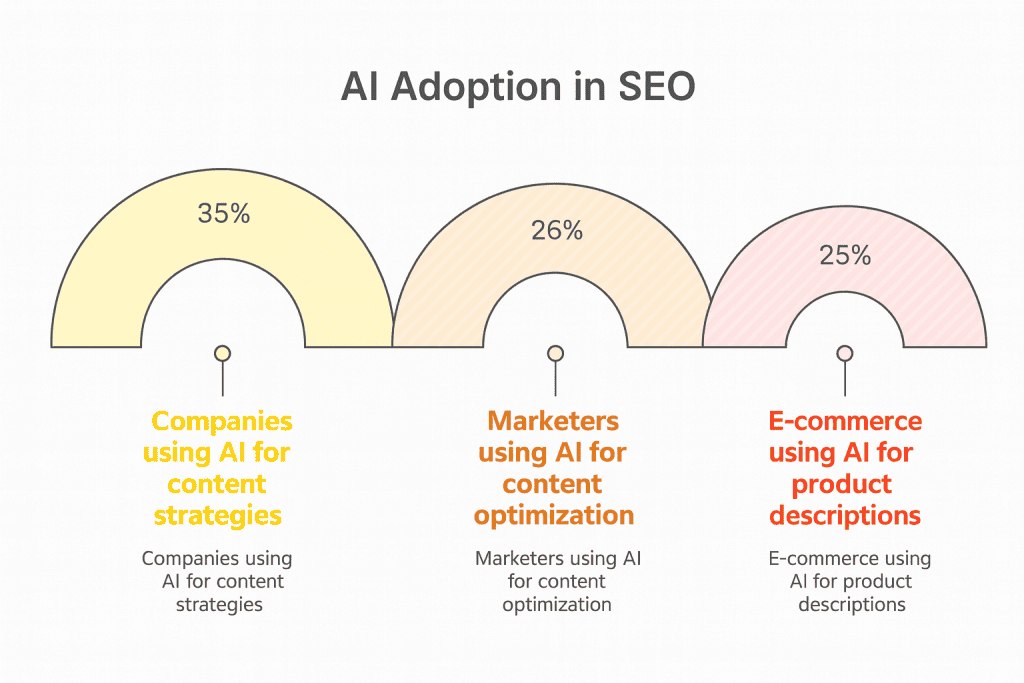
Only 26% of U.S.-based marketers use AI to optimise their content for SEO
35% of companies use AI to create SEO-driven content strategies
Most revenue still comes from traditional search, with 62% of SEOs saying AI search accounts for 0-5% of site earnings
What stands out here is the gap between belief and action. Plenty of SEO teams talk about AI, but actual implementation sits somewhere between cautious testing and limited deployment. The tools are available, but they’re not reshaping revenue streams yet. Most companies are dipping their toes in specific use cases rather than diving into full AI transformation.
Tools SEO Specialists Commonly Use Today
Most professionals today work with a mix of AI-powered tools and traditional platforms.
The typical stack includes comprehensive platforms, content optimisation tools, and AI writing assistants. Here’s what you’ll find in most SEO toolkits right now:
SEMrush and Ahrefs for keyword research and technical audits
Surfer SEO and Clearscope for content optimisation
ChatGPT and Jasper for content generation
Frase for content briefs
MarketMuse for content planning
These tools handle different parts of the SEO workflow. But they still need someone to make strategic decisions about which keywords to target, what content to create, and how to position a brand in search results.
What SEO Professionals Are Worried About
The anxiety in SEO communities is real. Scroll through Reddit or industry forums, and you’ll see a consistent theme: people wondering if their skills will matter in two years. Nearly 30% of workers fear AI might replace their jobs within 3 years, and SEO folks are no exception.
Here’s what’s hitting hardest. Entry-level SEO roles are seeing the most impact. Tasks like basic keyword research, meta tag optimisation, and content briefs used to be how you got your foot in the door. Now AI handles them in minutes. Data backs this up: early-career workers in AI-exposed jobs have seen a 13% employment decline since companies started integrating AI tools.
The shift is causing real uncertainty about which skills to invest in. You’re good at technical audits? Cool, but AI can crawl sites faster than you. You write solid content? AI does that too now. What many SEO professionals are realising is that their roles are evolving from execution to oversight. You’re less likely to be writing title tags and more likely to be checking if AI wrote them correctly.
Job Impact of AI on SEO Roles
AI is impacting SEO roles in different ways depending on experience level.
Mid-Level and Senior SEO Professionals
These roles are moving from doing tasks to making decisions. Senior SEOs spend less time manually checking pages or building spreadsheets. Instead, they’re:
Interpreting what AI tools tell them and deciding what action to take
Making judgment calls when Google’s algorithm changes
Connecting SEO work to bigger business goals
Deciding if AI content recommendations actually fit the brand
AI does the data work. Humans decide what it means and what to do with it.
Junior SEO Roles Are Struggling
Entry-level positions are getting hit hardest. Companies are hiring fewer junior SEOs because the tasks that used to train them are now automated:
Keyword research is done by AI tools
Meta tag updates happen automatically
Basic audits run through software
Employers now want people who already know how to manage AI tools and think strategically. That’s tough for someone just starting out.
The old path where you start with grunt work and slowly build skills is disappearing. The industry hasn’t figured out how to train new talent in this AI-first environment yet.
How SEO Specialists Can Stay Relevant
The shift isn’t about fighting AI, it’s about positioning yourself where automation can’t reach. . For anyone wondering will AI replace SEO specialists, the answer depends on how well you adapt to the parts of SEO that still require human intelligence.
Learn to manage AI tools like a manager, not a user. You need to know how to direct these tools, spot their mistakes, and refine their output. Think of yourself as the strategist who tells AI what to do, not the person doing what AI can already handle.
Build your strategic thinking and business acumen. Understand how SEO ties into revenue, customer lifetime value, and business goals. The more you can speak the language of the C-suite, the harder you are to replace.
Focus on relationships and networking. AI can’t grab coffee with a potential link partner or negotiate a collaboration. Your ability to build genuine connections becomes a competitive advantage.
Master data interpretation beyond the surface level. AI can pull reports, but can it tell you why traffic dropped despite rankings staying stable? Your job is connecting dots that algorithms miss.
Develop expertise in brand strategy and positioning. Understanding how a brand should be perceived and communicating that through search requires human judgement. AI doesn’t get brand nuance.
Build cross-functional skills across UX, CRO, and analytics. The broader your skill set, the more valuable you become. SEO increasingly overlaps with user experience and conversion optimisation.
Stay current with both AI capabilities and algorithm changes. You can’t direct what you don’t understand. Keep testing new tools and reading up on how search engines are evolving.
Sharpen your persuasion, communication, and negotiation skills. These human elements matter when you’re presenting strategy to stakeholders or convincing developers to prioritise your technical fixes.
Will AI Replace SEO Specialists?
The question isn’t whether AI will replace SEO specialists, but which ones it will replace.
If you’re only doing keyword research, writing meta descriptions, and running technical audits, AI will take your job. But if you’re building strategies, making business decisions, managing relationships, and steering AI tools toward real outcomes, you’re not getting replaced.
You’re becoming more valuable. The specialists who treat AI as a threat will struggle, while those who treat it as a tool will thrive.
A startup consultant, digital marketer, traveller, and philomath. Aashish has worked with over 20 startups and successfully helped them ideate, raise money, and succeed. When not working, he can be found hiking, camping, and stargazing.
Each week I share research backed AI oriented content in my newsletter.
There are AI ideas, AI trends, tutorials, and guides.
24k entrepreneurs read it. I'd love you to join.