[Reader Disclosure]Our content is reader-supported. This means we may earn a commission if you click on some of our links.
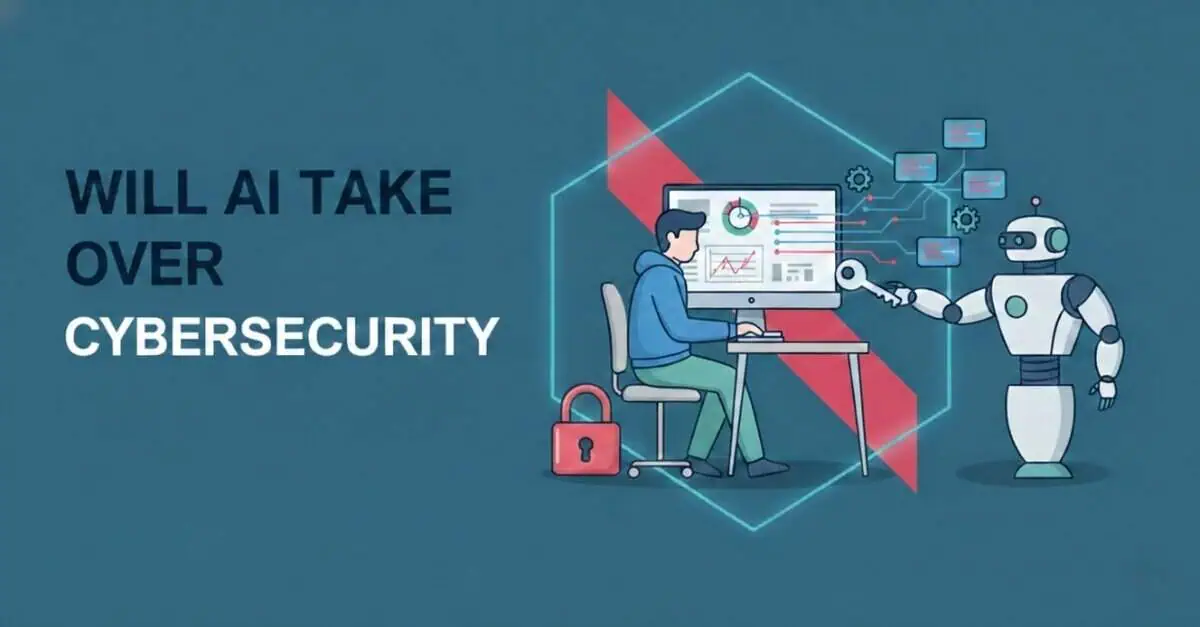
AI can scan millions of network events in seconds and spot threats that would take human analysts hours to find. It’s happening right now in security operations centres around the world.
The thing is, this shift is making a lot of people nervous. Security professionals are watching AI systems get smarter at detecting malware, predicting attacks, and responding to breaches. And they’re asking a fair question: will these machines eventually replace us?
Let’s break down what AI can actually do in cybersecurity, where it falls short, and what this means for the future of security work.
Before AI became part of security operations, cybersecurity followed a more structured and rule-based approach. Security teams relied on clearly defined processes, predefined alerts, and manual oversight to keep systems secure.
IT and security teams were responsible for configuring and maintaining core security infrastructure. This includes setting up firewalls, managing user permissions, reviewing system logs, and handling routine requirements like Windows VPN access for employees working remotely. These tasks required careful planning and consistent monitoring to ensure systems stayed compliant and functional.
Pre-AI cybersecurity typically involved the following responsibilities:
Alert-driven monitoring: Security teams tracked system alerts and notifications to identify potential issues as they surfaced
Manual log review: Analysts examined logs and activity records to investigate suspicious behaviour
Rule- and signature-based tools: Security solutions relied on known threat signatures and predefined rules to detect risks
Hands-on security management: Teams actively managed access controls, network configurations, and endpoint policies
Human-led incident response: Analysts evaluated incidents, determined impact, and decided on containment steps
This approach worked well for its time and established the foundation of modern cybersecurity practices. But it required significant human involvement and careful coordination across teams.
Role of AI in Cybersecurity Today
AI has shifted cybersecurity from a reactive game to a proactive defence. Instead of waiting for attacks to happen and then scrambling to respond, AI-powered systems now detect threats as they emerge by analysing massive volumes of data in real-time.
These systems continuously learn from new attack patterns, adapting their detection methods automatically. Plus, AI handles the repetitive tasks that used to eat up hours of human analyst time, scanning logs, identifying anomalies, flagging suspicious activity, which frees up security teams to focus on strategic decisions rather than drowning in alerts.
AI Adoption Rate in Cybersecurity
The numbers show how quickly organisations are embracing this shift:
According to ISC2’s AI Pulse Survey, 30% of cybersecurity professionals currently use AI security tools in their daily work
CrowdStrike’s State of AI Survey found that 76% of security teams prefer AI tools designed specifically for cybersecurity over generic AI solutions
The World Economic Forum’s Global Cybersecurity Outlook 2026 revealed that 64% of organisations now assess AI tool security before deployment, up from just 37% in 2025
What AI Does Better Than Humans in Cybersecurity
AI isn’t meant to replace security teams, but it clearly outperforms humans in areas that demand speed, scale, and constant monitoring. These are tasks where consistency and rapid processing matter more than human judgment.
Processes massive data at high speed: Enterprise networks generate millions of events daily. AI analyses them in real time and flags threats instantly, while human review takes hours or days.
Monitors systems 24/7 without fatigue: AI provides continuous monitoring at all hours, catching suspicious activity during off-hours when human attention may drop.
Detects subtle anomalies: AI identifies small deviations in behaviour or traffic patterns that are easily missed within large volumes of normal activity.
Responds instantly to threats: AI can automatically isolate systems, block malicious traffic, and stop attacks as soon as they’re detected, reducing response time to seconds.
Continuously improves from new threats: Each incident helps AI refine its detection models, allowing it to adapt quickly to evolving attack techniques.
Where AI Falls Short
Despite all the speed and pattern-matching power, AI systems have serious weaknesses that can actually make your security worse if you’re not careful about them.
It can’t think outside the box, understand why your company cares more about protecting customer data than last year’s marketing reports, or tell the difference between a genuine emergency and a weird-but-harmless anomaly. These aren’t small gaps you can patch with better algorithms. They’re fundamental limitations that make human oversight absolutely critical.
False positives and alert noise: AI security tools can generate thousands of alerts every day. With many of these being false alarms, security teams often spend more time reviewing noise than responding to real threats.
Vulnerable to adversarial attacks: Attackers can manipulate AI systems using carefully crafted data. Small changes that look harmless to humans can cause AI to misclassify threats, turning the system itself into a weakness.
Lacks business context: AI cannot understand what matters most to your organisation. It treats all data equally, while human analysts know that some systems and information are far more critical than others.
No ethical or legal judgment: AI cannot evaluate legal, ethical, or compliance implications. Decisions like blocking regions or shutting down live systems still require human judgment.
Requires continuous human oversight: Threats evolve, and AI models can drift over time. Without regular monitoring and adjustment by security professionals, over-reliance on AI can create new risks.
Impact of AI on Cybersecurity Jobs
What’s actually happening is a shift in what cybersecurity work looks like, not a reduction in how many people we need doing it.
According to research, skills shortages now eclipse staff shortages as the primary concern. You might have a full team on paper, but if they can’t work with AI tools or interpret what those systems flag, you’re still vulnerable.
Plus, non-technical skills like communication and critical thinking are becoming just as important as knowing how to configure a firewall. AI handles the repetitive grunt work, which means humans need to focus on the judgment calls machines can’t make.
The job market stays tight: Those 3.5 million unfilled positions show that demand for cybersecurity talent far exceeds supply, even as AI adoption accelerates.
Skills matter more than headcount: Organizations report that having the right capabilities matters more than simply having more people on the team.
Skills will keep growing in importance: The World Economic Forum’s Future of Jobs Report found that 76% of surveyed professionals see cybersecurity skills increasing in importance through 2030.
Upskilling becomes priority number one: That same WEF report shows 80% of organisations are prioritising workforce upskilling to keep pace with AI-driven changes.
Roles are being reimagined: A separate ISC2 AI Pulse Survey found that 44% of organisations are reconsidering what types of roles they actually need as AI reshapes the workflow.
Best AI Cybersecurity Tools
AI cybersecurity tools use machine learning and behavioural analysis to detect threats that traditional tools often miss, such as zero-day attacks and ransomware. These platforms help security teams automate detection and response while reducing alert fatigue and improving overall visibility.
1. Darktrace: An AI-powered cybersecurity platform that learns normal behaviour across networks, cloud environments, endpoints, and IoT devices to identify unusual activity. It is commonly used for detecting insider threats, preventing ransomware, and protecting remote work environments.
2. CrowdStrike Falcon: A cloud-native endpoint security platform that uses AI-driven behavioural analytics to detect and stop threats in real time. It is widely used for endpoint protection, ransomware prevention, and maintaining visibility across large enterprise environments.
3. SentinelOne Singularity: It is an autonomous AI security solution that protects endpoints and cloud workloads using behavioural analysis and automated response. It is best suited for zero-day threat prevention, attack recovery, and real-time threat containment.
4. Vectra Cognito: AI-based network detection platform that analyses network traffic to uncover hidden and advanced attacks. It is commonly used for detecting lateral movement, monitoring device behaviour, and conducting threat investigations.
5. Microsoft Security Copilot: An AI-powered security assistant that helps teams investigate incidents using natural language and global threat intelligence. It is especially useful for threat hunting, forensic analysis, and accelerating security operations within Microsoft environments.
Will AI Take Over Cybersecurity?
No. AI won’t take over cybersecurity, but it will change how security teams work. The future isn’t about replacing people, it’s about supporting them. AI handles tasks that require speed and scale, while humans provide judgment, context, and ethical decision-making. Cybersecurity works best when both operate together.
The data support this. Only about 30% of organisations currently use AI security tools, yet there is still a global shortage of 3.5 million cybersecurity professionals. If AI were replacing human roles, this gap would be shrinking. Instead, demand for skilled security professionals continues to grow because organisations understand that AI alone isn’t enough.
AI can detect threats in seconds, but it can’t assess business impact. It doesn’t know whether shutting down a critical system during peak hours will cause more harm than good. That kind of decision still requires human expertise.
This is why most organisations are focusing on upskilling rather than replacement. Around 80% of companies are training their existing teams to work alongside AI tools. AI identifies unusual activity and flags risks. Security professionals investigate those alerts, decide which ones matter, and choose the right response based on business priorities.
A startup consultant, digital marketer, traveller, and philomath. Aashish has worked with over 20 startups and successfully helped them ideate, raise money, and succeed. When not working, he can be found hiking, camping, and stargazing.
Each week I share research backed AI oriented content in my newsletter.
There are AI ideas, AI trends, tutorials, and guides.
24k entrepreneurs read it. I'd love you to join.