[Reader Disclosure]Our content is reader-supported. This means we may earn a commission if you click on some of our links.
People are typing fewer keywords into Google and asking ChatGPT full questions instead. You might think search is still the same game it was five years ago, but the way people find information online is shifting faster than most businesses realise.
AI search engines are answering questions directly, without making users click through ten blue links. AI platforms now surface brands through citations and mentions within generated answers, not just rankings.
Understanding these differences is crucial for improving your on-page SEO for AI search, especially as search behaviour shifts toward AI-generated answers.
If you’re still optimising content like it’s 2019, you’re about to get left behind. The good news? You’re not too late to adapt.
Let’s figure out what AI search optimisation actually means and how you can start ranking where your audience is already looking.
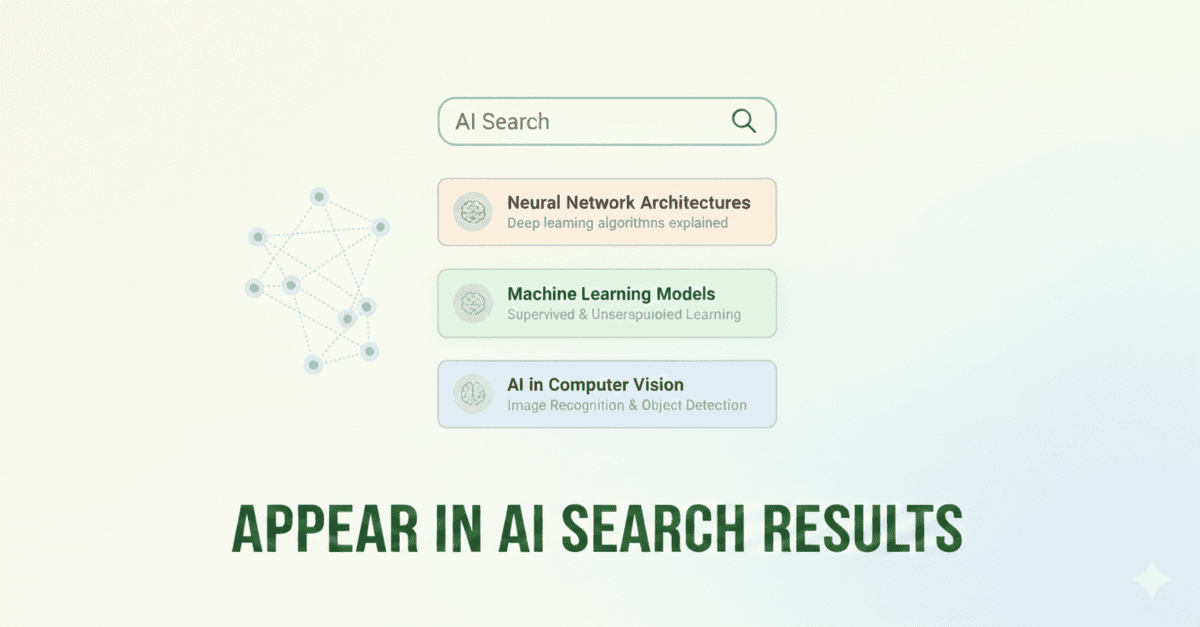
AI search results come from tools like ChatGPT, Perplexity, Google’s AI Overviews, and other platforms that use large language models to answer your questions. Instead of giving you a list of websites to browse, these tools generate direct answers by pulling information from multiple sources and synthesising it into one response.
The key difference? Traditional search shows you where to find answers. AI search gives you the answer.
According to research on AI search behaviour, AI search interprets the meaning behind natural language queries to synthesise answers, even if the exact phrasing doesn’t match what’s in the original source material.
When you ask Google “best running shoes for flat feet,” you get links to articles and product pages. Ask the same question to ChatGPT or Perplexity, and you get a complete answer with specific recommendations, comparisons, and reasoning.
What makes this shift interesting is how people phrase their searches. You’re not limited to short keywords anymore. AI search focuses on natural language questions rather than keyword-based queries. That means people ask “What should I eat before a morning workout if I hate breakfast?” instead of typing “pre workout meal no breakfast.” The AI understands context and intent, not just matching words.
Why AI Search Optimisation Matters
Gartner predicts website traffic from traditional search engines will fall by 25% by 2026, with AI search engines growing at 50-100%+ year-over-year. That’s not some distant future scenario. We’re talking about next year.
Even more telling, 5.6% of U.S. search traffic on desktop browsers already goes to AI-powered models like ChatGPT or Perplexity. That percentage might sound small, but it represents millions of searches that are bypassing Google entirely.
Here’s what surprised me while researching this: 38% of people have adopted AI tools, yet 95% still rely on search engines. More than 1 in 5 Americans use AI tools heavily. People aren’t abandoning Google, they’re adding AI search to their routine. That means your content needs to work in both worlds.
The thing is, if your brand isn’t showing up in AI-generated answers, you’re invisible to a growing chunk of your audience. When someone asks ChatGPT for software recommendations or Perplexity for marketing advice, will your company be mentioned? If not, your competitors who understand AI search optimisation will be. This isn’t about jumping on a trend. It’s about staying visible where people are actually searching.
How AI Search Engines Work
Understanding the mechanics behind AI search helps you optimise better. These systems work differently than the crawl-index-rank approach you’re used to with traditional search engines.
Here’s what’s actually happening behind the scenes.
Natural Language Processing
AI search engines rely on natural language processing to understand what you’re really asking. Instead of matching keywords, NLP analyses the context, phrasing, and intent behind your query.
Google introduced AI Overviews in May 2024, which uses this technology to grasp the nuances of conversational questions. When you type “best running shoes for flat feet,” the AI doesn’t just spot those exact words. It understands you’re looking for footwear recommendations based on a specific medical condition.
The system picks up on relationships between concepts, recognises synonyms, and figures out whether you want to buy, learn, or compare.
Data Sources and Crawling
AI search engines pull information from multiple sources across the web. They crawl websites like traditional search engines do, but they also prioritise structured data that’s easier to process.
AI-powered search engines like Bing Chat and Google AI Overview utilise structured data to deliver contextually rich responses. The systems scan your content, metadata, schema markup, and even user-generated content like reviews.
What’s different is how they treat this data. Rather than just indexing it for ranking purposes, AI systems analyse it to understand relationships, extract facts, and build knowledge bases they can tap into when generating answers.
Answer Generation Process
Once the AI understands your query and accesses relevant data, it synthesises information from multiple sources to create a coherent answer. This isn’t about showing you a list of links. The AI reads through various pages, identifies the most relevant information, and combines it into a single response. Sometimes it cites sources, sometimes it doesn’t.
The system weighs factors like content authority, freshness, and how well the information matches the query intent. That’s why appearing in AI-generated answers requires more than just ranking high. Your content needs to be clear, factual, and structured in a way that AI can easily extract and repackage.
Key Differences: Traditional SEO vs AI Search Optimisation
You’ve been doing SEO for years, but AI search changes the game. Understanding these differences is crucial, especially for AI search visibility for agencies that need to educate clients on why their optimisation strategy needs to evolve.
Here’s what’s actually different when you’re optimising for AI-generated answers instead of traditional rankings.
Aspect
Traditional SEO
AI Search Optimisation
Goal Focus
Get your page ranking on the first page so people click through to your site.
Get your content cited within the AI-generated answer. You’re chasing mentions, not clicks.
Content Format
Favours clear, factual content that directly answers questions. Straightforward language beats clever copywriting.
Favors clear, factual content that directly answers questions. Straightforward language beats clever copywriting.
Keyword Strategy
Target specific keywords and phrases people search for.
Focus on natural language and question-based content. Think “which CRM helps small businesses” vs “best CRM software.”
Structured Data
Schema markup helps with rich snippets but is optional.
Schema markup is critical. Without structured data, you risk being invisible when AI systems generate answers.
Traffic Impact
Drives traffic to your website that you can track through pageviews and sessions.
May not send traffic at all. Users stay in the AI interface. You’re trading clicks for brand visibility and authority.
How to Appear in AI Search Results?
Here’s how you can appear in AI search results: follow these steps:
Step 1: Create Clear, Conversational Content
AI search engines process queries the way people naturally speak. When someone asks their voice assistant a question or types into ChatGPT, they’re not using keywords. They’re having a conversation. Your content needs to match that style.
Here’s how to write content that AI engines can easily understand and recommend:
Write Like You’re Explaining to a Friend
Drop the corporate speak. If you’d say “help you save money” in person, don’t write “facilitate cost reduction initiatives” on your site. AI models trained on natural language prefer straightforward explanations over jargon.
Example: Instead of “Our solution leverages advanced methodologies,” write “We use a simple three-step process.” The second version is what someone would actually search for.
Answer Questions Directly in the First Sentence
Don’t make AI models dig through three paragraphs to find your answer. Put it upfront. If someone asks “How long does shipping take?” your content should immediately say “Standard shipping takes 3-5 business days” before explaining the details.
Use the Words Your Audience Uses
Pay attention to how real people phrase questions in forums, social media, or customer support tickets. If customers call something a “pricing plan” but you call it a “subscription tier,” you’re creating a disconnect. AI search pulls from actual queries, so match that language.
Keep Paragraphs Focused on One Idea
AI models break down content into digestible chunks. When you stuff multiple concepts into one paragraph, it’s harder for these systems to extract the right information. One paragraph should cover one point, then move on.
Step 2: Structure Your Content for AI Understanding
Content structure isn’t just about looking organised. It’s about creating clear signals that help AI understand what each section covers and how information connects. Think of it as building a map that guides both readers and AI engines through your content.
Use Descriptive Headings
Your headings should tell AI exactly what’s coming next. Generic labels like “Overview” or “More Information” don’t help. Specific headings like “How to Install Solar Panels on a Tile Roof” or “Average Cost of Kitchen Remodelling in 2024” give AI engines clear context.
Bad heading: “Getting Started” Good heading: “3 Steps to Set Up Your First Email Campaign”
Bad heading: “Features” Good heading: “Key Features That Reduce Customer Support Time”
The difference? Specific headings contain the actual terms people search for and clearly indicate what the section delivers.
Add Schema Markup
Schema markup is code that helps AI systems understand what your content is actually about. Think of it as labels on your content that say “this is a recipe,” “this is a product review,” or “this is a how-to guide.”
You don’t need to be a developer to add schema. Tools like Yoast SEO or Rank Math can add basic schema automatically. For more specific markup, you can use Google’s Schema Markup Generator.
Here’s what to prioritize:
FAQ schema: If you have a Q&A section, mark it up. AI engines love pulling direct answers from FAQ schema.
How-to schema: For step-by-step guides, this tells AI exactly what each step involves.
Article schema: Basic but important. It identifies your headline, author, and publication date.
The thing is, schema doesn’t just help AI find your content. It helps AI understand the relationship between different pieces of information on your page. When AI can see that your bullet points are steps in a process, not random facts, it’s more likely to use your content when answering “how to” questions.
You can test your schema using Google’s Rich Results Test. Just paste in your URL and it’ll show you what structured data it detects.
Implement Clear Hierarchies
Use heading tags in order: H2 for main sections, H3 for subsections, H4 for specific points within those subsections. Don’t skip levels. This hierarchy helps AI models understand which information is most important and how subtopics relate to main topics.
Also, use bullet points and numbered lists when breaking down steps or listing features. AI engines parse these formats efficiently because they signal organised, scannable information.
Step 3: Optimise for Question-Based Queries
People ask AI search engines questions. Not “best CRM software” but “What’s the best CRM software for small teams?” Your content needs to mirror these question patterns to get recommended.
Start by identifying the different question types your audience asks:
Who questions help with credibility and expertise. “Who should use project management software?” or “Who qualifies for this service?” Position yourself or your offerings as the answer.
What questions need clear definitions. “What is influencer marketing?” or “What tools do I need to start a podcast?” Lead with a straightforward explanation before diving deeper.
Where questions matter for location-based content. “Where can I find organic coffee beans?” or “Where to host a corporate event in Boston?” Include specific geographic references.
When questions address timing. “When should I refinance my mortgage?” or “When is the best time to post on Instagram?” Provide specific timeframes or conditions.
Why questions dig into reasoning and benefits. “Why do startups fail?” or “Why switch to cloud storage?” Connect causes to effects and explain underlying reasons.
How questions demand actionable steps. “How to write a business plan” or “How does solar energy work?” Structure these answers as clear processes with numbered steps when possible.
The trick is using these question formats as actual subheadings or incorporating them naturally into your first sentence. When your H2 reads “How to Reduce Customer Churn in SaaS” instead of just “Reducing Churn,” you’re matching the exact phrasing AI engines encounter in queries.
The trick is using these question formats as actual subheadings or incorporating them naturally into your first sentence. When your H2 reads “How to Reduce Customer Churn in SaaS” instead of just “Reducing Churn,” you’re matching the exact phrasing AI engines encounter in queries.
Step 4: Build Authoritative Content
AI search engines don’t just look at what you say. They evaluate whether you’re credible enough to cite. That means backing up your claims with data, expert perspectives, and verifiable sources. Here’s how to build content that AI systems trust enough to recommend.
1. Cite Data and Statistics: When you mention numbers or research findings, link to the original source. AI models prioritise content that references credible data over generic claims. Instead of saying “most businesses struggle with email marketing,” say “67% of small businesses report low email open rates” and cite where that number comes from.
2. Include Expert Quotes or Insights: If you can interview industry experts or reference their published work, do it. AI systems recognise authoritative voices and give more weight to content that features them. Even pulling a relevant quote from a recognised expert’s blog post and properly attributing it strengthens your authority.
3. Update Content Regularly: Fresh content signals reliability. AI engines favour recently updated pages over outdated ones, especially for topics where information changes frequently. Add a “Last updated” date at the top of your articles and revisit them every few months to refresh statistics or examples.
4. Show Your Credentials: If you’re writing about finance, mention your background in the industry. If you run a fitness blog, share your certifications. AI models trained to assess expertise look for signals that you actually know what you’re talking about. A simple author bio with relevant qualifications makes a difference.
Common Mistakes to Avoid
You can do everything right and still mess up your AI search visibility with a few simple mistakes. Here are the ones that trip up most people:
1. Burying Your Answer: You might think building suspense makes content engaging, but AI engines give up fast. If someone asks “how much does a website cost” and you spend three paragraphs on background before answering, AI will pull from a competitor who answers in the first sentence.
2. Overcomplicating Your Language: Using technical jargon or complex sentence structures makes it harder for AI to extract clean answers. Write like you’re explaining to someone who’s smart but unfamiliar with your industry. Simple beats clever every time.
3. Ignoring Schema Markup: Skipping structured data is like not labelling items in your store. AI can still find things, but it takes longer and might misunderstand what you’re offering. Even basic article schema gives you an edge over competitors who ignore it completely.
4. Focusing Only on Keywords: You’re still optimising like it’s 2015 if you’re stuffing keywords into content. AI search responds to natural phrasing and complete answers, not keyword density. Match how people actually ask questions instead of forcing awkward phrases into your copy.
5. Creating Thin Content: Short, surface-level articles don’t give AI much to work with. If your post on “email marketing tips” is 300 words of generic advice, AI will favour the 1,500-word guide that actually walks through specific strategies with examples. Depth matters more than ever.
Future-Proofing Your AI Search Strategy
Here’s the thing about AI search: it’s moving fast, and what works today might shift by next quarter. But certain principles will hold up regardless of which AI models dominate or how search behaviour evolves.
Focus on creating genuinely helpful content that answers real questions. AI models get better at detecting fluff and rewarding substance. The brands that stay visible are the ones solving actual problems with clear, detailed information. That won’t change even as algorithms improve. Also, stay flexible with your content strategy. Monitor where your audience is searching and be ready to adapt. If a new AI search tool gains traction in your industry, test it. See what content gets cited and adjust your approach based on what you learn.
The shift to AI search isn’t about abandoning everything you know about SEO. It’s about expanding your optimisation mindset to include conversational language, structured data, and authority building. You’re not starting from scratch. You’re adding new skills to what you already do well. Start with one or two changes from this guide, test what happens, and keep refining. The businesses that win in AI search are the ones that start adapting now instead of waiting until the shift is complete.
A startup consultant, digital marketer, traveller, and philomath. Aashish has worked with over 20 startups and successfully helped them ideate, raise money, and succeed. When not working, he can be found hiking, camping, and stargazing.
Each week I share research backed AI oriented content in my newsletter.
There are AI ideas, AI trends, tutorials, and guides.
24k entrepreneurs read it. I'd love you to join.