You ask an AI model a question and get a mediocre answer. You tweak your prompt and try again. Still not quite right.
The problem isn’t the AI. It’s that you’re asking the AI to do the work when you should be asking it to teach you how to ask better questions. That’s the shift meta prompting creates.
Meta prompting is the practice of designing prompts that define the structure, tone, or logic of other prompts used by language models. It’s a meta-level approach. You’re not asking for a direct answer. You’re asking the AI to help you create better instructions.
Here’s a simpler way to think about it: you’re using AI as your prompt engineering expert.
Instead of saying “Write me a marketing email,” you’d ask “What information do you need to write an effective marketing email? What structure should I follow?” The AI then builds the framework. You use that framework to get better results.
What makes this powerful is how it teaches AI how to think about solving problems by focusing on reasoning patterns. The AI doesn’t just spit out content. It considers what type of problem you’re solving and what logical steps fit that problem type. A math problem gets math-specific reasoning. A summarisation task gets summarisation logic.
This approach lets you step back from individual tasks and focus on the underlying patterns that make prompts work.
How Does Meta Prompting Work?
Here’s how it plays out. You tell the AI something like, “Help me design a prompt that analyses customer feedback for sentiment patterns.” The AI doesn’t jump straight into analysing feedback. Instead, it examines what you’re trying to accomplish and suggests how to structure the request. It might recommend breaking the task into stages: identify emotions, categorise themes, then rank urgency.
The process works in three ways:
The AI can generate brand-new prompts from scratch based on your goal.
It can refine prompts you already have by spotting gaps or unclear instructions.
Or it can analyse why a prompt isn’t working and fix the logic.
Let’s say you’re struggling to get useful product descriptions from AI. A direct prompt might be, “Write a product description for wireless headphones.”
A meta prompt would be, “Create a prompt template that generates product descriptions highlighting technical specs, user benefits, and emotional appeal for any product type.”
See the shift? You’re building a reusable structure instead of getting one-time output.
What makes this powerful is adaptability. Once the AI designs that prompt structure, you can apply it to headphones, laptops, or kitchen tools. You’re teaching the system how to think about the task, not just what to output.
Meta Prompting vs Other Prompting Techniques
Here’s the difference between meta prompting and other prompting techniques. Understanding the differences will help you figure out which prompting technique to use and when:
Meta Prompting vs Chain-of-Thought Prompting
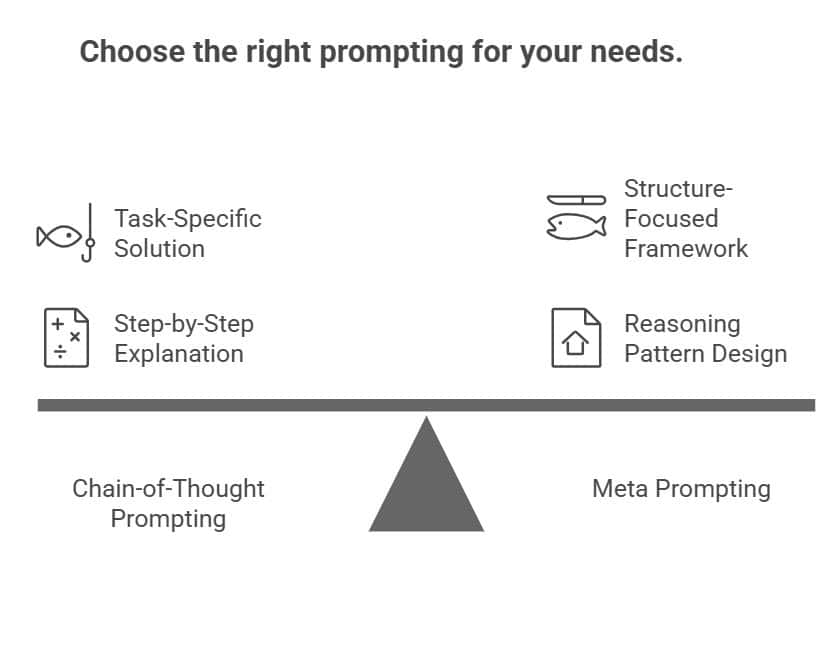
Chain-of-thought prompting tells AI to show its work. You ask it to explain each step while solving a problem, like a math student showing calculations. If you’re calculating shipping costs, chain-of-thought walks through: base price, weight multiplier, distance factor, then final total.
Meta prompting works differently. It doesn’t care about the specific steps for one problem. It focuses on designing the reasoning pattern itself. You’re not asking, “How do I calculate this shipping cost?” You’re asking, “What’s the best way to structure any pricing calculation prompt?”
The key split is this: chain-of-thought is task-specific. It solves the problem in front of you. Meta prompting is structure-focused. It builds a framework you can reuse across similar tasks. Chain-of-thought gives you the fish. Meta prompting teaches you how to set up the fishing system.
Meta Prompting vs Few-Shot Prompting
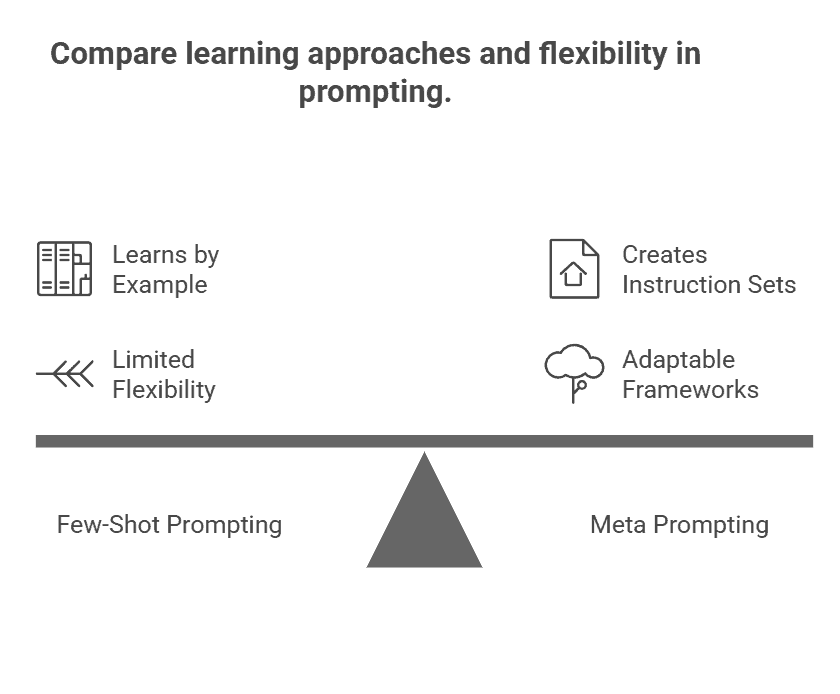
Few-shot prompting teaches by example. You show the AI three email responses you like, and it mimics that style for the next one. You’re training through demonstration.
Meta prompting flips this. Instead of giving examples, you ask the AI to create the instruction set itself. You might say, “Design a prompt that generates professional email responses matching our brand voice.” The AI builds the guidelines rather than copying patterns.
Here’s where they differ: few-shot locks you into the examples you provide. If your samples are all formal, you get formal outputs. Meta prompting gives you flexibility because the AI designs adaptable frameworks. You’re not bound by specific examples. You’re working with principles that adjust to different contexts.
Types Of Meta Prompting
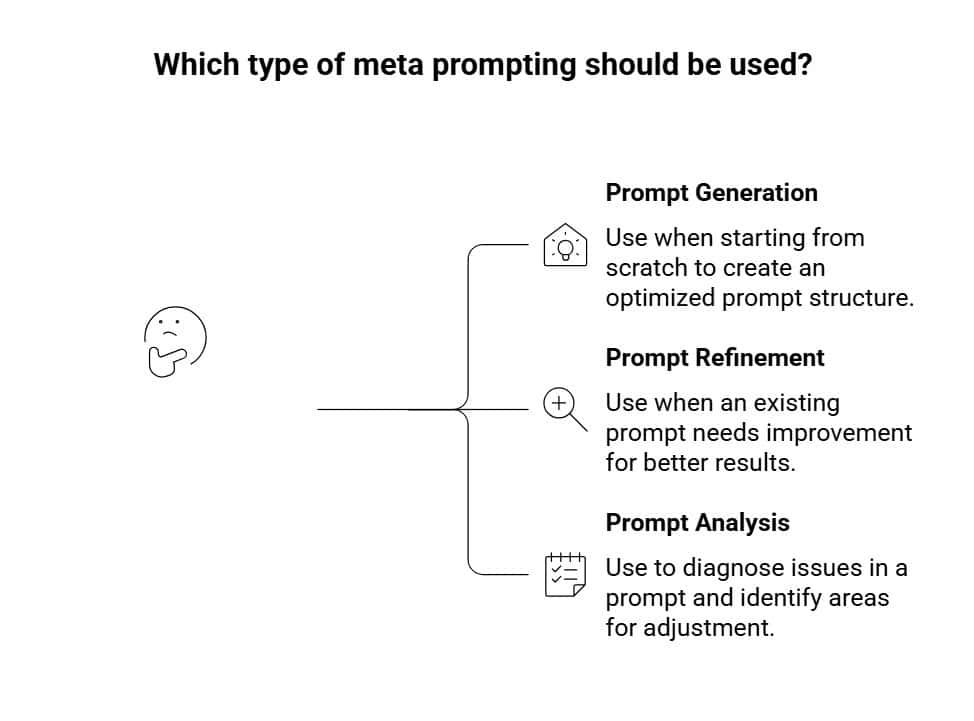
Meta prompting isn’t a one-size-fits-all approach. Depending on what you need, you can use it in three distinct ways. Let’s break down each type so you know exactly when to reach for which one.
1. Prompt Generation
This is where you start with nothing and ask the AI to build a prompt from scratch. You describe your goal, and the AI analyses what you’re trying to accomplish and creates an optimised prompt structure for it. It’s like having someone else draft the blueprint while you focus on the outcome.
Say you want to create customer onboarding emails but don’t know how to frame the request. Instead of asking “Write an onboarding email,” you’d say: “Generate a prompt that will help me create personalised onboarding emails for SaaS customers.” The AI then builds a detailed prompt with placeholders for product features, customer pain points, and tone specifications. What you get is a reusable template rather than a single email.
2. Prompt Refinement
You’ve got a prompt, but it’s not hitting the mark. The outputs feel generic, inconsistent, or they miss key details you need. That’s when refinement comes in. The AI examines your existing prompt, identifies weak spots, vague language, missing context, unclear instructions and suggests specific improvements.
Here’s what this looks like: You have a prompt that says “Write a blog post about productivity.” It works, but the results vary wildly. You ask the AI to refine it, and it might suggest: “Write a 1,200-word blog post about productivity for remote workers, including three actionable strategies, real-world examples, and a conversational tone.” Same goal, sharper execution.
3. Prompt Analysis
Sometimes you need to diagnose what’s going wrong before you can fix it. Prompt analysis is about understanding why your prompt isn’t delivering. The AI evaluates the logic, structure, and clarity, then pinpoints exactly where things break down.
Let’s say you’re working with a complex prompt for generating financial reports, but the output keeps mixing up data categories. You run it through analysis, and the AI identifies that your instructions conflict, you’re asking for both summarised and detailed data without specifying when to use each format. It shows you the exact sentence causing confusion. That’s the difference between guessing at fixes and knowing precisely what needs adjusting.
Benefits Of Meta Prompting
The biggest advantage? You create once, use many times. Instead of rewriting product descriptions for every new item, your meta prompt generates fresh templates on demand. That’s hours saved across a week.
Quality improves too. When you ask the AI to build a prompt rather than rushing to output, it structures things more thoughtfully. Your product descriptions include benefits, features, and emotional hooks, not just random text.
Here’s something that surprised us: effective prompt engineering can reduce operational costs significantly. Better prompts mean fewer retries and less wasted AI compute time.
Plus, meta prompting teaches you what makes prompts work. After seeing how the AI structures requests, you start spotting patterns. You learn faster than by trial-and-error alone.
Scalability matters too. One good meta prompt can handle product descriptions, email templates, and social posts just swap the context. That beats maintaining dozens of separate prompts.
Drawbacks Of Meta Prompting
Let’s be upfront: it takes longer at first. If you need one quick email subject line, meta prompting is overkill. Direct prompting gets you there faster.
The approach assumes you can clearly explain what you need. If your initial instructions are vague, the generated prompt will be equally unclear. Garbage in, garbage out.
Beginners might find it confusing. You’re essentially having a conversation about prompts before getting to actual work. That extra layer adds complexity.
The first generated prompt rarely nails it perfectly. You’ll need to refine, adjust, test. That iteration takes time you might not have for urgent tasks.
And honestly? If you already know how to write solid prompts, meta prompting might just slow you down. It’s a tool for building systems, not a requirement for every interaction.
How To Use Meta Prompting
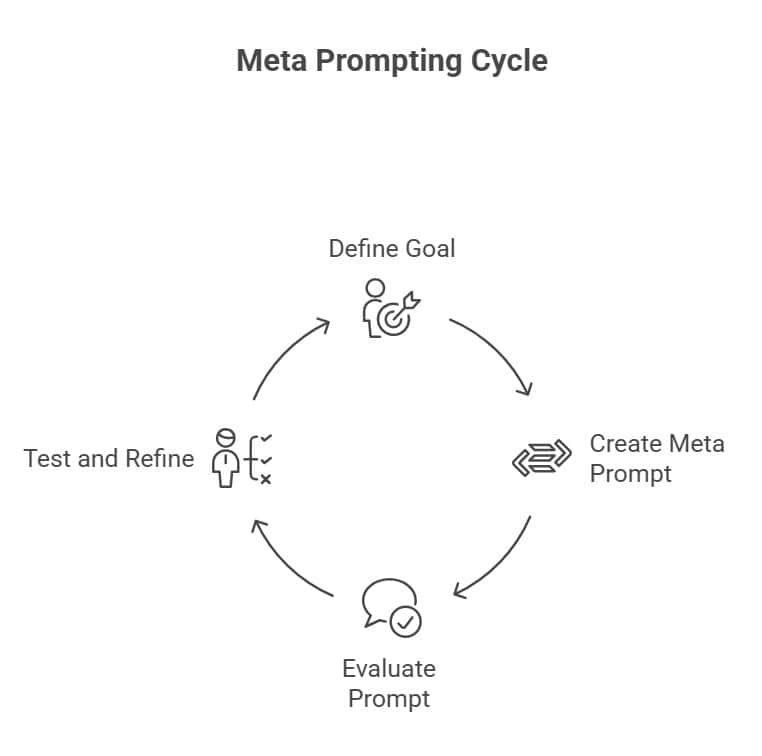
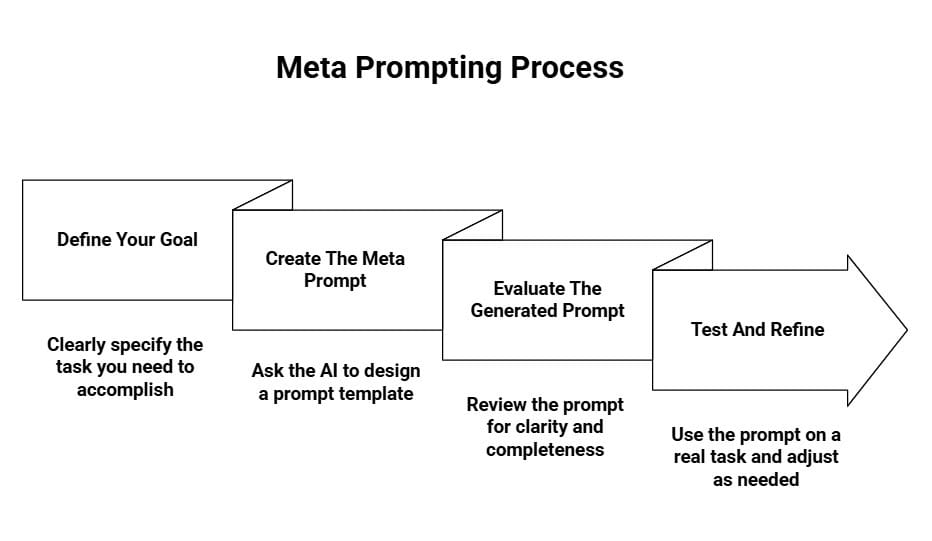
Here’s how you can start using meta prompting right now. You don’t need any special tools or technical knowledge, just follow these four steps.
Step 1: Define Your Goal
Before you ask AI to build a prompt, get specific about what you need. If this is a one-time task, skip meta prompting and just write the content directly. But if you’re doing something repeatedly, that’s where meta prompting shines.
Instead of “I need marketing content,” think “I need weekly LinkedIn posts that share industry insights in a friendly tone for small business owners.” The clearer you are about your goal, the better the meta prompt will be.
Step 2: Create The Meta Prompt
Ask the AI to help you design the prompt rather than doing the task itself. Frame it as “Help me create a prompt that…” or “Design a reusable prompt template for…”
Include key details like tone, format, audience, and any constraints. For example: “Help me create a prompt for writing product descriptions. They should be 100-150 words, highlight practical benefits, use a conversational tone, and end with a call-to-action.” You’re teaching the AI what your future prompts should look like.
Step 3: Evaluate The Generated Prompt
Don’t just accept what the AI gives you on the first try. Read through the generated prompt carefully. Does it cover everything you mentioned? Is anything vague or missing?
If you asked for a conversational tone but the prompt doesn’t specify that clearly, flag it. Think about edge cases, what if someone uses this prompt with unusual inputs? This review step catches problems before you start using the prompt repeatedly.
Step 4: Test And Refine
Use the generated prompt on a real task and see what happens. If the output isn’t quite right, that’s valuable feedback. Go back to the AI and say “The prompt generated descriptions that were too formal. Adjust it to sound more casual.”
You might need two or three rounds of testing before the prompt consistently delivers what you want. That’s normal. Once it works well, save that prompt and reuse it whenever you need it.
Meta Prompting Examples
Seeing meta prompting in action makes the difference clear. Let’s walk through three scenarios where meta prompting transforms how you work with AI.
Example 1: Content Creation
Say you’re writing weekly blog posts about productivity tools. A direct prompt might look like: “Write a blog post about time management apps.”
That gets you content, sure. But next week, you’ll start from scratch again. The tone might shift. The structure could be completely different.
Here’s what a meta prompt looks like instead:
“I need you to create blog posts about productivity tools. Each post should: 1) Start with a relatable problem scenario in the first paragraph, 2) Explain the tool’s core features in simple language with real-world examples, 3) Include a pros/cons comparison section, 4) End with specific use cases for freelancers and small teams. Maintain a helpful, conversational tone throughout. Aim for 1,200 words with clear H2 and H3 headings.”
Now you’ve got a template. Every post follows the same structure, hits the same quality bar, and speaks to your audience consistently. You just plug in different tool names each week.
Example 2: Data Analysis
Let’s say you’re analysing customer feedback from support tickets. A typical prompt: “Analyse this customer feedback and tell me what issues people are having.”
You’ll get surface observations. Maybe a list of complaints. But you’re missing the depth.
The meta prompt version:
“Analyze customer feedback using this framework: 1) Categorize issues by type (technical, user experience, pricing, feature requests), 2) Identify recurring patterns across at least 3+ mentions, 3) Assign severity levels (critical, moderate, minor) based on impact described, 4) Note any correlations between issue types and customer segments, 5) Suggest 2-3 actionable improvements per category. Present findings in a table format with example quotes.”
This creates a systematic approach. You’re not just getting observations—you’re getting structured insights you can actually act on. The analysis becomes repeatable across different feedback batches.
Example 3: Problem Solving
You’re troubleshooting why website conversions dropped. A basic prompt: “Why are my website conversions down?”
That’s too broad. You’ll get generic possibilities without real diagnostic value.
Here’s the meta prompt approach:
“Help me diagnose a conversion drop by: 1) Asking clarifying questions about what changed (design updates, traffic sources, pricing, competitor moves), 2) Breaking the conversion funnel into stages (landing → engagement → action), 3) Identifying potential failure points at each stage with specific metrics to check, 4) Suggesting A/B test ideas to validate each hypothesis, 5) Prioritizing fixes by likely impact and implementation difficulty. Walk through this step-by-step.”
See the difference? You’re not getting quick answers. You’re getting a diagnostic process that uncovers root causes. The AI becomes a thinking partner instead of just an answer machine.
Common Mistakes to Avoid
You’ve learned the technique. Now let’s look at where people usually go wrong with meta prompting and why it leads to weak results.
Writing vague meta prompts: Saying something like “create a prompt for marketing” produces generic output. You need to be specific about what you’re marketing, who it’s for, and what action you want. A weak meta prompt creates a shaky foundation for everything that follows.
Using meta prompting for simple tasks: If you just need a quick email reply or a basic definition, a meta prompt is unnecessary. It adds friction without real benefit. Save this technique for complex or recurring tasks.
Accepting the first generated prompt without testing: A prompt can look good on the surface but fail in real use. Always test it multiple times with different inputs before trusting it.
Forgetting important constraints: People often specify content but forget tone, format, or structure. If you don’t mention whether the output should be formal, casual, bullet-based, or paragraph-style, the AI has to guess.
Over-complicating the meta prompt: Adding too many rules makes the generated prompt rigid and brittle. When it can’t adapt to small changes, quality drops. Focus only on what truly affects output quality.
Best Practices For Meta Prompting
Now let’s flip it around. These are the habits that consistently lead to strong, reusable meta prompts.
Start with clear success criteria: Define what a “great” output looks like before writing the meta prompt. If you can’t describe success clearly, the prompt will be unfocused.
Include examples whenever possible: Instead of saying “make it engaging,” show an example of what engaging looks like. Examples act as a quality benchmark for the AI.
Test generated prompts thoroughly: Run them multiple times. Try edge cases. Use different inputs. Testing reveals weaknesses you wouldn’t notice otherwise.
Document what works: Treat successful meta prompts like assets. Save them in a library so you can reuse them later instead of starting from scratch.
Iterate based on real results: Don’t optimize based on assumptions. If tone or structure is consistently off, refine that specific part of the meta prompt using actual performance as feedback.
Balance specificity with flexibility: Be clear about requirements, but don’t over-restrict. Think of your meta prompt as guidelines, not handcuffs.
Know when to skip meta prompting: If the task is one-off or genuinely simple, write a direct prompt instead. Meta prompting is most valuable for repeated, complex workflows where the upfront effort pays off.
A startup consultant, digital marketer, traveller, and philomath. Aashish has worked with over 20 startups and successfully helped them ideate, raise money, and succeed. When not working, he can be found hiking, camping, and stargazing.
Each week I share research backed AI oriented content in my newsletter.
There are AI ideas, AI trends, tutorials, and guides.
24k entrepreneurs read it. I'd love you to join.