[Reader Disclosure]Our content is reader-supported. This means we may earn a commission if you click on some of our links.
You’ve probably seen the headlines. Writers losing jobs to AI. Content marketers panicking. Freelancers watching their client lists shrink as companies turn to ChatGPT instead.
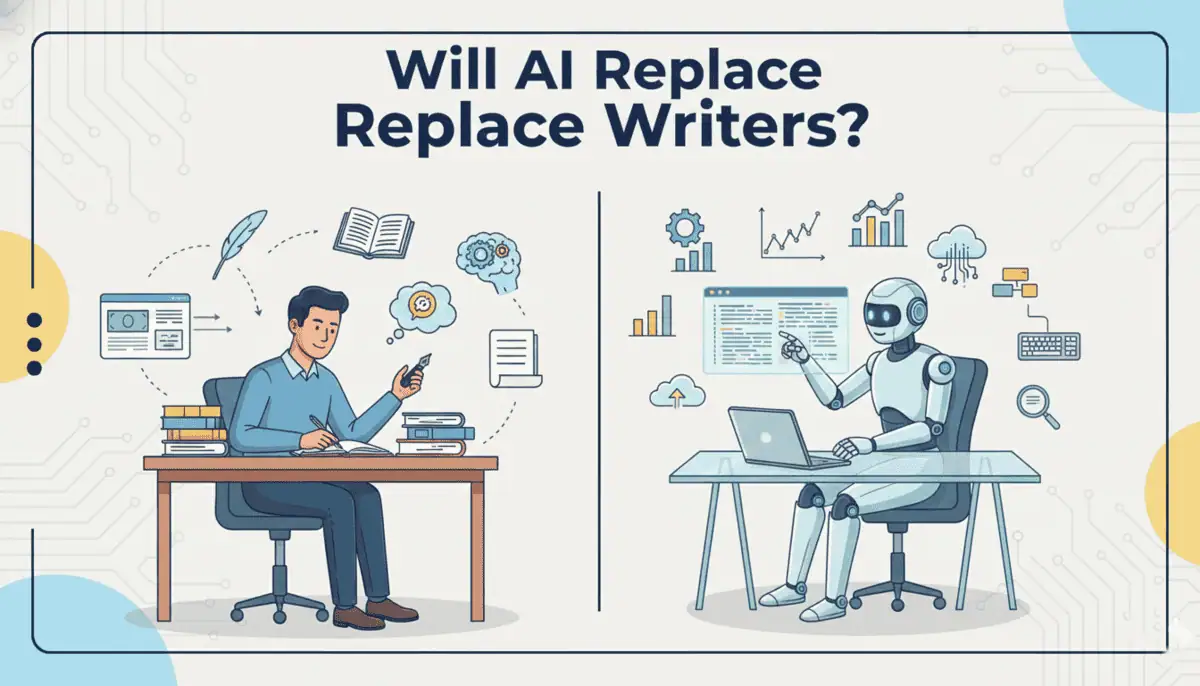
All these might make you think, “Will AI Replace Writers?” Is this the end of writing as a career? Or is this just another wave of tech panic that’ll pass once everyone realises AI can’t actually do what we do?
Let’s break this down honestly. We’ll look at what AI can actually do right now, where it falls short, and what this means for your career as a writer.
GPT-3 dropped in 2020, showing people that AI could write like a human. Then ChatGPT launched in November 2022, and suddenly everyone had access to AI writing. Within months, businesses weren’t asking if they should use AI; they were already trying to figure out how.
Today, you’ve got options. Here are the main AI writing tools people actually use:
ChatGPT – The one that started the mainstream craze
Jasper – Built specifically for marketers and content teams
Copy.ai – Focused on short-form copy and ads
Writesonic – Another marketing-focused option with SEO features
Claude – Known for longer, more nuanced writing
Grammarly (with AI features) – A grammar checker that now generates content
The numbers tell you everything. 82% of businesses now use AI tools for content creation, and the global AI market is projected to hit $1.8 trillion. What’s more, 40% of marketers use AI daily, with 68% reporting increased ROI from AI content tools. That’s not hype anymore. That’s adoption.
What AI Can Do in Writing Today
Let’s get practical. AI writing tools aren’t magic, but they’re not useless either. The reality sits somewhere in the middle, and what you get depends heavily on what you’re asking them to do.
1. Content and SEO Writing
This is what AI does the best. Tools can write full blog posts, product descriptions, and how-to guides that hit the basics. They’re decent at following SEO structure, incorporating keywords naturally, and maintaining a consistent tone throughout longer pieces.
The catch? The writing can feel robotic. You’ll get a solid first draft, but it needs human polish to stand out.
2. Social Media Content
AI handles social posts surprisingly well. Short captions, quick updates, and engagement hooks. The tools can adapt the tone for different platforms and generate multiple variations quickly.
3. Email Marketing
Subject lines, promotional emails, and newsletter drafts roll out fast. AI can personalise at scale and test different approaches without breaking a sweat.
According to research on AI adoption, 75.7% of digital marketers now rely on these tools for exactly this reason.
4. News Summaries and Reports
AI excels at condensing information and presenting data clearly. Financial reports, news roundups, and research summaries come out clean and organised. The writing stays factual and digestible.
5. Ad Copy and Marketing
Punchy headlines and benefit-driven copy? AI’s got this. It can generate dozens of ad variations quickly and follow proven copywriting frameworks. The downside is that the copy often feels derivative. You’ll recognise patterns from ads you’ve seen before because AI learns from what already exists.
6. Creative Writing
AI can write stories, poems, and scripts that follow proper structure. But the emotional depth isn’t there. Characters feel flat, plot twists seem mechanical, and the writing lacks the unpredictability that makes fiction compelling. It’s useful for brainstorming or getting unstuck, but you wouldn’t mistake it for human creativity.
What AI Cannot Replace in Writing
Here’s what you need to know: AI can’t conduct original research, interview people, or pull from personal experience. It can’t verify whether something it’s writing is actually true or just sounds convincing. While it processes language patterns beautifully, it misses the human elements that make writing connect with readers on a deeper level.
Let’s break down where AI genuinely struggles:
Original research and firsthand experience: AI can’t pick up the phone and interview an expert. It can’t attend an event, test a product, or observe something happening in real time. Everything it knows comes from existing text, which means it’s always working with secondhand information at best. When you need fresh insights or unique angles, you’re on your own.
Fact-checking and accuracy: AI generates text based on patterns, not truth. It’ll confidently write something that sounds right but is completely wrong. You’ve probably seen this happen when it cites studies that don’t exist or mixes up dates and statistics. It can’t verify its own claims, which means every fact needs human verification.
Understanding nuance and context: AI misses subtle meanings, cultural references, and the unspoken context that shapes how we communicate. It doesn’t get sarcasm reliably, struggles with idioms, and can’t read between the lines. What seems straightforward to a human often trips it up completely.
Real emotional intelligence: AI mimics empathy but doesn’t feel it. When writing about sensitive topics or trying to console someone, it falls flat. It processes emotional language without understanding the weight behind it. Readers can tell when the emotion isn’t genuine.
Brand voice consistency: AI can approximate a writing style, but it can’t internalise a brand’s personality the way a human writer does. It might nail the tone in one paragraph and drift in the next. Maintaining that subtle consistency across multiple pieces takes human judgement.
Knowing when to break the rules: Good writing sometimes requires breaking grammar rules or structure for effect. AI follows patterns too rigidly. It doesn’t understand when a fragment works better than a complete sentence or when repeating a word creates impact instead of redundancy.
Spotting what hasn’t been written yet: AI can’t identify emerging trends or gaps in existing content because it only knows what already exists in its training data. It can’t tell you what angle is fresh or what perspective is missing from the conversation. That kind of strategic thinking requires human insight.
AI Adoption Rate and Trends in Writing
AI writing isn’t spreading evenly across industries. Some sectors are adopting it at full speed, integrating tools into daily workflows with almost no hesitation. Others are much more cautious, putting up rules and restrictions before even considering it.
Marketing, tech, media, and e-commerce are leading the adoption wave. Marketers use AI for content generation. Tech teams use it for support communication and product copy. Media outlets experiment with automated sports coverage. And e-commerce brands rely on it for listings and ads. Even small businesses are joining in because AI offers what these industries value most: speed, scale, and consistency.
This uneven adoption pattern is an important indicator when asking, Will AI Replace Writers?, because it shows that the answer depends heavily on how each industry uses and regulates AI.
But education, publishing, and research-heavy institutions are resisting. Major school districts have banned tools like ChatGPT, and universities are restricting AI to avoid plagiarism.
Publishers such as The New York Times are fighting AI use on legal grounds. Many academic journals now require disclosure or reject AI-generated content entirely. Their concerns go beyond fear; they’re protecting learning, originality, and long-established intellectual property norms.
What Writers Are Saying About This
Ask ten writers about AI and you’ll get ten different answers. Some are treating it like a productivity breakthrough. Others act like it’s the end of their profession. Most fall somewhere in between, still trying to figure out where they stand.
1. The Optimists
These writers see AI as another tool in the toolbox, nothing more dramatic than that. They’re using it for brainstorming, research, or finding that word on the tip of their tongue. To them, the panic feels overblown. They point out that calculators didn’t kill mathematicians and spell-check didn’t destroy editors.
What matters is the final product, and they’re confident their judgement and creativity still drive the work. Plus, if it helps them write faster or pitch more ideas, why wouldn’t they use it?
2. The Pessimists
Then you’ve got writers who want nothing to do with this technology. Fiction authors especially feel strongly about this, viewing AI as fundamentally unethical and a threat to their livelihoods.
Training models on copyrighted work without permission crosses a line for them. The thought of being replaced by something that learnt from their own writing stings. They’re not interested in adapting when the whole system feels rigged against them.
3. The Realists
Then there’s the middle ground. These writers acknowledge AI isn’t going anywhere, but they’re not ready to embrace it with open arms either. They’re watching, testing cautiously, and trying to figure out how to protect their work while staying competitive.
They worry about clients choosing cheaper AI content over human writers, but they also recognise that quality still matters. Their approach? Stay sceptical, stay informed, and figure out how to position yourself as the human element that AI can’t replicate.
AI’s Impact on Writing Jobs
October 2025 saw record corporate layoffs in 20+ years, with content writers explicitly listed among replaced roles.
Companies that once employed teams of writers now operate with skeleton crews and AI tools. The shift happened faster than most industry experts predicted, and it’s hitting certain writing jobs harder than others.
High Risk Writing Jobs
Basic content writing sits at the top of the vulnerable list. Think product descriptions, simple blog posts, data entry writing, and routine reporting. These jobs share one thing in common: they follow predictable patterns and don’t require deep expertise.
A fantasy sports site laid off experienced writers and immediately replaced them with AI, proving that even specialised niches aren’t safe when the content follows templates. SEO article mills have collapsed almost entirely. Companies realised they could generate 100 articles for what they used to pay one writer. This is a shift that directly fuels the question, Will AI Replace Writers?, especially in roles where originality and critical thinking aren’t central to the output.
Medium Risk Writing Jobs
Copywriting and email marketing occupy this uncertain middle ground. AI handles the first drafts now, but companies still want human oversight for brand voice and strategy.
Social media managers are seeing their roles shift from creating content to editing AI outputs and managing analytics.
Technical writers face similar pressure. Canva laid off technical writers after assuring employees AI wouldn’t threaten jobs. The work still exists, but fewer people are doing it. You’re competing not just with other writers, but with tools that cost $20 per month.
Lower Risk Writing Jobs
Investigative journalism, long-form narrative writing, and brand strategy remain relatively protected. These roles require human judgement, source relationships, and creative thinking that AI can’t replicate yet.
Speechwriting for executives stays safe because it demands understanding of personality, context, and political nuance. Creative directors who shape entire campaigns still have their jobs. The common thread? These positions require expertise that takes years to build and involve high-stakes decisions where mistakes cost real money or reputation.
New Roles Emerging
‘AI content editors’ and ‘prompt engineers’ are the buzzwords right now, but let’s be honest about what they pay. Most of these positions offer 30-40% less than traditional writing roles, and they’re often contract work without benefits.
You’re essentially teaching AI to do what you used to get paid more to do yourself. Some writers are transitioning into hybrid strategist roles where they oversee AI teams, but there are far fewer of these jobs than there were traditional writing positions. The maths doesn’t work out in the writer’s favour.
Will AI Replace Writers?
Yes, AI is already replacing some writers. Especially those doing basic, repetitive, or low-value content.
If the work is generic, easy to automate, or something companies only need quickly, AI can handle it. That is why many simple blog and copywriting jobs are disappearing.
But skilled writers are becoming more important.
Writers who bring research, interviews, storytelling, brand understanding, or clear creative judgement still offer what AI cannot. The role is shifting toward guiding and improving AI output. So AI will replace some writers, but the ones who adapt and add real value will stay in demand.
A startup consultant, digital marketer, traveller, and philomath. Aashish has worked with over 20 startups and successfully helped them ideate, raise money, and succeed. When not working, he can be found hiking, camping, and stargazing.
Each week I share research backed AI oriented content in my newsletter.
There are AI ideas, AI trends, tutorials, and guides.
24k entrepreneurs read it. I'd love you to join.