Your phone reminds you about a meeting, adjusts your calendar, and books a taxi to get you there on time. All of this happens without you lifting a finger. That’s an AI agent at work.
These autonomous systems are changing how we interact with technology. They make decisions, solve problems, and take action on their own.
But what exactly are they? How do they work? And why should you care?
AI agent is like a smart assistant that doesn’t need constant instructions. According to research from the University of Wisconsin, an AI agent is an autonomous entity that perceives its environment through sensors, processes the information, and takes actions to achieve specific goals.
Here’s what that means in plain English: You give it a goal, and it figures out how to reach it.
Say you need to schedule five meetings with different people across different time zones. A regular calendar app just shows you free slots. You still do the work. But an AI agent? It checks everyone’s availability, considers time zones, sends invites, and confirms the meetings. Done.
That’s the difference. Traditional software waits for your commands. AI agents take initiative.
Regular software follows rigid rules. If this happens, do that. It’s like following a recipe to the letter. AI agents adapt. They learn from their environment. They handle unexpected situations without calling for help.
That’s why they’re different from the AI you might already use. A chatbot answers your questions. An AI agent books your flight, reschedules it when there’s a delay, and orders a ride to the airport.
AI Agents vs Traditional AI Systems
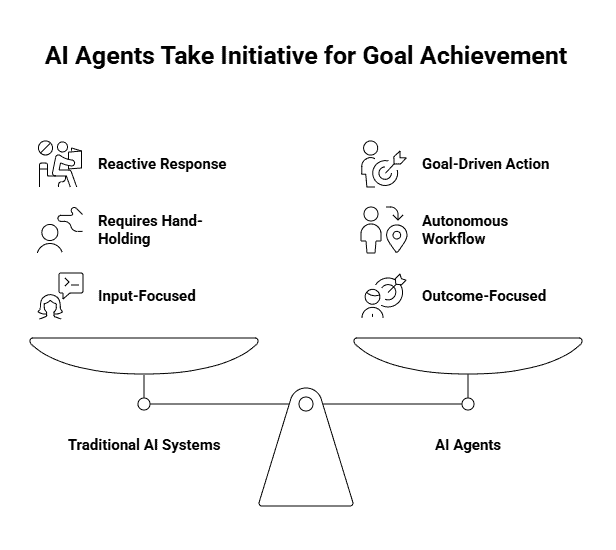
Traditional AI systems are reactive. You ask a question, they give an answer. Think about ChatGPT or any chatbot. You type something in, it responds, and then it waits for your next move.
AI agents flip this script.
They’re goal-driven. You tell them what you want done, and they figure out how to do it. No hand-holding required. A traditional AI might tell you the weather forecast if you ask. An AI agent would notice you have a morning flight, check the weather, realise there’s a storm, and automatically rebook you on an earlier flight.
Here’s what makes this possible: agents can autonomously design their workflow and use available software tools to get things done. They plan, adapt, and execute without you mapping out every step.
Traditional AI responds to inputs. AI agents achieve outcomes. One waits for instructions. The other takes initiative to reach a goal you set.
How Do AI Agents Work?
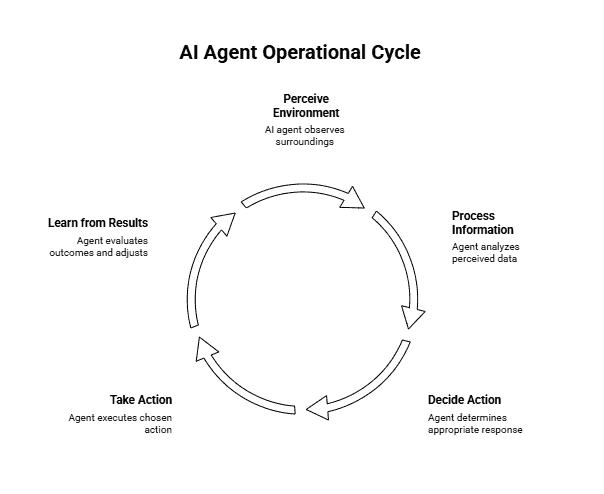
Think of AI agents as operating in a constant loop. They perceive what’s happening around them, process that information, decide what to do, take action, and learn from the results. Then they start over again.
Here’s how it plays out: Say you’re using an AI agent to manage your calendar. It perceives an incoming meeting request for Friday at 2 PM. It processes your existing schedule and notices you have a conflict. It decides to check alternative times that work for both parties. It takes action by manipulating tools like your email and calendar apps to propose a new time. Then it learns from whether that worked or caused issues.
This cycle runs continuously. The agent doesn’t just respond once and stop. It keeps monitoring, adjusting, and refining its approach based on what’s actually happening. That’s what separates it from a basic chatbot that waits for your next command.
The loop is what makes autonomy possible. Because the agent can perceive changes and act without you stepping in every time.
Core Components of AI Agents
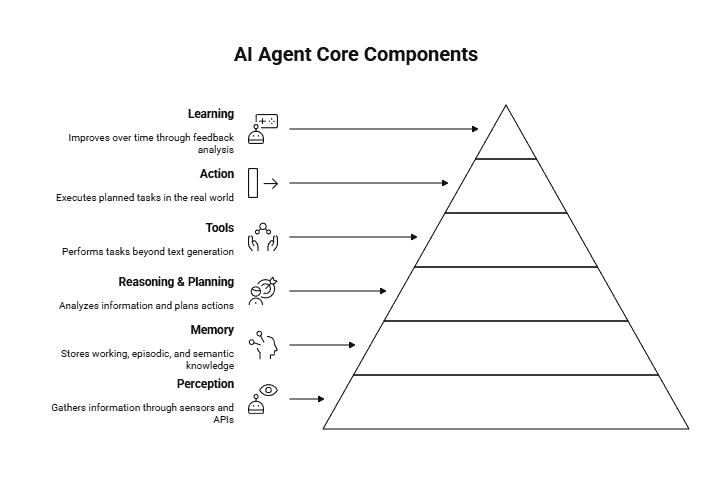
Think of AI agents as systems made up of several core components working together. Each component handles a specific role, and all of them are required for an agent to function reliably.
Perception: How the agent observes its environment by receiving inputs from users, sensors, APIs, or data streams. Without perception, the agent has no awareness of what is happening around it.
Memory: How the agent stores and recalls information so it can stay consistent over time. This includes working memory for current context, episodic memory for past interactions, and semantic memory for general knowledge.
Reasoning and Planning: How the agent processes information, breaks down goals into smaller steps, and decides what to do and in what sequence, instead of acting randomly.
Tools: External capabilities the agent can use to perform tasks beyond text generation, such as calling APIs, searching databases, or interacting with other software systems.
Action: The execution layer where the agent carries out decisions, such as sending messages, updating records, or triggering workflows.
Learning: The mechanism that allows the agent to improve over time by evaluating outcomes and adjusting future behaviour based on feedback.
Types of AI Agents
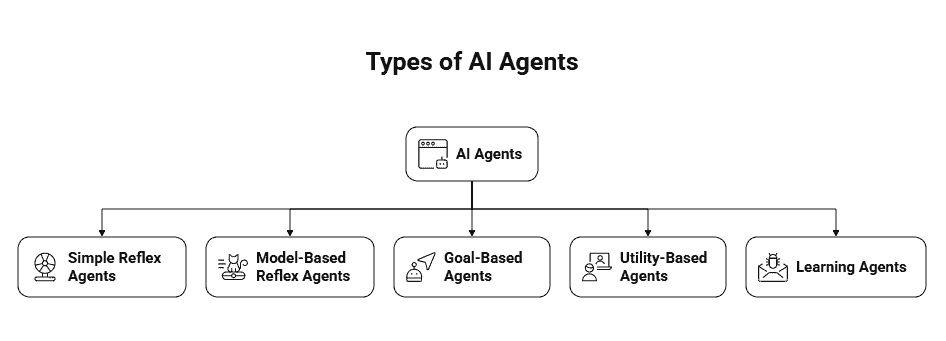
Not all AI agents are built the same. Some follow basic rules, while others learn and adapt over time. Here’s how they differ.
1. Simple Reflex Agents
These are the most basic type. They react to what’s happening right now using predefined rules. No memory, no learning, just immediate responses. Think of a thermostat that turns on heating when the temperature drops below a set point.
If this happens, do that. That’s it. They work well for straightforward tasks but can’t handle situations that need context or planning.
2. Model-Based Reflex Agents
These agents maintain an internal model of their environment. They track what they can’t directly see, which helps them make better decisions. A robot vacuum that maps your home as it cleans is a good example.
It remembers where it’s been and what obstacles exist, even when those obstacles aren’t currently in view. This memory lets it navigate more efficiently than a simple reflex agent.
3. Goal-Based Agents
Instead of just reacting, these agents plan ahead to achieve specific objectives. They evaluate different paths and choose actions that bring them closer to their goal. A GPS navigation system works this way. It knows where you want to go and calculates the best route to get you there, considering traffic and road conditions.
4. Utility-Based Agents
These agents don’t just aim for a goal. They evaluate multiple factors and trade-offs to find the optimal solution. An AI that schedules meetings considers everyone’s availability, time zones, and preferences before suggesting a time. It’s weighing competing priorities to maximise overall satisfaction, not just completing the task.
5. Learning Agents
The most sophisticated type. These agents improve through experience and feedback. A spam filter that gets better at catching junk emails based on what you mark as spam is learning from your actions. Over time, it adapts to your specific needs and becomes more accurate. This is where AI agents start feeling truly intelligent.
AI Agent Examples
You see AI agents everywhere now, even if you don’t realise it. Virtual assistants like Siri and Alexa respond to your voice commands, set reminders, and control your smart home devices. When you chat with customer service and get instant responses, that’s often a chatbot analysing your question and pulling solutions from a knowledge base.
Autonomous vehicles use AI agents to process sensor data, make split-second driving decisions, and navigate traffic. Netflix and Spotify use recommendation systems that learn your preferences and suggest content you’ll probably enjoy. The global AI agent market is projected to reach $7.63 billion in 2025, with expectations to hit $47.1 billion by 2030. That growth shows how quickly these systems are becoming essential across industries.
In business operations, robotic process automation handles repetitive tasks like data entry, invoice processing, and report generation. What ties all these together is their ability to sense, decide, and act without constant human input.
Benefits of AI Agents
AI agents are valuable because they combine speed, scale, and consistency.
Availability: Agents operate 24/7 without breaks, handling tasks continuously.
Automation: Repetitive and time-consuming work is offloaded, freeing humans for higher-value tasks.
Scalability: A single agent can handle hundreds or thousands of requests simultaneously.
Data processing: Agents analyse large volumes of data quickly and identify patterns humans would miss.
Cost efficiency: After setup, agents handle increased workload without proportional increases in labour costs.
Consistency: They apply the same logic every time, without fatigue or variability.
Limitations of AI Agents
Despite their strengths, AI agents have clear constraints.
Lack of emotional intelligence: They struggle with empathy, nuance, and social context.
Dependence on data quality: Biased or incomplete training data leads to flawed decisions.
Poor handling of novel situations: Unexpected scenarios can cause errors that humans would avoid.
High upfront costs: Implementation requires technical expertise and initial investment.
Ongoing maintenance: Agents need monitoring, updates, and retraining as conditions change.
AI agents are powerful, but they work best with human oversight rather than as fully autonomous replacements.
A startup consultant, digital marketer, traveller, and philomath. Aashish has worked with over 20 startups and successfully helped them ideate, raise money, and succeed. When not working, he can be found hiking, camping, and stargazing.
Each week I share research backed AI oriented content in my newsletter.
There are AI ideas, AI trends, tutorials, and guides.
24k entrepreneurs read it. I'd love you to join.