You’ve probably asked an AI to handle something complex, only to get a response that’s halfway decent but not what you needed. The output feels generic. It misses key details. Or it just doesn’t build on itself the way you expected.
Here’s the thing: most AI models work best when you break big tasks into smaller, connected steps. That’s where prompt chaining comes in.
Instead of throwing one massive prompt at an AI and hoping for the best, you create a sequence. The output from one prompt becomes the input for the next. Each step builds on the last, creating a logical flow that helps the AI understand context and deliver better results.
What this means for you is more control, better accuracy, and outputs that actually match what you’re trying to accomplish. Let’s look at how this actually works.
Think of prompt chaining like cooking a meal. You don’t just throw all the ingredients into a pot at once and hope for the best. You prep the vegetables first. Then you cook them in stages. Each step feeds into the next, and the final dish is better because of that structure.
Prompt chaining works the same way. The output of one AI prompt becomes the input for the next, forming a logical sequence of tasks.
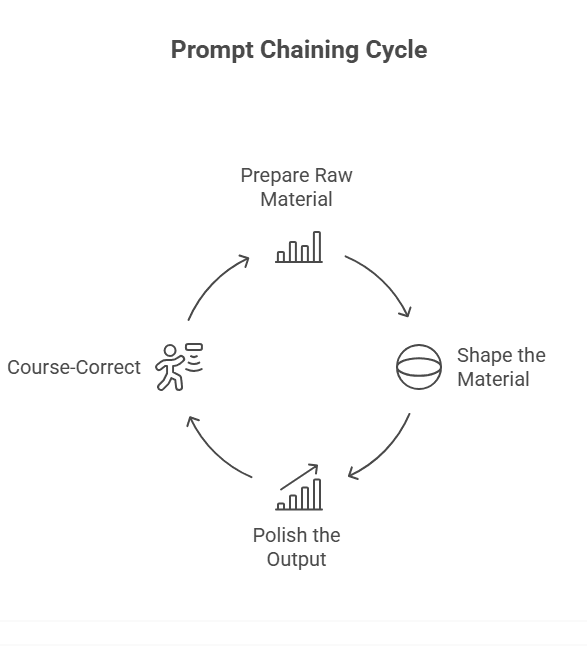
Each prompt focuses on one specific job. The first prompt gives you raw material. The second shapes it. The third polishes it. What makes this powerful is that the AI isn’t starting from scratch each time. It’s building on what came before, which helps it maintain context and stay focused.
According to CodeSignal, chain-of-thought prompting helps AI models break down problems into logical sequential steps. That’s exactly what prompt chaining does, but across multiple prompts rather than within a single one. The AI tackles complex workflows by handling them piece by piece.
This sequential approach also means you can course-correct along the way. If the first prompt’s output isn’t quite right, you can adjust before moving to the next step. You’re not locked into one long, complicated prompt that either works perfectly or fails completely.
Prompt Chaining vs Chain-of-Thought Prompting
Here’s where things get interesting. A lot of people mix up prompt chaining with chain-of-thought prompting. They sound similar, but they work completely differently.
Chain-of-thought prompting happens inside a single prompt. You’re asking the AI to show its reasoning process as it thinks through a problem. Think of it like asking someone to “show their work” on a math problem. The AI breaks down its thinking step-by-step, but it’s all happening in one conversation.
For example, you might ask: “Calculate the total cost of 15 items at $3.50 each, plus 8% tax. Show your reasoning.” The AI would then explain each calculation step before giving you the final answer.
Prompt chaining is different. You’re connecting multiple separate prompts where each output becomes the next input. It’s about building a workflow across several AI interactions, not just detailed thinking within one.
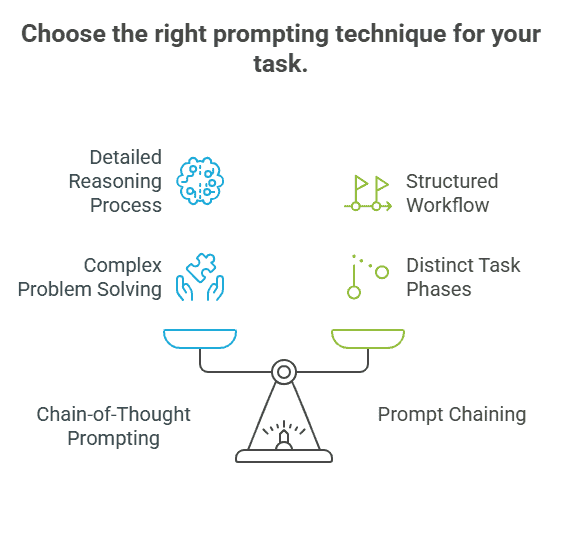
So when should you use each? Chain-of-thought works great when you need detailed reasoning for complex problems like financial calculations or technical troubleshooting. The AI needs to think deeply but can handle it in one go.
Use prompt chaining when your task has distinct phases that need different approaches. Writing that blog post? Research first, then outline, then draft, then edit. Each step needs focused attention and produces something concrete for the next phase.
The main thing to remember: chain-of-thought is about how the AI thinks. Prompt chaining is about how you structure your workflow.
Types of Prompt Chaining
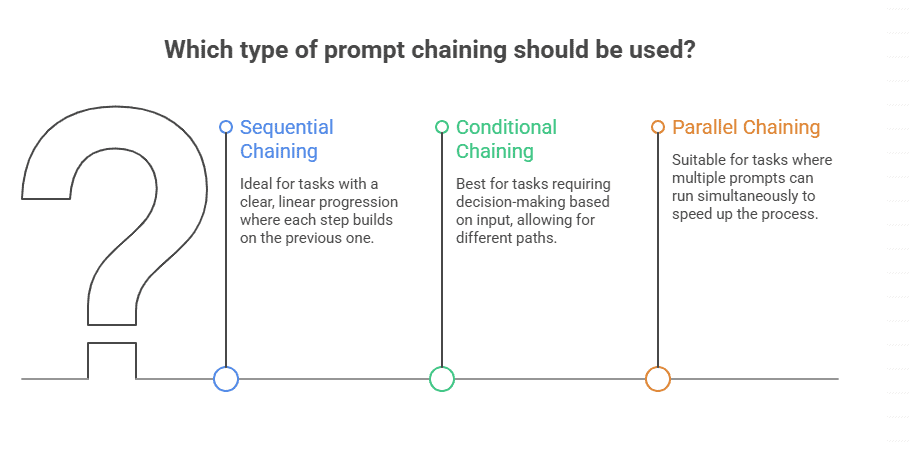
Not all chains work the same way. Depending on what you’re building, you’ll structure your prompts differently. Some tasks need a straight line from start to finish. Others need to make decisions along the way or handle multiple things at once.
1. Sequential Chaining
This is the most straightforward type. One prompt finishes, its output feeds into the next, and so on. Think of it like an assembly line where each station waits for the previous one to complete its work.
Say you’re writing a research report. The first prompt pulls relevant data from sources. The second organises that data into an outline. The third writes the actual content based on that outline. Each step builds directly on what came before it.
IBM Think notes that frameworks like LangChain let you create reusable chains with this linear progression. It’s ideal when your task has a clear order that can’t be shuffled around.
2. Conditional Chaining
Here’s where things branch. The chain doesn’t follow one path. Instead, it makes decisions based on what the previous output contains.
Picture a customer service system. If someone’s message contains angry language, the chain routes to an escalation prompt that crafts an apology. If it’s a simple question, it goes to a FAQ lookup prompt. If it’s a technical issue, it triggers a troubleshooting sequence.
You’re basically building “if this, then that” logic into your prompts. It’s more complex to set up, but it handles situations where different inputs need different treatment.
3. Parallel Chaining
Sometimes you don’t want to wait. Multiple prompts can run at the same time, then combine their outputs at the end.
Let’s say you’re launching a product. One prompt writes the marketing copy. Another generates technical specifications. A third calculates pricing tiers. They all work simultaneously, then a final prompt weaves everything together into one cohesive product page.
This speeds things up, but you need to coordinate carefully. The outputs need to fit together without contradicting each other.
Benefits of Prompt Chaining
Now that you know what prompt chaining is and how it works, let’s talk about why you’d actually use it. Here’s what this approach brings to the table.
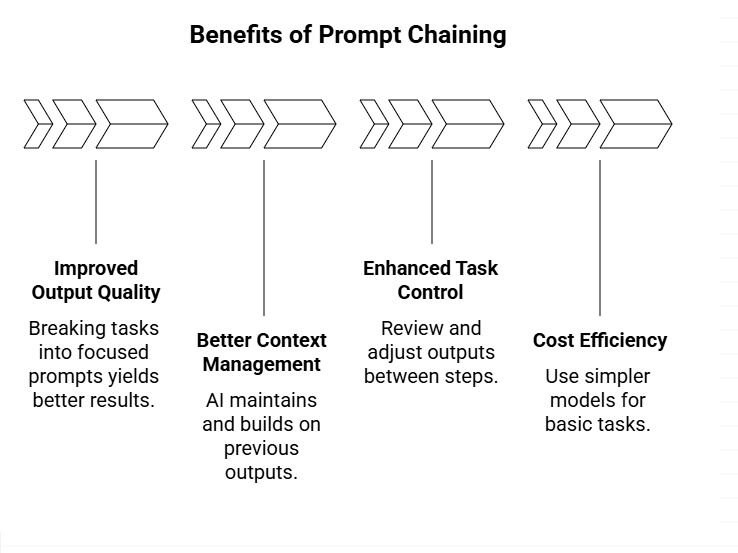
Improved output quality: Breaking tasks into smaller, focused prompts produces better results than cramming everything into one large prompt. Each step handles a specific job, which reduces confusion and lets you optimise each part individually before issues compound.
Better context management: The AI builds on previous outputs step by step instead of being overloaded with context all at once. This helps maintain tone, terminology, and continuity across longer workflows.
Enhanced task control: You can review and adjust outputs between steps instead of discovering problems at the end. This makes debugging easier and prevents large-scale rewrites based on early mistakes.
Cost efficiency: Not every step needs an expensive model. Simpler tasks can use lighter models, focused prompts use fewer tokens, and overall response times and costs go down at scale.
Drawbacks of Prompt Chaining
Prompt chaining works well, but it comes with trade-offs that are worth considering.
Time-consuming setup: Designing, testing, and refining a prompt chain takes longer upfront compared to writing a single prompt.
Management complexity: More steps mean more things to track, document, and maintain, especially in team environments.
Context loss risk: Important information can get diluted across steps if context isn’t carefully carried forward, requiring deliberate repetition and balance.
How To Implement Prompt Chaining
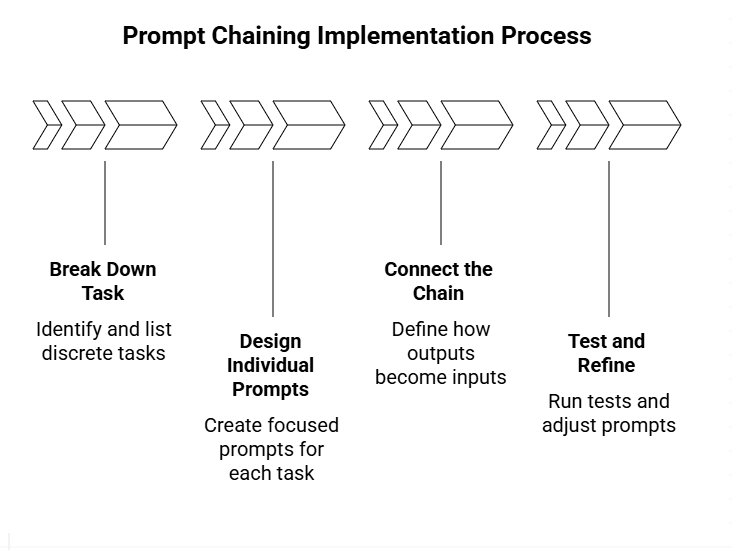
You’ve seen what prompt chaining can do. Now let’s build one. The process is straightforward once you break it into manageable steps.
Step 1: Break Down Your Task
Start with your end goal and work backwards. What’s the final output you need? Then ask yourself what needs to happen right before that. And before that.
Write out each step as a discrete task. If you’re building a blog post, your chain might look like this: research the topic → create an outline → write the introduction → draft body sections → edit for clarity. Each step should produce something concrete that feeds the next one.
The key is finding natural breaking points. Where does one type of thinking end and another begin? Research is different from organising. Organising is different from writing. Those are your chain links.
Step 2: Design Individual Prompts
Now write a focused prompt for each step. Be specific about what you’re feeding in and what you want out.
Here’s what that looks like: “Analyse this customer feedback data: [input]. Extract the 5 most common complaints and list them in order of frequency.” Notice how it states the input format and desired output clearly.
Test each prompt on its own before connecting anything. Does it produce what you expected? If Step 2 gives you garbage, Step 3 will amplify that garbage. Fix weak prompts now, not after you’ve built the whole chain.
Your prompt should also specify format. Do you want a bulleted list? A paragraph? JSON? Tell the AI exactly what structure you need.
Step 3: Connect the Chain
This is where you define the handoffs. How does the output from Step 1 become the input for Step 2?
Be explicit about what information carries forward. If Step 1 identifies three main themes, Step 2 needs to know those themes. Your prompt might say: “Using these themes: [Step 1 output], write a paragraph explaining how they connect.”
Set up your connection points carefully. Some chains pass everything forward. Others only pass specific pieces. Decide what each step actually needs. More context isn’t always better, especially if it includes irrelevant details that distract the AI.
Step 4: Test and Refine
Run your full chain with real data. Not hypothetical examples, actual use cases.
Watch where the chain breaks. Does Step 3 misunderstand Step 2’s output? Does context get lost between Step 4 and Step 5? Those are your weak links.
Adjust your prompts based on what happens. You might need to add more context to one step or simplify the output format from another. Sometimes you’ll realise you need an extra step you didn’t plan for.
Once it works smoothly, document your workflow. Write down the exact prompt sequence, what formats you use, and any quirks you discovered. Future, you will thank the present you.
Prompt Chaining Examples
Let’s look at how this works in practice. These examples show different approaches to chaining based on what you’re trying to accomplish.
Content Creation Workflow
Here’s a concrete chain for writing an article about email marketing.
Step 1: “Research and list 10 key benefits of email marketing for small businesses. Include one supporting statistic for each benefit.”
Step 2: “Using this research: [output from Step 1], create a detailed outline with 5 main sections. Each section should cover 2 related benefits.”
Step 3: “Based on this outline: [output from Step 2], write a 150-word introduction that hooks readers interested in growing their business through email.”
Step 4: “Using the first section from this outline: [output from Step 2] and this research: [output from Step 1], write a 200-word section explaining these benefits with examples.”
Notice how each step explicitly references what it needs. Step 4 pulls from both Step 1 and Step 2 because it needs both structure and substance. That’s sequential chaining with memory.
Data Analysis Process
Analysing customer survey data works differently. You’re moving from raw information to actionable insights.
Step 1: “Review this survey data: [dataset]. Extract and categorise all responses into positive, negative, and neutral sentiment.”
Step 2: “Using these categorised responses: [output], identify the top 3 patterns in negative feedback and top 3 patterns in positive feedback.”
Step 3: “Based on these patterns: [output], generate 5 specific recommendations for improving customer satisfaction. Prioritise actions that address the most common negative patterns.”
Chaining helps here because each step requires different thinking. Classification is mechanical. Pattern recognition is analytical. Recommendations are strategic. Asking the AI to do all three at once produces shallow results.
Customer Support Automation
Support workflows benefit from conditional chaining. Different inputs trigger different paths.
Step 1: “Analyse this customer inquiry: [message]. Classify it as: technical issue, billing question, feature request, or general feedback.”
Step 2a (if technical): “This is a technical issue: [message]. Check our knowledge base: [database] and provide step-by-step troubleshooting instructions.”
Step 2b (if billing): “This is a billing question: [message]. Review the customer’s account: [account data] and explain their charges in simple terms.”
Step 3: “Take this response: [output from Step 2] and personalise it using the customer’s name: [name] and purchase history: [history]. Match their tone, friendly or formal.”
The chain adapts based on what Step 1 discovers. That’s how you handle variety without writing a separate workflow for every scenario. One classification step routes everything else.
Tools for Prompt Chaining
You’ve got options when it comes to building prompt chains. Some tools require coding knowledge, while others let you build workflows visually.
LangChain is the go-to framework for developers. It manages LLMs like IBM Granite and OpenAI’s GPT models, lets you define custom prompts, and connects them into reusable chains. Think of it as the foundation for building complex AI workflows that need flexibility and control.
ChatGPT API gives you custom integration possibilities. You can build chains programmatically, passing outputs between prompts and controlling exactly how your AI processes information. It requires some technical setup, but the control is worth it.
Make.com and Zapier are your no-code options. These automation platforms let you connect ChatGPT with other tools in your workflow. Trigger a chain when a form is submitted, process the data through multiple prompts, and send the results wherever you need them. Perfect if you’re not comfortable writing code.
Claude and custom implementations offer similar capabilities. Claude’s API supports conversational context naturally, making it easier to maintain thread continuity. Custom implementations give you complete control but require development resources.
Start with what matches your skill level. You can always build more complex chains as you get comfortable with the basics.
Best Practices for Effective Prompt Chaining
Here’s what actually works when building chains:
Keep each step focused on one task. A prompt that tries to analyse, summarise, and format all at once will give you messy results. Break it down. One prompt analyses. The next summarises. The third formats.
Use consistent formatting across prompts. If your first prompt outputs bullet points, don’t suddenly expect paragraphs in step two. Consistent structure helps the AI understand what you’re asking and reduces errors in the chain.
Always restate important context. Like we mentioned in the drawbacks section, AI doesn’t naturally remember everything. When you move to a new prompt, explicitly reference the output from the previous step. “Based on the summary above…” or “Using the keywords identified in step 1…” keeps the chain grounded.
Test and refine iteratively. Your first chain won’t be perfect. Run it with different inputs. See where it breaks. Adjust the prompts until the outputs consistently meet your needs. This is normal.
Document your chains. Write down what each step does and why. Future you (or your team) will thank you when you need to troubleshoot or modify the chain months later.
Start simple, add complexity gradually. Build a two-step chain first. Make sure it works. Then add a third step. This approach saves you from debugging a massive chain where you can’t tell which step is causing problems.
The thing is, prompt chaining gets easier the more you practice. Start with a simple workflow you’re already doing manually. Build a chain for it. Watch how it performs. You’ll quickly develop an instinct for what works and what doesn’t.
A startup consultant, digital marketer, traveller, and philomath. Aashish has worked with over 20 startups and successfully helped them ideate, raise money, and succeed. When not working, he can be found hiking, camping, and stargazing.
Each week I share research backed AI oriented content in my newsletter.
There are AI ideas, AI trends, tutorials, and guides.
24k entrepreneurs read it. I'd love you to join.