
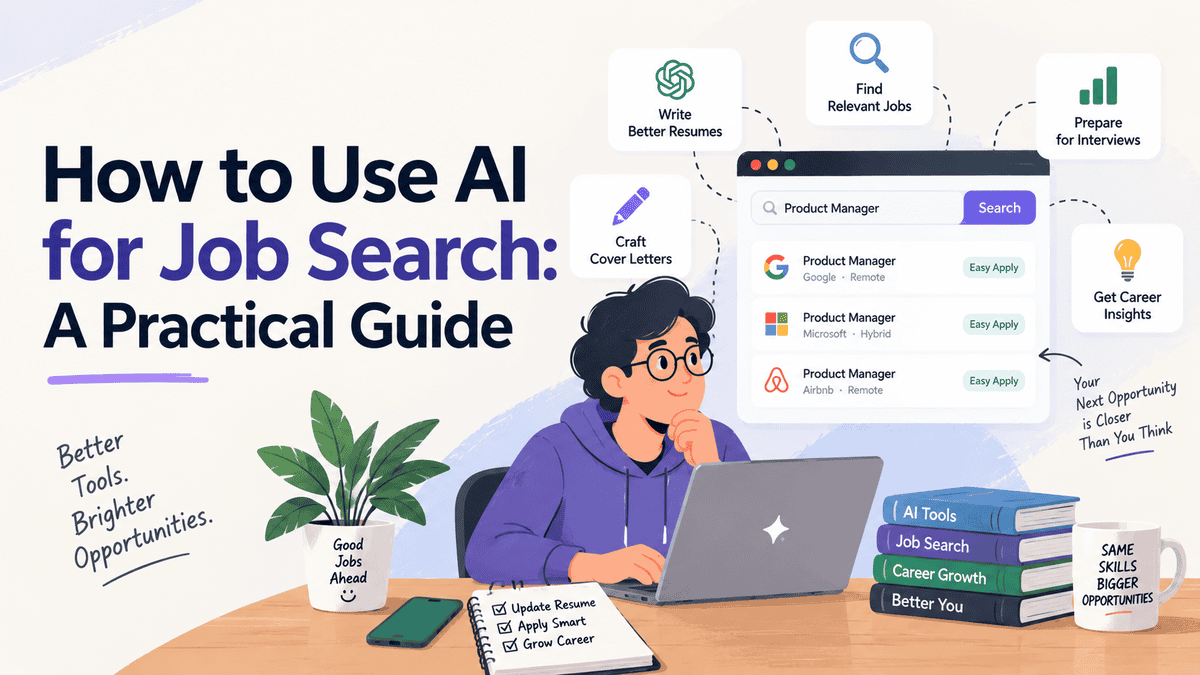
The average job posting gets 250 applicants. Before a human even looks at your resume, an ATS has already filtered out roughly 75% of them.
That’s the reality in 2026. And ignoring it is why most people send out 50 applications and hear back from two.
AI changes this. If you use it properly, it can cut your application time from 45 minutes to under 10. It sharpens your resume for every job description and can even help you with job interviews.
So, this guide walks through exactly how to use AI for job search, from finding roles worth applying to all the way through interview prep. Plus the tools that actually work and the mistakes that can tank your chances.
Why Use AI for Job Search
You probably already know AI can “help with resumes.” But the reason it matters right now goes deeper than that.
Recruiters are using AI to screen you. If you’re not using AI to prepare your application, you’re playing a different game than everyone else.
Tailoring a resume and cover letter manually takes 30 to 45 minutes per application. With a proper AI workflow, that drops to under 10. AI pulls out keywords from job descriptions that you’d miss reading it yourself. You can practice interview answers, get feedback, and walk in more prepared than most people in the room.
How to Use AI for Job Search
AI fits into almost every stage of job hunting. But you need to know what you’re actually solving at each point or you end up with a bunch of tabs open and no real system.
Start With Job Matching, Not Mass Applying
The most common mistake is opening a job board, typing your title, and applying to everything that looks relevant. That’s how you spend three weeks sending out 80 applications and hearing nothing back.
The smarter move is figuring out which roles you’re actually a strong fit for before you apply to anything. An AI powered job match tool lets you paste your resume and a job description and get back a fit score, what’s missing, and what keywords the ATS is looking for.
This gives you one of two things. A green light to apply. Or a list of gaps to fix first.
A practical rule: run every role through a match tool before applying. Only move forward on roles where you’re at 60% or above. Below that, either tailor further or move on to a better-fit posting.
Fix Your Resume for the Specific Role, Not in General
One generic resume for every job is one of the most common job search mistakes.
Every job description uses slightly different language for the same skills. ATS systems look for exact or near-exact matches. A resume written for “content strategy” might not rank well for a posting that says “editorial planning” even if it’s the same job.
Here’s a workflow that actually works:
- Paste the job description into ChatGPT or Claude. Ask it to extract the top 10 to 12 required skills and keywords. You’ll catch things you’d skim past reading it yourself.
- Use AI to compare those keywords against your current resume. Ask: “Which of these keywords are missing or need to be more prominent?” Get a gap list.
- Make AI rewrite bullet points around the gaps. Prompt: “Rewrite this bullet point to incorporate [keyword] while keeping my actual experience accurate.” Always review the output. AI doesn’t know the nuance of what you actually did.
- Run a final ATS check before submitting. Tools like Jobscan or Teal compare your resume to the job description and flag remaining gaps. Aim for 75% or above before hitting apply.
Write Cover Letters That Don’t Sound Like AI Wrote Them
Cover letters are still read. Research shows 94% of hiring managers say cover letters influence interview decisions. 72% expect one even when it’s listed as optional.
Here’s the problem: 80% of hiring managers can now spot generic AI-generated content. And they view it negatively.
The approach that works is the 70/30 rule. Let AI handle 70%, the structure, keywords, first draft. You bring the 30% that makes it human. A specific detail about the company, a real result from your work, language that sounds like you actually wrote it.
What to ask AI to do:
- Draft a 300-word cover letter based on the job description and your resume
- Open with something specific about the company, not “I am excited to apply”
- Include one quantified achievement relevant to the role
- Keep it under 300 words
After AI drafts it, read it out loud. If it doesn’t sound like something you’d say in a real conversation, rewrite those parts. Replace adjectives with evidence. Cut anything that could have been written by anyone applying to any company anywhere.
Optimise Your LinkedIn So Recruiters Find You
LinkedIn in 2026 runs on an AI-powered matching engine. It’s not just scanning your job title. It’s scoring keyword match, skills alignment, and profile activity before a recruiter ever clicks on you. If your profile hasn’t been tuned for how that algorithm reads it, you’re invisible to the searches that matter.
Three prompts worth running right now:
- Headline: “Write a LinkedIn headline for someone with [X years] in [field], specialising in [skills], targeting [role type] at [company type].”
- About section: “Rewrite my LinkedIn summary to position me for [target role]. Here’s what I do: [paste your current summary]. Make it conversational, not a resume dump.”
- Skills section: “Based on these 5 job descriptions I’m targeting [paste them], what are the top 10 skills I should prioritise on my LinkedIn profile?”
Prep for Interviews With AI
This is where AI gives the highest return of any stage. Most candidates spend 20 minutes looking at the company website before an interview. With AI, you can do in 30 minutes what used to take hours.
Three things to do before every interview:
- Company research. Paste the company’s About page or a recent press release into ChatGPT and ask: “What are their current priorities and challenges? What smart questions should I ask based on this?” You’ll walk in knowing things most candidates don’t.
- STAR answer prep. Give AI the job description and ask it to generate the 8 most likely behavioural interview questions. Then ask it to help you structure your actual experiences into STAR format (Situation, Task, Action, Result) for each one. Practice out loud, not just in your head.
- Mock interview. Use a tool like InterviewAI or prompt Claude to act as an interviewer for the specific role. Run a full 15-minute session and ask for feedback on clarity, specificity, and filler words.
Best AI Tools for Job Search
There are dozens of tools and most of them overlap. Pick one or two per stage rather than signing up for six and using none consistently.
Use Case | Tool | What It Does | Cost |
|---|---|---|---|
Job matching | ResumeCoach Job Match | Matches your resume to job descriptions, shows fit score and keyword gaps | Free tier available |
Resume ATS optimization | Jobscan | Compares resume to JD, gives match rate, keyword gaps, formatting fixes | 5 free scans/month; $49.95/mo paid |
Resume building + tracking | Teal | Resume builder, job tracker, keyword matching. 90% of features free. | Free; $9/week premium |
Cover letter drafting | ChatGPT / Claude | Draft, rewrite, and personalise cover letters using your own prompts | Free tiers available |
LinkedIn optimization | Careerflow.ai | Chrome extension that gives real-time optimisation suggestions on your LinkedIn profile | Free tier available |
Interview prep | InterviewAI | Role-specific mock interviews with feedback on your answers | Free + paid plans |
Application tracking | Huntr | Tracks all your applications, follow-ups, and deadlines in one board | Free tier available |
Build a Simple Weekly AI Workflow
Candidates who get results from AI aren’t using it randomly. They have a repeatable weekly routine. Here’s one that works without taking over your life:
Day / Stage | What to Do With AI | Time |
|---|---|---|
Monday | Ask AI to find 5 roles worth applying to. Run each through a job match tool. Shortlist only roles at 60%+ fit. | 30 to 45 min |
Tuesday | Tailor your resume for each shortlisted role. Use AI to find keyword gaps and rewrite bullet points. Run an ATS check before saving. | 60 to 90 min |
Wednesday | Write cover letters using the 70/30 method. AI drafts, you personalise. Apply. | 30 to 45 min |
Thursday | LinkedIn: check your profile against current target roles, update any outdated sections, send 2 to 3 personalised outreach messages drafted with AI help. | 20 to 30 min |
Friday | Review the week. Track what you applied to, any responses. Paste your weekly stats into Claude and ask it to diagnose your bottleneck. | 20 min |
Before every interview | Company research prompt, STAR answer prep, 15-minute AI mock interview. | 30 to 45 min |
What AI cannot do in this workflow: build real relationships with people who can refer you, communicate your personality to a hiring manager, or verify that your achievements are accurate.
Mistakes to Avoid
Most of these don’t feel like mistakes while you’re making them. That’s what makes them worth spelling out.
- Using AI to mass apply – Auto-apply tools that fire off 200 applications are creating exactly the noise recruiters now filter out first. Companies are being flooded with obviously AI-generated, generic applications. Quality targeting beats volume every time.
- Submitting AI output without editing it – AI writes a decent first draft. It doesn’t know your actual stories, your specific results, or your voice. Every cover letter and resume bullet needs a human pass before it goes out. Recruiters can spot templated language quickly.
- Optimising for ATS and forgetting about the human – A keyword-stuffed resume might pass the bot and still get binned by the recruiter. Optimisation and readability are not opposites. Read your resume like a human after every AI revision.
- Using one resume for every application – This is the single biggest gap between candidates who hear back and those who don’t. Small targeted tweaks per role, not a full rewrite, just 5 to 10 keyword adjustments, make a measurable difference to your match rate.
- Skipping interview prep because you know your experience – Knowing your experience and being able to articulate it clearly under pressure are two different things. AI mock interviews cost 15 minutes. Not doing them costs you second rounds.
- Relying on AI for networking – AI can draft an outreach message. It cannot build a relationship. The candidates getting referrals and hidden-role introductions are the ones doing the actual human work of reaching out and following up.