
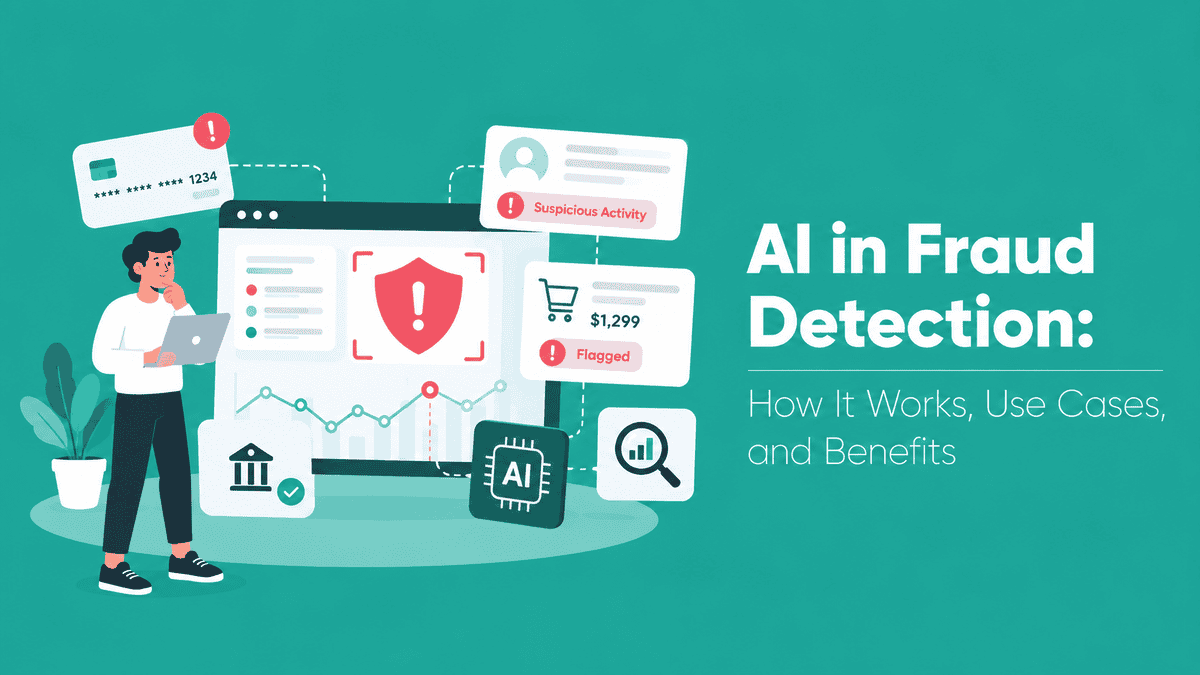
Fraud costs businesses $73.62 billion annually. That’s the size of the global fraud detection market, growing at 21.2% each year, according to The Business Research Company.
Why so massive? Because old methods aren’t working properly anymore. Manual reviews are slow. Rule-based systems miss new attack patterns. You need something smarter.
That’s where AI in fraud detection comes in. It spots suspicious activity in real time, learns from patterns, and adapts to new threats.
And the threat is evolving fast. 72% of business leaders expect AI-generated fraud to become a major challenge by 2026. Deepfakes. Synthetic identities. Traditional approaches can’t keep pace.
So, AI in fraud detection isn’t just a tool anymore. It’s becoming the new standard for security.
What Is AI in Fraud Detection?
AI in fraud detection uses machine learning to analyse millions of data points and spot suspicious patterns. Instead of following pre-written rules, it learns what normal behaviour looks like. Then it flags anything that doesn’t fit.
Here’s how it works in practice:
- Algorithms study transaction patterns, user behaviour, and historical fraud cases
- The system spots anomalies that human analysts might miss
- It adapts to new fraud tactics automatically without manual updates
That’s the big shift from traditional systems. Older methods use static “if-then” rules. If someone breaks a rule, they get flagged. But fraudsters learn those rules and work around them. AI flips this approach.
The result? Faster detection with fewer mistakes. And unlike older software, AI continuously learns from new data. It improves its accuracy over time rather than staying stuck with outdated rules.
Why AI in Fraud Detection Matters
Fraud isn’t just evolving. It’s getting smarter. For example, deepfakes that mimic your CEO’s voice or synthetic identities built from stolen data. Traditional methods can’t keep up with these.
72% of business leaders expect AI-generated fraud to be a major challenge by 2026. Manual review teams are overwhelmed. They’re trying to spot patterns that shift daily. They’re human. They miss things. That’s why AI matters: it doesn’t get tired or overlook subtle signs.
AI-powered systems are already making a difference. In 2025, they stopped an estimated $25.5 billion in fraud losses globally. That’s real money saved. Real reputation protected.
AI helps guard both your revenue and your customer relationships. It’s not just about catching bad actors. It’s about building a safer business.
How Does AI in Fraud Detection Work?
So how does this technology actually spot the fakes? It’s not any random guesses. It’s pattern recognition on a massive scale. The AI studies mountains of past transaction data to learn what normal activity looks like for each user. Then it flags anything that strays from that learned pattern.
The Learning Process
AI fraud systems start by digesting historical data: millions of transactions, logins, and user behaviours. From this, they build a baseline of “normal” for each account or user segment. When new activity happens, the system compares it against this learned baseline. If something doesn’t fit – like a login from a new country followed by a large purchase- it raises an alert.
Key Techniques Used
Different AI approaches tackle fraud from different angles. Here’s a breakdown of the main ones:
- Supervised Learning gets trained on labelled examples: transactions marked as “fraud” or “legitimate.” This approach uses predictive analytics to analyse data in real time and uncover suspicious patterns.
- Unsupervised Learning doesn’t need labels. It sifts through data to find new, previously unknown fraud patterns by spotting outliers and unusual clusters on its own.
- Graph Analysis maps relationships between accounts, devices, and transactions. This technique uncovers hidden fraud networks by analysing connections and identifying suspicious clusters.
The Role of Identity Verification
Before any of these techniques can work effectively, the system needs to know who it’s dealing with. That’s where identity verification comes in as a foundational layer. Modern systems combine document checking with liveness detection – confirming a real person is present, not just a photo or deepfake. Biometric liveness detection confirms the biometric input comes from a live person, not something spoofed or manipulated.
This verification step ensures the AI is analysing legitimate user behaviour from the start, making all subsequent fraud detection more accurate.
Real-World Use Cases
Here’s where AI fraud detection stops being theoretical and starts working in the real world. The technology isn’t just processing data. It’s stopping criminals, saving companies millions, and protecting everyday people.
Banking and Payments
Banks deal with millions of transactions daily. Manual review can’t keep up. That’s where AI steps in.
Take HSBC. They implemented AI systems and saw a 60% reduction in false positives. That means fewer legitimate customers get flagged incorrectly.
DBS Bank went even further. Their AI system achieved a 90% reduction in false positives. Customers spend less time dealing with blocked transactions. Banks save resources on manual reviews. Modern bank-grade platforms now detect payment fraud and mule accounts in milliseconds. Not minutes. Not hours. Milliseconds.
E-commerce
Online marketplaces face unique fraud challenges. Fake reviews. Account takeovers. Stolen credit card use.
Shopify uses AI to protect millions of merchants from these exact problems. Mastercard accelerated card fraud detection using generative AI. Amazon deployed AI innovations to stop both fraud and counterfeits at scale.
Insurance
Insurance fraud costs billions annually. AI reviews claims for patterns of exaggeration or fabrication. It checks consistency across documents and historical data.
A suspicious claim might look fine on its own. But AI spots when similar claims come from the same doctor. Or when reported injuries don’t match medical records.
Telecom and Scam Prevention
Telecom companies can use AI to stop scams before customers even reach a fraudulent website.
Airtel, for example, uses AI to analyse suspicious links sent through SMS, email, WhatsApp, Telegram and other apps. When someone clicks a link, the system checks it for fraud signals and can block the site before it loads. According to GSMA, Airtel’s system has identified more than 187,000 fraudulent domains and prevents around 3 million fraud attempts every day.
AI can also spot suspicious SIM registrations, spam calls and unusual activity linked to scam networks.
Employee Expense Fraud
Fraud doesn’t always come from customers. Sometimes it happens inside the company.
AI expense systems can review receipts and expense reports for duplicate claims, fake receipts, unusual prices and purchases that break company policy.
Chobani uses an AI-powered audit system from SAP Concur to review employee expenses. Instead of its finance team spending hours manually checking reports, AI reviews individual expense items and flags the ones that need attention.
This is becoming even more useful as employees can now create realistic fake receipts using image generators.
Government Payments and Tax Fraud
Governments process huge numbers of tax refunds, benefits and other payments. Fraudulent claims can easily get buried in that volume.
The U.S. Treasury uses machine learning to identify suspicious payments and unusual patterns before money goes out. Its enhanced fraud detection systems helped prevent or recover more than $4 billion in fraud and improper payments during fiscal year 2024.
The IRS also uses AI and advanced analytics to identify high-risk tax filings and possible fraud, allowing investigators to spend more time on cases that are actually suspicious.
Ride-Sharing and Delivery Platforms
Platforms such as Uber face more than stolen-card fraud. They also have account takeovers, fake trips, promotion abuse and cases where drivers and riders work together to cheat the system.
Uber uses machine learning to calculate fraud risk during activities such as logins and trip requests. A suspicious request can be challenged or blocked while normal users continue without interruption.
AI can also look at relationships between accounts. For example, several accounts sharing devices, payment methods or unusual trip patterns may reveal an organised fraud network that would be difficult to spot by checking each account separately.
Digital Advertising
Advertisers can lose money to bots that repeatedly click ads, fake impressions and websites designed to generate fraudulent ad revenue.
Google uses machine learning and AI to analyse clicks, impressions, websites, ad placements and user behaviour for signs of invalid traffic. Suspicious activity can then be filtered so advertisers aren’t charged for it.
Google said newer AI systems improved its ability to identify deceptive ad-serving practices, reducing invalid traffic from those practices by 40%.
Online Marketplaces and Seller Fraud
Marketplaces also need to determine whether the seller is legitimate, not just whether the payment is legitimate.
Amazon uses machine learning throughout the seller process. It checks seller identities, watches for links to previously detected bad actors, looks for fake reviews and scans listings for possible counterfeit products. Its systems analyse text, images, seller behaviour and other signals together to identify suspicious activity.
Walmart similarly uses AI and real-time monitoring to check marketplace listings for policy violations and intellectual-property abuse, alongside seller identity and business verification.
Key Benefits of Using AI in Fraud Detection
Numbers don’t lie. AI in fraud detection delivers concrete, measurable advantages that directly affect your operations and customer experience.
Benefit | Impact |
|---|---|
Reduced False Positives | AI cuts false alarms by 40-60%. According to Mastercard, 83% of businesses report AI significantly reduced false positives and customer churn. |
Higher Accuracy | Detection rates reach 87-94%. AI catches subtle patterns humans miss, like unusual login times or micro-transactions that signal account takeover. |
Real-Time Detection | Identifies threats in milliseconds. Stops fraud before it completes, preventing financial loss and protecting customer trust. |
Scalability | Handles millions of transactions daily. Manual teams cannot match this volume, making AI essential for growing businesses. |
Common Mistakes to Avoid
Even with the right intentions, many companies stumble when deploying AI for fraud detection. Here’s where things typically go wrong.
- Ignoring data quality. Bad data kills AI projects. According to research, up to 85% of AI projects fail because of poor data quality. Your system is only as good as what you feed it.
- Accepting black-box decisions. If you can’t explain why a transaction was flagged, you lose customer trust. Use explainable AI models that provide clear reasoning for each decision.
- Attempting a big bang rollout. Trying to replace legacy systems overnight causes major disruption. Banks especially need phased implementation approaches to avoid chaos.
- Forgetting edge cases. Fraudsters constantly test limits. Your system needs continuous retraining with new fraud patterns and emerging tactics.
Getting Started with AI Fraud Detection
You know the pitfalls. Now let’s talk about actually building this thing. Here’s how to get started without falling into those traps.
Follow these four steps:
- Assess your data first. You need clean, labelled historical data. This is the foundation. Without it, your AI system learns the wrong patterns.
- Start with a pilot. Pick one high-risk area. Payment fraud works well. Test your solution there before expanding. You’ll learn what works without risking your entire operation.
- Choose the right tools. Decide between building in-house or using established platforms. Bank-grade solutions like FICO Falcon and Feedzai use consortium data and neural networks. They’re battle-tested.
- Plan for integration early. How will your AI system connect to existing software? Map out these connection points before you start building. Integration complexity trips up many projects.