
You set up fraud alerts. You reviewed every flagged transaction. Then a $42,000 wire cleared because the pattern looked legitimate.
Fraud losses cost U.S. consumers $12.5 billion in 2024, a 25% jump from the year before, according to the FTC. Businesses face even steeper costs when fraud slips through.
I spent weeks testing the most recommended fraud detection tools on the market. Here are the 8 that actually hold up when real money is on the line.
I narrowed it down to the 8 best fraud detection tools in 2026 that I’d actually trust with your business.
The Rundown
- Catch Fake Documents Before Onboarding: Regula, “Verify 16,000+ identity documents from 254 countries using forensic-grade analysis and 99.7% liveness detection.”
- Spot Fake Accounts at Registration: SEON, “Enrich signups with 900+ real-time digital and device signals to catch fraudsters before they slip through.”
- Your Default Payment Fraud Shield: Stripe Radar, “Block fraudulent charges at $0.05 per screened transaction with network-level intelligence built into your Stripe dashboard.”
- Track Fraud Across the Full Journey: Sift, “Cover signup fraud, account takeovers, payment fraud, and content abuse across one unified risk platform.”
- Shift Chargebacks Off Your Plate: Riskified, “Approve more orders with uncapped chargeback coverage, paying only for transactions Riskified greenlights for you.”
- Built for Tier-1 Banks: Feedzai, “Tackle fraud and AML in one platform processing over 3,000 events per second at enterprise scale.”
- Covers Fraud and Non-Fraud Chargebacks: Signifyd, “Guarantee chargeback protection across Shopify Plus, BigCommerce, Adobe Commerce, and Salesforce in a single deployment.”
- Orchestrate Identity With 270+ Partners: Alloy, “Connect identity, account, and transaction data from 270+ vendors into one decisioning layer across the full lifecycle.”
The Best Fraud Detection
Regula
Pricing | Enterprise custom quotes; ROI calculator available |
Free Plan | No |
Document Coverage | 16,000+ identity documents from 254 countries |
Liveness Accuracy | 99.7% (iBeta PAD Level 1 and 2 certified) |
User Rating | 4.8/5 on Gartner Peer Insights |
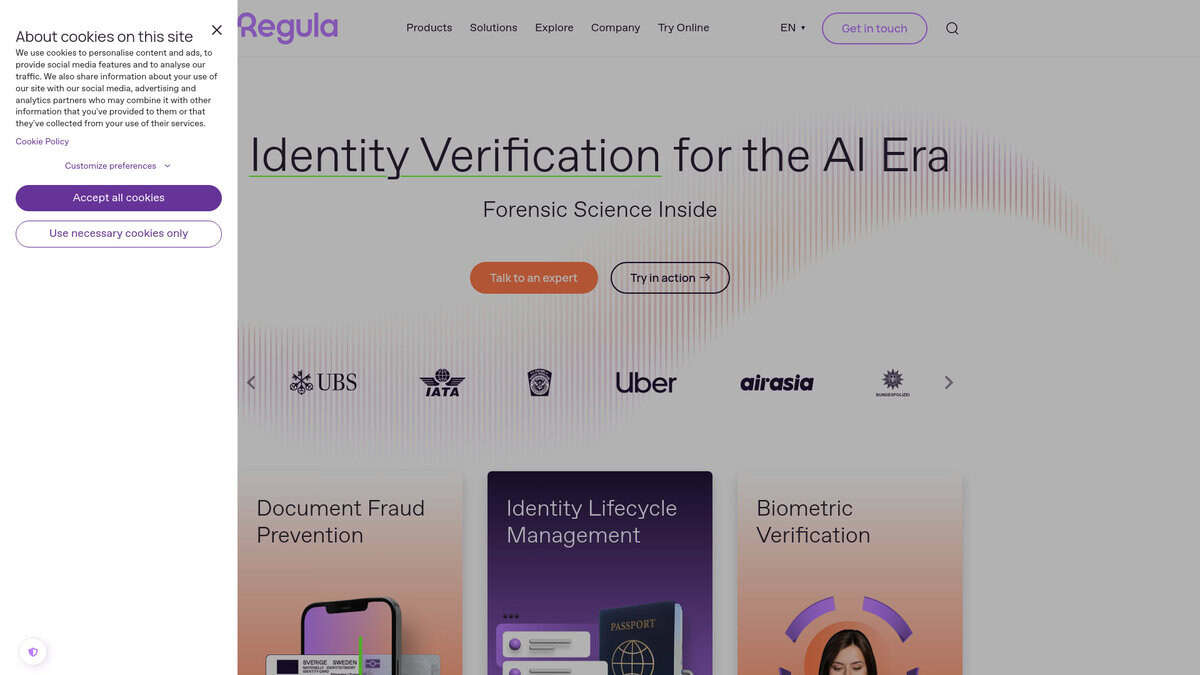
Most tools in this list handle transaction fraud. Regula does something different. It verifies identity documents at the point of onboarding. If your business needs to confirm that someone’s ID is real and matches their face, this is what Regula was built for.
I dug into their forensic document analysis and was surprised by the depth. Regula checks the visual zone, MRZ, NFC chips, barcodes, and holograms. It cross-references data points across the entire document. Their Face SDK combines active and passive liveness detection with face matching. According to Biometric Update, it supports more than 16,000 identity documents from over 250 countries. That kind of coverage matters if you operate internationally.
The real-world deployments speak for themselves. Uber is using Regula for driver onboarding across Poland. The Brazilian Federal Police expanded a nationwide deployment of Regula’s forensic document technology. Honeywell’s Sine platform integrated Regula for contractor compliance. These aren’t small pilots. They’re scaled operations that trust the technology with high-stakes verification.
On Gartner Peer Insights, Regula holds a 4.8 out of 5 rating. One reviewer from May 2026 called it “excellent and reliable automated ID verification” in a highly regulated environment. That track record matters when you’re dealing with compliance.
That said, Regula isn’t for everyone. If you just need basic liveness checks without document forensics, the breadth of this platform might be overkill. Some users also mention that implementation requires real technical expertise. You won’t plug this in over a weekend.
Regula claims up to 50% reduction in onboarding costs and 210% ROI, though those are vendor numbers. The Gartner Magic Quadrant placement in 2026 gives them independent credibility though. For businesses handling identity-heavy onboarding in regulated industries, Regula sits in a different category than the payment fraud tools here. I’d recommend it specifically if document verification is a core part of your compliance workflow.
SEON
Best For | Spotting suspicious users at registration and login |
Pricing | Starts at $699/month; Premium is custom |
Key Signals | 900+ digital and device signals |
Setup Time | Average 14 days via single API |
Ratings | Gartner 5.0/5, G2 4.6/5, Capterra 4.9/5 |
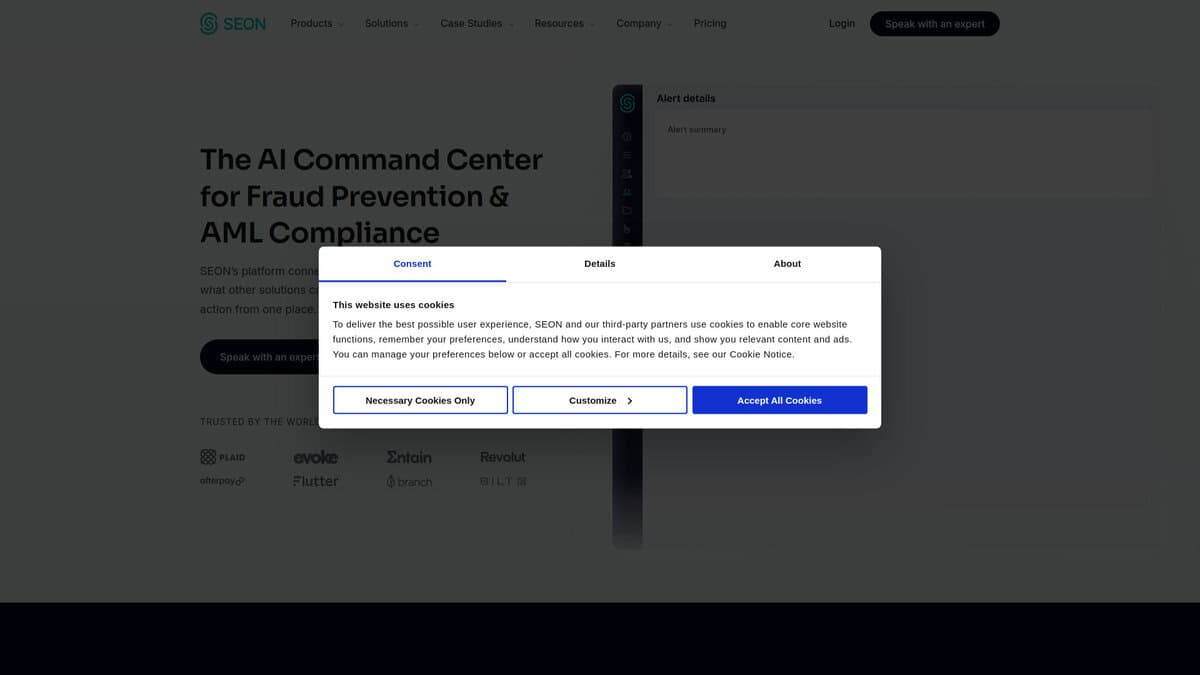
The first thing I noticed was how SEON builds a profile the moment someone enters an email or phone number. It checks that data against 900+ digital and device signals in real time, giving you a picture of whether a digital identity actually exists or was just invented five minutes ago.
That digital footprint approach is what separates it from tools focused purely on transaction scoring. If your problem is fake signups, bot-driven registrations, or account takeover at login, SEON is built exactly for that front door.
What impressed me in practice was the natural language rule builder. Instead of writing complex logic, you describe what you want to detect and the system suggests rules with predicted accuracy scores. It makes tuning fraud detection less of an engineering project and more of a collaborative process between your team and the platform.
The honest limitation is that SEON functions more as a data enrichment layer than a deep transaction-level fraud engine. One cybersecurity practitioner put it as “more of a data enrichment layer, good for pulling extra signals during onboarding.” If you need heavy payment scoring, you might need to pair it with something else.
Given the perfect score on Gartner Peer Insights, strong ratings across G2 and Capterra, plus named customers like Revolut and Afterpay, it is a solid choice for businesses focused on catching suspicious users early in their lifecycle.
Stripe Radar
Pricing | $0.05/tx (Standard), $0.25/tx (with Chargeback Protection) |
Free Plan | Baseline Radar included with every Stripe account |
Best For | Stripe-native merchants handling payment fraud |
Ease of Use | Zero setup on Stripe, works from day one |
Platforms | Web (Stripe Dashboard), API |
The reason is simple and hard for competitors to replicate. Stripe says there is a 92% chance Radar has seen a card before, somewhere else on its network, across millions of merchants. That network effect is what makes the default setting surprisingly good. It also analyzes behavioral signals like how fast you fill a form or whether you pasted your card number in, catching bot attacks that static rules miss.
Radar got a major upgrade at Sessions 2026. The standout additions are free trial abuse prevention with 95% precision, bot detection for AI agents, and custom models now generally available. Stripe also made Radar work outside Stripe payments for the first time. The tool now covers the full customer lifecycle, from signup through post-purchase, which is a significant expansion.
The pricing is what sells it for smaller teams. A third-party breakdown of Stripe’s 2026 pricing confirms the tiers. At $0.05 per screened transaction with no monthly minimums, a store processing a few hundred orders a month pays almost nothing. The custom rules engine lets you layer your own logic on top of Radar’s scoring. You could require 3D Secure for orders over $500 from new customers while auto-approving repeat buyers.
Independent testing backs this up. SmartFinPro gave Radar a 4.5/5 rating after screening over 5,000 transactions, reporting a 95%+ detection rate with only 1-2% false positives. That’s a solid balance between catching fraud and not annoying your real customers.
The catch? Radar is a payment processor’s fraud layer, not a full ecommerce fraud platform. It won’t stop account takeovers, return fraud, or post-purchase abuse. It’s a solid default for Stripe merchants comfortable owning the approval decision and chargeback risk. If your exposure goes beyond payment fraud, tools like Riskified or Signifyd fill those gaps.
Sift
Pricing | Per-event model, $29.6K-$600K/yr (median ~$150K) |
Free Plan | No |
Best For | Online businesses needing broad fraud coverage across payments, accounts, and content |
Setup Time | 3-6 weeks to first value |
API | Yes, 300+ signals evaluated per transaction |
For online businesses that need fraud detection across the full customer journey, not just at checkout.
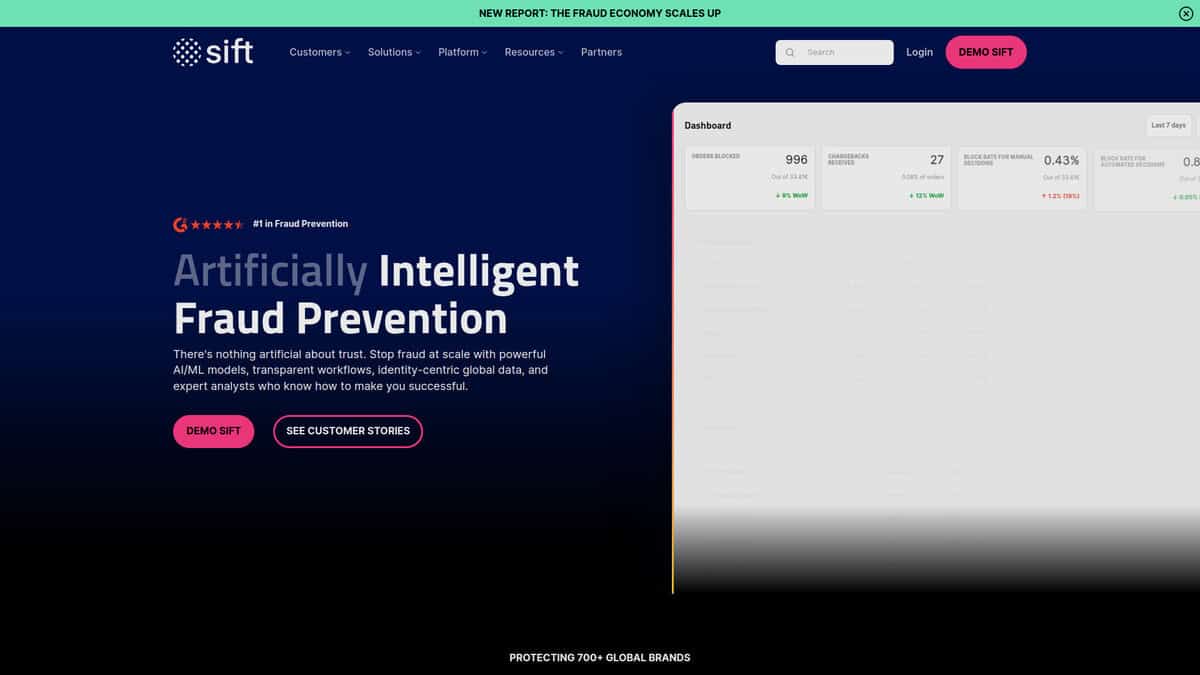
Most fraud tools I evaluated focus on one thing: catching bad transactions at checkout. Sift covers a much wider surface. It tracks users from signup through login, payments, and ongoing account activity. That means it catches fake account creation, account takeovers, promo abuse, content spam, and payment fraud in one platform instead of requiring separate tools for each.
The network effect is what gives Sift its real edge. Its data network processes over one trillion events annually across 34,000+ sites and holds 2.1 billion digital identity profiles. New-to-you fraudsters are often not new to Sift’s network. That kind of visibility is something smaller competitors simply cannot replicate.
Pricing runs per event, between $0.01 and $0.05 per API call. According to Vendr data from 50 real purchases, the median annual contract sits around $150,000. That’s generally cheaper than guarantee-model competitors like Riskified or Signifyd. But here’s the tradeoff: Sift does not include a chargeback guarantee. You’re paying less upfront and absorbing more risk yourself. For merchants with fraud rates below 0.3%, the math works in your favor.
Setup is where Sift loses some ground. Gartner Peer Insights reviews consistently flag the initial configuration as challenging. Expect three to six weeks before you see results, and your fraud team will need six to ten hours a week during that stretch. Competitors like Signifyd and Riskified typically reach first value in one to two weeks. There’s also no native BigCommerce integration, which could be a dealbreaker depending on your stack.
The 2026 product updates caught my attention though. ActivityIQ is a generative AI assistant that summarizes risk patterns across multiple user sessions in seconds. ThreatClusters uses industry-specific consortium models that can improve decision accuracy by up to 20%. These solve real problems that fraud analysts face daily.
Vendor-reported case studies show strong results: Patreon claims 19x ROI, ChowNow reports 99% fewer chargebacks, and Harry’s cut chargebacks 85% with a single fraud team member. G2 also ranked Sift number one across all three fraud prevention categories in Summer 2026. Take those with the usual grain of salt, but if your fraud problem extends beyond checkout disputes, Sift’s breadth is hard to match. Budget for the setup effort and go in knowing you won’t get a chargeback guarantee.
Riskified
Pricing | Pay only for approved orders; contracts start at $60K/year on AWS Marketplace |
Free Plan | Free to install on Shopify; additional charges apply per transaction |
Best For | Mid-to-large ecommerce stores facing high chargeback volume |
Ease of Use | Simple dashboard; reviewers consistently highlight its efficiency and ease of use |
Platforms | Shopify, custom builds, multi-processor setups |
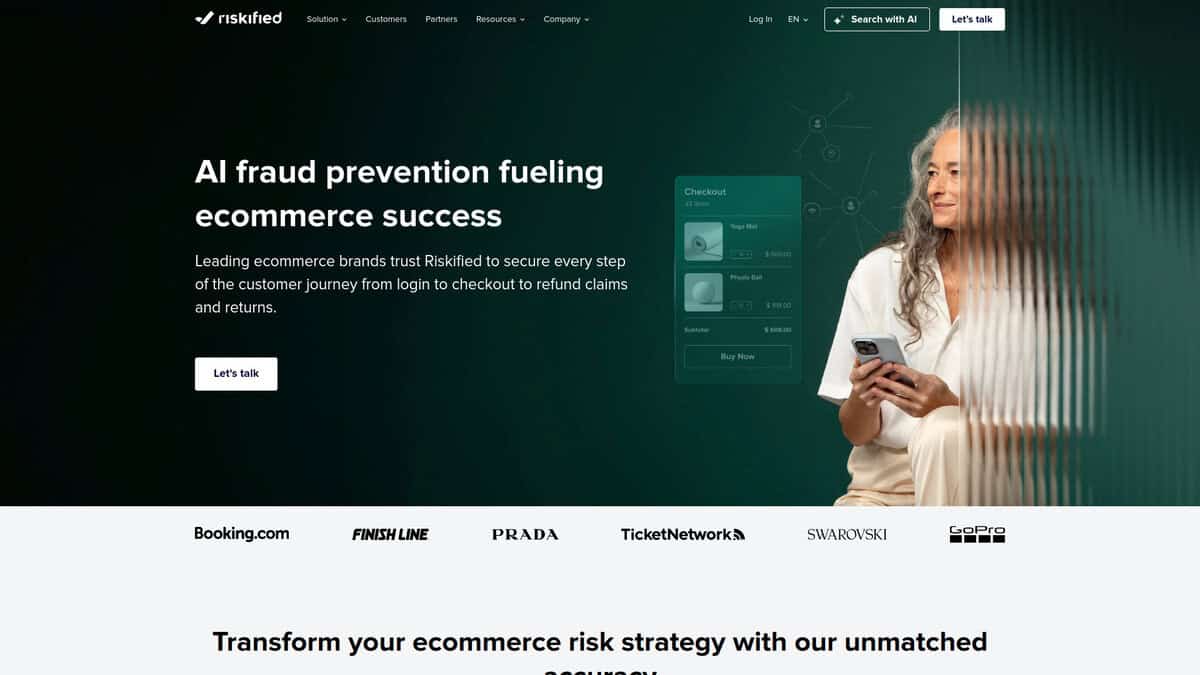
What caught my attention first was the chargeback guarantee. Riskified doesn’t just flag suspicious orders. It takes financial responsibility for them. If they approve an order and it turns out fraudulent, they cover the chargeback. Every single one, uncapped. That’s a bold promise.
I dug into how this actually works for merchants. The model is pay-only-for-approved-orders, so you’re not bleeding fees on transactions that never happen. Riskified’s research suggests merchants may be turning away roughly $50 billion in legitimate revenue annually due to false declines. The platform aims to approve more good orders instead of blanket-declining anything that looks slightly off.
The platform runs machine learning across over a billion historical transactions. Decisions happen in sub-second time. I found the dashboard straightforward. Nothing flashy, but it gets the job done without requiring a data science degree.
Consumer reviews paint a different picture. On Trustpilot, shoppers rate it 2.1 out of 5, mostly complaining about being blocked at checkout on stores like Dyson and JB HiFi. That’s the trade-off. Fewer chargebacks for you, but some legitimate shoppers might get turned away.
Riskified earned a spot on CNBC’s World’s Top Fintech Companies 2026 list in the Payments category for the second time. That gives some third-party weight to the claims.
If you run a growing ecommerce store and chargebacks are a real headache, this is worth a serious look. The guarantee alone removes a financial risk most tools won’t touch.

Feedzai
Pricing | Enterprise-only, no public pricing |
Best For | Tier 1 and tier 2 banks, global payment providers |
Ease of Use | 4.4/5 on Capterra (11 reviews) |
Differentiator | Integrated fraud + AML in one platform |
Review Rating | 4.9/5 on Gartner Peer Insights |
The first thing I noticed about Feedzai is how unapologetically big-bank it is. This is not a tool you deploy over a weekend. It processes over 3,000 events per second across more than a billion consumers, and the $9 trillion in annual payment volume it touches tells you exactly who its buyers are.
For banks drowning in false positives, the 12:1 ratio is the headline number. That means twelve genuine fraud catches for every false alert. One EU bank reported catching 70% of scams while blocking only 0.08% of total events. If your fraud ops team spends more time investigating legitimate transactions than stopping real ones, this ratio matters.
APP fraud is where Feedzai impressed me most. UK Finance reports that banks lost £450.7 million to authorized push payment fraud in 2024. Feedzai’s collaboration with Form3 won a Datos Insights award for achieving 95% APP fraud detection accuracy by analyzing both sender and beneficiary behavior in real time. That dual-sided analysis is something most competitors in this list simply do not offer.
The June 2026 IQ Score launch changed the conversation for mid-sized banks too. Previously, Feedzai’s intelligence network was available only to institutions that could afford the full platform. Now it is accessible via a single API on AWS Marketplace, claiming 4x more fraud detected and 50% fewer alerts from day one.
The catch? Implementation is heavy. Practitioners on Reddit consistently describe Feedzai as tier-1 bank territory requiring a dedicated team and serious budget. It is also the only tool in this listicle that combines fraud and AML in one platform, which is a genuine advantage but also means you are committing to one vendor for both workloads. If you are a regional bank or fintech looking for something lighter, the tools elsewhere in this list will get you running faster. But if you are a bank with the scale to absorb a complex deployment, Feedzai is the benchmark to measure against.
Signifyd
Pricing | Custom quotes (% of approved GMV) |
Free Plan | No |
Best For | Mid-market to enterprise ecommerce |
Ease of Use | Moderate |
Platforms | Shopify Plus, BigCommerce, Adobe Commerce, Salesforce |
Signifyd does something most fraud tools won’t. It takes financial liability for the orders it approves. When an approved order later results in a chargeback, Signifyd covers the loss. That alone sets it apart from tools that just hand you a risk score and wish you luck.
What surprised me is how broad that guarantee actually is. It covers both fraud and non-fraud chargebacks. That includes item not received, product unacceptable, duplicates, subscription cancellations, and authorization issues. Most competitors only guarantee fraud-related chargebacks. Botapolis’s breakdown of the guarantee model explains that you only pay for approved orders. Declined orders cost nothing. The incentive makes sense. Signifyd profits when it lets good orders through, not bad ones.
Here’s the catch nobody puts in the marketing. Chargeback.io points out that the guarantee does not lower your chargeback ratio toward Visa VAMP or Mastercard ECP thresholds. The chargeback still gets recorded against your account. You get reimbursed, sure. But if you’re near that 1.5% VAMP threshold, this won’t save you from monitoring programs. That’s a detail I’d want pinned to the wall before signing anything.
Pricing is custom and opaque. ERP Research notes that two merchants with identical revenue can receive very different quotes. Signifyd factors in your current chargeback losses, decline rate, and manual review effort. Not cheap for small sellers.
User reviews tell a split story. Shopify App Store sits at 4.4 out of 5 with 90 reviews. Most merchants praise the protection itself. Trustpilot paints a rougher picture. Complaints about unannounced billing changes, slow support during renewals, and false declines blocking legitimate orders.
For mid-market to enterprise merchants with high AOV and real chargeback exposure, Signifyd deserves a serious look. The guarantee model is genuinely different. Just go in with eyes open about the VAMP gap and the pricing.
Alloy
Pricing | Per-decision model (contact vendor) |
Best For | Fintechs and banks needing identity orchestration across the full customer lifecycle |
Data Partners | 270+ pre-built solutions |
Platforms | API-first, pre-built integrations with MANTL, Narmi, Clutch |
Ease of Use | Moderate learning curve; workflow builder is flexible but takes time to configure |
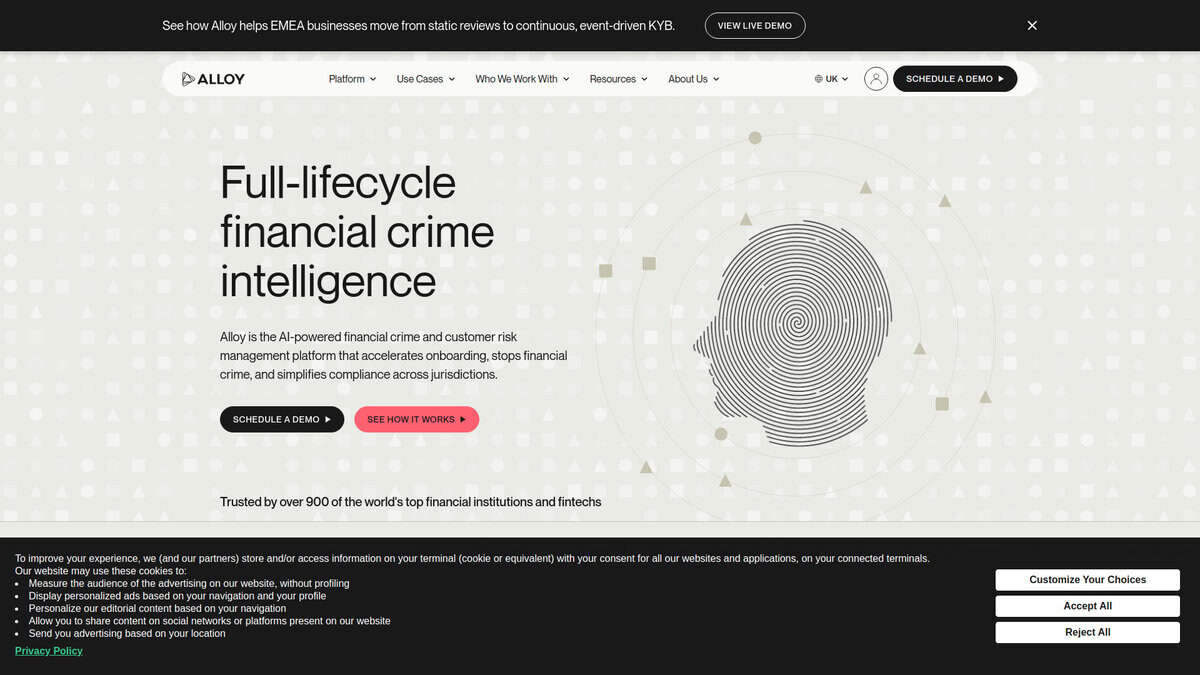
I went into Alloy expecting another identity verification tool. What I found was closer to a control tower. Alloy doesn’t just check if someone is real at the door. It pulls identity, account, and transaction data from 270+ partners and runs decisions at onboarding, login, and every touchpoint in between.
That orchestration approach is what sets Alloy apart from point solutions. Instead of building its own detection models on closed data, it connects best-in-class vendors into one decisioning layer. You can swap out a data source without tearing apart your integration. For a fintech scaling fast, that flexibility matters.
The numbers back this up. Suncoast Credit Union deployed Alloy starting at onboarding and expanded into ongoing monitoring. Their fraud losses dropped over 35% from 2023 to 2024, reversing a trend where losses had been climbing nearly 30% year-over-year. They also saw a 17% lift in digital membership completion and monitored 269 million logins. Alloy’s AI handles the bulk of those logins with minimal manual review.
The AI suite is genuinely interesting. Fraud Attack Radar catches portfolio-level attack patterns. Fraud Signal applies continuous ML-based scoring. Alloy reported that the AI Assistant automates 80% of high-volume watchlist hits at 98% precision.
Here’s my honest concern though. Alloy charges per decision. At low volumes, it’s reasonable. As you scale past a few hundred thousand monthly decisions, those costs compound quickly. If you’re a fast-growing fintech, model your long-term spend carefully before committing.
Pre-built integrations with digital account opening platforms like MANTL and Narmi mean you can be live in weeks, not quarters. Alloy’s own 2026 State of Fraud Report found that 91% of fraud leaders are seeing more AI-powered crimes. Their agentic AI approach feels like a direct response to that reality.
Alloy is the right pick if you want one platform managing identity risk from signup through ongoing account activity. If you only need payment fraud screening, there are narrower tools that cost less.