
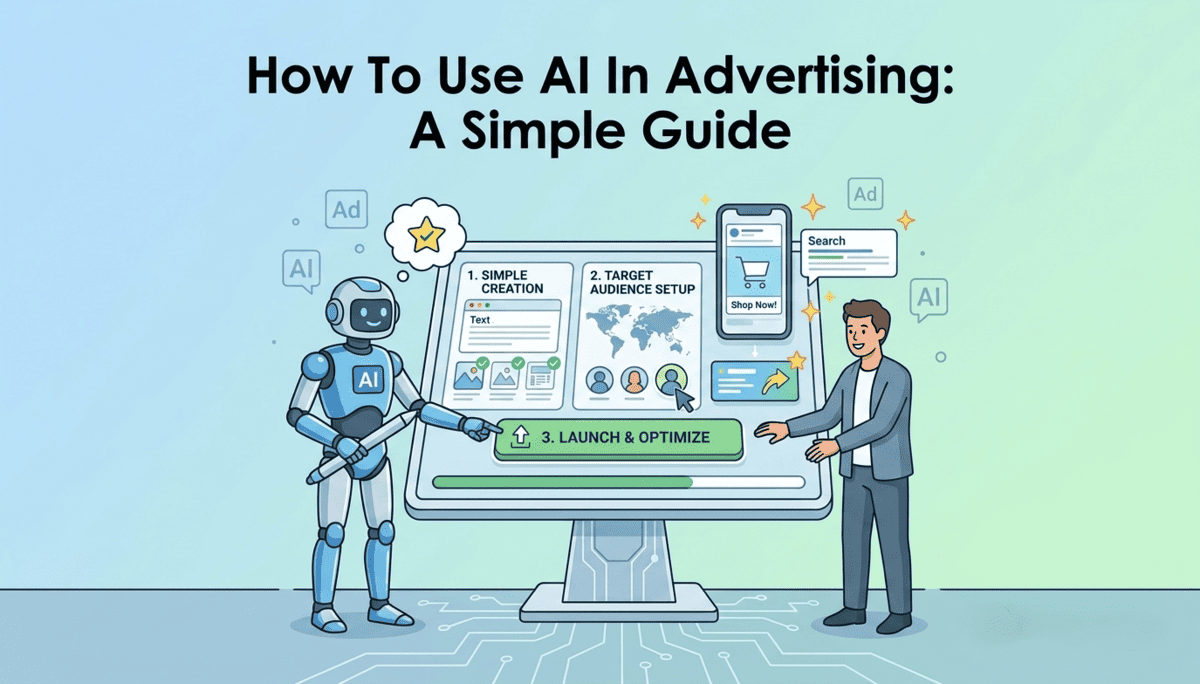
A couple of years ago, running an ad campaign meant spending weeks on market research, brainstorming creative ideas and creating visuals all by yourself. You’d launch a campaign, cross your fingers, and wait for the results to roll in.
Fast forward to 2026, and things look very different. AI has taken over a huge chunk of the advertising process. From writing ad copy to deciding who sees your ad and when, artificial intelligence is doing things that used to require entire teams of people.
And the best part? You don’t have to be a tech expert to use it.
In this guide, we’ll break down what AI in advertising means, how it’s being used right now, and how you can start using it for your own campaigns, even if you’re just getting started.
What Is AI in Advertising?
AI in advertising simply refers to using artificial intelligence tools and technologies to plan, create, run, and optimise ad campaigns. Instead of manually doing everything yourself, AI handles a lot of things like figuring out who your target audience is, writing ad headlines, adjusting your budget in real time, and even predicting which ad creative will perform best before you spend a single penny.
Here’s a simple example. Let’s say you’re running a Facebook ad for a new product. Traditionally, you’d pick the audience, write the copy, choose an image, set a budget, and then keep checking back to see how things are going.
With AI, platforms like Meta’s Advantage+ can automatically test different combinations of your ad creative, find the best-performing audience, and shift your budget towards what’s working, all without you lifting a finger.
In 2026, AI-powered advertising is not just an option anymore. It’s the default. Most major ad platforms, Google, Meta, and Amazon, now have AI baked into their systems. And if you’re not making use of it, you’re basically leaving money on the table.
How AI Has Changed Traditional Advertising
Traditional advertising was largely a manual game. Marketers would rely on demographic data, focus groups, and past campaign performance to guide their decisions. Creative teams would spend weeks developing concepts, and media buyers would negotiate placements and set bids by hand.
AI has flipped all of this. Here’s what’s changed:
- Audience targeting has gotten smarter. Instead of broad demographic categories like “women aged 25-34,” AI analyses behavioural signals, purchase history, and real-time intent data to find micro-audiences that are more likely to convert.
- Creative production has sped up dramatically. Tools powered by generative AI can now produce ad copy, images, and even full video ads in minutes. Google reported that advertisers used Gemini to generate nearly 70 million creative assets inside Performance Max campaigns in Q4 2025 alone.
- Campaign optimisation happens in real time. AI doesn’t wait for weekly reports. It continuously adjusts bids, reallocates budgets, and swaps out underperforming creatives on the fly. This means your campaigns are always improving, not just when you remember to check in on them.
- Predictive analytics has replaced guesswork. AI can now forecast campaign performance before you even launch. According to a Smartly survey of 450 marketing leaders, 31% of marketers said they want to use AI predictive models to forecast performance before a campaign goes live.
Key Benefits of Using AI in Advertising
If you’re still wondering if AI is worth the investment, here are some solid reasons to get on board:
- You can save time on repetitive tasks: Things like A/B testing ad variations, adjusting bids, and generating reports can all be automated with AI. This frees you up to focus on strategy and creative direction instead of getting bogged down in day-to-day campaign management.
- You can cut costs without cutting quality: Cost efficiency is one of the top benefits of AI in advertising in 2026, cited by 64% of ad executives in an IAB study. AI helps you spend smarter, not necessarily more.
- You can personalise ads at scale: Instead of creating one generic ad for everyone, AI lets you tailor messaging, visuals, and offers to different audience segments automatically. This makes your ads feel more relevant to each person who sees them.
- You can spot trends and issues early: AI-powered analytics tools can detect performance drops, audience shifts, and emerging trends faster than any human could. This lets you adjust your strategy proactively, not reactively.
- You can produce more creative variations: Need 50 different versions of an ad to test across channels? AI creative tools can generate dozens of variations in minutes, helping you find your winning combination much faster.
Use Cases of AI in Advertising
AI is being used across almost every aspect of advertising today. Here are some of the most impactful applications.
AI-Powered Ad Targeting and Segmentation
This is where AI really shines. Traditional targeting relied on broad categories, but AI takes things to another level. Machine learning algorithms analyse massive amounts of data, browsing behaviour, purchase history, location patterns, device usage, to build highly specific audience segments.
For example, instead of targeting “fitness enthusiasts,” AI can identify people who have recently searched for gym memberships, watched workout videos, and purchased protein supplements in the last 30 days. The result? Your ads reach people who are much more likely to take action.
AI Video Ad Creation
Video content is king in advertising right now, but producing high-quality videos is expensive and time-consuming. AI is changing that fast.
Tools like ByteDance’s Seedance 2.0 can now produce coherent multi-shot video sequences. You can create a full product commercial from a text prompt or a single product image. And if you already have existing video content, you can use tools like an AI video enhancer to improve resolution, adjust lighting, and sharpen details without needing a professional editing suite.
This is especially useful for small businesses and e-commerce brands that need video ads for social platforms but don’t have the budget for a full production crew.
Automated Ad Copywriting
AI tools like Jasper, ChatGPT, and Google’s built-in ad generators can now produce ad headlines, descriptions, and CTAs in seconds.
But here’s the thing, AI-generated copy works best when you:
- Feed the AI your brand guidelines and tone of voice.
- Provide context about your target audience.
- Use it as a starting point and refine the output with your own creativity.
Predictive Analytics and Budget Optimisation
AI doesn’t just help you run campaigns, it helps you plan them. Predictive analytics tools analyse historical data and market signals to forecast how a campaign is likely to perform before you even launch it.
This means you can:
- Predict which channels will deliver the best ROI for your specific goals.
- Allocate budget more effectively across campaigns.
- Identify the optimal time to launch ads for maximum impact.
If a product ad starts underperforming, the AI can automatically reallocate your budget to a stronger performer. No waiting. No manual adjustments. Just smarter spending from day one.
AI-Powered Competitive Intelligence
AI tools can now track your competitors’ advertising activity across multiple channels, what ads they’re running, what messaging they’re using, how their budgets are shifting, and which platforms they’re prioritising.
This kind of intelligence helps you make better strategic decisions. If you notice three competitors investing heavily in LinkedIn ads, that’s a strong signal the channel is working in your industry.
How to Use AI in Advertising: A Step-by-Step Approach
Ready to start using AI in your ad campaigns? Here’s a simple step-by-step process to follow:
Step 1: Audit your current campaigns
Before adding any AI tools, take a close look at where you’re spending time and money right now. Identify the bottlenecks: is it creative production? Audience targeting? Budget management? Reporting? Knowing your pain points helps you pick the right tools.
Step 2: Pick one high-value use case to start with
Don’t try to automate everything at once. Choose one area where AI can make the biggest immediate impact. For most advertisers, this is either creative generation or bid/budget optimisation.
Step 3: Select the right tools
Decide whether the AI features built into your existing ad platforms (like Google Ads or Meta Ads Manager) are enough, or if you need a specialised third-party tool. We’ve included a table of popular options below to help you decide.
Step 4: Train the AI on your brand
Feed your chosen AI tools with your brand guidelines, past campaign data, audience information, and performance benchmarks. The more context you give, the better the outputs will be.
Step 5: Run a pilot and measure results
Start with a small test campaign. Set clear KPIs, click-through rate, cost per conversion, return on ad spend, and measure the results after a few weeks.
Step 6: Optimise and scale
Based on what you learn from your pilot, refine your approach. Then gradually expand AI usage to other parts of your advertising workflow.
Best AI Tools for Advertising
Here’s a quick overview of popular AI tools you can use for advertising in 2026:
Tool | Best For | Pricing |
|---|---|---|
Google Ads (AI Max / Performance Max) | Automated bidding, targeting, and creative testing | Pay-per-click (free platform) |
Meta Advantage+ | Automated Meta/Instagram ad campaigns | Pay-per-click (free platform) |
Jasper AI | Ad copywriting and marketing content | Paid (starts at $49/month) |
AdCreative.ai | AI-generated ad creatives and banners | Paid (starts at $21/month) |
Canva Magic Studio | Quick ad design for non-designers | Free tier available; Pro at $15/month |
Madgicx | Meta ads optimisation and audience targeting | Paid (based on ad spend) |
Albert AI | Autonomous cross-channel campaign management | Paid (custom pricing) |
Pencil | AI-powered video and static ad generation | Paid (starts at $49/month) |
Adzooma | PPC optimisation across Google, Meta, and Microsoft | Free tier available; paid plans from $99/month |
Midjourney | AI-generated images for ad creatives | Paid (starts at $10/month) |
Common Challenges in Using AI for Advertising
AI is powerful, but it’s not perfect. Here are some challenges you should be aware of:
- Data quality matters a lot. AI is only as good as the data you feed it. If your customer data is messy, outdated, or incomplete, the AI’s targeting and recommendations will suffer. Garbage in, garbage out.
- There’s a risk of creative sameness. AI-generated creative risks making brands look and sound the same. When everyone’s using the same tools, standing out becomes harder.
- Consumer trust is still a work in progress. 45% of Gen Z and Millennial consumers feel positive about AI-generated ads, which is much lower than the 82% of ad executives who assumed consumers felt positive. There’s a real perception gap here.
- AI can be a black box. Some AI tools don’t explain why they made certain decisions. This lack of transparency makes it difficult to learn from the results or troubleshoot when things go wrong.
- Privacy regulations keep evolving. With data privacy laws expanding globally, you need to make sure your AI tools comply with regulations like GDPR and CCPA. Using first-party data responsibly is more important than ever.
Best Practices for Using AI in Advertising
To get the most out of AI in your advertising efforts, keep these practices in mind:
- Always keep a human in the loop. AI can automate and optimise, but it shouldn’t run entirely unsupervised. Review AI-generated creatives, check targeting decisions, and make sure everything aligns with your brand voice and values.
- Start small and scale gradually. Don’t overhaul your entire advertising setup overnight. Test AI on one campaign or one channel first, learn from the results, and then expand.
- Feed AI with quality data. Make sure your customer data, brand guidelines, and conversion signals are clean and up to date. The better the inputs, the better the outputs.
- Don’t rely on AI for creativity alone. Use AI to speed up creative production, but add your own unique ideas and perspective. The brands that win are the ones that combine AI efficiency with genuine human creativity.
- Be transparent with your audience. Research shows that consumers respond better to AI-generated ads when brands disclose AI usage. Transparency builds trust and can actually increase purchase likelihood.
- Monitor performance continuously. AI optimisation is not a set-it-and-forget-it situation. Regularly check your campaigns, review AI decisions, and refine your strategy based on real results.
- Stay updated on platform changes. AI features on ad platforms evolve fast. Google, Meta, and others frequently roll out new AI capabilities. Staying current helps you take advantage of new features before your competitors do.