
Most marketing teams treat AI as a glorified copywriting assistant. The companies pulling well ahead are using it for something far more precise: predicting exactly who buys, when, and why.
According to AI marketing statistics from 2025, customer targeting powered by AI produced 40% higher conversion rates and 35% increases in average order value. Those gains stem from smarter segmentation, not sharper headlines.
Here is where the strongest returns are showing up and which applications are worth prioritizing this year.
Key AI Marketing Statistics for 2025
AI marketing adoption doubled in two years while full transformation barely moved: the numbers below tell both stories.
- 87% of marketers use generative AI in at least one recurring workflow as of Q1 2026, up from 76% in Q1 2025 (Salesforce State of Marketing 2026)
- That rate has nearly doubled from 51% in Q1 2024, making AI marketing tools the fastest-adopted category in the modern stack
- Virtually zero CMOs report having fully transformed their marketing function with AI, and only a tiny fraction say AI is integrated across all areas (Spencer Stuart 2026)
- Marketing teams using AI across core functions report a 44% increase in output and ROI versus non-AI peers (SQ Magazine 2026)
- AI-optimized campaigns generate 1.5x to 1.7x higher returns than traditional approaches, with first-year ROI gains in the 15-40% range
- 89% of marketers use generative AI for content creation as of 2026 (Averi State of AI in Marketing)
- 86% of marketers say AI saves more than an hour daily on creative tasks, with senior practitioners saving 8-10 hours weekly (HubSpot AI Trends 2026)
- The average marketer saves 6.1 hours per week using AI, while junior staff save 3-4 hours (HubSpot AI Trends 2026)
- AI now powers 15.1% of all marketing activities as of 2026 (SQ Magazine 2026)
- 34% of enterprise marketing teams run at least one autonomous agent in production, more than double the 14% reported in Q4 2025
AI Marketing Adoption and Implementation Statistics
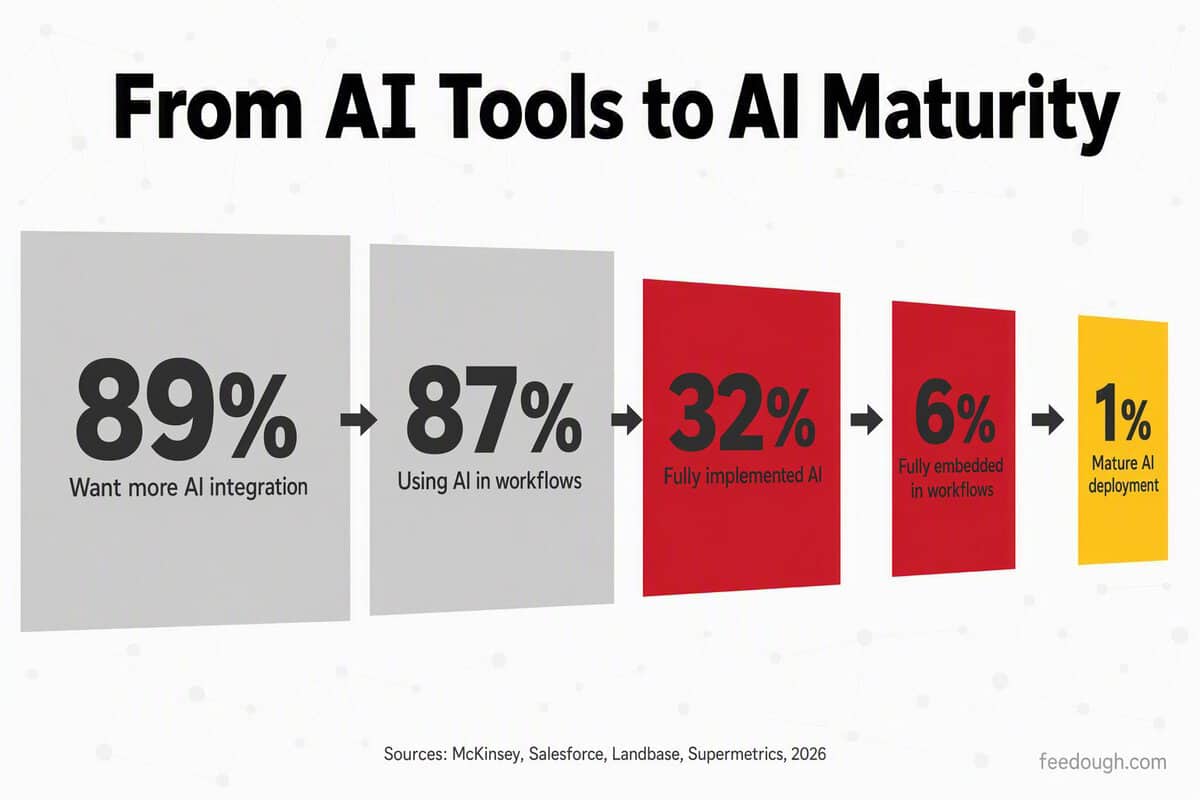
Only 1% of business leaders describe their companies as mature in AI deployment. Meanwhile, 92% plan to increase AI investment over the next three years, according to McKinsey. Nearly every marketing team claims to be using AI, but almost none have built the infrastructure to use it well. The average marketer now juggles 4.3 different AI tools.
Metric | Value | Source |
|---|---|---|
Using AI in at least one recurring workflow | 87% | Salesforce 2026 |
Wanting more AI integration into existing tools | 89% | Salesforce 2026 |
Fully implemented AI solutions | 32% | Landbase 2026 |
Fully embedded AI into workflows | 6% | Supermetrics 2026 |
Average AI tools used per marketer | 4.3 | Chiefmartec 2026 |
AI marketing adoption statistics show the same pattern across every survey: teams are adopting AI tools faster than they are building the workflows to use them properly. The mismatch between tool proliferation and deep integration is where most AI marketing investments are going to waste.
Surface vs. Deep AI Marketing Integration Gap Statistics
78% of marketers use AI daily. 78% of agencies design campaigns with it. Same percentage, entirely different populations, and neither tells you whether AI is actually reshaping how decisions get made.
Integration Depth | Adoption Rate | Population | Source |
|---|---|---|---|
Daily workflow use | 78% | All marketers globally | HubSpot 2026 |
Generative AI in campaign design | 78% | Marketing agencies | Statista 2026 |
Predictive analytics for planning | 92% | Top-performing teams only | SQ Magazine 2026 |
The first 78% counts individual access. The second measures agency-level deployment. Even the agency figure climbed 42% from 2023, yet neither reaches the strategic layer. 92% of top-performing teams use AI-driven predictive analytics for campaign planning, per SQ Magazine. That level of integration remains confined to a small fraction of the market. The divide is organizational, not technological.

AI Marketing Adoption Statistics by Company Size
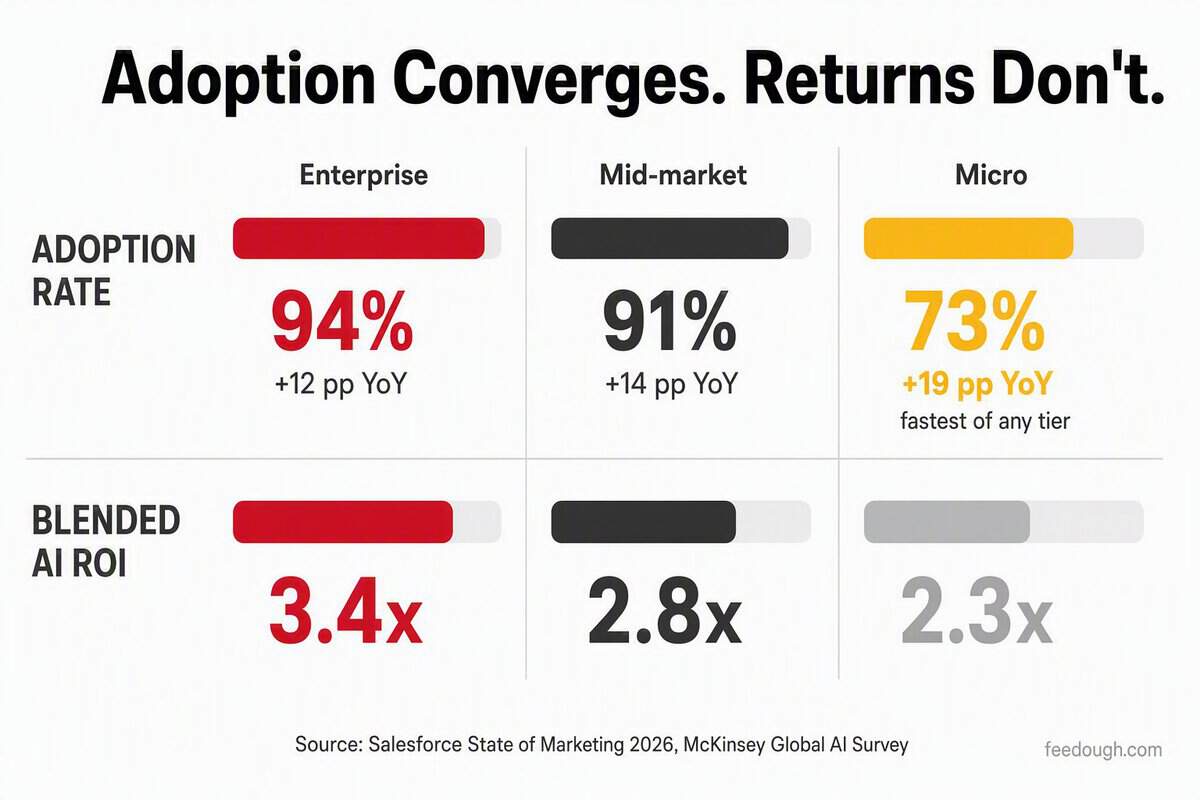
Enterprise teams hit 94% AI adoption in Q1 2026. Micro teams reached 73%, closing the gap to just 21 percentage points. That 19-point jump was the fastest of any tier, according to Salesforce’s State of Marketing 2026.
Company Size | Q1 2025 | Q1 2026 | YoY Change |
|---|---|---|---|
Enterprise (250+ marketers) | 82% | 94% | +12 pp |
Mid-market (50–249 marketers) | 77% | 91% | +14 pp |
Micro (1–10 marketers) | 54% | 73% | +19 pp |
Adoption is converging. Return is not. Enterprise teams report a 3.4x blended AI ROI, compared to 2.8x for mid-market and 2.3x for SMBs, per McKinsey’s Global AI Survey.
The difference traces to failure tolerance. 88% of AI pilots never reach production deployment, according to CIO research, and large enterprises absorb those losses at scale. S&P Global found enterprises abandoned an average of 2.3 AI initiatives in 2025, compared to 1.1 for mid-market firms. Smaller teams that pick the wrong pilot have fewer chances to try again.
AI Marketing Adoption by Region and Use Case Statistics
Geographic spread in AI marketing adoption covers just 20 percentage points across five global regions. North America leads at 91%, the Middle East and Africa sits at 71%, and the points between them form a remarkably flat gradient. The functional story tells a very different tale, per HubSpot’s AI Trends 2026 survey.
Region | AI Adoption Rate |
|---|---|
North America | 91% |
Western Europe | 88% |
Asia-Pacific | 84% |
Latin America | 79% |
Middle East & Africa | 71% |
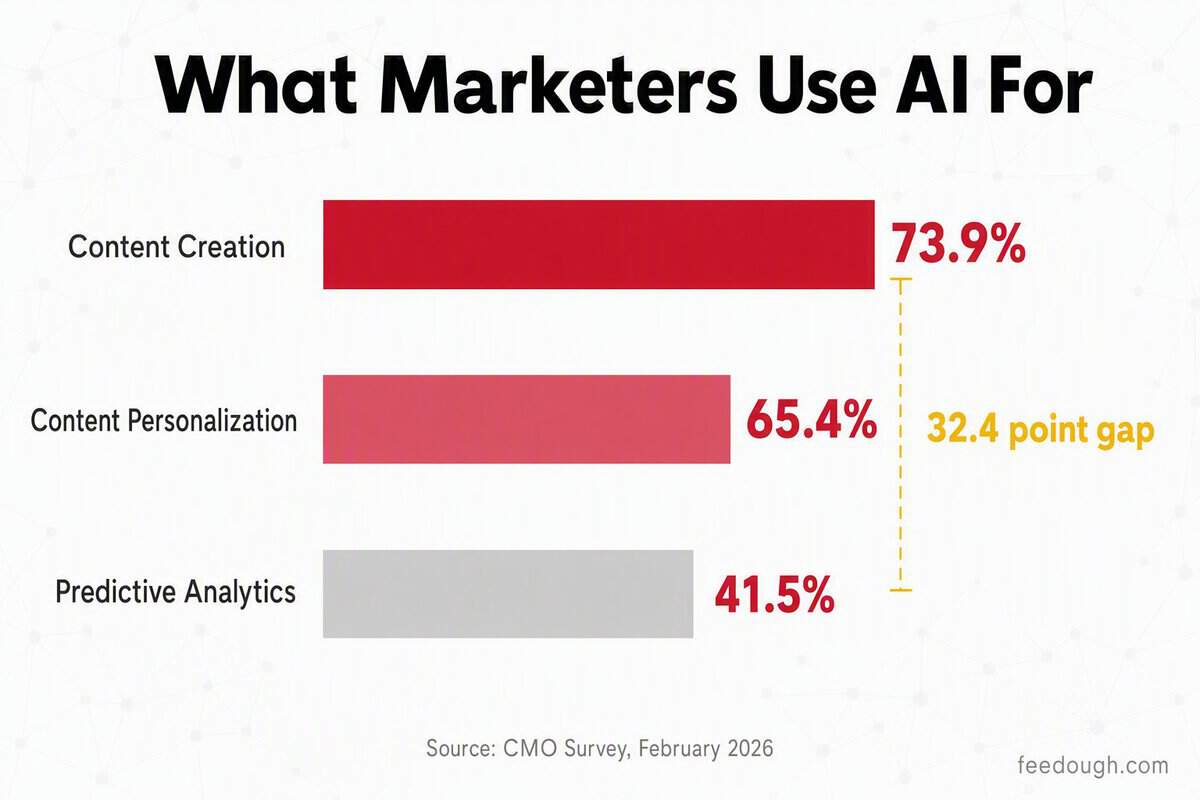
Content creation reached 73.9% of companies in early 2026, while predictive analytics for customer insights hit just 41.5%, per the CMO Survey’s February 2026 data. The gap between the most and least adopted AI use cases runs more than twice as wide as the geographic spread. AI agent deployment adds another layer of uneven maturity:
- 73.9% of companies use AI for content creation, making it the leading AI marketing use case (CMO Survey, February 2026)
- 65.4% have adopted AI-driven content personalization (CMO Survey, February 2026)
- 41.5% use predictive analytics for customer insights, less than half the content creation rate (CMO Survey, February 2026)
- 80% of enterprises now embed an AI agent in at least one production application, up from 33% in 2024, per Gartner
- Only 30% of CMOs report mature AI readiness, even though 70% call becoming an AI leader a critical goal for the year, per Gartner’s 2026 CMO Spend Survey
AI Marketing Use Cases and Applications Statistics
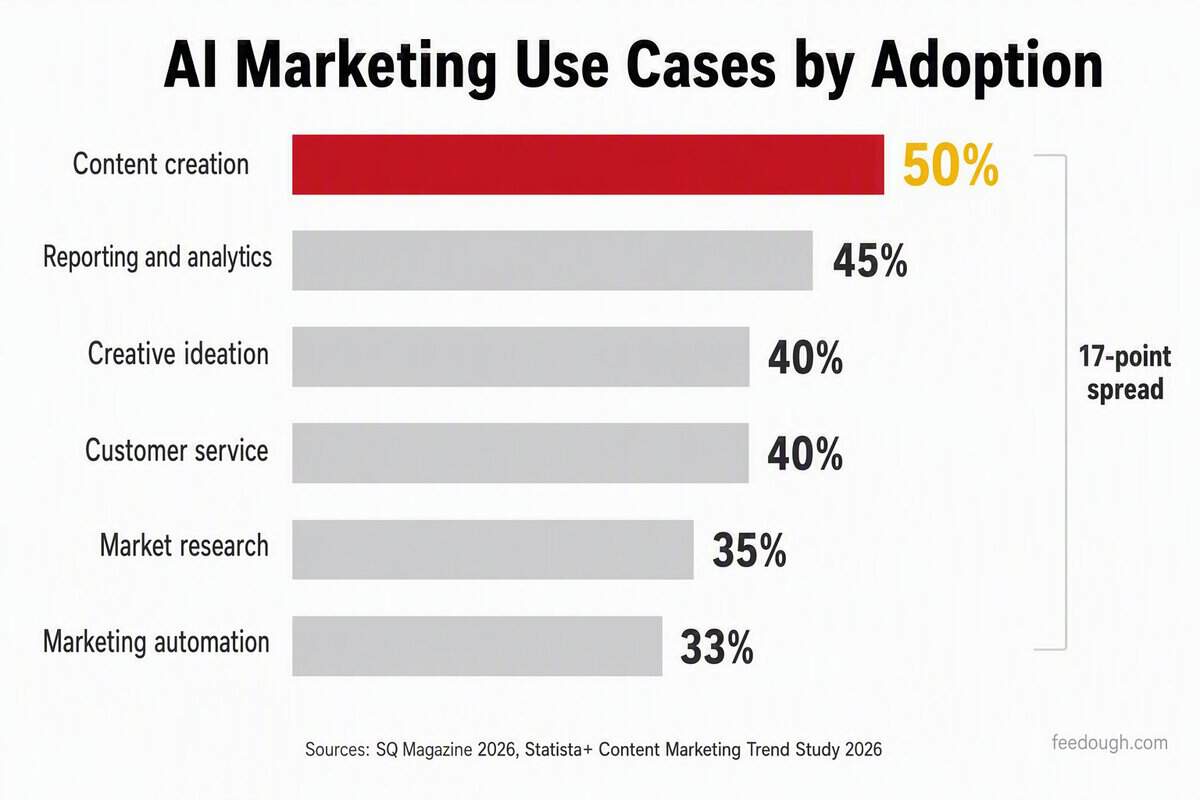
50% of marketers use AI primarily for generating content, double the rate of any other application. AI marketing use cases now span at least five distinct categories, each at different stages of adoption maturity.
Use Case | Adoption Rate | Source |
|---|---|---|
Content creation | 50% | SQ Magazine 2026 |
Reporting and analytics | 45% | Statista+ Content Marketing Trend Study 2026 |
Creative ideation | 40% | Statista+ Content Marketing Trend Study 2026 |
Customer service | 40% | Statista+ Content Marketing Trend Study 2026 |
Market research | 35% | SQ Magazine 2026 |
Marketing automation | 33% | SQ Magazine 2026 |
The 17-point spread between content creation and marketing automation reflects the difference between using AI as a tool and using AI as infrastructure.
Within content creation, adoption concentrates at the top of the workflow, where risk is lowest and output is most visible:
- 62% of marketers use AI for brainstorming topics
- 53% use it for summarizing content
- 44% use it for writing first drafts
Gartner’s CMO Spend Survey found 77% of GenAI-using marketers apply AI to creative development, the single most widespread use case across enterprise marketing teams. Only 4% of organizations report not using AI for content marketing at all. The adoption floor has been set. The ceiling is how far teams push past the creative layer into operational workflows that compound over time.
AI Content Creation in Marketing Statistics
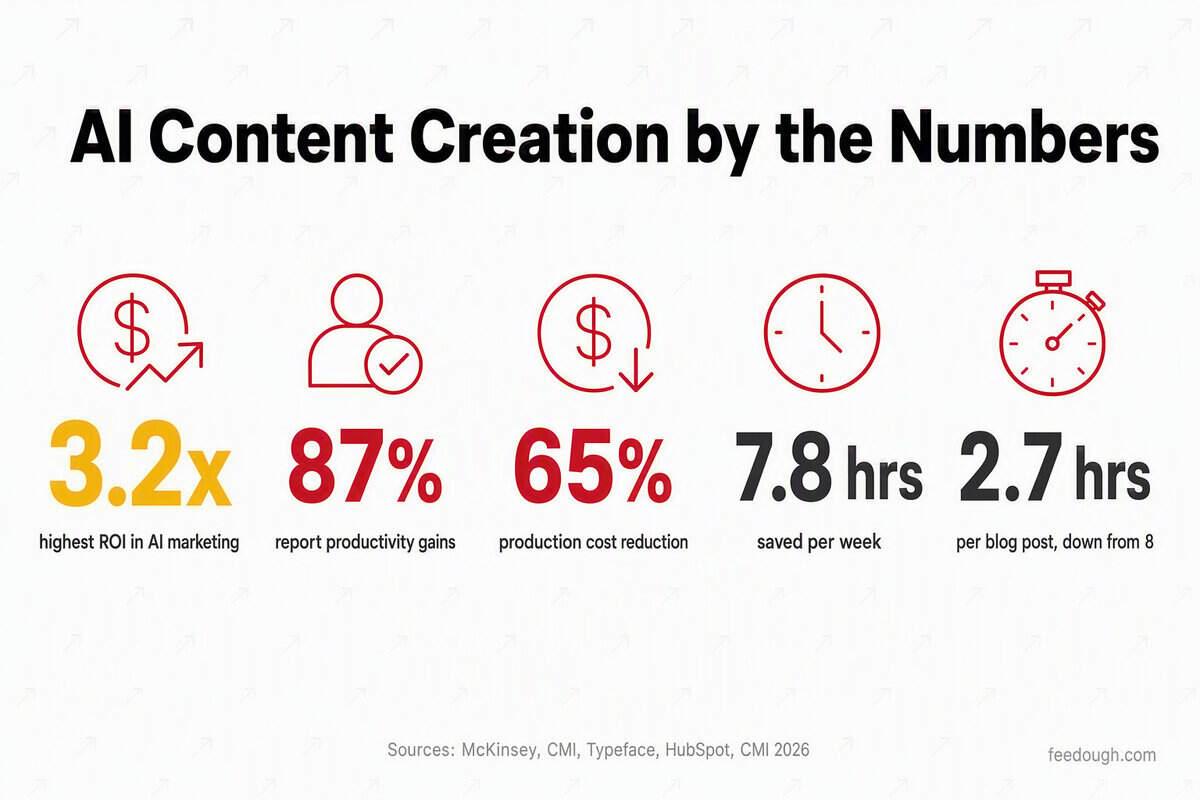
AI content drafting delivers 3.2x return on investment, the highest ROI of any AI marketing use case, per McKinsey’s Global AI Survey. Personalization engines come next at 2.7x. Nothing else clears 2x. The productivity data explains why content creation dominates the adoption curve.
Metric | Value | Source |
|---|---|---|
Monthly content output increase | +47% | Semrush 2026 |
Time per blog post | 2.7 hours (down from 8) | Content Marketing Institute 2026 |
Production cost reduction | 65% | Typeface 2026 |
Weekly time saved per marketer | 7.8 hours | HubSpot 2026 |
B2B marketers reporting productivity gains | 87% | Content Marketing Institute 2026 |
The output question is settled. AI cuts blog production from 8 hours to 2.7, handles first drafts and formatting, and lets editors focus on voice and strategy. 58% of marketers say AI has improved content quality, but 12% report the opposite, typically in teams that over-rely on automation without editorial oversight. The split in outcomes tracks directly with how much human judgment stays in the loop.
Customer Service AI Adoption and Impact Statistics
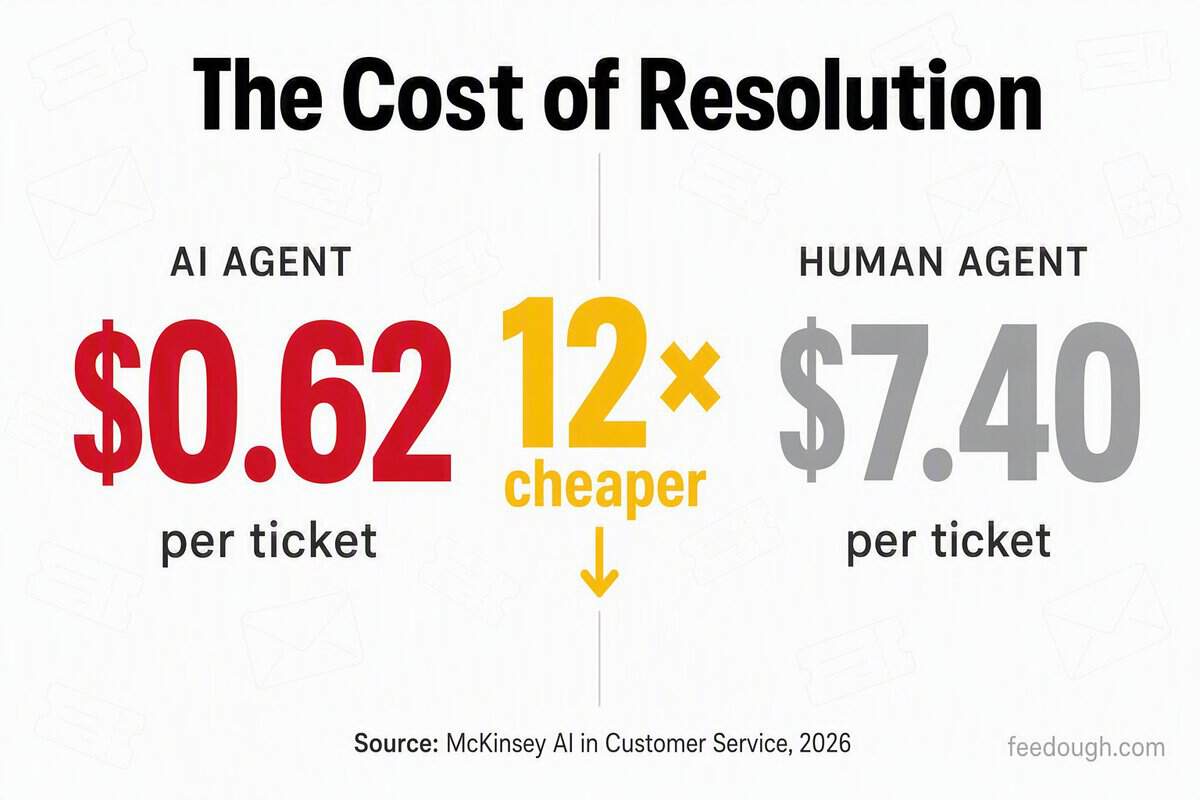
AI resolves a customer service ticket for $0.62. A human agent costs $7.40. That 12x gap explains why customer service accounts for 65% of all AI marketing applications, more than any other single use case.
Metric | Value | Source |
|---|---|---|
AI cost per resolution | $0.62 | McKinsey 2026 |
Human agent cost per resolution | $7.40 | McKinsey 2026 |
Self-service contact cost | $1.84 | Gartner/Lorikeet CX |
Agent-assisted contact cost | $13.50 | Gartner/Lorikeet CX |
Median tier-1 deflection rate | 41.2% | Zendesk 2026 |
Global AI customer service market | $15.12B (2026) | Lorikeet CX |
Adoption is accelerating along the same cost curve:
- 66% of customer service organizations now use AI agents, up from 39% in 2025 (Salesforce State of Service)
- AI chatbot adoption surged from 5% in 2020 to over 80% in contact centers by 2025 (Gartner)
- Voice-AI handles 19% of inbound volume in 2026, up from 6% in 2024, led by banking and telecom (Forrester)
- 92% of businesses report improved customer satisfaction after adopting AI in service (Lorikeet CX 2026)
Salesforce projects 50% of service cases resolved by AI by 2027, up from 30% in 2025. Gartner estimates conversational AI will cut contact-center labor costs by $80 billion.
AI SEO and A/B Testing Statistics
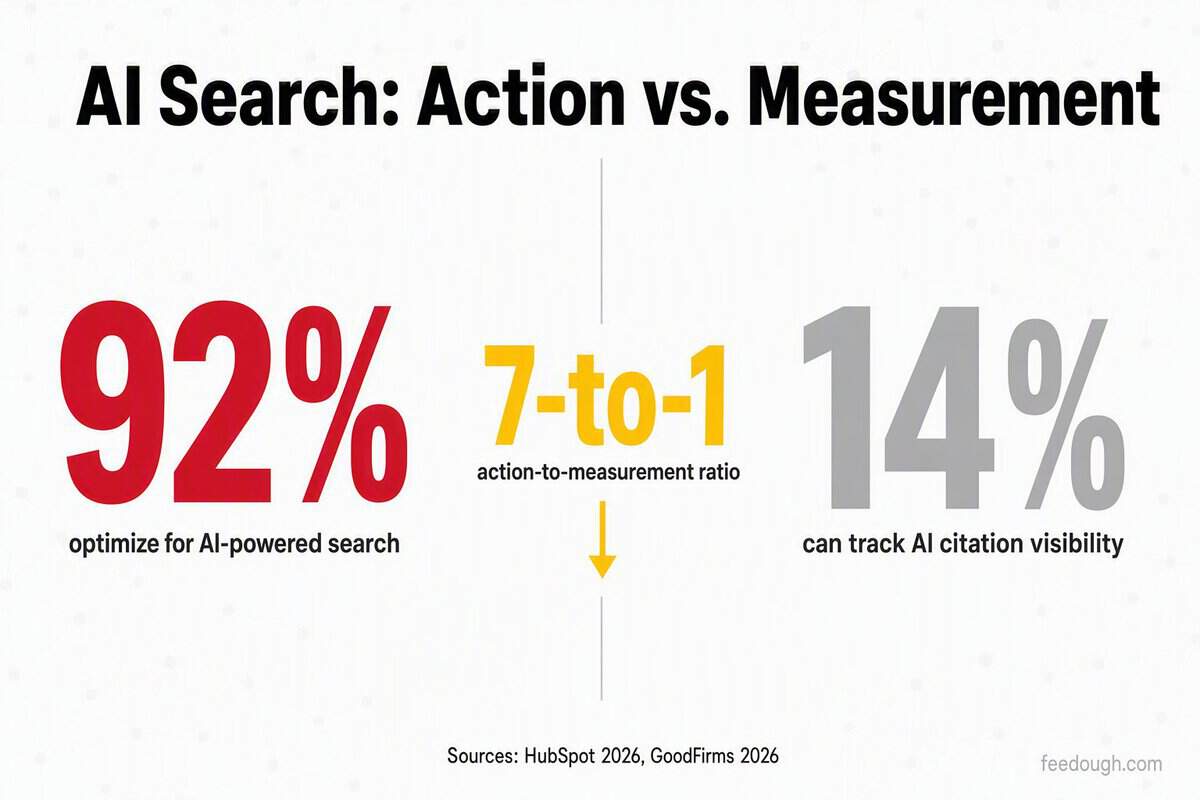
92% of marketers now optimize for AI-powered search engines. Just 14% can track whether those systems actually cite their content. The action-to-measurement ratio in AI SEO is roughly 7-to-1.
AI Overviews now trigger on 25.1% of Google searches, up from roughly 16% six months earlier, per Conductor’s analysis of 21.9 million queries. On pages with an AI Overview, the top organic result’s click-through rate falls from 1.41% to 0.64%. Ahrefs documented that 54% decline across 300,000 keywords. Only 43% of marketers actively implement GEO strategies in response, per GoodFirms’ 2026 survey.
Metric | Value | Source |
|---|---|---|
Marketers optimizing for AI-powered search | 92% | HubSpot 2026 |
Actively implementing GEO strategies | 43% | GoodFirms 2026 |
Google searches triggering AI Overviews (Q1 2026) | 25.1% | Conductor 2026 |
Position 1 CTR drop with AI Overview present | -54% | Ahrefs 2025 |
Track AI/LLM citation visibility | 14% | GoodFirms 2026 |
SEO professionals using AI in workflows | 86% | Aira 2025 |
The measurement gap carries a direct cost: AI search referral traffic converts 22% higher than traditional organic, per Digital Applied’s 2026 benchmarks. A/B testing shows what happens when infrastructure arrives first:
- 62% of CRO professionals use AI for hypothesis generation, traffic allocation, and results analysis (VWO 2026)
- AI-powered testing reaches statistical significance 31% faster: 14 days versus 21 for traditional tools (Digital Applied 2026)
- AI-allocated tests identify 18% more winning variations by detecting interaction effects across page elements simultaneously (Digital Applied 2026)
- Organizations running AI-powered testing produce 2.7x more experiments per quarter than manual methods (Digital Applied 2026)
- 37% of top-quartile converters use AI personalization versus just 8% of bottom-quartile converters (Digital Applied 2026)
AI Email Marketing, Social Media, and Predictive Analytics Statistics
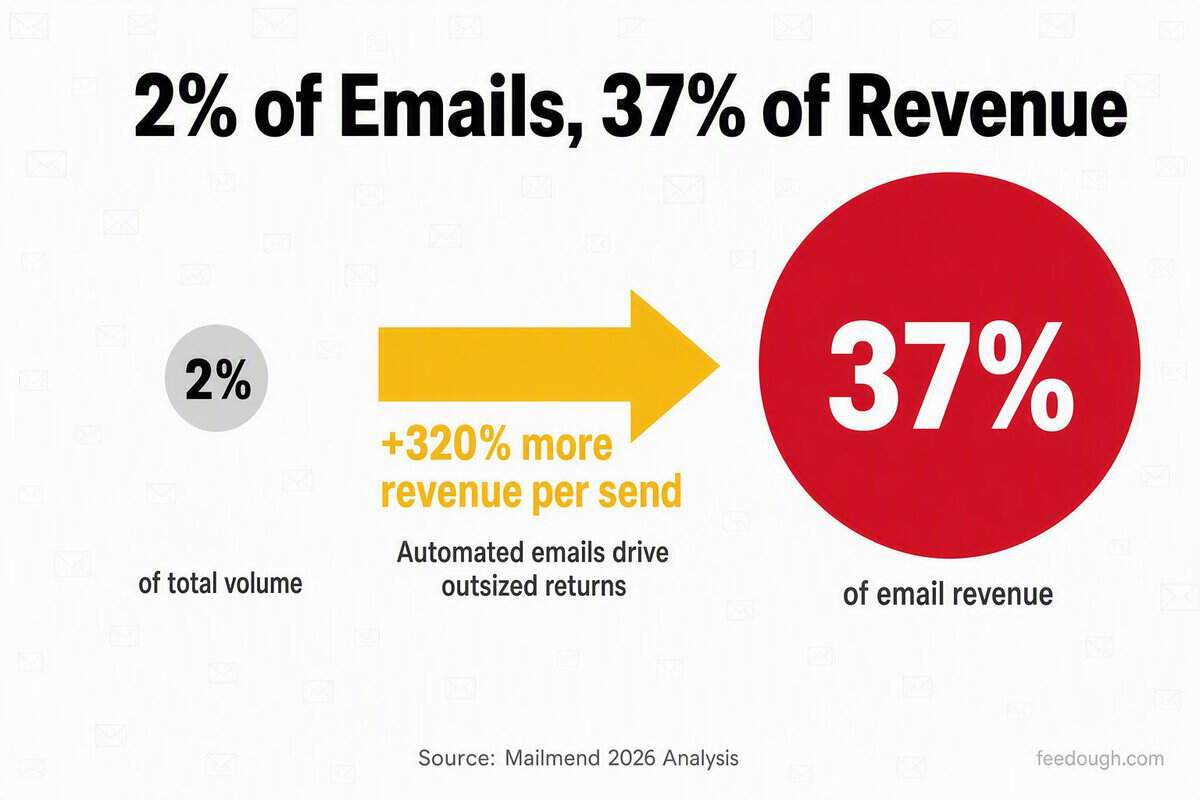
Automated emails generate 320% more revenue per send than non-automated campaigns. They make up just 2% of total email volume yet drive 37% of all email-generated sales, per Mailmend’s 2026 analysis.
Email Personalization Metric | Value | Source |
|---|---|---|
Automated email revenue lift vs. non-automated | +320% | Mailmend 2026 |
Automated email share of total volume | 2% | Mailmend 2026 |
Automated email share of total email revenue | 37% | Mailmend 2026 |
Triggered email opens vs. broadcast | 8x higher | Mailmend 2026 |
AI-powered email campaign revenue vs. traditional | +41% | Robly 2026 |
Personalized subject line open rate lift | +50% | Robly 2026 |
82% of marketers now use automation to create triggered emails, and 87% report AI-powered personalization has lifted open rates by at least 25%, per Averi’s 2026 guide. Yet only 46% use AI-predicted engagement scores to segment their lists, meaning more than half of email marketers still rely on demographic data rather than behavioral signals.
The same personalization playbook is reaching social and predictive channels, where AI adoption is near-universal but engagement gains remain more varied:
- 89.7% of social media marketers use AI at least several times a week, with 64.1% using it daily (Sociality.io 2026)
- AI-assisted social posts achieved a 5.87% median engagement rate versus 4.82% for human-only posts across 1.2 million posts analyzed by Buffer
- Meta’s GEM ranking model added 3.5% to Facebook ad clicks and over 1% to Instagram conversions in Q4 2025
- B2B paid social conversion rates on LinkedIn reached 1.4% with AI-powered audience segmentation, compared to 0.9% with standard targeting (Forrester 2026)
- Marketers using AI agents reclaim 8 hours per week and see a 20% lift in marketing ROI (Salesforce 2026)
52% of consumers will switch brands if emails lack personalization, per Mailmend’s 2026 data. The technology to prevent that exists at every scale. Most teams still are not using it.
AI Marketing Implementation Challenges and Barriers Statistics
79% of organizations now report significant challenges adopting AI, a double-digit increase from 2025, per Writer.com’s 2026 Enterprise AI Adoption Survey. The barriers are not isolated to one bottleneck. They stack: strategy, skills, data, and organizational readiness all pull in different directions at once.
Barrier | % of Marketers | Source |
|---|---|---|
AI strategy more for show than internal guidance | 75% | Writer.com 2026 |
Struggle to achieve and scale AI value | 74% | BCG 2026 |
Knowledge gaps among non-adopters | 72% | MarTech 2026 |
Concerns about AI bias | 68% | Envive AI 2026 |
Hallucinations and inaccuracies | 56% | SQ Magazine 2026 |
AI adoption causing internal disruption | 54% | Writer.com 2026 |
The root cause is training. Only 17% of marketers have received comprehensive, job-specific AI training, per Loopex Digital’s 2026 report. Another 32% received no formal training whatsoever, and 20% describe what they got as too generic to be useful. The result: 59% of employees now use unapproved AI tools at work, and 75% of those users share potentially sensitive company information through them, per Cybernews’ 2025 research.
Companies that invest in structured AI training achieve 43% higher project success rates, per Loopex Digital. The vast majority of marketing teams have not made that investment, and the barrier severity across the data above tracks directly with the training gap.

Future of AI Marketing Growth Projections and Trends Statistics
Marketers are accelerating AI investment as if consumer trust were a trailing indicator. It is not. Only 45% of consumers are comfortable with AI agents making purchases on their behalf as of Q1 2026, down from 70% just one quarter earlier, per Riskified’s Agentic Commerce Pulse. The steepest drop in AI consumer confidence in recent memory happened between December and March.
That collapse tracks a broader erosion. Consumer trust in AI peaked at 62% in 2023 and fell to 59% by 2025, per Avaya’s research, while the share calling AI “very untrustworthy” more than doubled from 5% to 12% over the same period. Klaviyo’s 2026 AI Consumer Trends Report puts the floor even lower: only 13% of consumers completely trust AI, with another 36% offering only partial trust. The trajectory is not holding steady. It is declining on every measure.
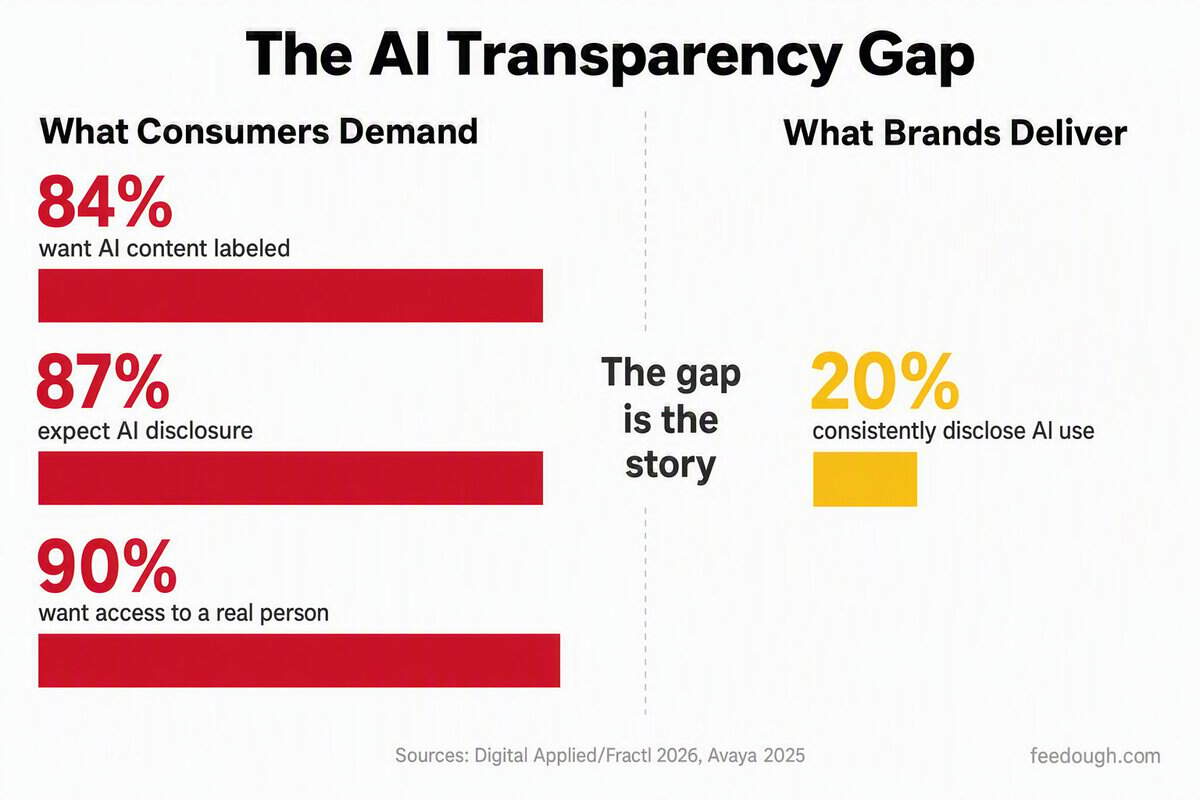
The demand side tells the same story from the opposite angle. Consumers are not rejecting AI utility. They are insisting on transparency around it, and most brands are not delivering.
| Consumer Trust and Demand Metric | Value | Source | |
|---|---|---|---|
| Comfortable with AI agents purchasing on their behalf (Q1 2026) | 45% | Riskified 2026 | |
| Trust AI less than humans with personal data | 52% | Usercentrics 2026 | |
| Demand labeling for AI-written text | 84% | Digital Applied/Fractl 2026 | |
| Want access to a real person instead of AI | 90% | Avaya 2025 | |
| Expect disclosure when AI is being used | 87% | Avaya 2025 | |
| Will pay more for brands trusted on AI | 73% | Usercentrics 2026 | |
| Brands that consistently disclose AI use | 20% | Digital Applied/Fractl 2026 |
The gap between demand and delivery is the defining fracture in AI marketing’s near-term outlook. 84% of consumers want explicit labeling for AI-generated text, per the Digital Applied/Fractl 2026 study, yet only 20% of brands consistently disclose when AI produced the content. Another 33% never disclose at all. Meanwhile, 53.9% of consumers believe AI increases the risk of online fraud, and 73.9% expect strong safeguards like biometric or one-time password authentication for every AI-driven transaction, per Riskified’s Q1 2026 survey.
These are not adoption barriers waiting to be engineered away. They are conditions for earning the right to deploy AI at scale. The brands that treat transparency as infrastructure, not liability, will capture the 9% pricing premium that 73% of consumers say they will pay for brands that have earned their trust, per Usercentrics’ 2026 State of Digital Trust report. The ones that ship faster without solving for trust will face the same wall the data describes: rising usage, falling confidence, and no algorithm that bridges the gap.
AI Marketing Integration and ROI Statistics
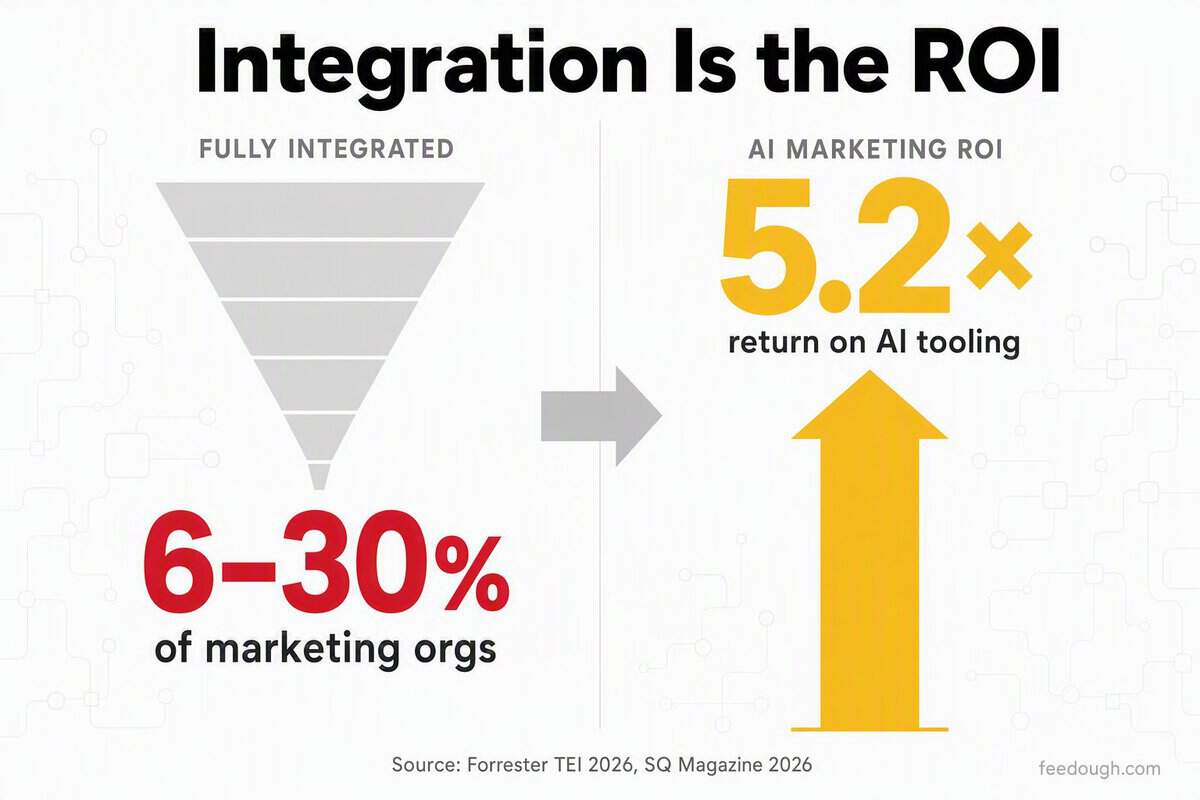
Only 6-30% of marketing organizations have fully integrated AI across their workflows. Those that have report a 5.2x return on their AI marketing tooling, per Forrester’s 2026 Total Economic Impact Study. The ROI from deep integration dwarfs what surface-level adoption produces.
ROI Metric | Value | Source |
|---|---|---|
AI marketing tooling ROI (deep integration) | 5.2x return | Forrester TEI 2026 |
Cross-functional AI integration | +44% output and ROI | SQ Magazine 2026 |
Average ROI across all AI applications | +35% | McKinsey Digital 2026 |
AI campaign ROI vs. traditional | +22% | McKinsey 2026 |
AI campaign conversions vs. traditional | +32% | McKinsey 2026 |
AI campaign customer acquisition cost | -29% | McKinsey 2026 |
Those returns explain the spending surge:
- Median monthly AI tool spend per mid-market marketing team tripled from $1,200 to $3,400 in 12 months, a 183% increase (Digital Applied 2026)
- 95% of marketers plan to increase AI spending in 2026, and 66% expect to allocate 10% or more of their marketing budget to AI (Jasper/Benchmarkit 2026)
- AI marketing tools available grew from 1,200 in 2024 to over 3,800 in 2026, more than tripling in two years (Searchlab 2026)
- The global AI marketing market reached $57.99 billion in 2026, up from $6.46 billion in 2018, and is on track to reach $107.5 billion by 2028 at a 37.2% CAGR (MarketsandMarkets 2026)
- 61% of CMOs report confidence in AI ROI, compared to just 12% of individual contributors, a gap that mirrors the integration divide (Jasper/Benchmarkit 2026)
GenAI applies to only 15.12% of all marketing activities on average, per the CMO Survey’s Spring 2025 data. The spending is surging toward tools. The integration that turns those tools into compounding returns is what most teams are still deferring.
Sources
- https://www.mckinsey.com/capabilities/mckinsey-digital/our-insights/superagency-in-the-workplace-empowering-people-to-unlock-ais-full-potential-at-work (2025-01-01)
- https://www.digitalapplied.com/blog/ai-marketing-statistics-2026-adoption-data-points (2026-04-08)
- https://www.folio3.ai/blog/ai-project-failure-rate-stats (2026-06-16)
- https://connectedpaths.com/insights/ai-project-failure-statistics (2025-10-01)
- https://aibusinessweekly.net/p/ai-agents-statistics (2026-06-08)
- https://www.digitalapplied.com/blog/ai-agent-productivity-statistics-2026-roi-data-points (2026-01-01)
- https://christopholivierconsulting.com/ai-in-marketing-statistics (2026-07-26)
- https://sqmagazine.co.uk/ai-agents-statistics (2026-01-01)
- https://masterofcode.com/blog/ai-agent-statistics (2026-01-01)
- https://www.statista.com/chart/35976/use-of-ai-tools-in-content-marketing (2026)
- https://www.omnibound.ai/blog/marketing-ai-adoption-statistics (2026)
- https://thestacc.com/blog/state-ai-marketing (2026-03-01)
- https://contentmarketinginstitute.com/b2b-research/b2b-content-marketing-trends-research (2026-01-01)
- https://cited.so/blog/ai-content-marketing-automation (2026-01-01)
- https://thestacc.com/blog/ai-marketing-statistics (2026-01-01)
- https://www.digitalapplied.com/blog/customer-service-ai-agent-statistics-2026-data (2026-04-22)
- https://www.lorikeetcx.ai/articles/ai-customer-service-statistics (2026-03-01)
- https://www.digitalapplied.com/blog/ai-customer-support-statistics-2026-adoption-roi-data (2026-05-25)
- https://www.goodfirms.co/resources/seo-statistics-ai-search-rankings-zero-click-trends (2026-09-01)
- https://www.digitalapplied.com/blog/ai-search-seo-statistics-2026-definitive-collection (2026-01-01)
- https://www.digitalapplied.com/blog/conversion-rate-benchmarks-2026-industry-channel (2026-04-05)
- https://sqmagazine.co.uk/ai-seo-statistics (2025-01-01)
- https://www.amraandelma.com/best-conversion-rate-optimization-statistics (2026-04-04)
- https://searchlab.nl/en/statistics/conversion-optimization-statistics-2026 (2026-03-17)
- https://www.averi.ai/learn/the-complete-guide-to-email-marketing-in-2026 (2026)
- https://mailmend.io/blogs/email-personalization-statistics (2026)
- https://sociality.io/blog/ai-in-social-media-marketing-report/ (2026-01-26)
- https://buffer.com/resources/ai-assistant-post-performance/ (2024-10-15)
- https://www.salesforce.com/news/stories/state-of-marketing-2026/ (2026-02-19)
- https://about.fb.com/news/2026/01/2026-ai-drives-performance/ (2026-01-01)
- https://www.amraandelma.com/best-social-media-conversion-rate-statistics (2026)
- https://www.digitalapplied.com/blog/email-marketing-statistics-2026-data-points (2026-04-05)
- https://writer.com/blog/enterprise-ai-adoption-2026 (2026-01-01)
- https://biziq.com/blog/ai-in-marketing-statistics (2026-06-10)
- https://agilebrandguide.com/ai-technology-statistics (2025-01-01)
- https://technologychecker.io/blog/ai-in-marketing-statistics-use-cases (2026-01-01)
- https://www.digitalapplied.com/blog/ai-search-trust-decline-2026-fractl-study-aeo-strategy (2026-01-01)
- https://www.supermarketnews.com/grocery-technology/consumer-trust-in-ai-drops (2026-04-27)
- https://www.klaviyo.com/solutions/ai/consumer-trust-in-ai (2026-01-01)
- https://usercentrics.com/resources/state-of-digital-trust-report-2026 (2026-03-01)
- https://www.avaya.com/en/blogs/customer-experience-statistics-2026 (2025-01-01)
- https://www.karooli.ai/blog/ai-consumer-behavior-statistics-2026 (2025-01-01)
- https://partnercentric.com/blog/ai-shopping-statistics-trends (2026-01-07)
- https://searchlab.nl/en/statistics/ai-marketing-statistics-2026 (2026-03-08)
- https://www.jasper.ai/blog/state-of-ai-marketing-2026 (2026-01-01)