

Most companies are still debating whether AI belongs in customer service. The ones that deployed it two years ago already stopped debating and started expanding into every touchpoint they could find.
AI in customer service statistics from 2025 show that 88% of organisations now use AI in at least one business function, with customer service leading every other department in adoption speed and measurable returns.
The full dataset covers which tools work, what they cost, and where real returns are showing up.
Key AI Customer Service Statistics: Business Impact & ROI
AI in customer service has moved past the experimental phase. 88% of contact centers now use AI-powered solutions in their customer experience operations. Here are the numbers that define where the industry stands.
- 88% of contact centers use AI-powered solutions in their customer experience operations
- 70% of CX leaders say generative AI led their organisations to re-evaluate customer experiences
- 47% of companies that don’t currently use AI plan to implement it in 2025
- 95% of customer service leaders plan to retain human agents to strategically define AI’s role
- 50% of organizations that expected to significantly reduce their customer service workforce will abandon these plans
- 30% average cost reduction across enterprises using AI chatbots for tier-one inquiries
- 52% decrease in resolution times with AI-powered customer support
- 44% faster issue resolution across all ticket types
- $325 million in estimated annualised value from enhanced productivity
- 15.8% average revenue increase and 15.2% cost savings reported by early GenAI adopters
- Up to 75.5% cost reduction in optimal AI implementations
- 80% of customer support inquiries can now be handled autonomously by AI agents (ServiceNow)
Consumer Satisfaction with AI Customer Service Statistics
Most companies assume customers tolerate AI in customer service. The data suggests the opposite. Customers rate their overall chatbot experience at 4.0 out of 5. For simple queries, they actually prefer chatbots over human agents at 4.2 out of 5.
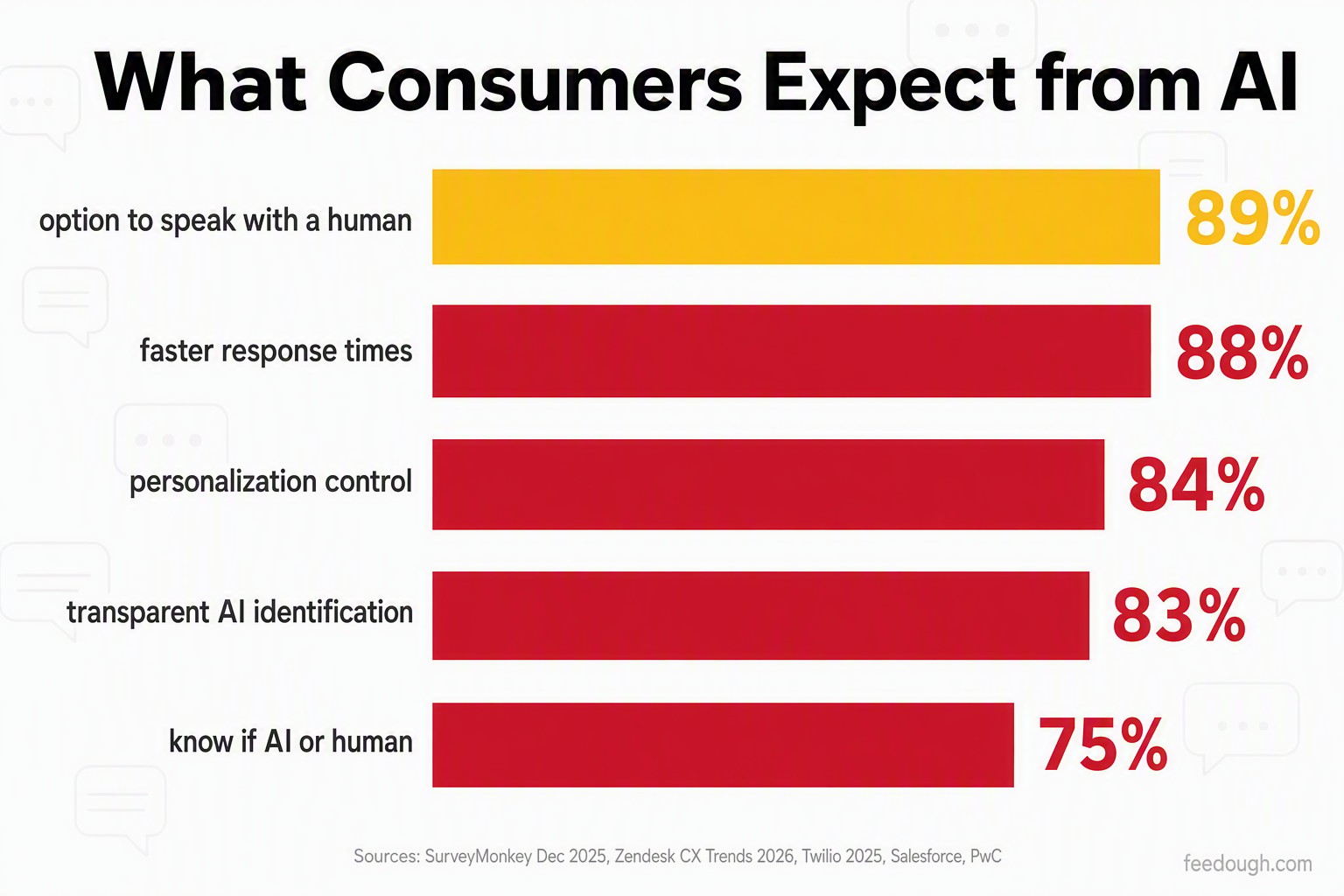
Speed matters more than the agent type. 81% of consumers would rather get an instant AI response than wait for a human. A similar share prefers self-service options before contacting support at all. But satisfaction comes with specific conditions, and the data shows exactly where the line sits between helpful automation and frustrating automation.
Consumer Expectation | % | Source |
|---|---|---|
Option to speak with a human agent | 89% | SurveyMonkey, Dec 2025 |
Faster response times than last year | 88% | Zendesk CX Trends 2026 |
Control over personalization settings | 84% | Twilio 2025 |
Transparent identification of AI interactions | 83% | Salesforce |
Knowledge of whether interacting with AI or human | 75% | PwC |
Accessible customer service around the clock | 74% | Zendesk CX Trends 2026 |
No repetition across different agents or channels | 74% | Zendesk CX Trends 2026 |
The COPC 2025 study quantified the transparency effect. Customers who knew they were speaking with AI reported satisfaction rates 34 percentage points higher than those kept in the dark. Among CX leaders, 63% report that consumer demand for AI transparency has increased since last year, pointing toward a standard where honesty about automation is no longer optional.
AI Customer Service Adoption Statistics
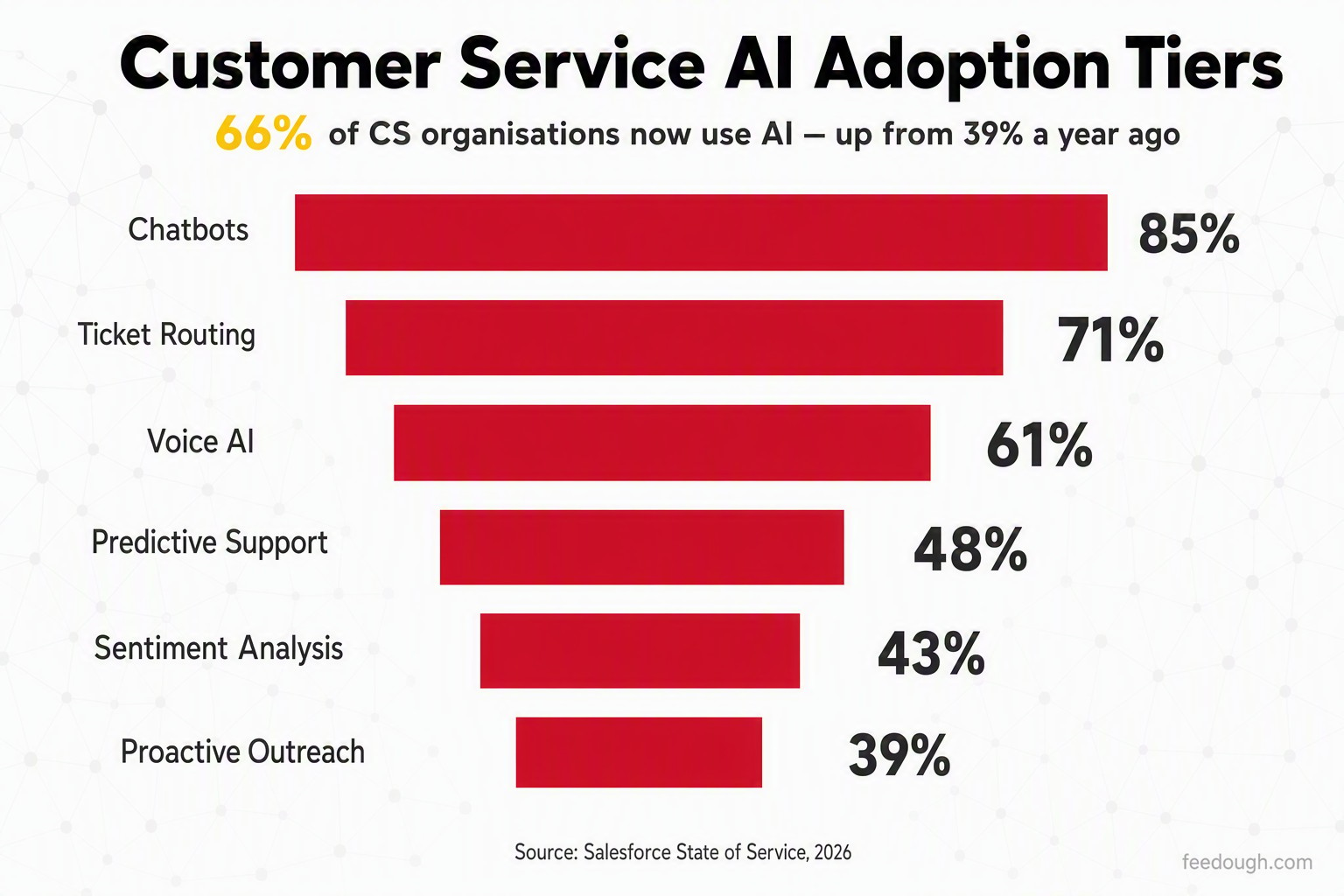
66% of customer service organisations now use AI agents in production, up from 39% just one year ago. That 1.7x jump is not incremental progress. It marks the threshold between optional tool and operational necessity. 91% of customer service leaders say executives are pushing them to move faster in 2026.
- 85% of companies start with chatbots for basic inquiries
- 71% add AI for ticket routing and prioritisation
- 61% expand to voice AI assistants
- 48% implement AI for predictive customer support
- 43% use AI for sentiment analysis
- 39% deploy AI for proactive customer outreach
The adoption pattern is not random. Each tier requires deeper data infrastructure, more complex integration, and greater leadership confidence to execute. Chatbots need a knowledge base. Ticket routing needs historical case data. Voice AI and sentiment analysis depend on real-time model performance against unstructured interaction histories.
Metric | Value | Source / Year |
|---|---|---|
Chatbot market size | $9.30 billion | Mordor Intelligence, 2025 |
Chatbot market projection | $32.45 billion | Mordor Intelligence, 2031 |
CIOs increasing AI budgets | 78% | Gartner, 2026 |
Projected contact center labor cost reduction | $80 billion | Gartner, 2026 |
Voice AI inbound contact center volume | 19% | Forrester, 2026 |
Voice AI illustrates the acceleration most clearly. It handled 6% of inbound contact center volume in 2024. By 2026, that share tripled to 19%, led by banking and telecom. The trajectory points to voice AI becoming a standard layer in the contact-center stack. With 92% of businesses reporting improved customer satisfaction after deploying AI chatbots, the return on investment now justifies the accelerating budgets.
AI Customer Service Adoption Statistics
When 91% of support leaders report executive pressure to deploy AI faster, the debate shifts from whether to adopt to how quickly the stack goes up. 66% of organisations now run AI agents in production, up from 39% one year earlier.
Metric | Value | Source / Year |
|---|---|---|
Chatbot market size | $9.30 billion | Mordor Intelligence, 2025 |
Chatbot market projection | $32.45 billion | Mordor Intelligence, 2031 |
CIOs increasing AI budgets | 78% | Gartner, 2026 |
Contact center labor cost reduction | $80 billion | Gartner, 2026 |
Voice AI inbound contact center volume | 19% | Forrester, 2026 |
Agent throughput with AI tools | +35–40% | Zendesk, 2026 |
Behind the investment totals sits a consistent pattern of AI customer service adoption. Organisations do not roll out AI across every channel simultaneously. They start with the lowest-friction use case and layer upward, each step demanding deeper data infrastructure and tighter integration.
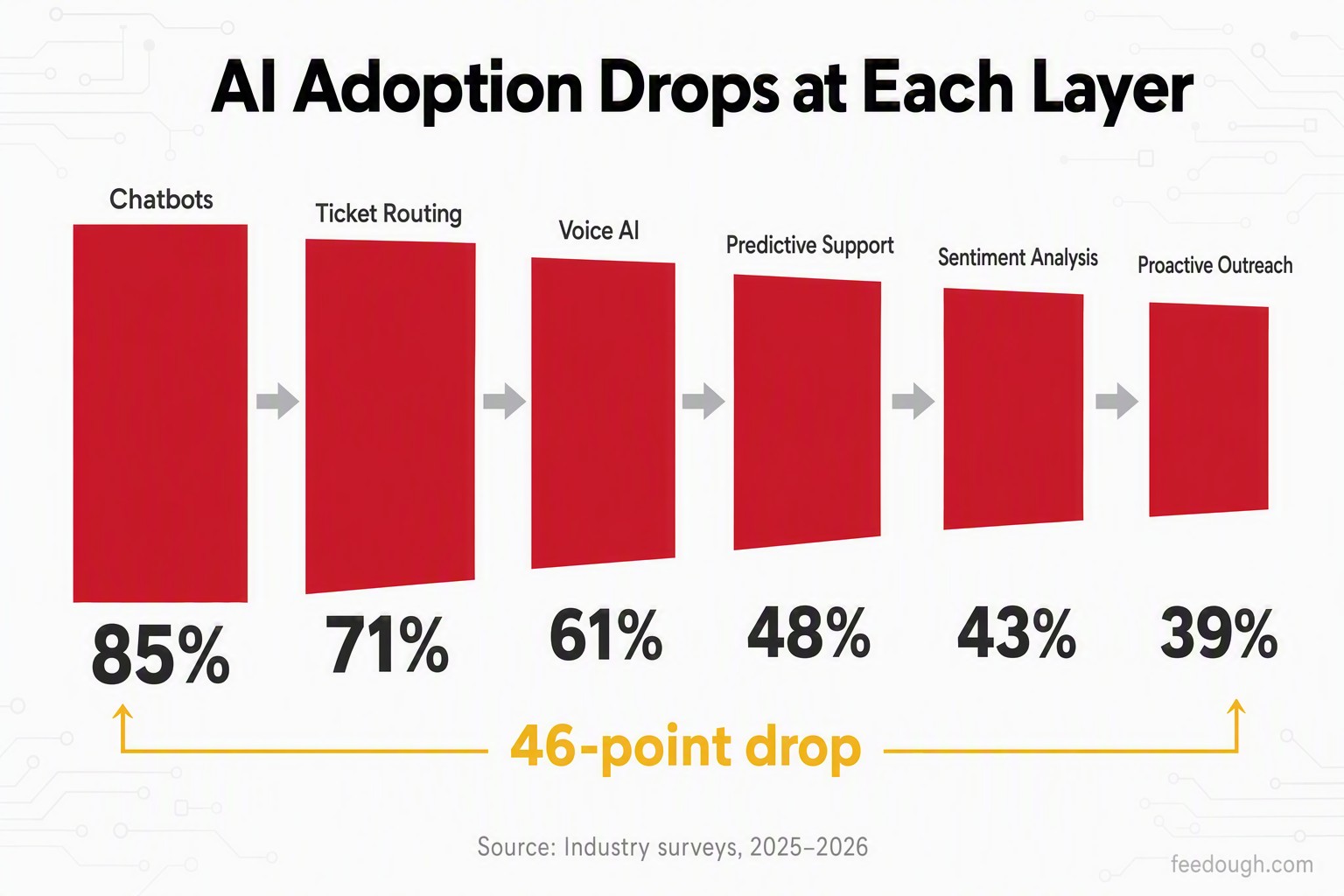
- 85% of companies start with chatbots for basic inquiries
- 71% add AI for ticket routing and prioritisation
- 61% expand to voice AI assistants
- 48% implement AI for predictive customer support
- 43% use AI for sentiment analysis
- 39% deploy AI for proactive customer outreach
The 46-point drop from 85% to 39% reflects infrastructure complexity, not waning interest. Chatbots need a knowledge base. Voice AI needs real-time transcription and context management. Proactive outreach requires predictive models trained on years of interaction data. Support agents using AI tools now handle 35–40% more tickets per shift without quality loss, which is the efficiency gain that justifies each successive layer.
AI Customer Service Adoption by Industry Statistics
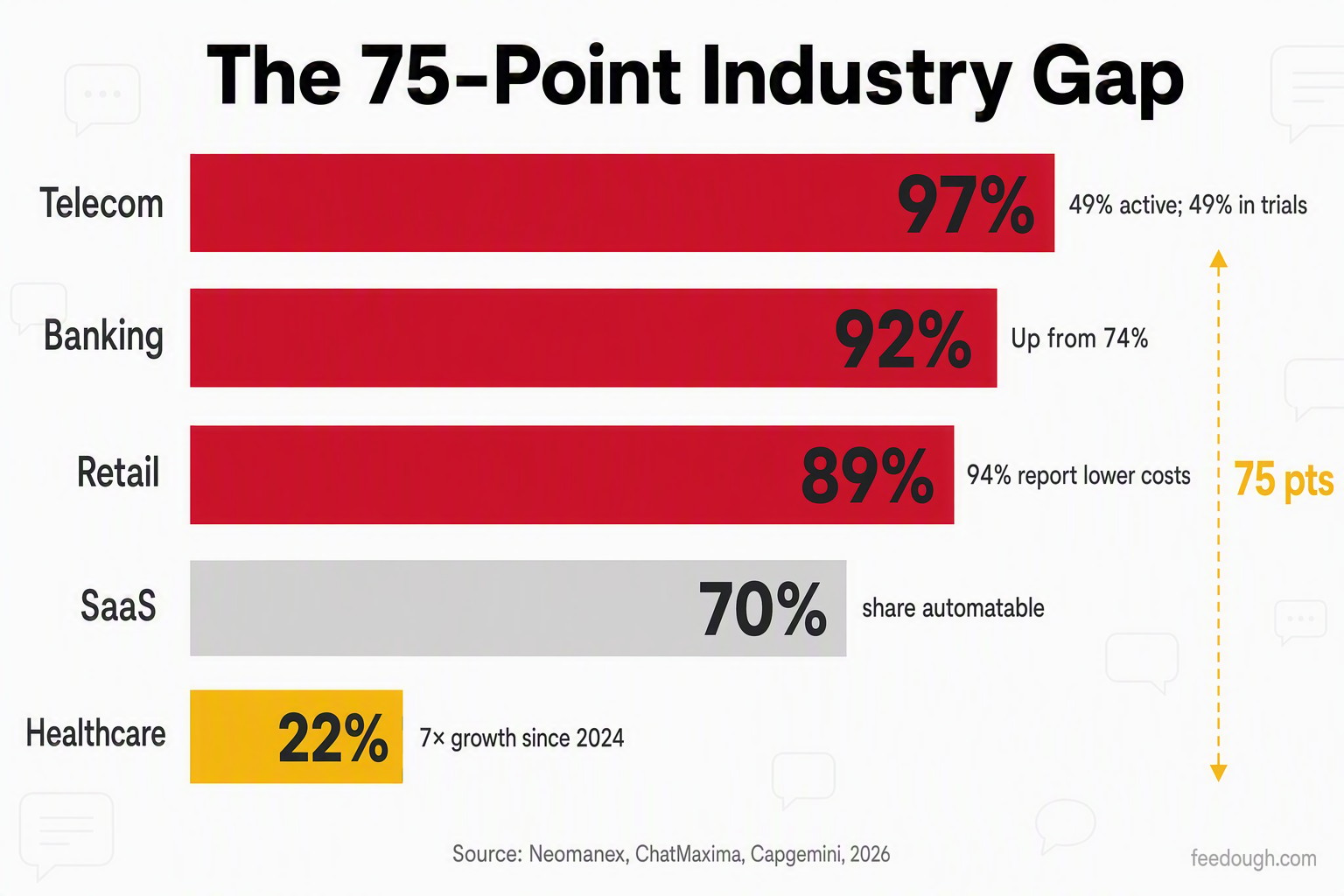
97% of telecom companies are engaged with AI in customer service. Healthcare sits at 22%. That 75-point gap is not about willingness to adopt. It reflects how difficult each industry makes it to automate human conversation.
Banking has closed the distance faster than any other sector, reaching 92% adoption (up from 74% in earlier surveys). Retail holds at 89%. The pattern is consistent: industries with standardised, repeatable interactions move first. Those with complex regulatory requirements start later but accelerate harder once they begin.
Industry | AI Adoption Rate | Key Detail |
|---|---|---|
Telecommunications | 97% engaged | 49% actively using; 49% in trials |
Banking & Finance | 92% | Up from 74%; projected $300B in cost savings |
Retail & CPG | 89% | 94% report decreased operational costs |
SaaS & Technology | Up to 70% automatable | Highest share of requests AI can handle |
Healthcare | 22% domain-specific | 7× increase since 2024 |
Healthcare’s 22% understates the trajectory. Domain-specific adoption grew 51.9% year-over-year as providers automated scheduling, prescription management, and patient communication. The gap between leaders and laggards is narrowing fastest precisely where it looked widest.
Retail AI Customer Service Statistics
Retail generates clearer AI customer service ROI than any other sector. The interactions are high-volume, repeatable, and easy to measure. 89% of retail and CPG companies using AI report increased annual revenue, returning $3.50 for every dollar invested.
Retail AI customer service adoption spans the full customer journey:
- 76% use AI chatbots for customer inquiries
- 64% use AI for product recommendations during support
- 58% implement AI for order tracking
- 52% report improved satisfaction scores from AI deployment
- 41% deploy AI for inventory-related questions
Over 80% of retailers are now adopting or piloting generative AI projects, with 98% planning investment within 18 months, according to NVIDIA. The deployments produce outcomes the surveys only hint at:
Retailer | AI Implementation | Result |
|---|---|---|
Sephora | AI handles 85% of routine inquiries | 40% reduction in call centre volume; $2.3M saved annually |
H&M | Generative AI chatbot for styling and sizing | 70% response time reduction; 92% sizing accuracy; 89% CSAT |
H&M | Conversational platform handling 7M contacts/month | 65% end-to-end automation; 25% higher conversion; 20% lower cart abandonment |
An omnichannel retailer using AI-driven helpdesk automation cut average response time by 43% and improved satisfaction scores by 18% in a single quarter. AI chatbots in retail now resolve up to 86% of customer questions without human intervention. Proactive AI chat recovers 35% of abandoned shopping carts. Those same interventions generate 64% of their revenue from first-time shoppers. AI in retail is not just serving existing customers. It is acquiring new ones.

Healthcare AI Customer Service Statistics
Healthcare still gets labeled an AI laggard. 75% of U.S. health systems are now using or planning at least one AI application, with half running three or more solutions, representing a 67% year-over-year increase in multi-solution deployment.
Health System | AI Use Case | Result |
|---|---|---|
Kaiser Permanente | Routine patient inquiries | 78% handled by AI; $18M saved annually; 92% patient satisfaction |
Mayo Clinic | Appointment scheduling | 83% processed through AI; 31% faster scheduling; 27% wait time reduction |
Tampa General Hospital | Voice AI across scheduling, prescriptions, billing | 56% drop in ambulatory queue call abandonment; 35% improvement in specialty queue; 17% increase in daily appointments |
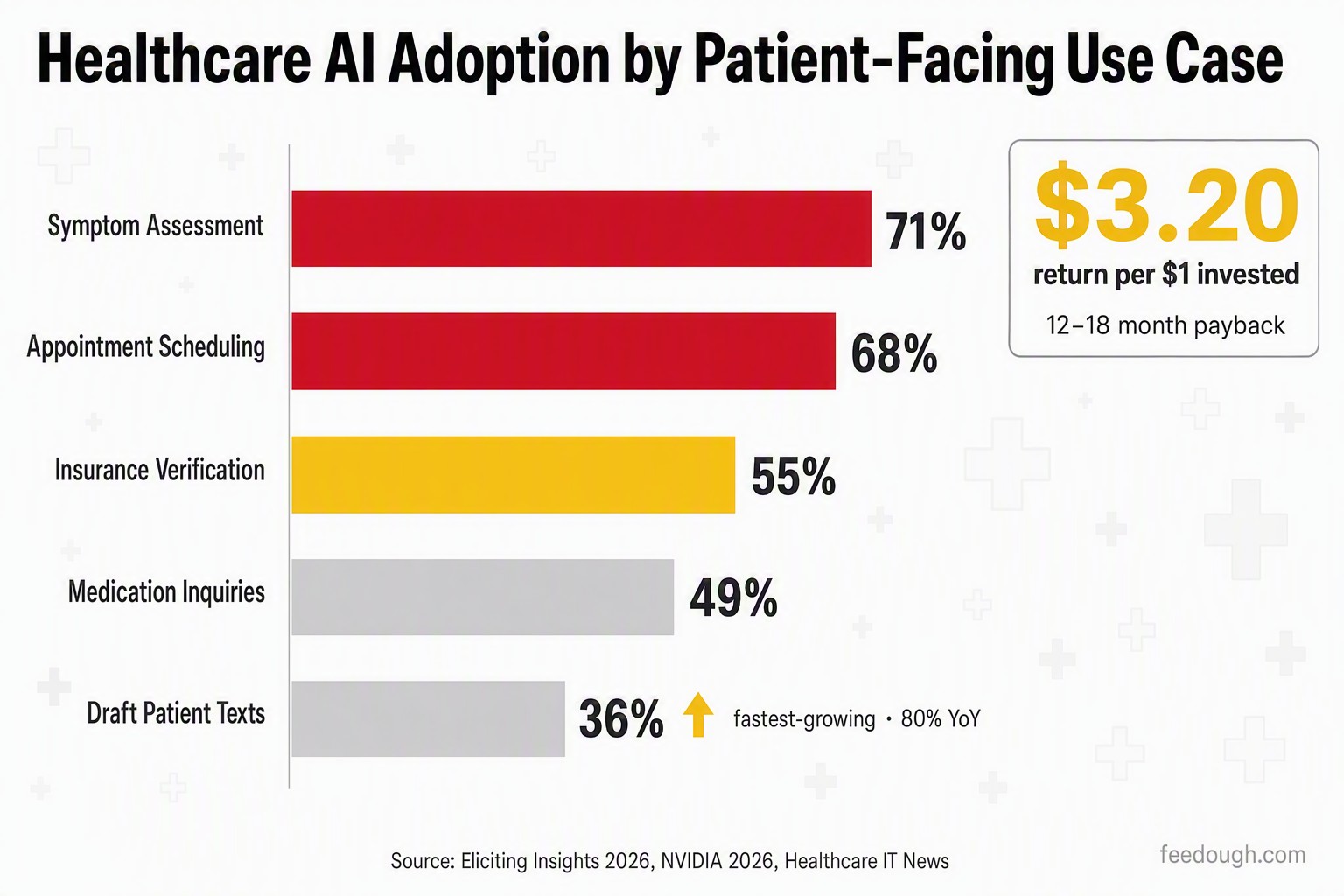
The return on these deployments outpaces most other sectors. Healthcare AI investments return roughly $3.20 for every $1 invested, with a typical payback period of 12 to 18 months. NVIDIA’s 2026 State of AI in Healthcare survey found 81% of adopters report increased revenue and 73% report lower operating costs. At the macro level, AI could generate up to $150 billion in annual savings for the U.S. healthcare economy.
Clinical note-taking and ambient listening leads adoption at 68%, but the customer-facing use cases show where patient interaction is being directly automated:
- 71% adoption for basic symptom assessment, reducing triage time and front-line staff burden
- 68% adoption for appointment scheduling, with 31% faster scheduling reported at Mayo Clinic
- 55% adoption for insurance verification, with 83% of deployers seeing a 10%+ reduction in claim denials
- 49% adoption for medication inquiries, cutting call volume from one of the top patient questions
- 36% adoption for AI-generated draft replies to patient texts, the fastest-growing use case at 80% year-over-year growth
Administrative burden drove the initial case for AI in healthcare customer service. The ROI data now sustains expansion across every patient-facing touchpoint, with multi-solution deployment accelerating faster in healthcare than in any other sector surveyed.
Healthcare AI Customer Service Statistics
Healthcare’s reputation as an AI laggard no longer matches the data. 75% of U.S. health systems are now using or planning at least one AI application. Half run three or more solutions, a 67% year-over-year increase that outpaces every other sector.
The operational returns explain the acceleration:
- 45% reduction in administrative call volume after AI deployment, freeing clinical staff for patient care
- 38% decrease in no-show rates from AI-driven scheduling and automated reminders
- 30% to 40% reduction in support ticket volume within the first 30 days of chatbot deployment
- 50% reduction in incoming call volume at Northwell Health after deploying a scheduling chatbot
- 56% drop in ambulatory queue call abandonment at Tampa General Hospital after deploying voice AI
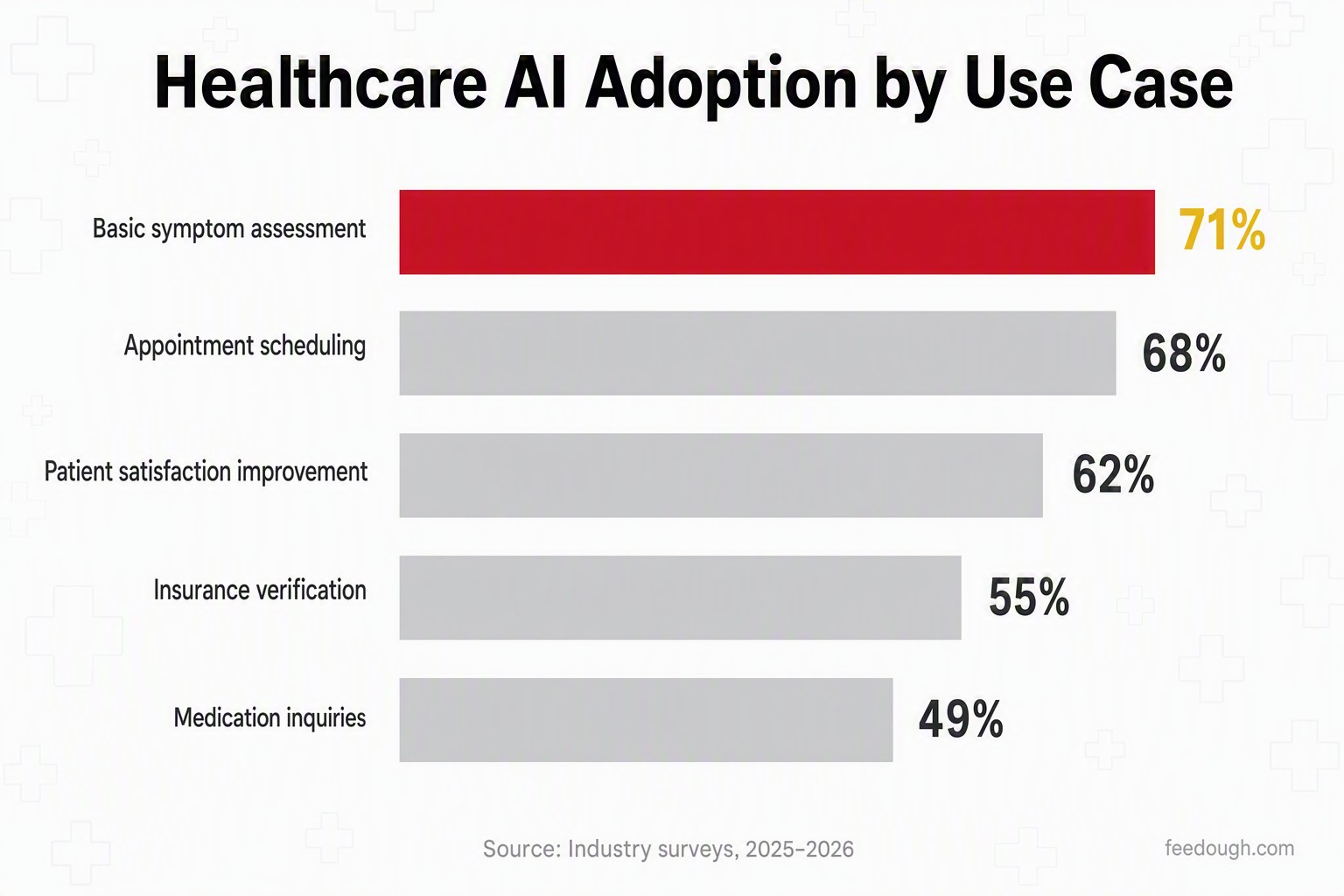
Administrative burden is the primary target. The use cases with the highest adoption rates map directly to the tasks consuming the most staff hours:
AI Use Case | Adoption Rate | Measured Impact |
|---|---|---|
Basic symptom assessment | 71% | Reduces triage burden on front-line staff |
Appointment scheduling | 68% | 31% faster scheduling (Mayo Clinic) |
Patient satisfaction improvement | 62% | Reported after AI deployment across use cases |
Insurance verification | 55% | 83% of deployers saw 10%+ reduction in claim denials |
Medication inquiries | 49% | Reduces volume from a top patient call driver |
Healthcare AI investments return approximately $3.20 for every $1 invested, with a typical payback period of 12 to 18 months. NVIDIA’s 2026 State of AI in Healthcare survey found 81% of adopters report increased revenue and 73% report lower operating costs. At the largest health systems, the results reach nine figures. Kaiser Permanente’s AI handles 78% of routine patient inquiries and saves $18 million annually. Mayo Clinic processes 83% of appointment requests through AI, cutting scheduling times by 31% and wait times by 27%.
Newer deployments are matching those benchmarks. Sutter Health launched Epic’s Ask Emmie chatbot in March 2026 and hit 94% patient satisfaction for symptom checking and triage. Cleveland Clinic deployed AI documentation across 4,000-plus clinicians, saving each provider 14 minutes per day over more than one million patient encounters. Houston Methodist implemented agentic AI targeting scheduling, revenue cycle operations, and prior authorization, projecting 25% to 50% cost reductions in administrative areas. Industry-wide, Juniper Research estimates healthcare chatbots save $3.6 billion annually in administrative costs.
Banking AI Customer Service Statistics
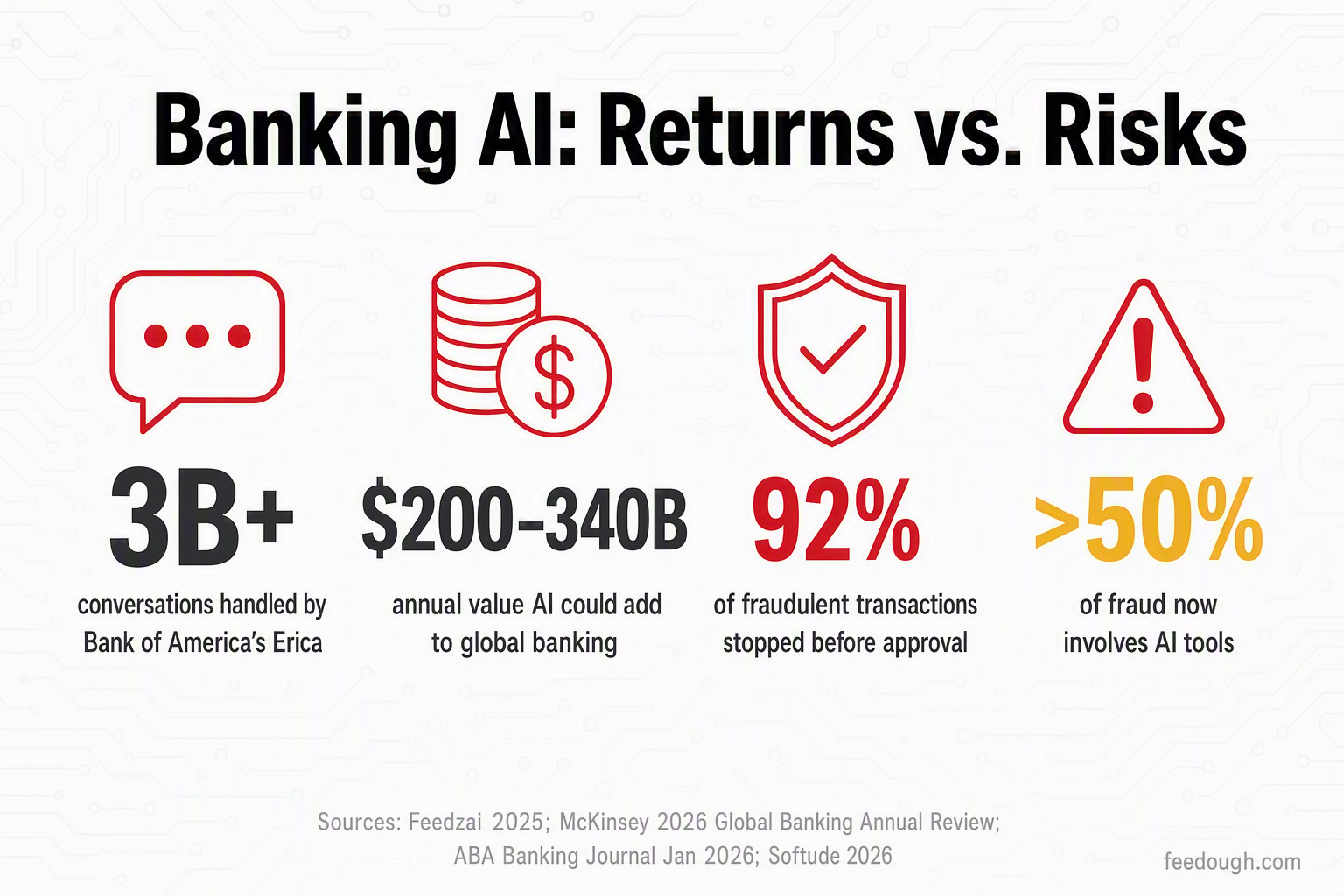
Bank of America’s virtual assistant Erica has handled over 3 billion customer conversations as of 2026. It resolves 70% to 85% of routine queries without human involvement. That scale makes banking the vertical where AI customer service generates its largest measurable returns. JPMorgan Chase alone reports nearly $1.5 billion in total AI savings across fraud detection, trading, and credit decisions.
Institution / Scope | AI Deployment | Key Result |
|---|---|---|
Bank of America | Erica virtual assistant | 3 billion+ conversations; 70% to 85% resolved without human agents |
JPMorgan Chase | Voice AI call handling | 156,000+ calls/month; 94% first-call resolution; $7.7M annual savings |
JPMorgan Chase | COiN contract automation | 360,000+ legal work hours saved annually |
Industry-wide | AI fraud countermeasures | 90% of institutions deployed; 92% of fraudulent transactions stopped before approval |
McKinsey estimates generative AI could add $200 billion to $340 billion annually to global banking, equivalent to 9% to 15% of operating profits. The urgency extends beyond cost savings. More than half of all fraud now involves AI in some form. Deepfakes were reported by 44% of banking professionals. Voice cloning appeared in 60% of cases, and AI-powered phishing in 59%, per Feedzai’s 2025 report. The same technology driving efficiency gains is now the primary threat banks must defend against.
Technology and SaaS AI Customer Service Statistics
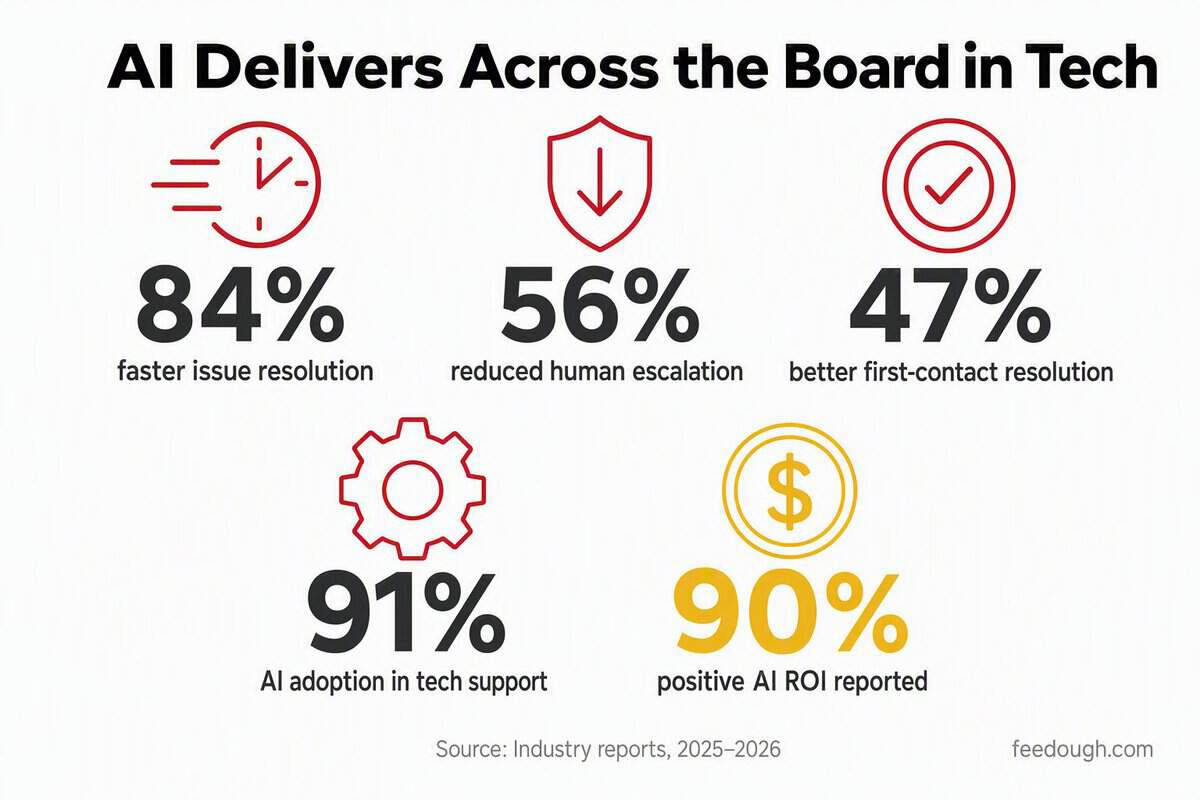
Technology is where AI customer service gets stress-tested. High ticket volumes, technical complexity, and zero tolerance for failed resolution make this the hardest proving ground in the market. 84% of tech companies report faster issue resolution from AI. The sector also shows a 56% reduction in human escalation needs and a 47% improvement in first-contact resolution.
Metric | Value | Source |
|---|---|---|
Microsoft auto-resolution rate | 79% | $127M saved annually; 91% CSAT |
Salesforce routine case handling | 86% | 35% improvement in team efficiency |
CX leaders reporting positive AI ROI | 90% | Zendesk CX Trends 2026 |
The outcomes justify the deployment depth. 91% of tech companies use AI for technical support. 78% implement it for troubleshooting guidance, 65% for billing and subscription questions, and 59% for feature guidance and tutorials.
Across the SaaS sector, 90% of CX leaders report positive ROI from AI tools deployed for their customer service agents. The agent-side data reinforces the case. 83% of service professionals report better career prospects when working with AI tools, and 82% developed new skills through collaboration, per Salesforce’s State of Service 2025. Among consumers, 67% already prefer AI assistants for customer service queries. The technology sector is not dragging anyone into an AI future.
AI Customer Service Benefits and ROI Statistics
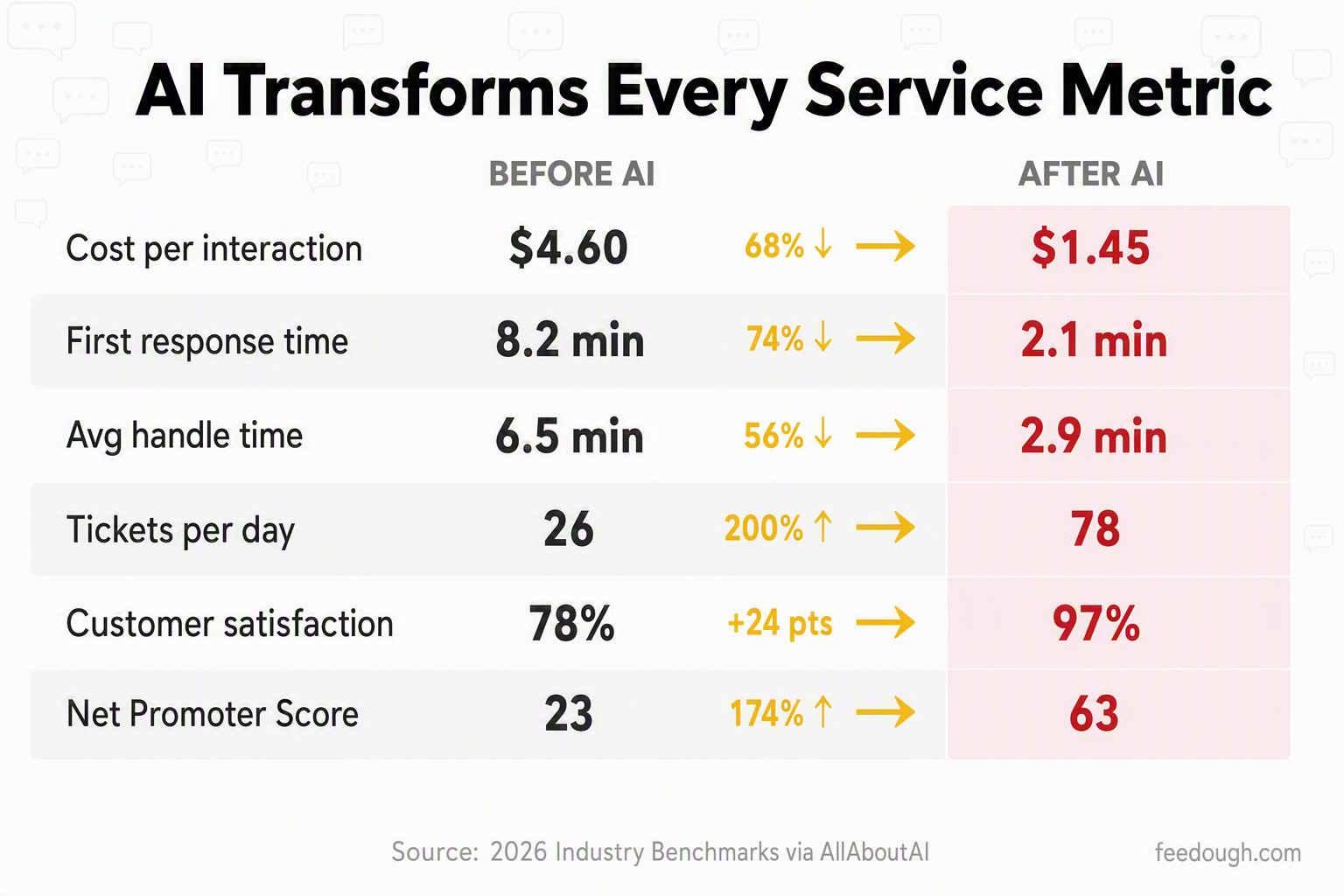
AI customer service benefits compound faster than most organisations anticipate. The average cost of a customer interaction drops 68% after implementation, falling from $4.60 to $1.45. Fully automated AI interactions cost just $0.18, compared to $4.32 for human-only service.
Metric | Before AI | After AI | Change |
|---|---|---|---|
Cost per interaction | $4.60 | $1.45 | 68% reduction |
First response time | 8.2 minutes | 2.1 minutes | 74% reduction |
Average handle time | 6.5 minutes | 2.9 minutes | 56% reduction |
Agent tickets per day | 26 | 78 | 200% increase |
Customer satisfaction (CSAT) | 78% | 97% | +24 percentage points |
Net Promoter Score | 23 | 63 | 174% increase |
The per-interaction savings are immediate. The full return takes longer. Returns compound across consecutive years: 41% in year one, 87% in year two, and 124% by year three, according to 2026 industry benchmarks. The acceleration reflects organisations moving from basic automation to deeper integration across the service stack.
Beyond cost and speed, AI reshapes the workforce and service model:
- 43% drop in employee turnover among frontline reps, driven by less repetitive work and fewer hostile customer interactions
- After-hours service availability expands from 17% to 98%, a 476% increase in coverage
- AI-augmented agents handle 4.2 simultaneous conversations versus 1.5 without AI, a 180% increase in concurrent capacity
Each metric connects to the next. Higher availability reduces wait times, which lifts satisfaction, which lowers repeat contacts, which frees agents for complex cases. The result is a service operation that improves itself with every layer of automation added.
AI Customer Service Implementation Challenges Statistics
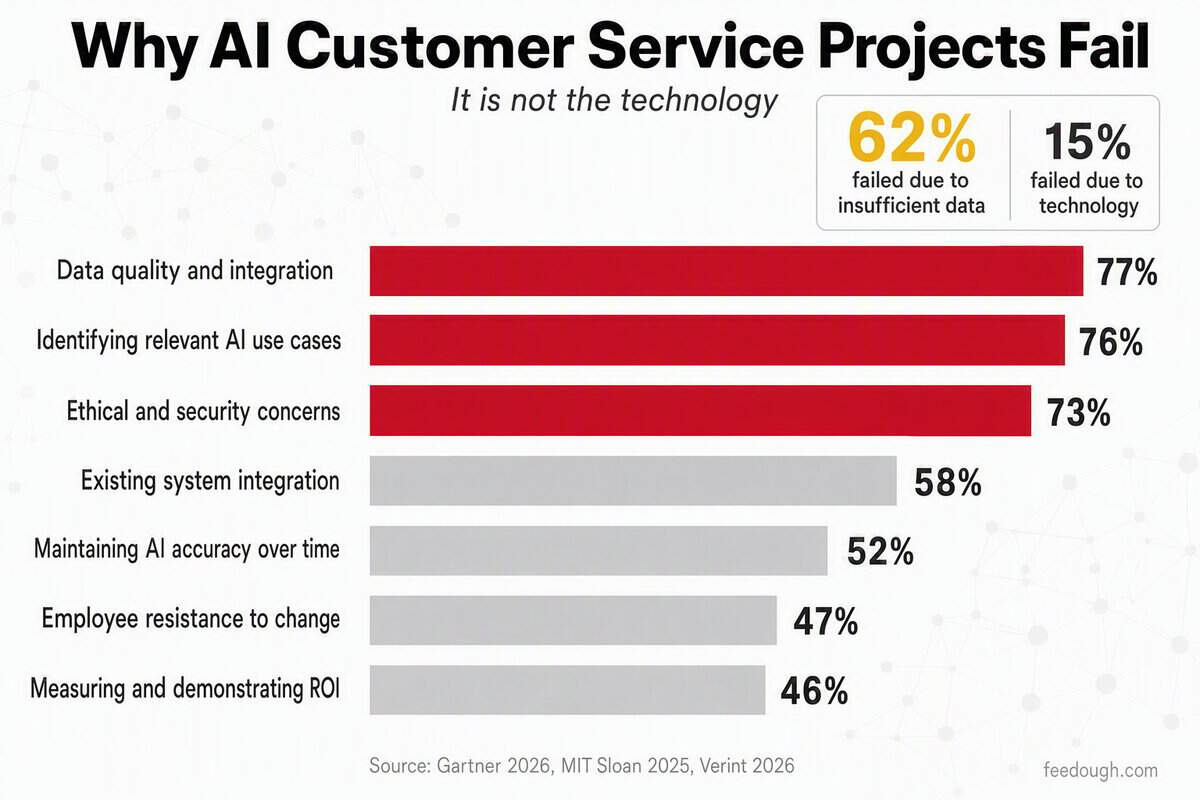
At least half of all generative AI projects were abandoned after proof of concept by the end of 2025. The technology was not the problem. Gartner’s 2026 survey of 782 I&O leaders found that 62% of underperforming AI customer service projects failed due to insufficient data preparation. Only 15% failed because of technology limitations.
The failure pattern is consistent across organisations of every size. A 2025 MIT Sloan study and Gartner’s latest research point to the same root causes:
- 73% of failed AI projects had no agreed definition of success before the project started (MIT Sloan 2025)
- 61% of enterprise AI projects were approved on projected ROI that was never measured after launch (MIT Sloan 2025)
- 57% of organisations that experienced AI failure attributed it to expecting too much too fast, without the data foundation or change management to make it work (Gartner 2026)
- 50% of generative AI projects had been abandoned after proof of concept by end of 2025 (Gartner)
These are not technology failures. They are preparation failures. The barrier data confirms the pattern:
Barrier | Share of Organisations | Category |
|---|---|---|
Data quality and integration | 77% | Technical / Infrastructure |
Identifying relevant AI use cases | 76% | Strategic / Capability |
Ethical and security concerns | 73% | Governance / Regulatory |
Existing system integration | 58% | Technical / Infrastructure |
Maintaining AI accuracy over time | 52% | Operational / Maintenance |
Employee resistance to change | 47% | Organisational / Cultural |
Measuring and demonstrating ROI | 46% | Operational / Strategic |
The operational reality behind these numbers is more granular. Verint’s 2026 survey of 500 contact center leaders found that integration complexity is the single greatest challenge for AI project approval at 54%. Data and privacy concerns follow at 49%. Among organisations that have already deployed AI, 57% of calls still require manually gathering context upon escalation, and 53% say data accuracy and protection remains a persistent challenge during implementation. The AI model works. The infrastructure around it often does not.
AI Customer Service Market Forecast and Future Predictions Statistics
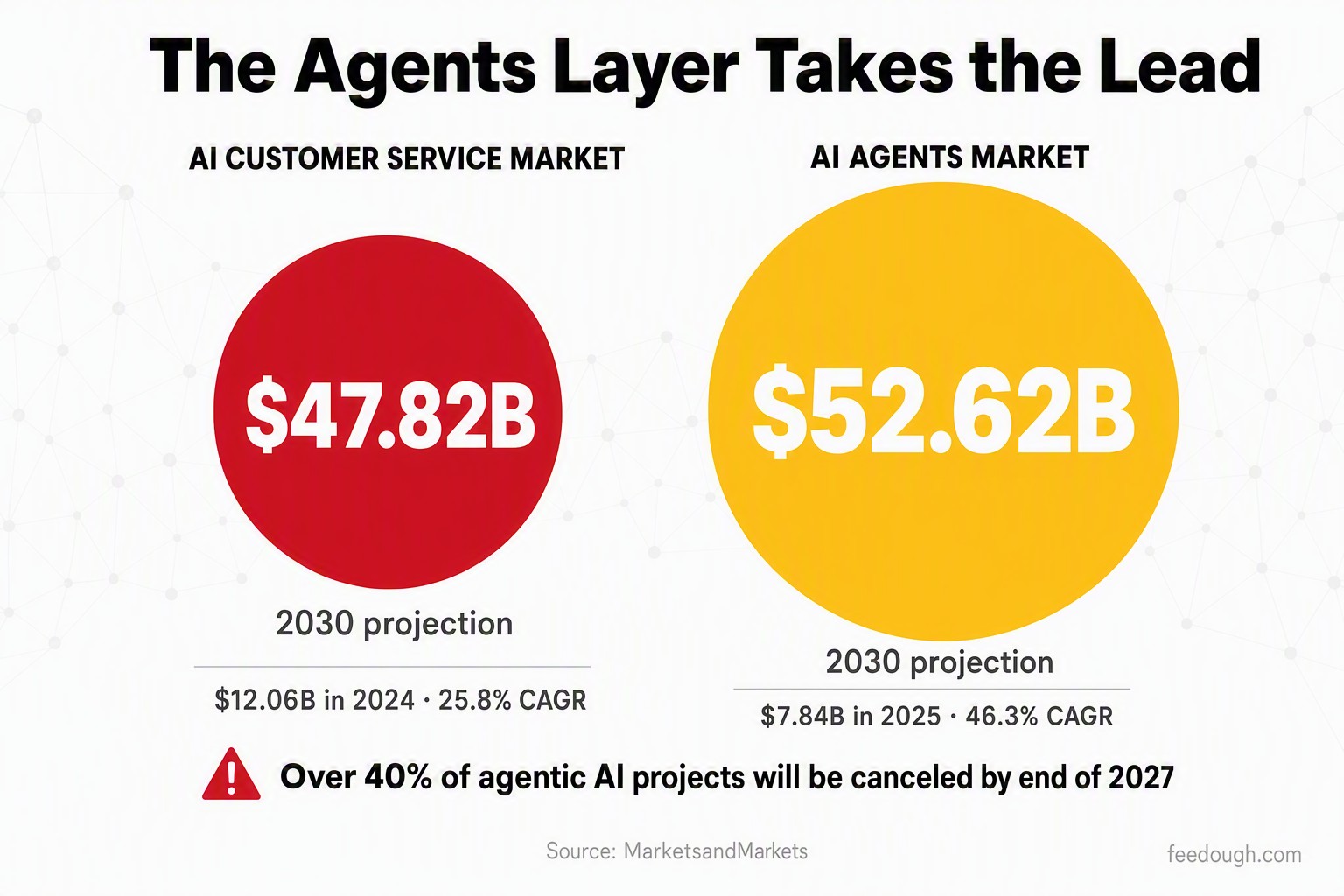
The global AI customer service market is on a trajectory that most research firms have had to revise upward. MarketsandMarkets valued it at $12.06 billion in 2024 and projects $47.82 billion by 2030, a 25.8% compound annual growth rate. Within that broader market, the AI agents segment is expanding faster still, at 46.3% annually, to reach $52.62 billion by 2030.
The divergence between the parent market and the agents layer tells the real story. Growth is not just about more companies buying chatbots. It is about deeper, more autonomous systems replacing the first generation of tools.
Forecast Area | Current Value | 2030 Projection | Source |
|---|---|---|---|
AI customer service market | $12.06B (2024) | $47.82B (25.8% CAGR) | MarketsAndMarkets |
AI agents market | $7.84B (2025) | $52.62B (46.3% CAGR) | MarketsandMarkets |
Customer interactions involving AI | Rapidly expanding | 85% by 2028 | Gartner |
Enterprise apps with AI agents | <5% (2025) | 40% by end 2026 | Gartner |
Autonomous AI service interactions | Early adoption | 20% by 2030 | Forrester |
The market projections measure dollars. The technology forecasts describe what changes for customers. Gartner projects 85% of customer interactions will involve AI by 2028. Voice-first chatbots will represent 35% of deployments, and emotional AI will be integrated into 40% of enterprise chatbots. Multimodal systems combining text, voice, and vision could capture 25% market share by 2029. Forrester expects conversational AI to become the primary customer service channel for Fortune 500 companies by 2029.
The speed of the shift creates its own risk. Gartner estimates over 40% of agentic AI projects will be canceled by end of 2027. Escalating costs, unclear business value, and weak risk controls drive the cancellation rate. The market trajectory is well-documented. Whether organizations can execute against these forecasts will determine how much of the projected growth actually materializes.
AI Customer Service Market Forecast Statistics
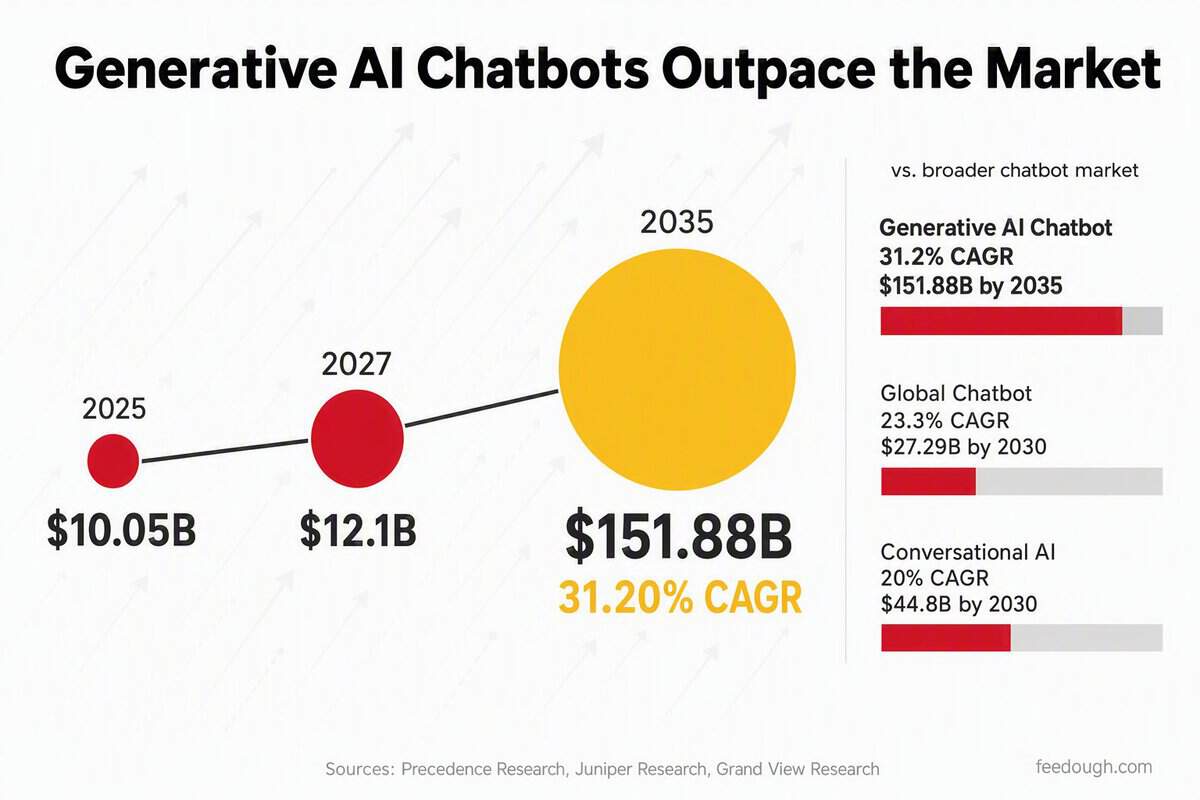
The generative AI chatbot market is growing at 31.20% annually, nearly 10 points faster than the broader chatbot market’s 23.3% CAGR. Precedence Research values the generative segment at $10.05 billion in 2025 and projects it will reach $151.88 billion by 2035. Juniper Research puts the AI chatbot segment’s growth rate at 32.4%, confirming the same trajectory from a second source.
Market Segment | 2024-2025 Valuation | Projection | Growth Rate |
|---|---|---|---|
Generative AI Chatbot | $10.05B (2025) | $151.88B by 2035 | 31.20% CAGR |
Conversational AI | $15B (2024) | $44.8B by 2030 | 20% CAGR |
Global Chatbot | $9.56B (2025) | $27.29B by 2030 | 23.3% CAGR |
The financial projections set the scale. The operational forecasts describe what changes at the customer interface. Gartner projects agentic AI will resolve 80% of common customer service issues by 2029 while reducing operational costs by 30%. Deloitte forecasts that by 2027, half of all enterprises will deploy agentic AI assistants in frontline roles. Voice AI is projected to handle 40% of contact center calls end-to-end by 2029. The shift from reactive chatbots to autonomous agents is already priced into the growth rates above.
Sources
- https://www.amplifai.com/blog/customer-service-statistics (2026-08-12)
- https://www.getnextphone.com/blog/ai-customer-service-statistics
- https://thestacc.com/blog/ai-customer-service-cost-savings (2026-07-10)
- http://aistrategypath.com/executive-guides/chief-strategy-office-cso-ai-strategy
- https://www.desk365.io/blog/ai-customer-service-statistics
- https://www.chatbot.com/blog/chatbot-statistics (2025-10-01)
- https://masterofcode.com/blog/ai-in-customer-service-statistics (2026-08-03)
- https://chatmaxima.com/blog/ai-customer-support-statistics-2026 (2026-02-18)
- https://www.mordorintelligence.com/industry-reports/global-chatbot-market (2025)
- https://greetnow.com/blog/chatbot-statistics (2026-01-07)
- https://www.digitalapplied.com/blog/ai-customer-support-statistics-2026-adoption-roi-data (2026-05-25)
- https://aibusinessweekly.net/p/ai-customer-service-statistics
- https://neomanex.com/blog/ai-customer-service-statistics (2026-02-16)
- https://blogs.nvidia.com/blog/ai-in-retail-cpg-survey-2026 (2026-01-07)
- https://www.coderio.com/blog/biz-tech/generative-ai-in-retail-industry-changing-impacts (2026-03-05)
- https://salesgroup.ai/how-retailers-are-using-ai-to-scale-customer-service (2026-04-09)
- https://socialtargeter.com/blogs/transforming-customer-service-case-studies-of-brands-using-ai-chatbots-effectively (2025-11-12)
- https://www.tidio.com/blog/chatbot-statistics/ (2026)
- https://www.anchorgroup.tech/blog/ai-ecommerce-trends-statistics (2026-06-18)
- https://www.ringly.io/blog/ai-in-retail-statistics-2026 (2026-06-03)
- https://elicitinginsights.com/news/health-systems-accelerate-ai-adoption-with-67-increase-in-multi-solution-deployment-2026 (2026-03-24)
- https://www.aboutchromebooks.com/ai-in-healthcare-adoption-statistics (2025)
- https://emorphis.health/blogs/cost-of-implementing-ai-in-healthcare (2026)
- https://www.healthcareitnews.com/news/tampa-generals-call-center-ai-drives-roi (2025-12-17)
- https://www.kommunicate.io/blog/top-5-use-cases-of-chatbots-in-healthcare (2026)
- https://www.techaheadcorp.com/blog/ai-chatbots-in-healthcare-12-use-cases-implementation-costs-in-2026 (2026)
- https://www.conferbot.com/blog/chatbot-for-healthcare (2025)
- https://www.softude.com/blog/ai-use-cases-fintech-2026 (2026-06-10)
- https://axis-intelligence.com/ai-in-banking-statistics (2026-07-24)
- https://www.salesforce.com/news/stories/ai-service-agents-improve-customer-satisfaction (2025-11-01)
- https://fin.ai/learn/roi-ai-customer-service-agents-benchmarks (2026)
- https://www.salesforce.com/ap/service/what-is-customer-service/stats (2025)
- https://www.zendesk.com/blog/ai/productivity/ai-customer-service-statistics (2026)
- https://www.salesforce.com/news/stories/state-of-service-report-announcement-2025 (2025)
- https://www.allaboutai.com/resources/ai-statistics/customer-service (2025-12-04)
- https://builts.ai/blog/ai-customer-service-trends-2026 (2026-05-09)
- https://www.verint.com/guides/4-contact-center-ai-trends-for-2026 (2026)
- https://saigontechnology.com/blog/ai-implementation-challenges (2026)
- https://www.folio3.ai/blog/ai-project-failure-rate-stats (2026)
- https://chatmaxima.com/blog/ai-agent-statistics (2026-09-04)
- https://www.mavenagi.com/blog/conversational-ai-trends
- https://www.puzzel.com/blog/what-is-an-agentic-ai
- https://www.precedenceresearch.com/generative-ai-chatbot-market