
When your entrepreneur friends tell you they rent desks in a coworking space, you probably picture a scrappy startup upsetting the corporate office. You might be holding an outdated version of that story. CBRE, the world’s largest commercial real-estate services firm, bought Industrious, one of the largest US operators.
You might still think of WeWork first, but IWG, owner of Regus, is actually the sector’s largest operator. You will find WeWork second by footprint and Industrious third. You can now pick from 9,384 US coworking locations, up 2.7% in Q2 2026 alone.
You might expect landlords to treat these operators as rivals. Instead, you see landlords signing management agreements with them. So before you book a desk or sign a lease, you should know who is really behind these spaces now.
What Is Coworking Space?
Coworking space is a shared office service model. Individuals and teams rent desks, private offices, and meeting rooms on flexible terms, working independently or side by side. You book by the day or the month; the operator handles reception, cleaning, and IT. Even so, the environment is built to feel like an established venture. By 2026 that model no longer means a metro startup clubhouse. Companies rent coworking space as satellite offices for hybrid teams. The service side has converged with hospitality: hotel-like coworking space design, curated food and drink, concierge-level service.
Location has shifted too. Of Industrious’s last 50 workspace openings, a disproportionate number landed in neighborhoods rather than large central business districts. People want to work near where they live. The US had 9,384 coworking locations as of Q2 2026, up 2.7% that quarter alone. Their combined 166.36 million square feet equals 2.34% of all US commercial office space. Average location size fell 1.2% to about 17,728 sq ft as smaller spaces opened in secondary markets. Grand View Research puts the global coworking spaces market (not the wider flexible-office category) at $22.6B in 2026. It projects $62.8B by 2033, a 15.7% CAGR.
How Coworking Space Makes Money?
A coworking space runs on a different business model than a traditional office landlord. It disrupted the office market by selling office space as a monthly service rather than a long-term lease. By 2026 the incumbents have moved in, and rent is only one of several revenue streams. The bigger shift is in how the deals themselves are structured.
Management Agreements
The old playbook was simple: lease a whole building, fill it with desks, and carry the rent alone. The dominant structure of 2026 looks different. Operators sign management agreements with landlords. They run part of a building and split profits and risk with the property owner. The arrangement works like a hotel management company, which runs a property it neither owns nor fully leases.
Industrious has grown quickly on this asset-light model. There is a catch, though. Industrious CEO Jamie Hodari calls flex “a sector that overperforms in good times and underperforms in bad times.” In a downturn, he says, long-term leasing might fall 6-10%, while flex could fall around 25%.
Renting
1. Private Offices And Dedicated Workstations
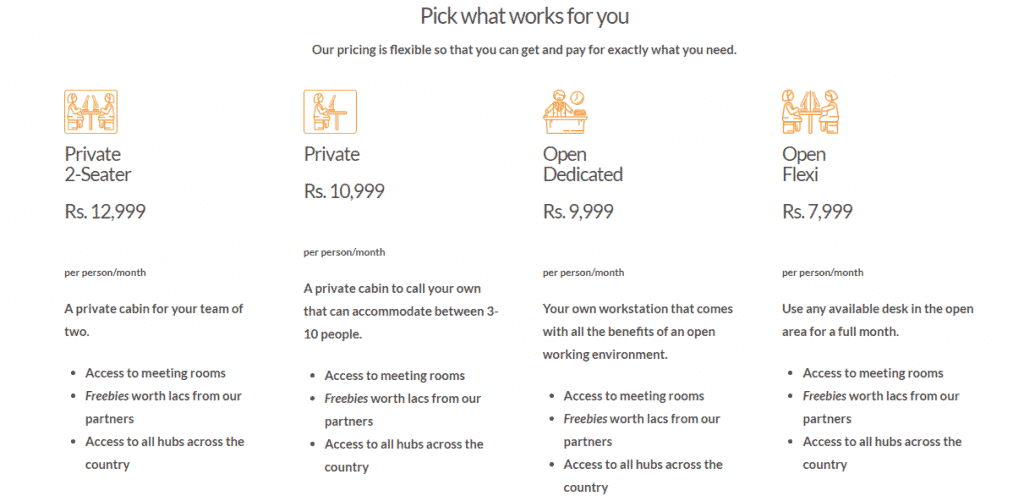
Private offices, not hot desks, are where the money is. One operator revenue report, cited by Archie, puts private offices at roughly 72.5% of the average coworking space’s revenue, while traditional coworking memberships account for just 8.8%. Those are directional figures from a vendor blog, not audited numbers. Even so, the shape is consistent: dedicated space is the primary revenue line.
2. Meeting Rooms, Event Space And Day Passes
On-demand products earn a smaller share but grow the fastest. The same Archie report puts meeting rooms, day offices, event space, and day passes at about 7.2% of revenue. Workbox publishes 2026 pricing of $35 for a day pass. Meeting rooms start at $60 per hour during staffed hours. Both work as a first touchpoint. A day-pass user books a meeting room, likes the space, and converts into a full-time member.
Enterprise Contracts
Enterprises, not just startups, are now the sector’s largest customer group, with a 46.5% share of demand. Market Research Future, citing a 2024 JLL survey, reports that 73% of multinational corporations devote at least 15% of office expenditure to flexible leasing. That is up from 42% in 2020. The deal shape has shifted with it. Month-to-month memberships for small teams have given way to managed contracts. The typical deal runs two to three years and is worth $2 million to $8 million.
Virtual Offices
Some coworking spaces even add virtual offices offering to their business model. A virtual office is a premium work address which the business uses for listings and mails and packages, while the team works from home.
A virtual office is a boon for entrepreneurs who like to work from home but need a dedicated premium looking address for their startup.
Marketing
Since there is a lot of diversity in terms of types of companies, work structure, and employees in coworking spaces, some B2B companies usually use these spaces for promotional activities.
Even workshops or training that are conducted in coworking space serve as a means of promoting a product and become a source of revenue.
Premium Membership
Every product venture at some point of time does introduce features and facilities that could be availed by paying some amount. Premium membership is a one time fee usually charged annually and gives access to marquee facilities. This form of revenue generation also ensures loyalty.
Partnerships
Since there are a plethora of tasks that are being done under one roof, it becomes easier for both the investors and members to reach one another.
Strategic tie-ups with angel investors or venture capitalists lead to an increase in revenue and also popularity among the masses. Coworking spaces act as an easy medium to connect investors to the startup founders and charge a small commission or fee for the same.
Why Have Coworking Spaces Become So Popular?
Hybrid work is the biggest reason. You now run small teams spread across different cities. Signing a long lease for a handful of people makes little sense. So you use a coworking space as a satellite office, close to where your staff actually live. That pattern keeps driving coworking demand.
Cost still plays a role, but it is no longer the whole story. You can book a room for two people or an entire floor for a larger team. You also avoid the long-term lock-in that comes with traditional leases. That flexibility alone accounts for a lot of the interest.
Quality explains the rest. Companies want their smaller offices to feel as good as headquarters, so staff do not leave for competitors. Industrious CEO Jamie Hodari says it is “really hard for even JPMorgan or Google to run a really beautiful, engaging office experience for 43 people.” Coworking operators now sell exactly that to corporate teams. For a company with a scattered workforce, matching that in-house is difficult.
Benefits Of Coworking Spaces
Zero Capital Investment
The biggest benefit of coworking spaces is that entrepreneurs don’t have to shed their pockets or look for investors to invest in offices before the actual product is released or the actual business is set up.
Productivity
Working from home has an abundance of distractions like TV, pets, bed, and family, and such constant distractions reduce productivity.
Maintaining a clear distinction between work and home allows an individual to keep the structure in their life, and provides all the more reason to get out of the comforts of their home and work in an office like environment.
Networking
Since coworking space brings people from diverse background, it provides you with an opportunity to work with people vastly different skillsets and gain a new perspective about solutions to a problem and if you are in a coworking space that has more professionals aligned with interest you could actually come with a novel solution.
Flexibility
As a budding entrepreneur, it is impossible to set up a fully functional office as you might be investing even the seed funding in hiring the best talent to help your venture grow.
Apart from this owning an office space is no easy task in itself.
Lease agreements, utility bills and the infrastructure for ensuring smooth functioning require a significant amount of money as well as time.
On the other hand coworking spaces already have these arrangements in place.
Emotional Stability
There will be times when you as an entrepreneur would feel like nothing is working and would tend to give up. When in self-doubt, the best way to overcome it is the being in the company of people. Their stories and struggles might motivate you and reduce the negative vibes in your life.
Also working alone in your home would make you feel lonely and you would want someone to address your concerns be it technical or spiritual.
Working in a coworking space brings you an opportunity to connect with people and learn from them.
The Best Coworking Spaces In The World
Choosing the best coworking space takes more than a quick tour. Three parameters do most of the judging.
The best coworking space can be judged on three parameters – Location, Innovativeness and Community.
Location: A business district address is no longer the whole story. Consider Industrious, a flex-office firm. A disproportionate share of its last 50 openings sit in neighbourhoods, not large central business districts. People want to work near where they live. For your members, location now means an easy trip from home.
Innovativeness: Quirky architecture alone no longer earns the label. A strong space pairs hospitality-grade service and design with enterprise-grade meeting rooms. It also gives hybrid teams the tooling they need.
Community: Coworking is still about people. What makes a space work is the programming and events around those people.
With those criteria in place, here are some of the best coworking spaces around the globe.
1. Capital C (formerly TQ), Amsterdam, Holland
TNW started TQ as a tech startup space, and the brand now operates under the name Capital C. You get two central Amsterdam addresses: Singel 542 at the Flower Market and the Diamantbeurs building. The offer covers private offices, dedicated desks, meeting rooms and premium hospitality. The seminars, events and community that built TQ’s name still run through the program. The space also remains on I amsterdam’s current coworking list. For an entrepreneur in Amsterdam, that mix is the draw.
2. Village Underground Lisboa, Lisbon, Portugal
The structure is still the headliner. Shipping containers and retired double-decker buses were recycled into offices, a restaurant and conference rooms on the Tagus riverbank. It runs as coworking by day and a cultural venue by night. Current listings show 24/7 access for members. The Lisbon site opened in 2014. The platform itself was founded in London in 2006.
3. The Pool, Mexico City, Mexico
The Pool runs 24/7 across two Mexico City locations, Polanco and Calle Toledo. You can pick shared desks, private offices or meeting rooms fitted with teleconferencing gear. Memberships run from about 1,995 MXN per month to roughly 4,640 MXN for premium plans. The creative atmosphere comes from the setup. Flexible space, central addresses and a door that stays open around the clock.
Go On, Tell Us What You Think!
Did we miss something? Come on! Tell us what you think of this article on coworking spaces in the comments section.