
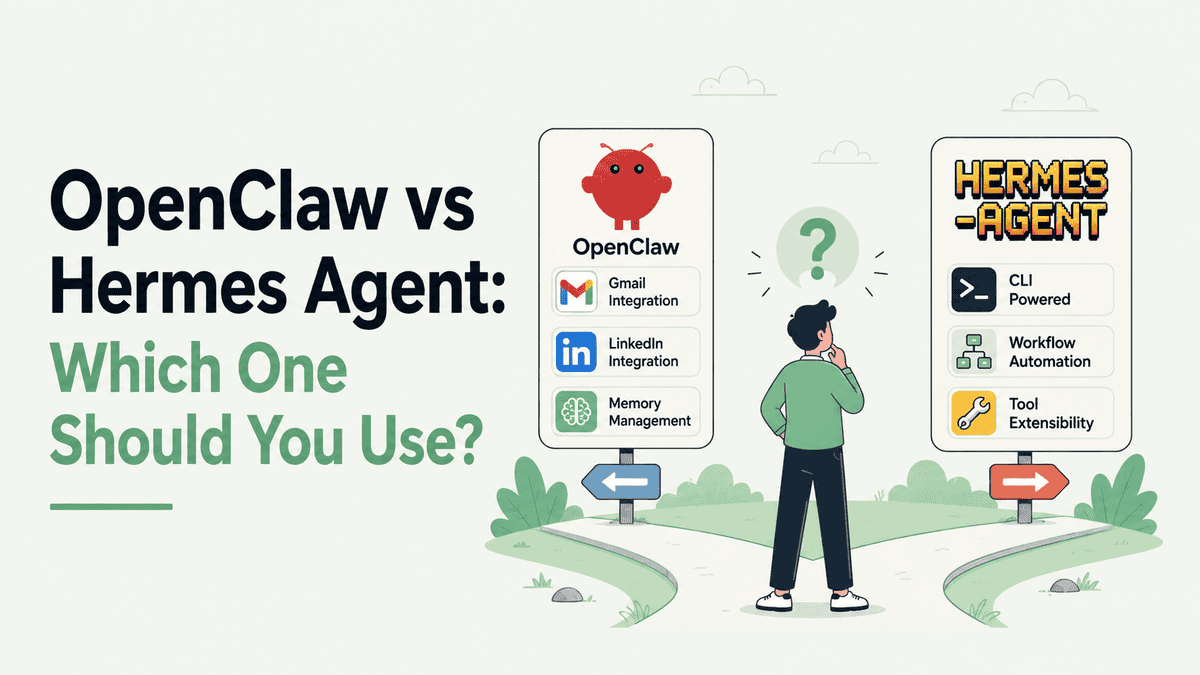
If you’ve spent any time in AI communities in 2026, you must have seen these two names thrown around together. OpenClaw and Hermes Agent.
They are both open-source, self-hosted AI agents that automate tasks across messaging platforms.
Both have persistent memory. Both run 24/7 on your own hardware.
But the OpenClaw vs Hermes Agent debate isn’t really about features. It’s about philosophy. OpenClaw is a gateway that connects your AI to everything. Hermes is an agent that learns from everything. That difference shapes who should use which, and when.
This comparison article covers what actually matters.
What Is OpenClaw?
OpenClaw is a self-hosted AI agent that lives on your device or server and connects to the messaging apps you already use. WhatsApp, Telegram, Discord, Slack, Signal, iMessage, Google Chat, and 40+ others.
You bring your own API key (OpenAI, Anthropic, Google, or a local model through Ollama), and OpenClaw routes everything through a central gateway process. It can manage your inbox, send emails, automate file tasks, browse the web, run code, and execute scheduled jobs.
It started as a side project by Peter Steinberger (founder of PSPDFKit) in late 2025. Originally called Clawdbot, it went through a rename to Moltbot after a trademark dispute, then settled on OpenClaw. Openclaw crossed 350,000 GitHub stars within months, beating React’s 10-year total.
What Is Hermes Agent?
Hermes Agent is an open-source, self-hosted AI agent that runs persistently on your machine, automates tasks across messaging platforms, and gets smarter the longer you use it.
It supports 17 platforms including Telegram, Discord, Slack, WhatsApp, Signal, and email. It ships with 70+ built-in tools covering web search, browser automation, file operations, code execution, and scheduled tasks.
Hermes is built by Nous Research, the lab behind the Hermes series of open-source language models. It launched on February 25, 2026, hit 180,000+ GitHub stars within four months, and currently sits at #1 on OpenRouter’s global rankings with 224 billion daily tokens. It’s Python-based, MIT-licensed, and shipped an official desktop app in June 2026.
The thing that sets Hermes apart is the closed learning loop. After every task, the agent evaluates what happened, pulls out reusable patterns, and saves them as skill files. Next time it encounters a similar task, it skips the reasoning and uses the skill it already built.
How to Use OpenClaw
OpenClaw requires Node.js 22 or higher. The fastest way to install it:
- Run the one-line installer: curl -fsSL https://openclaw.ai/install.sh | bash
- Run the onboarding wizard: openclaw onboard
- The wizard asks three things: your LLM provider (Anthropic, OpenAI, Google, or Ollama), your API key, and which messaging platform to connect first
- Start the gateway: openclaw gateway start
That’s it. The gateway runs as a background process. You can now message your agent on whichever platform you connected. For Windows, use WSL2 or the PowerShell installer. Docker Compose is available for always-on VPS deployments. DigitalOcean and Hostinger both offer one-click deploys.
If you’re starting from scratch and want to understand what goes into building one of these, here’s how to build your own AI agent first.
How to Use Hermes Agent
Hermes requires Python 3.11 or higher. To install:
- Run the installer: curl -fsSL https://hermes-agent.nousresearch.com/install.sh | bash
- Set up your model: hermes model (walks you through choosing a provider)
- Connect a messaging platform: hermes gateway setup
- Verify everything works: hermes doctor
- Start chatting: hermes
You can also download the Hermes Desktop app (available for macOS, Windows, and Linux) and skip the terminal entirely. For VPS deployments, Docker is supported with a single container command. A $5 VPS with 1 vCPU and 1 GB RAM is enough when the LLM runs over an API.
OpenClaw vs Hermes Agent: What’s the Difference?
Both tools are open-source, self-hosted, and connect to your messaging apps. But that’s roughly where the similarities end. Here are the differences that actually matter when picking between them.
Architecture: Gateway-First vs Agent-First
This is the fork in the road. Everything else follows from this.
OpenClaw‘s bet is that the hard problem is routing and control. The gateway is the single source of truth. It manages sessions, channels, and permissions. The agent wraps around this messaging infrastructure. Run the same task 100 times and it treats each one as a new problem.
This is optimised for breadth: more channels, more integrations, more skills. Not for long-term workflow learning.
Hermes‘s bet is that the hard problem is memory and self-improvement. Every 15 tool calls, the agent reflects, evaluates, and saves workflow files. It creates and installs its own skills autonomously. It delegates to isolated subagents for complex tasks. It remembers learnings across sessions and builds a deepening model of who you are.
If OpenClaw is a Swiss Army knife with 100 blades, Hermes is a knife that sharpens itself the more you use it.
What this means for you: if your problem is “I need AI across a dozen platforms and services,” OpenClaw’s architecture fits better. If your problem is “I need AI that gets smarter at my specific workflows,” Hermes wins.
Feature Comparison
Here’s how they stack up side by side.
Dimension | OpenClaw | Hermes Agent |
|---|---|---|
Language | TypeScript / Node.js | Python |
Messaging platforms | 50+ | 15+ |
Built-in tools/skills | 100+ AgentSkills | 70+ tools |
Community marketplace | ClawHub (44,000+ skills) | 310+ community workflows |
Self-learning | No | Core feature |
Desktop app | No native app | Native app (macOS, Windows, Linux) |
Memory system | Session-based | Persistent + checkpoint/rollback |
Maintainer | OpenClaw Foundation | Nous Research |
License | MIT | MIT |
Memory and Learning
Both agents remember things across sessions. But how they learn is completely different.
OpenClaw uses JSONL transcripts as a factual log of what happened. It manages context windows carefully and loads previous conversation history before each model call. Skills are static files written by humans, installed from ClawHub. If you want a new capability, you find a skill or write one yourself. The agent doesn’t change on its own.
Hermes uses SQLite with FTS5 full-text search for cross-session recall. But the real difference is skill synthesis. When Hermes completes a task, it automatically:
- Evaluates whether the outcome succeeded
- Extracts reusable reasoning patterns
- Stores them as Markdown skill files
- Pulls relevant skills on future similar tasks
This matters most for repetitive workflows. Daily reports, content pipelines, data processing, research loops. Anything you do often enough that the agent can recognise the pattern. OpenClaw does the same task the same way every time. Hermes gets faster at it.
One honest caveat: the improvement is domain-specific. A skill learned from summarising GitHub PRs doesn’t transfer to planning a database migration.
Platform Integrations
OpenClaw wins on sheer numbers.
Factor | OpenClaw | Hermes Agent |
|---|---|---|
Messaging platforms | 50+ | 17 |
Key platforms | Telegram, Discord, Slack, WhatsApp, Signal, Matrix, Email, SMS, WeChat, DingTalk | Telegram, Discord, Slack, WhatsApp, Signal, Matrix, Email, SMS |
MCP support | Yes | Yes |
Browser automation | Playwright-based | Camofox / Playwright |
Security and Risk
This is where OpenClaw’s rapid growth became a liability.
OpenClaw’s track record:
- 138+ CVEs disclosed in five months
- Two vulnerabilities scored CVSS 9.9 (the maximum practical severity)
- The ClawHavoc supply chain attack hit ClawHub with 1,400+ malicious skills. At one point, 12% of all skills on the marketplace were malware
- 135,000+ exposed instances found on the public internet, 63% without authentication
- Microsoft advised against deploying OpenClaw on machines with sensitive data
OpenClaw has since partnered with VirusTotal to scan ClawHub uploads and patched the worst vulnerabilities. But prompt injection and dynamic loading can still bypass static analysis.
Hermes’s track record:
Hermes looks cleaner on paper but isn’t spotless. An independent audit of v0.8.0 in April 2026 found 4 critical and 9 high-severity vulnerabilities across 812 Python files. The most serious: the terminal tool passes arbitrary commands to bash with no syscall restrictions, no allowlist, and no sandbox on the default local backend.
Hermes has only one formal CVE to date (CVE-2026-7396, a path traversal in the WeChat adapter). Fewer CVEs partly reflects less security scrutiny, not necessarily fewer bugs.
The takeaway for both: run in Docker, don’t install unvetted skills, and don’t give either agent access to anything you’d panic about losing.
Pricing and Running Costs
Neither tool costs money to download. The real costs are hosting and API usage.
Factor | OpenClaw | Hermes Agent |
|---|---|---|
Self-hosted VPS | $5-24/month | $5-10/month |
Managed hosting | OpenClaw Cloud at $49/month | No official managed option yet |
API costs (moderate use) | $15-65/month | $15-65/month |
Typical total (solo user) | $30-80/month | $20-65/month |
One thing to know about Hermes: 73% of every API call is fixed overhead (tool definitions, system prompt, memory context). This eats into your token budget before your actual message hits the model. Both tools support OpenRouter, so you can route cheap tasks to budget models and save expensive ones for complex reasoning.
OpenClaw Cloud’s flat $49/month is more predictable if you hate surprise API bills.
Skills and Ecosystem: ClawHub vs Hermes Marketplace
Ecosystems often matter more than core architecture. Most users spend more time installing and using skills than configuring the framework itself.
ClawHub has scale. 44,000+ community skills, with the most popular ones exceeding 35,000 installs. But that growth outpaced moderation. Before the early-2026 cleanup, roughly 12% of skills on the marketplace were flagged as malicious during the ClawHavoc campaign.
Security researchers also found skills passing secrets into LLM context windows and exposing credentials in plaintext. ClawHub has since introduced stronger vetting and a VirusTotal scanning partnership.
Hermes takes a different approach. Its ecosystem is smaller but built around self-generated skills that the agent creates autonomously from completed tasks, refines during real use, and compounds through persistent memory.
The community side includes 310+ reusable workflows and 78 community-listed skills on awesome-hermes-skills. The philosophical difference: OpenClaw’s ecosystem grew fast and cleaned up later. Hermes’s ecosystem is smaller but doesn’t carry the same supply chain baggage.
OpenClaw vs Hermes Agent: Which One Should You Pick?
Pick OpenClaw if:
- You need the widest possible integration ecosystem (50+ platforms, 44K skills)
- You want managed hosting without server admin work
- You’re building multi-agent teams that need persistent coordination across sessions
- You prioritise ecosystem maturity over cutting-edge features
Pick Hermes if:
- You do repetitive tasks and want the agent to genuinely improve over time
- You want a leaner, cheaper setup with fewer moving parts
- You care about security defaults out of the box
- You prefer Python over TypeScript for customisation
Use both if:
This is where experienced users are heading. OpenClaw as the orchestrator for routing and sequencing across platforms. Hermes as the execution engine for fast, repeatable task loops. It’s a real pattern gaining traction in developer communities.
Switching? Hermes ships a built-in migration command (hermes claw migrate) if you want to move over from OpenClaw.