[Reader Disclosure]Our content is reader-supported. This means we may earn a commission if you click on some of our links.
Most people think AI stops at chatbots answering questions. You type something, it responds, and that’s it. But here’s what’s actually happening: AI is learning to do things on its own. Not just respond, but act.
These AI agents can read your emails, figure out what’s important, and draft replies without you lifting a finger. They can scan twenty calendars, find a meeting time that works, and send the invites. They’re perceiving what’s happening, deciding what needs to be done, and taking action.
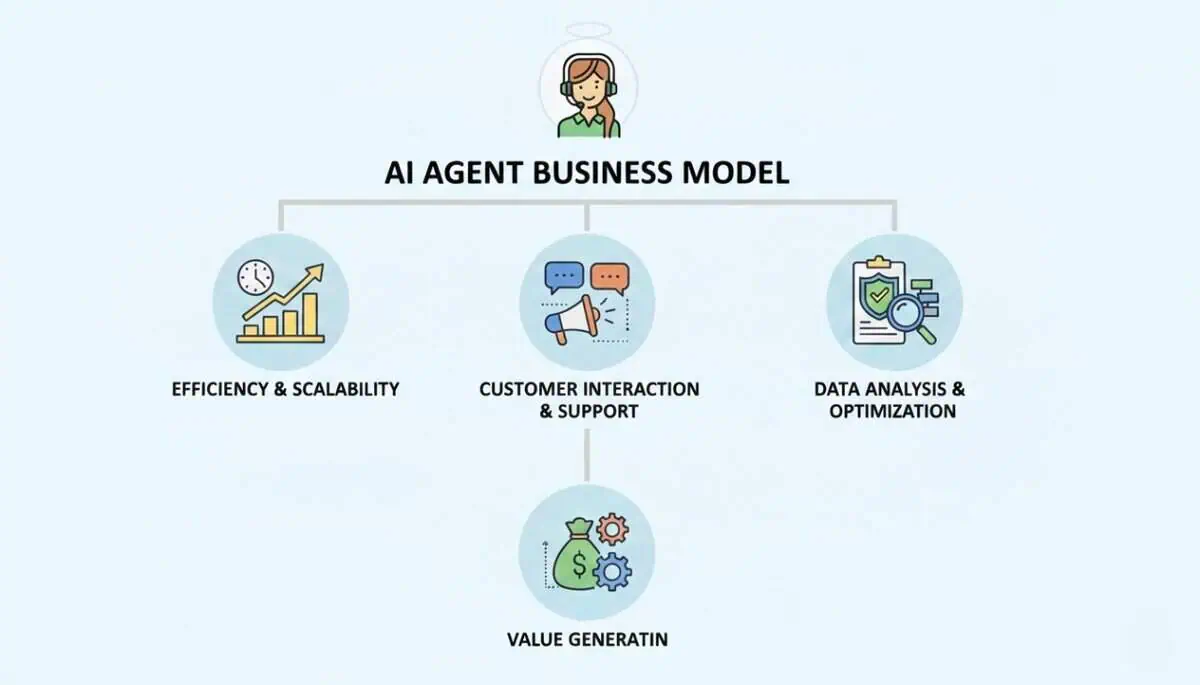
Entire startups are now being built around this shift from conversational AI to autonomous agents that actually complete tasks. This is where the AI agent business model comes in.
An AI agent business model refers to how a company builds, delivers, and captures value using autonomous AI agents. It’s the framework for turning AI that can act independently into a profitable product.
Here’s the shift: the agent itself becomes the core product. You’re not selling software with an AI feature tucked in the settings menu. You’re selling an autonomous worker that handles entire workflows without human intervention.
Think about the difference between traditional SaaS and an AI agent business. With traditional SaaS, you buy project management software like Asana or Monday. You learn the interface, create boards, assign tasks, and update statuses. You’re the operator.
With an AI agent business, you’re buying an AI project manager that tracks deadlines, reassigns tasks when someone’s overloaded, sends progress updates, and flags blockers automatically. You hired a digital employee, not a tool you need to master.
Aspect
Traditional SaaS Business Model
AI Agent Business Model
Core Value Proposition
Sells software tools that help users perform tasks more efficiently
Sells autonomous agents that perform tasks and complete workflows on behalf of users
Role of the User
User operates the software and drives all actions
User sets goals or instructions while the agent executes the work
Revenue Model
Mostly subscription-based, often priced per user or seat
Subscription plus usage-based or outcome-based pricing tied to tasks completed
Cost Structure
Predictable infrastructure and development costs that don’t vary heavily with usage
Higher variable costs due to AI model usage, compute power, and API calls per task
Scalability Driver
Growth comes from acquiring more users and teams
Growth comes from increasing the volume and complexity of tasks handled by agents
Types of AI Agent Businesses
AI agent startups operate in different niches depending on what tasks their agents handle.
1. Personal Productivity Agents
These agents manage the daily grind for individuals and knowledge workers. Email assistants that draft responses, scheduling agents that find meeting times without the back-and-forth, personal task managers that prioritise your to-do list based on deadlines and energy levels.
Companies building these agents target professionals drowning in administrative work who’d rather focus on deep work. The agent becomes your personal assistant without the salary.
2. Business Workflow Agents
This category focuses on automating internal operations that bog down teams. CRM automation agents that update customer records after sales calls, report generation agents that pull data from multiple systems and create executive summaries, internal process automation for approvals and procurement workflows. SMBs and enterprise operations teams are the sweet spot here.
According to V7 Labs research on AI agent examples, operations teams using invoice matching and data validation agents report significant reductions in manual processing time. These agents handle the repetitive stuff that eats up hours every week.
3. Customer-Facing AI Agents
These agents interact directly with customers on behalf of the business. Support agents that resolve tickets end-to-end without escalating to humans, sales agents handling initial outreach and qualification before passing warm leads to reps.
Customer service and sales teams are the primary buyers. According to research, platforms like Sendbird help support teams deliver proactive, personalised customer service across channels. The agent doesn’t just answer questions. It understands context, follows up, and closes the loop.
4. Developer and Data Agents
These agents tackle technical and analytical work that requires specialised knowledge. Code review agents that catch bugs and suggest improvements, automated debugging tools that trace errors and propose fixes, data analysis agents that clean datasets and generate insights, SKU classification agents for e-commerce catalogues.
Engineering teams and data-heavy enterprises are the target market. The agent acts like a junior developer or analyst who never sleeps and processes information faster than any human could.
How AI Agent Business Model Makes Money
AI agent companies don’t reinvent monetisation from scratch, they borrow proven SaaS pricing models and tweak them to match automation and usage. The core difference is this: instead of just paying for access to software, customers are often paying for work done by the software.
Here are the main ways AI agent businesses generate revenue:
Subscription Model – Fixed monthly or annual fee for ongoing access to the AI agent
Usage-Based Pricing – Customers pay based on how many tasks, actions, or API calls the agent performs
Tiered Plans – Different price levels tied to automation limits or feature access
Enterprise Licensing – Custom contracts for large organisations with broader usage and support
Outcome-Based Pricing – Pricing linked directly to results delivered, not just activity
Comparison of AI Agent Revenue Models
Model
How It Works
Best For
Why Customers Like It
Example
Subscription
Flat monthly or yearly fee for access
Personal productivity agents, internal tools
Predictable costs, simple budgeting
$20/month for unlimited use of a writing assistant
Usage-Based
Pay per task, action, or API call
Customer support, data processing, automation-heavy tools
Pay only for what you use
$0.05 per support ticket handled
Tiered Plans
Pricing increases with higher limits or features
Growing startups and SMBs
Easy to scale as needs grow
$49 for 100 tasks, $199 for 1,000
Enterprise Licensing
Custom pricing for large teams or org-wide use
Enterprises with large workflows
Dedicated support, bulk value
$50,000/year for company-wide deployment
Outcome-Based
Pay for successful results delivered
High-trust, high-impact use cases
Direct ROI alignment
$2 per ticket resolved without human help
Cost Structure of an AI Agent Business
AI agent businesses face both traditional software startup costs and AI-specific expenses that scale with usage.
What surprises most founders is how variable the costs become compared to typical SaaS. Traditional software has predictable infrastructure costs, but AI agents? Every customer interaction literally costs you money.
AI Model and API Usage
Costs from OpenAI, Anthropic, or other LLM providers. Every agent action burns tokens, making this a variable cost that scales with customer usage. If your agent suddenly goes viral and processes 10x the queries, your API bill follows right behind.
Cloud Hosting and Infrastructure
Servers, databases, and compute resources to run the agents 24/7. Plus the API gateways, load balancing, and observability tools to make sure everything stays running smoothly when your customer expects their agent to work at 2 AM.
Engineering and Product Development
Building and maintaining the agent logic, integrations, and improving reliability. You’re constantly tweaking prompts, adding new integrations, and fixing edge cases where the agent does something unexpected.
Customer Support
Ironically, AI agent companies still need humans to help customers set up and troubleshoot their agents. Someone has to explain why the agent misunderstood a particular request or help configure it for a customer’s specific workflow.
Sales and Marketing
Getting in front of potential customers, especially in enterprise where deals take months. You’re not just explaining what your product does, you’re educating buyers on what AI agents even are and why they should trust autonomous software with business-critical tasks.
How AI Businesses Get Their First Users
Most AI agent startups don’t launch with a full product. They start small, test interest, and grow with feedback from early users.
Step 1: Create a Simple Landing Page
Founders build a basic page explaining what the AI agent does, who it’s for, and what problem it solves. The goal is clarity, not fancy design.
Step 2: Show the Agent in Action
A short demo video helps people understand the value fast. Instead of big promises, startups show the agent completing real tasks.
Step 3: Set Up a Waitlist
Before the product is fully ready, startups collect emails from interested users. This validates demand and builds an early audience.
Step 4: Build Trust with a Branded Website
To look credible, founders launch the page on their own domain instead of using a generic link. This usually starts with domain registration to secure the product name before promoting it. A proper domain makes the AI agent feel like a real product from day one.
Step 5: Share in the Right Communities
Startups post in places where their target users already hang out: Product Hunt, AI forums, LinkedIn groups, and niche Slack communities.
Step 6: Learn from Early Users
The first users give feedback on what’s confusing, what’s useful, and what’s missing. Startups use this input to improve the agent before scaling.
Step 7: Use AI to Find More Users
Many founders also use AI tools for prospect research and personalised outreach, helping them reach the right audience faster and at lower cost.
Examples of AI Agent Startups
Here are a few companies already building businesses around AI agents.
1. Sierra
Sierra develops AI agents that handle customer service tasks like processing exchanges and updating subscriptions without human involvement. It mainly serves e-commerce and subscription-based businesses that deal with high volumes of repetitive support requests.
How it makes money: Likely through enterprise contracts combined with usage-based pricing, where clients pay more as the agent handles more customer interactions.
2. Moveworks
Moveworks provides AI agents that support employees inside large organisations. These agents help resolve IT issues, answer workplace questions, and retrieve internal knowledge automatically.
How it makes money: Enterprise pricing, often based on the number of employees using the system or the volume of queries handled.
3. Beam AI
Beam AI offers a platform that lets enterprises build and manage multiple AI agents across different workflows. These agents automate operational processes across teams and departments.
How it makes money: Platform licensing fees plus usage-based pricing tied to how extensively companies deploy and run their agents.
Advantages of the AI Agent Business Model
AI agent businesses have structural advantages over traditional SaaS that make them particularly attractive to investors and founders.
1. High Scalability: Once built, agents can handle thousands of customers simultaneously without proportional cost increases. Adding the 1,000th customer doesn’t require hiring more support staff or expanding infrastructure in the same way a service business would. The marginal cost of each new customer approaches zero while revenue keeps climbing.
2. Recurring Revenue: Subscription and usage-based models create predictable, recurring revenue that compounds over time. Customers who integrate agents into their daily workflows rarely churn because pulling out the agent means rebuilding processes from scratch. That stickiness translates into reliable cash flow you can count on month after month.
3. Deep Product Stickiness: When an agent learns a customer’s specific workflows, preferences, and data patterns, switching costs become massive. You’d have to retrain a completely new agent, migrate all your data, and teach your team new processes. Most customers would rather stick with what’s working than go through that hassle, which keeps churn incredibly low.
4. Strong Automation Value: Customers see direct ROI by replacing human hours with agent automation, making the purchase decision straightforward. It’s easy to justify the expense when you’re saving 20 hours a week on data entry or customer support. That clear value proposition shortens sales cycles and makes renewals almost automatic because the ROI speaks for itself.
Challenges in AI Agent Business Model
AI agents can automate real work, but turning them into reliable, profitable businesses comes with serious challenges.
Model Reliability and Accuracy: AI agents can make mistakes, and when they act autonomously, those mistakes can have real consequences. Wrong customer responses or incorrect data handling can quickly damage user trust.
High Compute Costs: Every action an AI agent takes consumes API calls and cloud resources. As usage grows, costs can rise sharply, making pricing and cost control critical for sustainability.
Trust and Adoption Barriers: Many employees and organisations are still hesitant to let AI make decisions without oversight. This slows adoption and often requires extra approval layers that reduce the efficiency gains agents promise.
Data Privacy and Security Risks: AI agents often need access to sensitive customer and company data. This creates compliance, security, and legal risks, especially in regulated industries like healthcare and finance.
Competition from Big Tech: Large companies like Google and Microsoft are building their own AI agent platforms. Startups must focus on niche problems, specialization, or industry-specific solutions to compete effectively.
The Future of AI Agent Businesses
The next phase isn’t about single agents handling isolated tasks. It’s about multi-agent systems where specialised agents collaborate on complex workflows. Enterprises are moving from single agents to orchestrated multi-agent systems that can handle complex, multi-dimensional tasks.
What this means for you: agents will work across multiple tools like CRM, email, and project management seamlessly, without humans switching between apps. One agent gathers information, another analyses it, a third takes action based on the analysis, all coordinated automatically.
The bigger shift is from “software tools” to “software workers.” We’re seeing the rise of AI-native startups that are built around agents from day one, not traditional companies tacking on AI features. According to PwC’s AI agent survey, enterprise budgets for AI agents are surging with measurable ROI being realised.
The companies winning this transition aren’t just automating tasks—they’re reimagining entire workflows around what agents can do autonomously. AI agents aren’t just changing how software works; they’re fundamentally reshaping how software delivers value by doing the work instead of enabling humans to do the work.
A startup consultant, digital marketer, traveller, and philomath. Aashish has worked with over 20 startups and successfully helped them ideate, raise money, and succeed. When not working, he can be found hiking, camping, and stargazing.
Each week I share research backed AI oriented content in my newsletter.
There are AI ideas, AI trends, tutorials, and guides.
24k entrepreneurs read it. I'd love you to join.