

Professional-quality artwork once required years of training and expensive software. That barrier has vanished, and what replaced it is larger than any single creative breakthrough: tens of millions of people who never held a brush now produce work that competes with professionals.
AI art statistics from 2026 put the global image generation market at $15.18 billion this year, a 30.3% jump from $11.65 billion in 2025. Image generation is now the largest standalone segment in all of generative media.
Here is who is building these tools, who is using them, and where the money is going.
Key AI Art Statistics for 2025
AI art crossed from experiment to industry in 2025. These are the numbers defining its market, its makers, and its limits.
- The AI image generation market is projected to grow from $9.1 billion in 2025 to $272.8 billion by 2035, a 40.5% CAGR (Market.us, 2025)
- The AI-powered design tools market is expected to reach $4.4 billion by 2025, growing at a 34.8% CAGR (Grand View Research, 2025)
- Market.us’s January 2026 report values the global AI in Art and Creativity Market at $16.23 billion in 2025, projected to reach $161.11 billion by 2034, growing at a 25.8% CAGR (Market.us, January 2026)
- Midjourney had approximately 19.83 million registered Discord users as of January 2026, down slightly from 19.94 million in December 2025 (DemandSage, 2026)
- Midjourney generated an estimated $500 million in revenue in 2025, up about 66.7% from $300 million in 2024, with roughly 1.2 to 2.5 million daily active users (Morphed, June 2026)
- Visual art and image generation account for 61.8% of the AI in art and creativity market, making them the dominant category (Market.us, 2025)
- Over 35% of fine art auctions now feature AI-generated pieces, reflecting mainstream acceptance in traditional art markets (Artsmart.ai, 2025)
- Only 9% of gallery professionals consider AI-generated art a legitimate new medium, while 25% see it as a destabilizing force for authorship and value (Artsy AI Survey 2026)
- Nearly 25% of promotional products firms already have AI built into internal processes, and 69.2% are somewhere in the AI onboarding process, with marketing and artwork showing the biggest gains (PPAI, 2026)
- 91% of designers use AI in their design work at least weekly, up from 54% a year earlier, with 75% using it daily (AI in Design Report 2026)
- The average designer now regularly uses 7 AI design tools, more than double the 3 tools reported in 2025 (AI in Design Report 2026)
- Adobe Firefly has generated more than 29 billion images and assets since its 2023 launch, now averaging roughly 1 billion generations per month (Adobe, 2026)
- Commercial AI art detection software identifies AI-generated images with approximately 98% accuracy, while general users perform near chance level at roughly 50% and professional artists reach around 83% (Hall & Schofield, February 2025)
- Human accuracy at classifying deepfake images was statistically indistinguishable from chance in a February 2026 University of Florida study, while a CNN model achieved 97% accuracy; participants misclassified deepfake images as real 69% of the time (University of Florida, February 2026)
- Humans correctly identify high-quality deepfake videos at a rate of just 24.5%, while AI detection tools achieve up to 96% accuracy in lab conditions but drop to roughly 45 to 50% in real-world use (StationX, 2026)
- Only 0.1% of participants could reliably distinguish real content from AI-generated content in iProov research, highlighting the difficulty of human detection (iProov, 2026)
AI Art Market Size and Growth Statistics
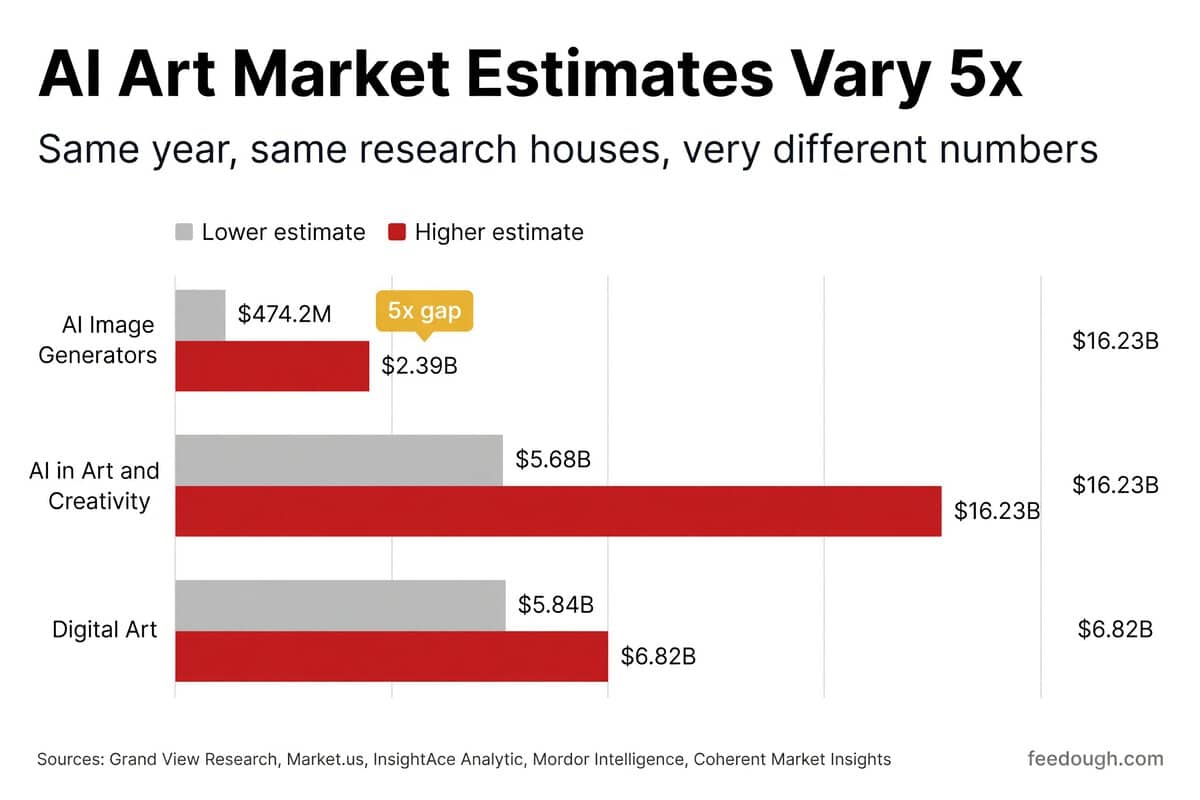
Grand View Research values the entire AI image generator market at $474.2 million in 2025. Other research firms put that same segment at $2.39 billion for roughly the same period. Both sets of numbers describe 2025, and both come from established research houses.
That gap is the defining feature of AI art market size research. Firms rarely disagree on direction; every forecast in the field compounds at double digits. They disagree on boundaries: where one segment ends and where adjacent creative software begins. Compare the estimates side by side and the pattern is hard to miss.
Segment | Lower Estimate | Higher Estimate | CAGR Spread |
|---|---|---|---|
AI in Art and Creativity (broad) | $5.68B in 2025, reaching $54.04B by 2035 (InsightAce Analytic) | $16.23B in 2025, reaching $161.11B by 2034 (Market.us) | 25.4% vs 25.8% |
AI Image Generators | $474.2M in 2025, reaching $1.85B by 2033 (Grand View Research) | $2.39B in 2024, reaching $30.02B by 2033 | 18.8% vs 32.5% |
Digital Art | $5.84B in 2025, reaching $13.26B by 2031 (Mordor Intelligence) | $6.82B in 2026, reaching $21.07B by 2033 (Coherent Market Insights) | 14.7% vs 17.5% |
The clearest tell is the image generator row. On current value, the estimates differ by a factor of five, and the growth rates diverge by nearly 14 percentage points. Broader reports bundle design platforms, creative suites, and generation tools into one line item, which inflates the base and compresses the growth rate. Narrower reports isolate a single tool category, which shrinks the base and inflates the rate.
Picking a growth rate therefore means picking a segment definition first. The broad creative category compounds near 25% a year, while thin slices such as AI-generated fashion photography ($1.8 billion in 2025, projected at $9.4 billion by 2034) attract sparse coverage and carry wider error bars. A CAGR quoted without its segment attached tells a buyer almost nothing.
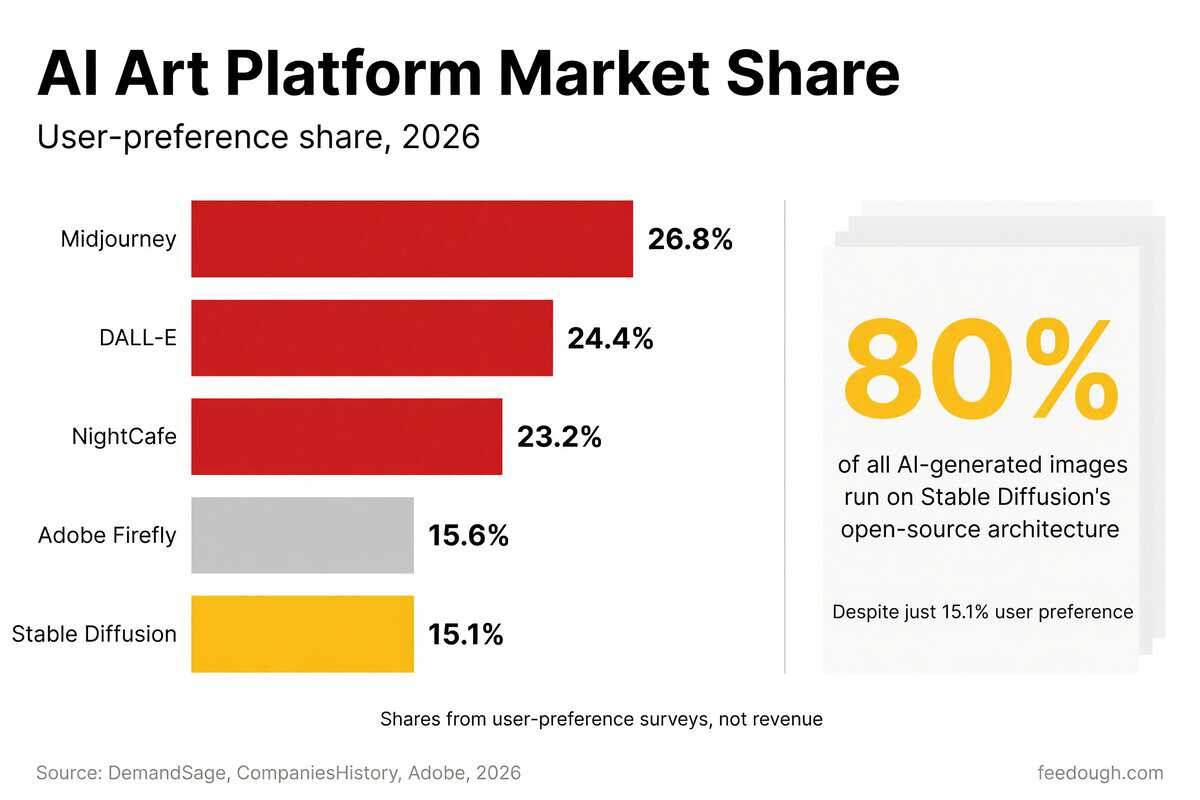
Volume estimates for AI image output disagree wildly. 2026 compilations put daily production at roughly 34 million images, less than half the 80 million figure that circulated earlier, and fact-checkers now note that no reliable census of AI image volume exists. Platform-level data is the sharper instrument, and the AI art platform market share it produces tells a story of churn rather than consolidation.
Platform | Market Share | Key Usage Metric |
|---|---|---|
Midjourney | 26.8% | 19.83M registered users; roughly 10M images per day |
DALL-E | 24.4% | Deprecated May 12, 2026; replaced by GPT Image 1.5 |
NightCafe | 23.2% | Community-driven generation model |
Stable Diffusion | 15.1% | Open-source architecture behind roughly 80% of all AI-generated images |
Adobe Firefly | 15.6% | Used by 75% of Fortune 500 companies |
SeaArt | Emerging | 30M MAU; roughly 3M images per day; ARR near $50M |
These shares come from user-preference surveys rather than revenue filings, which is why competing sources never quite sum to 100%. The Stable Diffusion row is still the one worth sitting with. The brand holds 15.1% of user preference, yet roughly 80% of all AI-generated images worldwide run on platforms built on its open-source architecture.
Leadership at the model level rotates just as fast. On Poe, Flux absorbed close to 40% of image generation traffic as the catalog expanded from about three image options to around 25, while DALL-E 3’s relative share fell roughly 80% before OpenAI deprecated it. Midjourney’s web traffic shows the same fade: 10.84 million visits in August 2026, down from more than 16 million monthly visits in late 2025.
Engagement data narrows the picture further, separating registered accounts from people who actually show up:
- Between 1.2 million and 2.5 million users are active on Midjourney on any given day, roughly 7.5% of its registered base
- 68% of Midjourney users create for fun versus 32% who use it as a work tool, and 83% describe the platform as a form of art therapy (DemandSage, 2026)
- Adobe Firefly sustains a 70% weekly active engagement rate among its user base
- 24% of US adults and 48% of AI chatbot users say they use chatbots to create or edit images or video (Pew Research Center, February 2026)
- 86% of creators actively use creative generative AI, with 55% citing editing and upscaling, 52% generating new assets, and 48% ideation as top use cases; 60% used more than one tool in the past three months (Adobe Creators’ Toolkit Report, 2026)
A 7.5% daily active rate reads as modest until you remember this is a paid creative tool, not a social feed. For that category, it signals real workflow integration, and the recreational skew explains why the professional core looks narrower than the registration totals imply. SeaArt points at the counter-model: its users spend more than three times longer online than those on comparable platforms, sustained by 2 million hosted creative assets and over 980,000 community models. Converting casual experimenters into daily practitioners is the entire growth equation from here.
AI Art Industry Adoption and Business Integration Statistics
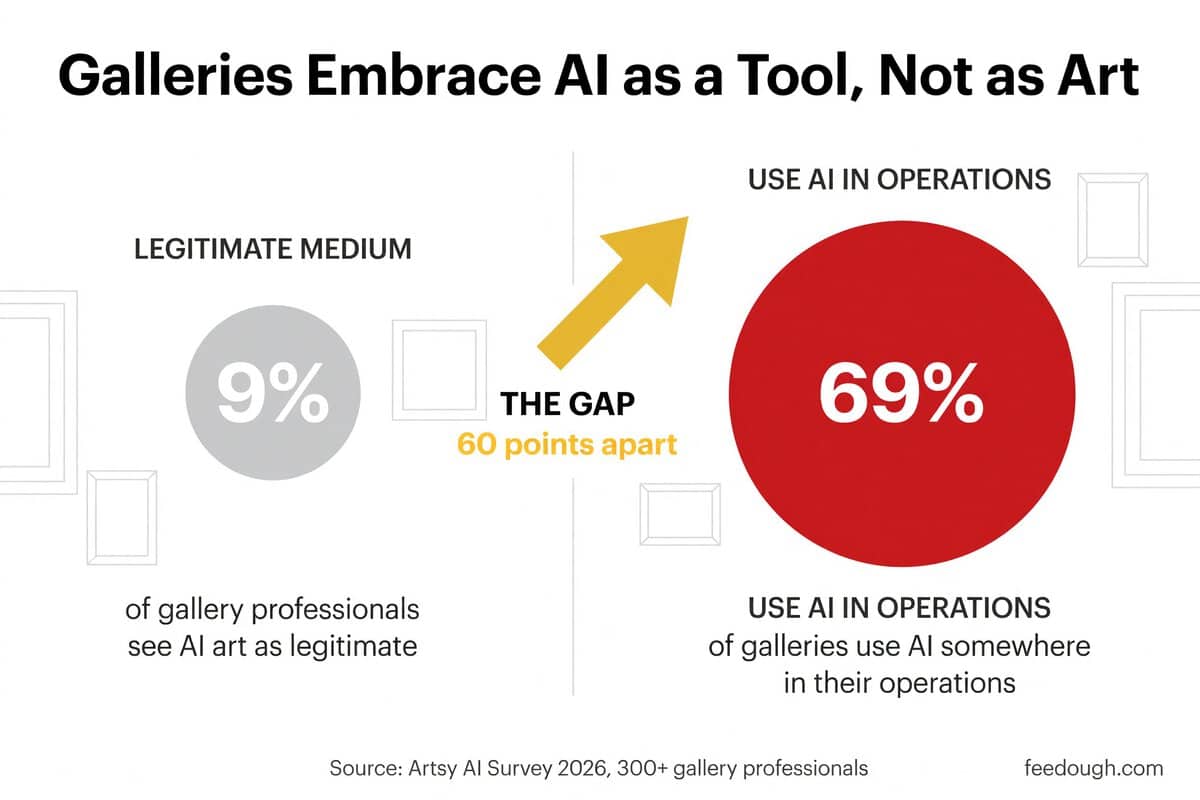
Only 9% of gallery professionals consider AI-generated art a legitimate medium. Yet 69% of those same galleries now use AI somewhere in their operations. The foothold is administrative, and the gap between AI as tool and AI as art now has numbers attached.
Artsy’s AI Survey 2026, drawn from more than 300 gallery professionals, maps where AI art industry adoption actually sits: in correspondence, files, and scheduling. None of it touches the work on the wall.
Operational Use Case | Share of Galleries |
|---|---|
Drafting emails and communications | 57% |
Writing or editing artist bios, statements, and CVs | 36% |
Image editing and file management | 27% |
Research, archiving, and data organization | 24% |
Strategy and legal work, including contracts and grant writing | 23% |
Scheduling, travel planning, and meeting transcription | 20% |
The gradient tracks exposure, not enthusiasm for the technology. Every task in the table sits downstream of production: galleries let AI handle correspondence and logistics while leaving authorship alone. The artists they represent show the same reluctance.
- 61% of galleries say none of their represented artists use AI in their practice
- 19% report that one to two represented artists use AI, and 8% report three or more
- 36% of gallery professionals expect AI to become an established artmaking tool, similar to photography
- 33% of artists represented by surveyed galleries are critical of AI, citing data scraping and ethical concerns
- 28% describe AI art as an evolving category whose market value remains unclear
- 25% view AI as a destabilizing force for authorship and value
Commercial markets run on different incentives. In promotional products, nearly a quarter of firms have AI built into internal processes, and 69.2% are somewhere in the onboarding process. Marketing and artwork post the biggest gains. Traditional fine art absorbs the technology from the money side: over 35% of auctions now feature AI-generated pieces, and the world’s leading auction houses brought in nearly $10 billion in the first half of 2026. Much of that surge traces to wealth created in AI-adjacent industries. The technology reshaping the art market is also bankrolling its buyers.
AI Art Detection Accuracy and Consumer Awareness Statistics
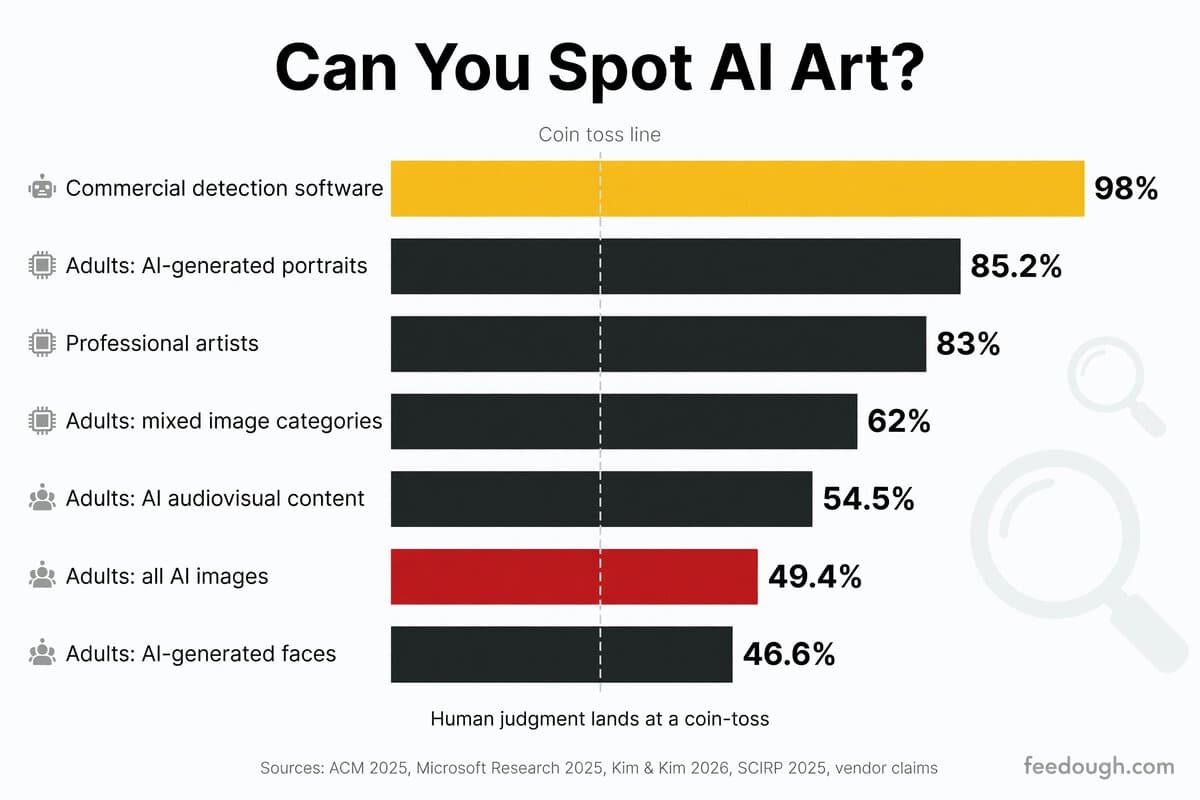
Commercial detection tools advertise near-perfect accuracy. People trusting their own judgment score 49.4% on AI-generated images, effectively a coin toss. That figure comes from an ACM study of 1,276 participants, and it was the lowest accuracy measured across any media type tested.
AI art detection rates move with the task, not with any improvement in human discernment. A Microsoft Research study of more than 12,500 participants logged 62% accuracy across mixed image categories. A portrait-focused preprint with 1,664 participants reached 85.2% on AI-generated faces.
Detector or Group | Accuracy | Source |
|---|---|---|
General adults, all AI images | 49.4% | ACM, 2025 |
General adults, AI-generated faces | 46.6% | ACM, 2025 |
General adults, AI audiovisual content | 54.5% | ACM, 2025 |
General adults, mixed image categories | 62% | Microsoft Research, 2025 |
General adults, AI-generated portraits | 85.2% | Kim & Kim, 2026 |
Professional artists, AI artwork | 83% | SCIRP, 2025 |
Commercial detection software | 98% | Vendor claims |
The errors run in one direction. Participants classified real content correctly 64.6% of the time but caught AI-generated content only 38.8% of the time. The default assumption, across studies, is that everything is genuine.
Training does not fix it. Prior knowledge of synthetic media failed to improve detection in the ACM study. In a Conjointly survey, 42% of respondents rated their own ability as high and scored no better than anyone else.
That self-assurance collides with commercial reality. A Stylitics survey of 411 shoppers found 71% could not distinguish AI-generated product photos from real ones. Clutch’s June 2026 survey of 408 consumers found 55% feel less favorable toward a brand once they know AI made its creative work. Only 24% feel more favorable.
Disclosure changes the reaction rather than deepening the backlash. 78% of Clutch respondents felt more favorable toward brands that state work is hand-illustrated. 60% of Stylitics shoppers reacted positively or neutrally to learning product images were AI-generated. Zapiet’s 2026 shopper analysis found 86% call disclosure important and 59% say its absence erodes trust.
Consumer awareness is outrunning consumer approval. IAB’s 2026 data shows 71% of consumers believe they have seen an AI-generated ad, up from 54% in 2024. Only 45% viewed those ads positively, while ad executives estimated real positive sentiment at 82%. That 37-point gap widened from 32 points in 2024.
Gen Z drives the shortfall. 39% report negative sentiment toward AI ads versus 20% of millennials, and 30% call the brands using them inauthentic. It is not a purchase dealbreaker: in the same IAB survey, 73% of Gen Z and millennial consumers said knowing an ad used AI would either raise purchase likelihood or make no difference.
The tooling does not rescue the gap either. A NewsGuard audit published in May 2026 tested the vendor claims directly. Leading commercial tools flagged authentic images as AI-generated 13.33% of the time, and one tool was wrong 40% of the time. The 98% accuracy figure belongs to lab conditions that do not survive contact with real feeds.
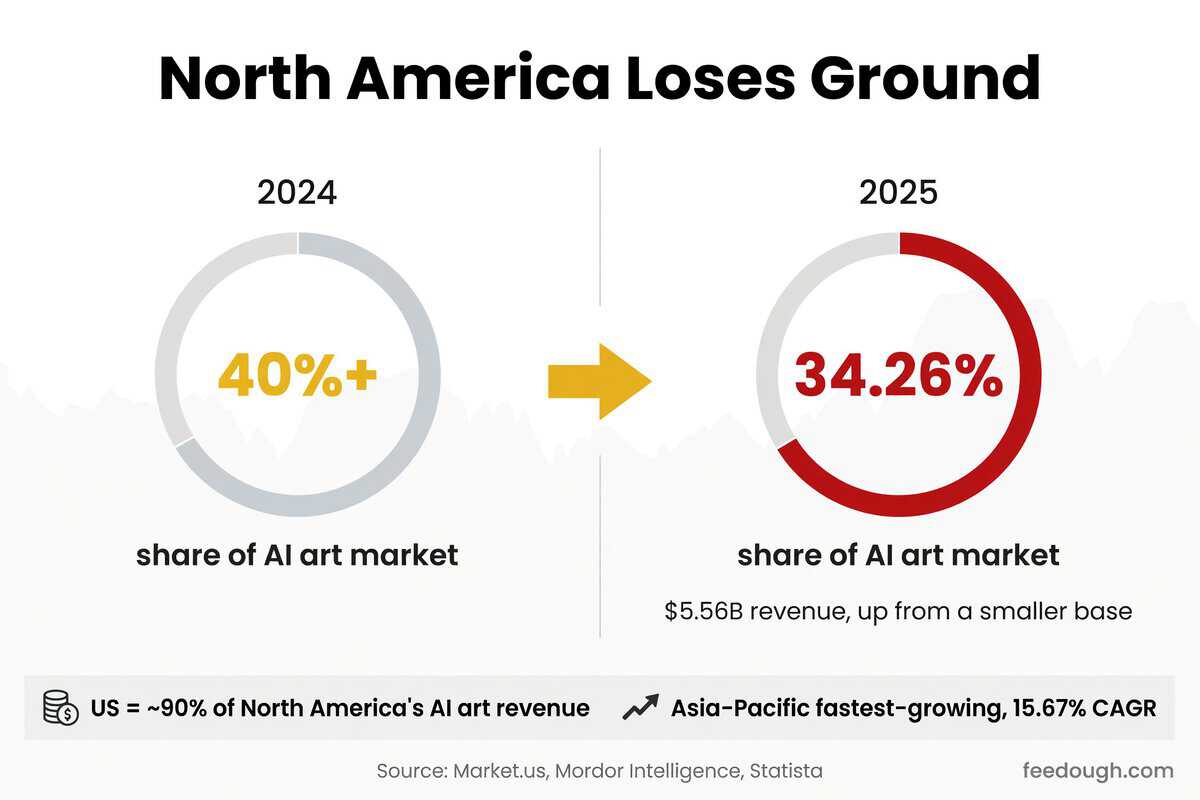
North America still leads the AI art market, and it is losing ground in the only metric that tracks relative influence. The region’s share of the AI in art and creativity market fell to 34.26% in 2025, down from over 40% a year earlier, even as its revenue climbed to $5.56 billion. The money grew. The percentage did not, because every other region grew faster.
Three research firms now measure AI art market share by region, and their numbers cluster tightly enough to treat as one picture. Market.us puts North America at 36.2% of the digital art market; Mordor Intelligence puts it at 36.73%. In the broader AI market, the region holds 35.5% of 2026 global revenue, a share that has barely moved even as total spending jumped 19% in a single year.
Region or Market | Share or Value | Context |
|---|---|---|
North America (AI in Art and Creativity) | 34.26% ($5.56 billion) | Down from over 40% in 2024 (Market.us) |
United States (AI in Art and Creativity) | $5.02 billion | 22.33% CAGR; roughly 90% of North America’s total |
North America (Digital Art) | 36.2% ($2.44 billion of $6.75 billion) | Mordor Intelligence independently puts the regional share at 36.73% |
Asia-Pacific (Digital Art) | Fastest-growing region | 15.67% CAGR through 2031 |
United States (Generative AI Revenue) | 32% to 33% of global total | $21.6 billion in 2025, projected at $34.7 billion in 2026 |
North America (Overall AI Market) | 35.5% of $514.5 billion | Global AI spending rose 19% from $390.9 billion in 2025 |
The compression comes from below, not from retreat. The United States alone accounts for roughly 90% of North American AI art revenue, leaving about $540 million for Canada and Mexico combined. Asia-Pacific, meanwhile, is scaling the digital art market at 15.67% a year through 2031, the fastest regional pace measured, driven by China’s research-to-product pipeline and a manufacturing base that commercializes models quickly.
America’s share of global generative AI revenue has held between 32% and 33% across the entire forecast period. That stability is the real story. The US generative AI market is set to triple from $21.6 billion in 2025 to roughly $143 billion by 2031, so a flat percentage now represents far more absolute revenue than the same share did two years ago. North America is not shrinking. The map around it is filling in.
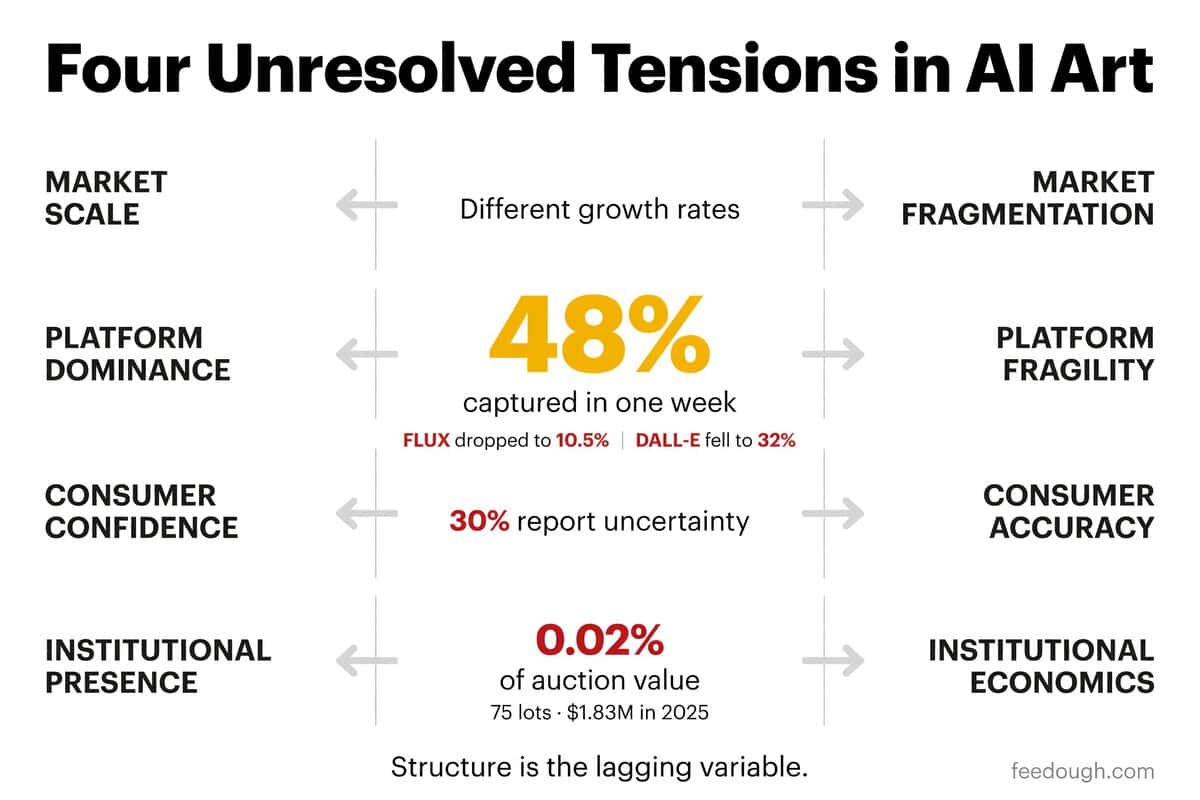
What AI Art Statistics Reveal: Four Unresolved Tensions
The AI art market does not have a growth problem. It has a governance problem. The same four tensions run through the AI art statistics gathered in 2026, at every level from platform share to auction results.
Tension | What the Data Shows | What It Implies |
|---|---|---|
Market scale vs. market fragmentation | Image generation, design tools, and generative art each grow at different rates from different baselines | No single platform or category captures the whole market; leadership in one segment does not transfer to another |
Platform dominance vs. platform fragility | Gemini 2.5 Flash Image captured 48% of Poe’s image generation activity within a week of its summer 2025 launch, dropping FLUX to 10.5% while DALL-E slipped from 45% in 2024 to 32% in 2026 | User loyalty tracks output quality, not brand; leaders can lose position inside a single product cycle |
Consumer confidence vs. consumer accuracy | General users detect AI-generated images at near-chance accuracy, yet 30% report uncertainty about whether content they encounter is AI-generated (Conjointly, September 2025) | Disclosure and transparency carry more weight than detection; trust is built on honesty, not on users catching AI unaided |
Institutional presence vs. institutional economics | Artprice counts 75 NFT and generative art lots sold at public auction in 2025, worth $1.83 million (0.02% of global fine art auction revenue) | AI art has entered traditional institutions, but its share of actual auction value remains negligible |
The four tensions share a mechanism. Lead times have compressed from years to product cycles, disclosure regimes lag the tools they regulate, and institutional access has arrived ahead of institutional volume. Structure is the lagging variable in every case.
For creators and businesses, the gap is where the consequential decisions sit now. A platform that takes 48% of a major aggregator’s image traffic in a week does not have a moat; it has a moment. The durable moves are the ones that do not reset with each model release: disclosure practice, workflow integration, and rights management.
Sources
- https://market.us/report/ai-in-art-and-creativity-market (2026-01)
- https://www.demandsage.com/midjourney-statistics (2026)
- https://morphed.app/stats/midjourney-statistics (2026-06-12)
- https://www.ppai.org/media-hub/ppai-research-new-year-new-ish-trends
- https://www.artsy.net/article/artsy-editorial-artsy-ai-survey-2026-galleries-ai-art (2026)
- https://www.adaptivesecurity.com/blog/ai-deepfake-trends-the-complete-2025-2026-guide-to-statistics-threats-detection-and-defense-stra
- https://app.stationx.net/articles/deepfake-statistics
- https://resources.rework.com/tools/ai-tools/best-ai-graphic-design-tools-2026 (2026)
- https://www.insightaceanalytic.com/report/ai-in-art-and-creativity-market/2734 (2026-02-18)
- https://www.grandviewresearch.com/industry-analysis/artificial-intelligence-ai-image-generator-market-report
- https://www.coherentmarketinsights.com/industry-reports/digital-artwork-market
- https://autofaceless.ai/blog/ai-image-generation-statistics-2026 (2026-04-27)
- https://www.globenewswire.com/news-release/2026/02/05/3232941/0/en/seaart-ai-quietly-crosses-30-million-mau-as-its-creator-community-scales.html (2026-02-05)
- https://www.semrush.com/website/midjourney.com/overview (2026-08)
- https://longyield.substack.com/p/adobe-inc-ai-winner-or-disrupted (2026)
- https://www.wearview.co/blog/ai-image-statistics (2026)
- https://sqmagazine.co.uk/ai-image-generation-statistics (2026)
- https://www.companieshistory.com/midjourney-statistics (2026)
- https://morphed.app/stats/ai-image-detection-statistics (2026-09-22)
- https://www.newsguardtech.com/special-reports/leading-ai-image-detection-tools-mislead-online-users-often-declaring-authentic-content-fake (2026-05-08)
- https://clutch.co/resources/should-brands-disclose-ai-use (2026-07-14)
- https://www.marketingprofs.com/charts/2026/54424/ai-ads-the-perception-gap-between-marketers-and-consumers (2026)
- https://www.atlascloud.ai/blog/tips/ai-generated-ads (2026)
- https://lumalabs.ai/news/ai-powered-advertising-campaign-statistics (2026)
- https://scalio.app/blog/fashion-brands-using-ai-photography
- https://zapiet.com/blog/ai-trust-gap-shoppers-2026 (2026)
- https://technologychecker.io/blog/ai-market-size-statistics (2026)
- https://market.us/report/digital-art-market
- https://www.companieshistory.com/ai-market-share-by-company (2026)
- https://www.mordorintelligence.com/industry-reports/digital-art-market