
You can run an online store without ever owning a product. You list the items, a customer orders, and a supplier ships the package. You don’t pay for inventory until that customer has already paid you.
That core promise still holds in 2026. What changed is everything around it. The old playbook of cheap imports and cheap ads no longer works. Customs duties now hit low-price parcels, and paid ads cost more every year. In one 2025 Shopify survey of 500 merchants, finding customers ranked as the top first-year challenge.
So dropshipping isn’t dead. The easy-money version of it is. You can still build a real business this way, but it rewards patience over hype. And it all starts with knowing what the dropshipping business model actually is.
What Is Dropshipping?
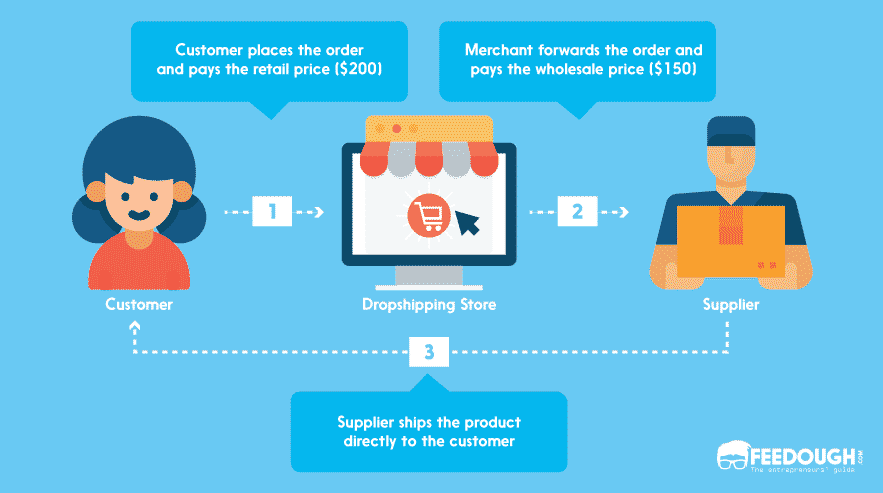
The dropshipping business model is an order fulfilment model where the merchant sells a product under their own brand but keeps no inventory of it. When a customer buys, the merchant purchases the item from a third party, and that supplier ships it straight to the customer. The merchant never handles the goods.
An example among drop shipping business ideas is an ecommerce store dealing in drones and drone accessories. The store takes orders under its own brand, while an AliExpress dropshipping supplier handles the shipping. Suppliers now commonly ship from their own overseas warehouses or from US and EU warehouses. The domestic option has become the norm for fast delivery. Anything shipped direct from China now clears customs in the buyer’s country and can carry duties.
Grand View Research projects the global dropshipping market at $583.5 billion in 2026, rising to about $2.18 trillion by 2033. Other research firms publish estimates hundreds of billions of dollars apart, so treat any single figure as one reading of a fast-growing market.
Benefits Of Dropshipping
A dropshipping store looks exactly like any other traditional ecommerce store but doesn’t bear all the risks involved in running an e-commerce store.
Dropshipping Is Easy To Start, Manage, & Grow
To launch a dropshipping store, you need a niche, a supplier, a website, and some marketing skill. You never rent a warehouse or sign delivery contracts. Your supplier stores the products and handles fulfilment. Some suppliers now ship from US or EU warehouses, delivering in 2 to 7 days.
Starting is the easy part. A store only turns profitable when you acquire customers at a cost that leaves margin. Across more than 1,200 analyzed dropshipping stores, net margins typically run 15-25%. The model rewards disciplined unit economics over chasing viral products.
Dropshipping Involves Very Less Investment
You rarely buy inventory upfront, so most of your spending goes to marketing and branding, not stock. That is the defining financial edge over a store that handles its own fulfilment.
But a low financial barrier is not low commitment. The cash you burn is mostly ad spend, and it leaves before profits arrive. Beginner dropshippers typically gross about $1,000-2,000 a month, while advanced sellers cross $50,000, per Zendrop data cited by Shopify. The entry ticket is small. The monthly cost that matters is marketing, and early months can spend more than they make.
Location Of The Merchant Doesn’t Affect The Business
You could still run the store from an apartment in India while your customers sit in the US. Your own address doesn’t gate the business. What changed is where your supplier ships from.
The US suspended its de minimis exemption, and CBP codified that suspension through an indefinite interim final rule effective June 24, 2026. Sub-$800 parcels from China now need a customs entry, and duties and brokerage fees can land on each order. That hits delivery speed and your margins.
The mainstream fix in 2026 is suppliers with US or EU warehouses. They ship in days and skip the surprise-duty problem on every parcel.
Merchant Doesn’t Have To Deal With The Unsold Inventory
As you don’t have to deal with the actual product, there’s no stress on how to deal with the unsold inventory.
Dropshipping Involves Very Less Losses
Because you never pre-buy stock, you can’t get stuck with unsold inventory. If a product flops, you simply stop ordering it. No warehouse lease, no dead stock, no clearance sale.
The money you can lose is real, though. It mostly leaks out through ad spend, app subscriptions, and monthly overhead before your store gains traction. Failed dropshippers rarely lose inventory value. They burn months of advertising budget with nothing to show for it.
For perspective, only 34.7% of US businesses started in 2013 were still operating a decade later. That’s US Bureau of Labor Statistics data cited by Shopify. It covers businesses generally, not dropshipping specifically, but it sets an honest survival bar.
How Dropshipping works?
The dropshipping process is very easy to understand. You’ve already gotten an overview of how dropshipping works, but here’s a detailed explanation for you to get a better understanding and launch your own dropshipping store.
Dropshipping Business Model
The dropshipping business model can be divided into two segments –
The front-end: the front-end is how things look to the customer. He sees your store like any other niche ecommerce store and orders the products he likes at a price set by you. After a few hours or days, he receives a notification that his order has been shipped. The notification also includes the tracking information which lets him track the order just like with any other ecommerce website.
The back-end: As soon as the customer orders the product, you purchase the same from the supplier and ask him to ship directly to the customer. The customer never gets to know about the fulfilment process as he gets the same experience like that with a traditional ecommerce store.
Dropshipping in 2026: What Changed
For years, one rule made AliExpress dropshipping work: parcels entering the US under $800 cleared customs duty-free. That is de minimis, and it kept China-direct shipping cheap and simple.
The US suspended the exemption on August 29, 2025. It kept the suspension in place on February 20, 2026, after the Supreme Court invalidated the IEEPA tariffs.
US Customs and Border Protection then codified an indefinite suspension via an interim final rule effective June 24, 2026. Congress set a permanent statutory repeal for July 1, 2027. For scale, CBP processed about 1.36 billion de minimis shipments in FY2024, roughly ten times the 2015 figure.
For your dropshipping business model, the math changed. Duties and brokerage fees can apply to every cross-border order, so landed cost and delivery time drive your pricing.
The US is not alone. The EU introduced an interim 3 euro customs duty on parcels under 150 euros, starting July 1, 2026. A small-parcel handling fee follows by November 1, 2026. The UK is phasing out duty relief under 135 pounds.
So how do you adapt? Source from suppliers that hold stock in US or EU warehouses. They clear customs domestically and reach buyers in days, with no surprise duty at the door.
That setup is now the standard, not the exception. China-direct suppliers still exist, but you must price for duties and slower clearance.
How to Start A Dropshipping Business In 2026?
Dropshipping is a proven, competitive business model in 2026, not a secret loophole. The steps that follow show how it actually works now. You’ll work from the current playbook, not the 2019 one.
Create A Website
Your website is how you’ll interact with your buyers. Social media pages help, but a real website builds more buyer trust, which leads to more sales. We suggest you start with Shopify. It remains the sensible base for a beginner dropshipping store in 2026. The sourcing plumbing now comes built in from two directions. Shopify Collective connects your store to suppliers with margins running 20-50%. Well-rated sourcing apps in the Shopify App Store link you to suppliers in a few clicks. An integrated setup like this minimizes the manual work on your end.
Here’s an article we wrote on create a website for your startup.
Find A Profitable Niche & Products
This is one of the hardest parts of starting a dropshipping business. Get this step right and the store has a real shot. Get it wrong and nothing else you do will save it. Start by checking what’s trending on:
- Google Trends
- Amazon
- Etsy
- Instagram (check the ads)
- TikTok (browse TikTok Shop and the ad library)
Some niches and drop shipping business ideas you can look for are:
- Accessory-heavy niches like laptops, phones, drones, etc. so you can target the accessory micro-niche and pave your way through.
- Accessory-heavy hobbies like golf, biking, etc. where you can target their passion and or problem.
- Products that are innovative and hard to find locally.
- Products that demonstrate well on short video, since product discovery increasingly happens in short-form video feeds.
Skip fixed price brackets. Pick products priced high enough that a healthy margin can absorb your ad cost per order. Add import duties when goods cross a border. A useful target is a 40-60% gross margin. That is roughly what it takes to still net 15-20% after ads, according to TrueProfit’s unit-economics analysis. One older rule still holds: customers should be willing to buy without talking to a salesperson first. So avoid ultra-high-ticket items.
Find A Trustable Supplier
On Shopify, a sourcing app connects your store to supplier catalogs and pushes products in a few clicks. On WooCommerce or another platform, the same tools connect through their own integrations.
The biggest selection criterion in 2026 is where the supplier ships from. US and EU warehouses deliver faster and keep surprise buyer duties off the table. Here’s the current stack, with what each is built for:
- DSers: the most established Shopify sourcing app. A 5.0 rating across 5,811 reviews, a free tier, and paid plans at $19.90 and $49.90 per month.
- Zendrop: best overall for beginners, shipping from US warehouses in days instead of multi-week China transit.
- Spocket: curated US and EU supplier network.
- AutoDS: multi-store automation.
- CJdropshipping: private-label and custom branding.
- Syncee: wholesale and brand-supplier connections.
China-direct suppliers, AliExpress included, still work. Just price for duties and slower clearance before you pick a product.
Add Your Products
Once you’ve selected your products and the supplier, list them on your website. Price each listing to protect the gross-margin headroom you targeted when picking products. Write your own product descriptions and never copy the supplier’s text word for word. Draft each description to match the angle your ads will use. The click and the product page should feel like one conversation.
Market Your Store
Your channel mix in 2026 has three jobs. Search catches intent. Social drives discovery. Remarketing recovers the shoppers who left without buying.
Google search ads still reach people already typing in what they want. Facebook and Instagram remarketing through the Meta pixel still brings back window shoppers. Then add TikTok Shop as your discovery layer. It is projected to reach $23.41 billion in US GMV in 2026, up 48% year over year. US social commerce overall is projected near $101 billion, growing 18%.
Here is the honest part. Social commerce is still only about 7% of US ecommerce. It grows fast, but it is a slice of the market, not the whole thing. Keep search and remarketing running while you test it.
Format-wise, short-form video is the default now. On TikTok Shop, creators and affiliates drive much of the selling, and user-style product demos beat polished brand films. We suggest pairing your video ads with social validation strategies like comments, reviews, ratings, and testimonials. That is what turns a scroll into a sale.
Go On, Tell Us What You Think!
Did we miss something? Come on! Tell us what you think about our article on how dropshipping works and the dropshipping business model in the comments section.