
Universities spent decades building sophisticated plagiarism detection systems. Then generative AI showed up, and the entire enforcement model broke overnight.
AI cheating statistics from 2025 reveal how fast the ground shifted: UK universities projected 7.5 cases per 1,000 students caught using AI tools in the 2024-25 academic year, a 4.7x increase from just two years earlier. That figure tracks only the students who got caught.
Here is what the data shows about how widespread this is, which institutions are being hit hardest, and whether detection can keep pace.
Key AI Cheating Statistics
AI cheating has moved from a fringe concern to a documented crisis: formal misconduct cases in UK universities more than tripled in a single academic year, and the pattern is spreading globally.
- Nearly 7,000 UK university students were formally caught using AI to cheat in 2023-24, equivalent to 5.1 cases per 1,000 students (up from 1.6 per 1,000 the prior year)
- AI cheating incidents rose from 1.6 per 1,000 students in 2022-23 to 7.5 per 1,000 in 2024-25, according to Anara’s 2025 higher education report
- 92% of students globally use AI for their studies, per the Digital Education Council’s updated survey of over 27,000 students across 35 countries in 2025, up from 66% in 2024
- 94% of UK undergraduates now use generative AI to help with assessed work and 12% directly include AI-generated text in assessed work, up from 8% in 2025 and 3% in 2024, per the HEPI Student Generative AI Survey 2026 of 1,054 full-time UK undergraduates
- 95% of the academic community believes AI is being misused at their institutions, per a 2025 study by Turnitin and Vanson Bourne
- Approximately 15% of English-language essay submissions reviewed by Turnitin’s AI detection tool had greater than 80% AI-generated writing between October 2025 and February 2026, up from an average of 3.3% when the detector launched in April 2023
- 71% of teachers report that students’ AI use creates an additional burden on them to discern whether student work is AI-generated, per a 2025-2026 survey by the Center for Democracy and Technology
- 35% of UK students have used AI in a school learning context, the highest rate across surveyed European countries, per the Future of Education Report 2025
Student AI Usage Patterns Statistics
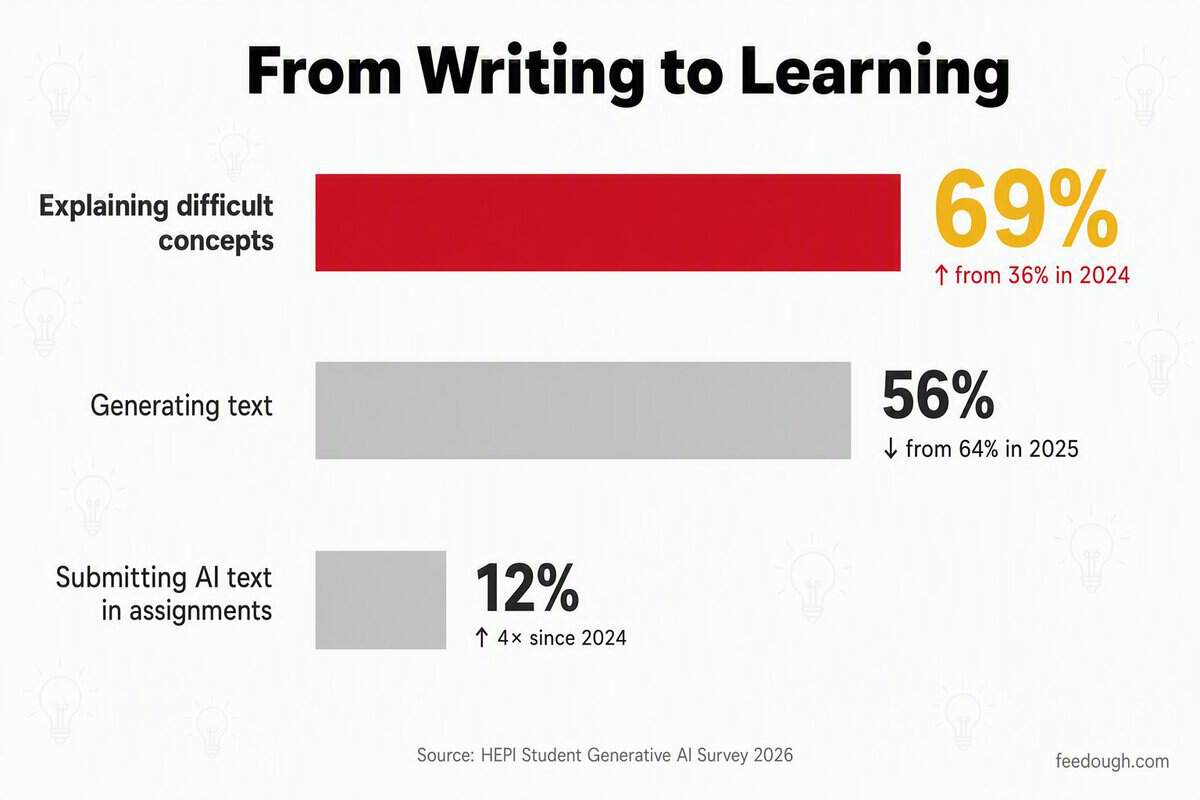
Everyone assumes students use AI to write essays. The latest UK data says that is no longer even the most common use case. 69% of students now use AI to explain difficult concepts, up from 36% in 2024, while text generation dropped from 64% to 56%.
AI Use Case | 2024 | 2025 | 2026 |
|---|---|---|---|
Explaining difficult concepts | 36% | 58% | 69% |
Generating text | 30% | 64% | 56% |
Submitting AI text in assignments | 3% | 8% | 12% |
Most students are shifting toward AI as a learning aid. But the share submitting AI-generated work directly has quadrupled in two years, crossing from support to substitution. The frequency and platform data show how normalized these tools have become:
- 74% of UK students use AI at least weekly for schoolwork, with 29% using it daily (Save My Exams AI in Education Survey 2026)
- 87% use ChatGPT as their primary AI study tool, followed by Google Gemini at 38% and Microsoft Copilot at 26% (Save My Exams AI in Education Survey 2026)
- 51% say they use AI primarily to save time and 50% to improve work quality (HEPI Student Generative AI Survey 2026)
The same pattern is emerging in the U.S. Over 70% of American college students use AI tools at least weekly for academic tasks, up from 65% in early 2025, per Tyton Partners.
AI Detection Accuracy and Enforcement Statistics
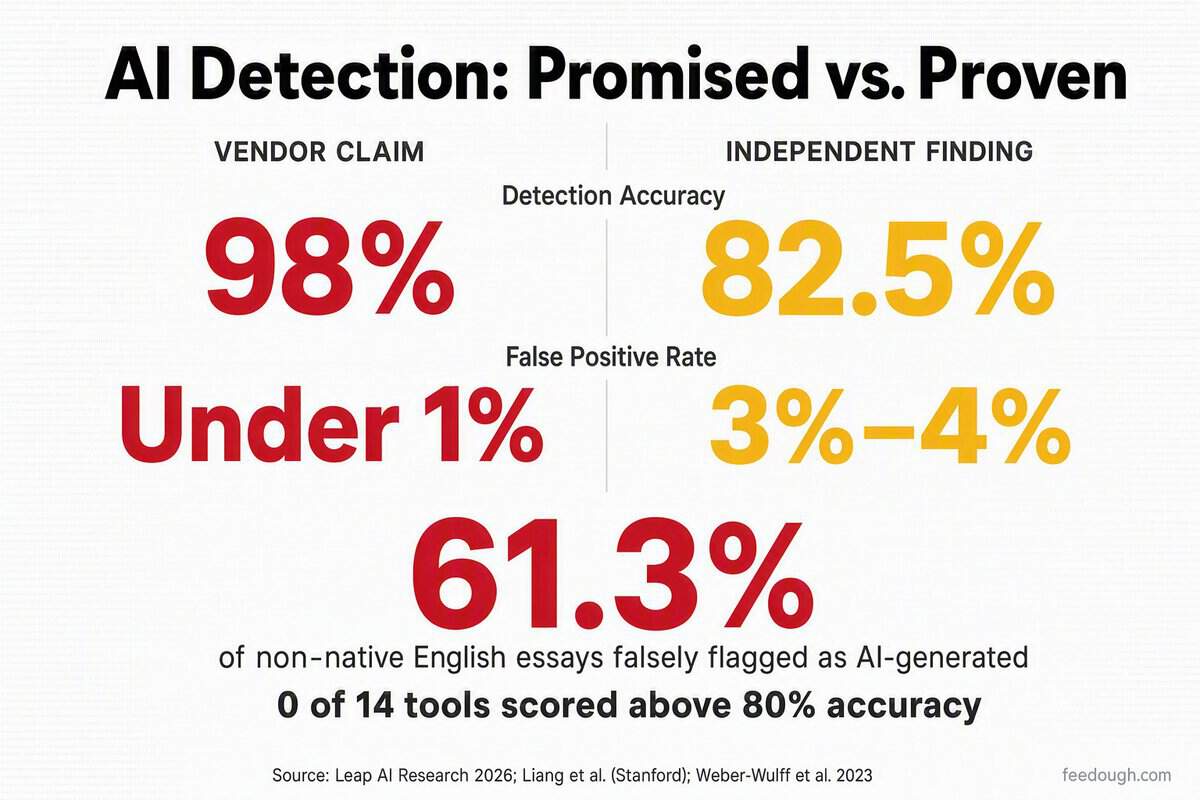
Turnitin reported 98% accuracy for its AI detection tool. Independent testing put the real figure at roughly 82.5%. The false positive rate was three to four times higher than what the vendor reported.
Metric | Vendor Claim | Independent Finding | Source |
|---|---|---|---|
Turnitin AI detection accuracy | 98% | 82.5% | Leap AI Research, 2026 |
Turnitin false positive rate | Under 1% | 3% to 4% | Leap AI Research, 2026 |
GPTZero false positive rate | ~1% | 2% to 4% | Leap AI Research, 2026 |
Non-native English essays falsely flagged | Not disclosed | 61.3% | Liang et al. (Stanford), Patterns |
Tools above 80% accuracy (14 tested) | N/A | Zero | Weber-Wulff et al., 2023 |
- Australian Catholic University reported 6,000 AI cheating allegations in 2024, roughly 90% of all integrity cases; 25% of referrals were dismissed after investigation, leading the university to abandon Turnitin in March 2025
- The University of Waterloo disabled Turnitin in September 2025 after internal testing found it flagged human-written text as 100% AI-generated
- The University of Cape Town announced in July 2025 it would stop using Turnitin’s AI Score, calling the tools unreliable and not fit for purpose
- Adelphi University won a federal court case in February 2026 when a judge ruled the Turnitin-based AI cheating accusation against a student was without merit
Over 50 universities worldwide have banned or disabled AI detection tools as of March 2026, including 31 US institutions. Only 18% of teachers strongly agree these tools are accurate and effective. The California State University system spent $1.1 million on Turnitin in 2025, purchasing a tool that a growing number of institutions have formally rejected.
AI Cheating Consequences and Penalty Statistics
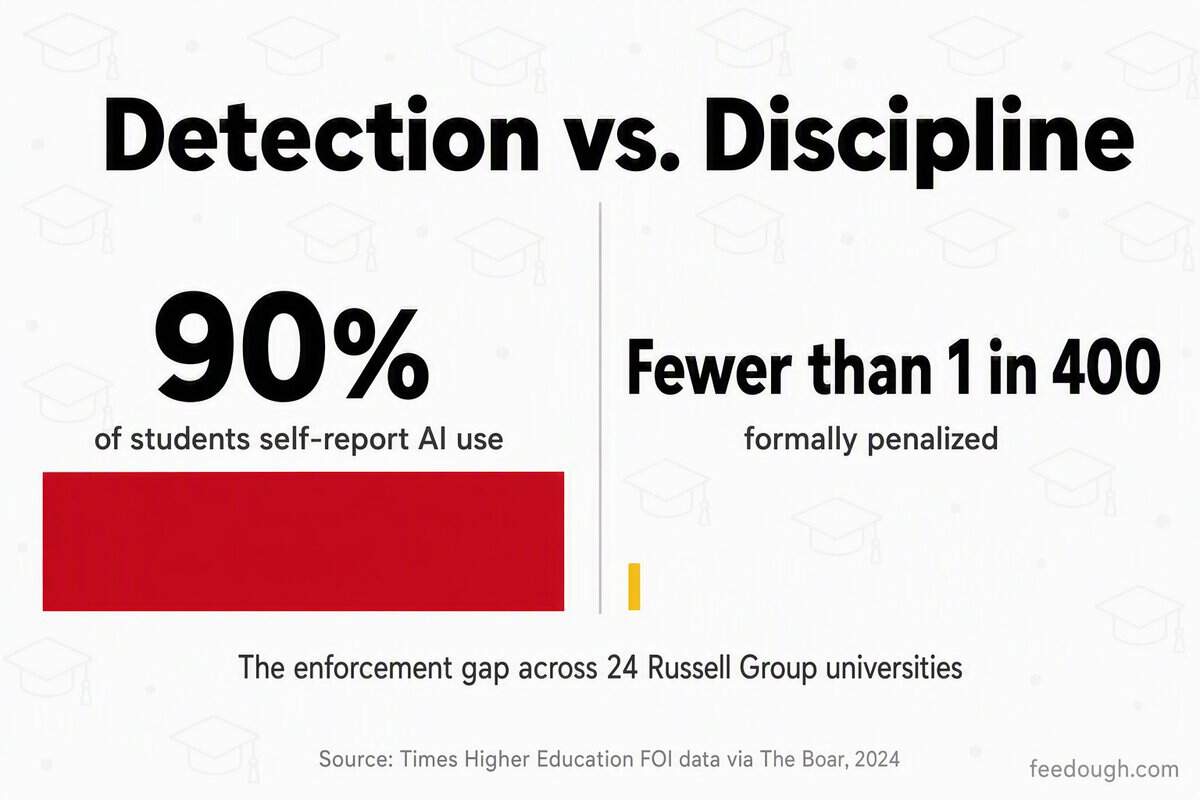
At Queen Mary University of London, every student suspected of AI cheating in 2023-24 received a penalty. Across all 24 Russell Group universities, though, fewer than 1 in 400 students were formally disciplined despite roughly 90% self-reporting AI use. The escalation is real at the individual institution level. The system-wide enforcement rate barely registers.
Institution | Earlier Cases | Latest Cases | Penalties / Outcomes |
|---|---|---|---|
UK universities overall (per 1,000) | 1.6 (2022-23) | 5.1 (2023-24) | Not disaggregated |
Queen Mary University of London | 10 suspected | 89 suspected (2023-24) | 89 penalties (100%) |
University of Sheffield | 6 cases | 92 cases (2023-24) | 79 penalties |
University of Glasgow | 36 suspected | 130 suspected (2023-24) | 78 penalties |
King’s College London | Not reported | 32 investigated (2024-25) | 10 expelled, 42 disciplined |
London School of Economics | Fewer than 5 | 40 investigated (2024-25) | Not disaggregated |
Queen’s University Belfast | 0 | 0 | 0 |
King’s College London data comes from Roar News student newspaper investigations. Glasgow, LSE, and Queen’s Belfast data came from Times Higher Education Freedom of Information requests across all 24 Russell Group universities. Every institution that reported cases shows an upward trajectory. Queen’s Belfast, with zero cases in both years, is the only exception. In US K-12 schools, the pattern mirrors the UK. 64% of teachers reported student discipline for AI misconduct in 2024-25, up from 48% two years earlier.
AI Cheating by Student Demographics Statistics
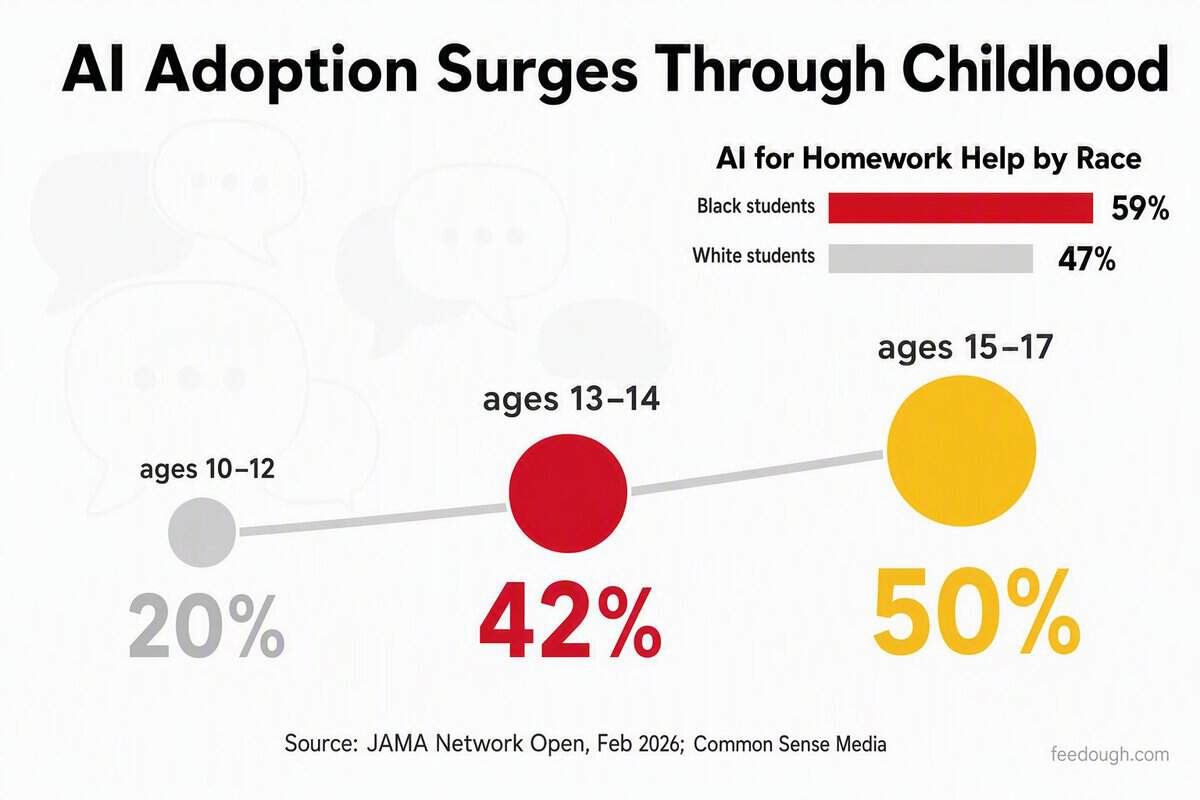
Nearly one in three American children has already used a generative AI app. Not college students, not exclusively teenagers. A February 2026 JAMA Network Open study analyzed device data from 6,488 U.S. youths aged 4 to 17. The result: 32% had used generative AI, with adoption climbing sharply at every age threshold.
Age Group | AI Usage Rate | Source |
|---|---|---|
Ages 10–12 | 20% | JAMA Network Open, Feb 2026 |
Ages 13–14 | 42% | JAMA Network Open, Feb 2026 |
Ages 15–17 | 50% | JAMA Network Open, Feb 2026 |
Teens 13–17 (for schoolwork) | 54% | Pew Research Center, Oct 2025 |
K–12 students (for school) | 54% | RAND American Youth Panel, Sept 2025 |
College students (weekly academic use) | 57% | Lumina Foundation–Gallup, 2026 |
The age data reveals a technology adoption curve compressed into childhood. What took social media a decade to accomplish, generative AI did in roughly two years. ChatGPT usage among U.S. teens doubled between 2024 and 2025, from 26% to 54%, per Pew Research Center, and adoption extends well below the teenage years.
Gender complicates the pattern. Male U.S. college students report daily AI use at 27%, compared with 17% of female students, per Lumina Foundation-Gallup 2026 data. Students in business, technology, and engineering programs lead all fields in frequency. ChatGPT’s broader user base tells a different story. Female users rose to 52% of the total by July 2025, up from roughly 37% in January 2024, per NBER analysis of name-classified accounts. The gap in academic frequency has not closed. The gap in raw adoption has reversed.
Race and study intensity create additional fault lines:
- 59% of Black students used AI for homework help, compared with 47% of White students, per Common Sense Media
- The gap widened for personal advice: 25% of Black students versus 14% of White students
- For code writing, the difference was sharper: 17% versus 7%
- Students studying three or more hours nightly used AI at 72%, compared with 61% among those studying one to two hours, per Quizlet
Despite this adoption, students themselves draw boundaries. A Stanford/Challenge Success study found that 82.73% of high school students believe AI should never write entire papers. Yet 24.27% admitted to using AI or digital devices as unauthorized aids during assessments, up from 6% to 15% the prior year.
AI Detection Tool Accuracy and Limitations Statistics
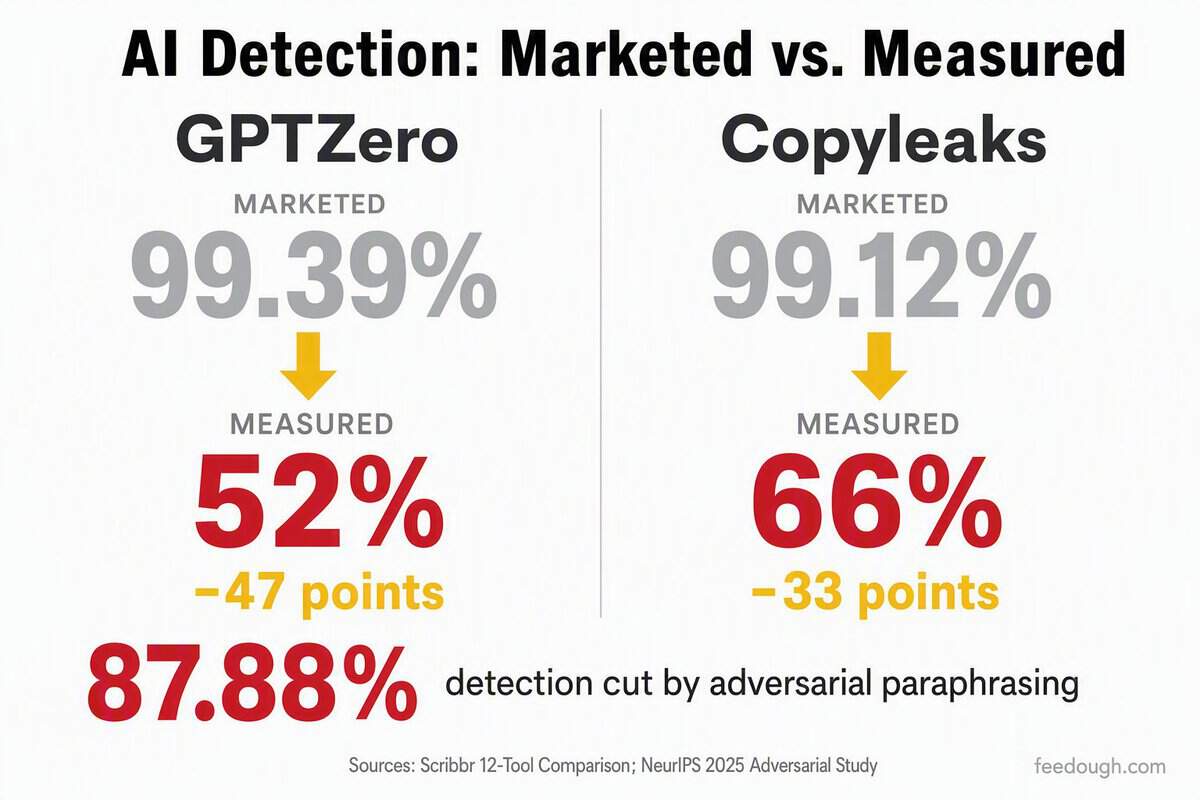
Any student with a paraphrasing tool can now evade every major AI detection platform. A 2025 adversarial study found that targeted paraphrasing cuts detection rates by 87.88% on average. The attack transfers across all detectors from a single calibration.
Condition | Detection Performance | Source |
|---|---|---|
After adversarial paraphrasing (all detectors) | 87.88% avg reduction | NeurIPS 2025 |
After DIPPER tool (DetectGPT) | 4.6% (from 70.3%) | NeurIPS 2023 |
Text under 50 words (all tools) | 65–72% | EyeSift benchmarks, 2026 |
Text 250+ words (all tools) | 88–93% | EyeSift benchmarks, 2026 |
Claude output (Turnitin) | 53–60% | EyeSift benchmarks, 2026 |
ChatGPT/Gemini output (Turnitin) | 98–100% | EyeSift benchmarks, 2026 |
These are the conditions that break detection. The gap between marketed AI detection accuracy and independent findings has never been wider.
- GPTZero claims 99.39% accuracy; Scribbr’s independent 12-tool comparison measured 52%
- Copyleaks claims 99.12% accuracy; Scribbr measured 66%
- Turnitin acknowledges a ±15 percentage point margin of error in every AI writing score it produces, meaning a score of 50% could represent anywhere from 35% to 65%
The AI detector market hit $0.58 billion in 2025 and is projected to reach $2.06 billion by 2030. Institutions are scaling spending on tools whose AI detection accuracy claims do not survive independent scrutiny.
The Reality Gap in AI Detection Accuracy Statistics
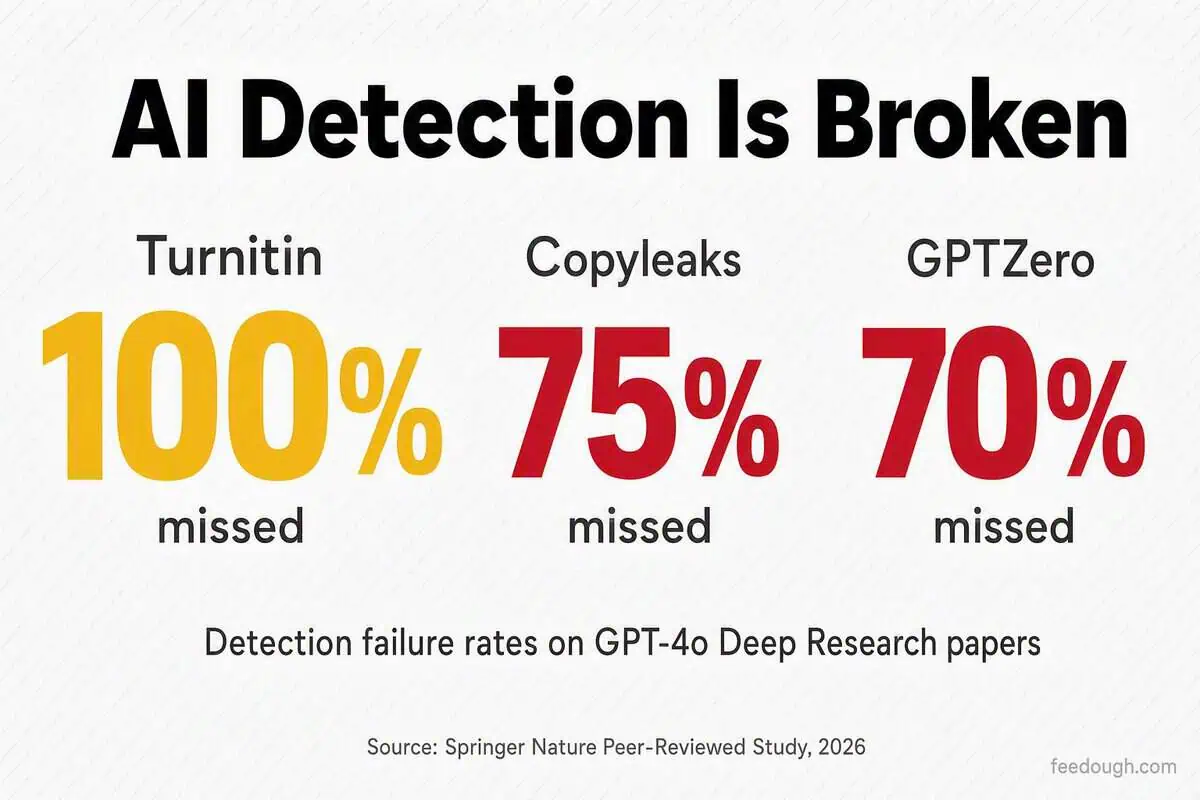
Turnitin classified 100% of GPT-4o Deep Research papers as false negatives in a 2026 peer-reviewed study. GPTZero missed 70% of the same papers; Copyleaks missed 75%.
Detector | GPT-4o Deep Research | After Humanisation |
|---|---|---|
Turnitin | 0% detected (100% false negatives) | 50% |
GPTZero | 30% detected (70% false negatives) | 2.5% |
Copyleaks | 25% detected (75% false negatives) | 22.5% |
The humanisation column is worse. A simple prompt to increase perplexity and burstiness collapsed GPTZero to 2.5% accuracy. Even Turnitin dropped to 50%. No technical skill required.
A 2026 study of 192 balanced texts found the problem extends beyond which model generated the text into what the text is about. Turnitin’s AI detection accuracy ranges from 0.86 on humanities essays to just 0.51 on scientific writing. Originality shows the same pattern: 0.96 on humanities versus 0.58 on science.
STEM students face substantially higher misclassification risk from the same tools their institutions require. Both detectors also struggle with hybrid human-AI texts, where Originality achieves near-zero recall.
A separate test of 160 papers found zero false positives for Pangram, Copyleaks, and Turnitin. The tools have learned not to accuse the wrong people. They have not learned to catch the right ones.
AI Detection False Positive Statistics at Scale
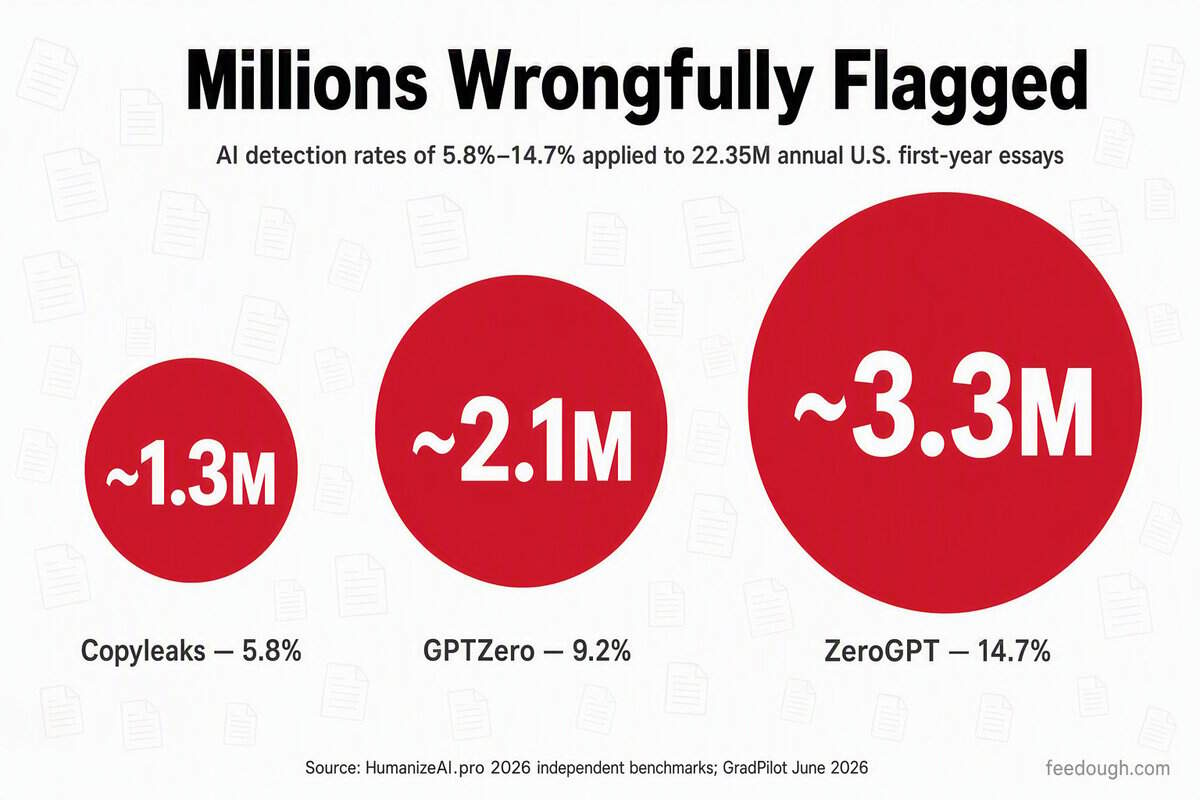
Independent 2026 testing found false positive rates between 5.8% and 14.7% across major AI detection tools. Applied to the 22.35 million essays U.S. first-year college students write annually, even the lowest measured rate produces over a million wrongful flags. The student on the receiving end does not experience a rate. They experience a misconduct charge.
False Positive Rate | Tool / Testing Context | Projected False Flags per Year (U.S. First-Year Students) |
|---|---|---|
5.8% | Copyleaks (multi-university consortium, 2026) | ~1,296,300 |
9.2% | GPTZero (Stanford NLP Group, 2026) | ~2,056,200 |
14.7% | ZeroGPT (AI Detection Review, 2026) | ~3,285,450 |
These are national projections. The institutional evidence confirms the problem at individual campuses:
- Vanderbilt University estimated that even at its vendor’s claimed sub-1% rate, processing 75,000 papers annually produces 750 false accusations (GradPilot, June 2026)
- Washington State University scanned 148,547 assessments via Turnitin in Fall 2024 alone; 33% of its AI misconduct review-board cases from 2023 to 2025 ended in a “not responsible” finding, often when a Turnitin score was the only evidence (WSU Provost Office / GradPilot, June 2026)
- Non-native English writers face false positive rates 2 to 3 times higher than native speakers, with averages ranging from 12% to 45% depending on detector and proficiency level, meaning the scale burden falls disproportionately on international students (HumanizeAI.pro, 2026)
- 12% of Pulitzer-nominated articles from 2024 were flagged as AI-generated by at least one commercial detector, extending the problem beyond student writing into professional journalism (Washington Post / HumanizeAI.pro, 2026)
Institutional AI Policy and Teacher Training Statistics
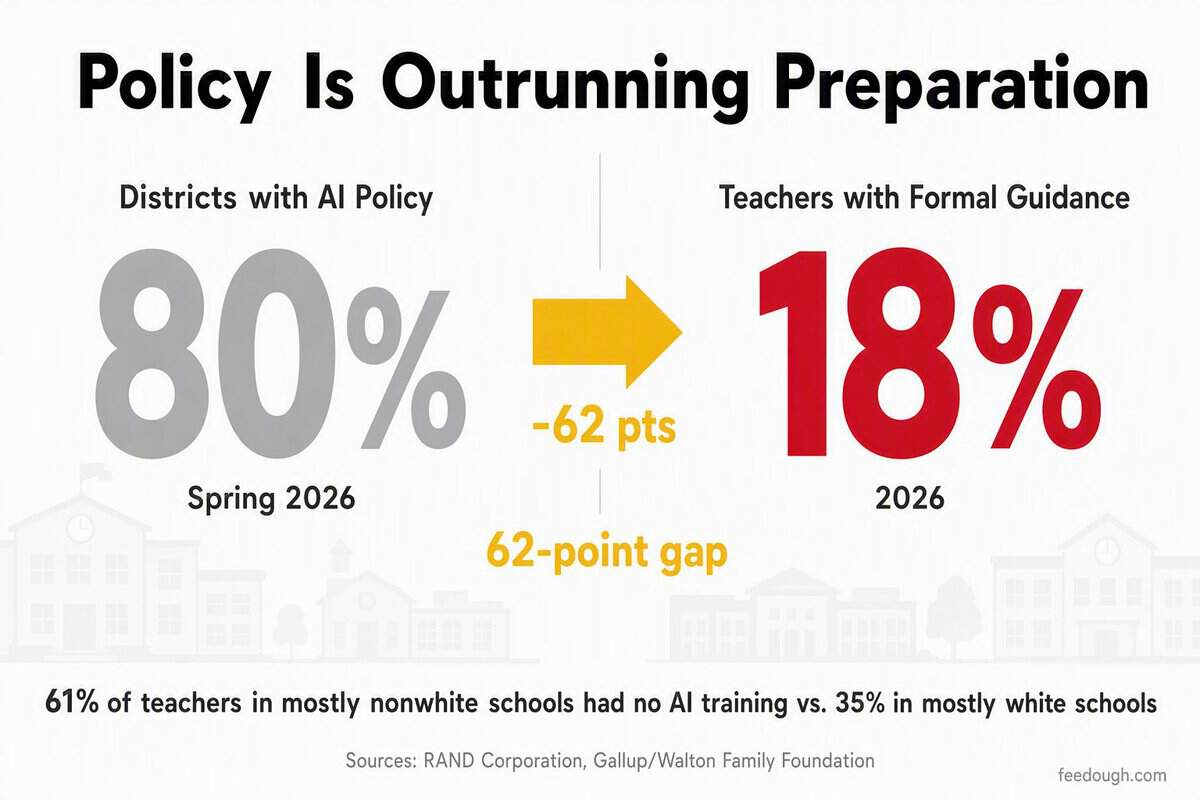
80% of U.S. school principals now say their district has an AI policy, roughly double the share from two years earlier. Only 18% of teachers report receiving formal guidance from administrators on how to use AI tools. The Walton Family Foundation and Gallup’s 2026 survey of 2,069 teachers confirms what many educators already know: policy is outrunning preparation.
The gap is structural, not just a matter of time. Of the teachers who receive some form of guidance, 48% describe it as informal advice from colleagues rather than structured district training. Another 34% report receiving no guidance at all on any AI-related task. Nearly all of 14 district leaders interviewed by RAND described teachers who viewed AI as a threat to traditional teaching. 11 of 14 built their own training programs from scratch due to a scarcity of qualified external experts.
Metric | Rate | Source |
|---|---|---|
Districts providing teacher AI training, Fall 2023 | 23% | RAND Corporation, 2024–2025 |
Districts providing teacher AI training, Fall 2024 | 48% | RAND Corporation, 2024–2025 |
Districts providing teacher AI training, Fall 2025 (projected) | 74% | RAND Corporation, 2024–2025 |
Low-poverty districts (projected) | 87% | RAND Corporation, 2024–2025 |
High-poverty districts (projected) | 62% | RAND Corporation, 2024–2025 |
Teachers in mostly nonwhite schools, no AI training | 61% | RAND Corporation, 2026 |
Teachers in mostly white schools, no AI training | 35% | RAND Corporation, 2026 |
The training tripling in two years is real. It is also deeply uneven. Even where training reaches classrooms, 85% of teachers feel unprepared to manage AI, with 32% completely unprepared, per EdTech Magazine.
High-poverty districts project 62% coverage by fall 2025, a full 25 points behind low-poverty districts. The racial gap cuts deeper. 61% of primary teachers in mostly nonwhite schools have received no AI training, versus 35% in mostly white schools. The communities where AI-generated coursework could cause the most harm are the ones least equipped to address it.
Global AI Cheating Trends and Regional Differences Statistics
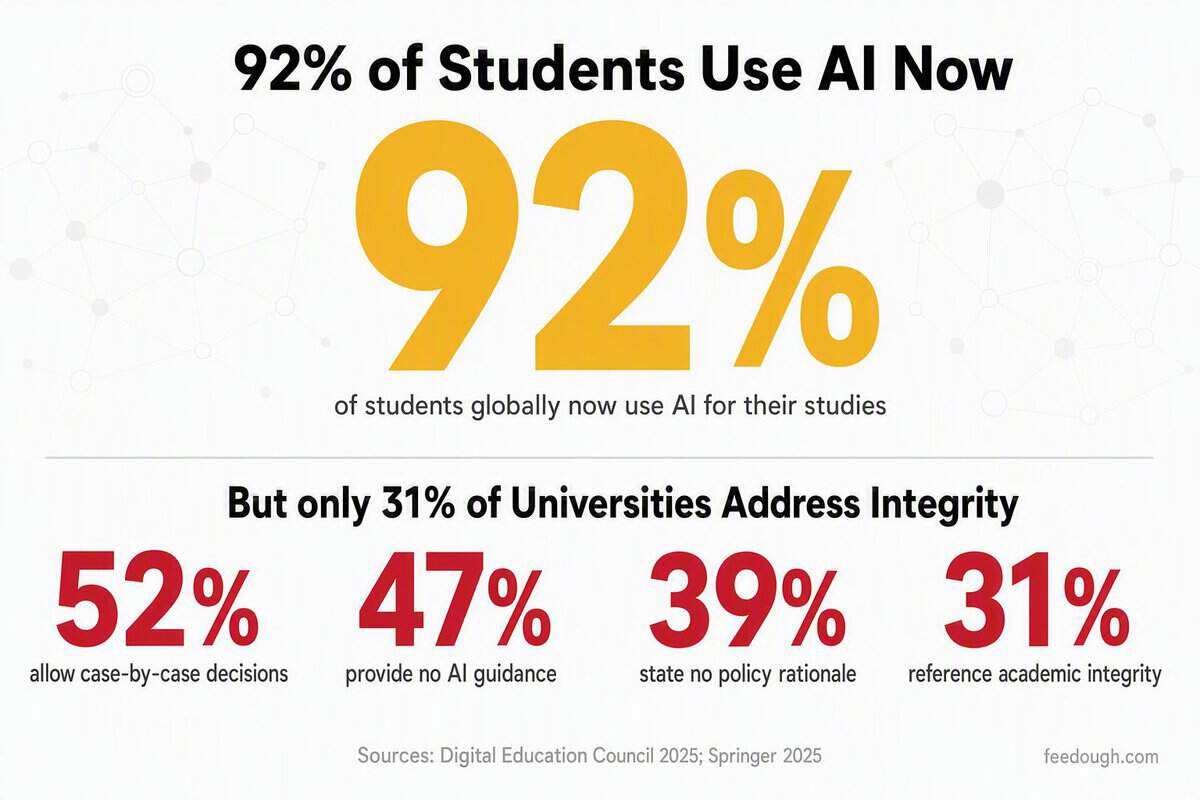
Around the world, students have converged on the same behavior. Their institutions have not. A 2025 analysis of 343 top universities across five countries found that only 31% reference academic integrity in their AI policies. Another 47% provide no additional information on AI use to students or staff.
Policy Characteristic | Share of 343 Universities | Source |
|---|---|---|
Allow instructors to determine AI use case-by-case | 52% | Springer, 2025 |
Provide no additional information on AI use | 47% | Springer, 2025 |
No stated rationale for AI policy | 39% | Springer, 2025 |
Reference academic integrity in AI policy | 31% | Springer, 2025 |
The policy fragmentation sits on top of behavior that barely varies. 92% of students globally now use AI for their studies, per the Digital Education Council’s 2025 survey of over 27,000 students across 35 countries. UC Berkeley’s SERU study surveyed more than 95,000 students at 20 research-intensive universities. Two-thirds used generative AI, and 26% of daily users admitted to cheating with AI versus 7% of monthly users.
Region-specific data reinforces the gap between use and enforcement. Eighty percent of Australian university students use AI, but the sector is shifting from detection toward assessment redesign and AI literacy education. Seven Australian institutions including Curtin and the University of Queensland disabled Turnitin’s AI detection by early 2026, citing it as unreliable. In the U.S. and Canada, the rate of students submitting unedited AI work (18% in 2026) barely differs from the 2012 phone-cheating rate (17%).
Access itself is uneven. Low-income, racially underrepresented, and female students used AI less than their peers, per the same Berkeley survey. If AI fluency becomes a workplace requirement, unequal access in education could widen workforce readiness gaps.
AI Cheating Costs and Consequences Statistics
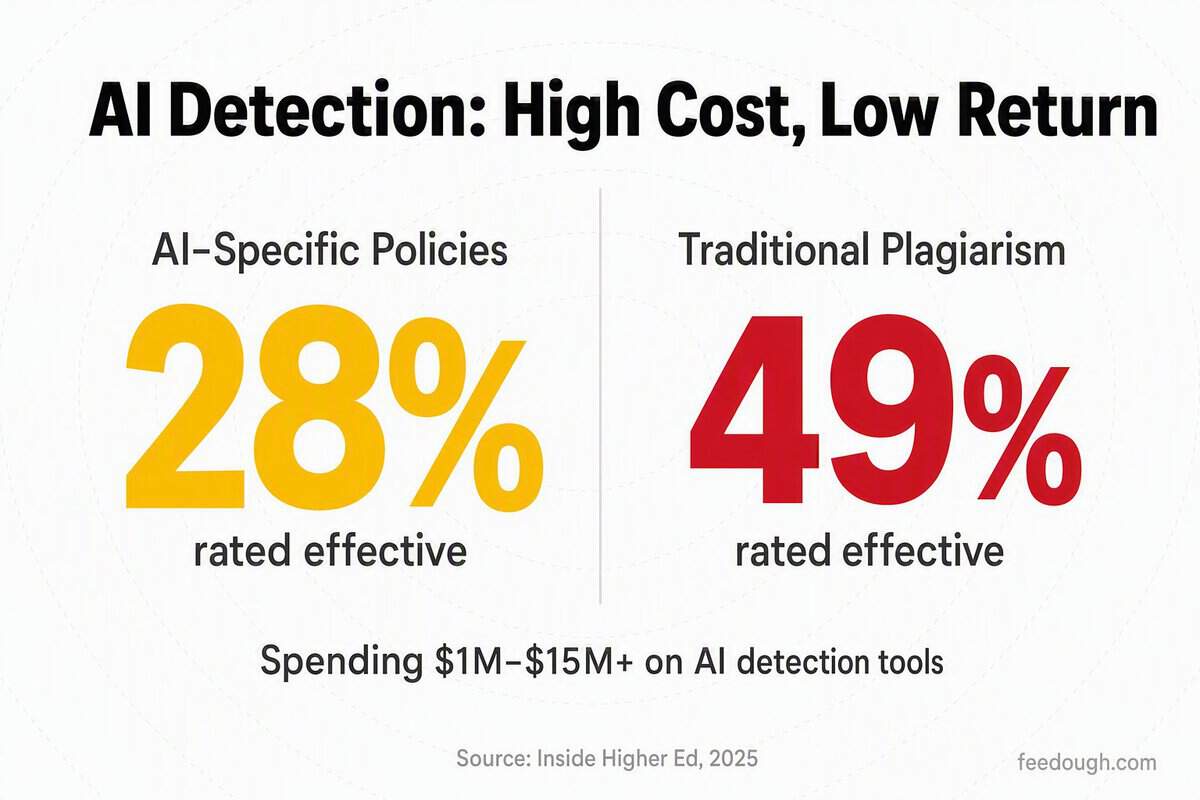
Universities are spending millions on AI detection tools and investigation infrastructure. 54% of higher education leaders say their faculty cannot reliably recognize AI-generated content, per AAC&U and Elon University.
The resulting AI-specific integrity policies are rated as just 28% effective, compared to 49% for traditional plagiarism frameworks.
Metric | Amount | Context |
|---|---|---|
University System of Georgia (Turnitin) | $1,112,886 | FY2025, up from $886,000 in FY2021 |
CUNY system (Turnitin contract) | $1.88 million | Five-year commitment |
California universities (Turnitin) | $15+ million | All CA universities, 2019–2025 |
Per-case misconduct investigation | $3,200 – $8,500 | Administrative, legal, and committee costs |
Annual investigation costs (200-case campus) | Up to $1.7 million | Before detection or prevention spending |
AI-specific policy overhaul (per policy) | $15,000 – $75,000 | Consultant and legal expert fees |
For mid-sized universities allocating 3 to 7% of their operating budget to AI misconduct response, the annual cost can reach $7 million. California community colleges lost $11 million in financial aid to applicant fraud in 2024. Industry-wide false positive rates on AI detectors average 5 to 15%, meaning the investment produces wrongful accusations alongside missed cheaters. Publicized integrity breaches have correlated with enrollment drops of 8 to 12% over the following two years.
Future AI Cheating Trends and Projections Statistics
65% of UK undergraduates now say their assessment has changed significantly because of generative AI, up from 59% in 2025. Across a national higher education system, that six-point jump took twelve months. Academic integrity frameworks are not being planned. They are being rebuilt under pressure.
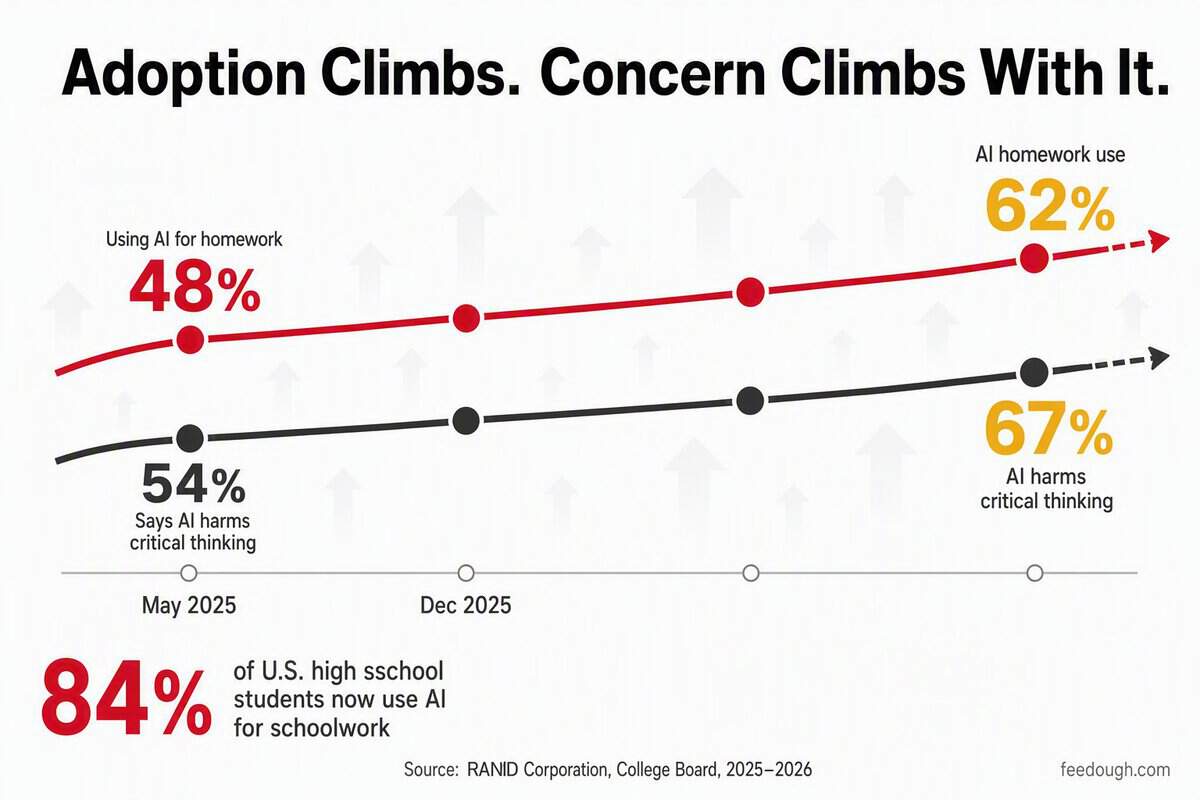
The students entering higher education are already further along. 84% of U.S. high school students reported using generative AI for schoolwork by May 2025, up from 79% in January, per College Board. Among U.S. students spanning middle school through college, 62% used AI for homework help by December, up from 48% in May, per the RAND Corporation. These students did not adopt AI as an experiment. They adopted it as default infrastructure.
Metric | Earlier Measure | Current Measure | Source |
|---|---|---|---|
Institution-wide AI adoption (HE sector) | 49% (2024) | 66% (2025) | Ellucian 2025 |
HEI respondents expecting AI use to keep rising | Not reported | 88% | Ellucian 2025 |
UK undergraduates: assessment changed significantly | 59% (2025) | 65% (2026) | HEPI 2026 |
Students saying staff well-equipped for AI | 18% (2024) | 42% (2025) | HEPI 2025 |
U.S. high school students using AI for schoolwork | 79% (Jan 2025) | 84% (May 2025) | College Board 2025 |
U.S. students using AI for homework help | 48% (May 2025) | 62% (Dec 2025) | RAND 2025 |
Every metric in the table points in the same direction. What has not kept pace is the support infrastructure around the students already using these tools. Only 36% of UK undergraduates say their institution encourages AI use, and only 38% say they are provided with AI tools, per the HEPI Student Generative AI Survey 2026. The technology is on campus. The guidance is not.
Students themselves are not uniformly comfortable with that gap. A RAND Corporation survey of 1,214 youth conducted in December 2025 found that 67% now say using AI for homework harms critical thinking skills, up from 54% in May. The concern is climbing alongside adoption, not instead of it:
- 67% of U.S. students say AI homework help harms critical thinking skills, up from 54% in May 2025 (RAND American Youth Panel, Dec 2025)
- 49% of UK undergraduates worry about becoming too dependent on AI tools (HEPI 2025)
- 35% report receiving any institutional support to develop AI skills, leaving the majority navigating these tools without formal guidance (HEPI 2025)
- 10% of U.S. teens use AI for all or most of their homework (Pew Research Center, early 2026)
- 60% of teens say students at their schools use AI to cheat often (Pew Research Center, early 2026)
Student concern about AI harming critical thinking rose 13 points in seven months, reaching 67% by December 2025. That trajectory is unusual: concern climbing alongside adoption, not instead of it. The institutions building integrity frameworks around these students are solving for a behavior that the students themselves have not resolved.
Sources
- https://detectiondrama.com/ai-cheating-consequences-statistics (2026)
- https://programs.com/resources/ai-education-statistics (2026)
- https://www.turnitin.com/press/turnitin-data-shows-transparency-about-ai-use-benefits-students-and-educators (2026-02-24)
- https://www.hepi.ac.uk/reports/student-generative-ai-survey-2026 (2026)
- https://edworkforce.house.gov/news/documentsingle.aspx?DocumentID=413126 (2026-02-24)
- https://www.timeshighereducation.com/news/near-universal-student-ai-use-leading-polarised-views (2026-03-12)
- https://coursiv.io/blog/best-ai-tools-for-education-2026 (2026-03-26)
- https://www.savemyexams.com/learning-hub/insights/ai-in-education-statistics (2026-03-06)
- https://www.undetectedgpt.ai/blog/turnitin-ai-detection-guide (2026)
- https://detectiondrama.com/universities-that-banned-ai-detectors (2026-03)
- https://www.curtin.edu.au/news/oasis-news/update-on-turnitin-ai-detection-tool (2026-01)
- https://roarnews.co.uk/2026/exclusive-kings-spends-35k-on-copilot-ai-as-10-students-expelled-for-ai-misuse-since-2022 (2026)
- https://www.pewresearch.org/internet/2026/02/24/how-teens-use-and-view-ai (2026-02-24)
- https://news.gallup.com/poll/704090/routine-college-students-despite-campus-limits.aspx (2026)
- https://link.springer.com/article/10.1007/s11423-026-10587-1 (2026-02-03)
- https://www.rand.org/pubs/research_reports/RRA4742-1.html (2026-03-17)
- https://acequiz.ai/blog/ai-in-education-statistics (2026-02)
- https://www.marketsandmarkets.com/Market-Reports/ai-detector-market-199981626.html (2025-09)
- https://www.eyesift.com/blog/ai-detection-for-students (2026-04-01)
- https://arxiv.org/abs/2506.07001 (2025)
- https://www.eyesift.com/blog/ai-detection-accuracy-benchmarks (2026-04-01)
- https://link.springer.com/article/10.1007/s40979-026-00226-w (2026-06-29)
- https://link.springer.com/article/10.1007/s40979-026-00213-1 (2026-02-02)
- https://thehumanizeai.pro/articles/can-ai-detection-be-wrong-false-positives (2026)
- https://gradpilot.com/news/university-ai-detection-procurement-2025-investigation (2026-06-19)
- https://news.gallup.com/poll/710534/teachers-receive-no-formal-guidance.aspx (2026-03)
- https://www.rand.org/pubs/podcasts/policy-minded/2026/back-to-school-three-big-challenges.html (2026-08-12)
- https://www.rand.org/pubs/research_reports/RRA956-31.html (2025-04-08)
- https://etcjournal.com/2026/06/02/ai-and-the-promise-of-educational-equity (2026-06-02)
- https://www.edtechinnovationhub.com/news/q6zw9wco2mttajdbd1jyeonjnpiovu (2026)
- https://www.trinka.ai/blog/the-rise-of-ai-policy-standardization-in-higher-education (2026)
- https://grademap.com.au/blog/ai-detection-tools-dying (2026)
- https://link.springer.com/article/10.1007/s10791-025-09745-5 (2025)
- https://news.berkeley.edu/2026/05/21/the-largest-study-of-ai-use-by-undergrads-is-in-revealing-disparities-in-access-and-in-cheating (2026-05-21)
- https://plagiarismcheck.org/blog/has-ai-made-academic-cheating-worse-2026-data (2026-02-12)
- https://www.allaboutai.com/resources/ai-statistics/ai-cheating-in-schools
- https://newsroom.collegeboard.org/new-research-majority-high-school-students-use-generative-ai-schoolwork (2025-10-06)