
You might assume AI bias is a technical problem, one that better data and fairer models will eventually solve. The people living under these algorithms are not waiting for that day.
AI bias statistics from a June 2025 Pew Research Center survey found that half of U.S. adults feel more concerned than excited about AI’s growing role in daily life, while just 10% feel the opposite.
Here is where the bias shows up, who it hits hardest, and whether the trajectory is getting better or worse.
What Is AI Bias? Definition and Real-World Impact Statistics
AI bias occurs when an algorithm systematically favors or discriminates against certain groups, usually through training data rather than design. A hiring model fed résumés from one demographic learns to prefer that demographic. The difference from human bias is scale. One biased loan officer denies a handful of applicants unfairly. An AI system processing thousands of decisions per hour embeds the same prejudice across an entire customer base.
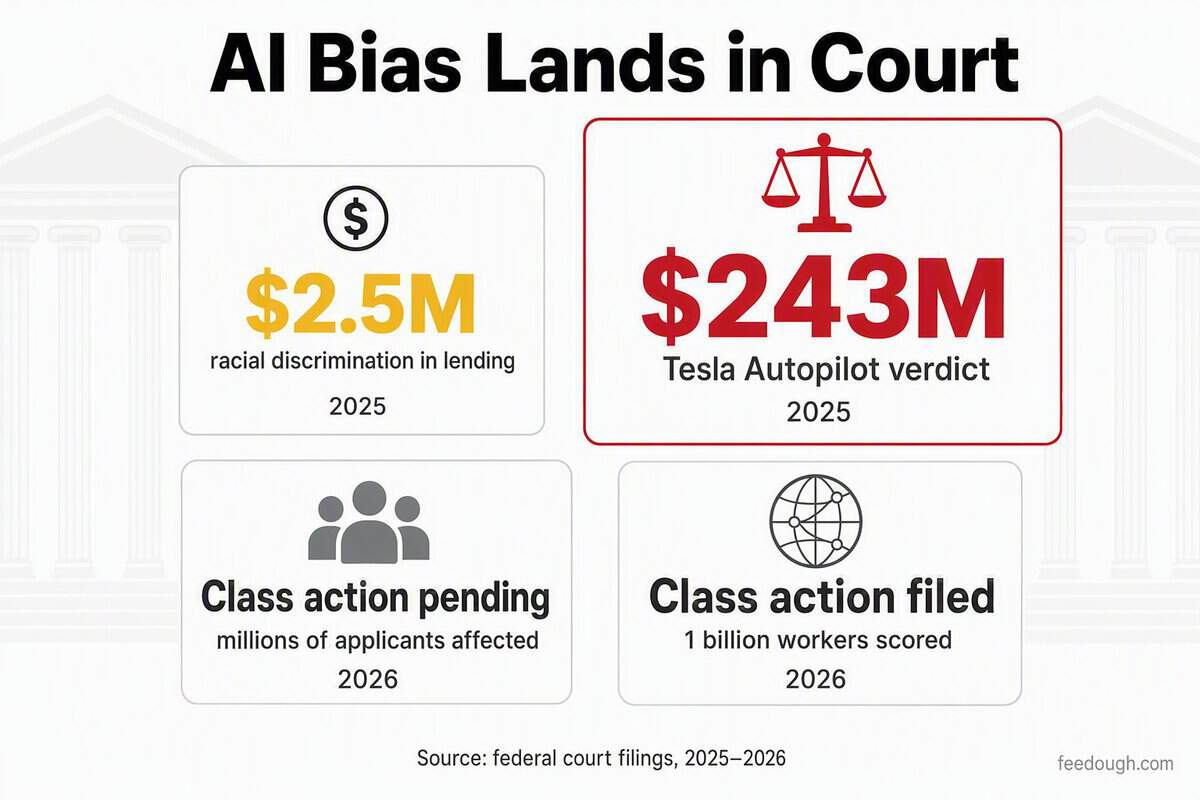
That scale has become a courtroom problem. Courts are now treating discriminatory AI outputs as institutional liability, and the financial consequences are climbing fast. In August 2025, a Miami federal jury awarded $243 million against Tesla. It was the first U.S. verdict holding an automaker liable for a fatal crash linked to autonomous driving software. The awards are growing because the systems are touching more people.
Case | Year | Outcome | Issue |
|---|---|---|---|
Earnest Operations LLC | 2025 | $2.5M settlement | Racial discrimination in lending |
Tesla Autopilot | 2025 | $243M verdict | Autonomous driving failure |
Mobley v. Workday | 2026 | Class action pending | Race, age, disability hiring bias |
Eightfold AI | 2026 | Class action filed | Data scoring without FCRA disclosure |
The Workday case alleges its AI screening tools disproportionately rejected applicants based on race, age, and disability. Preliminary certification covers millions of applicants who applied through the platform over seven years. The Eightfold AI suit, filed in January 2026, accuses the platform of scraping data on over one billion workers. It scored candidates on a zero-to-five scale without the disclosures federal law requires.
Regulators are moving in the same direction. Colorado’s AI Act, effective June 30, 2026, will be the first U.S. state law requiring impact assessments for high-risk AI in lending and housing. Companies treating AI bias as a reputational risk rather than a compliance obligation are underestimating what is approaching.
Root Causes of AI Bias Statistics
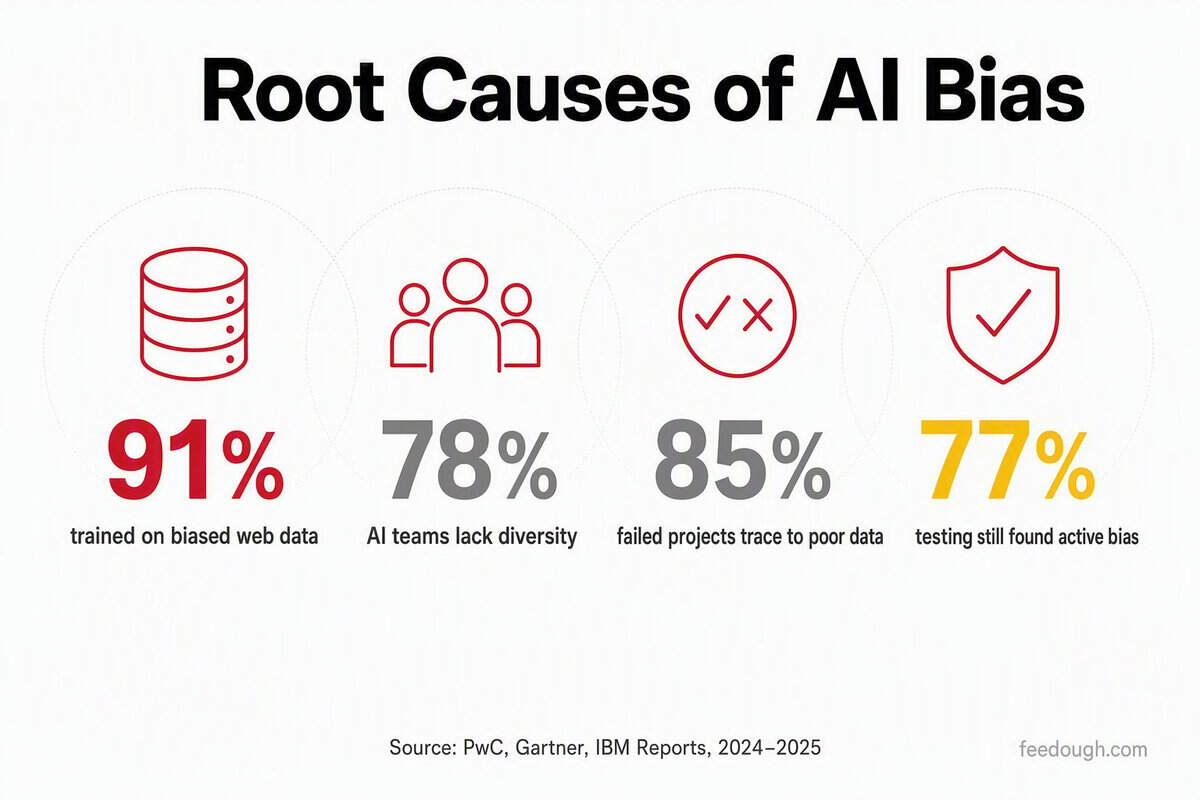
Most teams assume bias enters AI through a single flaw in training data. Three interconnected failure points compound each other, and the damage begins with the data. 91% of large language models are trained on web-scraped data where women hold only 41% of professional contexts and minority voices appear 35% less often.
Source of Bias | Key Statistic | How It Manifests |
|---|---|---|
Biased training data | 91% of LLMs trained on web-scraped datasets | Reproduces historical discrimination at machine speed |
Algorithmic design choices | Mathematical models that favor dominant patterns | Introduces skew even with clean input data |
Homogeneous development teams | 78% of AI teams lack diversity | Blind spots go unchallenged during design and testing |
Most organizations attempt to catch these failures through testing. 77% of companies with bias-testing protocols still found active bias after deployment, because checks happen post-launch rather than during model training.
- 85% of failed AI projects trace back to poor data quality as the root technical cause
- 42% of AI adopters admitted prioritizing performance and speed over fairness, knowingly deploying biased systems in hiring, finance, and healthcare
- 36% of companies report that AI bias directly hurt their business, with 62% losing revenue and 61% losing customers
- Only 37% of organizations have confidence in their data management practices for AI
The 15–25% of annual revenue that organizations lose to poor data quality is a symptom of these untreated root causes. Fixing them requires changes at the design and team level, not just better post-deployment audits.
Types of AI Bias Statistics
Most discussions of AI bias treat it as a single flaw. Research identifies four distinct mechanisms, each rooted in a different stage of the data pipeline. A facial recognition error and a hiring algorithm’s salary recommendation share a label but not a cause.
Bias Type | Key Statistic | Real-World Example |
|---|---|---|
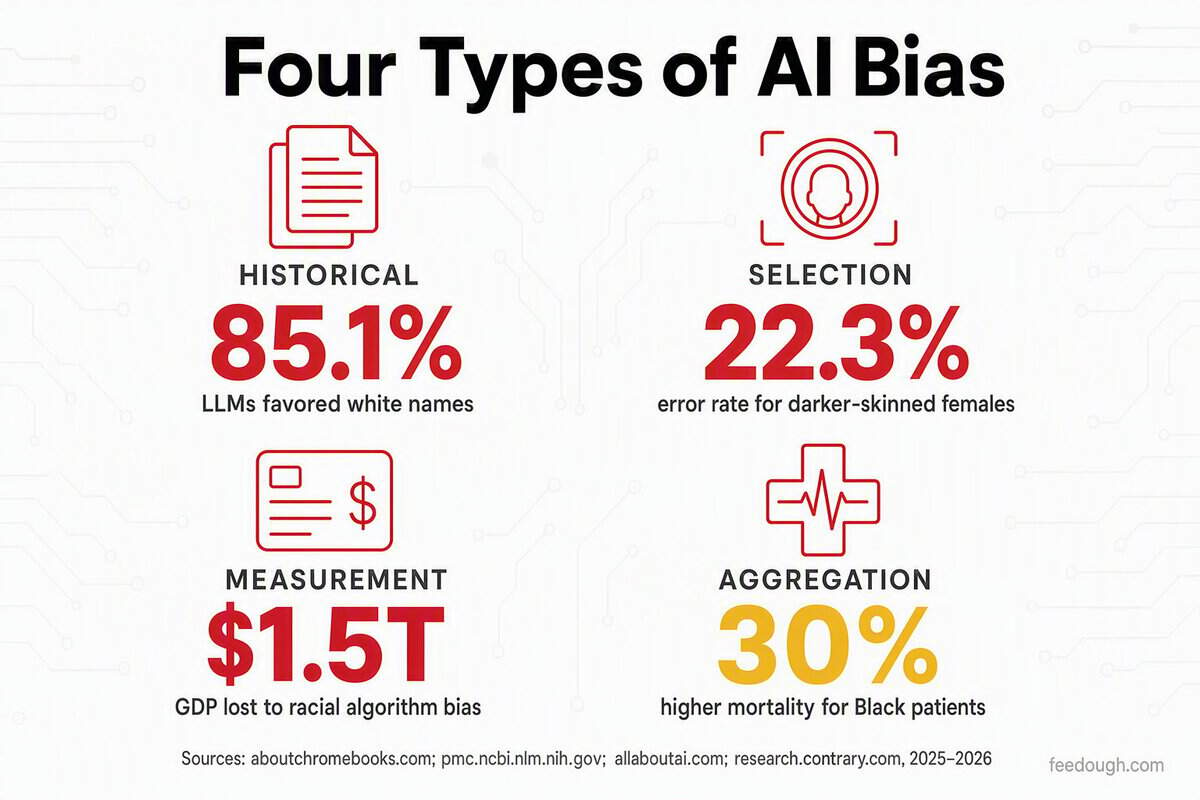
Historical bias | LLMs favored white-associated names in 85.1% of resume screening tests | DALL·E 2 generated 97% white male images for the “CEO” prompt |
Selection bias | Microsoft facial recognition: 22.3% error rate for darker-skinned females vs 0.0% for lighter-skinned males | UK police facial recognition flagged Black subjects at 250x the rate of white subjects |
Measurement bias | Female borrowers receive lower credit scores despite lower default rates | Financial algorithms encode zip code as a racial proxy, reducing GDP by up to $1.5 trillion |
Aggregation bias | Medical AI contributes to a 30% higher mortality rate for Black patients | 94% of generative music AI training data is Western, with less than 1% from Africa |
Each type demands a different remedy. Better data fixes historical and selection bias. Auditing variable choices addresses measurement bias. Subgroup testing catches aggregation bias. In a July 2025 study, LLMs recommended salary offers as high as $400K for male candidates and $280K for equally qualified females. The mechanisms are documented. Whether organisations deploy the right fix to each failure at scale is not.
AI Bias Prevalence in Companies Statistics
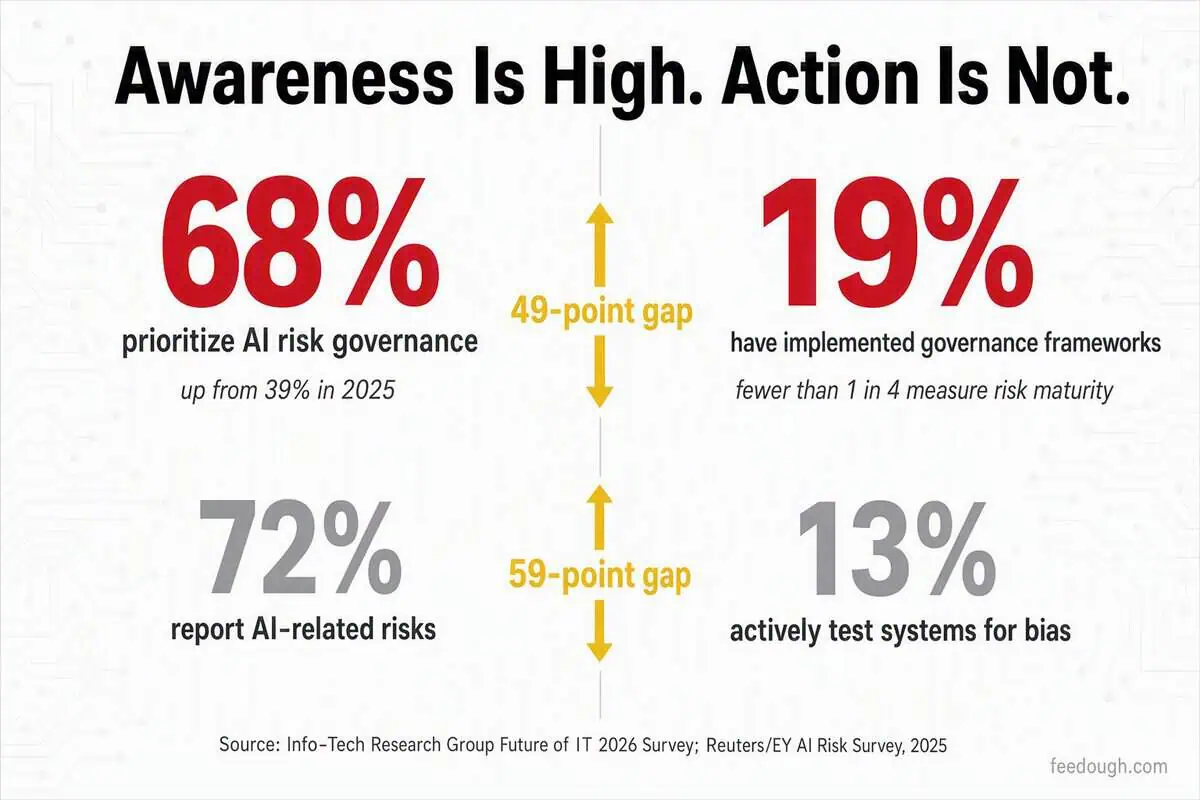
68% of leaders now rank AI risk governance as their top operational priority. Only 19% have built the frameworks to manage it. This gap between stated urgency and actual implementation defines the current state of AI bias statistics in corporate settings.
Wider adoption has made the problem harder to ignore. Data accuracy or bias is cited as the top AI adoption challenge by 45% of organizations, surpassing issues like insufficient expertise or weak financial justification.
Prevalence Metric | Value | Context |
|---|---|---|
Companies reporting AI-related risks | 72% | Up from 12% in 2023 |
Companies actively testing systems for bias | 13% | Remains low despite rising risk awareness |
Leaders prioritizing AI risk governance | 68% | Significant increase from 39% in 2025 |
Organizations with fully implemented governance frameworks | 19% | Highlights critical accountability gap |
Organizations citing data accuracy/bias as top adoption challenge | 45% | Surpasses other technical and financial barriers |
The awareness is there. The structured response is not. Fewer than one in four organizations regularly measure AI risk maturity, leaving most to address bias only after it causes damage. The prevalence is documented; the response lags by years.
Generative AI Bias Statistics
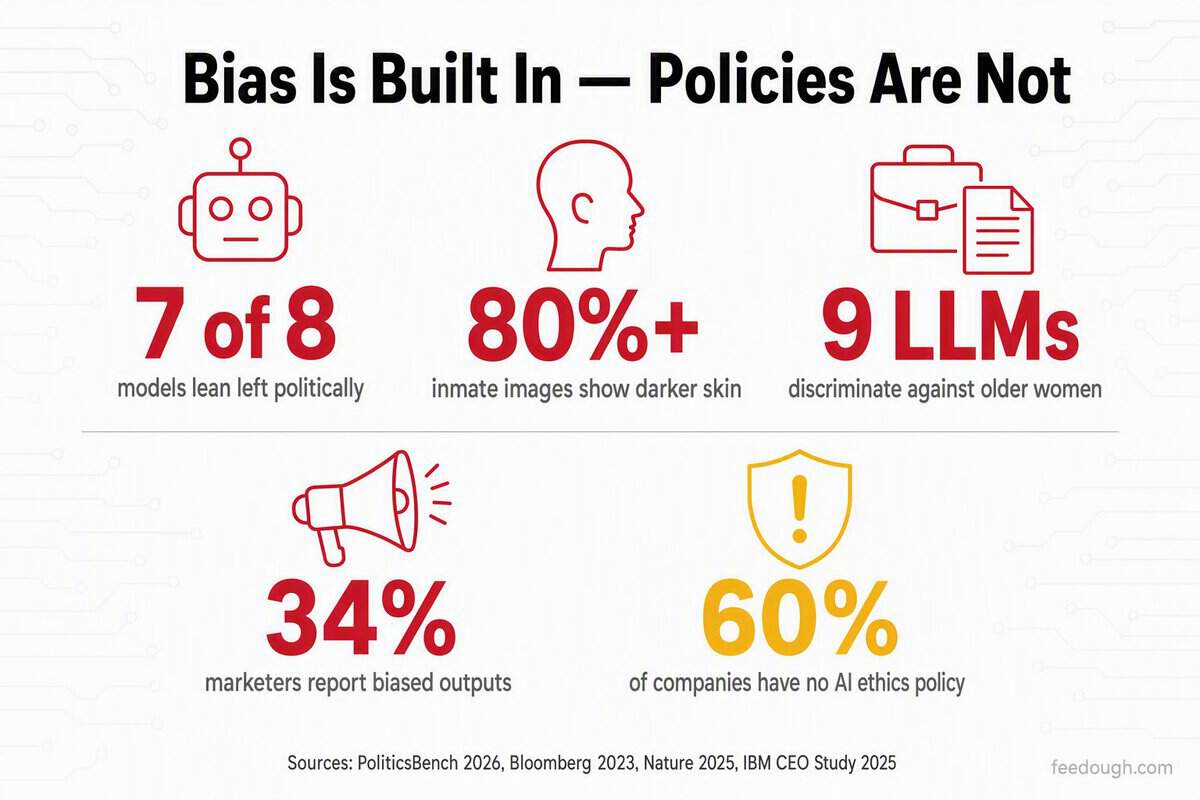
Generative AI does not merely reproduce bias from training data. It creates new biased content and distributes it at machine speed. A 2026 PoliticsBench study tested eight prominent language models using a multi-turn roleplay framework and found seven of eight leaned politically left. Grok was the sole exception.
Platform | Political Lean | Evidence |
|---|---|---|
ChatGPT | Left-leaning | Almost exclusively left arguments on political questions (Washington Post, 2026) |
Google Gemini | Balanced | Presented both sides in more than 90% of responses (Washington Post, 2026) |
Grok | Right-leaning | Only right-leaning model among eight tested (PoliticsBench, 2026) |
LLMs broadly | Left-leaning | Nearly all perceived as significantly left-leaning across 24 models and 30 political topics (2025 user study) |
A 2025 user-evaluation study collecting 180,126 paired judgments from 10,007 U.S. respondents confirmed the pattern at scale. Political bias is the most measurable channel, but bias surfaces across visual, text, and workplace outputs:
- Over 80% of “inmate” images generated by Stable Diffusion depicted darker-skinned people, while high-paying roles were dominated by lighter-skinned men (Bloomberg, 2023)
- A 2025 Nature study found 9 LLMs consistently depicted older women as younger and less experienced than equally qualified male candidates in resume generation
- 34% of marketers report that generative AI sometimes produces biased information in their workflows
59% of workers already worry that generative AI outputs carry bias. Yet 60% of companies using AI have no ethical AI policy, and 74% do not specifically address bias. Only 25% of AI initiatives have delivered expected ROI, per IBM’s 2025 CEO Study. The AI governance market is projected to grow from $839.2 million in 2025 to $13.1 billion by 2035. The spending is growing. The policies are not.
Gender Bias in AI Statistics
When women use AI to create résumés, evaluators rate them as less competent. When men use the same tools, they are credited with taking initiative. A 2025 Harvard study and a 2026 Chatoo study both confirm the pattern. Men who did not use AI rated women engineers 26% more harshly than men producing identical work.
Domain | AI Application | Gender Disparity |
|---|---|---|
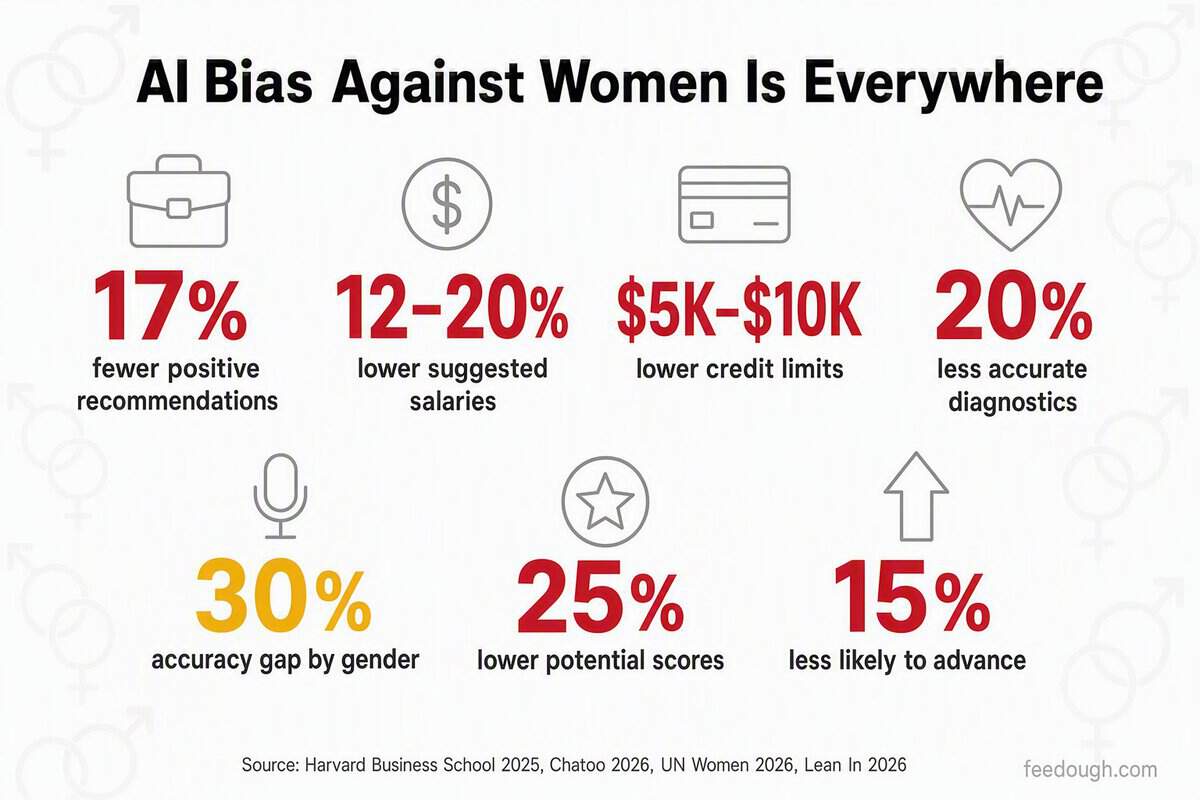
Hiring | Resume screening | 17% fewer positive recommendations for women |
Compensation | Pay benchmarking algorithms | 12–20% lower suggested salaries for female-dominated roles |
Finance | Credit scoring systems | $5,000–$10,000 lower credit limits for women with identical financial profiles |
Healthcare | Cardiac diagnostic AI | 20% less accurate for women due to male-dominated training data |
Technology | Voice recognition systems | 30% more accurate for male voices than female voices |
Workplace | Leadership evaluation AI | 25% lower potential scores for female managers with identical qualifications |
Career Growth | Promotion algorithms | 15% less frequently recommend women for advancement |
- Women are 25% less likely to use AI tools than men, a gap driven partly by this competency penalty (Lean In, 2026)
- Women make up 86% of workers both highly exposed to AI-driven job displacement and least able to adapt (Lean In, 2026)
- Women account for just 30% of the global AI workforce (UN Women, 2026)
- Women face nearly 2x the automation risk of men (UN Women, 2026)
- Only 7% of global healthcare research funding goes to conditions exclusively affecting women, skewing the data foundation for medical AI (Kearney, 2026)
Econometric analysis across 142 countries found that a 10-percentage-point increase in female AI adoption raised labor-force participation by just 2.3%. The gender wage gap narrowed by only 0.6 percentage points. Returns diminish as exposure grows, which means the women most affected by biased AI benefit least from adopting it.
Racial Bias in AI Statistics
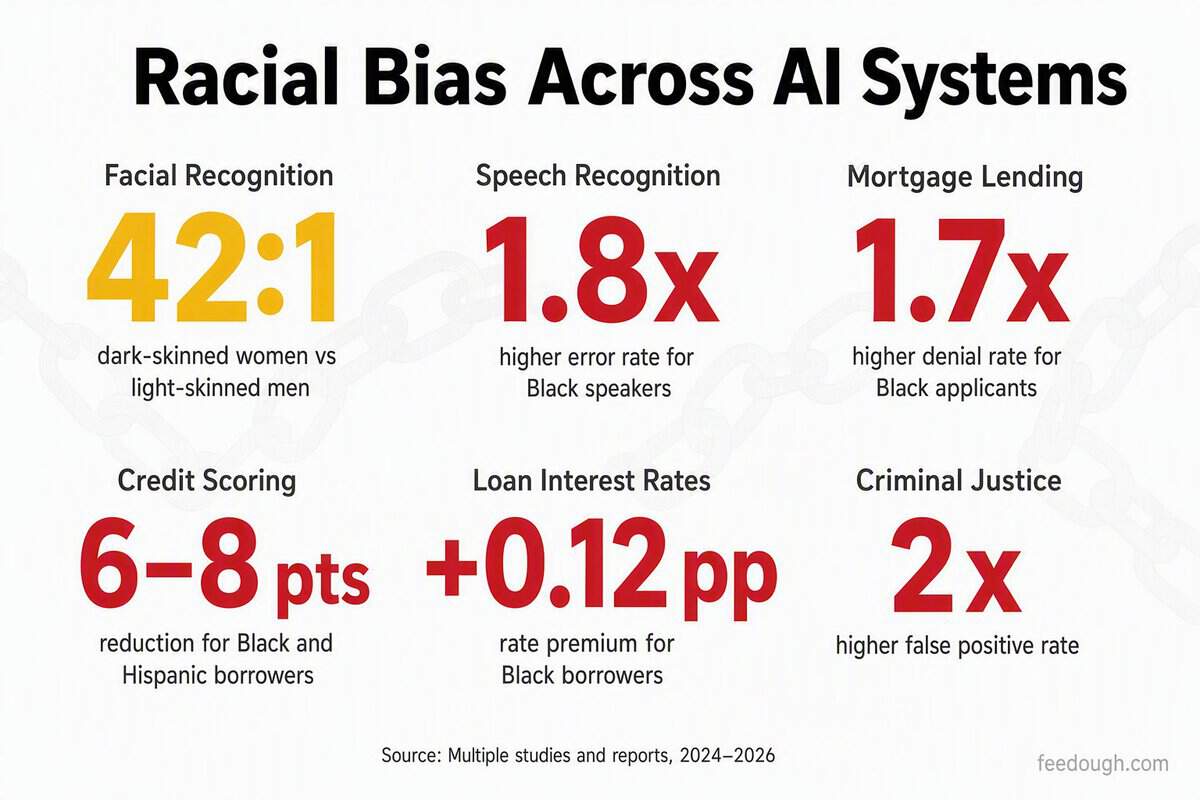
Facial recognition systems misclassify dark-skinned women at a rate of 34%. For light-skinned men, the figure is 0.8%. That 42-to-1 disparity is the most documented instance of racial bias in AI, but it is far from the only one.
Domain | Metric | Racial Disparity |
|---|---|---|
Facial recognition | Misclassification rate | 34% (dark-skinned women) vs 0.8% (light-skinned men) |
Speech recognition | Word error rate | 35% (Black speakers) vs 19% (white speakers) |
Mortgage lending | Denial rate | 19% (Black applicants) vs 11.27% (all applicants) |
Credit scoring | Score reduction | 6-8 points disproportionately applied to Black and Hispanic borrowers |
Loan interest rates | Rate premium | 0.10-0.12 percentage points higher for Black borrowers with identical credit |
Criminal justice | False positive rate | Approximately 2x higher for Black defendants |
The danger is not any single row in that table. It is how the rows chain together. A Black applicant denied a mortgage by a biased lending algorithm also faces higher interest rates on future credit. That same applicant encounters misidentification by security cameras and criminal justice risk scores that treat skin color as a predictive variable. These outcomes come from separate models built by separate teams on separate datasets. The person experiencing them encounters one environment that consistently produces worse results.
Healthcare data from a 2025 Cedars-Sinai study published in NPJ Digital Medicine reveals the same pattern in clinical settings. Most of the four tested LLMs exhibited racial bias in psychiatric treatment recommendations for African American patients. The strongest effects appeared in schizophrenia and anxiety cases, producing dramatically different care plans for otherwise identical patients. Two models omitted ADHD medication when African American race was listed, while another recommended guardianship proceedings for depression only when race was specified. A heart failure prediction model underperformed for young Black patients, particularly women. Retraining, demographic variables, and race-specific model designs all failed to resolve the gap. Deep learning systems can now identify a patient’s race from ECG signals alone, encoding racial information that no clinician can see or override.
The legal system is beginning to treat these patterns as discrimination rather than technical limitation. A $68 million DOJ settlement with a Texas lender in March 2026 treated algorithmic bias in mortgage decisions as a civil rights violation. Federal enforcement is no longer asking whether AI can be biased. It is asking what happens to the companies that deploy it without checking.
Age Bias in AI Hiring Statistics
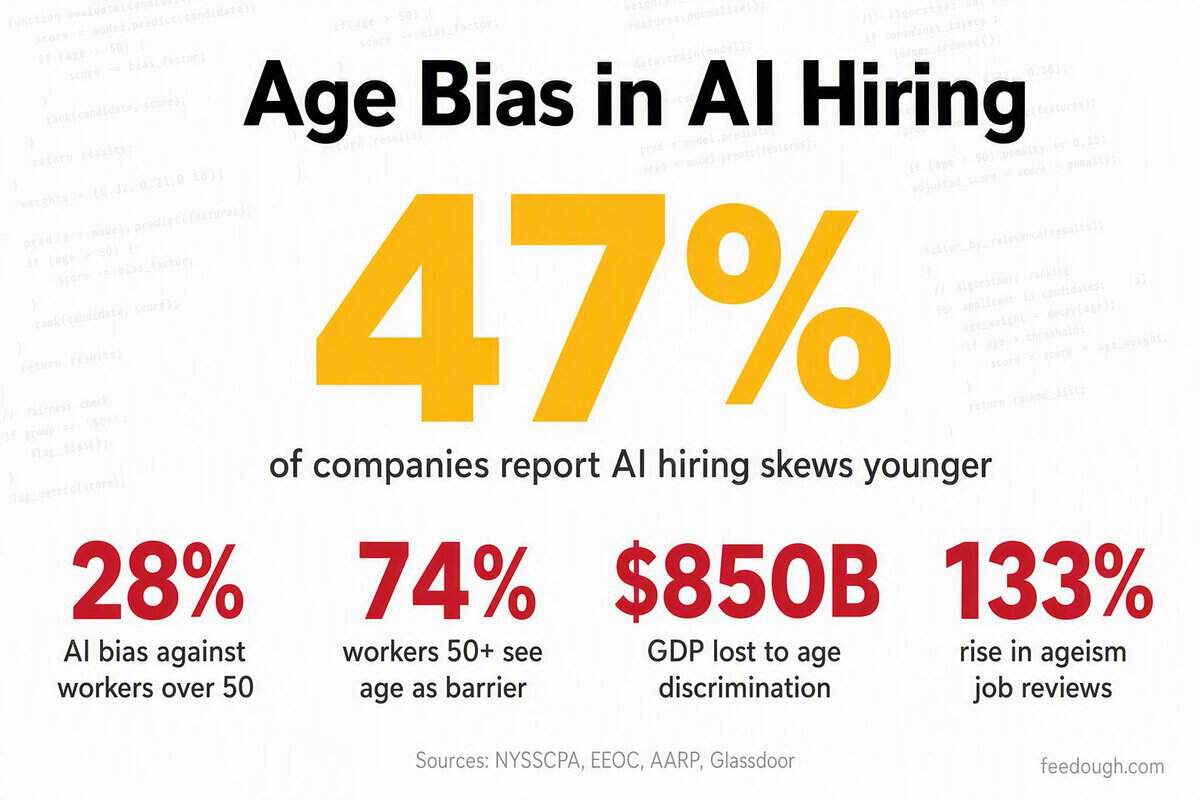
Workers age 75 and older are the fastest-growing age group in the U.S. labor market, per Pew Research Center data. At the same time, AI hiring tools are systematically filtering older candidates out of consideration. A NYSSCPA survey found that 47% of companies using AI in recruitment observed the technology skewing toward younger candidates, with 9% reporting biased results always and another 24% saying it happens often.
Age Bias Indicator | Value | Period / Context |
|---|---|---|
EEOC age discrimination charges | 16,223 | FY2024 (up 41% from FY2022) |
Employer payouts for age discrimination claims | $100 million | FY2024 |
AI video interview bias against candidates over 50 | 28% | 2026 algorithmic audit |
Workers 50+ experiencing discrimination | 64% | Jan 2026 |
Workers 50+ who see age as barrier to new job | 74% | Jan 2025 |
GDP lost to age discrimination | $850 billion | 2018 (projected $3.9 trillion by 2050) |
The mechanism is direct. Algorithms treat graduation dates and years of experience as proxies for age, removing older applicants before a human reviews their résumé. An AARP and OECD analysis found that workers over 50 experience unemployment nearly twice as long as their younger peers, and the financial damage persists long after rehiring.
- Over 50% of U.S. workers age 50+ are laid off or pushed out of career jobs before they choose to retire, and only 1 in 10 ever again earn what they did before these setbacks (ProPublica/Urban Institute)
- Glassdoor reports that mentions of ageism in job-seeker reviews rose 133% year-over-year in Q1 2025, one of the platform’s largest sentiment spikes on record
- A 2026 Resume Genius survey found that 53% of hiring managers noticed an increase in applicants over 50, yet only 48% said age never affects a candidate’s hireability
AI Chatbot Political Bias Statistics
OpenAI reports that fewer than 0.01% of ChatGPT responses carry political bias. Independent evaluations reach a different conclusion. Promptfoo’s analysis of 2,500 political questions found that 83.5% of GPT-4.1 outputs leaned left. Anthropic’s paired-prompt scoring from November 2025 measured the same directional pattern across six competing models.
Model | Evenhandedness Score | Assessment |
|---|---|---|
Gemini 2.5 Pro | 97% | Highest political neutrality |
Grok 4 | 96% | Near-neutral |
Claude Opus 4.1 | 95% | Near-neutral |
Claude Sonnet 4.5 | 94% | Near-neutral |
GPT-5 | 89% | Moderate directional lean |
Llama 4 | 66% | Significant directional lean |
The gap between self-assessment and third-party measurement matters because bias does not stay inside the model. Stanford research found that users perceive OpenAI models as carrying four times the left-leaning slant of Google models. A University of Washington study published in August 2025 confirmed the effect extends beyond perception. Users shifted their political views toward whichever direction a chatbot displayed, regardless of party.
- Copenhagen University researchers found that ChatGPT and Gemini favor specific political parties when asked who users should vote for, making them unsuitable for election guidance (April 2026)
- During Japan’s 2026 election, left-leaning defaults in five AI models from OpenAI, Google, and xAI caused party recommendation swings of 50 to 98 percentage points
- A March 2026 PNAS Nexus experiment found that GPT-4o historical summaries moved readers toward more liberal opinions than Wikipedia, even when the content was factually accurate
OpenAI’s October 2025 research reported that GPT-5 reduced political bias by 30% over earlier models. Anthropic’s scoring confirms the improvement, yet GPT-5’s 89% evenhandedness still trails the 94% to 97% range that competing models achieved. At least 20 U.S. states have enacted laws addressing AI in political advertising or deepfakes as of 2025, though several face First Amendment challenges.

AI Bias in Healthcare Statistics
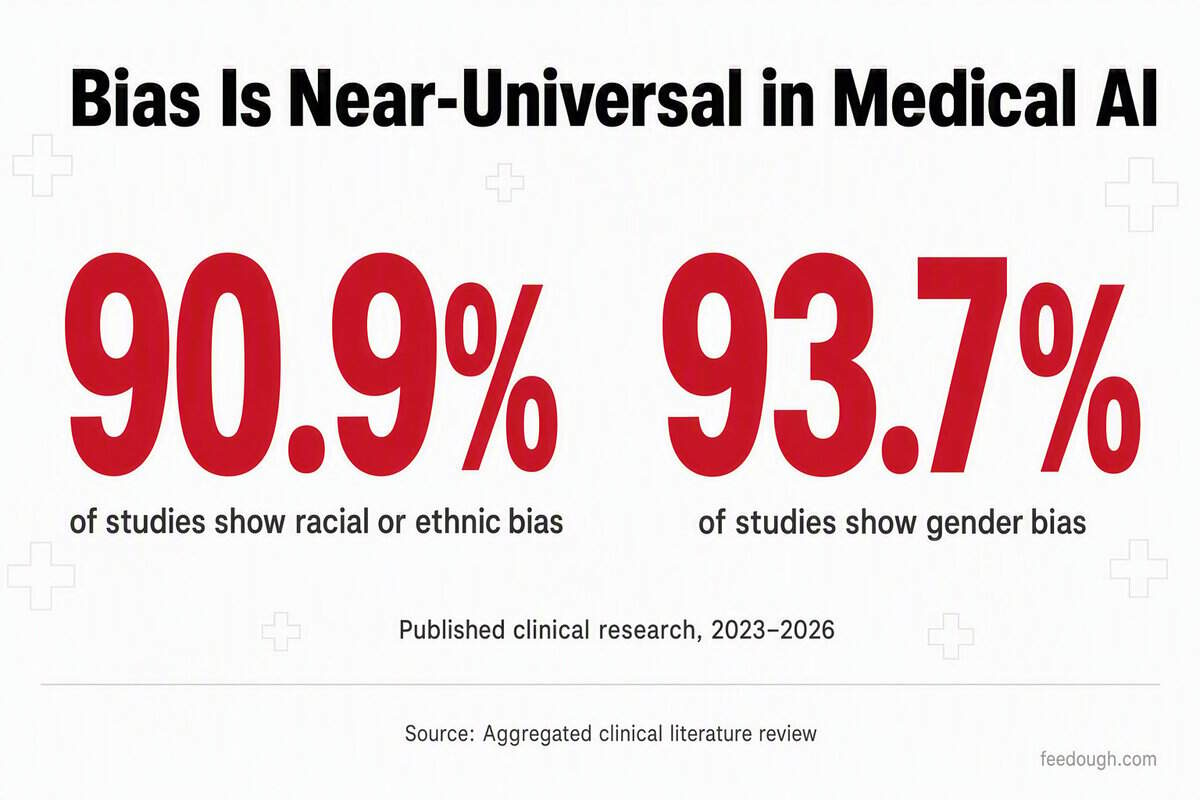
Racial or ethnic bias appeared in 90.9% of healthcare AI studies examined. Gender bias showed up in 93.7%. The near-universal presence of bias across published clinical research changes the question. It is no longer whether medical AI discriminates, but how often patients absorb the consequences.
Clinical Domain | Bias Finding | Source |
|---|---|---|
Suicide prediction | 62% detection rate for White patients vs 10% for Black patients | KFF, 2026 |
Heart failure prediction | Retraining, race-specific models, and demographic variables all failed to reduce bias for young Black patients | PMC, 2025 |
Diagnostic accuracy | 31% higher misdiagnosis rates for minority patients | JAMA, 2023 |
Medical testing rates | 4.5% lower testing rates for Black patients with identical conditions | Clinical data |
Malpractice exposure | 14% increase in AI-related malpractice claims from 2022 to 2024 | Industry data |
The suicide prediction gap is the most cited example, but the heart failure finding may matter more. Retraining the model, adding demographic variables, and building race-specific versions all failed to reduce bias for young Black patients. The failure persists even when developers specifically attempt to fix it.
47 states introduced more than 250 healthcare-specific AI bills in 2025. 21 states enacted laws with penalties ranging from $10,000 to $250,000 per violation. Average AI security breach costs in healthcare reached $7.42 million in 2025, and medical malpractice settlements involving AI have hit $17 million. When biased algorithms decide who gets screened and which complications get caught, delayed diagnoses follow. Some of those delays are fatal.
Public Trust and Concern About AI Bias Statistics
Consumer trust in AI peaked at 62% in 2023 and fell to 59% by 2025. The share who find AI “very untrustworthy” more than doubled, from 5% to 12%, according to Avaya’s 2025 Signals of Connection report. Meanwhile, 93% of IT leaders are already deploying or planning AI initiatives. The people building these systems and the people living under them are pulling in opposite directions.
The Thales Digital Trust Index 2026 surveyed more than 15,000 consumers globally. Just 23% trust companies to use AI responsibly with their data. KPMG’s 2025 survey of 48,000 people across 47 countries put the global willingness to trust AI systems at 46%. On the regulatory side, only 44% of U.S. adults trust the federal government to regulate AI effectively, while 47% have little or no trust, per Pew Research Center.
Trust Metric | % | Source |
|---|---|---|
Trust companies to use AI responsibly | 23% | Thales Digital Trust Index 2026 |
Willing to trust AI systems (global) | 46% | KPMG/University of Melbourne, 2025 |
Distrust both businesses and government | 77% | Gallup-Bentley University |
Little or no trust in government to regulate AI | 47% | Pew Research Center, 2025 |
Say AI’s risks outweigh its benefits | 43% | Politico/Public First, May 2026 |
Among the youngest adults, the erosion shows up in behavior. Gallup’s 2026 survey of Gen Z Americans found excitement about AI fell 14 percentage points in one year to 22%. Anger rose 9 points to 31%, even as daily use held steady. The distrust carries market consequences: only about 3% of the world’s 1.8 billion AI users pay for premium services, leaving a $432 billion annual monetization gap.
Consumers are not asking for less AI. They are asking for more disclosure:
- 91% of consumers want AI transparency, per Emplifi’s 2026 survey of 1,650 consumers
- 90% say they should have access to a real person if they choose not to interact with AI (Avaya, 2025)
- 85% believe companies should be required to disclose when AI is used
- 76% would switch brands for meaningful transparency about how their data is used in AI systems (Relyance AI)
- 50% would pay more for transparency about how companies use their data in AI
People do not reject AI. They reject opacity.

AI Regulation and Compliance Statistics
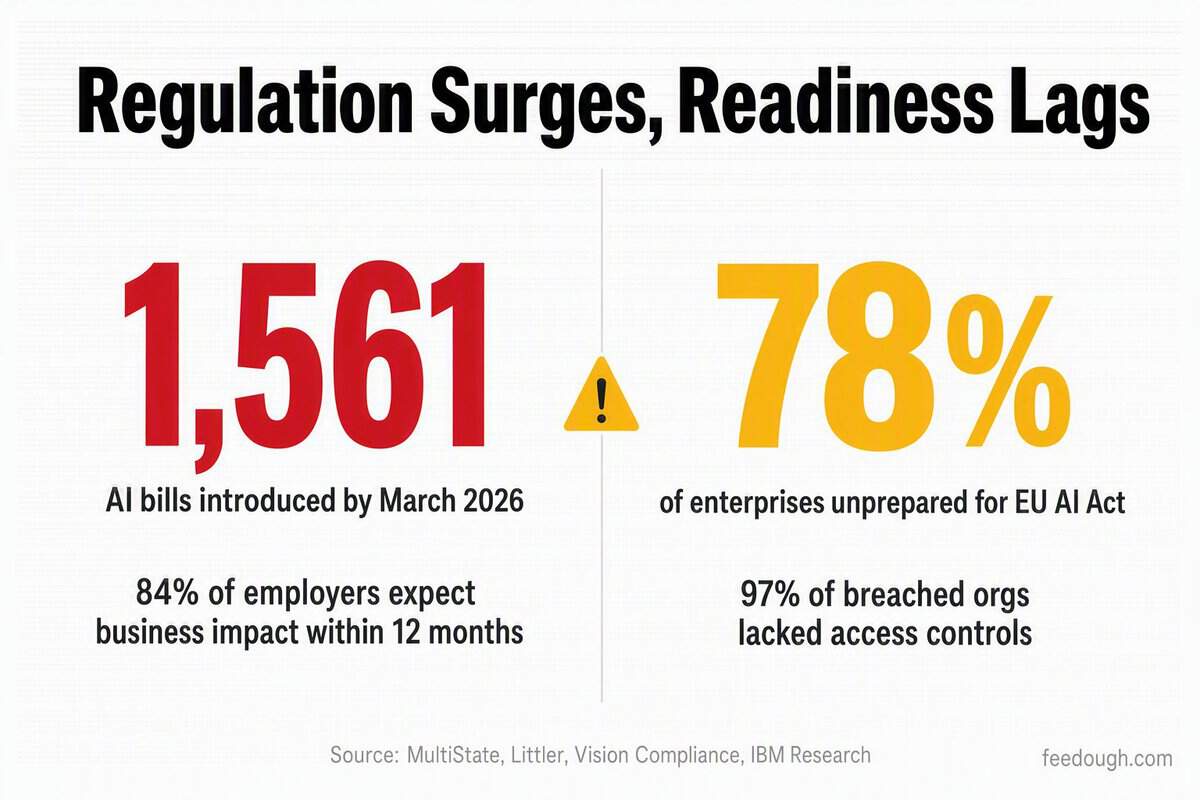
In 2025, state lawmakers across all 50 US states introduced 1,208 AI-related bills and enacted 145 of them, according to MultiState. By March 2026, lawmakers in 45 states had introduced 1,561 bills, surpassing the entire 2024 total before most sessions reached their midpoint. The regulatory machine is accelerating faster than the compliance infrastructure built to absorb it.
EU AI Act Violation | Maximum Fine | Revenue Threshold |
|---|---|---|
Prohibited AI practices | €35 million | 7% of global annual turnover |
High-risk AI or GPAI non-compliance | €15 million | 3% of global annual turnover |
Incorrect or misleading information to authorities | €7.5 million | 1.5% of global annual turnover |
The US regulatory landscape remains fragmented. State-level enforcement creates a compliance patchwork that shifts across state lines. The EU framework sets a global baseline that multinational companies cannot ignore. 84% of US employers expect business impacts from AI-related regulatory changes within 12 months, double the share from 2025. AI is now the top workplace policy concern, ahead of immigration and DEI, per Littler’s 2026 survey of over 300 C-suite executives. Yet 78% of enterprises remain unprepared for their EU AI Act obligations, with full enforcement for high-risk AI systems beginning August 2, 2026.
- The global RegTech market was valued at $17.12 billion in 2025 and is projected to reach $99.07 billion by 2034, a 21.5% CAGR per Polaris Market Research
- AI in regulatory affairs alone reached $1.6 billion in 2025, growing at 18.65% annually toward $8.86 billion by 2035
- AI risk jumped to the number-two position on the Allianz Risk Barometer in 2026, up from number 10 the year before
- 69% of organisations report having AI evaluation and testing capabilities in place or planned, per PwC’s 2025 Responsible AI survey
Thirteen percent of organizations reported breaches of AI models or applications in 2025. Of those, 97% lacked proper access controls at the time of the incident, according to IBM research. The infrastructure to enforce these rules is being built alongside the rules themselves. The gap between the two determines who absorbs the cost.
AI Language Bias Statistics
Claude Opus 4.7 scores 5 out of 5 on English coding tasks but just 1 out of 5 on identical Arabic tasks. GPT-5.5 and Gemini 3.1 Pro score 0 out of 5 on Korean notification generation while holding perfect English scores. The performance gap is not about language complexity; it is about which languages the training data treated as worth learning.
Language | Performance Score (Reliable Version Editing) | Training Resource Level |
|---|---|---|
German | 53.66% | High-resource European |
English | 46.34% | Dominant (70–80% of training data) |
Korean | 36.59% | Underrepresented in benchmarks |
Arabic | 31.71% | Underrepresented in benchmarks |
- Safety safeguards that held in English degraded sharply in West African languages, with refusal rates dropping by over 50% in some cases, suggesting alignment mechanisms do not reliably transfer across languages (2026 benchmark)
- The International AI Safety Report 2026 found AI models answered 79% of questions about everyday US culture correctly but only 12% about Ethiopian culture, revealing a disparity that extends beyond language performance into worldview representation
- LILT’s April 2026 analysis found roughly 20.7 percentage points of measured multilingual performance gaps stem from benchmark translation artifacts rather than genuine model capability limits, with Korean showing the largest correction at +28.3pp
- The SAHARA benchmark evaluated 517 African languages across 16 NLP tasks and confirmed persistent performance gaps between English and widely spoken languages including Hausa, Wolof, and Oromo, attributing disparities to policy-driven data inequities
LILT estimates that 4 out of 5 people worldwide do not speak English with meaningful proficiency, yet English makes up 70–80% of training corpora across over 50 multilingual models. Only a few hundred of the world’s roughly 7,000 languages have meaningful representation in major AI systems. Speakers of low-resource languages do not receive worse answers. They receive answers shaped by a different language’s worldview.

How Companies Are Reducing AI Bias Statistics
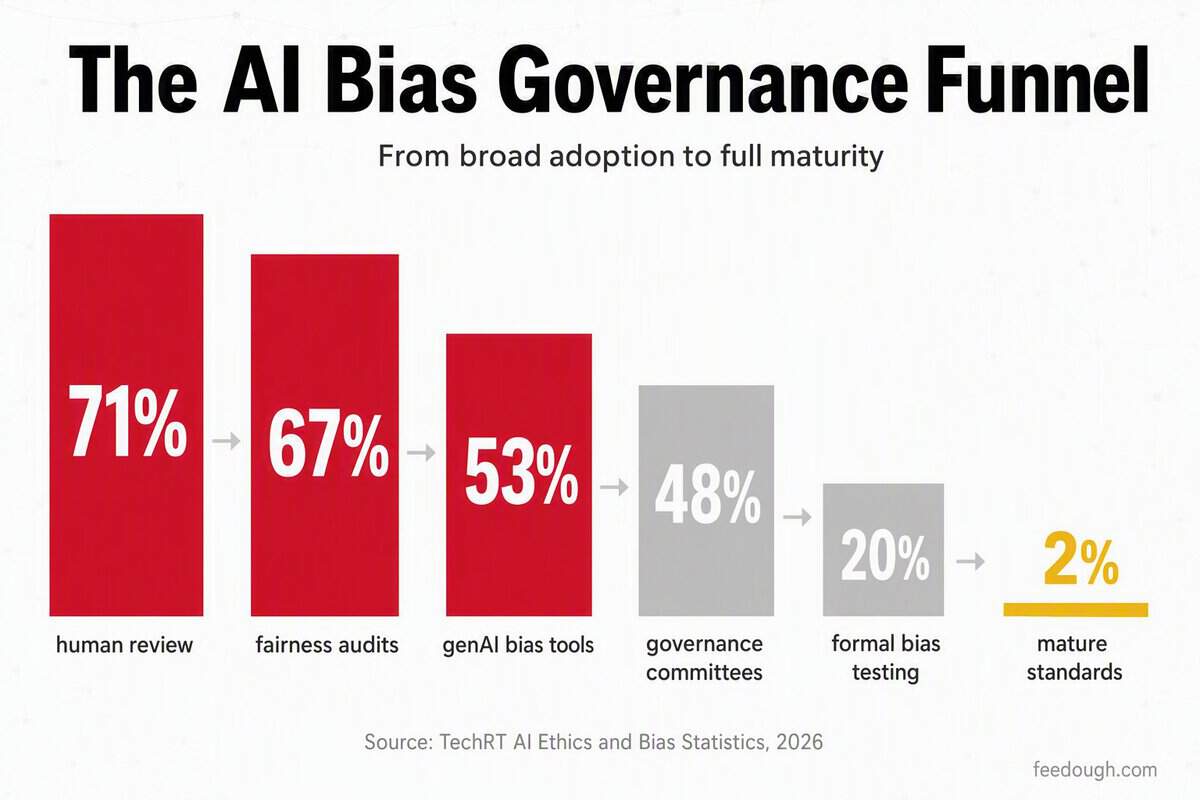
67% of organizations now embed fairness audits and bias-risk scoring into their AI development pipelines. Only 2% meet mature responsible-AI deployment standards in global surveys. The governance infrastructure is being built. The depth it requires is not.
Bias Reduction Measure | Adoption Rate | Governance Depth |
|---|---|---|
Require human review before final AI decisions | 71% | Oversight layer |
Embed fairness audits in development pipelines | 67% | Process integration |
Implement tools to reduce biased generative AI outputs | 53% | Technical remediation |
Establish dedicated AI governance committees | 48% | Structural governance |
Conduct formal bias testing on AI models in use | 20% | Active validation |
Meet mature responsible-AI deployment standards | 2% | Full maturity |
The decline from 71% human oversight to 2% maturity follows the resource line. AI governance and ethics tools account for just 3% of enterprise AI marketing budgets, with ROI timelines exceeding 12 months. Only 13% of organizations have hired AI compliance specialists. Six percent have added AI ethics specialists, per IBM’s Global AI Adoption Index. The structures exist. The people to staff them mostly do not.
Companies with formal AI bias strategies report 80% success in bias reduction, compared to 37% for those without. Despite these results, 47% of organizations still detect biased AI-generated content, and only 20% conduct formal bias testing on production models. Enterprises with mature frameworks report 23% higher employee satisfaction and over 15% better sales outcomes. That market, valued at $2.95 billion in 2025, is projected to reach $21.06 billion by 2035 with bias-detection growing fastest. The spending is climbing. Whether it reaches the depth that produces results determines which organizations close the gap and which do not.
Sources
- https://electrek.co/2026/02/20/tesla-has-to-pay-historical-243-million-judgement-over-autopilot-crash-judge-says (2026-02-20)
- https://hiredaiapp.com/blog/ai-hiring-bias-lawsuits-are-reshaping-recruiting-in-2026-what-every-employer-and-job-seeker-needs-to-know (2026-02-17)
- https://www.joneswalker.com/en/insights/blogs/ai-law-blog/ai-hiring-under-fire-what-the-eightfold-lawsuit-means-for-every-employer-using-a.html (2026-02-25)
- https://intuitionlabs.ai/articles/algorithmic-redlining-solutions (2025)
- https://www.marthabuyer.com/articles/2025/8/15/be-aware-of-the-risk-of-ai-bias.html (2025-08-15)
- https://www.folio3.ai/blog/ai-project-failure-rate-stats (2025)
- https://atlan.com/know/gartner/key-takeaways-from-gartner-da-summit-2026 (2026)
- https://www.aboutchromebooks.com/ai-algorithm-bias-detection-rates-by-demographic (2026)
- https://www.allaboutai.com/resources/ai-statistics/ai-bias (2026)
- https://research.contrary.com/report/bias-fairness (2025-10-10)
- https://pmc.ncbi.nlm.nih.gov/articles/PMC12823528 (2026-01-08)
- https://www.aiprm.com/bias-in-ai (2025)
- https://finance.yahoo.com/news/ai-trends-2026-report-risk-160600888.html (2025-11-17)
- https://www.walkme.com/blog/ai-adoption-statistics (2026-04-17)
- https://etcjournal.com/2026/06/24/ai-chatbots-are-liberal-left-biased (2026-06-24)
- https://www.ibm.com/think/perspectives/agentic-ai-is-your-workforce-ready (2025)
- https://www.gminsights.com/industry-analysis/ai-governance-market (2026)
- https://www.prolific.com/resources/ai-bias-10-real-world-failures-and-what-they-reveal-about-training-data (2026-04-17)
- https://www.arcastgroup.com/insights/the-roi-of-ai-75-of-projects-fail.-build-a-business-case-that-works (2025)
- https://dataintelo.com/report/ai-ethics-advisory-services-market (2025)
- https://www.forbes.com/sites/michelletravis/2026/06/25/women-who-use-ai-seen-as-incompetent-men-who-use-ai-seen-as-pragmatic (2026-06-25)
- https://www.forbes.com/sites/michelletravis/2025/11/20/metas-plan-to-evaluate-employees-ai-use-may-negatively-impact-women (2025-11-20)
- https://www.medicaldevice-network.com/comment/gender-bias-in-ai-health-advice-when-innovation-learns-from-incomplete-data (2026-01-27)
- https://leanin.org/articles/findings/the-ai-gender-gap (2026-03-07)
- https://www.ictworks.org/gender-productivity-paradox (2026)
- https://news.un.org/en/story/2026/06/1167776 (2026-06)
- https://medcitynews.com/2025/12/aha-cardiology-healthcare (2025-12-22)
- https://amwa-doc.org/the-role-of-gender-in-ai-medical-tools-are-algorithms-reproducing-human-bias-in-healthcare-delivery (2025)
- https://www.cedars-sinai.org/newsroom/cedars-sinai-study-shows-racial-bias-in-ai-generated-treatment-regimens-for-psychiatric-patients (2025-06-30)
- https://actnowtraining.blog/2025/12/10/home-office-acknowledges-racial-and-gender-bias-in-uk-police-facial-recognition-technology (2025-12-10)
- https://www.lawcommentary.com/articles/openai-agrees-to-32-million-doj-settlement-in-us-worker-discrimination-probe (2026-08-06)
- https://www.gibsondunn.com/dei-task-force-update-may-6-2026 (2026-05-06)
- https://informedclearly.com/en/ai/41231/algorithmic-hiring-bias-audit-findings-policy-2026 (2026)
- https://www.forbes.com/sites/sheilacallaham/2025/11/25/in-2026-age-bias-will-become-impossible-for-employers-to-ignore (2025-11-25)
- https://www.facebook.com/USEEOC/posts/the-age-discrimination-in-employment-act-adea-protects-workers-aged-40-and-older/1311638967664117 (2025-12-15)
- https://resumegenius.com/blog/job-hunting/hiring-trends-report-2026 (2026-06)
- https://www.axios.com/2025/11/13/anthropic-bot-bias-data (2025-11-13)
- https://phys.org/news/2026-04-chatbots-political-bias-voters-parties.html (2026-04-16)
- https://aparc.fsi.stanford.edu/news/voters-increasingly-use-ai-political-advisor-new-study-shows-risks (2026)
- https://academic.oup.com/pnasnexus/article/5/3/pgag022/8503065 (2026-03-03)
- https://employerbranding.news/resources/ai-in-hiring-statistics-2026-adoption-bias-trust-and-regulation (2026-05)
- https://www.greenhouse.com/blog/2026-candidate-ai-interview-report (2026)
- https://enhancv.com/blog/ai-hiring-statistics (2026-04-30)
- https://sqmagazine.co.uk/ai-recruitment-statistics (2026)
- https://www.callyourgirlfriend.com/blog/ai-legislation-statistics (2025-06-01)
- https://www.paubox.com/blog/the-ai-trust-gap (2025-10-07)
- https://www.avaya.com/en/blogs/customer-experience-statistics-2026 (2026-02-17)
- https://www.facebook.com/Emplifi/posts/the-data-is-in-authenticity-drives-revenue-we-asked-1650-consumers-what-makes-a-/1426548322844541 (2026-04-15)
- https://www.polarismarketresearch.com/industry-analysis/regtech-market (2025)
- https://techpolicy.press/where-state-ai-legislation-stands-half-way-into-2026 (2025)
- https://www.corporatecomplianceinsights.com/news-roundup-may-14-2026 (2026-05-14)
- https://optro.ai/blog/ai-governance-stats (2026)
- https://evolvancemarketresearch.com/statistics/ai-governance-statistics (2026)
- https://lilt.com/blog/multilingual-agent-benchmark-gaia-v2-lilt (2026-04-29)
- https://techpolicy.press/the-multilingual-ai-gap-is-not-closing-it-is-being-rebranded (2026-04-10)
- https://internationalaisafetyreport.org/publication/international-ai-safety-report-2026 (2026)
- https://lilt.com/blog/multilingual-ai-coding-gap-non-english-developers (2026-05-18)
- https://lilt.com/blog/multilingual-ai-language-gap (2026-04-01)
- https://techrt.com/ai-ethics-and-bias-statistics (2026)
- https://www.precedenceresearch.com/ai-trust-risk-and-security-management-market (2025-12-22)