
HR leaders are still debating whether AI belongs in recruitment. Their teams already answer that question every morning.
AI in recruitment statistics from 2025 and 2026 show the market moving from $596 million toward a projected $921 million by 2031. Adoption among HR teams leapt from 26% to 39% in one year, and another 46% expect to implement by the end of 2026.
Here is what those numbers reveal about where this is happening, how fast it is spreading, and which applications are actually delivering results.
AI Adoption in Recruitment Statistics by Company Size
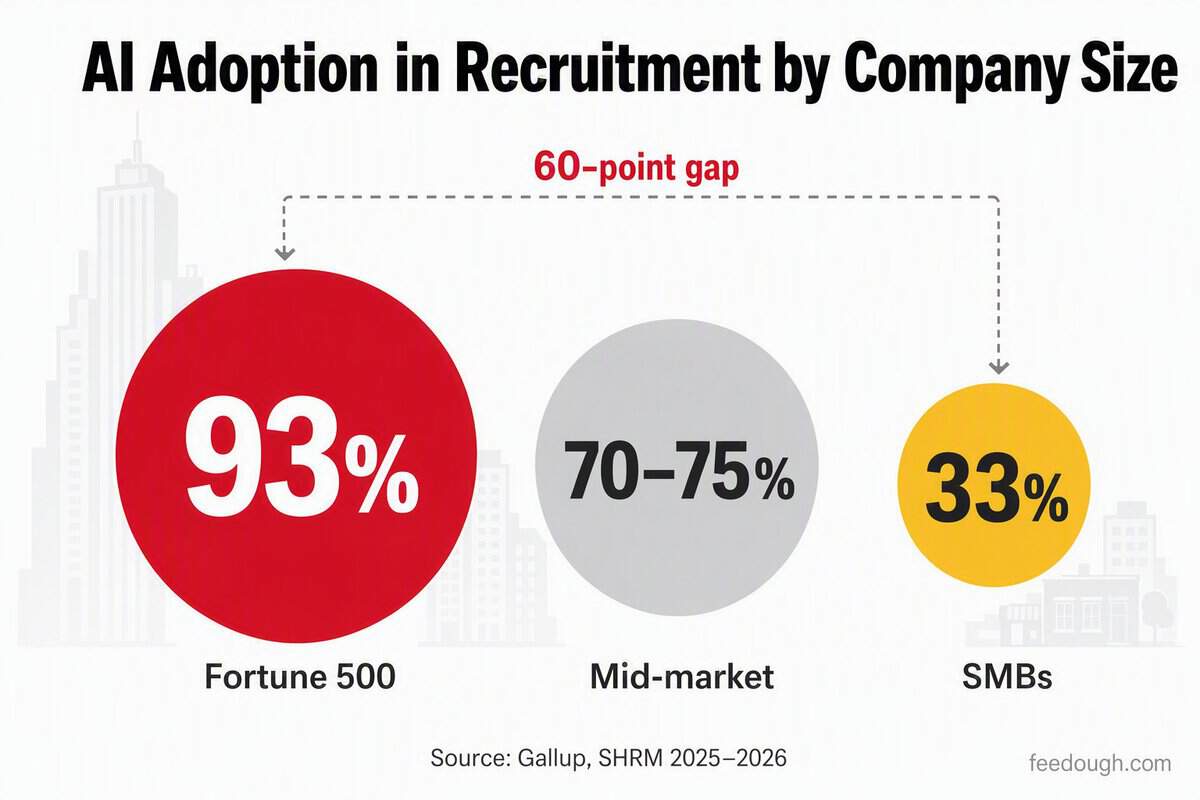
93% of Fortune 500 CHROs are integrating AI into recruitment. At companies with fewer than 100 employees, the adoption rate is 33%. The 60-point gap is not narrowing.
Company Size | AI Adoption Rate | Key Context |
|---|---|---|
Fortune 500 / Large enterprises (500+) | 93% | Near-universal; most have used AI for 3+ years |
Mid-market (100–499 employees) | 70–75% | Majority adopted within the past two years |
SMBs (under 100 employees) | 33% | Cost and integration complexity remain primary barriers |
Headline adoption rates mask a deeper problem. Most organizations using AI in recruitment are deploying it narrowly, not across their full workflow.
- 69% of companies use AI in hiring in some capacity
- 18% use it broadly across the recruitment process
- 6% have automated more than three-quarters of their workflow
Deep AI adoption in recruitment delivers 2 to 3x faster time-to-hire. Organizations that fully leverage AI in hiring workflows see an average 340% return on investment within 18 months. For SMBs still on the sidelines, the performance gap widens with each hiring cycle.
AI Recruitment Task Automation Statistics
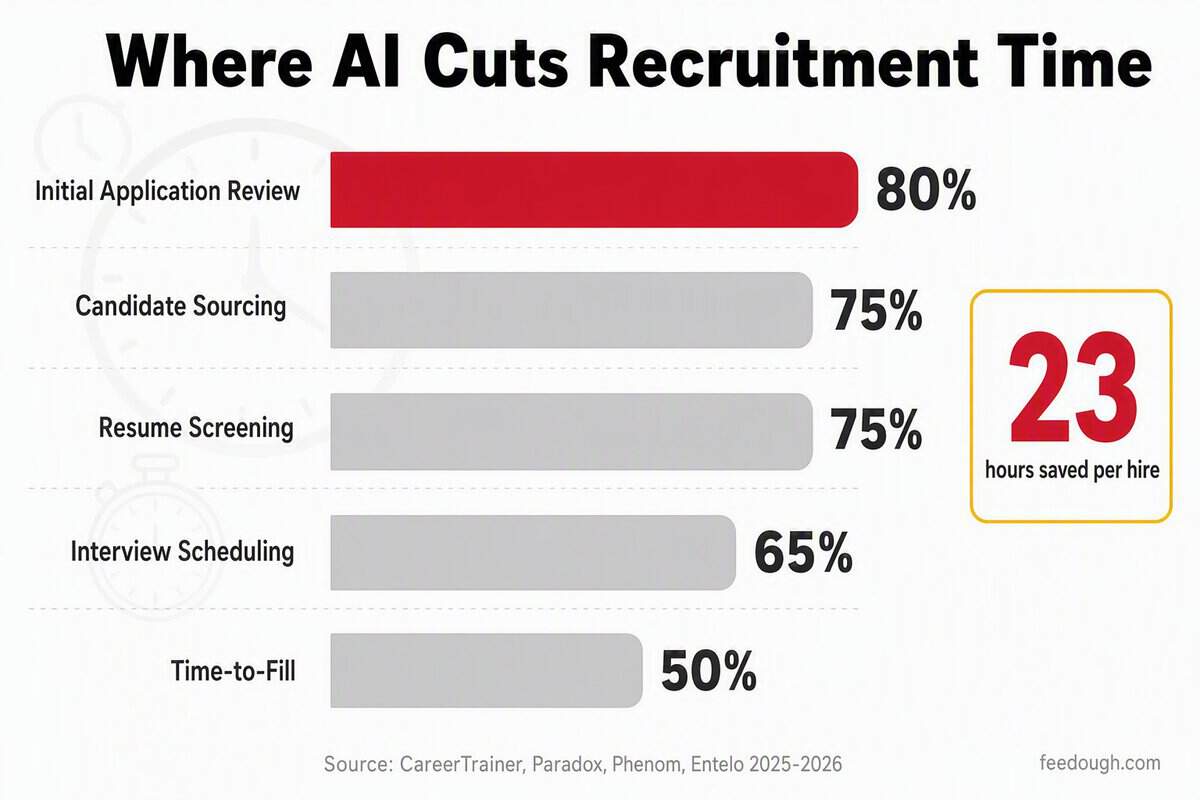
Interview scheduling alone accounts for 35% of recruiter time. That bottleneck explains why AI recruitment task automation delivers its sharpest returns in sourcing, screening, and scheduling rather than across the hiring process uniformly.
Recruitment Task | Efficiency Metric | Reported Value |
|---|---|---|
Initial Application Review | Applications processed by ML algorithms | 80% |
Candidate Sourcing | Time-to-screen reduction | 75% |
Resume Screening | Applications processed vs. manual review | 75% more |
Interview Scheduling | Coordination time reduction | 65% |
Time-to-Fill | Reduction in overall hiring cycle | 50% |
Per-Hire Efficiency | Average time saved per hire | 23 hours |
The weekly capacity gains are measurable. Recruiters using AI schedule 2.5x more interviews per week, and candidate response times have dropped from 7 days to under 24 hours. For high-volume employers, these improvements compound with each hiring cycle.
Candidate Perspectives on AI in Hiring Statistics
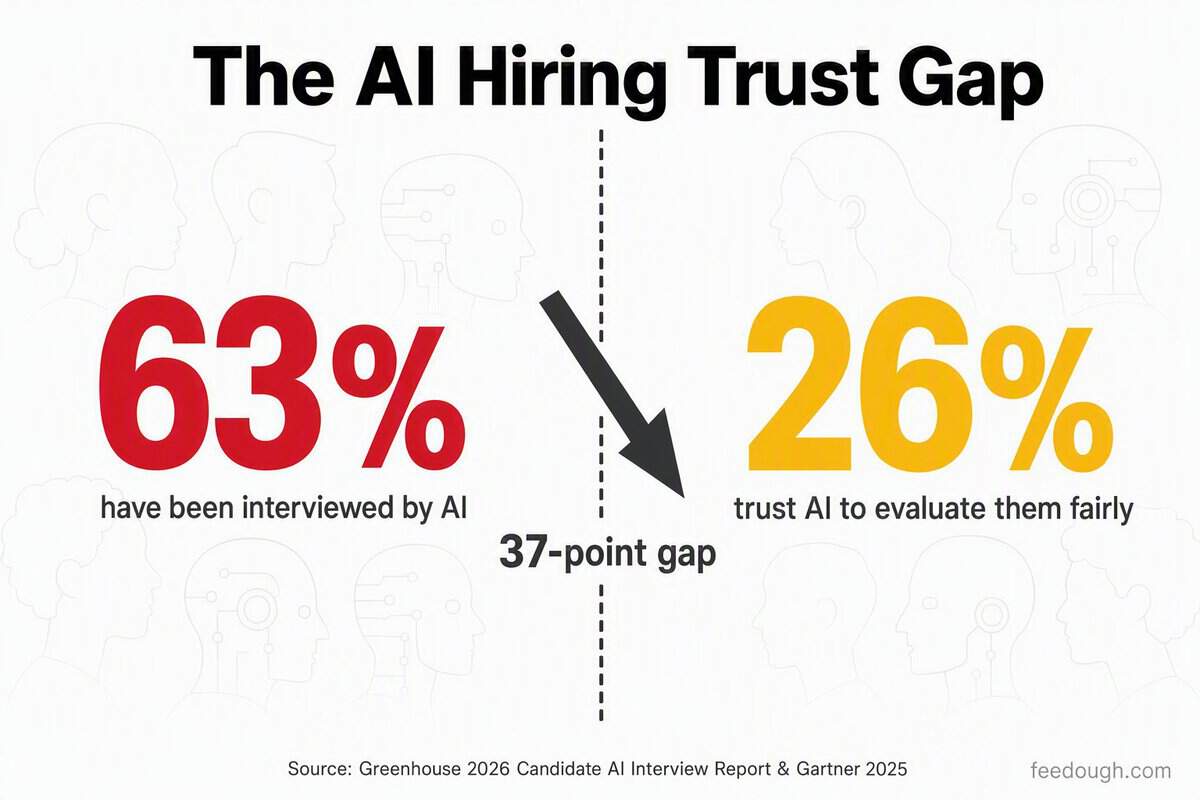
63% of job seekers have now been interviewed by AI, up 13 percentage points in just six months. Only 26% trust AI to evaluate them fairly. The trust gap is not about resistance to technology. It is about how AI shows up in the hiring process.
- 70% of candidates were never clearly told upfront that AI would evaluate them
- 57% believe AI disclosure should be a legal requirement
- 46% want the option to request a human interview instead
Outcome After AI Interview | Share of Candidates |
|---|---|
Moved to next round | 28% |
Received formal rejection | 13% |
Never heard back | 51% |
38% of candidates have already walked away from a hiring process that included an AI interview, and another 12% say they would. Yet only 19% want less AI in hiring overall. The demand is not for less technology. It is for more transparency.
Candidate Trust in AI Hiring Statistics
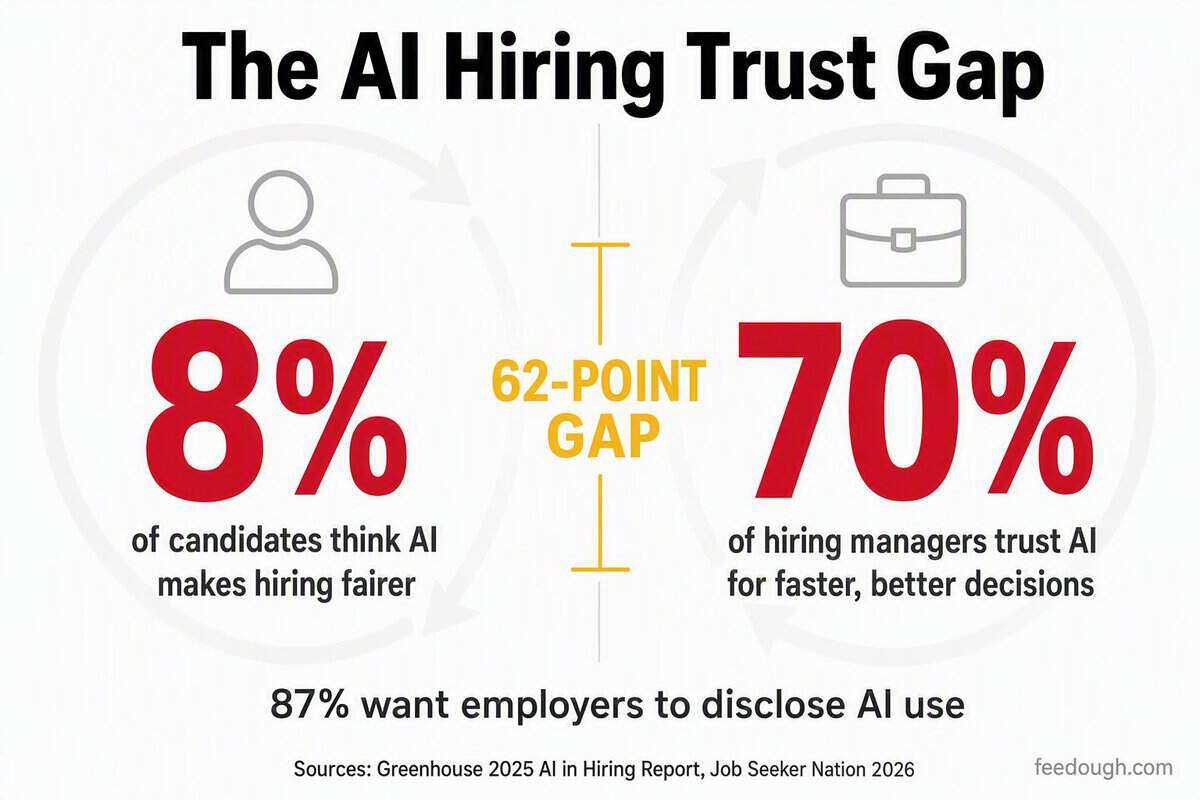
Only 8% of job seekers think AI makes hiring fairer. 70% of hiring managers trust it to make faster, better decisions. The 62-point gap between deployers and subjects shapes every other metric in this space.
Candidate Trust Metric | % of Candidates |
|---|---|
Think AI makes hiring fairer | 8% |
Doubt AI can assess soft skills | 42% |
Concerned about losing personal connection | 64% |
Want employers transparent about AI use | 87% |
- 66% of job seekers report at least one AI rejection before a human reviewed their application
- 34% believe they have been automatically rejected by AI
- 91% of recruiters and hiring managers say they have caught or suspected a candidate using AI deceptively
This gap produces a feedback loop. Candidates who feel screened out by opaque AI have little incentive to engage honestly. Recruiters who suspect candidates are gaming the system lean harder on automated detection. Employer disclosure is the only exit, and it remains the exception rather than the rule.
AI Applications Across the Recruitment Funnel Statistics
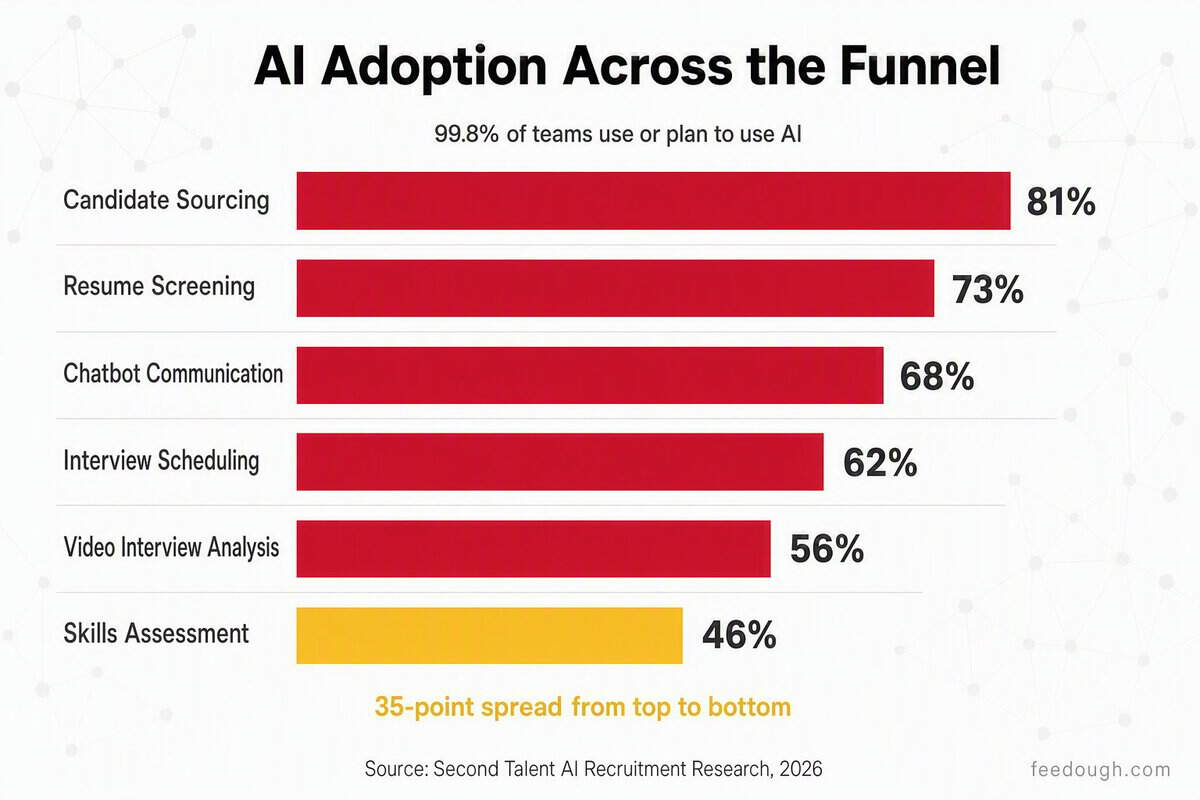
AI in recruitment has reached near-universal adoption. 99.8% of talent acquisition teams now use, pilot, or plan to use AI agents. Yet the distribution across the recruitment funnel reveals where the technology has earned buy-in and where it has not.
Recruitment Stage | % of Organizations Using AI |
|---|---|
Candidate sourcing | 81% |
Resume screening | 73% |
Chatbot communication | 68% |
Interview scheduling | 62% |
Video interview analysis | 56% |
Skills assessment | 46% |
The 35-point spread between sourcing and skills assessment, documented in Second Talent’s 2026 research, tracks a consistent pattern. AI earns adoption first in functions with standardized logic and clear outputs.
Where organizations deploy AI past the top of the funnel, the results are sharp. Resume screening drops from 10 days to 2, and interview scheduling from 5 days to 1. Teams using automated scheduling are 1.6 times more likely to hit their hiring goals. Mastercard’s AI-powered talent community grew from fewer than 100,000 to over 1 million profiles, generating 141,000 more leads than the industry average.
The communication layer is at 68% adoption. AI chatbots now handle 58% of initial candidate inquiries without human intervention.
AI Recruitment Deployment Statistics
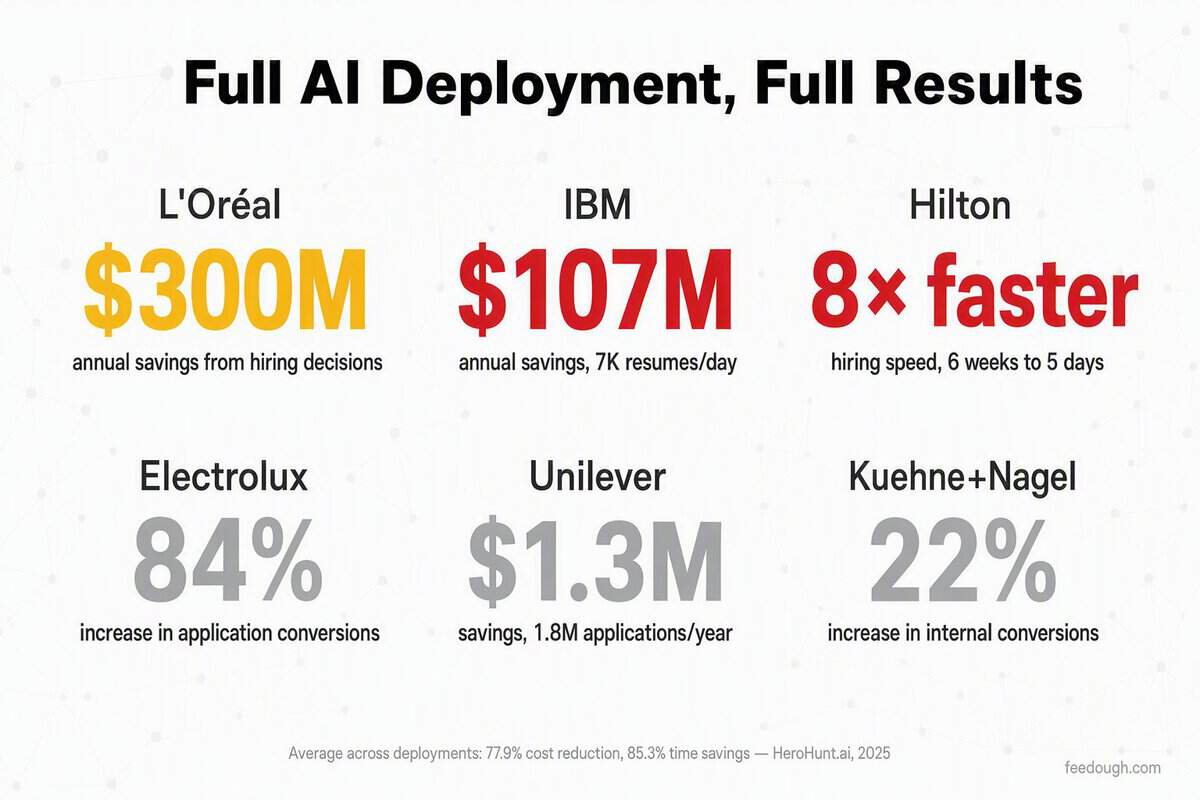
IBM’s Watson Recruitment processed 7,000 resumes daily and returned $107 million in savings in a single year. That is not a pilot outcome. It is what happens when companies deploy AI across the full hiring workflow rather than testing it in one corner.
Company | AI Deployment Focus | Key Outcomes |
|---|---|---|
IBM Watson Recruitment | Predictive hiring analytics and resume processing | $107M annual savings, 7,000 resumes/day, application conversion tripled from 12% to 36% |
L’Oréal | Skill-based evaluation and matching | ~$300M annual savings from improved hiring decisions, 30% higher retention, 50% faster new-hire productivity |
Unilever | Resume screening, video interviews, gamified assessments | $1.3M annual savings, 1.8M applications processed/year, 16% increase in workforce diversity |
Hilton | Conversational AI chatbot and video assessment | 93% candidate conversations within 1 hour, 8x faster hiring (6 weeks to 5 days), candidate NPS of 84.9 |
Electrolux Group | Talent experience platform (Phenom) | 84% increase in application conversions, 78% time saved on AI scheduling, 51% fewer incomplete applications |
Kuehne+Nagel | Internal AI talent marketplace | 22% increase in internal candidate conversion, 20% faster time-to-fill, 500 internal hires through AI matching |
Across these deployments, HeroHunt.ai’s 2025 year-in-review found an average 77.9% reduction in hiring costs and 85.3% time savings. The gap between these results and isolated pilots comes down to coverage: AI compounds returns when it touches every hiring stage simultaneously.
AI in Recruitment Statistics by Industry
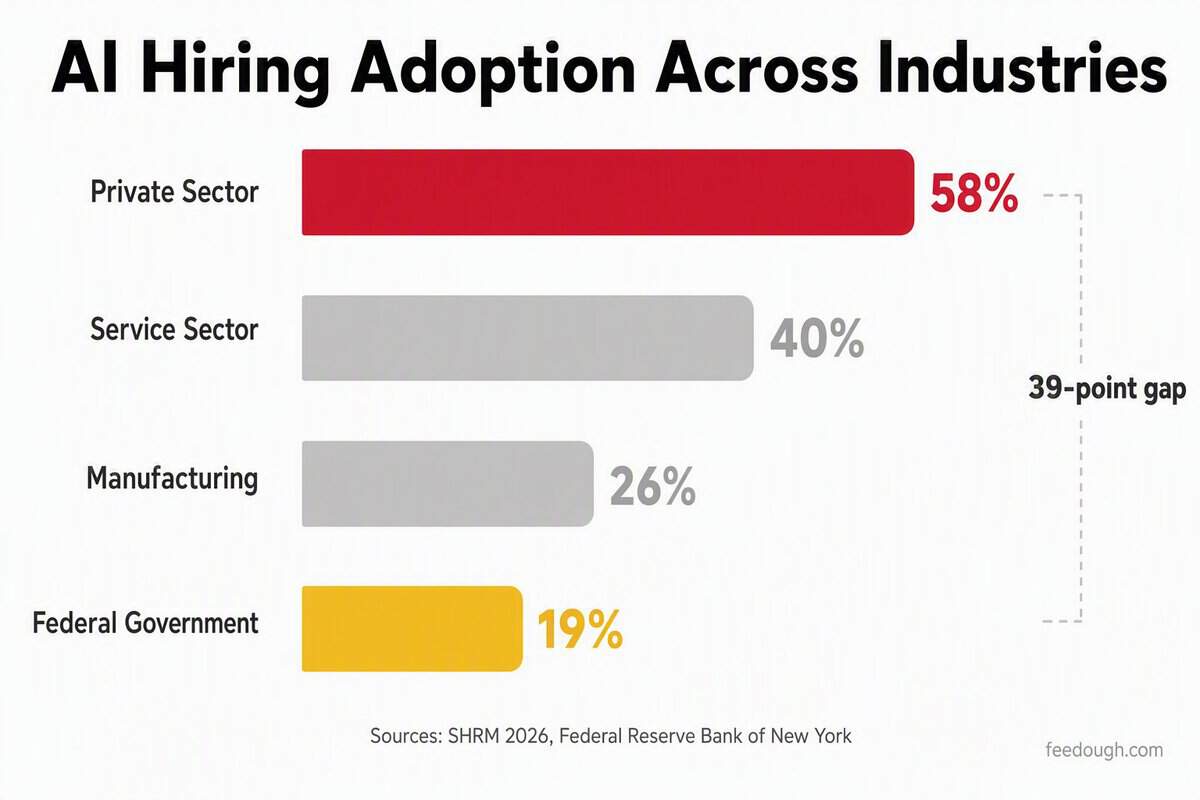
Federal government employers use AI in recruitment at 19%. Publicly traded for-profit companies use it at 58%. The 39-point gap maps less to budget than to which industries treat hiring as a volume problem worth automating.
Industry Sector | AI Adoption Metric | Key Outcome |
|---|---|---|
IT & Telecommunications | 28.66% of global market revenue (2025) | Largest market share; early adoption culture |
Healthcare | 13.05% CAGR through 2035 | Fastest-growing segment; nursing and radiology shortages driving demand |
Service Sector | 40% adoption in 2025 (from 25% in 2024) | 15 pp year-over-year increase; steepest jump across US industries |
Manufacturing | 26% adoption in 2025 (from 16% in 2024) | 10 pp year-over-year increase |
Financial Services (BFSI) | $98.5M market value (2025) | Compliance-intensive recruitment workflows |
Government / Public Sector | 19% federal vs. 58% private sector | 39 percentage-point adoption gap |
Adoption rates capture the spread. The operational impact goes deeper in sectors that committed to AI-driven hiring at scale:
- Healthcare: 640,000+ AI-related positions created in 2025; AI screening cut time-to-first-interview from days to hours
- Manufacturing: 620,000 AI positions created in 2025, concentrated in production automation and predictive maintenance
- Retail and Hospitality: AI scheduling reduced candidate no-show rates by 20-35%; automated FAQs saved managers roughly 4 hours per week on hiring tasks
Industries facing chronic talent shortages see faster returns. Compliance-heavy sectors deploy AI more narrowly, but the measurable impact on bias reduction justifies the targeted approach.
Technology Sector AI Recruitment Statistics
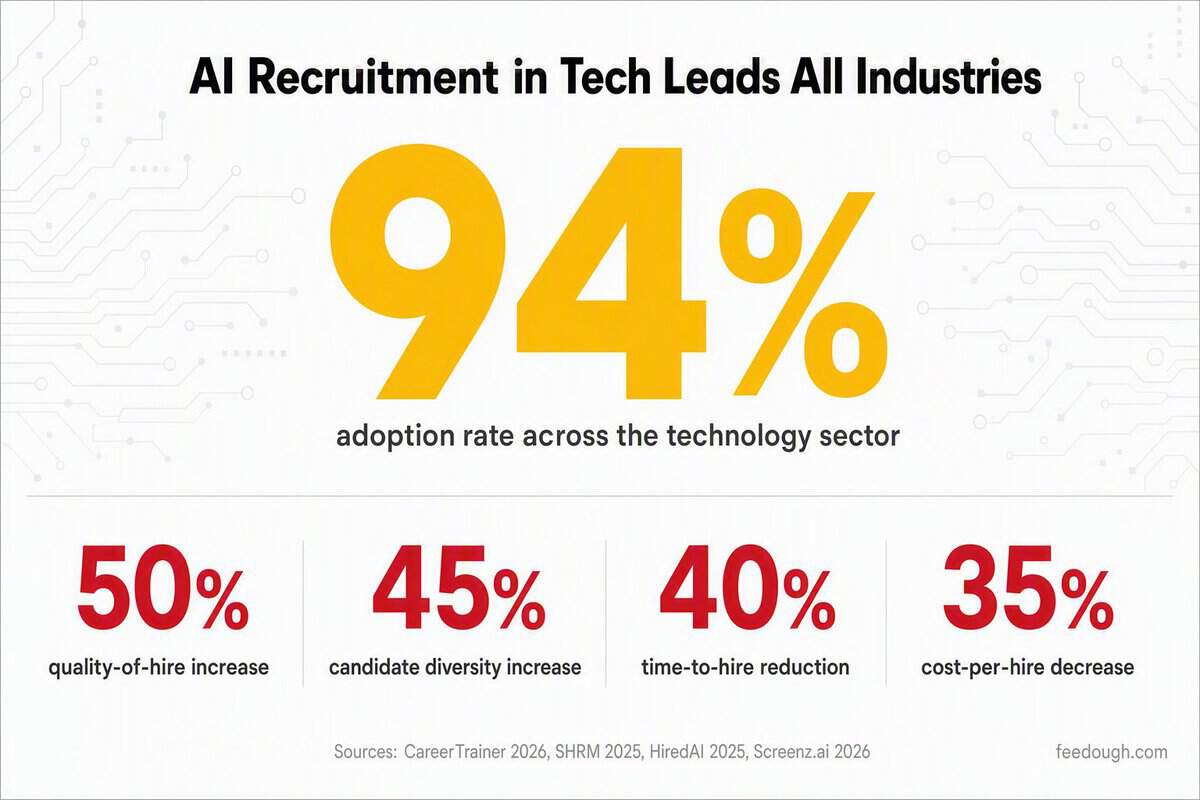
Technology leads every industry in AI recruitment adoption at 94%, according to CareerTrainer’s 2026 research. The gap is not just in deployment speed. It shows up in hiring outcomes no other sector has matched.
Organizations in the sector report a 50% improvement in quality-of-hire after deploying AI-powered tools, per SHRM’s 2025 benchmarking data. Retention gains are equally sharp: first-year turnover dropped from 23.7% to 12.1% in companies using predictive models.
Outcome Metric | Value | Source |
|---|---|---|
Quality-of-hire improvement | 50% | SHRM 2025 |
Candidate diversity increase | 45% | HiredAI 2025 |
Time-to-hire reduction | 40% | Screenz.ai 2026 |
Cost-per-hire decrease | 35% | Industry benchmark |
First-year turnover | 12.1% (from 23.7%) | Pin.com 2026 |
The strongest outcomes trace back to two structural shifts. Skills-based hiring, now at 78% adoption in the sector, is 5 times more predictive of job performance than education-based screening, per McKinsey. Predictive models improve performance predictions by 67% over traditional methods, according to Deloitte’s 2024 Human Capital Trends report. Organizations using predictive analytics report 41% better hiring outcomes and 38% lower regrettable turnover.
Retail and Hospitality AI Recruitment Statistics
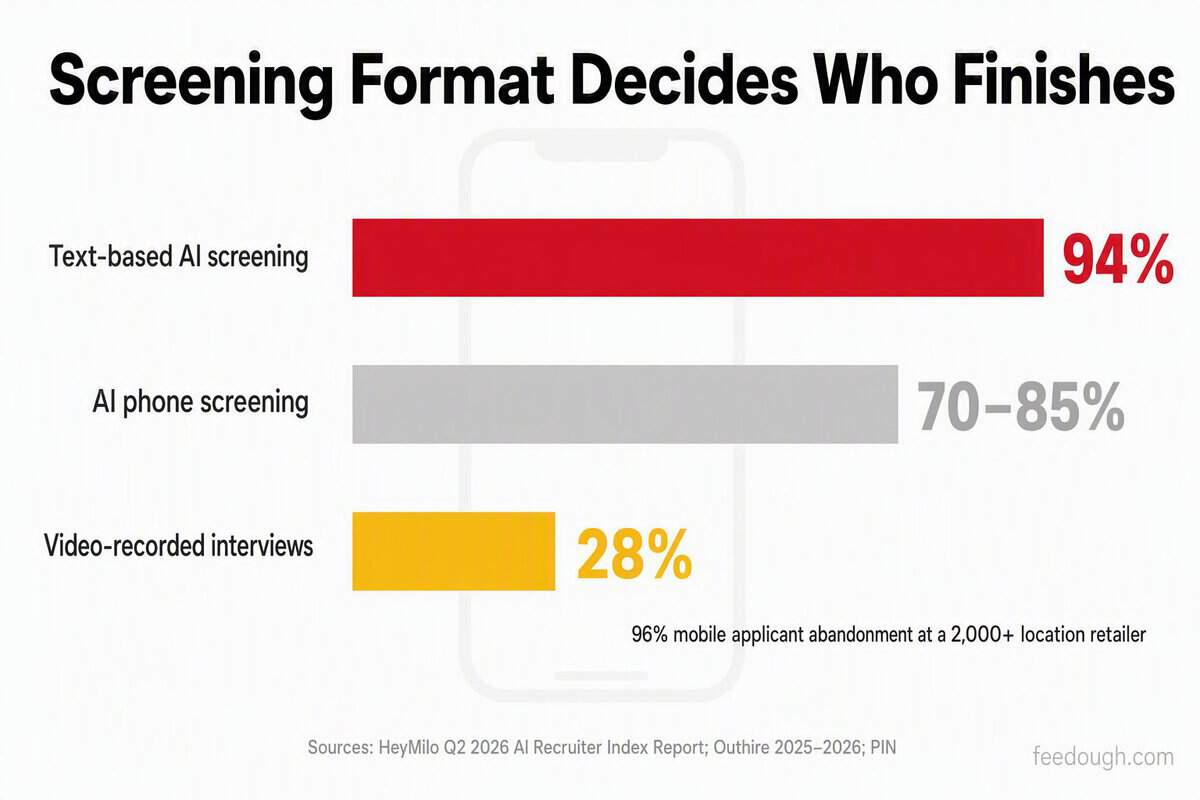
Retail and hospitality staffing runs on a boom-bust cycle where seasonal demand can triple labor needs overnight. AI recruitment tools deliver a 60% improvement in seasonal hiring efficiency. But at one national retail chain with over 2,000 locations, 96% of mobile applicants abandon the hiring process before completion.
Screening Format | Candidate Completion Rate | Key Constraint |
|---|---|---|
Text-based AI screening | 94% | Under 5 minutes; phone-native design |
AI phone screening | 70–85% | Under 15 minutes; natural voice quality critical |
Video-recorded interviews | 28% | Requires device, quiet space, and lighting |
- Marriott deployed Apply by Text through GoHire and saw a 562% increase in application completion, with 90% of candidates finishing all pre-screening questions
- Alto, a luxury rideshare company, raised candidate completion from 28% with video interviews to 54% with voice AI
- 64% of retail and hospitality organizations now use AI in recruiting, but only 20% have deployed it extensively, per First Advantage’s 2026 Global Workforce Trends Report
43% of hourly staff leave within 90 days, meaning every screening format choice compounds across the next hiring cycle almost immediately. McDonald’s McHire platform was breached in June 2025. Operated by Paradox.ai for roughly 90% of McDonald’s franchises, the breach exposed up to 64 million applicant records through default credentials. The automation that drives throughput at scale also concentrates risk at the same scale.
Healthcare AI Recruitment Statistics
Healthcare’s AI recruitment adoption jumped 16 percentage points in a single year. 75% of health systems now deploy at least one AI recruitment solution, up from 59% a year earlier, per Eliciting Insights’ February 2026 survey. Half of those systems run three or more AI applications. Multi-solution adoption grew 67% year-over-year.
Operational Metric | Improvement | Source |
|---|---|---|
AI-powered credentialing timeline | 120 to 30 days (75% reduction) | Censinet 2025 |
Credential verification speed | 40% faster | uRecruits 2026 |
Time-to-fill reduction | 40% | uRecruits 2026 |
Recruitment cost reduction | 25% | uRecruits 2026 |
Recruiter time saved per week | 19 hours | Bullhorn GRID 2025 |
ROI from deployed AI solutions | At least 2x | Eliciting Insights 2026 |
Case studies confirm the scale of the gains. Stanford Health Care’s AI chatbot handled 250,000 interactions in six months, generated more than 11,000 leads, and cut days to offer by 41. Connected Health Care saved roughly 200 hours per week on automated tasks, with placements growing over 35% month over month.
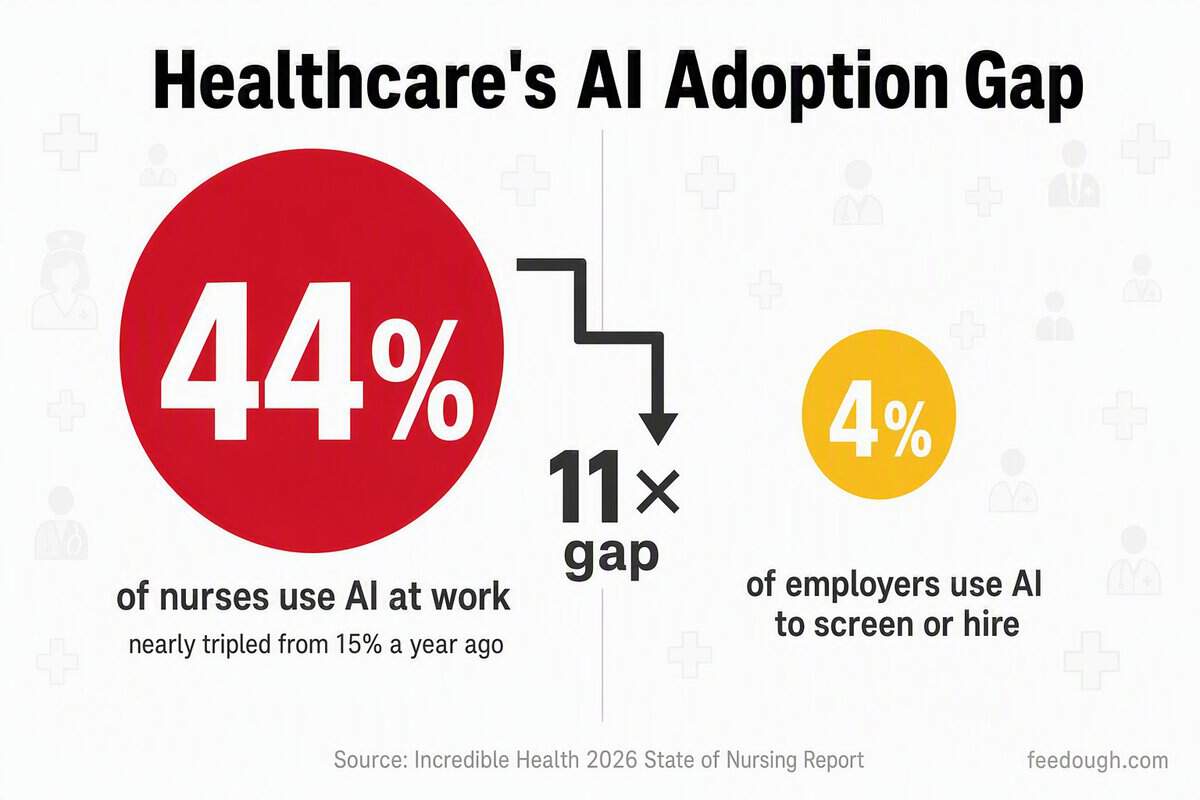
Staffing firms using AI at any recruitment stage are 3.5 to 4.5 times more likely to have grown revenue. Among healthcare providers, 75% rate their experience with recruitment AI as positive. But the workforce is ahead: 44% of nurses use AI at work, while only 4% of employers use AI to screen or hire them.
AI Recruitment Efficiency and Performance Metrics Statistics
The average recruiting team shrank from 31 members in 2022 to 24 in 2024. That 23% reduction coincided with each recruiter’s open requisitions jumping from 9 to 14. Annual application reviews per person climbed to over 2,500, nearly triple the prior load. On LinkedIn, applications surged 45% year-over-year, with roughly 11,000 submitted every minute.
Metric | 2021-2022 Baseline | Current (2025) | Change |
|---|---|---|---|
Time-to-fill | 33 days | 44 days | +33% |
Interviews per hire | 14 | 20 | +42% |
Applications per recruiter (annual) | ~900 | 2,500+ | 2.7x |
Open requisitions per recruiter | 9 | 14 | +56% |
Recruiting team size | 31 | 24 | −23% |
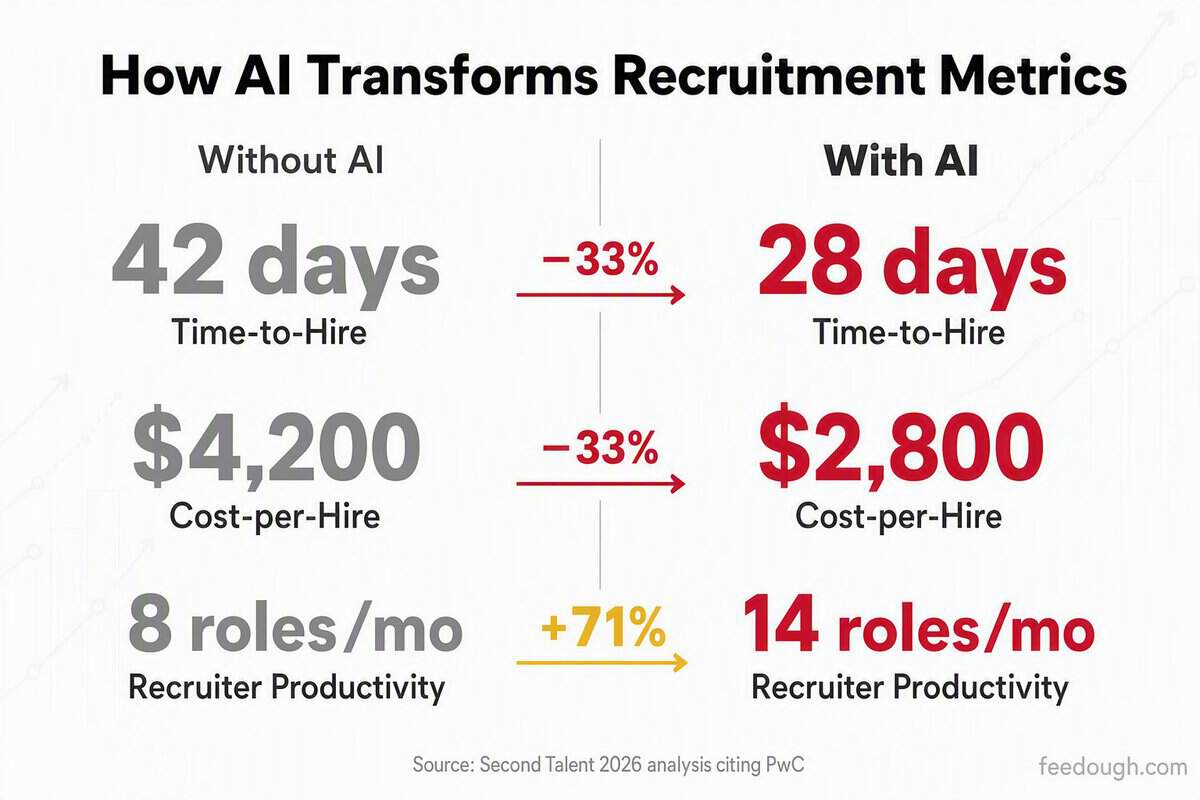
Organizations using AI tools report time-to-hire dropping from 42 to 28 days. Cost-per-hire fell from $4,200 to $2,800, and recruiter productivity rose from 8 to 14 roles per month, per Second Talent’s 2026 analysis citing PwC. Staffing firms with AI screening are 86% more likely to place candidates in under 20 days. They expect to recover 17 hours per recruiter each week.
How AI Improves Hiring Quality Statistics
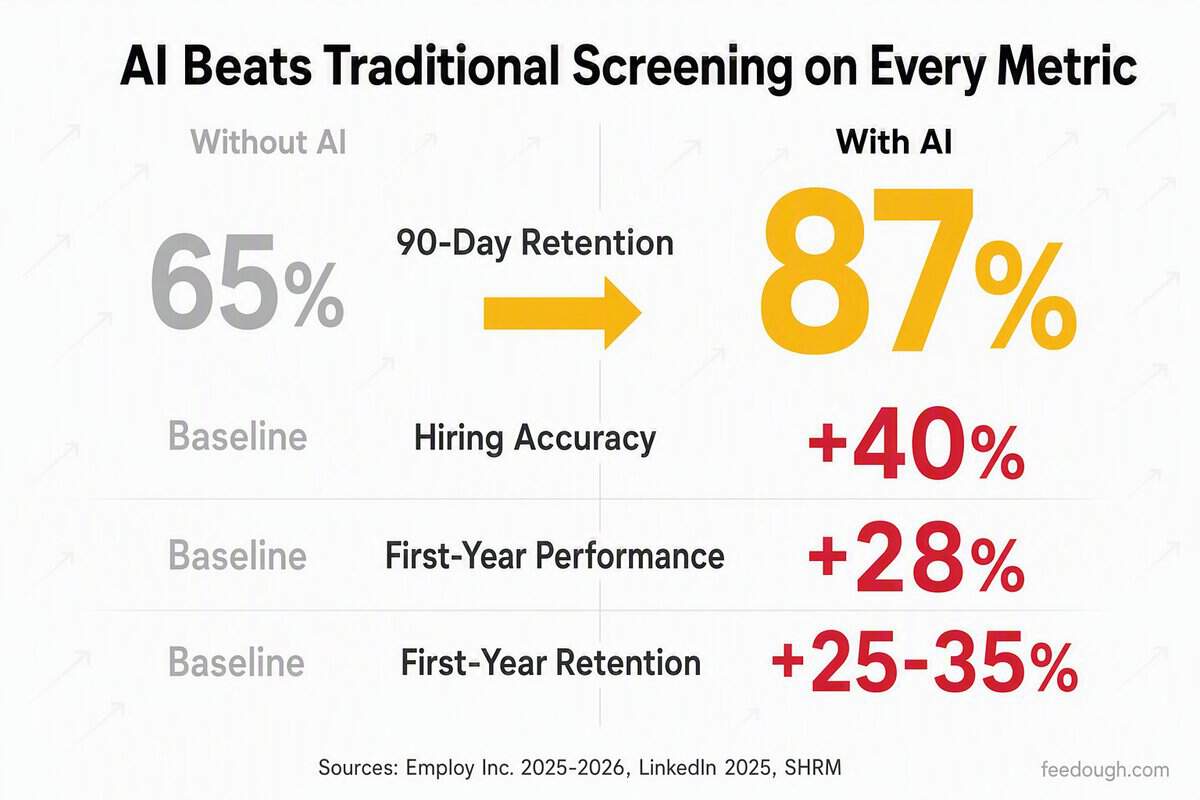
AI-screened candidates show 87% retention after 90 days. Traditional screening produces 65%. The 22-point gap is not a quirk of one measurement; it repeats across every hiring quality metric tracked.
Quality Metric | With AI | Without AI |
|---|---|---|
90-day retention rate | 87% | 65% |
Hiring accuracy | 40% improvement | Baseline |
First-year performance ratings | 28% higher | Baseline |
First-year retention | 25-35% higher | Baseline |
These outcomes trace back to predictive capabilities that manual screening cannot replicate at scale:
- AI-based skill matching predicts job performance with 78% accuracy (Second Talent, 2025)
- Structured AI-supported interviews show 24-30% higher assessment consistency compared to unstructured formats (Harvard Business Review, 2024)
- Predictive analytics models forecast retention likelihood with 83% accuracy, letting organizations identify at-risk hires before offers are extended (Second Talent, 2025)
AI Recruitment Bias, Fairness, and DEI Statistics
Identified bias patterns in algorithmic hiring surged 40% between 2024 and 2026. Compliance preparedness improved just 15% over the same window. Detection is outpacing the infrastructure meant to prevent the problems it finds.
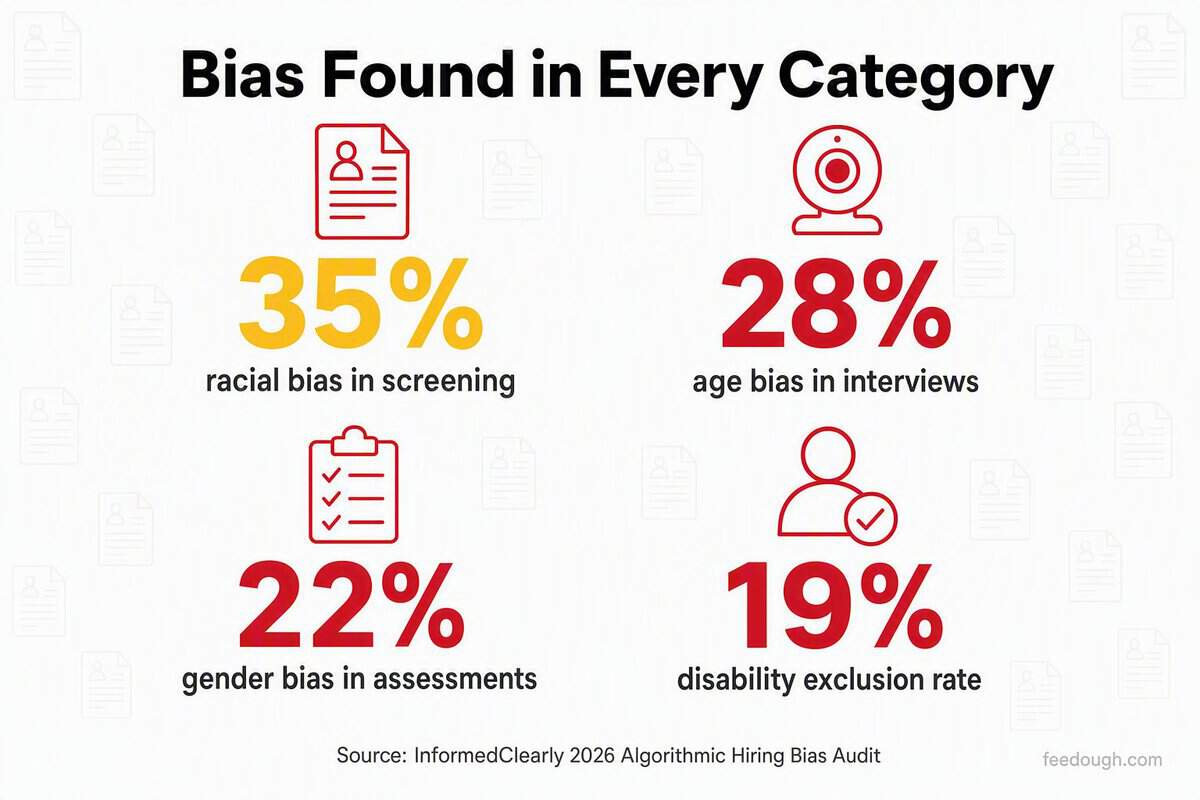
InformedClearly’s 2026 algorithmic hiring bias audit tested tools companies already have running in production. The bias patterns surface across every demographic category measured:
- Resume screening algorithms were 35% less likely to advance applications from candidates with names perceived as African American
- Video interview tools showed 28% bias against candidates over age 50
- Personality assessment algorithms carried 22% gender bias
- Resume screening systems excluded candidates with disabilities at a rate 19% higher than non-disabled applicants
McKinsey’s research shows that combining AI recruitment tools with structured human oversight produces 73% better fairness outcomes than AI alone. Companies proactively addressing algorithmic bias report 25% higher candidate satisfaction and 18% improvements in diversity metrics, per InformedClearly. But the institutional commitment to building those guardrails is contracting.
DEIB Metric | Value | Source |
|---|---|---|
HR teams prioritizing DEIB in next 12 months | 16% | Lattice 2026 |
Eliminated or planning to eliminate DEIB roles | 28% | Lattice 2026 |
Companies that planned to reduce DEIB programs | 1 in 8 | Resume.org / Lattice 2026 |
Cited political climate as key reason for cuts | 49% | Resume.org / Lattice 2026 |
Organizations treating DEIB as significant retention objective | 25% | Select Software Reviews 2026 |
Only 16% of HR teams plan to prioritize DEIB in the next 12 months. The shrinking infrastructure means fewer people reviewing audit findings, fewer processes for acting on them, and fewer consequences for ignoring them. Bias that goes unaddressed compounds across every subsequent hiring cycle.
AI Recruitment Candidate Experience Statistics
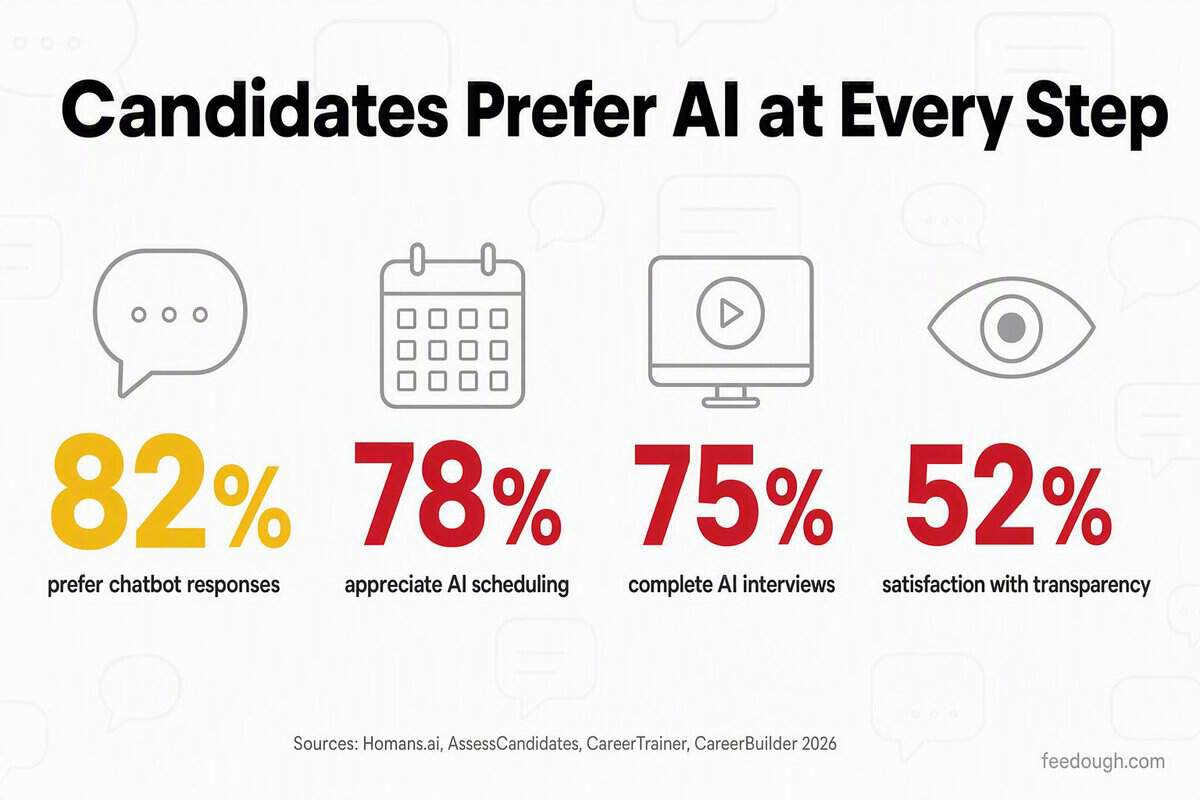
Candidates say they want human recruiters. Their behavior says otherwise. 82% of candidates prefer getting quick answers from chatbots over waiting for a human recruiter to respond, per Homans.ai’s 2026 analysis. The preference is not about replacing people. It is about eliminating the silence that makes candidates disengage.
AI Recruitment Touchpoint | Candidate Experience Metric | Impact |
|---|---|---|
Chatbots (early-stage) | Preference over waiting for human response | 82% |
Scheduling assistants | Appreciate elimination of back-and-forth | 78% |
AI interviews | Completion rate when invited | 75% |
AI interviews | Average satisfaction among completers | 4.5 out of 5 |
Transparent AI processes | Higher satisfaction vs. opaque automation | 52% |
The consistency across touchpoints is the finding. Organizations using recruitment chatbots report 41% higher candidate engagement and 34% faster application completion, per AssessCandidates’ 2026 data. L’Oréal’s AI chatbot drove a 600% increase in interview completions and a 35% jump in satisfaction scores. But the boundary is sharp: Gartner found that 25% of candidates trust employers less when they learn AI was involved in hiring. Candidate experience in AI recruitment splits along one line: whether the process is transparent and explained.
AI Recruitment Cost Savings and ROI Statistics
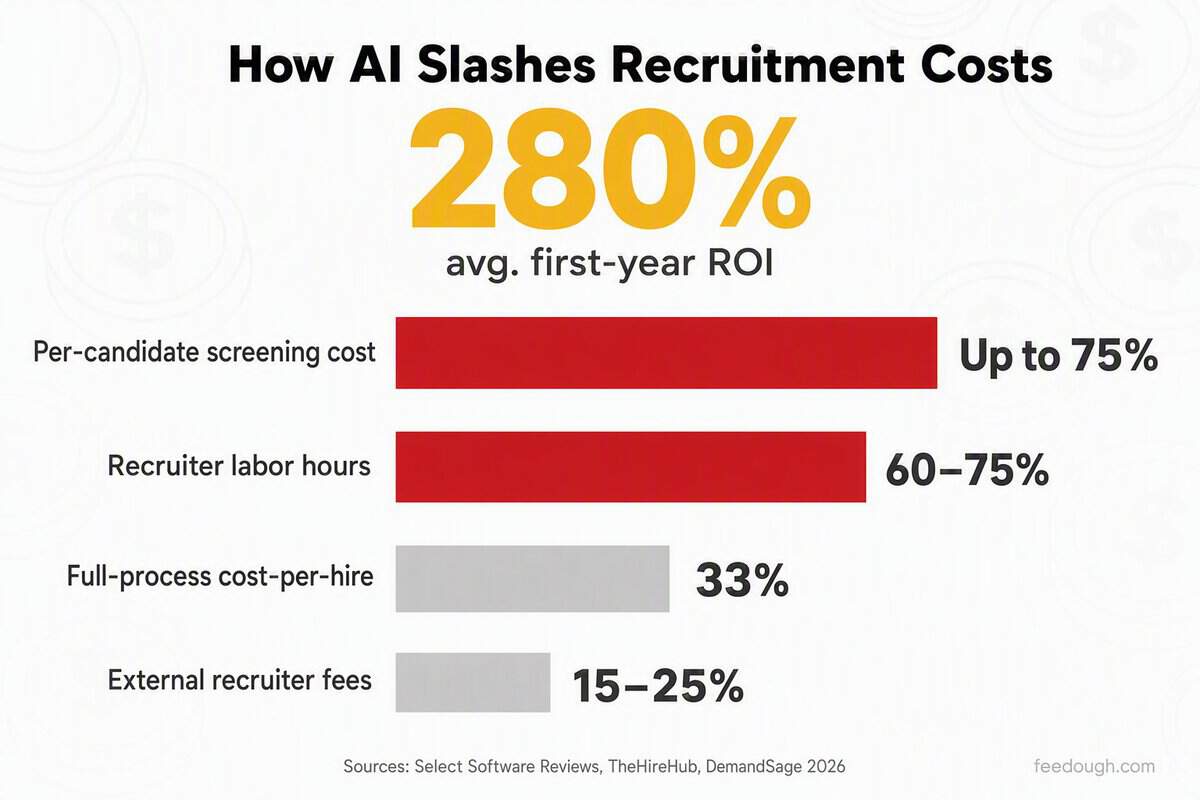
77.9% of companies using AI recruiting tools report measurable cost savings. High-volume hiring teams cut costs by 60% to 80% compared to fully manual processes, according to aggregated enterprise case study data from Select Software Reviews. The savings are not confined to one line item. They span screening, sourcing, scheduling, and turnover reduction at the same time.
Cost Category | AI Reduction | Primary Mechanism |
|---|---|---|
Per-candidate screening cost | Up to 75% lower | Automated resume review and initial filtering |
Recruiter labor hours per hire | 60–75% reduction | Direct labor savings of $2,400–$3,000 per hire |
External recruiter fees | 15–25% of salary saved per hire | AI-driven sourcing replaces outsourced search |
Full-process cost-per-hire | 33% average reduction | End-to-end AI deployment across recruiting workflow |
Manual recruiting costs between $3,375 and $4,500 per hire at a standard recruiter rate of $75 per hour, per TheHireHub’s 2026 analysis. AI cuts recruiter hours by 60% to 75%, translating into direct savings of $2,400 to $3,000 per hire. Across a 100-person hiring cycle, that gap alone approaches six figures before accounting for reduced turnover.
- 280% average first-year ROI for mid-market companies using AI recruitment tools, based on 3,000+ hiring projects across 35 countries (TheHireHub, 2026)
- 40% average HR cost reduction using AI in North America, compared to 30% in Europe and 20% in Asia-Pacific (DemandSage, 2026)
- 4% average increase in revenue per employee linked to AI-driven recruitment improvements (DemandSage, 2026)
Regional cost reductions track adoption maturity. North America’s 40% figure nearly doubles Asia-Pacific’s 20%, reflecting a multi-year head start in deployment density. Meanwhile, 89% of HR professionals say AI saves time or increases efficiency in recruitment, according to SHRM’s 2025 Talent Trends report. Only 36% specifically cite cost reduction, but in a function where labor is the dominant expense, time savings are cost savings.
AI Recruitment Implementation Challenges Statistics
75% of organizations implementing AI recruitment systems cite bias and fairness as their most severe obstacle. Only 61% resolve it successfully, and the process takes up to 18 months.
Challenge | % Affected | Severity | Resolution Time | Success Rate |
|---|---|---|---|---|
Bias and fairness | 75% | Critical | 8–18 months | 61% |
Regulatory compliance | 48% | Critical | 4–12 months | Not reported |
User adoption | 43% | Medium | 2–6 months | 84% |
- 47% of companies identify age bias in their AI hiring tools
- 44% cite socioeconomic bias in hiring algorithms
- 30% report gender bias in algorithmic outputs
- 19% say their automation tools screened out qualified applicants (SHRM)
The regulatory landscape is hardening. The EU AI Act classifies employment-related AI as high-risk, with non-compliant deployers facing fines up to EUR 15 million or 3% of global annual turnover. Full enforcement begins August 2, 2026. Colorado’s SB 24-205 takes effect even sooner, requiring bias audits for high-risk AI in employment decisions as of February 1, 2026.
User adoption resolves fastest at 84% success, but the bottleneck is not technology. Only 30% of HR professionals report receiving adequate training on AI tools. The gap explains why 70% of workers remain uncomfortable with AI making sensitive HR decisions without human oversight.

How AI Affects Recruiter Roles Statistics
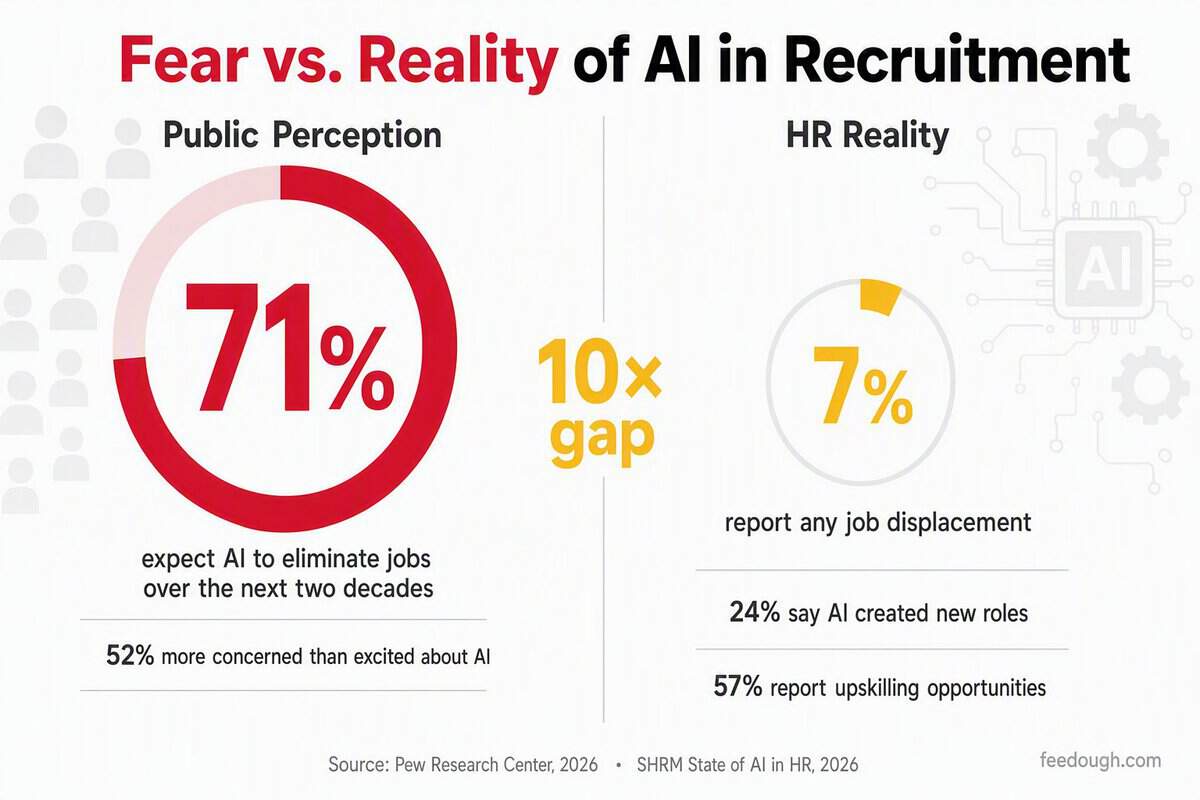
71% of Americans expect AI to eliminate jobs over the next two decades, up from 64% in 2024. Among HR professionals at companies using AI in recruitment, only 7% report any displacement at all. The gap between public fear and deployment reality has never been wider.
Recruiter Impact Metric | % of HR Professionals | Source |
|---|---|---|
Report frequent upskilling or reskilling opportunities | 57% | SHRM 2026 |
Say AI created new jobs or roles | 24% | SHRM 2026 |
Report any job displacement | 7% | SHRM 2026 |
SHRM’s 2026 State of AI in HR report quantifies the shift. New job creation is 3.5 times more likely than job loss among organizations using AI. Job responsibilities are 5.5 times more likely to change than be eliminated. Skills are more than 8 times as likely to be impacted as jobs are to be displaced. The technology is not removing recruiters. It is rewriting the requirements of the role underneath them.
Pew Research’s August 2026 survey found that 52% of Americans are more concerned than excited about AI in daily life, up from 37% in 2021. That concern is widespread but generic. The recruitment-specific data tells a narrower story: a profession being restructured around AI, not reduced by it.
Future of AI in Recruitment Statistics
Enterprise AI agent deployment quadrupled from 11% to 42% in six months, per KPMG’s Q3 2025 AI Pulse Survey. The AI recruitment market tracking that expansion will roughly double by the early 2030s. But the market forecast is the slower part of the story.
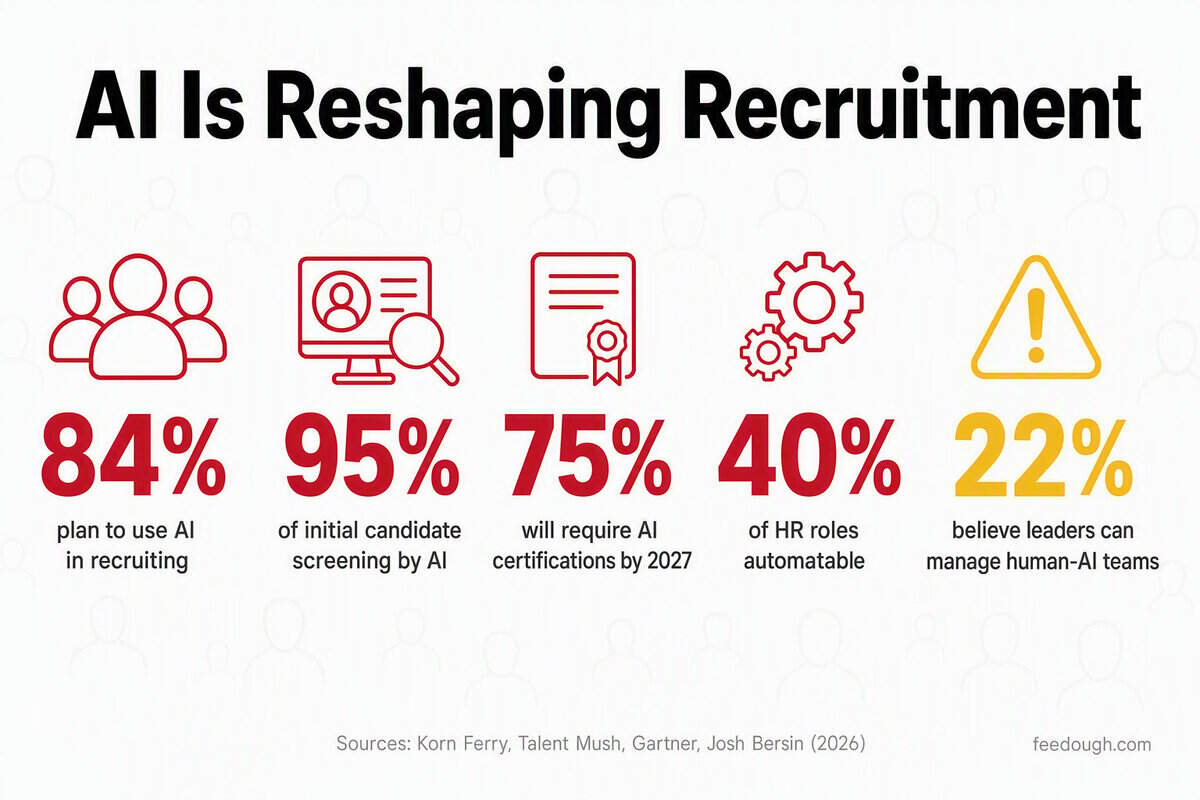
The structural shift inside recruitment processes is already further along than market sizing captures. Korn Ferry surveyed 1,674 talent leaders in 2026. 84% plan to use AI in recruiting this year, and 52% intend to add autonomous AI agents to their teams.
Source | Projected Market Value | Target Year | CAGR |
|---|---|---|---|
Mordor Intelligence | $920.91M | 2031 | 7.52% |
DataM Intelligence | $1,321.81M | 2035 | 6.70% |
Market Research Future | $1,377.10M | 2035 | 8.05% |
These projections measure spending. The operational transformation they undercount is already visible in near-term predictions:
- 95% of initial candidate screening is expected to be handled by AI, per Talent Mush data cited by BrainWorks
- 30–40% of existing HR roles are automatable with relatively low effort, with 100–200% improvement in work quality when teams re-engineer around AI agents (Josh Bersin, April 2026)
- 75% of hiring processes will include AI proficiency certifications by 2027, meaning candidates must demonstrate fluency with the tools evaluating them (Gartner)
- The World Economic Forum projects that two-thirds of employers will hire AI-skilled talent by 2030, while 40% expect to reduce headcount where AI automates tasks
Only 22% of organizations believe their leaders can effectively manage mixed human-AI teams, according to Korn Ferry. The deployment timeline does not wait for readiness. By 2028, Gartner projects one in ten hiring managers will work with an AI avatar recruiter capable of conducting interviews. That number sits near zero today.
Universal AI Recruitment Adoption Statistics
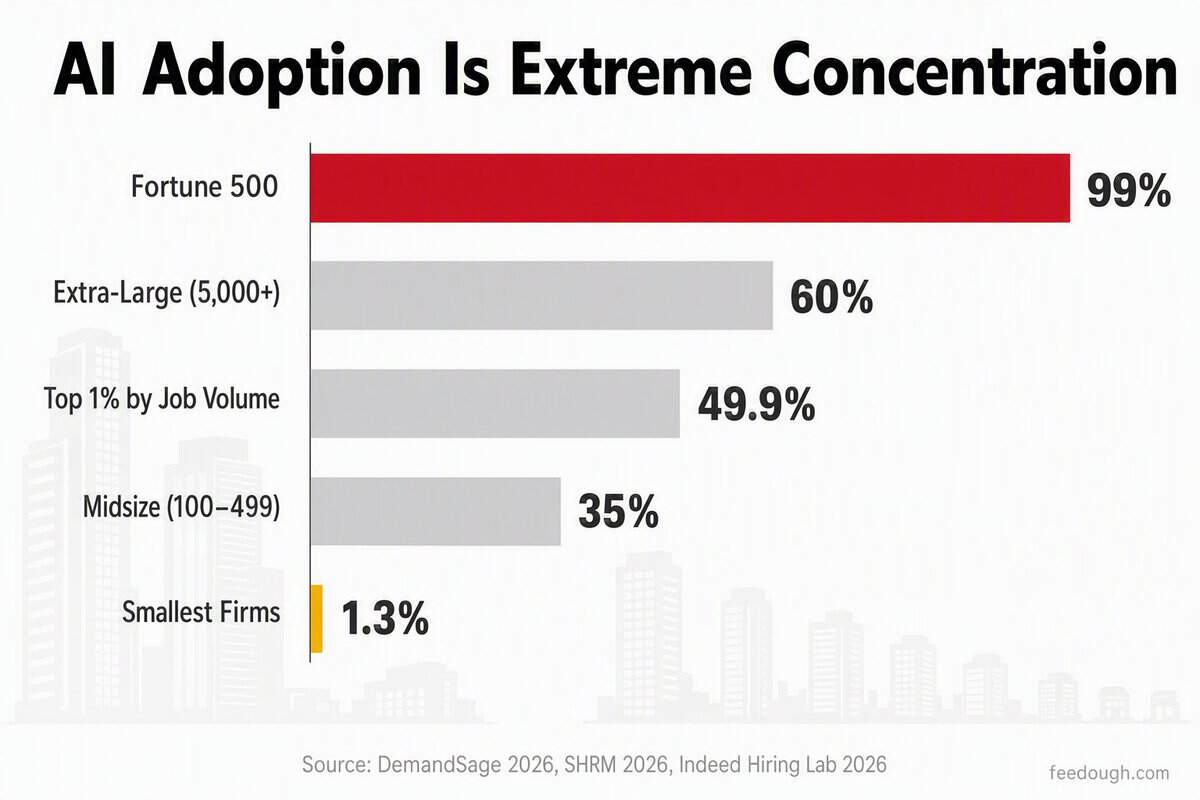
90% of all AI-related job postings come from just 1% of companies. Only 5.7% of US firms had posted a single AI-related role by November 2025, per Indeed Hiring Lab’s January 2026 analysis. The universal adoption narrative does not match these numbers. What exists is extreme concentration among the largest employers.
Company Category | AI Adoption Rate | Source |
|---|---|---|
Fortune 500 companies | 99% | DemandSage 2026 |
Extra-large (5,000+ employees) | 60% | SHRM 2026 |
Top 1% by job posting volume | 49.9% | Indeed Hiring Lab 2026 |
Midsize (100–499 employees) | 35% | SHRM 2026 |
Smallest firms by job posting volume | 1.3% | Indeed Hiring Lab 2026 |
Gallup’s Q2 2026 survey found that 47% of US employees now say their organization has integrated AI tools, up from 41% in Q1. That six-point jump is the sharpest quarterly increase Gallup has recorded.
SHRM’s 2026 research captures the paradox: 88% of HR leaders say their teams have not seen significant business value from AI tools. Yet 62% of companies predict AI will run their entire hiring process by year-end, and 74% plan to increase AI hiring spending anyway.
AI Recruitment Capability Expansion Statistics
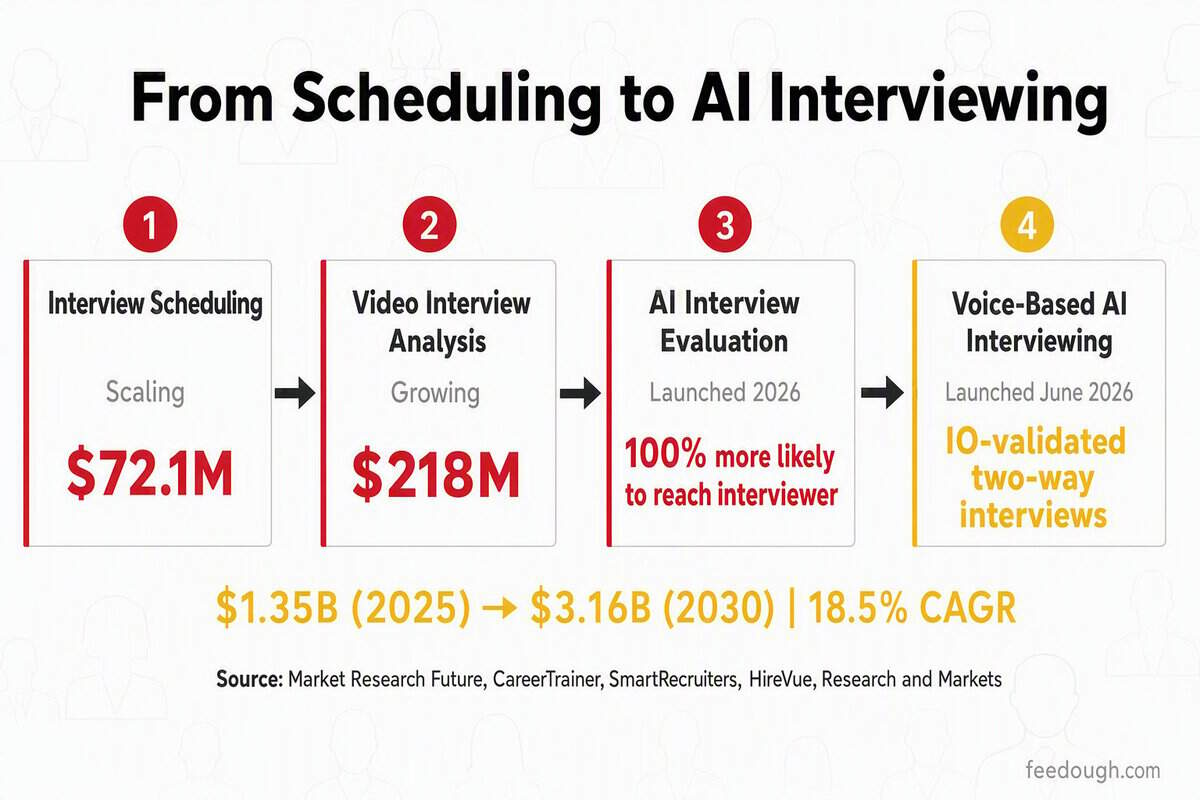
The AI in talent acquisition market is growing from $1.35 billion in 2025 to a projected $3.16 billion by 2030. That 18.5% compound annual growth rate tracks a shift that already happened. Recruitment AI moved past resume screening into live interview evaluation, and the first production tools shipped in 2026.
Capability | Deployment Stage | Key Metric | Source |
|---|---|---|---|
Interview scheduling | Scaling | $72.1M market segment in 2025 | Market Research Future |
Video interview analysis | Growing | $218M AI video interviewing market in 2024 | CareerTrainer |
AI interview evaluation | Launched 2026 | Winston AI candidates 100% more likely to reach interviewer | SmartRecruiters |
Voice-based AI interviewing | Launched June 2026 | HireVue dynamic, IO-validated two-way interviews | HireVue |
HireVue now serves more than 1,150 customers including over 60% of the Fortune 100. It has completed 180 million assessments and 80 million video interviews. SmartRecruiters was named a 2025 Gartner Magic Quadrant Leader for Talent Acquisition Suites, serving 4,000-plus customers across 120-plus countries.
Winston AI is embedded across matching, screening, engagement, and interviewing. Both vendors shipped features in 2026 that most industry roadmaps placed in 2028. Analysts project full interview cycle automation within three years. The pace of these launches suggests that timeline may be conservative.
Sources
- https://www.mordorintelligence.com/industry-reports/ai-recruitment-market
- https://www.pin.com/blog/ai-adoption-recruiting-report (2026-01-01)
- https://sqmagazine.co.uk/ai-recruitment-statistics
- https://copilot.recruitaisuite.com/blog/ai-recruiting-statistics-2026 (2026)
- https://www.pin.com/blog/ai-recruiting-adoption-by-company-size (2026-06-23)
- https://taleva.io/blog/ai-recruiting-statistics-2026 (2025)
- https://www.hiretruffle.com/blog/best-ai-recruitment-statistics (2026)
- https://adai.news/resources/statistics/recruitment-ai-statistics-2026 (2026-03-01)
- https://careertrainer.ai/en/reports/ai-in-recruitment-statistics (2026-04-26)
- https://www.thehirehub.ai/blog/candidate-experience-ai-hiring (2026-08-18)
- https://detectiondrama.com/ai-detection-in-hiring-statistics (2025-11-19)
- https://negio.app/blog/find-a-new-job-2026-ai-job-search-trends (2026)
- https://www.lever.co/blog/7-job-seeker-statistics-every-recruiter-should-know-about-in-2026 (2026)
- https://www.datarefs.com/statistics/ai/ai-recruitment (2026-01-17)
- https://goodtime.io/blog/talent-operations/hiring-statistics (2026-02-02)
- https://incruiter.com/blog/ai-in-recruitment-2026-trends-stats-what-works (2026)
- https://sparkeighteen.com/blog/the-ai-agents-making-it-to-production-12-agentic-ai-case-studies-with-measurable-roi-from-2025-2026 (2025)
- https://www.codebridge.tech/articles/10-real-world-ai-in-hr-case-studies-problems-solutions-and-measurable-results (2026-02-27)
- https://homans.ai/blog/how-ai-is-revolutionizing-recruitment-in-2025 (2026)
- https://www.herohunt.ai/blog/fastest-growing-ai-roles-in-2026-data-and-rankings (2026-01-01)
- https://www.marketresearchfuture.com/reports/ai-recruitment-market-8289 (2025-01-01)
- https://hiredaiapp.com/skills-based-hiring-2025-statistics-trends-ai-recruiting-software (2025)
- https://www.pin.com/blog/talent-intelligence-platforms (2025)
- https://fadv.com/article/5-workforce-trends-reshaping-retail-and-hospitality-in-2026 (2026-04-02)
- https://outhire.ai/blog/ai-phone-screening-complete-guide (2026-01-01)
- https://rmaindia.org/case-study-mcdonalds-mchire-ai-hiring-breach-123456-and-64-million-applicant-records (2025-12-18)
- https://www.fountain.com/posts/how-to-use-ai-for-hourly-hiring (2026-04-21)
- https://www.pin.com/blog/retail-hospitality-hiring (2026-01-01)
- https://www.zappyhire.com/blog/top-retail-recruiting-strategies (2026-06-03)
- https://gohire.com/recruiting-ai (2026-01-01)
- https://www.heymilo.ai/resources/ai-recruiter-index-report (2026-07-01)
- https://www.bullhorn.com/blog/applicant-tracking-system-usage-report (2026)
- https://www.bullhorn.com/blog/ai-in-healthcare-staffing-real-results-real-roi (2025-12-11)
- https://www.bullhorn.com/blog/best-healthcare-staffing-software (2026)
- https://www.fiercehealthcare.com/ai-and-machine-learning/75-us-healthcare-systems-use-plan-use-ai-platform-2026 (2026-03-24)
- https://ravehealth.com/blog/2026-healthcare-recruiting-trends (2025)
- https://www.incrediblehealth.com/wp-content/uploads/2026/07/Incredible-Health-2026-State-of-Nursing-Report.pdf (2026-07-01)
- https://censinet.com/perspectives/ai-agents-provider-credentialing-improvements (2025-12-13)
- https://www.shrm.org/topics-tools/research/2025-recruiting-benchmarking (2025-10-15)
- https://www.hiretruffle.com/blog/cost-per-hire (2026-02-01)
- https://www.gem.com/blog/10-takeaways-from-the-2025-recruiting-benchmarks-report (2025)
- https://www.linkedin.com/business/talent/blog/talent-acquisition/future-of-recruiting-2025 (2025)
- https://www.bullhorn.com/grid/2025-industry-trends/ (2025)
- https://www.secondtalent.com/resources/ai-in-recruitment-statistics (2026)
- https://www.pin.com/blog/state-of-talent-acquisition-2026 (2026-05-09)
- https://informedclearly.com/en/ai/41231/algorithmic-hiring-bias-audit-findings-policy-2026 (2026)
- https://lattice.com/articles/how-to-keep-deib-a-priority (2026-01-08)
- https://www.thehirehub.ai/blog/ai-bias-free-hiring (2026-04-08)
- https://www.selectsoftwarereviews.com/blog/recruiting-statistics (2026)
- https://www.aboutchromebooks.com/ai-algorithm-bias-detection-rates-by-demographic (2025)
- https://employerbranding.news/resources/ai-in-hiring-statistics-2026-adoption-bias-trust-and-regulation (2026)
- https://stealthagents.com/research/ai-in-recruiting-and-hiring-statistics-2026 (2026-05-22)
- https://www.demandsage.com/ai-recruitment-statistics (2026-04-20)
- https://www.thehirehub.ai/blog/ai-recruitment-roi-calculator-guide (2026)
- https://www.adaptivesecurity.com/blog/ai-compliance-management-the-complete-guide-6afe7 (2025-10-01)
- https://www.herohunt.ai/blog/ai-adoption-in-recruiting-2025-year-in-review (2025-11-16)
- https://www.pewresearch.org/short-reads/2026/08/18/young-adults-in-the-us-are-increasingly-wary-of-ai-concerned-it-will-take-jobs (2026-08-18)
- https://www.shrm.org/executive-network/insights/real-impact-of-ai-hr-march-2026-en-insights-forum-recap (2026-03-30)
- https://www.datamintelligence.com/research-report/ai-recruitment-market (2026-07-03)
- https://brainworksinc.com/the-state-of-the-recruiting-industry (2026)
- https://www.pin.com/blog/future-of-recruiting-ai (2026-05-09)
- https://www.gallup.com/workplace/712736/organizational-adoption-jumps-six-points.aspx (2026-05-06)
- https://www.herohunt.ai/blog/best-ai-recruiting-tools-2026-15-ranked-and-priced (2026-04-07)
- https://www.squarelogik.com/blogs/how-ai-is-changing-recruitment-agencies (2025)
- https://www.pin.com/blog/smartrecruiters-pricing (2025)