
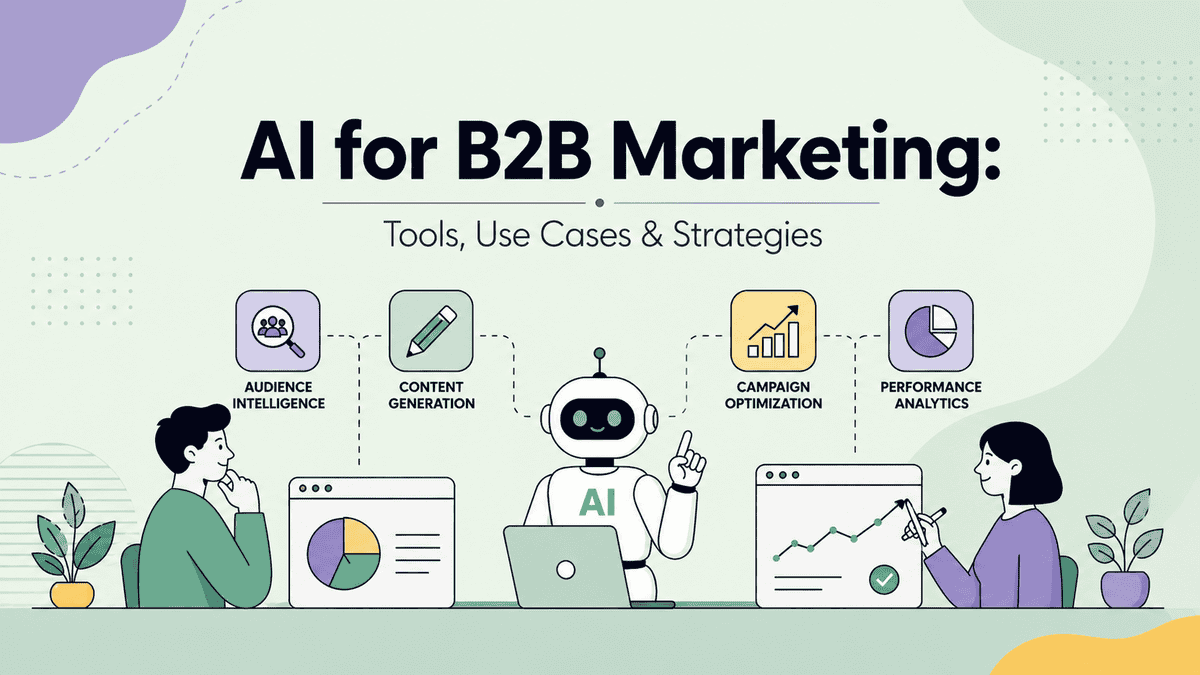
B2B marketing has never been easy. Long sales cycles, multiple stakeholders, complex buying journeys and the constant pressure to prove ROI make it one of the hardest areas to crack.
But here’s what’s changed: AI is now doing a lot of the heavy lifting that used to eat up your team’s time. From scoring leads and personalising outreach to writing content and optimising ad spend, AI tools are helping B2B teams work faster and smarter than ever before.
In fact, a 2026 survey by Demand Gen Report found that 96% of B2B marketers are already using AI in some capacity. That’s not a trend, that’s the new baseline.
In this guide, we’ll break down what AI for B2B marketing actually means, how it’s being used, the best tools available right now and practical strategies to get started. Let’s get into it.
What Is AI for B2B Marketing?
AI for B2B marketing is the use of artificial intelligence to automate, improve and scale marketing activities between businesses. You can analyse heaps of data, personalise outreach, score leads and optimise campaigns, all without you having to do the heavy lifting manually.
In simple terms, instead of your team spending hours figuring out which leads are worth pursuing or writing dozens of email variations for different segments, AI does it for you. It looks at patterns in your data, predicts what’s likely to work and takes action based on those predictions.
For example, an AI tool can track how a prospect interacts with your website, score them based on buying intent and automatically trigger a personalised follow-up email, all in real time.
How AI Is Changing B2B Marketing
B2B marketing has traditionally been slower and more complex than B2C. Longer sales cycles, multiple decision-makers and data-driven buying processes make it a tough game.
AI is changing that by making B2B marketing faster, more precise and far less manual. Here’s how:
- Smarter lead qualification: AI analyses behavioural data, engagement history and firmographics to identify which leads are actually worth your sales team’s time. No more guessing.
- Hyper-personalisation at scale: Instead of sending the same generic email to 5,000 contacts, AI lets you tailor messaging for specific industries, job roles and even individual accounts, without writing each one from scratch.
- Predictive analytics: AI can forecast which accounts are most likely to convert, which campaigns will perform best and where your budget will have the most impact. It’s like having a crystal ball backed by data.
- Faster content production: From blog outlines and social posts to ad copy and email sequences, AI tools can draft content in minutes. According to HubSpot’s 2026 State of Marketing report, over 42% of marketers are now extensively using AI for content creation.
- Real-time campaign optimisation: AI monitors campaign performance and makes adjustments on the fly. It can test dozens of subject lines, shift ad budgets to better-performing channels and flag campaigns that are about to underperform.
- Sales and marketing alignment: AI-powered CRMs bridge the gap between sales and marketing by giving both teams a shared view of lead behaviour, intent signals and pipeline data.
Top Use Cases of AI in B2B Marketing
AI isn’t just a buzzword in B2B; it’s being used in very specific, practical ways across the marketing funnel. Let’s look at the most impactful use cases.
1. Predictive Lead Scoring
This is probably the most popular use case right now. AI looks at historical data, behavioural signals (like page visits, content downloads and email engagement) and market trends to rank leads based on how likely they are to convert.
This means your sales team isn’t wasting time chasing cold leads. They focus on the ones that actually matter.
Tools like HubSpot Breeze and 6sense are widely used for this.
2. Data Enrichment and Prospecting
Before you can sell to someone, you need to know who they are. AI tools can enrich your contact data with firmographic details, job titles, company size and even technographic information. This kind of data enrichment makes outbound campaigns far more targeted and saves your team hours of manual research.
For example, let’s say you want to run an outbound campaign targeting AI companies. You can use tools like Cognism or Apollo to find verified contacts and build prospect lists. For finding specific email patterns, you can use the OpenAI email format or the email structure of any company you’re prospecting into.
Pair that with Clay for enriching those contacts with funding data, tech stack info and LinkedIn activity, and you’ve got a highly targeted list ready for outreach without a single Google search.
3. Content Creation and Repurposing
B2B content marketing is demanding. You need blogs, whitepapers, case studies, social posts and email sequences, often for multiple personas. AI tools like Jasper and Copy.ai can generate drafts quickly, while also helping you repurpose existing content.
For example, you can feed a 45-minute webinar transcript into an AI tool and get back a blog post, a LinkedIn carousel, five social posts and an email newsletter, all derived from the same core content.
4. Account-Based Marketing (ABM)
ABM is all about targeting specific high-value accounts with personalised campaigns. AI makes this much more practical by:
- Identifying which accounts show buying intent based on online behaviour
- Personalising website content, ads and emails for each target account
- Coordinating outreach across multiple channels simultaneously
Platforms like Demandbase use AI-powered account identification and predictive analytics to help marketing and sales teams align their strategies around the accounts that matter most.
5. Email Marketing Optimisation
AI takes B2B email marketing beyond basic automation. It continuously tests subject lines and preview text, triggers messages based on real behaviour (not just schedules), adjusts outreach at the account level based on engagement and even holds back messages when signals suggest a prospect isn’t ready yet.
The result? Fewer, more targeted emails with better timing and higher response rates.
6. Chatbots and Conversational Marketing
AI-powered chatbots are no longer just for answering FAQs. In B2B, they now qualify leads, book meetings, guide prospects through the funnel and provide real-time support. Among B2B marketers who use chatbots, 26% have reported a 10-20% increase in lead generation. Tools like Drift and Intercom are leading this space.
Best AI Tools for B2B Marketing
The market is flooded with AI marketing tools, but not all of them deliver real value. Here’s a curated list of tools that are actually making a difference for B2B teams:
Tool | Category | Best For |
|---|---|---|
HubSpot (Breeze AI) | CRM & Marketing Automation | All-in-one marketing, lead nurturing and campaign automation |
Jasper | Content Creation | Generating blog posts, emails and ad copy at scale with brand voice |
Demandbase | Account-Based Marketing | AI-powered account identification, intent data and ABM campaigns |
6sense | Predictive Analytics & Intent | Identifying in-market accounts and predicting buyer intent |
Cognism | Sales Intelligence & Data | Verified B2B contact data and prospecting |
Drift | Conversational Marketing | AI chatbots for lead qualification and real-time engagement |
Zapier | Workflow Automation | Connecting 5,000+ apps and automating repetitive marketing tasks |
Surfer SEO | SEO Optimisation | Data-driven content optimisation for search rankings |
Clay | Data Enrichment | Enriching lead data from 50+ sources for personalised outreach |
Copy.ai | Content & Sales Copy | Generating sales emails, landing pages and marketing copy |
How to Use AI for B2B Marketing: Practical Strategies
Having AI tools is one thing. Actually using them to drive results is another. Here are strategies that work, with real examples.
Start with One Clear Pain Point
Don’t try to “AI everything” at once. Pick the area where your team spends the most time or gets the least results.
For example, if your SDRs spend three hours a day researching prospects, set up an AI enrichment tool like Clay to pull firmographic data, recent funding rounds and LinkedIn activity automatically. That alone can free up 15+ hours per week across a small team.
Build an AI-Powered Content Repurposing Pipeline
Most B2B companies massively underutilise their best content. Here’s a practical workflow:
- Record a podcast or webinar (your founder or subject matter expert shares insights)
- Use an AI transcription tool to create a structured transcript
- Feed the transcript into Jasper or ChatGPT to extract key insights
- Generate a blog post, 5 LinkedIn posts, an email newsletter and a few social snippets from the same source material
One piece of content becomes ten. That’s how lean teams compete with companies that have entire content departments.
Use AI for Personalised ABM Campaigns
Let’s say you’re targeting 50 mid-market SaaS companies. Instead of sending them all the same case study, use AI to personalise the approach. Pull intent data from 6sense to see which of those 50 accounts are actively researching solutions like yours. Then use Jasper to create tailored landing pages and email sequences for each segment.
For example, a prospect in fintech gets a case study about a fintech client, while a prospect in healthcare sees healthcare-specific messaging. This level of personalisation used to take weeks. With AI, it takes hours.
Automate Lead Scoring and Routing
Set up AI-powered lead scoring in your CRM (HubSpot’s Breeze AI does this well). When a prospect visits your pricing page, downloads a case study and opens three emails in a week, the AI flags them as high-intent and automatically routes them to a sales rep, complete with context on what they’ve been looking at. No manual handoff. No leads falling through the cracks.
Optimise Ad Spend with AI
Instead of manually adjusting Google or LinkedIn ad campaigns, let AI tools analyse performance data and reallocate budget in real time. If a particular ad creative is performing well with a specific audience segment, AI doubles down on it. If another one is underperforming, it pulls the budget. This kind of real-time optimisation can significantly improve your cost per lead.
Challenges of Using AI in B2B Marketing
AI is powerful, but it’s not a magic bullet. There are real challenges you should be aware of before going all in.
- Data quality issues: AI is only as good as the data you feed it. If your CRM is full of outdated contacts, duplicate records or incomplete information, your AI tools will make bad predictions.
- Integration headaches: Most B2B teams use five to ten different marketing tools. Getting AI to work across all of them can be complex and time-consuming. Only 29% of enterprise applications are actually integrated with each other.
- The “generic content” trap: AI-generated content can sound the same as everyone else’s. When every competitor is using the same tools to write the same types of blog posts and LinkedIn outreach, nothing stands out. The fix? Use AI for the first draft and structure, but add your own expertise, opinions and data to make it unique.
- Adoption gaps: Even though 96% of B2B marketers report using AI, only 19% have fully integrated it into their daily workflows. Many teams still take an ad hoc approach, using AI here and there without a clear strategy. This fragmented usage limits the value AI can deliver.
- Privacy and compliance risks: AI tools often process large amounts of customer data. You need to ensure compliance with regulations like GDPR and establish clear policies around data usage. Without proper governance, you risk eroding customer trust.
- Over-reliance on automation: AI can automate outreach, but B2B deals are still built on relationships. Automated LinkedIn messages have seen reply rates drop to 5-15% in 2026. When prospects feel like they’re talking to a bot, trust goes down. The best approach is to use AI for the research and prep work, while keeping the actual conversations human.
Bottom Line
AI for B2B marketing isn’t about replacing your team. It’s about making them faster, smarter and more effective. The companies seeing real results aren’t the ones with the fanciest tools. They’re the ones that have identified where AI adds the most value, implemented it strategically and kept the human element where it matters most.
Start small. Pick one use case, whether that’s lead scoring, content creation or email personalisation. Get it working well, measure the results and then expand from there. That’s how you turn AI from a buzzword into a genuine competitive advantage.