
Let’s talk about the use of cause marketing so well that a ‘profitable’ business model is built around it.
Intrigued?
Imagine a company that makes millions by giving away their products for free. Yes, the Toms Shoes Business Model, with its roots in social entrepreneurship and cause marketing, has helped Toms show the world that it is possible to make a profit even while doing good for society.
What Is Toms Shoes?

TOMS Shoes is a for-profit retail company that sells shoes and eyewear across more than 30 countries. Blake Mycoskie founded it in 2006 in Venice Beach, California. He got the idea after visiting Argentina, where he saw children going without shoes and joined a local shoe drive.
The experience inspired a simple idea: you buy a pair, TOMS donates a pair. The Toms Shoes Business Model became the brand’s identity for over a decade. At its peak, TOMS had given away close to 100 million pairs of shoes.
But the model couldn’t sustain the company financially. In late 2019, a creditor group took over the company. The group included Jefferies Financial Group, Nexus Capital Management, and Brookfield Asset Management. They exchanged debt relief on roughly $300 million in loans for control. Mycoskie and Bain Capital stepped aside.
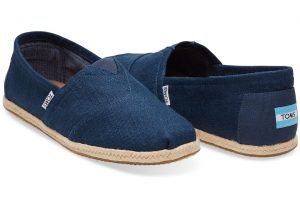
Today, TOMS still sells its signature Alpargata shoes alongside eyewear. The company is a Certified B Corporation. The TOMS charity model has shifted too. Instead of one-for-one, TOMS now donates one-third of net profits to grassroots organizations. The TOMS donation scheme comes through cash grants, product donations, and partnerships focused on children’s education, health, and well-being.
So how does TOMS actually make this work as a business?
How Does Toms Shoes Work | One-for-One Business Model
TOMS built its brand on the One-for-One model: buy a pair, give a pair. It was simple, memorable, and made TOMS a household name. But the Toms Shoes Business Model couldn’t sustain the company financially. Since 2019, TOMS donates one-third of net profits to grassroots organizations focused on children’s education, health, and well-being.
The problem with one-for-one was its fixed cost structure. Every pair sold triggered a donation expense, whether TOMS profited on that sale or not. Under the new TOMS charity model, giving scales with profitability. When the company earns more, it gives more.
How the Giving Works Now
TOMS channels its giving through cash grants, product donations, and long-term partnerships with grassroots organizations. In 2024, the company supported 32 giving partners across seven countries. As a Certified B Corporation, TOMS has third-party verification of its social and environmental practices.
Since founding, TOMS has given more than $200 million in shoe donations and monetary grants. That giving has reached over 105 million lives.
How TOMS Reaches You
You can buy TOMS through its brick-and-mortar retail stores, its website, and third-party e-commerce platforms. TOMS also runs an affiliate program that lets online businesses partner with the brand. Affiliates promote products through promotional links and offers while earning revenue for themselves.
If you care about where your money goes, TOMS still offers something rare: a purchase visibly tied to a social cause. For brand-conscious consumers, that signal matters, even though the mechanism behind it has changed.
Toms’ Marketing Strategy
The Toms charity model was, at its core, a cause marketing masterstroke. Every pair you bought came with a story you could share. Research from Wharton professor Deborah Small shows that people are most motivated when they feel connected to the people they help. A pair of shoes for a specific child made that connection tangible.
This emotional pull translated into massive word-of-mouth and earned media. Campaigns around donation drives gave TOMS a constant stream of shareable content without paying for ads. Adidas spent around $3.5 billion on marketing in 2018. TOMS leaned on its cause-driven narrative instead, generating free press at a fraction of the cost.
But the Toms Shoes Business Model carried a financial flaw. The fixed per-unit donation cost stayed the same even as revenue dropped. Once growth plateaued and debt mounted after the Bain Capital deal, that structure became unsustainable. Critics added pressure, arguing that one-for-one created dependency, undermined local cobblers, and treated symptoms rather than root causes. When TOMS shifted to donating one-third of profits in 2019, the decision itself became a major press moment.
Under new CEO Jessica Alsing, appointed in October 2025, the brand is leaning into this fresh chapter. “The world is ready for Toms to come back,” she told Glossy, eyeing the brand’s 20th anniversary in 2026. The cause marketing approach remains, but now backed by a model that can actually sustain it.
So how does TOMS turn a profit while giving away a third of its earnings?
How Does TOMS Make Money?
The Toms Shoes Business Model’s core math is straightforward. Like most footwear brands, the cost to manufacture each pair is a fraction of the retail price. TOMS shoes typically sell between $45 and $110, while production costs run well below that. The exact margin depends on style and materials, but the markup is healthy enough to cover operations, charitable giving, and profit.
The difference from traditional shoe companies is where that margin goes. After shifting its TOMS donation scheme in 2019, TOMS donates one-third of net profits to grassroots organizations. The old model was donating a pair for every pair sold.
Your purchase contributes to social impact. The amount scales with profitability, not as a fixed cost per unit.
Since TOMS is privately held, you won’t find exact financial disclosures. But the giving is real. TOMS reports more than $200 million donated in shoes and grants, impacting over 105 million lives. That figure includes both shoe donations and monetary grants to nonprofits across the globe.
TOMS Revenue & Net Worth
At its peak, TOMS pulled in around $336 million in annual net sales according to Footwear News. More recent estimates put revenue closer to ~$275 million, reflecting years of decline before the brand began stabilizing. As CMO Ian Stewart told the U.S. Chamber of Commerce, TOMS has “turned the corner after eight years of decline.”
The valuation story has been turbulent. In 2014, Bain Capital purchased a 50% stake, valuing TOMS at $625 million. That figure rose to roughly $650 million when founder Blake Mycoskie later sold his stake. A $300 million loan came due in 2020. This triggered a creditor takeover that wiped out equity for both Bain and Mycoskie. Creditors have controlled the company since.
Is the One-for-One Business Model Sustainable?
Short answer: even TOMS didn’t think so. The company that pioneered the one-for-one model retired it in 2019. It switched to a pledge of one-third of net profits toward grassroots causes. If the model that launched the movement wasn’t sustainable for the company that created it, that tells you something important.
The issue, according to development economists, is what free products do on the ground. “The unintended consequence is that there is a local cobbler who actually makes shoes and sells them. Can you imagine what happened to that guy the day the truck showed up with TOMS shoes?” asks Andreas Widmer of Catholic University. Michael Matheson Miller of PovertyCure puts it more bluntly: free products undermine local producers. They create dependency and treat symptoms of poverty rather than root causes.
That criticism is fair, but the one-for-one idea wasn’t entirely wrong. It just needed refinement. Several cause-aligned brands have kept the core concept alive while adapting it. Warby Parker operates a "Buy a Pair, Give a Pair" program that has distributed over 25 million pairs of glasses. Bombas follows a one-purchased-equals-one-donated model focused on socks and basics, with over 200 million items donated to date. Cotopaxi, a B Corp certified outdoor brand, donates 1% of revenue to poverty alleviation rather than matching products one-for-one.
Notice a pattern. The companies that keep some version of this model alive sell tangible, day-to-day commodities. Sales are easy to account for, and donations map cleanly to demand. Software and services are a harder fit. And the brands that have lasted tend to pair their giving with local partnerships, not just free handouts.
One-for-one works as a starting point. But the companies that stuck with it had to grow past the original idea to survive.
In A Nutshell
TOMS didn’t just pioneer one-for-one. It made cause marketing mainstream. Corporate giving through cause marketing hit $21 billion by 2022. That wave of growth traces back to the awareness TOMS created.
But the model had real problems. Donating shoes didn’t fix poverty. Companies could claim tax credits for their donations. It raised questions about whether the gesture served the cause or the bottom line. These weren’t minor complaints. They were serious enough that TOMS abandoned one-for-one in 2019.
The company shifted to donating one-third of its profits and became a Certified B Corporation. Mycoskie himself moved on to launch ENOUGH, a nonprofit-owned brand focused on mental health.
What stays with you is the bigger picture. The Toms Shoes Business Model proved that social entrepreneurship can be profitable. It also showed that no model is permanent. The brands that endure are the ones willing to outgrow their founding idea.
Go On, Tell Us What You Think!
Did we miss something? Come on! Tell us what you think of our article on Toms Shoes Business Model in the comments section.