Feedough Logo

Blog

  • What Is Zero-Shot Prompting? A Complete Guide

    What Is Zero-Shot Prompting? A Complete Guide

    You type a question into ChatGPT, hit enter, and get an answer. No tutorial needed. No examples provided. Just a direct ask and a direct response. That’s zero-shot prompting at work, and you’ve probably been using it without knowing it had a name.

    Here’s the thing. While most people start zero-shot prompting naturally, understanding how it actually works can make you way more effective at getting AI to do what you need. 

    This guide breaks down the mechanics, shows you when it shines, and helps you spot when you need a different approach. Whether you’re building AI tools or just trying to get better outputs from ChatGPT, knowing this foundational technique matters.

    What Is Zero-Shot Prompting?

    Zero-shot prompting is the simplest way to interact with AI models. You give the model a direct instruction or question without showing it any examples first. That’s it.

    ScienceDirect research defines zero-shot prompting as direct prompting where you describe what you want without providing training data or demonstrations. The model taps into what it already learned during its massive pre-training phase to figure out your request.

    Think of it like this. You ask someone who speaks multiple languages, “Translate ‘hello’ to Spanish.” You don’t show them ten other translation examples first. They just know it’s “hola” because they already learned Spanish. The AI works the same way. It uses patterns and knowledge baked into it from training on billions of text examples.
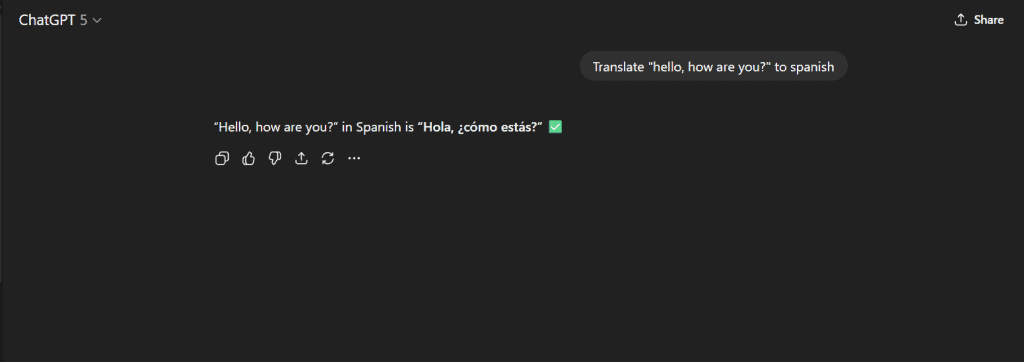
    What makes this different from other prompting methods is the absence of examples. You’re not showing the model how to format an answer or giving it a sample output. You’re counting entirely on its pre-existing knowledge to understand and complete your task.

    This approach works because modern language models have seen so much text during training that they’ve internalised countless patterns. When you ask them to summarise text, classify sentiment, or answer questions, they recognise these as tasks they’ve encountered variations of before. They don’t need you to spell it out with examples because they’ve already learned the general concept.

    How Does Zero-Shot Prompting Work?

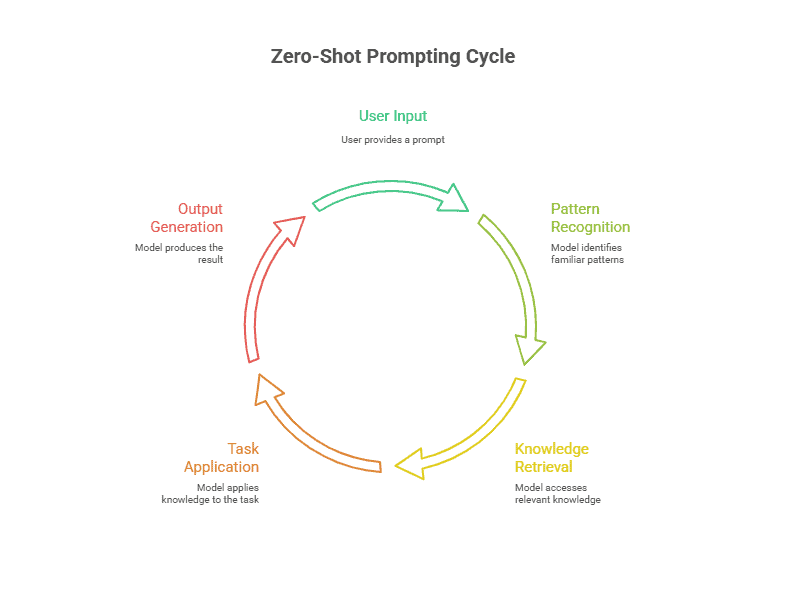
    Here’s what happens behind the scenes. You type an instruction like “Is this review positive or negative: ‘I loved this product!’” The model reads it and recognises the pattern. It’s seen sentiment analysis tasks in countless forms during training. Not this exact review, but similar requests across millions of text examples.

    The model then pulls from its pre-trained knowledge. It knows “loved” connects with positive emotions. It understands review structures. It’s learned what positive versus negative language looks like. All without you providing any examples of correct answers.

    What makes this possible? Research shows that zero-shot prompting works because models are exposed to diverse task descriptions during training. They’ve processed everything from news articles to scientific papers to social media posts. This massive exposure teaches them to recognise what you’re asking for, even when phrased in completely new ways.

    Your instruction activates the relevant knowledge. The model doesn’t need task-specific training because it’s already seen similar patterns. It just applies what it learned broadly to your specific request. The catch? How well it performs depends on whether your task resembles something from its training data.
    Zero-Shot Prompting vs Few-Shot Prompting

    Here’s where things get interesting. Zero-shot prompting has a close cousin called few-shot prompting. The difference? Few-shot includes examples right in your prompt to show the AI what you want.

    Let’s see this in action. A zero-shot prompt looks like: “Classify this email as spam or not spam: Check out this exclusive offer!” You’re giving direct instructions and expecting the model to figure it out.

    A few-shot version adds examples first: “Classify emails as spam or not spam. Example 1: ‘Claim your prize now!’ = spam. Example 2: ‘Your package will arrive Tuesday’ = not spam. Now classify: Check out this exclusive offer!” You’re showing the pattern before asking.

    Research indicates that choosing the right prompting technique can improve performance by 8-47% over basic approaches. That’s a huge difference.

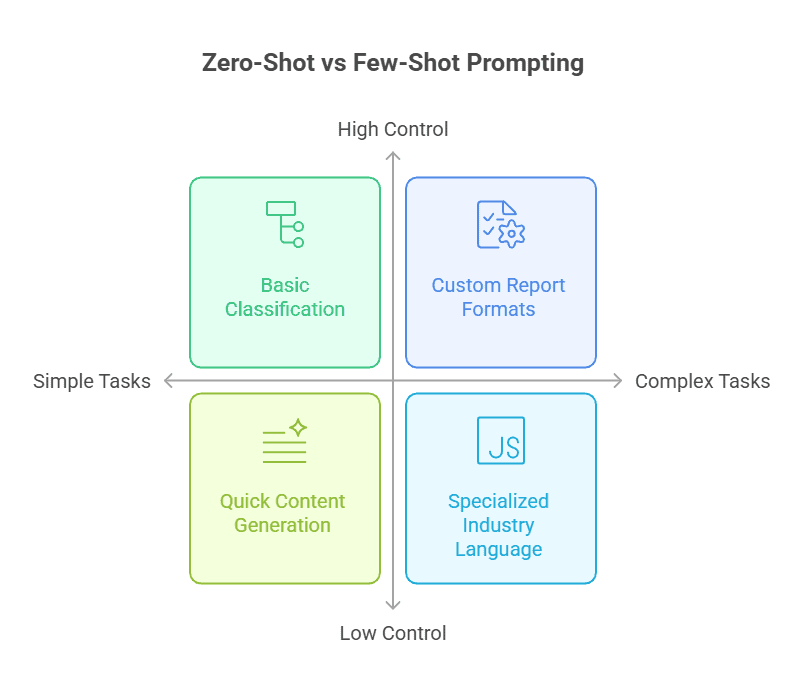
    So when should you use each? Zero-shot works great for straightforward tasks like basic classification, simple questions, or quick content generation. It’s faster because you skip creating examples. Plus, you save on token usage.

    Few-shot shines when you need specific formatting, handle nuanced requirements, or work with complex classification systems. Think custom report formats or specialised industry language. The tradeoff? You’ll spend time crafting good examples and use more tokens per request.

    The task complexity drives the decision. Simple and clear? Go zero-shot. Intricate or format-specific? Few-shot gives you that extra control.
    When To Use Zero-Shot Prompting

    So when does zero-shot prompting actually make sense? It works best for straightforward tasks where the model already knows what to do. According to Lakera AI research, zero-shot prompts work best for well-known, straightforward tasks like writing summaries and answering FAQs. 

    Think about asking an AI to “translate this sentence to Spanish” or “classify this customer review as positive or negative.” These are tasks the model has seen thousands of times during training.

    You’ll also want zero-shot when you’re pressed for time. Creating examples takes effort, and sometimes you just need an answer now. This makes it perfect for prototyping new ideas or testing whether an AI can handle your use case before you invest in more complex approaches.

    Plus, there’s the token efficiency angle. Every example you add increases your token count, which means higher costs and slower responses. If your task is simple enough that the model gets it without hand-holding, why spend the extra tokens? It’s like giving someone directions to a place they already know how to find.

    Benefits Of Zero-Shot Prompting

    There are significant benefits to using zero-shot prompting. Here are some of them:

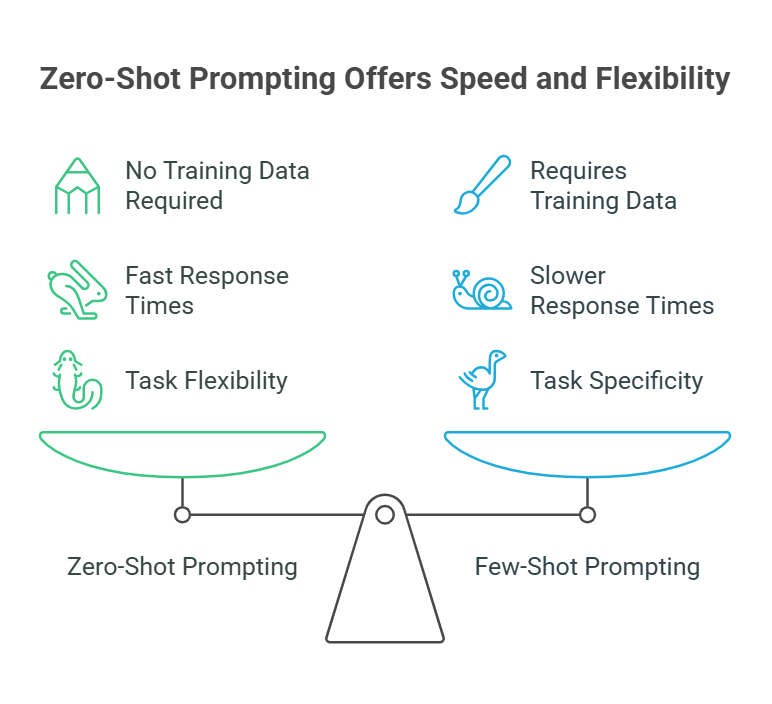
    No Training Data Required

    Here’s the thing that makes zero-shot so accessible: you don’t need to collect or create any examples. No hunting through old conversations to find the perfect demonstration. No formatting sample inputs and outputs. You just write your instruction and go.

    This saves you hours of prep work. While someone using few-shot might spend their afternoon curating examples, you’re already getting results. It’s especially helpful if you’re not technical. You don’t need to understand how to structure training data or worry about whether your examples are representative enough. The model handles everything with what it already knows.

    Fast Response Times

    Fewer tokens mean the model has less to process. That’s basic math, but it matters more than you might think. When you’re not feeding the model several examples before your actual request, responses come back faster.

    This speed advantage really shows up in real-time applications. Chat interfaces, live customer support, instant content generation—these all benefit from shaving off those extra milliseconds. And there’s a practical bonus: fewer tokens per request means lower costs when you’re paying per API call. If you’re running thousands of requests daily, those savings add up quickly.

    Flexibility Across Tasks

    What you learn with zero-shot transfers immediately to new situations. The same approach that worked for summarising articles also works for translating text, answering questions, or generating email responses. You’re not locked into one task type.

    Need to switch from sentiment analysis to keyword extraction? Just change your instruction. No need to maintain separate libraries of examples for each task or retrain anything. The model adapts instantly to whatever you’re asking. This flexibility makes zero-shot ideal when you’re working on varied projects or need to handle unpredictable request types throughout your day.
    Limitations Of Zero-Shot Prompting

    That said, zero-shot prompting isn’t perfect for every situation. While it’s fast and flexible, there are real scenarios where it falls short. Knowing these limitations helps you decide when to switch to few-shot prompting or fine-tuning instead.

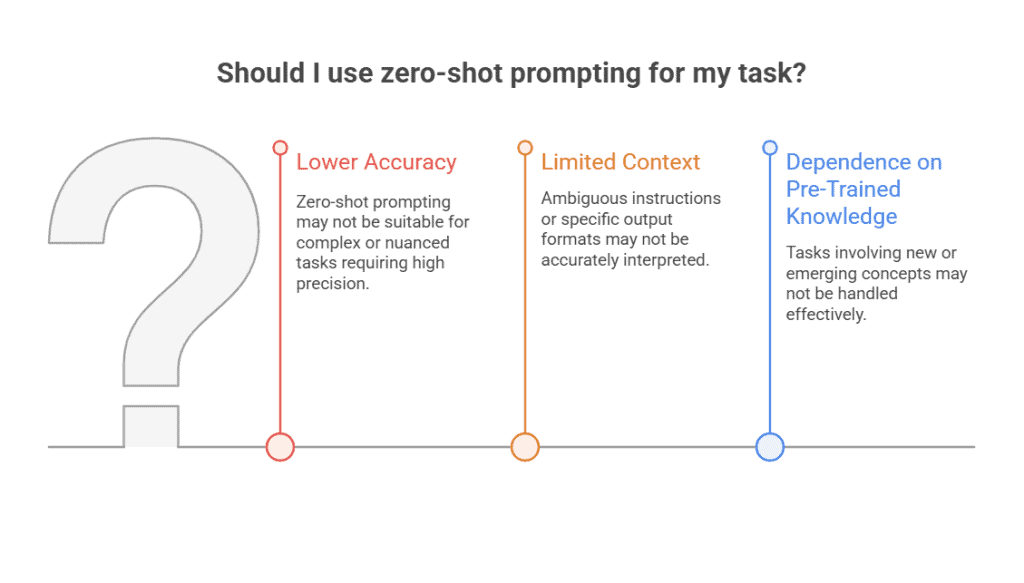
    Lower Accuracy For Complex Tasks

    Zero-shot prompting struggles when tasks get nuanced or highly specialised. The model might miss subtle requirements or fail to grasp domain-specific terminology it hasn’t seen much during training.

    Say you ask it to analyse a legal contract for compliance issues. Without examples showing what “compliance” means in your specific context, the AI might flag generic concerns but miss industry-specific violations. Same goes for medical diagnosis or technical code reviews, where precision matters.

    When you need precision and can’t afford mistakes, zero-shot becomes risky. The model is working from general patterns rather than specific guidance tailored to your exact needs.

    Limited Context Understanding

    Without examples, the model is essentially guessing what you want. This creates problems when your instructions are ambiguous or when you need a specific output format.

    Let’s say you want a JSON structure with particular field names and nested objects. A zero-shot prompt might give you JSON, but the structure could be completely different from what you need. Or if you’re asking for “a professional email,” your idea of “professional” and the model’s interpretation might not align.

    You end up compensating with extremely detailed instructions. But even then, the model might misinterpret your intent because it has no reference point. That’s exactly why few-shot prompting exists, those examples clarify what “good” looks like.

    Dependence On Model’s Pre-Trained Knowledge

    Zero-shot only works well when your task resembles something in the model’s training data. If you’re asking about events after the training cutoff date or emerging concepts, the model simply won’t know.

    Ask about a software framework released last month, and you’ll get outdated or made-up information. Request analysis of a brand-new regulation, and the model can’t help because it’s never encountered that material.

    Plus, performance varies wildly based on model quality. A smaller or older model might struggle with tasks that a newer, larger model handles easily in zero-shot mode. You’re limited by what the AI has “seen” during pre-training, which means truly novel tasks fall outside its comfort zone.
    How To Write Effective Zero-Shot Prompts

    Knowing the limitations is one thing. Actually writing prompts that work is another. The good news? You don’t need to be a prompt engineer to get solid results. You just need to follow a few practical guidelines that eliminate guesswork and help the model understand exactly what you’re asking for.

    Be Clear and Specific

    Vague prompts get vague results. Instead of “Tell me about this article,” try “Summarise this article in 3 bullet points.” See the difference? The second one uses a precise verb (summarise) and states exactly what you want (3 bullet points).

    Clear, specific instructions broken into simple steps significantly improve AI output quality. The model isn’t trying to guess whether you want a summary, an analysis, or a full rewrite. You’ve already told it. This saves time and cuts down on back-and-forth revisions.

    Define The Task Explicitly

    State the task type right at the start. Don’t make the model figure out whether you’re asking for classification, translation, or something else entirely. Remove all guesswork about what you’re requesting. If you want sentiment analysis, say “Classify the following customer review as positive, negative, or neutral:” before pasting the review. The action (classify) and the subject (customer review) are both crystal clear. That’s how you get consistent results without needing to provide examples.

    Provide Context When Needed

    Some tasks need background info to make sense. If you’re asking the model to draft an email response, it helps to know whether you’re a customer service manager, a sales rep, or a tech support agent. Try “As a customer service manager, draft a response to this complaint:” instead of just “Respond to this.”

    But here’s the thing: don’t overload your prompt with unnecessary details. Add context only when it actually changes how the task should be approached. Think domain, industry, or role information that shifts the tone or focus.

    Specify The Output Format

    Tell the model how to structure its response. Want bullet points? Say so. Need a numbered list? Request it. Looking for a specific word count? Set the limit upfront. Specifying output structure dramatically improves response consistency.

    Try “Answer in exactly 50 words” or “Provide your answer as a numbered list with no more than 5 items.” This simple step gives you control over the format without needing to rewrite your entire prompt or ask for revisions.

    Zero-Shot Prompting Examples

    Let’s look at some real-world examples you can start using today. These show how different tasks benefit from clear, direct prompts.

    Text Classification Example

    Say you’re sorting through articles or support tickets. Here’s what works:

    “Classify this customer support ticket into one of these categories: Technical Issue, Billing Question, Feature Request, or Account Access. Ticket: My password reset link isn’t working, and I’ve tried three times already.”

    This works because you’re giving the model a closed set of options and a clear task. The model doesn’t need training data, it understands what “Technical Issue” means and can match the context. Models perform well when categories are explicitly stated upfront.

    Sentiment Analysis Example

    When you’re analysing customer feedback or social media mentions, structure matters:

    “Analyse the sentiment of this product review as Positive, Negative, or Neutral: The delivery was fast but the product quality didn’t match the photos. Disappointed overall.”

    What makes this effective? You’ve defined exactly three outcomes and provided the text to analyse. The model won’t wander into irrelevant territory or give you a rambling explanation when you just need a quick sentiment label. Plus, limiting options to three clear categories makes the output immediately actionable.

    Content Generation Example

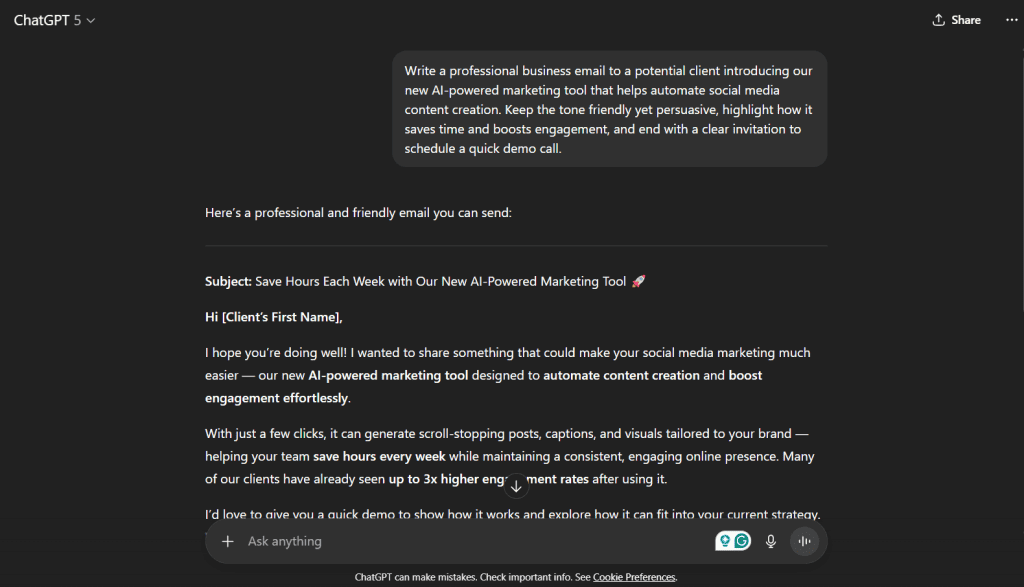
    “Write a professional email to a client explaining a project delay. Include an apology, brief reason for the delay, new timeline, and next steps. Keep it under 100 words and maintain a reassuring tone.”

    This prompt works because it specifies format, length, tone, and required elements. You’re not leaving the model guessing about what “professional” means in your context. The constraints, word count, specific components, tone guide the output without needing example emails. That’s the thing about good zero-shot prompts: they replace examples with precise instructions.

    Question Answering Example

    “Answer this question in 2-3 sentences using language a 10th grader would understand: How does blockchain technology ensure security?”

    The constraints here do the heavy lifting. By specifying sentence count and reading level, you’re preventing both oversimplification and technical jargon overload. The model knows to explain the concept without diving into cryptographic hash functions or distributed ledger minutiae. You get a focused answer that’s actually useful, not a textbook chapter.

    Common Use Cases For Zero-Shot Prompting

    Zero-shot prompting shows up in more places than you might think. Once you start noticing it, you’ll see it everywhere.

    • Customer support teams use it to automatically route tickets to the right departments without building custom classifiers. It can scan incoming requests and decide whether something belongs in billing, technical support, or account management. Same goes for generating FAQ responses; you don’t need to anticipate every possible question.
    • Content creators lean on it for quick social media posts, first-draft emails, or blog outlines when they’re staring at a blank screen. MIT research demonstrates zero-shot prompting’s effectiveness for content generation tasks, especially when you don’t have training examples to work from.
    • Data processing workflows use it for text classification, pulling specific entities from documents, or labelling datasets without manual annotation. You can point it at customer feedback and ask it to extract product names or feature requests.
    • Translation and localisation work surprisingly well, especially for languages where you don’t have parallel corpora sitting around. Marketing teams use it for sentiment monitoring across social platforms, tracking how people feel about their brand without setting up complex systems.
    • Developers use it for quick prototyping, testing whether AI can handle a task before committing resources. And educators are finding it useful for generating explanations, simplifying complex topics, or creating tutoring responses tailored to different learning levels.

    The beauty is you can start using these applications immediately. No dataset collection. No model training. Just clear instructions.

    Start With What You Already Know

    Zero-shot prompting is your starting point with any AI model. It won’t solve every problem; you’ve seen its limitations, but it handles way more than most people expect.

    The examples we walked through aren’t theoretical. Try them. Adjust the wording. See what breaks and what surprises you. You’ll develop an instinct for when zero-shot is enough and when you need to level up to few-shot or fine-tuning.

    Most tasks don’t need fancy techniques. They need clear communication. That’s what you’re learning here: how to talk to these models in a way they understand. The more you practice, the better your results get.

    So pick a task you’ve been curious about. Write a straightforward prompt. Hit enter. You might be surprised by what happens.
  • What is Generative AI? A Guide for Non-Techies

    What is Generative AI? A Guide for Non-Techies

    You’ve probably noticed AI-generated images flooding your social feeds. Or maybe you’ve caught yourself using ChatGPT to draft a work email. Here’s the thing: generative AI isn’t just a tech trend anymore. 

    According to Netguru’s 2025 research, 78% of organisations now use AI in at least one business function, and generative AI attracted $33.90 billion in investment. That’s an 18.7% jump from 2023. 

    These tools are reshaping how we work, create, and solve problems. But what actually is generative AI? And how does it differ from the AI we’ve been hearing about for years? Let’s break it down in plain English.

    What Is Generative AI?

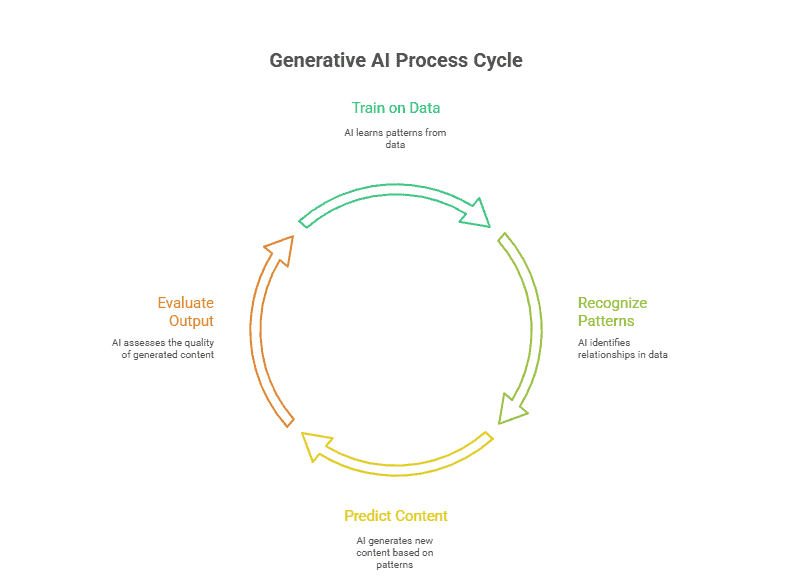
    Generative AI is a type of artificial intelligence that creates new content. It can produce text, images, videos, audio, or even code. The technology learns patterns from massive amounts of existing data. Then it uses those patterns to generate something entirely new.

    Think of it like a chef who’s tasted thousands of dishes. They understand flavour combinations, cooking techniques, and ingredient pairings. When asked to create something new, they don’t just copy a recipe. They combine what they’ve learned to make an original dish. Generative AI works the same way.

    The AI studies countless examples. A text generator reads millions of articles and books. An image generator analyses millions of photos and artworks. It spots patterns in how words connect or how visual elements come together. When you give it a prompt, it creates something new based on those learned patterns.
    What makes this different from simply copying? The AI generates content that didn’t exist before. It’s not pulling from a database of pre-written responses. It’s created in the moment.
    Generative AI vs Traditional AI

    You might think all AI does the same thing. But traditional AI and generative AI solve completely different problems.

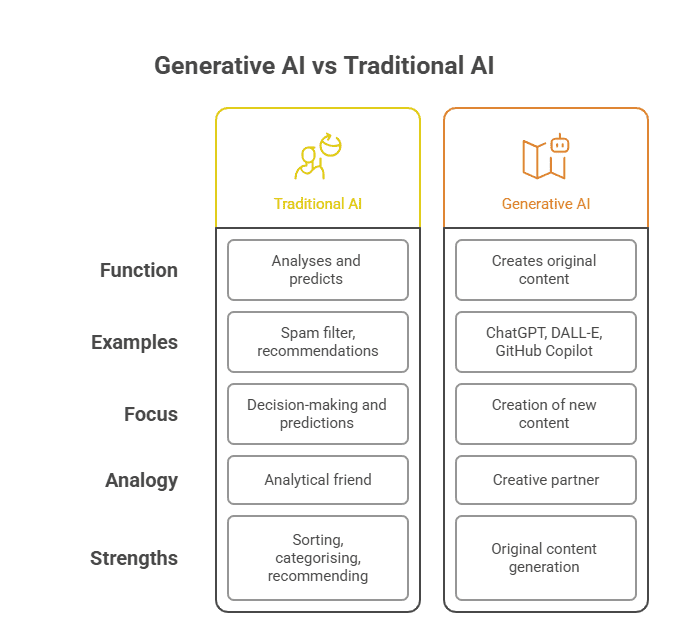
    Traditional AI analyses and predicts. Your email’s spam filter? That’s traditional AI examining incoming messages and deciding which ones are junk. Netflix recommendations? Traditional AI looks at your viewing history and predicts what you’ll like next. A fraud detection system? Traditional AI spots suspicious patterns in transaction data.

    Generative AI creates. ChatGPT writes that email for you. DALL-E generates an image from your description. GitHub Copilot suggests code as you type. Futurense explains that traditional AI processes data to make decisions and predictions, while generative AI focuses on creation.

    Here’s a simple way to remember it: traditional AI is your analytical friend who helps you make choices. Generative AI is your creative partner who helps you build something new.

    Both types are powerful. But they serve different needs. Traditional AI excels at sorting, categorising, and recommending. Generative AI shines when you need original content, whether that’s a blog post, a product design, or a customer service response.

    How Does Generative AI Work?

    You might wonder what’s actually happening inside these AI systems when they generate content. It’s actually simpler than you’d think. No need to get into complex math or technical jargon here. 

    Think of it this way: generative AI works by learning patterns from massive amounts of data, then using those patterns to predict what should come next.

    Training Data and Pattern Recognition

    Generative AI learns the same way you’d learn a new language by reading thousands of books.

    The AI gets fed enormous amounts of data. We’re talking millions of images, billions of words, or countless hours of audio. It scans through all this information looking for patterns. What words tend to appear together? What shapes make up a human face? What notes create a melody?

    Here’s the thing: both the quantity and quality of this training data matter. The model needs diverse, high-quality examples to learn from. If you trained an AI only on mystery novels, it wouldn’t know how to write a romance. The more varied and accurate the training data, the better the AI becomes at recognising relationships and making predictions.

    The AI doesn’t memorise this data. Instead, it builds a kind of internal map of relationships. It learns that “cat” often appears near “meow” or “whiskers.” It recognises that portraits usually have eyes positioned a certain distance apart. These connections form the foundation for everything the AI will create later.

    The Prediction Process

    Once trained, the AI creates new content through educated guessing.

    You know how your phone’s autocomplete suggests the next word as you type? Generative AI works similarly, just way more sophisticated. When you give it a prompt, it predicts what should come next based on all those patterns it learned.

    Let’s say you ask it to write about coffee. The AI calculates probabilities. What word is most likely to follow “coffee”? Maybe “beans” or “cup” or “morning.” It picks one based on probability, then repeats the process for the next word, and the next.

    What you need to understand is this: the AI isn’t thinking or understanding meaning. It’s recognising patterns and playing the odds. It doesn’t know what coffee tastes like or why people drink it. It just knows that certain words, phrases, and concepts tend to cluster together in the data it studied. That’s exactly why sometimes AI outputs sound convincing but miss the mark on deeper meaning.

    Types of Generative AI Models

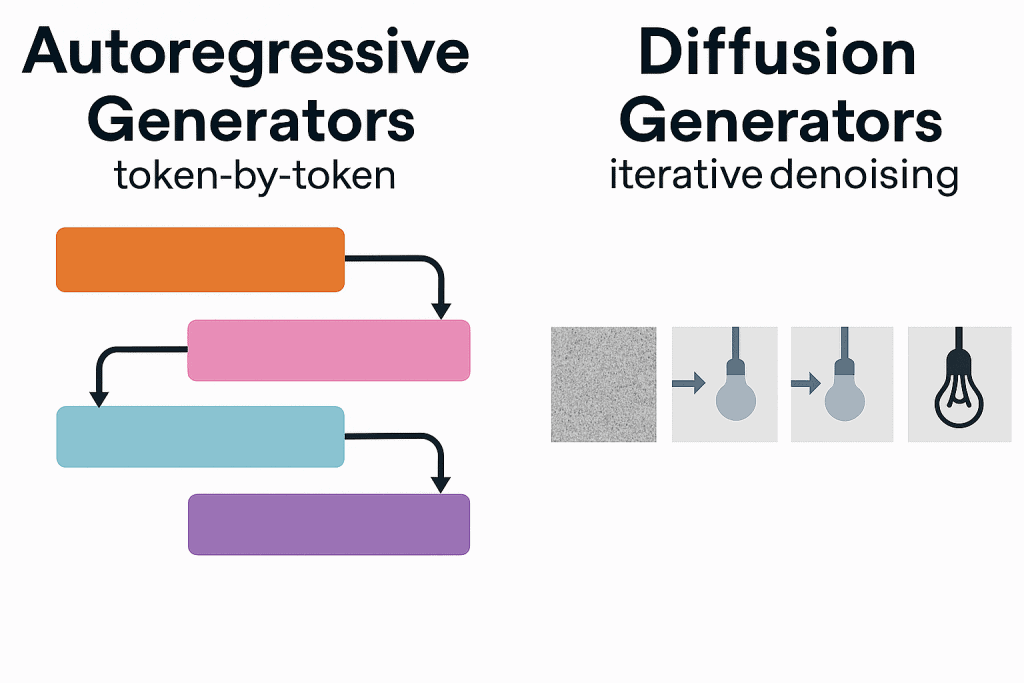
    So generative AI can create content. But how does it actually pull that off? Here’s the thing: there are different approaches to generation. Think of it like cooking, you can bake, fry, or grill to create a meal. The end result is food, but the process differs. In generative AI, two main approaches dominate: autoregressive models and diffusion models. Let’s break down what makes each one tick.

    Autoregressive Models

    These models work like you’re writing a text message. You type one word. Then the next. Then another. Each word you choose depends on what you’ve already written.

    That’s exactly how autoregressive models generate content. They create one piece at a time, in sequence. Each new piece relies on everything that came before it. If you’re generating text, the model predicts the next word based on all the previous words. Then it uses that new word to predict the one after. And so on.

    This is how ChatGPT works when you ask it a question. It doesn’t write your entire answer at once. It builds it word by word, making sure each word fits naturally with what it’s already said. The same approach works for code generation and even some music creation. The key here is that sequential flow. The model can’t skip ahead. It has to move step by step, building as it goes.

    Diffusion Models

    Now picture this: you’re looking at a photo covered in static. Then the static slowly clears. Details emerge. Colours sharpen. Eventually, you see a crisp, clear image.

    That’s how diffusion models work. They start with pure noise. Random pixels that look like TV static. Then they gradually clean it up. Step by step, they remove the noise and add structure. The fuzzy mess becomes shapes. The shapes become details. The details become a finished image.

    Think of it like a sculptor working with clay. They don’t start with a perfect statue. They begin with a rough blob and refine it. Each pass adds more definition. More detail. More clarity. That’s what the model does, except it’s removing randomness instead of chipping away clay.

    This approach is huge in image generation. Tools like DALL-E and Midjourney use variations of this process. You give them a prompt, and they transform noise into something that matches what you described. The whole process happens in reverse from how we usually think about creation. Instead of building up from nothing, they clean up from chaos.

    What Can Generative AI Create?

    Think about the last time you saw an AI-generated image or used a chatbot. That’s generative AI at work. These systems can produce everything from simple text messages to full-length videos. Let’s break down the main types of content you’ll encounter.

    Text Generation

    This is probably the type you’ve interacted with most. Text-generating AI can write chatbot responses, draft emails, create articles, and even generate code. ChatGPT is the most recognisable example. People use it daily to brainstorm ideas, write job descriptions, debug programming errors, or translate languages.

    What makes text generation powerful is its flexibility. You can ask for the same content in different tones. Need a formal business email? Done. Want that same message as a casual text? It can do that too. The AI adjusts its style based on what you ask for. This is why customer service bots can sound friendly while legal document generators maintain a professional tone.

    Image Creation

    Type a description, get an image. That’s the basic idea behind tools like DALL-E, Midjourney, and Nano Banana. You might ask for “a cat wearing a spacesuit on Mars,” and within seconds, you’ve got a unique image that matches your prompt.

    Businesses use these tools to create product mockups before manufacturing anything. Marketers generate dozens of social media visuals in the time it would take a designer to create one. Artists experiment with styles they couldn’t physically produce. A process that once took hours or days now happens in under a minute.

    The quality has improved dramatically too. Early AI images looked obviously artificial. Now, some are hard to distinguish from photographs or professional illustrations. You’ve probably scrolled past AI-generated images online without realising it.

    Video Generation

    Video is the newest frontier and also the most complex. Current tools can create short animations, edit existing footage, or generate simple video clips from text descriptions. The technology is still developing, so you won’t see feature-length films yet.

    Right now, you’ll find AI-generated videos in explainer content, social media ads, and educational materials. Some tools can animate still images or change elements in existing videos. Others create entirely new footage from scratch. It’s slower and more resource-intensive than image generation, but it’s getting better fast.

    Audio and Voice Generation

    From music tracks to podcast voiceovers, AI can handle audio creation too. You’ve likely heard AI-generated voices in navigation apps, automated phone systems, or even audiobooks. Some systems can clone specific voices with just a few minutes of sample audio.

    Musicians use AI to compose background tracks or experiment with new sounds. Content creators generate voiceovers without recording studios. Sound designers create custom sound effects for games or videos. The technology serves both creative exploration and practical business needs.

    Some voice generators let you adjust emotion and emphasis. You’re not stuck with a monotone robot voice anymore. The AI can sound excited, concerned, or professional based on your needs.

    Common Uses of Generative AI

    You’ve probably already interacted with generative AI today without realising it. That chatbot that answered your question on a website? Generative AI. The email draft your work software suggested? Same thing.

    Marketing teams use it to pump out blog posts, social media captions, and ad copy in minutes instead of hours. Customer service departments rely on AI chatbots to handle basic questions so human agents can tackle the complex stuff. 54% of employees use ChatGPT or other generative AI tools at work, and 21% of organisations using this technology have completely redesigned their workflows around it.

    Developers lean on tools like GitHub Copilot to write code faster. Teachers create personalised lesson plans and practice quizzes tailored to individual students. Product designers generate prototypes and mockups before investing in physical materials.

    The creative industries are all over it too. Musicians use AI to experiment with melodies and arrangements. Writers use it to break through writer’s block or outline articles. Graphic designers generate concept art to show clients before committing to final designs.

    What connects all these uses is speed and accessibility. Tasks that used to require specialised skills or hours of work now take minutes. You don’t need to be a graphic designer to create a decent logo concept. You don’t need to be a programmer to write basic code. That’s the real shift generative AI brings to the table.

    Benefits and Drawbacks

    Let’s be straight about what generative AI can and can’t do for you.

    The speed advantage is real. You can generate a first draft, a design concept, or lines of code in seconds. That’s not hype. It’s genuinely faster than doing everything from scratch. Plus, it’s cheaper than hiring specialists for every task, especially for small businesses or individuals who can’t afford a full creative team.

    The accessibility factor matters too. You can now create professional-looking content without years of training. Need a presentation graphic? Generate it. Need to translate customer emails? Done. The barrier to entry for creative and technical work has dropped significantly.

    But here’s where you need to pump the brakes. Generative AI makes mistakes. Often. It generates information that sounds confident but is completely wrong. McKinsey’s 2025 survey found that inaccuracy is the AI-related risk organisations most often experience. That’s not a minor issue when you’re making business decisions or publishing content.

    The quality swings wildly. Sometimes it nails exactly what you need. Other times it’s generic, repetitive, or just off. You can’t predict which you’ll get.

    What you’re working with isn’t true understanding. These models match patterns they’ve seen before. They don’t think through problems or grasp context the way humans do. They’re sophisticated autocomplete, not creative partners.

    Then there are the ethical questions nobody’s fully answered yet. Who owns the copyright when AI generates an image trained on thousands of artists’ work? What happens when anyone can create deepfake videos? How do we handle job displacement in industries being automated?

    The technology is powerful and useful. But it’s a tool that requires oversight, fact-checking, and human judgment. You can’t just plug it in and walk away expecting perfection.

  • 86+ AI in HR Statistics 2026: Market Growth & Adoption Rates

    86+ AI in HR Statistics 2026: Market Growth & Adoption Rates

    Most companies are still debating whether AI belongs in HR. Unilever already used it to cut recruitment processing time by 75% across more than 250,000 annual applications.

    AI in HR statistics from 2025 show the global market reaching $8.16 billion this year, up from $7.01 billion in 2024, growing at 21.3% annually according to Precedence Research. The market size, though, is the least surprising part of what is happening.

    Here is what the data actually shows about where adoption is accelerating, which functions are changing fastest, and what the numbers mean for companies still on the sidelines.

    Key AI in HR Statistics for 2025

    AI adoption in HR nearly doubled in a single year: from 26% of organisations in 2024 to 43% in 2025, according to SHRM’s 2025 Talent Trends Report.

    • 67% of organisations use AI in recruitment
    • 99% of hiring leaders report using AI in some capacity in 2025, according to Insight Global’s 2025 AI in Hiring Survey Report
    • 52% of HR leaders aim to improve employee experience through generative AI
    • 46% of organizations deploying AI tools for performance management use them to help facilitate employee goal setting, according to SHRM’s 2024 Talent Trends report
    • 89% of HR professionals whose organisation uses AI to support recruiting say it saves them time or increases their overall efficiency, according to SHRM’s 2025 Talent Trends Report
    • 86.1% of recruiters utilising AI report that it accelerates the hiring process, according to research cited by SHRM
    • AI recruitment can reduce hiring costs by up to 30% per hire, with organisations reporting 20–40% lower cost-per-hire when AI automates screening and scheduling, according to SHRM (2024)
    • The global AI in HR market is projected to grow from $8.16 billion in 2025 to $30.77 billion by 2034, at a CAGR of 15.94%, according to Precedence Research
    • Companies investing in AI training for HR report a 27% higher rate of AI tool adoption
    • AI adoption among HR professionals rose from 26% of organisations in 2024 to 43% in 2025, with recruiting as the leading use case, according to SHRM’s 2025 Talent Trends Report
    • 57% of organisations using AI in performance management use it to help managers provide more comprehensive and actionable feedback to their teams, according to SHRM
    • Talent acquisition professionals using generative AI report a 20% reduction in overall workload, equivalent to saving approximately one full workday per week, according to LinkedIn’s Future of Recruiting 2025 report

    AI in HR Market Size and Growth Statistics

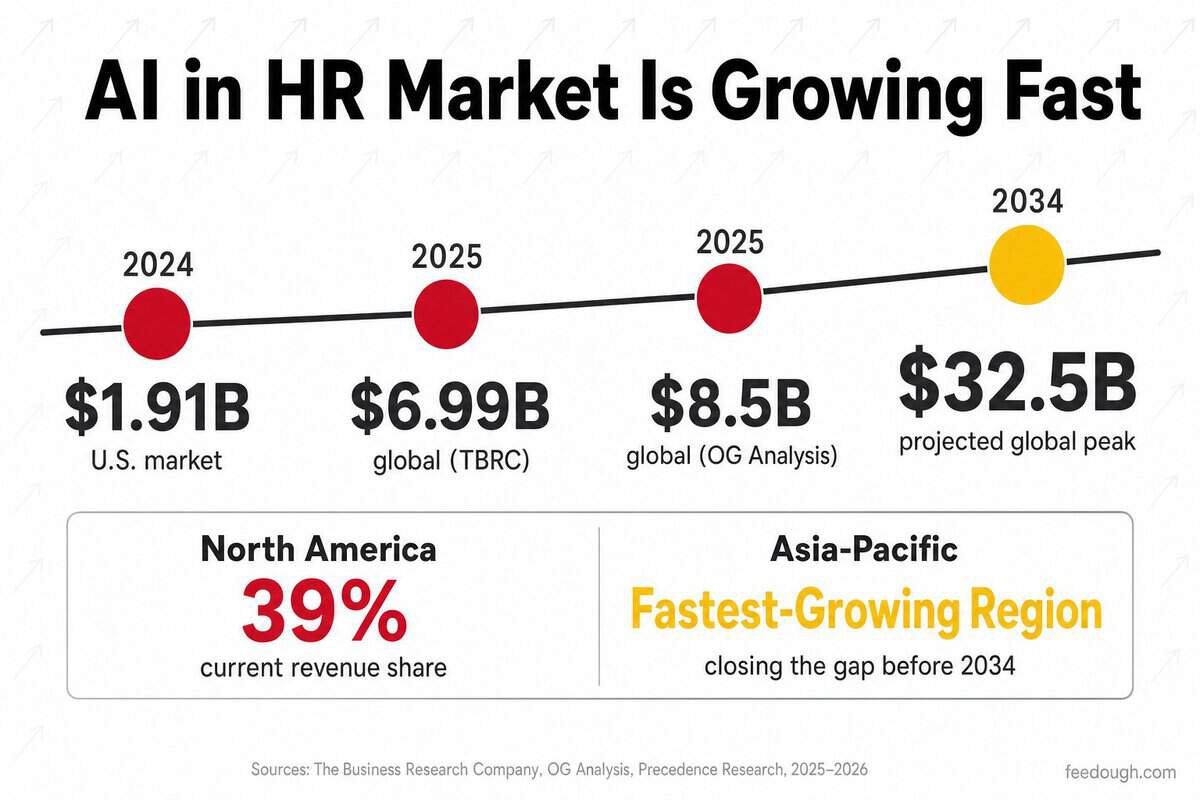
    Every research firm tracking AI in HR arrives at a different number. Every one of them agrees on the direction. The Business Research Company puts the global market at $6.99 billion in 2025, growing to $16.83 billion by 2030 at a 19.3% CAGR. OG Analysis, using a broader market definition, puts 2025 at $8.5 billion and the 2034 endpoint at $32.5 billion. The spread between those estimates is a methodology question. The trajectory is not in dispute.

    Market / Segment
    Base Value
    Projected Value
    CAGR
    AI in HR (The Business Research Company, 2026)
    $6.99B (2025)
    $16.83B by 2030
    19.3%
    AI in HR (OG Analysis / Research and Markets, Oct 2025)
    $8.5B (2025)
    $32.5B by 2034
    16.1%
    HR Technology broadly (SNS Insider, Sep 2025)
    $41.64B (2024)
    $84.82B by 2032
    9.3%
    HR Technology broadly (Technavio, 2025)
    Baseline (2024)
    +$18.31B by 2029
    8.4%
    U.S. AI in HR (Precedence Research, Jul 2025)
    $1.91B (2024)
    $8.60B by 2034
    16.24%

    The U.S. figures are worth isolating. A market moving from $1.91 billion to $8.60 billion in a single decade represents more than organic growth. It reflects enterprise budgets actively reallocating toward AI tooling as implementation costs fall and use cases expand beyond recruiting. North America currently holds 39% of global AI in HR revenue. Asia-Pacific is closing that gap faster than any other region, according to Precedence Research’s July 2025 report, and these AI in HR market size statistics suggest the regional balance will look different well before 2034.

    AI in HR Market Size and Growth Projections

    Company AI Adoption Rates and Implementation Statistics

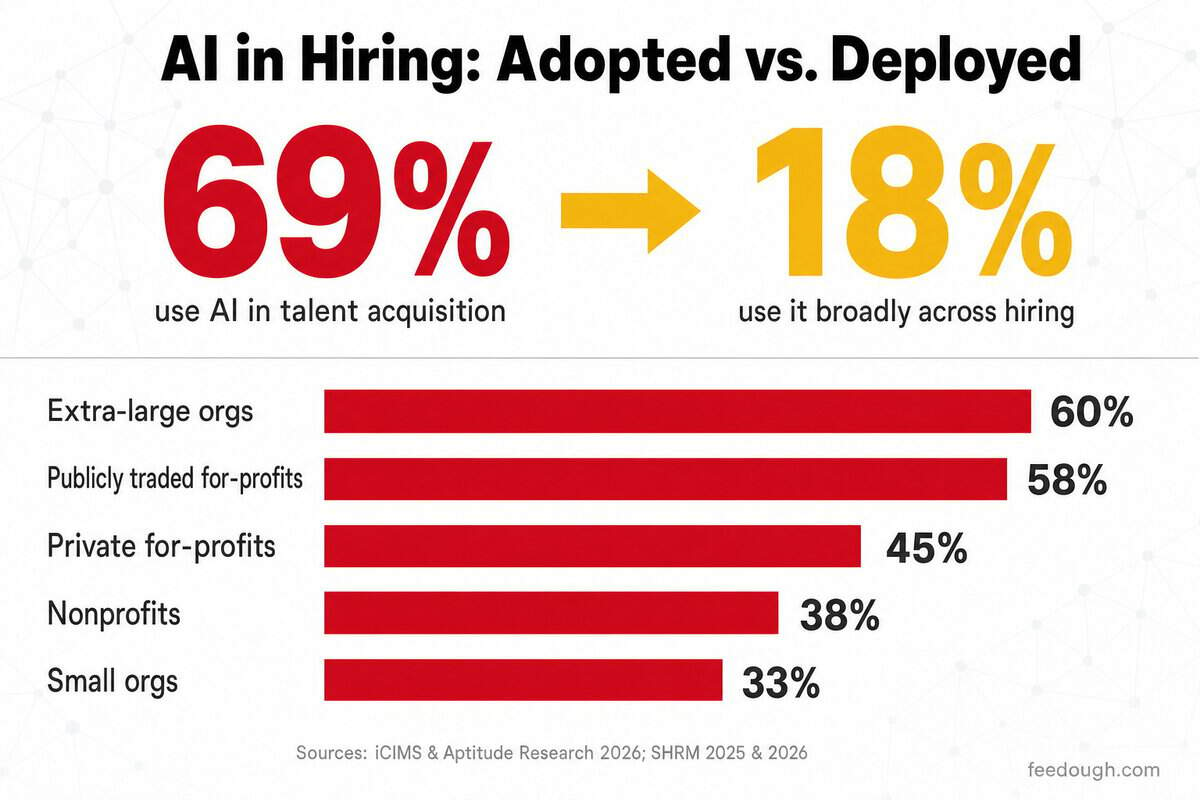
    99% of hiring leaders now use AI in some capacity, according to GoodTime’s 2025 Hiring Insights Report. But that near-universal headline number obscures a sharper reality: only 18% say they are using AI broadly across their hiring processes.

    Organization Type
    AI Adoption Rate
    Source
    Publicly traded for-profits
    58%
    SHRM 2025 Talent Trends (n=2,040)
    Private for-profits
    45%
    SHRM 2025 Talent Trends (n=2,040)
    Extra-large organizations
    60%
    SHRM State of AI in HR 2026 (n=1,722)
    Midsize organizations
    35%
    SHRM State of AI in HR 2026 (n=1,722)
    Small organizations
    33%
    SHRM State of AI in HR 2026 (n=1,722)
    Nonprofits
    38%
    SHRM 2025 Talent Trends (n=2,040)
    Federal government
    19%
    SHRM 2025 Talent Trends (n=2,040)

    The size gap is the most telling pattern in these company AI adoption statistics. Extra-large organizations run at 60% implementation. Small organizations sit at 33%. That 27-point gap does not close on its own. Large enterprises have dedicated IT infrastructure, vendor relationships, and change management budgets that make AI rollouts tractable. Smaller firms face the same tools at comparable price points but with far less capacity to integrate them.

    The sector split follows a similar logic. Publicly traded for-profits answer to shareholders who expect measurable efficiency gains. At 58%, they lead every other organizational type by a margin. Federal agencies, at 19%, operate under procurement constraints and risk frameworks that slow adoption regardless of intent.

    Where adoption is happening, the use cases are narrowing quickly. Here is where recruiters report AI delivering the clearest returns:

    • 87% of companies now use AI in their recruitment processes, with 67% of hiring leaders citing time savings as the primary benefit, according to SightsIn Plus research
    • 93% of talent acquisition teams plan additional technology investments in 2025, according to GoodTime’s 2025 Hiring Insights Report
    • 58% of recruiters who use AI find it most useful for candidate sourcing, and 56% find it most useful for screening candidates, according to Azumo’s 2026 AI Recruitment Statistics report
    • 69% of companies report using AI in talent acquisition in some capacity, yet only 18% say they are using it broadly across hiring processes, according to iCIMS and Aptitude Research’s 2026 AI Adoption Report (n=400+ U.S. talent acquisition leaders)

    That 69%-to-18% collapse is the defining tension in the current adoption landscape. Most organizations have introduced AI somewhere in hiring. Far fewer have integrated it systematically. The gap between touching AI and deploying it at scale is where competitive advantage is actually being built or lost.

    Company Adoption Rates and Implementation Statistics

    Regional AI in HR Market Share Statistics

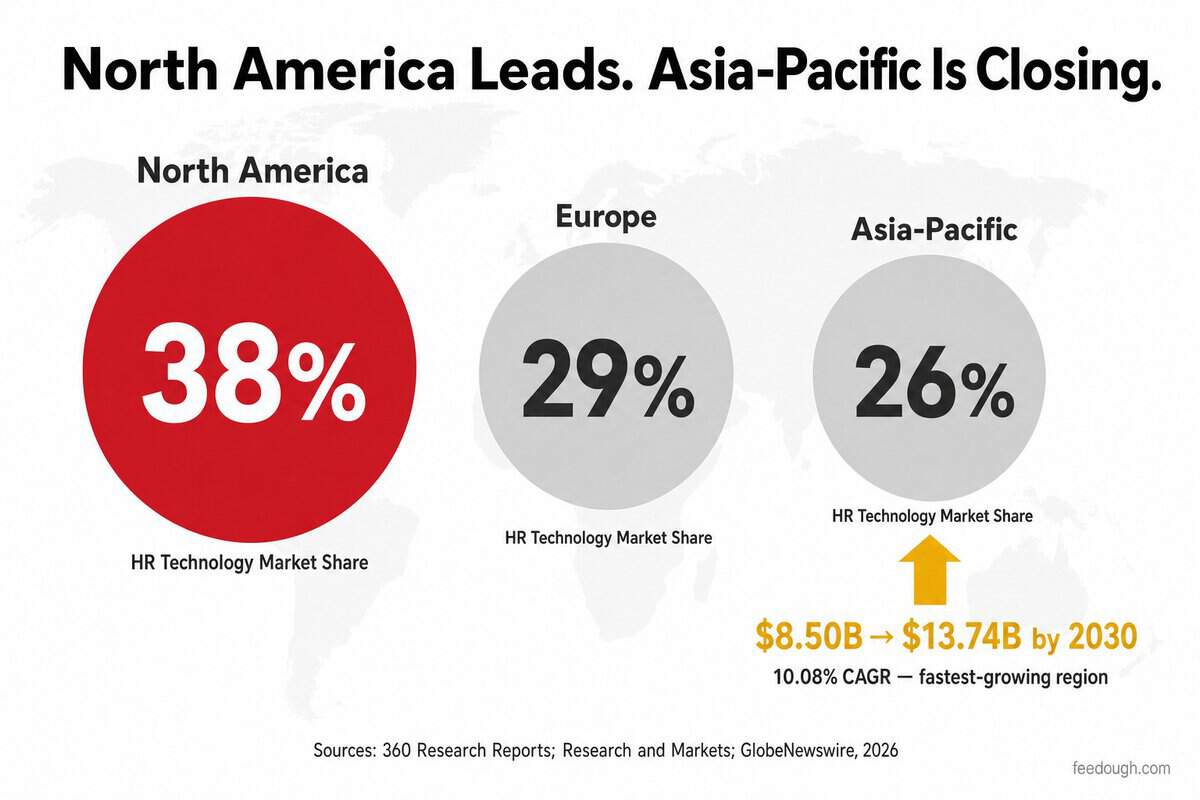
    North America holds 38% of the global HR technology market. That lead is real. Asia-Pacific’s 10.08% CAGR in human capital management software is the reason it will not look the same by 2030.

    Region
    Market Share / Value
    Trajectory
    Source
    North America
    38% of HR technology market
    Largest regional share; leads HR analytics software in 2025
    360 Research Reports; GlobeNewswire (Mar 2026)
    North America
    34.2% of HR professional services
    Largest revenue share in 2024
    Grand View Research
    Europe
    29% of HR technology market
    Second-largest region; stable share
    360 Research Reports
    Asia-Pacific
    26% of HR technology market; $8.50B HCM software (2025)
    Fastest-growing region; projected $13.74B by 2030 at 10.08% CAGR
    360 Research Reports; Research and Markets
    Asia-Pacific
    Fastest-growing in HR analytics software
    Forecast to lead regional growth through 2030
    GlobeNewswire (Mar 2026)

    The structural reasons behind Asia-Pacific’s acceleration are documented across multiple research reports: expanding economies, aging workforces in Japan and South Korea creating urgent automation demand, and rapid enterprise digitalization across markets like Singapore and India. These regional AI in HR market share statistics reflect conditions that compound over time. North America built its lead on mature tech infrastructure and early enterprise adoption. Asia-Pacific is building on scale and necessity, and those are harder forces to slow down.

    Regional Market Distribution and Leadership

    AI Applications in Recruiting and Talent Acquisition Statistics

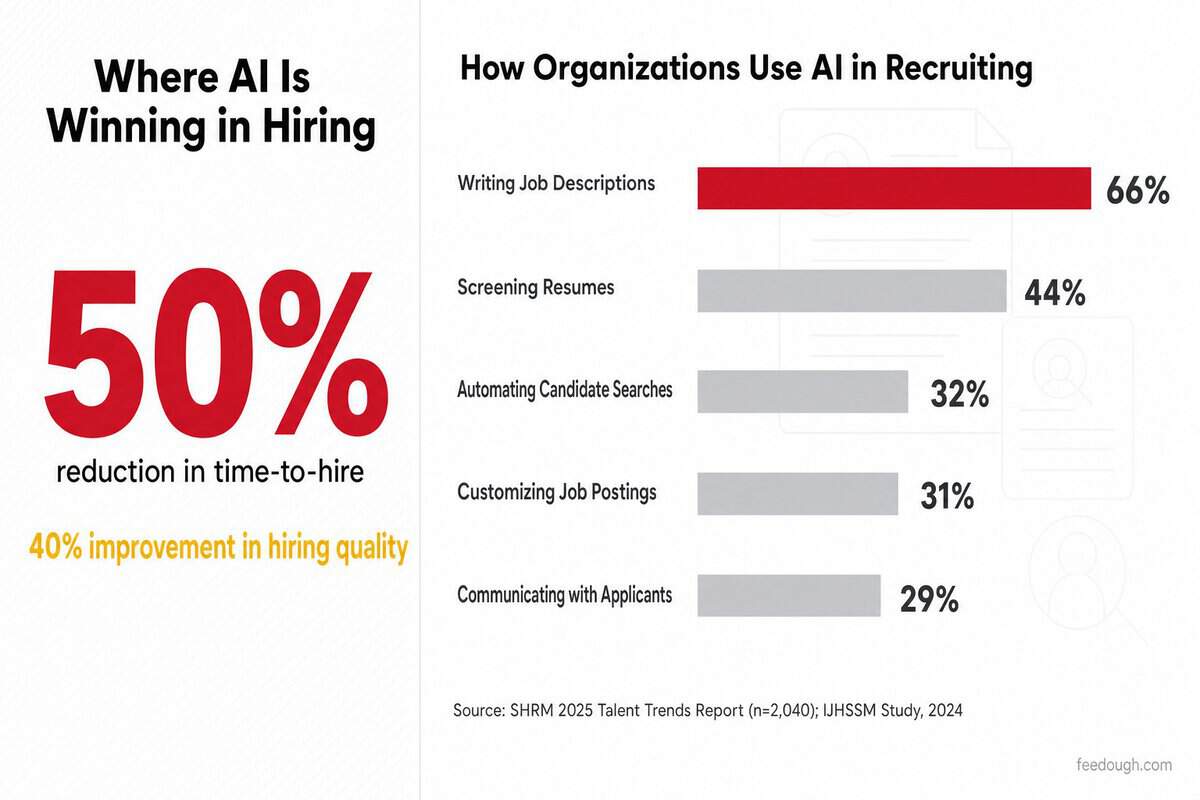
    Cutting time-to-hire by 50% translates to roughly a 30% reduction in cost-per-hire. That math is what moved recruiting from AI’s most obvious testing ground to its most documented success story. A study published in the International Journal of Humanities, Social Science, and Management found that resume screening windows dropped from 10 days to 2 days and interview scheduling from 5 days to 1 day, while hiring quality improved by 40%.

    SHRM’s 2025 Talent Trends Report (n=2,040 HR professionals) shows where those gains are actually coming from. Among organizations already using AI in HR, these are the recruiting functions it is being applied to most frequently:

    Recruiting Application
    % of Organizations Using AI for This Task
    Writing job descriptions
    66%
    Screening resumes
    44%
    Automating candidate searches
    32%
    Customizing job postings
    31%
    Communicating with applicants
    29%

    The task distribution matters. Writing job descriptions at 66% is a low-risk, high-frequency starting point. Resume screening at 44% is where AI in recruiting statistics show the clearest efficiency gains. The drop-off toward candidate communication (29%) reflects where trust in AI outputs is still developing, not where the tools are absent.

    Beyond task adoption, here is what the outcome and perception data shows across the broader recruiting function:

    • 64% of organizations using AI in HR apply it specifically to recruiting, interviewing, or hiring, making talent acquisition the primary entry point ahead of learning, performance management, or workforce planning, according to SHRM’s 2025 Talent Trends Report
    • AI adoption among HR professionals surged from 58% in 2024 to 72% in 2025, reflecting a shift from experimentation to full-scale implementation, according to HireVue’s 2025 Global Guide to AI in Hiring (n=4,000+ HR leaders and employees)
    • 74% of hiring managers believe AI can assist in assessing the compatibility of an applicant’s skills with the position they applied to, according to Insight Global’s 2025 AI in Hiring Survey Report
    • 68% of recruiters believe AI will remove unintentional bias from the hiring process, according to Tidio research cited by Workable’s Top AI in Hiring Statistics report (2024)
    • 44% of recruiters cite saving time as the primary reason they use AI in recruitment processes, according to Tidio research cited by Workable (2024)

    The 68% bias-reduction figure reflects recruiter belief, not confirmed outcome. AI reduces human bias only when its training data is unbiased to begin with, and that remains an active challenge for vendors and practitioners alike.

    AI Applications in Recruiting and Talent Acquisition

    AI in Employee Experience and Performance Management Statistics

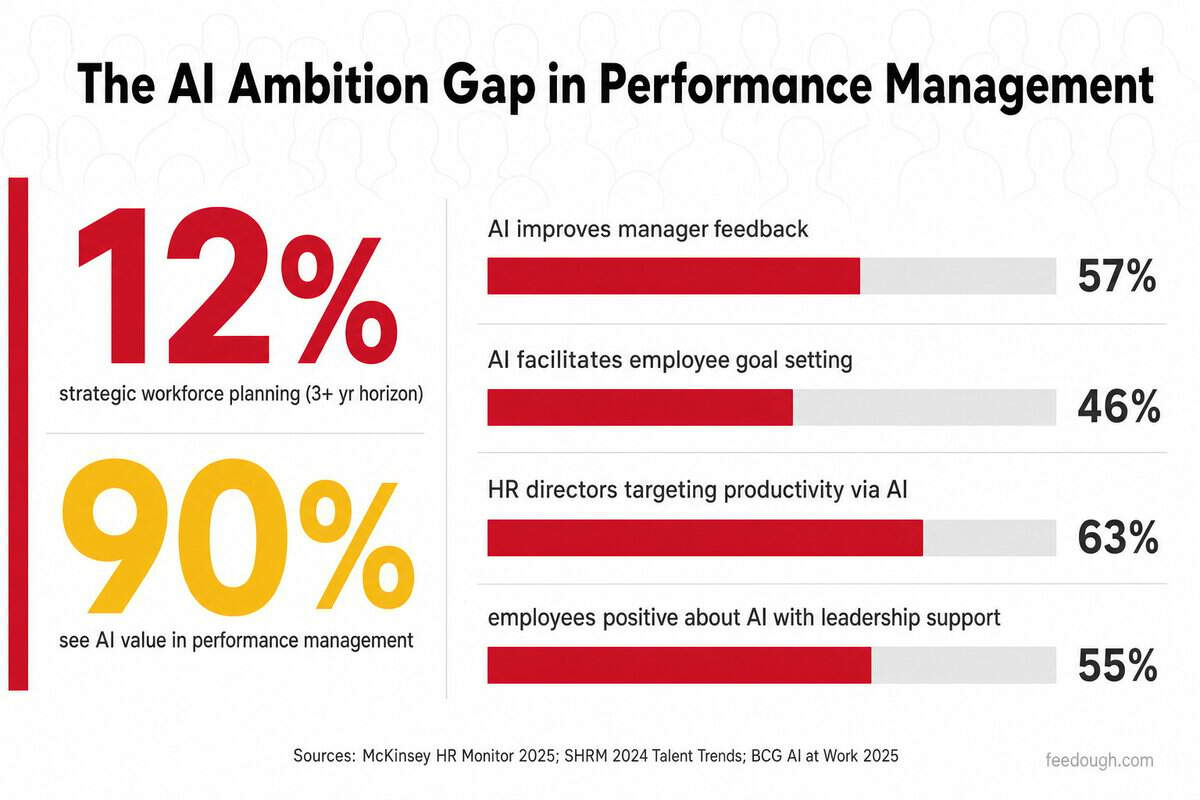
    The stated ambition is wide. The operational reality is much narrower. Only 12% of HR leaders in the United States say they conduct strategic workforce planning with at least a three-year horizon, even as 73% of surveyed organizations report doing full operational workforce planning, according to McKinsey’s HR Monitor 2025 (n=4,069 employees and 1,925 HR professionals across seven countries, fielded December 2024).

    Where AI is being deployed in this space, the focus has shifted toward performance feedback and goal-setting rather than long-range planning. The gap between where AI is applied and where it is most needed defines the current state of AI in employee experience and performance management statistics:

    Metric
    Value
    Source
    HR leaders conducting strategic workforce planning (3+ year horizon)
    12%
    McKinsey HR Monitor 2025 (n=4,069)
    Organizations using AI in performance management to improve manager feedback
    57%
    SHRM 2024 Talent Trends
    Organizations using AI tools to facilitate employee goal setting
    46%
    SHRM 2024 Talent Trends
    HR directors looking to use generative AI to enhance productivity and employee experience
    63%
    SHRM AI-Driven HR Analytics (Nov 2024)
    HR professionals who see generative AI’s value in refining performance management
    90%
    SHRM AI-Driven HR Analytics (Nov 2024)

    The 90% figure on perceived value versus 12% on strategic execution is not a contradiction. It is a measurement problem: most organizations are tracking what AI does within existing processes, not whether those processes are pointed at the right horizon. The BCG AI at Work 2025 survey (n=10,600+ across 11 countries) adds a sharper variable to this picture. The share of employees who feel positive about generative AI in the workplace rises from 15% to 55% when they receive strong leadership support. Tools and intent get organizations partway there. Leadership is the multiplier.

    Employee Experience and Performance Management

    The Future of AI in HR Statistics

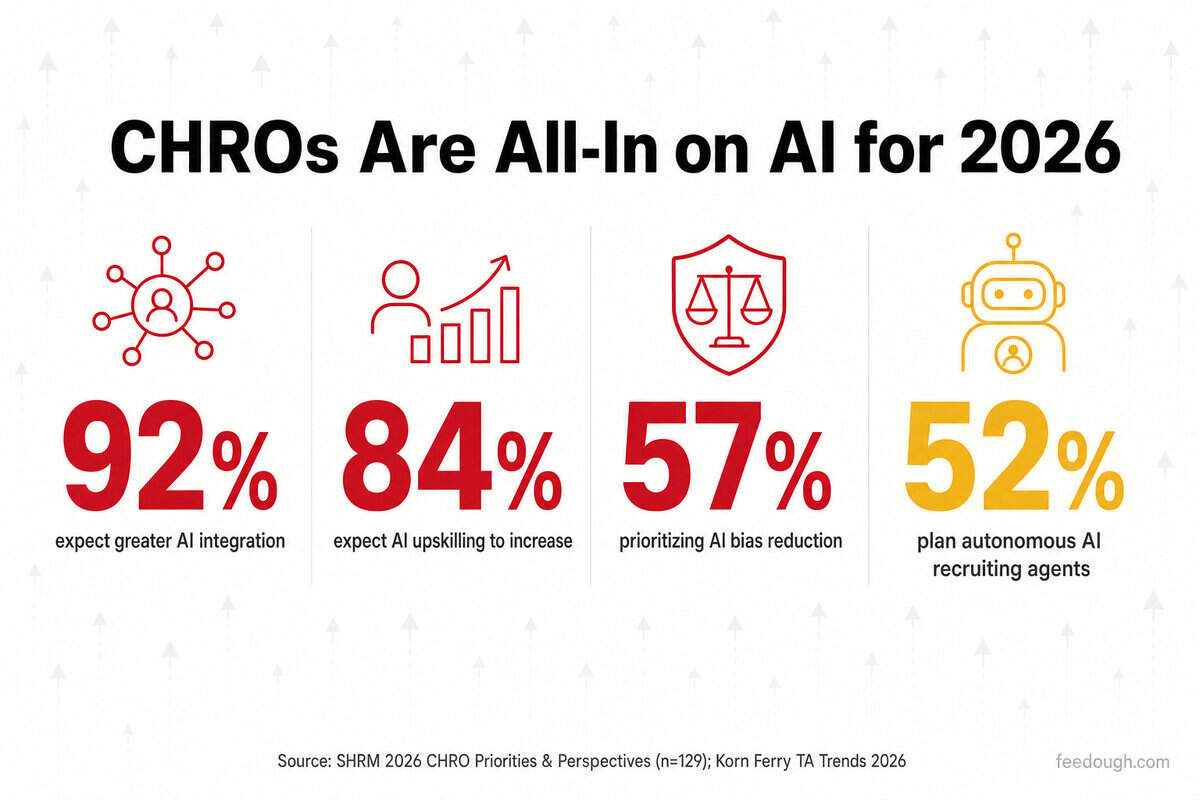
    92% of CHROs anticipate greater AI integration in workforce operations in 2026, according to SHRM’s 2026 CHRO Priorities and Perspectives report (n=129 CHROs, fielded October–November 2025). That near-unanimity is notable because CHROs are not optimists by default. They live with implementation reality.

    CHRO Priority for 2026
    % Expecting Increase
    Source
    Greater AI integration in workforce operations
    92%
    SHRM 2026 CHRO Priorities (n=129)
    Increased AI adoption within HR processes specifically (up from 83% in 2025)
    87%
    SHRM 2026 CHRO Priorities (n=129)
    Upskilling in AI-specific skills
    84%
    SHRM 2026 CHRO Priorities (n=129)
    Reducing bias in AI hiring tools as an organizational priority
    57%
    SHRM 2026 CHRO Priorities (n=129)

    The 84% upskilling figure sits alongside 57% on bias reduction. Those two numbers define the near-term tension in these future of AI in HR statistics: organizations are accelerating adoption while simultaneously acknowledging that neither their people nor their tools are fully ready for what that means.

    The Korn Ferry TA Trends 2026 report adds the sharpest forward signal of all. 52% of talent leaders are planning to add autonomous AI agents to their recruiting teams in 2026. Not AI-assisted workflows. Autonomous agents making decisions inside hiring pipelines.

    • 92% of CHROs expect greater AI integration across workforce operations in 2026, up from a baseline where 83% had already forecast increased HR-specific AI adoption in 2025, according to SHRM
    • 84% of CHROs anticipate AI-specific upskilling will increase in 2026, signaling that headcount investment in AI literacy is moving from optional to planned budget line, according to SHRM’s 2026 CHRO Priorities and Perspectives report
    • 57% of CHROs say reducing bias in AI hiring tools will become a more prevalent organizational priority in 2026, according to SHRM’s 2026 CHRO Priorities and Perspectives report
    • 52% of talent leaders plan to add autonomous AI agents to their recruiting teams in 2026, according to Korn Ferry’s TA Trends 2026: Human-AI Power Couple report (published October 27, 2025)

    Autonomous agents represent a different category of risk than AI-assisted screening. When an agent acts, it acts without a human reviewing each output in real time. The 57% prioritizing bias reduction and the 52% deploying agents are not in conflict. They are two parts of the same problem organizations will spend the next several years working through.

    The Future of AI in Human Resources

    Sources

  • 86+ AI Cheating Statistics 2026: Academic Misconduct Rates & Trends

    86+ AI Cheating Statistics 2026: Academic Misconduct Rates & Trends

    Universities spent years perfecting plagiarism detection. Then generative AI arrived, and the entire enforcement model broke.

    AI cheating statistics from 2025 show nearly 7,000 UK university students were formally caught cheating with AI tools in the 2023-24 academic year alone, up from 1.6 cases per 1,000 students to 5.1, a more than threefold increase in a single year. That figure counts only the students who got caught.

    Here is what the data actually shows about how widespread this is, which institutions are feeling it most, and how far detection has (and has not) come.

    Key AI Cheating Statistics for 2025

    AI cheating has moved from a fringe concern to a documented crisis: formal misconduct cases in UK universities more than tripled in a single academic year, and the pattern is spreading globally.

    • Nearly 7,000 UK university students were formally caught using AI to cheat in 2023-24, equivalent to 5.1 cases per 1,000 students (up from 1.6 per 1,000 the prior year)
    • AI cheating incidents rose from 1.6 per 1,000 students in 2022-23 to 7.5 per 1,000 in 2024-25, according to Anara’s 2025 higher education report
    • 86% of students globally use AI tools in their studies, per the Digital Education Council Global AI Student Survey 2024 of 3,839 students across 16 countries
    • 18% of UK undergraduate students admit to submitting AI-generated text in their assignments, per 2025 HEPI research
    • 95% of the academic community believes AI is being misused at their institutions, per a 2025 study by Turnitin and Vanson Bourne
    • 1 in 10 writing assignments reviewed by Turnitin’s AI detection tool showed some evidence of AI use, with 3 in 100 generated mostly by AI
    • 68% of educators now use AI detection tools, up substantially from the previous year, per the Center for Democracy and Technology
    • 35% of UK students have used AI in a school learning context, the highest rate across surveyed European countries, per the Future of Education Report 2025

    Student AI Usage Patterns and Statistics

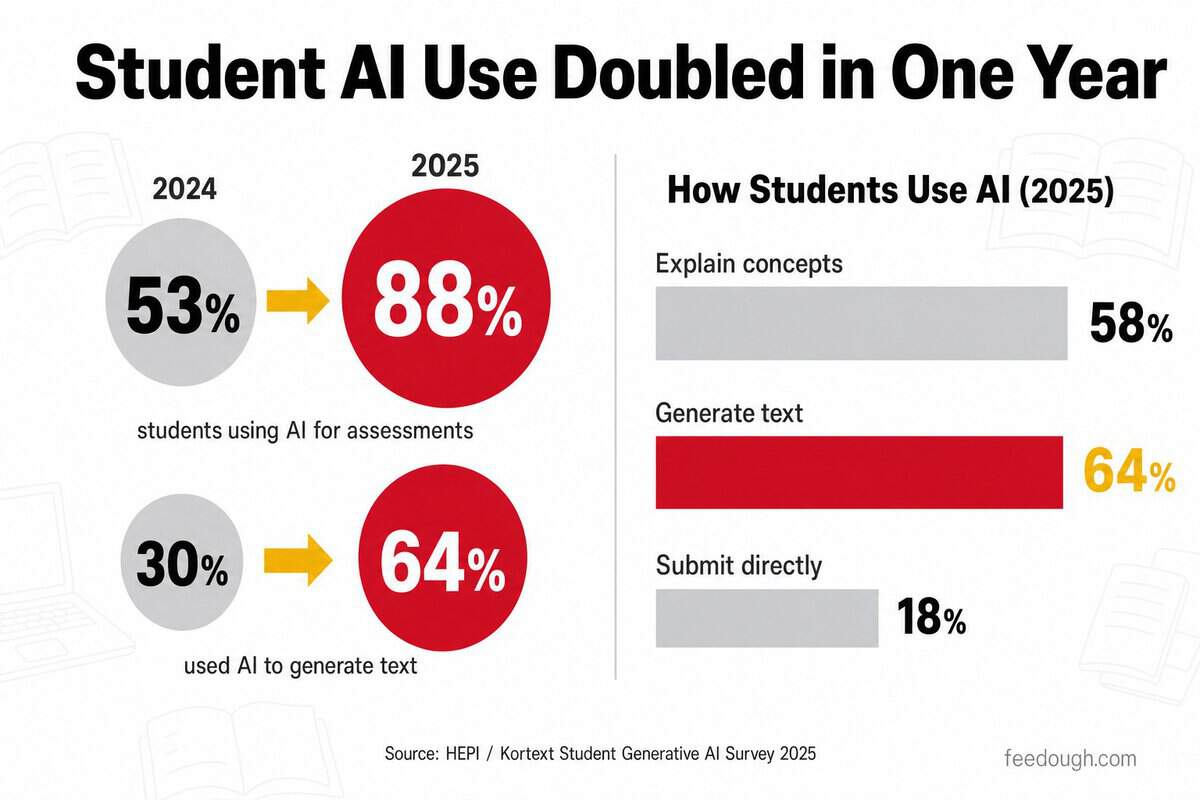
    In one year, the share of UK undergraduates using AI for assessments jumped from 53% to 88%. That is not gradual adoption; that is a near-complete shift in how a generation approaches academic work. The 64% of students now using AI specifically to generate text (up from 30% in 2024) is where this tips from tool use into academic integrity territory.

    Metric
    2024
    2025
    Source
    Students using AI for assessments
    53%
    88%
    HEPI / Kortext Survey 2025
    Undergraduates using AI for academic work (any form)
    66%
    92%
    HEPI / Kortext Survey 2025
    Students using AI to generate text
    30%
    64%
    HEPI / Kortext Survey 2025
    Students submitting AI-generated text directly
    Not reported
    18%
    HEPI / Kortext Survey 2025
    U.S. college students using gen AI chatbot at least weekly
    Not reported
    65%
    Time for Class Survey, Spring 2025

    Text generation doubled as a use case in a single academic year. But not every AI interaction is a misconduct incident. The student AI cheating statistics that matter most are the ones that show what students are doing with the output. Explaining concepts is the most common individual use case among UK undergraduates, per HEPI, which places much of this activity closer to tutoring than to cheating. The breakdown of use cases shows where the line sits:

    • 58% of UK undergraduates use AI to explain concepts, the single most common use case, up from 36% in 2024 (HEPI / Kortext Survey 2025)
    • 64% use AI to generate text, more than doubling from 30% in 2024 (HEPI / Kortext Survey 2025)
    • 18% admit to submitting AI-generated text directly in assignments (HEPI / Kortext Survey 2025)
    • 30% of U.S. college students used ChatGPT specifically for schoolwork in the 2022-23 academic year (Intelligent.com survey, 1,223 students)

    The 40-point gap between students generating text (64%) and students submitting it directly (18%) suggests most are using AI as a drafting aid rather than a wholesale replacement. Whether institutions treat that distinction as meaningful is the question reshaping academic policy right now.

    Student Usage Patterns

    AI Detection and Enforcement Statistics

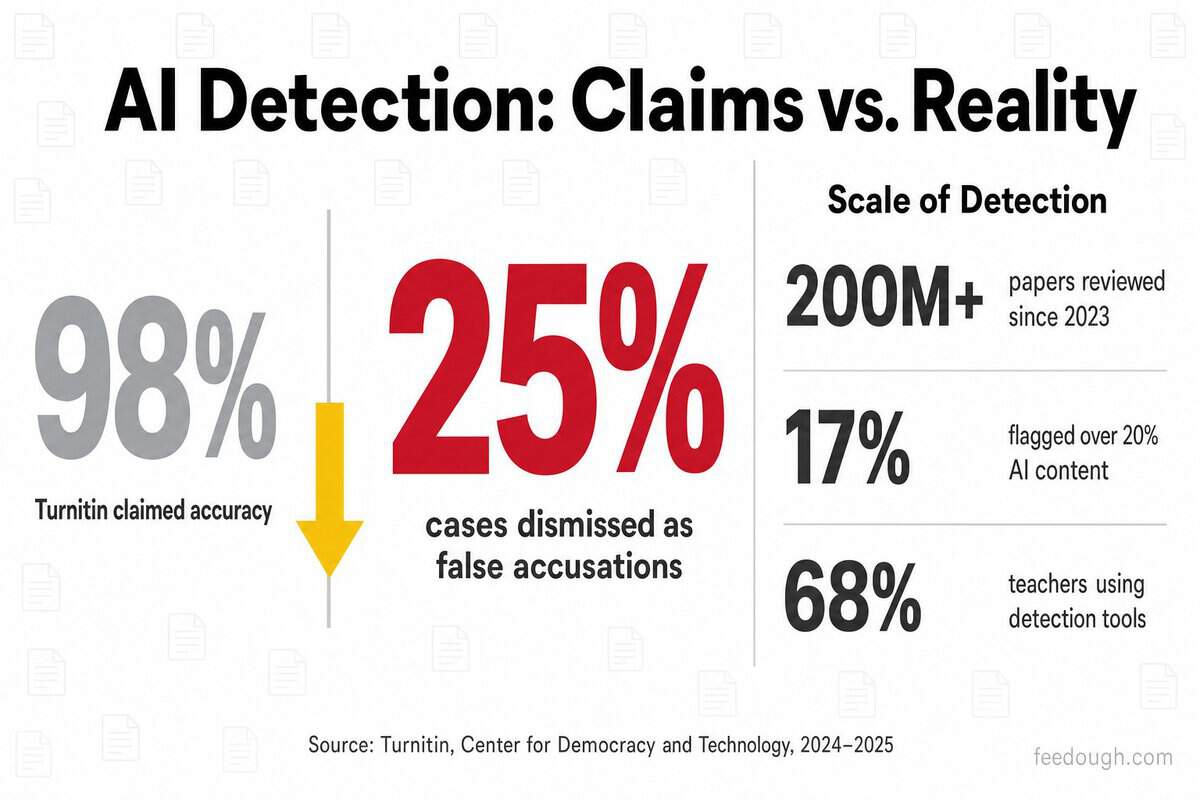
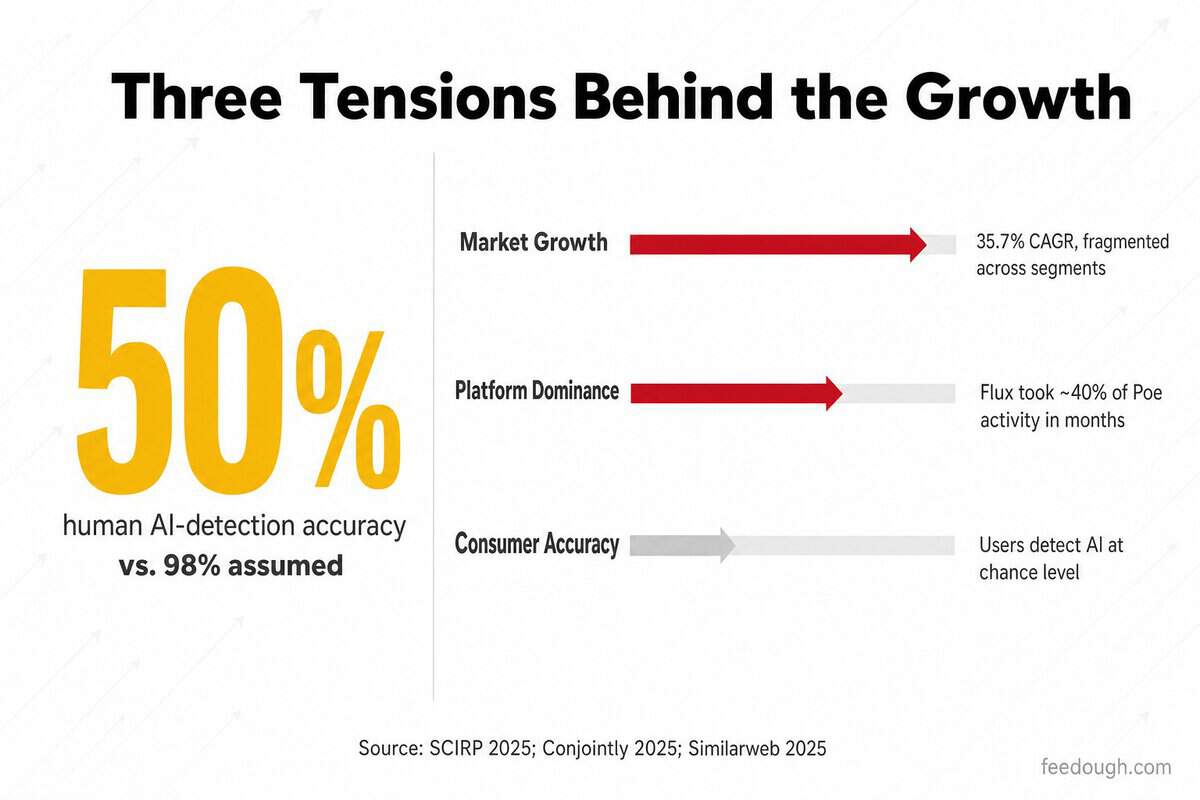
    Turnitin claims 98% accuracy for its AI detection tool, based on its own internal testing, with a false positive rate of under 1%. Those figures are self-reported, and the real-world record tells a different story. Since launching in April 2023, the tool has reviewed over 200 million papers, and 17% of all submissions between January and August 2024 showed more than 20% likely AI-generated content, up from 11% in the tool’s first year. The scale of what detection tools are being asked to process has grown faster than confidence in their reliability.

    Metric
    Value
    Source / Period
    Turnitin claimed detection accuracy
    98%
    Turnitin internal testing (2025)
    Turnitin claimed false positive rate
    Less than 1%
    Turnitin internal testing (2025)
    GPTZero false positive rate (standard testing)
    1–2%
    Standard testing scenarios
    Total papers reviewed by Turnitin AI detector
    Over 200 million
    Since April 2023 (Campus Technology)
    Papers flagged with more than 20% AI content (2024)
    17% of submissions
    Turnitin, Jan–Aug 2024
    Papers flagged with more than 80% AI content (2024)
    5% of submissions
    Turnitin 2024 Wrapped report
    Teachers using AI detection tools (2023–24)
    68%
    Center for Democracy and Technology

    The 68% of middle and high school teachers using AI detection tools in 2023–24 (up from 38% the prior year) reflects a system moving fast to respond. But some of the largest adopters have since reversed course, citing false accusation rates that damaged trust without improving integrity. The AI cheating detection statistics that matter most right now are not about accuracy claims; they are about institutional confidence:

    • Australian Catholic University reported nearly 6,000 AI cheating allegations in 2024, roughly 90% of all academic integrity cases; around 25% of all referrals were dismissed after investigation, leading the university to abandon Turnitin’s AI detection tool in March 2025
    • The University of Cape Town announced in July 2025 it would stop using Turnitin’s AI Score from October 1, 2025, citing evidence that the tools are unreliable and not fit for purpose

    When a tool flags 25% of its own cases as wrongful accusations at scale, the enforcement problem does not get solved by better software. It gets handed back to faculty with no clearer standard than before.

    Detection and Enforcement

    AI Cheating Consequences and Discipline Statistics

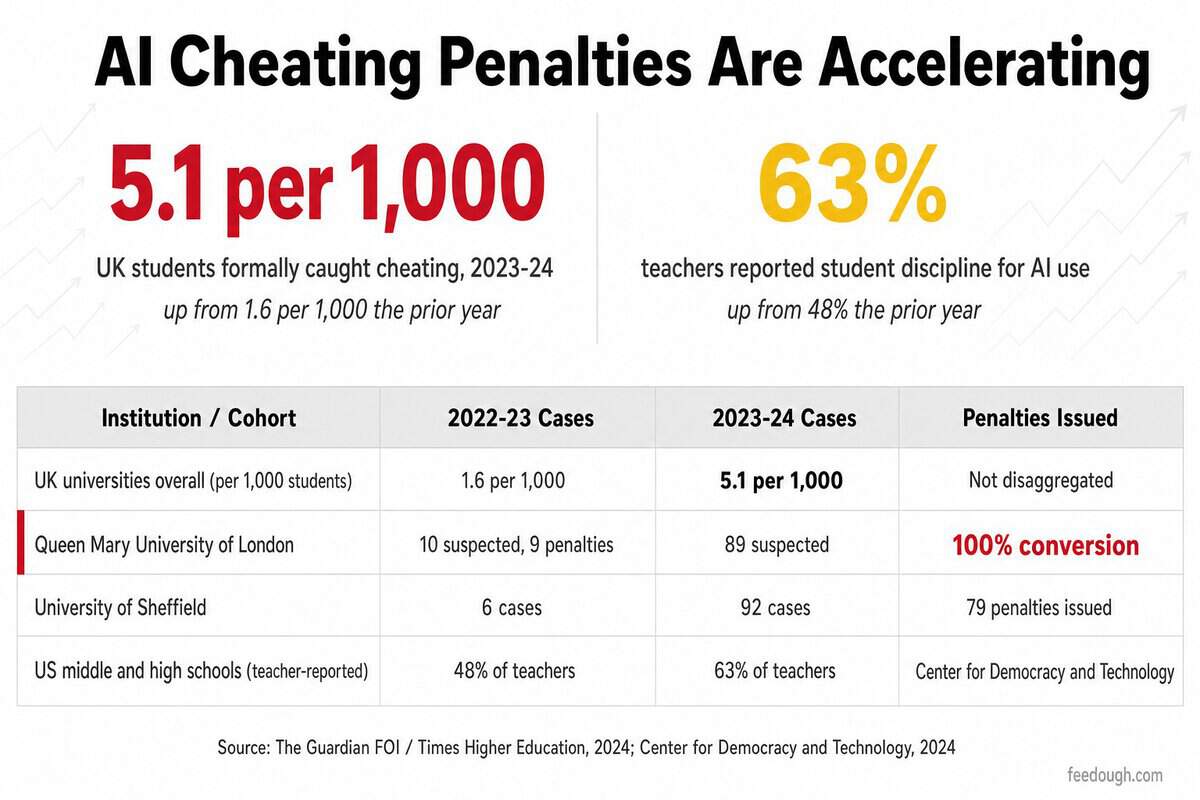
    Formal penalties for AI cheating are no longer rare outcomes; they are becoming the default. 5.1 per 1,000 UK university students were formally caught cheating with AI in 2023-24 (up from 1.6 per 1,000 the prior year), according to Freedom of Information data obtained by The Guardian from 131 universities. At the same time, 63% of middle and high school teachers reported that students had gotten in trouble for AI use accusations during 2023-24, up from 48% the year before, per the Center for Democracy and Technology.

    Institution / Cohort
    2022-23 Cases
    2023-24 Cases
    Penalties Issued
    UK universities overall (per 1,000 students)
    1.6 per 1,000
    5.1 per 1,000
    Not disaggregated
    Queen Mary University of London
    10 suspected, 9 penalties
    89 suspected
    89 (100% conversion)
    University of Sheffield
    6 cases
    92 cases
    79 penalties issued
    US middle and high schools (teachers reporting student discipline)
    48% of teachers
    63% of teachers
    Center for Democracy and Technology

    The Queen Mary figure is the sharpest illustration of where enforcement is heading. Every single suspected case in 2023-24 resulted in a penalty, a conversion rate that reflects institutions moving away from case-by-case discretion toward near-automatic consequences. The University of Sheffield’s fifteenfold case increase in one year, with 79 of 92 suspected students penalized, points in the same direction. These AI cheating consequences and discipline statistics come from Times Higher Education Freedom of Information data covering all 24 Russell Group universities, which means the pattern holds across the UK’s most research-intensive institutions, not just outliers.

    Consequences and Discipline

    AI Cheating by Student Demographics: Usage Patterns and Statistics

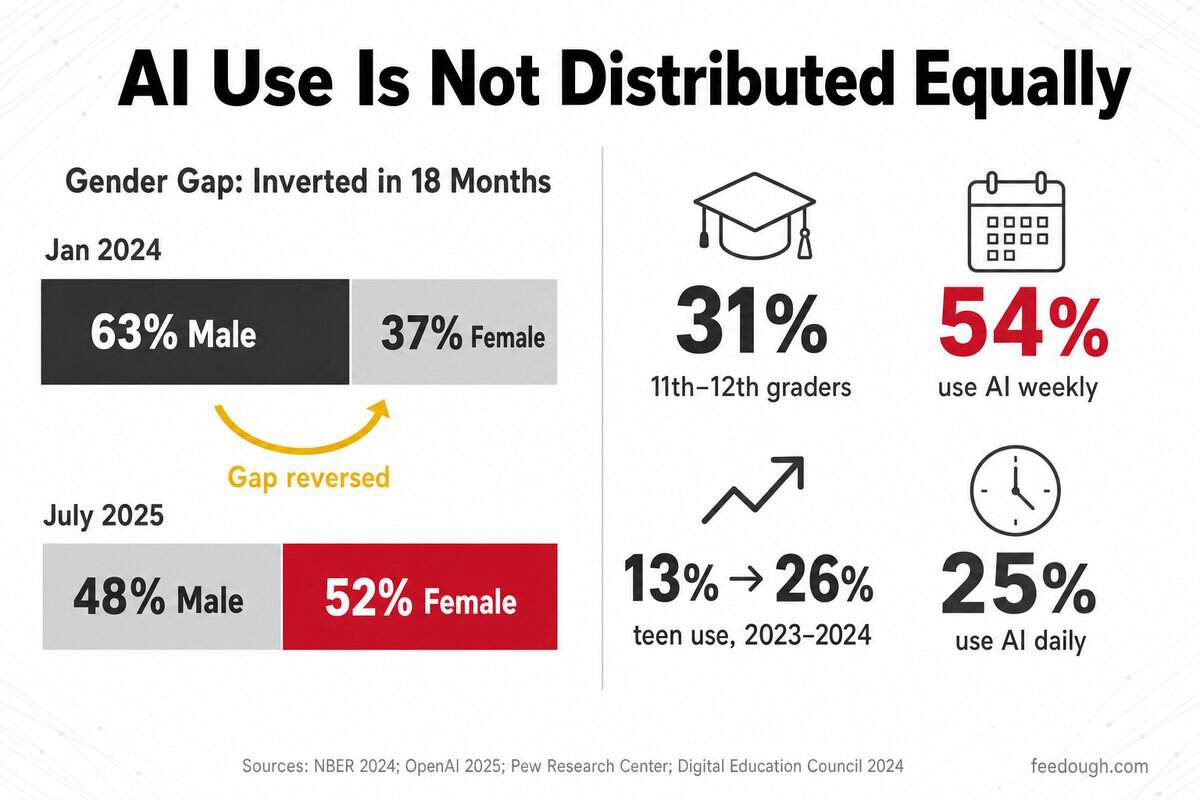
    Teen use of ChatGPT for schoolwork doubled in a single year, rising from 13% in 2023 to 26% in 2024. That acceleration did not hit all students equally. Grade level, gender, field of study, and household income each predict whether a student reaches for an AI tool, and by how much.

    The grade-level gradient is the clearest pattern in the data. Among U.S. secondary students, ChatGPT use for school climbs steadily with age: 20% for 7th and 8th graders, 26% for 9th and 10th graders, and 31% for 11th and 12th graders, according to Pew Research Center data. By the time students reach college, 84% of U.S. high schoolers reported using generative AI tools for schoolwork as of May 2025, up from 79% in January, per College Board surveys conducted across the 2024–2025 academic year.

    • Teen use of ChatGPT for schoolwork rose from 13% in 2023 to 26% in 2024, a full doubling in one academic year (Pew Research Center)
    • 84% of U.S. high school students used generative AI for schoolwork by May 2025, up from 79% in January 2025 (College Board)
    • 69% of U.S. high school students specifically used ChatGPT for assignments and homework (College Board, June 2024–June 2025)
    • 45% of all ChatGPT users globally are under 25 years old
    • Male students, STEM and health course students, and more socioeconomically advantaged students are significantly more likely to use generative AI than their peers (HEPI / Kortext Student Generative AI Survey 2025, 1,041 UK undergraduates)
    • Women express stronger concern than men about the risk of AI misconduct accusations and about biased or false AI outputs (HEPI / Kortext Survey 2025)
    AI Tool
    Student Usage Share
    Source
    ChatGPT
    66%
    Digital Education Council Global AI Student Survey 2024
    Grammarly
    25%
    Digital Education Council Global AI Student Survey 2024
    Microsoft Copilot
    25%
    Digital Education Council Global AI Student Survey 2024
    Average number of AI tools per student
    ~2 tools
    Digital Education Council Global AI Student Survey 2024
    Students using any AI tool daily
    25%
    Digital Education Council Global AI Student Survey 2024
    Students using any AI tool weekly
    54%
    Digital Education Council Global AI Student Survey 2024

    The gender gap in AI tool adoption has shifted more than most reporting reflects. In January 2024, approximately 63% of ChatGPT users (among those with classifiable names) were male, per NBER analysis. By July 2025, OpenAI’s own published research showed female users had risen to 52% of the user base: a full inversion in roughly 18 months. The HEPI data suggests the underlying cause is not that women became more comfortable with AI broadly, but that their specific concerns (about false accusations and unreliable outputs) were never really about the tools themselves. They were about how institutions would respond when things went wrong.

    AI Cheating by Student Demographics

    AI Detection Tool Accuracy and Limitations Statistics

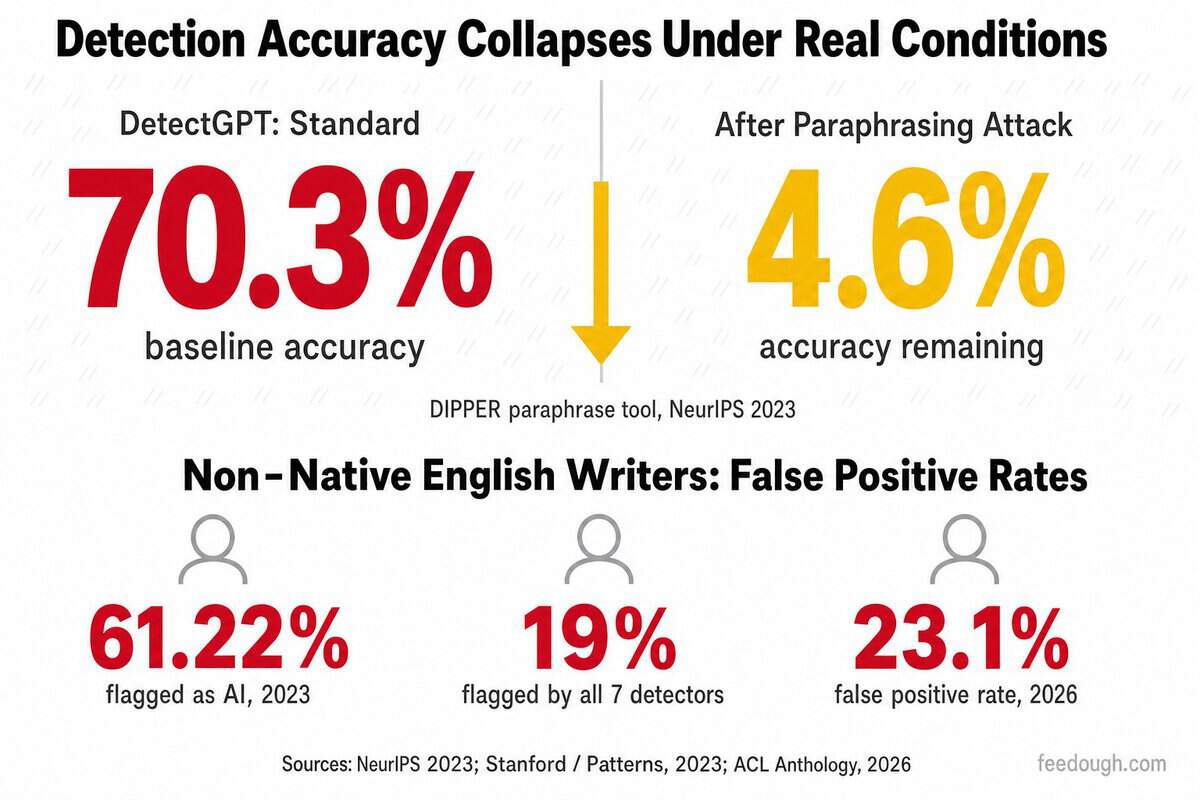
    AI detection tools are being adopted at scale by institutions that believe the accuracy claims on the label. Those claims do not survive contact with two real-world conditions: paraphrasing and non-native English writing. A 2023 NeurIPS study found that a paraphrasing tool called DIPPER dropped DetectGPT’s detection accuracy from 70.3% to just 4.6% at a constant false positive rate of 1%. That is not a marginal performance dip; it is near-total failure triggered by a freely available text-spinning tool any student can use.

    Tool / Condition
    Claimed or Measured Accuracy
    False Positive Rate
    Source
    Turnitin (self-reported, internal testing)
    Up to 98%
    Less than 1%
    Turnitin / BestColleges, 2025
    GPTZero (controlled testing)
    Not specified
    1–2%
    Standard controlled testing
    DetectGPT (standard conditions)
    70.3%
    1%
    NeurIPS 2023
    DetectGPT after DIPPER paraphrasing attack
    4.6%
    1%
    NeurIPS 2023
    Seven AI detectors (TOEFL essays, non-native speakers)
    61.22% falsely flagged as AI
    61.22%
    Stanford / journal Patterns, 2023
    Seven AI detectors (TOEFL essays, 2026 replication)
    Improved, but gap persists
    23.1%
    ACL Anthology, 2026

    The bias problem cuts along the same lines as the paraphrasing problem: neither requires a student to do anything unusual to trigger a false result. The AI detection tool accuracy statistics from the Stanford study reveal just how uneven the risk is for non-native English writers specifically:

    • A Stanford University study in the journal Patterns found that seven popular AI detectors classified 61.22% of TOEFL essays written by non-native English students as AI-generated
    • All seven detectors unanimously flagged 19% of those non-native English essays as AI-generated, compared to a mean false positive rate of just 5.1% for essays written by U.S.-born students
    • At least one detector flagged 97% of the non-native English essays as AI-generated
    • A 2026 replication study published in ACL Anthology found the false positive rate for non-native English writing had fallen from 61.3% to 23.1%, improved but still substantially higher than the rate for native English speakers
    • The AI detection tool market is projected to grow from $359.8 million (2020) to $1.02 billion (2028), even as institutional confidence in the tools is visibly eroding
    AI Detection Tool Accuracy and Limitations

    The Reality Gap in AI Detection Accuracy

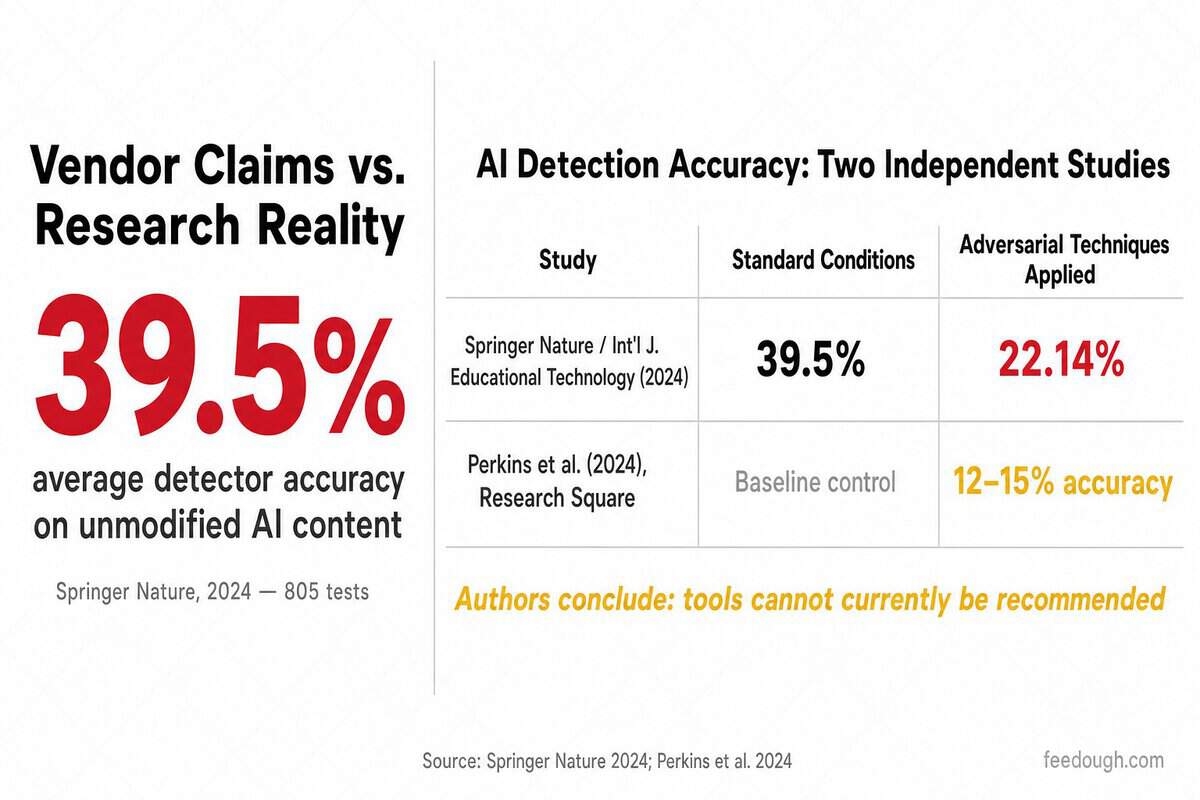
    Independent research consistently finds that AI detectors perform at a fraction of the accuracy their vendors claim. A 2024 study published in the International Journal of Educational Technology in Higher Education (Springer Nature) ran 805 tests across six adversarial techniques and found the average detection accuracy on unmodified AI content was only 39.5%. Apply a simple manipulation, and that figure drops to 22.14%. The authors’ conclusion was direct: these tools cannot currently be recommended for determining academic integrity violations.

    Study
    Condition
    Detection Accuracy
    Springer Nature / Int’l Journal of Educational Technology in Higher Education (2024), 805 tests
    Non-manipulated AI content
    39.5%
    Springer Nature / Int’l Journal of Educational Technology in Higher Education (2024), 805 tests
    Adversarial techniques applied
    22.14%
    Perkins et al. (2024), Research Square
    Standard conditions
    Baseline (used as control)
    Perkins et al. (2024), Research Square
    Paraphrasing and synonym replacement applied
    17.4 percentage points lower than baseline
    Perkins et al. (2024), Research Square
    Most effective adversarial techniques
    12–15% accuracy

    Two independent research teams, different methodologies, same direction: accuracy does not degrade gradually under realistic conditions; it collapses. The Perkins et al. finding that some techniques reduce detection to 12–15% is significant because synonym replacement and paraphrasing require no technical skill. A student with access to any free rewriting tool can reduce a detector’s reliability to near-random performance. That is the gap between a vendor’s internal accuracy figure and what the peer-reviewed AI cheating detection statistics actually show.

    The Reality Gap

    Why AI Detection False Positives Matter at Scale

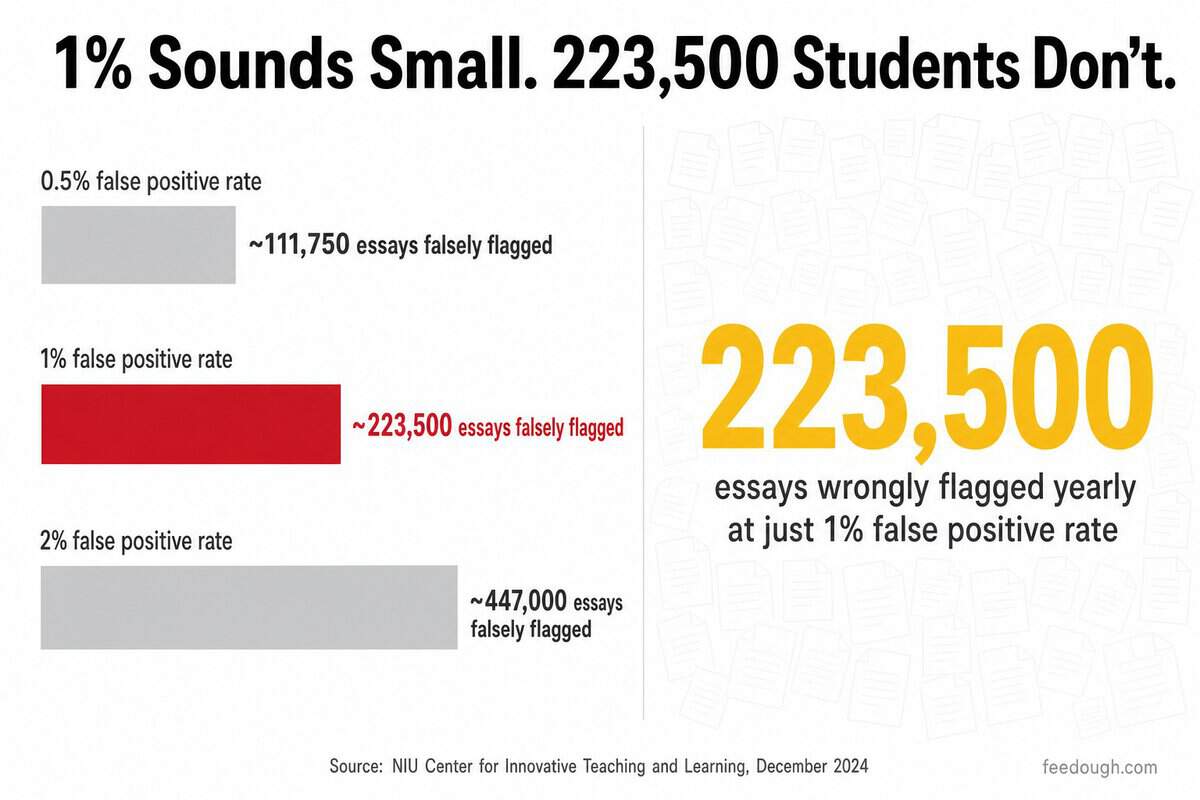
    A 1% false positive rate sounds like a quality control footnote. Applied to the volume of student writing that flows through AI detection tools each year, it becomes a wrongful accusation engine. U.S. first-year college students write an estimated 22.35 million essays annually. At a 1% false positive rate, that is 223,500 essays flagged as AI-generated that were written entirely by humans, according to NIU’s Center for Innovative Teaching and Learning (December 2024). The student on the receiving end of one of those flags does not experience a percentage. They experience a misconduct charge.

    • A Bloomberg test of GPTZero and CopyLeaks on 500 pre-generative-AI essays found false positive rates of 1–2%, and likely higher, per NIU’s Center for Innovative Teaching and Learning (December 2024)
    • At 1% across 22.35 million first-year college essays written annually in the U.S., approximately 223,500 essays would be falsely flagged as AI-generated each year
    • Consequences for falsely flagged students include academic penalties, loss of scholarships, and lasting damage to academic records and future opportunities
    False Positive Rate Scenario
    Essays Falsely Flagged per Year (U.S. First-Year Students)
    Basis
    0.5% (Turnitin’s claimed rate, halved)
    Approximately 111,750
    22.35M essay estimate, NIU CITL (December 2024)
    1% (Bloomberg test lower bound)
    Approximately 223,500
    Bloomberg / NIU CITL (December 2024)
    2% (Bloomberg test upper bound)
    Approximately 447,000
    Bloomberg / NIU CITL (December 2024)
    In a university of 20,000 students at 1–2%
    200–400 students per semester
    NIU CITL illustrative scale (December 2024)
    Why False Positives Matter

    Institutional Response and Discipline Rate Statistics

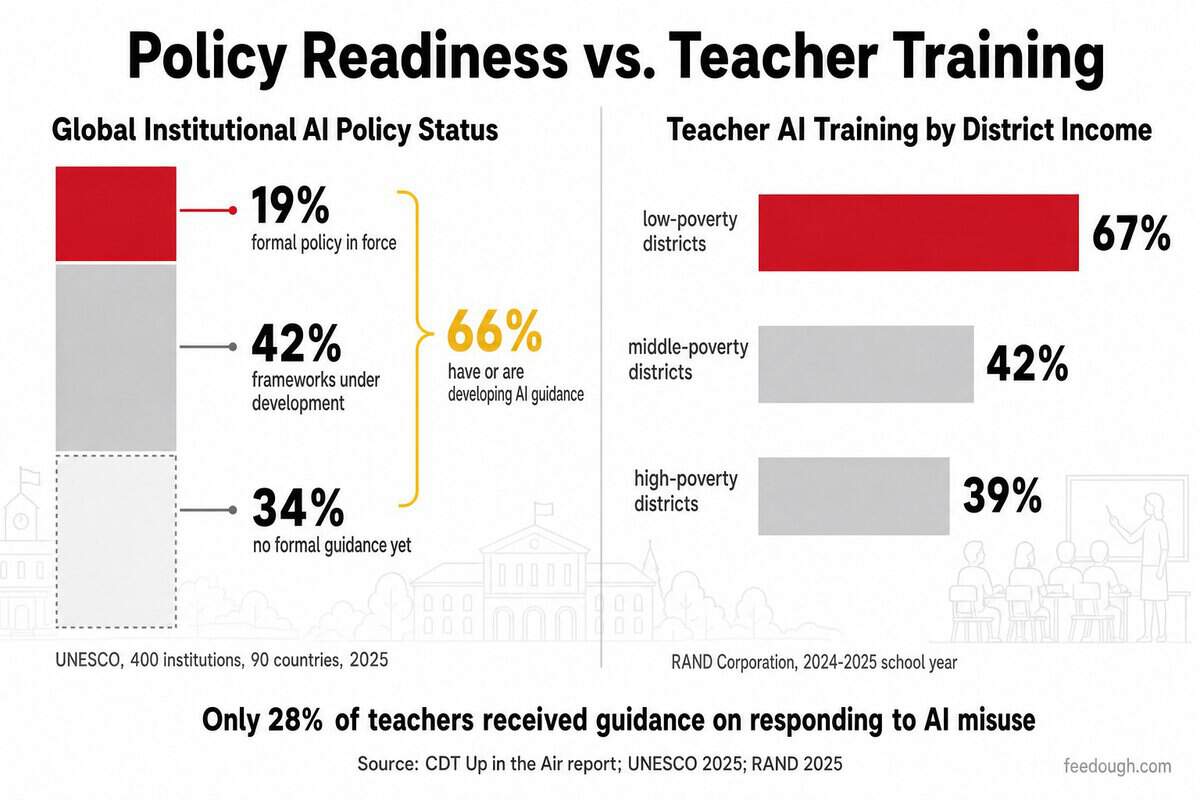
    Only 28% of teachers have received guidance on how to respond when they suspect a student has used generative AI inappropriately, according to the Center for Democracy and Technology’s “Up in the Air” report, as cited in a December 2024 U.S. Commission on Civil Rights report on AI in K-12 education. That figure sits alongside a discipline rate that has climbed sharply. The gap between how often students are being penalized and how often educators feel equipped to make that call is the central tension in institutional AI governance right now.

    Policy Status
    Share of Institutions
    Source
    Formal AI policy already in force
    19%
    UNESCO global survey, Sept. 2025 (400 institutions, 90 countries)
    Guiding AI framework under development
    42%
    UNESCO global survey, Sept. 2025
    Have or are developing formal AI guidance (combined)
    66%
    UNESCO global survey, Sept. 2025
    No formal guidance yet
    34%
    UNESCO global survey, Sept. 2025

    The UNESCO data covers 400 institutions across 90 countries. Two-thirds have a policy or are actively building one. But a policy document and a trained faculty body are different things. The institutional response and discipline rate statistics from RAND’s American School District Panel reveal a starker version of the same problem at the K-12 level, and the gap runs along income lines:

    • 67% of low-poverty U.S. school districts had provided teacher training on AI use by fall 2024 (RAND Corporation, 2024–2025 school year)
    • 42% of middle-poverty districts had provided the same training by fall 2024 (RAND Corporation)
    • 39% of high-poverty districts had provided teacher AI training by fall 2024 (RAND Corporation)
    • 28% of teachers overall have received any guidance on how to respond to suspected AI misuse, per the Center for Democracy and Technology’s “Up in the Air” report

    The training gap by district income means the institutions least resourced to handle AI misconduct are also the ones most likely to handle it inconsistently. A student in a high-poverty district faces a teacher with no formal guidance and no training. A student in a low-poverty district is more likely to face one who has both. That disparity does not show up in misconduct statistics, but it shapes them.

    Institutional Response and Discipline Rates

    Global AI Cheating Trends and Regional Differences Statistics

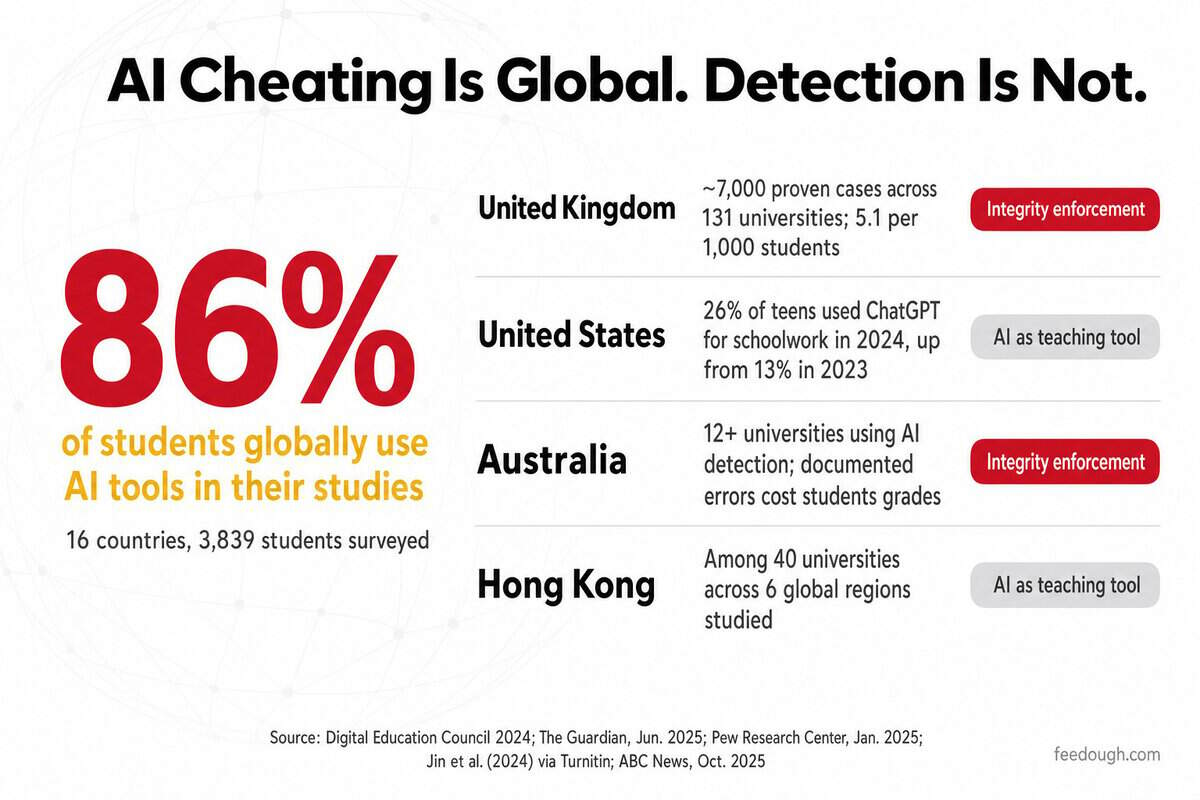
    The UK leads the world in documented AI cheating cases. It almost certainly does not lead the world in actual AI cheating. Almost 7,000 proven AI misconduct cases were tracked across 131 UK universities in the 2023-24 academic year, at a rate of 5.1 cases per 1,000 students, up from 1.6 per 1,000 the prior year, according to a Guardian investigation using Freedom of Information Act requests. That tripling happened inside the world’s most systematically monitored higher education system. What it reveals about the UK is less about student behavior and more about institutional capacity to catch it.

    Region / Country
    Key Documented Metric
    Policy Orientation
    Source
    United Kingdom
    ~7,000 proven cases across 131 universities in 2023-24; 5.1 per 1,000 students (up from 1.6 per 1,000)
    Academic integrity and originality enforcement
    The Guardian / FOI, June 2025
    United States
    26% of teens used ChatGPT for schoolwork in 2024 (up from 13% in 2023); no national case tracking system
    Leveraging AI to enhance teaching and learning
    Pew Research Center, Jan. 2025; Jin et al. (2024) via Turnitin
    Australia
    At least a dozen universities using AI detection software; documented errors costing students grades and graduation standing
    Academic integrity enforcement (similar to UK)
    ABC News, Oct. 2025
    Hong Kong
    Policy studies in 40-university cross-regional analysis
    Leveraging AI to enhance teaching and learning
    Jin et al. (2024) via Turnitin
    Global (16 countries)
    86% of students use AI tools in their studies; 54% use AI weekly; nearly 1 in 4 use it daily
    Varies by institution
    Digital Education Council Global AI Student Survey 2024 (3,839 students)

    The 86% global AI usage figure cuts across every regional policy distinction. Students in countries with strict enforcement frameworks and students in countries with permissive or ambiguous ones are using these tools at comparable rates. What diverges is not the behavior but the institutional response to it. A study of 40 universities across six global regions found that UK and Australian institutions frame the issue primarily as an academic integrity and originality problem, while US and Hong Kong institutions lean toward AI as a teaching enhancement tool. That framing difference shapes which cases get counted and which disappear into the gap between policy and practice.

    Australia’s situation adds a specific complication. At least a dozen universities are actively deploying AI detection software, but ABC News reporting from October 2025 confirmed that documented errors from those tools have already cost students grades, caused failed subjects, and threatened graduation timelines at institutions including Queensland University of Technology and the University of Melbourne. Deploying detection infrastructure does not resolve the regional data gap. It adds a new one: cases where the tool was wrong.

    Global AI Cheating Trends and Regional Differences

    Impact of AI Cheating on Institutions: Costs and Consequences

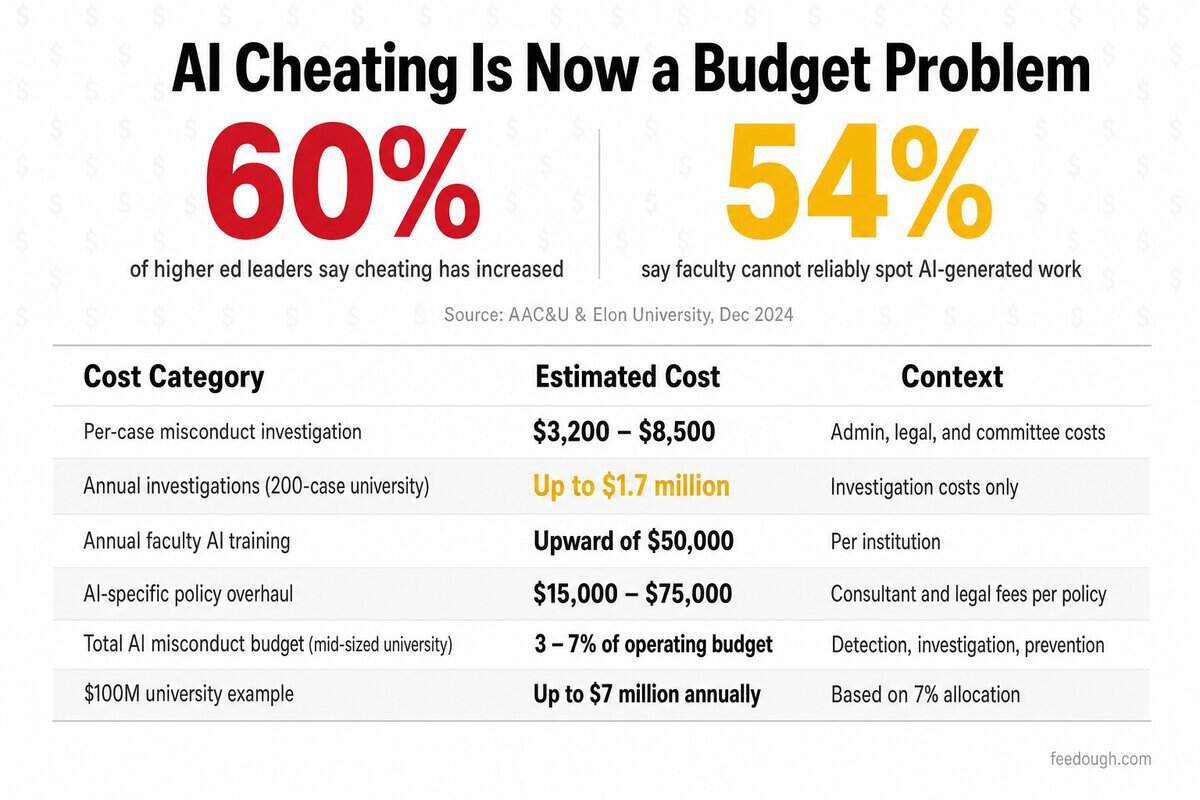
    Sixty percent of higher education leaders say cheating has increased since generative AI became widely available. Most of them are also paying to address it without being sure they can even see it clearly: 54% say their faculty are not effective at recognizing AI-generated content, according to a survey of higher education executives conducted by AAC&U and Elon University between November and December 2024. That combination, rising misconduct and unreliable detection capacity, is what has turned an academic integrity problem into a budget problem.

    • Each misconduct investigation costs institutions an average of $3,200 to $8,500 when administrative time, legal reviews, and academic committee proceedings are factored in
    • A single large university handling 200 cases annually faces investigation costs alone reaching $1.7 million
    • Some colleges spend upward of $50,000 annually on faculty training programs to help educators identify AI-generated work
    • Policy overhauls cost institutions between $15,000 and $75,000 per comprehensive AI-specific academic integrity policy, covering consultant and legal expert fees
    • California Community Colleges lost $11 million in financial aid funds to applicant fraud in 2024, with 31% of applications identified as fraudulent (BCG analysis, EdSource, September 2025)
    • Institutions experiencing publicized academic integrity breaches have seen average enrollment drops of 8–12% over the following two years
    Cost Category
    Estimated Cost Range
    Context
    Per-case misconduct investigation
    $3,200 – $8,500
    Includes administrative, legal, and committee costs
    Annual investigation costs (200-case university)
    Up to $1.7 million
    Investigation costs only, before detection or prevention
    Annual faculty AI training (per institution)
    Upward of $50,000
    Training to identify AI-generated academic work
    AI-specific policy overhaul (per policy)
    $15,000 – $75,000
    Consultant and legal expert fees
    Total AI misconduct budget (mid-sized university)
    3 – 7% of annual operating budget
    Detection, investigation, and prevention combined
    For a university with a $100M operating budget
    Up to $7 million annually
    Based on 7% allocation figure

    The AI cheating impact statistics from California add a dimension that goes beyond campus misconduct systems. When fraudulent applications at a community college system reach 31%, the financial aid pipeline itself becomes compromised. AI-based fraud detection tools identified twice as many fraudulent applications as manual review in that same system, per BCG analysis, which points toward where institutional spending is likely to shift next: not just toward catching students who cheat on assignments, but toward screening who enters the system in the first place.

    Impact of AI Cheating

    Future Trends and Projections in AI Cheating Statistics

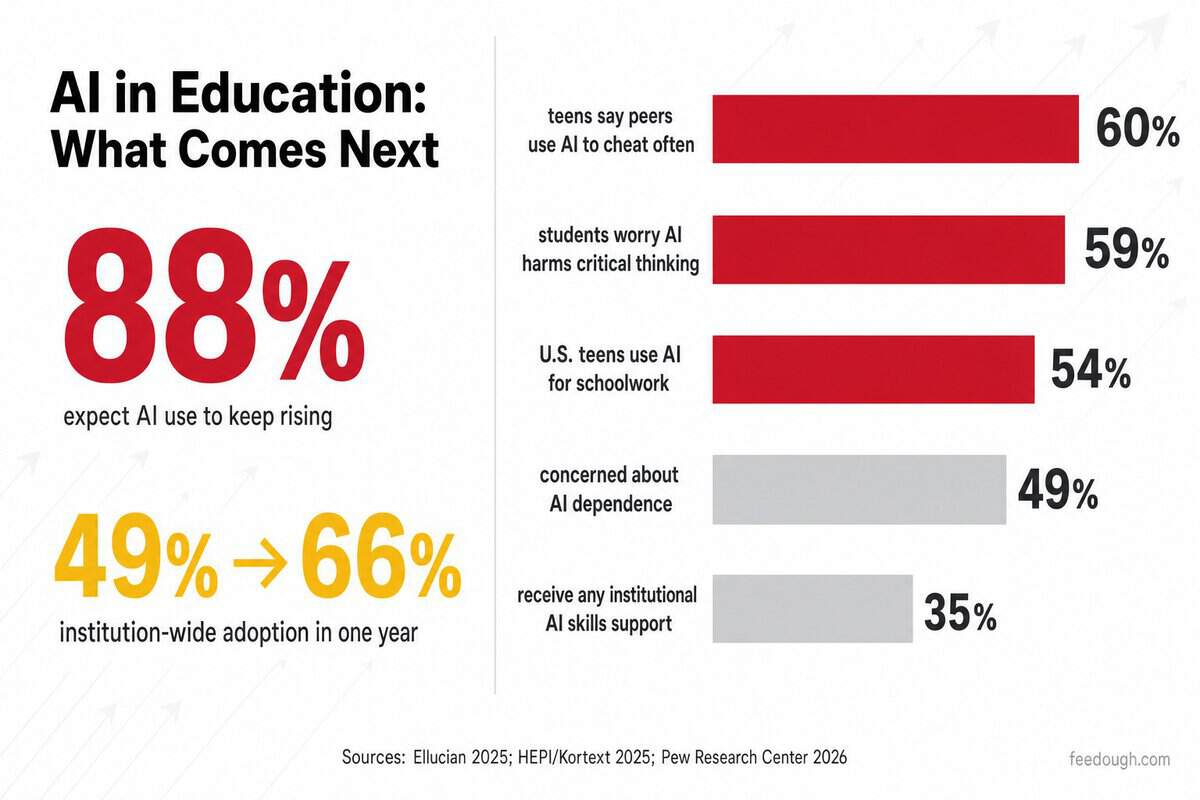
    Institution-wide AI adoption in higher education jumped from 49% to 66% in a single year, and 88% of higher education institution respondents expect their institution’s AI use to keep rising over the next two years, according to Ellucian’s 2025 AI in Higher Education survey. That number is not a projection built on assumptions. It reflects what the people running these institutions see happening inside them right now. The question is no longer whether AI becomes standard in academic life. It is whether the support structures around it catch up before the integrity gaps widen further.

    Assessment frameworks are already shifting in response. In the UK, 59% of undergraduates said the way they are assessed has changed “a lot” because of generative AI, per the HEPI and Kortext Student Generative AI Survey 2025 (1,041 full-time UK undergraduates). The proportion of students saying university staff are well-equipped to work with AI doubled in twelve months, from 18% in 2024 to 42% in 2025. That is meaningful progress. It also means 58% of students still do not believe their institutions are ready.

    Trend Metric
    Earlier Measure
    Current / Projected Measure
    Source
    Institution-wide AI adoption (HE sector)
    49% (2024)
    66% (2025)
    Ellucian 2025 AI in Higher Education survey
    HEI respondents expecting AI use to keep rising
    Not reported
    88% over next two years
    Ellucian 2025 AI in Higher Education survey
    Students saying staff are well-equipped for AI
    18% (2024)
    42% (2025)
    HEPI / Kortext Student Generative AI Survey 2025 (1,041 UK undergraduates)
    UK undergraduates who say assessment has changed “a lot” due to AI
    Not reported
    59% (2025)
    HEPI / Kortext Student Generative AI Survey 2025
    U.S. teens using AI chatbots for schoolwork (Pew 2026)
    26% used ChatGPT for schoolwork (2024)
    54% use AI chatbots for schoolwork (early 2026)
    Pew Research Center, 1,458 U.S. teens ages 13–17
    Teens reporting peers use AI to cheat “often”
    Not reported
    60% (early 2026)
    Pew Research Center, 1,458 U.S. teens ages 13–17

    The Pew 2026 data on U.S. teens is the sharpest early indicator of where the next phase lands. Among 13-to-17-year-olds, 54% already use AI chatbots for schoolwork, and 10% use AI for all or most of their homework. That cohort is two to five years from higher education. The academic integrity frameworks being built now will be tested by students for whom AI assistance was never experimental. It was just how school worked.

    Students themselves are not uniformly comfortable with that trajectory. The concern data from HEPI 2025 and Turnitin’s analysis of AI-native academic integrity trends shows a generation that is using these tools while remaining genuinely uncertain about what they are doing to their own development:

    • 59% of students worry that AI could reduce their critical thinking skills (HEPI 2025 / Turnitin analysis)
    • 49% are concerned about becoming too dependent on AI tools (HEPI 2025 / Turnitin analysis)
    • 35% of students report receiving any institutional support to develop AI skills, leaving the majority navigating these tools without formal guidance (HEPI 2025 / Turnitin analysis)
    • 10% of U.S. teens report using AI for all or most of their homework (Pew Research Center, 1,458 teens ages 13–17, early 2026)
    • 60% of U.S. teens say students at their schools use AI to cheat often (Pew Research Center, early 2026)
    Future Trends and Projections

    Sources

  • 86+ AI Art Statistics 2026: Growth, Usage & Industry Impact

    86+ AI Art Statistics 2026: Growth, Usage & Industry Impact

    Just three years ago, professional-quality artwork required years of training and expensive software. Today, the tools doing that work are being used by tens of millions of people who have never held a brush.

    AI art statistics from 2025 show the global AI image generation market is on track to reach $1.3 billion this year, expanding at 35.7% annually. That growth rate puts it among the fastest-scaling segments in the entire creative technology industry.

    Here is what the data shows about who is driving that growth, which platforms are winning, and what it means for the people whose livelihoods depend on making art.

    Key AI Art Statistics for 2025

    The AI art market is not experimenting anymore: it is scaling, and the numbers across market size, platform adoption, and commercial use all point in the same direction.

    • The global AI image generation market is projected to reach $1.3 billion by 2025, expanding at a 35.7% CAGR (SuperAGI, 2025)
    • The AI-powered design tools market is expected to reach $4.4 billion by 2025, growing at a 34.8% CAGR (Grand View Research, 2025)
    • The global AI creativity and art generation market is projected to grow at a 26.5% CAGR from 2025 to 2034, reaching approximately $141.7 billion by 2034, up from $13.5 billion in 2024 (Market.us, August 2025)
    • Midjourney has nearly 21 million members on its Discord server as of June 2025, confirming continued growth from prior-year levels (AIPRM, June 2025)
    • Visual art represents over 50% of the total AI creative market, making it the dominant category in AI-generated content (God of Prompt, 2025)
    • Over 35% of fine art auctions now feature AI-generated pieces, reflecting mainstream acceptance in traditional art markets (Artsmart.ai, 2025)
    • 24% of promotional suppliers use AI for artwork creation, demonstrating significant adoption in commercial applications (ASI, 2025)
    • Commercial AI art detection software identifies AI-generated images with approximately 98% accuracy, while general users perform near chance level at roughly 50% and professional artists reach around 83% accuracy (Hall & Schofield, SCIRP Art and Design Review, February 2025)

    AI Art Market Size and Growth Statistics

    The AI art market reached a combined baseline of roughly $13.5 billion in 2024. By 2034, Market.us projects the AI creativity and art generation segment alone will hit $141.7 billion, compounding at 26.5% annually for a full decade.

    That headline figure obscures something worth separating out: AI art is not one market. It is three overlapping ones, each growing at a different rate and from a different starting point.

    Market Segment
    Current Value
    Projected Value
    CAGR
    AI Creativity and Art Generation (broad)
    $13.5 billion (2024)
    $141.7 billion by 2034
    26.5%
    Generative AI in Art (narrow)
    Baseline 2024
    +$1.69 billion growth by 2029
    37.8%
    AI Image Generator
    $412.51 million (2025)
    $1.75 billion by 2034
    17.4%
    AI-Powered Design Tools
    $6.74 billion (2025)
    $18.16 billion by 2030
    21.9%
    Visual Art segment share
    Over 50% of AI creative market
    Dominant category
    N/A

    The gap between segments is not a contradiction. The narrower the definition, the faster the growth rate tends to appear, because the base is smaller and the use case is more concentrated. Generative AI in art at 37.8% is expanding from a tighter base than the broad creativity market at 26.5%. Both are real; they are just measuring different perimeters of the same territory.

    Design tools tell a different story. At 21.9%, they grow more slowly because they compete directly against Adobe and Canva, two companies with deep enterprise contracts and decades of workflow lock-in. Pure AI art market size statistics show image generation and generative art expanding into space those incumbents never occupied, which is why their growth rates run higher despite smaller absolute revenues.

    Market Size and Growth Statistics

    AI Art Platform Usage and User Statistics

    Midjourney still leads. But the platform that once had no serious competition now holds 26.8% of the global AI image generator market, with three competitors collectively holding the remaining 63% and new entrants cutting further into that gap every quarter.

    Platform
    Market Share (2024)
    Notable Metric
    Midjourney
    26.8%
    21 million Discord members (May 2025)
    DALL-E
    24.4%
    Usage share on Poe dropped ~80% as model count scaled
    NightCafe
    23.2%
    Community-driven generation model
    Stable Diffusion
    15.1%
    Open-source; runs locally without subscription
    Adobe Firefly
    29% of AI design tools segment
    24 billion assets generated by June 2025; 45% CC subscriber adoption
    Flux (Black Forest Labs)
    ~40% of Poe image messages (2025)
    Displaced DALL-E 3 as top model on platform

    The Flux story is the sharpest signal of how quickly this market reshuffles. When Poe launched with roughly three image generation models, DALL-E 3 dominated. By 2025, the model count had grown to approximately 25, and Flux absorbed close to 40% of all image generation activity on the platform. DALL-E 3’s relative share fell nearly 80%. These AI art platform usage statistics reflect a broader pattern: user attention concentrates around whichever model produces the best output at a given moment, and loyalty to any single platform is shallow.

    Within Midjourney itself, the engagement picture is more stable. The platform’s registered user base is large, but a specific subset does the heavy lifting:

    • Midjourney’s website recorded 14.68 million visitors in May 2025, up from 13.44 million in March 2025, a 9.2% increase in two months
    • Approximately 1.1 million to 2.5 million users are active on any given day, representing roughly 7.5% of the total registered base
    • 65% of Midjourney’s user base is Millennials or Gen Z; only 3.46% are over 65
    • Adobe Firefly generated over 24 billion AI assets by June 2025, with platform traffic growing more than 30% quarter over quarter

    A 7.5% daily active rate would be unremarkable for a social app. For a paid creative tool, it signals genuine workflow integration rather than casual experimentation. The demographic skew toward younger users also points to where the next wave of professional adoption is coming from: designers and creators who grew up treating digital tools as default, not as a supplement to traditional methods.

    Platform Usage and User Statistics

    AI Art Industry Adoption and Business Integration Statistics

    Commercial buyers and traditional auction houses are not moving in sync, but they are both moving. 35% of fine art auctions now feature AI-generated pieces while, across the promotional products industry, AI art industry adoption statistics show the technology has become a standard workflow tool rather than a pilot program.

    Sector / Use Case
    Adoption Figure
    Context
    Promotional suppliers using AI for artwork generation
    24%
    2nd most common AI use case among suppliers
    Promotional distributors integrating AI into design workflows
    19%
    3rd most popular AI application among distributors
    Fine art auctions featuring AI-generated pieces
    Over 35%
    Signals institutional acceptance in traditional art markets
    AI artwork generation rank (suppliers)
    2nd most common
    Trails only general AI productivity use cases
    AI artwork generation rank (distributors)
    3rd most popular
    Embedded within broader AI workflow adoption

    The split between suppliers at 24% and distributors at 19% reflects where in the supply chain AI image generation delivers the most direct time savings. Suppliers control the creative brief and the output; distributors operate one step removed, using AI to adapt and present existing assets rather than generate from scratch. The gap is narrow enough that both groups are well past the early adopter phase.

    • AI artwork generation sits at 2nd place among all AI use cases for promotional suppliers, behind only general productivity tools
    • For distributors, AI design workflow integration ranks 3rd, showing cross-function adoption beyond just the creative team
    • Over 35% of fine art auctions now include AI-generated pieces, putting AI art inside the same institutional frameworks that once gatekept it out
    Industry Adoption and Business Integration

    Consumer AI Art Awareness and Detection Statistics

    The original assumption was that consumers had developed a sharp eye for AI-generated images. The data says the opposite. A September 2025 Conjointly study of 301 U.S. adults found that participants correctly identified AI-generated images only 52% of the time and real images 49% of the time: both figures hover at the statistical boundary of random guessing. What makes that finding sharper is that 42% of those same respondents reported high confidence in their ability to tell the difference.

    These consumer AI art detection statistics hold up across multiple studies, and each one adds a layer. The SCIRP research (Hall and Schofield, 2025) that originally anchored the 98% accuracy claim was measuring commercial detection software, not human perception. For actual humans, accuracy scales with professional experience and art training, not with general familiarity with AI tools.

    Study / Source
    Population
    Detection Accuracy
    Conjointly (Sept 2025)
    301 U.S. adults (general)
    52% (AI images); 49% (real images)
    SCIRP, Hall and Schofield (Feb 2025)
    General users
    ~50% (chance level)
    SCIRP, Hall and Schofield (Feb 2025)
    Artists with limited experience
    ~75%
    SCIRP, Hall and Schofield (Feb 2025)
    Professional artists
    ~83%
    SCIRP, Hall and Schofield (Feb 2025)
    Commercial AI detection software
    ~98%
    Frontiers in Artificial Intelligence (2025)
    General participants (landscapes, architecture, interiors)
    63.7% overall; accuracy declined with age

    The gap between the 98% software figure and the 50% human baseline is not a rounding error. It is the entire story. Humans bring context, aesthetics, and intuition to the task; they also bring overconfidence. Software brings pattern recognition without the assumptions. The Frontiers study’s finding that accuracy declined with age and improved among those with prior AI tool experience points to a learned skill, not an instinct.

    That gap has a direct commercial consequence. According to Getty Images’ “Building Trust in the Age of AI” report (April 2024), nearly 90% of consumers want transparency when brands use AI-generated images, and 98% say authentic images and videos are pivotal to establishing trust. The IAB’s 2026 report found that 71% of Gen Z and Millennial consumers believe they have already seen an AI-generated ad (up from 54% in 2024), while only 45% feel positive about them. Ad executives put that positive sentiment figure at 82%, a perception gap that has widened from 32 points in 2024 to 37 points in 2026. Creators who are counting on poor detection to avoid disclosure are misreading the environment entirely: consumers may not be able to identify AI art reliably, but they know it is there, and they have opinions about it.

    Consumer Awareness and Detection Statistics

    AI Art Regional Market Distribution Statistics

    North America accounted for over 40% of total AI art market revenue in 2024, reaching approximately $1.2 billion on the strength of frontier AI companies and institutional investment in creative technology. That lead is real. It is also shrinking. Asia-Pacific held 33% of global AI software revenue in 2025 and is forecast to reach 47% by 2030, a trajectory that would push North America’s share down from 54% to 33% over the same period, according to ABI Research.

    Region / Market
    Current Position
    Projection or Trend
    North America (AI art revenue, 2024)
    Over 40% share; ~$1.2 billion
    Dominant now; share projected to decline to 33% by 2030
    North America (Generative AI in Art, 2023)
    38%+ share; ~$125.2 million of $298.3 million global total
    Largest single region, ahead of Europe and Asia-Pacific
    Asia-Pacific (AI software revenue, 2025)
    33% of global revenue
    Forecast to reach 47% by 2030, potentially overtaking North America
    Global Generative AI in Art market
    $0.43 billion (2024)
    $2.51 billion by 2029; 42% CAGR
    Primary investment hubs (global)
    United States, China, European Union
    Identified across all major forecasts as core growth centers

    These AI art regional market statistics reflect a broader pattern visible across the AI industry: North America built the foundational infrastructure and attracted the early capital, while Asia-Pacific is scaling on top of it at a faster rate. China’s AI investment growth is the primary driver of the Asia-Pacific forecast, and the EU’s position as an investment hub means European regulatory caution has not translated into market absence. The seven-region global footprint of the generative AI in art market, spanning from Africa to Eastern Europe, suggests the $2.51 billion 2029 projection is built on genuinely distributed demand, not concentration in one geography alone.

    Regional Market Distribution

    What the AI Art Statistics Actually Reveal

    Growth at **35.7%** annually is the headline. The more interesting story lives underneath it, in three contradictions the data surfaces when read together. The market is expanding at a pace most technology sectors never reach. The platforms leading that market are less entrenched than their user numbers suggest. And the consumers participating in that market understand less about what they are consuming than they think they do.

    These AI art statistics do not describe a technology finding its footing. They describe one that has already scaled past the point where course corrections are easy, with structural tensions that will define the next phase of competition, regulation, and creative practice.

    Tension
    What the Data Shows
    What It Implies
    Market scale vs. market fragmentation
    The broad AI creativity market is on track for $141.7 billion by 2034, but image generation, design tools, and generative art are each growing at different rates from different baselines
    No single player or category captures the whole market; the winner in one segment does not automatically lead in another
    Platform dominance vs. platform fragility
    Midjourney leads with roughly 27% market share, but Flux captured close to 40% of image generation activity on Poe within months of launch, and DALL-E’s relative share dropped nearly 80% as model count grew
    User loyalty tracks output quality, not brand; leading platforms can lose ground faster than adoption figures suggest
    Consumer confidence vs. consumer accuracy
    General users detect AI-generated images at roughly 50% accuracy (chance level), yet 42% of those same users report high confidence in their detection ability
    Disclosure and transparency carry more weight than detection; consumer trust is built on honesty, not on users catching AI on their own
    Institutional resistance vs. institutional acceptance
    Over 35% of fine art auctions now feature AI-generated pieces; 24% of commercial suppliers use AI for artwork generation
    The gatekeepers that once excluded AI art have already moved; the question is terms and attribution, not inclusion

    The pattern across all four tensions is the same: AI art has moved faster than the frameworks built to manage it. Market projections, platform strategies, consumer education, and institutional policy are all catching up to a technology that did not wait for them. For creators and businesses, that gap between adoption speed and structural readiness is where the most consequential decisions are being made right now.

    What These Numbers Reveal

    Sources

  • Will AI Replace Web Developers? Impact on Jobs, Skills, & Careers

    Will AI Replace Web Developers? Impact on Jobs, Skills, & Careers

    You’ve seen it. AI writes code in seconds that used to take hours. ChatGPT debugs your CSS. GitHub Copilot autocompletes entire functions before you finish typing. And somewhere in the back of your mind, a question nags: “Am I next?”

    Here’s the thing. This isn’t the first time technology threatened to wipe out web developers. Remember WYSIWYG editors? Drag-and-drop website builders? WordPress templates that promised anyone could build a site without touching code?

    Developers are still here.

    But AI feels different. It’s faster. Smarter. Actually useful. So let’s figure out what’s really happening. We’ll look at where web development has been, what AI can actually do right now, and whether your job is about to get automated or just… different.

    How Web Development Got Here

    The 1990s: Static HTML and Tables

    Websites were basically digital brochures. You wrote HTML by hand, used tables to create layouts (yes, really), and changed text colours to feel fancy. Every update meant manually editing files and uploading them via FTP.

    The 2000s: CSS, JavaScript, and Dynamic Web

    The web got interactive. CSS separated design from content, JavaScript made pages respond to clicks, and AJAX let websites update without refreshing. Suddenly you could build actual applications, not just pages. Dreamweaver and similar tools promised anyone could build websites without coding. Sound familiar?

    The 2010s: Responsive Design and Frameworks

    Mobile exploded. Developers scrambled to make sites work on screens of every size. Frameworks like React, Angular, and Vue arrived to tame JavaScript’s chaos. Bootstrap made responsive layouts less painful. Each tool supposedly made things “easier,” but you still needed developers who understood what was happening under the hood.

    The 2020s: AI Enters the Picture

    Now AI can generate code, design layouts, and even debug. It feels different this time because the tech actually works pretty well. But here’s what history shows: tools that automate parts of development don’t kill the profession. They shift what developers spend their time on.

    Where Web Development Stands in 2025

    Let’s look at the actual numbers. The web development market is sitting at $80.60 billion in 2025, and it’s projected to hit $125.40 billion by 2030. That’s not a dying field.

    The Developer Population Keeps Growing

    According to the 2025 Stack Overflow Developer Survey, 69% of developers spent time last year learning new coding techniques or languages. That’s not what happens in a shrinking profession. People don’t invest in learning skills that won’t pay off.

    The developer market continues to expand. Companies are hiring across all experience levels, from junior developers building their first projects to senior engineers architecting complex systems. The demand isn’t slowing down because websites and applications keep getting more sophisticated, not simpler.

    The Tech Stack Is Evolving, Not Shrinking

    Here’s what’s interesting. Developers now use an average of 6 or more tools to do their jobs. The stack isn’t simplifying. It’s getting more complex, which means more things to know and manage.

    React still dominates frontend work, especially with Next.js. Developers are learning new frameworks like Svelte and exploring different backend options. The landscape is expanding, not consolidating.

    How AI Is Changing Web Development

    Here’s what makes this moment different from past “threats” to web developers: the speed of adoption is staggering.

    According to the 2025 Stack Overflow survey, 76% of professional developers now use AI coding tools. That number jumps to 82% among early career developers. This isn’t some niche experiment anymore.

    GitHub Copilot and Code Assistants Take Over

    GitHub Copilot crossed 15 million active users in early 2025. That’s a 400% increase in just 12 months. The tool went from interesting novelty to essential workflow faster than most technologies achieve mainstream adoption.

    But Copilot isn’t alone. AI-powered IDEs like Cursor, Replit, and V0 are building entire interfaces around AI assistance. These aren’t add-ons. They’re reimagining how developers interact with code from the ground up.

    The Productivity Question

    What’s driving this adoption? Real productivity gains.

    AI coding assistants deliver 20-55% productivity gains according to internal Microsoft data, with AI contributing to 30% of code written inside the company. That’s not theoretical. That’s measurable output increase.

    The thing is, these tools aren’t replacing developers. They’re changing what developers spend their time on. Less boilerplate. Less syntax lookup. More architecture decisions and problem-solving.

    How Non-Developers Are Building Websites Without Code

    Something interesting happened while developers were getting more productive with AI. People without any coding background started building their own websites.

    They’re called “citizen developers.” According to Congruence Market Insights, North America is leading this movement, powered by AI development platforms that let non-technical folks create actual functioning websites.

    These aren’t people who went to coding bootcamps or studied computer science. They’re business analysts, designers, and entrepreneurs who needed a website and decided to just… make it themselves.

    The thing is, they’re not writing code in the traditional sense. They’re describing what they want, and AI generates it.

    What Is Vibe Coding?

    That approach has a name: vibe coding. You tell an AI the vibe you’re going for, and it writes the code.

    Here’s how it actually works. You open a platform like Replit or Lovable and type something like “I need a portfolio website with a contact form and image gallery.” The AI generates the code in real languages like React or Next.js. You can tweak things by chatting back and forth. “Make the header bigger.” “Change the colour to blue.” The code updates in real time.

    According to Nucamp’s analysis, by 2030, vibe coding could automate 80% of repetitive coding tasks. Projects that took months might take weeks. You’re not overthinking this, but those are some pretty bold productivity claims.

    What’s interesting is that you can export the generated code and manage it through GitHub like any standard project. So it’s not just throwing something together that only works inside one platform. The code is real.

    Vibe Coding vs Traditional Web Development

    Vibe coding wins on speed. You can go from idea to working prototype in hours instead of weeks. That’s huge for testing concepts or building simple landing pages. But here’s where things get messy.

    The code quality isn’t what you’d want in production. AI generates what works, not what’s maintainable. You end up with bloated files, repeated logic, and structures that make sense to the AI but confuse human developers later. Think of it like building a house with duct tape. It holds together until you need to add a second floor.

    Can Vibe Coding Replace Professional Developers?

    Let’s be straight about what vibe coding actually does well. It’s fantastic for MVPs, portfolio sites, and internal tools that five people will use. You need a simple booking form or a product showcase? Vibe coding handles that beautifully.

    Where It Falls Short

    But ask it to build a multi-tenant SaaS platform with role-based permissions, and you’re in trouble. Custom business logic, complex data relationships, and performance optimisation still need human developers who understand the why behind the code.

    Real example: You’re building a healthcare app that needs HIPAA compliance. Vibe coding might generate a login system, but it won’t understand encryption requirements, audit logging, or data retention policies. A human developer knows to ask about these before writing a single line.

    The realistic answer? Vibe coding replaces the tedious parts of development. It won’t replace the developers who architect systems, debug production issues at 2 AM, or translate messy business requirements into clean solutions. It’s a power tool, not a replacement for the person holding it.

    Skills AI Cannot Replace

    AI can write code, but it can’t decide what to build. That’s the line in the sand.

    1. System Architecture and Design Decisions

    When you’re architecting a system, you’re making tradeoffs. Should you prioritise speed or consistency? Monolith or microservices? SQL or NoSQL? These decisions ripple through your entire product. AI tools suggest patterns, but they don’t understand your business constraints, team size, or future growth plans. You’re weighing factors that don’t fit into a training dataset.

    Say you’re building a social platform. AI might generate a database schema, but it won’t know that your team of three can’t maintain a complex microservices setup. It won’t factor in that your users are mostly in regions with spotty internet, so you need aggressive caching strategies. Those calls require context AI doesn’t have.

    2. Business Logic and Problem-Solving

    Complex business rules don’t come with clear specifications. You’re often interpreting vague requirements from stakeholders who aren’t sure what they want. When a product manager says “make the pricing flexible,” you’re the one figuring out what that actually means in code. Do they want tiered pricing? Volume discounts? Regional adjustments? AI can’t read between the lines or ask clarifying questions that matter.

    3. User Experience and Creative Judgment

    AI can’t decide if a feature feels intuitive or clunky. It can’t tell you that a technically correct implementation frustrates users because it requires too many clicks. You’re the one who understands that people hate waiting, even if the code runs efficiently. This kind of judgment comes from understanding human behaviour, not pattern recognition.

    4. Code Review and Quality Assurance

    Reviewing code isn’t just about syntax errors. You’re catching logical flaws, spotting performance bottlenecks, and identifying maintainability issues. When you see a function that technically works but will confuse every developer who touches it next month, that’s human judgment. AI can flag style violations, but it can’t tell you that this approach will create technical debt you’ll regret in six months.

    The Dead Internet Theory

    It’s the idea that most of what you see online isn’t created by real people anymore. Just bots talking to bots, AI churning out content for other AI to consume.

    And it’s not entirely conspiracy theory. Bot traffic makes up a substantial portion of internet activity now. When you add legitimate bots into the mix, over half of what’s happening online isn’t human.

    The content side is even more striking. AI-generated articles have been steadily increasing, and they’re now competing with human-written ones for prominence. That’s just what we can detect. Plenty of “human-written” content is actually AI-drafted and lightly edited.

    What does this mean for web development? If the internet becomes a bot playground, who are you building websites for?

    The Future: Superapps and Centralised Internet Access

    Now picture this: the open web as we know it gets replaced by superapps. Think WeChat in China, where you don’t browse websites anymore. You chat, shop, pay bills, book appointments, and consume content all within one giant app.

    In that world, traditional web development changes completely. You’re not building standalone sites hoping someone finds them through search. You’re building mini-programs that live inside someone else’s ecosystem.

    Combine that with the bot-dominated internet we just talked about, and you get a strange scenario. Maybe AI agents handle most of the routine web interactions. They parse information, compare prices, fill out forms, and make decisions. The websites still need to exist for them to access, but they’re not designed for human eyes anymore.

    This isn’t science fiction. We’re already seeing it happen. More users access information through AI chatbots than by clicking links. The shift is underway.

    The Verdict: Will AI Replace Web Developers?

    So here’s the answer you’ve been waiting for: No, AI won’t replace web developers. But the job is already changing.

    AI augments your work. It speeds up the boring parts. It generates starter code. It suggests solutions you might not have considered. But it doesn’t understand your user’s specific needs. It can’t navigate the messy politics of stakeholder meetings. It won’t push back when a client wants something that’ll tank their conversion rate.

    The work shifts from writing every line of code by hand to orchestrating systems, making strategic decisions, and solving problems that don’t have template solutions. You become more of an architect and less of a brick-layer. That’s not a downgrade, that’s evolution.

    Want to future-proof yourself? Focus on the skills AI can’t touch: understanding user psychology, communicating technical concepts to non-technical people, making strategic product decisions, and building relationships with clients and teammates.

    The internet might be changing. The tools might be changing. But the need for humans who understand both technology and people? That’s not going anywhere.

    AI is your coworker, not your replacement. Learn to work with it, and you’ll be building the future instead of worrying about it.

  • Will AI Replace Content Writers? Statistics & Analysis 2025

    Will AI Replace Content Writers? Statistics & Analysis 2025

    76% of marketers are already using AI to write content. If you’re a content writer or planning to be one, it’s completely normal to wonder if AI will replace content writers.

    You’ve seen it yourself. AI can write blog posts in minutes, write product descriptions by the hundreds, and generate social media captions faster than a human can. Maybe you’ve even used it yourself and thought, “Well, this is pretty good actually.” 

    The tools are getting better every month, and it’s hard not to wonder if you’re watching your job slowly disappear.

    So what’s actually going on? Are content writers getting replaced, or is something else happening that the headlines aren’t telling you?

    How AI Has Changed Content Writing

    AI tools have automated specific tasks that used to eat up hours of a writer’s day. But when it comes to the nuanced stuff? That’s where the cracks show.

    Tasks AI Has Automated

    The tedious work. The repetitive stuff. AI handles these without breaking a sweat:

    • First draft generation and outline creation: Feed it a topic, get a structure back
    • Grammar and spell checking: Catches typos faster than any human could
    • SEO optimisation and keyword insertion: Drops keywords where they need to go
    • Social media post variations: Generates ten versions of the same message
    • Product descriptions and routine content – Churns out specifications and feature lists

    That’s where freelancers report a noticeable decline in writing opportunities, especially for entry-level and general content creators. The easy jobs got automated first.

    Tasks AI Still Struggles With

    But here’s the thing. AI hits a wall when the work requires actual thinking:

    • Original research and expert analysis: Can’t conduct interviews or synthesise new insights
    • Brand voice consistency: Mimics style but doesn’t internalise it
    • Emotional storytelling and persuasion: Follows formulas without understanding what moves people
    • Strategic content planning: Lacks business context to make real decisions
    • Complex audience understanding: Misses cultural nuances and unspoken needs

    AI writes what looks like content. Humans write what actually connects.

    AI’s Impact on Content Writing Job Market

    This isn’t just about creative jobs vanishing. It’s about how companies are fundamentally restructuring their workforce.

    Overall Job Impact Statistics

    The tech sector experienced 150,000+ job cuts, with AI cited as a contributing factor. That’s a single month showing what automation can do at scale.

    According to JobsPikr, AI-related layoffs in 2025 represent structural workforce shifts. Traditional roles are declining while AI-adjacent positions grow 20% quarterly.

    What this means for you: Companies aren’t just cutting people. They’re redesigning entire job categories around what AI can do versus what humans should do.

    Content Writing Specific Impact

    The shift hits writers in specific ways. Entry-level positions that used to be training grounds? They’re getting automated first. General content creation roles? Those are seeing the steepest declines.

    Meanwhile, roles that involve AI oversight, strategy, or specialised technical writing are growing. The gap between “content creator” and “content strategist who uses AI” is widening fast.

    You’re not imagining the squeeze. The data backs up what you’re seeing in your job search or freelance pipeline.

    What AI Cannot Replace in Content Writing

    Here’s what separates you from the algorithm: lived experience. AI pulls from patterns in existing text. You pull from that time you watched a startup founder cry after a failed pitch or the moment a customer’s face lit up when they finally understood your product.

    That difference shows up in four places where AI consistently falls short.

    1. Human experience and unique perspective. You’ve been through things. You’ve failed, succeeded, observed, and learnt. AI can describe heartbreak or career pivots, but it’s never felt either. When you write from genuine experience, readers sense it immediately.

    2. Strategic thinking and brand alignment. AI doesn’t understand why your brand uses humour while your competitor stays serious. It can’t weigh whether launching a controversial opinion piece serves your long-term positioning. That requires judgement, not pattern matching.

    3. Emotional intelligence and persuasion. Real persuasion means reading the room. It’s knowing when to push and when to pull back. When to use data and when to tell a story. AI follows formulas. You read between the lines.

    4. Original research and expert analysis. AI synthesises existing information brilliantly. But it can’t interview your CEO, analyse proprietary data, or develop a genuinely new framework. Original thinking still requires an original thinker.

    What Content Writers Should Do To Not Get Replaced

    You’re still figuring out how to stay relevant in this mess. Fair enough. Here’s what actually works when the automation wave is crashing around you.

    Develop Specialised Expertise

    Stop calling yourself just a “content writer”. That’s what AI is now.

    Instead, become the person who writes:

    • SaaS product documentation for healthcare compliance software
    • Thought leadership for cybersecurity executives
    • Technical explainers for blockchain developers

    The narrower your focus, the harder you are to replace. AI can write generic blog posts about marketing trends. It can’t write about the specific regulatory challenges facing your niche unless it has deep, structured knowledge you provide. Build that knowledge yourself, and you become the source AI needs.

    Choose one or two industries. Learn their jargon, their pain points, their inside jokes. Read their trade publications. Join their communities. Position yourself as someone who gets it, not just someone who can string sentences together.

    Learn AI Rather Than Resist It

    Fighting AI is like fighting calculators. The writers who stayed relevant after spell-check weren’t the ones who refused to use it.

    Learn to use AI for the grunt work it handles well. First drafts. Outline generation. Research summarisation. Then apply your human judgement to transform that raw output into something actually worth reading.

    This means developing new skills:

    • Prompt engineering that gets you 80% of the way there
    • Editing AI outputs to add voice, nuance, and strategic thinking
    • Knowing which tasks to automate and which require human touch from the start

    The thing is, clients don’t care how you write anymore. They care about results. If you can deliver better content faster by using AI as your research assistant, you win. The writers getting squeezed are the ones who can’t do anything AI can’t.

    Offer Multi-Skilled Services

    Content writing alone isn’t enough. You need to bundle it with skills AI can’t easily replicate:

    • Content strategy and planning: Understanding what to write, when, and why based on business goals
    • SEO and analytics: Interpreting data to optimise content performance, not just following keyword lists
    • Brand voice development: Creating and documenting the unique way a company communicates

    When you can do strategy, execution, and optimisation, you become a partner, not a vendor. Partners don’t get replaced as easily as task-doers.

    Double Down on What Makes You Human

    This is where you actually pull ahead. AI can’t build relationships. It can’t develop a distinctive voice that makes readers say, “Yeah, that sounds exactly like them.”

    Focus on:

    • Storytelling ability: Not just recounting events, but shaping narratives that create emotional impact
    • Unique voice and perspective: The specific way you see and describe the world that no one else can replicate
    • Relationship building: Making clients feel understood, anticipating their needs, becoming someone they trust

    The writers surviving this shift aren’t necessarily the most technically skilled. They’re the ones clients actively want to work with because the collaboration itself adds value. Be that person, and you’ll have work regardless of what AI can do.

    The Honest Answer: Will AI Replace Content Writers?

    The uncomfortable truth is that we’re already past the point of debating whether this will happen. It’s happening. Those 77,999 eliminated positions weren’t theoretical. The question isn’t “will it?” anymore. It’s “which writers?”

    AI Will Replace Some Writers

    You’re going to see fewer opportunities if you’re:

    • An entry-level generalist with no niche. The market for basic blog posts and generic content is shrinking fast. Companies can get “good enough” from AI now.
    • Competing purely on speed and price. You can’t out-cheap a tool that works 24/7 for pennies. That race to the bottom? AI has already won it.
    • Refusing to adapt or learn new tools. Writers who treat AI like it’s 2019 are pricing themselves out of relevance.
    • Producing commodity content anyone could write. If your writing doesn’t require you specifically, someone will eventually ask why they’re paying you at all.

    AI Won’t Replace These Writers

    But here’s what matters more. AI struggles with writers who are:

    • Deep specialists in specific industries. The freelancer who understands SaaS positioning or healthcare compliance? Still irreplaceable. AI can’t fake ten years of domain expertise.
    • Strategic thinkers who shape content direction. Knowing what to write matters more than writing it. Strategy isn’t getting automated anytime soon.
    • Embracing AI as a productivity tool. Writers using AI to handle grunt work while focusing on high-value thinking? They’re not getting replaced. They’re becoming more valuable.
    • Bringing a unique voice and perspective. Original thinking, personal experience, opinionated takes. That’s the stuff AI trains on, not what it creates.

    You get to choose which side of this you’re on. AI isn’t coming for content writers as a category. It’s coming for the ones who haven’t figured out how to be irreplaceable yet. The difference between those two groups? It’s not talent. It’s not luck. It’s adaptation.

  • Will AI Replace Accountants: Trends & Analysis

    Will AI Replace Accountants: Trends & Analysis

    AI is already changing accounting.

    Software that once took hours to process reconciliations now does it in minutes. Tasks you trained for years to master are being automated. The profession you built your career in looks different than it did five years ago.

    But is AI really capable enough to replace accountants completely? Let’s look at what’s happening right now.

    How AI Is Changing Accounting

    The shift isn’t sudden, but it’s real. Firms are quietly swapping spreadsheets for software that reads invoices, flags errors, and reconciles accounts without being told.

    According to Gartner, 59% of finance functions were using AI in 2025, up from 58% in 2024 and 37% in 2023. That’s not hype; that’s adoption.

    What’s actually changing? AI handles the repetitive stuff. Data entry, invoice matching, transaction categorisation. Tasks that used to eat up hours now run in the background. This frees accountants to spend time where it matters: analysing trends, advising clients, and catching issues before they snowball.

    The role isn’t disappearing. It’s evolving.

    What Accounting Tasks AI Has Already Replaced

    According to Thomson Reuters, 21% of tax firms are already using GenAI technology, with 53% either planning to use it or considering it. The manual grunt work? It’s mostly gone.

    Here’s what AI has taken over:

    • Data entry and transaction recording
    • Invoice processing and matching
    • Bank reconciliations
    • Receipt scanning and extraction
    • Basic financial report generation
    • Transaction categorization

    These tasks share something in common. They’re repetitive, rule-based, and time-consuming. That’s exactly what AI handles best.

    What Accounting Tasks AI Will Replace Soon

    The next wave of automation is already in testing phases at major firms. Here’s what’s moving from human desks to AI systems:

    • Tax return preparation (simple returns): Straightforward 1040s and basic business filings
    • Payroll processing: End-to-end calculation, filing, and payment execution
    • Audit sampling and testing: Selection and preliminary review of transaction samples
    • Compliance checking: Real-time monitoring against regulatory requirements
    • Anomaly detection in transactions: Flagging unusual patterns that need human review

    What makes these different from current automation? They require judgment calls that AI is just now getting good enough to handle.

    What Accounting Tasks AI Cannot Replace

    While 71% of tax professionals now believe GenAI should be applied to their work, they’re not saying it should replace them. They’re saying it should work for them. That’s a huge difference.

    These are the areas where human accountants remain irreplaceable:

    • Complex tax planning and strategy
    • Client advisory and business consulting
    • Ethical judgment and regulatory interpretation
    • Fraud investigation and forensic analysis
    • Relationship management and communication
    • Nuanced decision-making in ambiguous situations

    AI can crunch numbers, but it can’t read the room when a client’s worried about cash flow, and it definitely can’t decide whether a grey-area deduction is worth the audit risk for someone’s specific situation.

    Current AI Adoption In Accounting

    These numbers show you how fast things are moving and where firms are placing their bets.

    • 59% of finance functions will use AI in 2025 (up from 58% in 2024 and 37% in 2023)
    • 21% of tax firms already use GenAI, with 53% planning or considering it
    • 90% of finance teams plan to deploy AI by 2026
    • 75% of accounting firms have increased focus on tech skills in hiring
    • 71% of tax professionals believe GenAI should be applied to their work
    • 98% of accountants surveyed have used AI to help clients

    The gap between early adopters and the rest is closing fast.

    Yes, AI is changing accounting work. But losing your job? That’s a different story than what the headlines suggest.

    Actual Job Displacement Numbers

    Only 1.8% of U.S. layoffs in 2025 (17,375 out of 946,426) were explicitly attributed to AI. That’s it. Not the mass elimination we keep hearing about. Most job cuts have nothing to do with AI; they’re tied to the usual suspects like restructuring, budget issues, and market shifts.

    The thing is, firms aren’t replacing accountants wholesale. They’re figuring out how AI fits into existing teams.

    How Hiring Requirements Are Changing

    Job postings now list things like “experience with automation tools” or “comfort with data analytics platforms” alongside traditional requirements. Firms want accountants who can work with AI, not around it.

    Think of it as adding a new tool to your kit rather than replacing the entire toolbox. The role is evolving, not disappearing. You’re still doing accounting, but you’re just doing it with better tools.

    What Accountants Should Do To Stay Relevant

    Here’s the thing, AI isn’t ending the accounting profession. It’s redefining it. If you’re willing to adapt, you’ll find yourself in a stronger position than before. These five moves will set you up to thrive.

    1. Learn AI Tools and Systems

    Start experimenting with AI platforms your firm already uses. You don’t need to code. Just get comfortable with how tools analyse data, flag anomalies, and generate reports. The accountants who know how to work alongside AI will manage the ones who don’t.

    Spend a few hours each week testing features, watching tutorials, and figuring out what these systems can and can’t handle.

    2. Develop Advisory Skills

    When AI handles bookkeeping and data entry, clients will pay you for strategic guidance. That means learning to interpret financial patterns, recommend growth strategies, and help businesses make smarter decisions.

    You’re not just reporting numbers anymore. You’re translating those numbers into actionable insights that drive real results.

    3. Build Soft Skills

    Communication, critical thinking, and creativity separate good accountants from irreplaceable ones. AI can’t read a room, sense when a client is anxious, or craft a message that lands just right. These human skills become your edge. Practise explaining complex concepts simply. Work on asking better questions. Clients remember how you make them feel, not just the accuracy of your calculations.

    4. Stay Current on Regulations and Ethics

    Compliance and professional judgement require human oversight. AI can flag potential issues, but it can’t weigh ethical grey areas or apply nuanced regulatory knowledge to unique situations. Keep your certifications current. Attend industry seminars. This expertise is where machines hit their limits, and your value skyrockets.

    5. Specialise in Complex Areas

    Focus on high-stakes work that demands human judgment. Tax planning for multi-state operations, forensic accounting, and merger analysis. These areas involve too many variables and too much context for AI to handle alone. Specialisation makes you indispensable, not interchangeable.

    So, Will AI Replace Accountants?

    AI isn’t coming for your job. It’s coming for the way you do your job.

    And the answer for those who ask, “Will AI Replace Accountants?” is quite simple.

    The accountants who treat AI like a threat will spend the next decade watching opportunities slip away. The ones who treat it like a tool will spend that same decade building practices that are faster, sharper, and more valuable to clients. The choice isn’t between adapting or surviving. It’s between leading and following.

    Your technical skills got you here. Your ability to pair those skills with technology will determine where you go next. The profession isn’t shrinking; it’s evolving. And you’re either evolving with it, or you’re not.

  • Will AI Replace Copywriters? Evidence-Based Analysis

    Will AI Replace Copywriters? Evidence-Based Analysis

    You watch an AI tool give out five ad variations in 30 seconds. That task would’ve taken you an hour, maybe two if you were working with different angles. The question hits you before you can stop it: How long before companies decide they don’t need you at all?

    AI isn’t going anywhere. It’s already writing product descriptions, social posts, and email campaigns. But the real question isn’t whether AI will replace copywriters. It’s which copywriters will it replace?

    This article breaks down what’s actually happening in the copywriting field right now. You’ll see where AI falls short, what skills keep you irreplaceable, and how to position yourself so you’re not competing with tools but working alongside them.

    What Do Copywriters Do?

    Copywriters write the words that convince people to take action. They create the text you see in ads, on websites, in your inbox, and across social media. The job is about getting people to click, buy, sign up, or engage with a brand.

    Here’s what that looks like day-to-day:

    • Writing ads (Google, Facebook, display)
    • Creating email campaigns
    • Building landing pages and website copy
    • Crafting social media posts
    • Developing product descriptions
    • Writing video scripts and sales pages

    But it’s not just about typing words. Copywriters need to understand their audience well enough to know what makes them tick. They research what problems people have, what language they use, and what objections they might raise. Then they figure out how to address all that in a way that fits the brand’s voice.

    The real skill is persuasion. You’re not just describing a product. You’re making someone care enough to act on it.

    How AI Has Changed Copywriting

    76% of marketers now use AI for basic content creation and copywriting, which tells you everything about how fast this shift happened. AI hasn’t replaced everything equally. Some tasks vanished overnight, others are on borrowed time, and a few remain stubbornly human.

    Copywriting Tasks AI Has Replaced Completely

    These are the tasks that copywriters used to grind through, but now AI handles them faster, cheaper, and honestly, just as well:

    • Basic product descriptions – The “Features: X, Y, Z” stuff that fills e-commerce sites
    • Simple social media posts – Generic “Happy Monday” updates and promotional captions
    • Template emails – Welcome sequences, password resets, order confirmations
    • Meta descriptions – Those 160-character snippets under search results
    • Basic ad variations – Slight tweaks to headlines for A/B testing

    These tasks never needed human creativity in the first place. They followed formulas. AI is really good at formulas.

    Copywriting Tasks AI Will Replace Soon

    This is where things get uncomfortable for some copywriters. These tasks still need a human touch today, but AI is catching up fast:

    • First drafts – AI already creates rough versions that humans then refine
    • A/B test variations – Tools can now generate dozens of headline options in seconds
    • Routine blog posts – Informational content that follows predictable structures
    • Standard landing pages – Sales pages built from proven templates

    You’re seeing the pattern here. If the task is repeatable and follows a structure, AI will figure it out. What separates “will replace soon” from “replaced completely” is just time and better training data.

    Copywriting Tasks AI Can Never Replace

    Human copywriters still win in some areas, and probably always will. These tasks require something AI fundamentally lacks:

    • Strategic brand messaging – Understanding what makes a brand different and why it matters requires human judgment
    • Complex storytelling – Weaving narratives that connect emotionally across multiple touchpoints
    • Nuanced emotional copy – Writing that shifts tone based on unspoken context and cultural subtleties
    • Deep customer insights – Reading between the lines of what customers say versus what they actually mean
    • Adapting to complex feedback – When a client says “make it pop” or “I’ll know it when I see it,” humans decode that mess

    AI can mimic emotion. It can’t feel it, understand it, or know when to bend the rules. That’s the gap that keeps human copywriters employed—and it’s bigger than most people think.

    Current AI Adoption Rate in Copywriting

    AI isn’t some distant future thing anymore; it’s already here, and copywriters are using it right now. The data shows just how fast this shift is happening.

    Current adoption numbers:

    • 90% of content marketers use AI in 2025, jumping from 83.2% in 2024 and 64.7% in 2023
    • 87% use AI for content development
    • 68% use it for ideation
    • 90% of marketers use AI for text-based tasks, including idea generation (90%), draft creation (89%), and headline writing (86%)

    These numbers tell a pretty clear story. We’re past the “should we try AI?” phase. Most copywriters and marketers have already tested it and built it into their workflow. The growth from 64.7% to 90% in just two years shows this isn’t a trend that’s slowing down. 

    What’s interesting is how AI gets used across different parts of the writing process, from brainstorming to headlines to full drafts. That means it’s not replacing one specific task. It’s becoming a tool that sits alongside copywriters throughout their entire workflow.

    Are Companies Still Hiring Copywriters?

    Yes, but the job you’re applying for looks different than it did three years ago. Companies aren’t just looking for someone who can write. They want copywriters who know how to work with AI, edit its output, and bring the strategic thinking machines can’t replicate.

    The shift is real. According to Final Round AI, 77,999 jobs were eliminated by AI in 2025. The roles disappearing are mostly entry-level content mill positions. The jobs that remain require a different skill set. One that combines writing chops with AI literacy.

    How AI Has Changed Job Hiring for Copywriters

    Hiring managers now ask about your experience with AI tools during interviews. They want to know if you can prompt ChatGPT effectively, edit AI-generated drafts, and identify when the output misses the mark. Basic writing skills alone won’t cut it anymore.

    What companies are actually looking for:

    • Strategic thinking to guide AI in the right direction
    • Editing skills to refine AI output and add human nuance
    • Brand voice expertise that AI can’t replicate
    • Understanding of audience psychology beyond surface-level data

    Companies see AI as a productivity multiplier. They’re hiring fewer copywriters overall, but expecting each one to produce more with AI assistance. That means you need to be comfortable managing AI as part of your workflow, not competing against it.

    Technology sector job postings dropped 58% in 2025, which includes content creation roles. That’s significant. But it’s not the whole story.

    What’s actually happening in the market:

    • Entry-level “content writer” positions are down significantly
    • Mid-level strategic copywriter roles remain stable
    • Specialist positions (like conversion copywriting and brand messaging) are still in demand
    • Freelance opportunities are shifting toward project-based strategic work

    Companies are consolidating their content teams. Instead of hiring five junior writers to churn out blog posts, they’re hiring two experienced copywriters who can strategise, write, and optimise AI-assisted content. The bar for entry has risen, but the opportunities for skilled professionals haven’t disappeared. They’ve just evolved.

    What Copywriters Say About AI

    Talk to copywriters today, and you’ll hear a mix of worry, frustration, and reluctant acceptance. The job security question keeps people on edge. According to discussions about job displacement, the anxiety is real.

    Working copywriters are dealing with:

    The good stuff they admit:

    • AI helps when you’re blank and have no ideas
    • First drafts happen faster, which frees up time for strategy
    • Research and headline variations take minutes instead of hours

    The frustrating parts:

    • Clients expect lower rates because “AI can write it”
    • Every AI draft needs a lot of editing to sound human
    • Junior copywriters aren’t learning the fundamentals anymore
    • Competition from people who think running text through ChatGPT makes them copywriters

    What’s interesting is how many experienced writers have made peace with it. They use AI for the boring stuff, product descriptions, meta tags, basic outlines. But they’re keeping the strategic thinking, brand voice work, and emotional storytelling for themselves.

    The consensus? AI isn’t stealing jobs from good copywriters yet. But it’s changing what clients expect, what they’re willing to pay, and how the work gets done. That’s forcing everyone to either level up their skills or compete on price with a robot.

    Final Thoughts

    Will AI replace copywriters? Yes it has already replaced some of them, but not entirely.

    The copywriters who are thriving right now aren’t just tech-savvy. They’re the ones who understand strategy, know how to read an audience, and can craft messaging that actually connects. AI can’t replicate that yet.

    What you can control? How you respond. Learn the AI tools that are becoming standard in the industry. Get comfortable prompting, editing AI output, and knowing when to scrap it entirely. But don’t stop there.

    Focus on the skills that make you irreplaceable. Get better at research. Sharpen your strategic thinking. Build expertise in specific industries or niches where context matters more than speed.

    This shift isn’t comfortable. But it’s also not the end. It’s a recalibration of what copywriting means and what clients actually value. You either adapt to that reality or get left behind.

    The choice is yours.

  • 88+ AI in Healthcare Statistics 2026: Clinical Adoption & Impact Data

    88+ AI in Healthcare Statistics 2026: Clinical Adoption & Impact Data

    AI diagnostic models are now outperforming human physicians in cancer detection, and the gap is widening across cardiovascular disease, diabetes, and neurological disorders. The question is no longer whether AI belongs in clinical settings. It is how fast health systems can keep up.

    A February 2025 study in the Journal of Theoretical and Applied Information Technology found AI diagnostic models achieved 94% accuracy in cancer detection compared to 88% for human doctors. AI in healthcare statistics from 2025 reinforce that finding at scale: 80% of U.S. hospitals had predictive AI sourced from their EHR developer in use by 2024, with overall adoption reaching 71% across all source types.

    Here is what the data actually shows about where clinical AI is delivering results, where adoption is accelerating, and what the numbers mean for patients and providers.

    Clinical Applications of AI in Healthcare Statistics

    86% of health systems were running some form of AI in their organizations by 2024, per the HIMSS–Medscape AI Adoption by Health Systems Report. That near-universal figure obscures an uneven picture. Diagnostic imaging anchors adoption at 67% of hospitals. Clinical documentation and predictive analytics have moved the fastest over the past 12 months.

    Clinical Use Case
    Adoption Rate
    Source / Note
    Predictive analytics
    71% of U.S. hospitals
    ONC/ASTP Data Brief; up from 66% in 2023
    Diagnostic imaging
    67% of hospitals
    Deloitte Health Research
    Clinical documentation (ambient AI)
    ~65% of Epic hospitals
    AJMC study, June 2025
    Patient triage systems
    52% of hospitals
    Deloitte Health Research
    Treatment planning workflows
    41% of hospitals
    Deloitte Health Research
    Drug discovery processes
    38% of hospitals
    Deloitte Health Research
    AI-assisted surgical systems
    29% of hospitals
    Deloitte Health Research

    The broader momentum behind these numbers becomes clearer when looking at scale and speed of uptake across other clinical applications of AI in healthcare:

    • 60% of health systems recognize AI’s ability to uncover health patterns and diagnoses beyond human detection, per the HIMSS–Medscape AI Adoption report (2024)
    • 22% of healthcare organizations had implemented domain-specific AI tools by late 2025, a 7x increase over 2024 and 10x over 2023, with health systems leading at 27% adoption (Menlo Ventures/Morning Consult survey of 700+ executives)
    • 37 distinct clinical AI use cases across 10 categories were in active deployment at large U.S. health systems as of fall 2024, per a Scottsdale Institute study published in PMC

    The predictive analytics and documentation surges share a common cause. Both tool types are now native to major EHR platforms. That removes the procurement and integration steps that slow every other category on this list.

    Clinical Applications of AI in Healthcare

    %. Intraoperative complications fell by 30% and surgical efficiency rose by 20% compared to conventional approaches.

    AI Integration Rates by Clinical Workflow

    Radiology tops every clinical workflow integration ranking. HIMSS research puts AI adoption at 81% in radiology departments. Emergency departments follow at 73%, with intensive care units at 68%. The gap between radiology and every other specialty is not accidental.

    Clinical Specialty
    FDA-Authorized AI Devices
    Share of All Approvals
    Radiology
    956
    76.7%
    Cardiovascular care
    116
    9.3%
    Neurology
    56
    4.5%
    All other specialties combined
    119
    9.5%

    The FDA authorized 253 AI-enabled medical devices in 2024 alone, the highest single-year total on record, with 96% cleared via 510(k). McKinsey data shows radiology AI systems reduce diagnostic errors by 23% and cut interpretation time by 35%. These AI integration rates by clinical workflow follow a familiar pattern. The specialty fastest to adopt is also the first to identify what isn’t working.

    Philips’ 2025 Future Health Index found 78% of radiologists have been involved in building new AI tools at their organization. Yet 41% report those tools do not adequately address real-world workflow needs. Surgery presents a different trajectory: rapid adoption driven by measurable outcomes. AI-assisted procedures produce 21% fewer complications than conventional approaches, and surgical AI adoption jumped 127% in two years. A 2025 PMC review of 25 peer-reviewed studies found AI-assisted robotic surgeries cut operative time by 25%. Intraoperative complications fell by 30% and surgical efficiency rose by 20% compared to conventional approaches.

    What clinical workflows show highest AI integration rates?

    Patient Attitudes Toward Medical AI Statistics

    Patients are not simply skeptical of medical AI. The resistance is selective. A Memorial Sloan Kettering cross-sectional survey of 330 oncology patients found 80.2% are comfortable with AI for cancer screening. That figure drops to 61.5% for AI involvement in prognosis. The same patients, very different answers, depending entirely on what the AI is being asked to do.

    AI Application
    Patient Comfort Level
    Source
    Cancer screening
    80.2%
    MSK oncology patient survey, 2026
    Supportive care (exercise guidance)
    78.2%
    MSK oncology patient survey, 2026
    Supportive care (dietary guidance)
    74.8%
    MSK oncology patient survey, 2026
    Treatment planning
    64.8%
    MSK oncology patient survey, 2026
    Prognosis
    61.5%
    MSK oncology patient survey, 2026

    The comfort gradient tracks directly to perceived stakes. Screening and supportive care feel lower-risk and more bounded. Treatment planning and prognosis feel consequential in ways patients are not yet willing to hand to an algorithm. These patient attitudes toward medical AI statistics reflect not a rejection of the technology, but a demand that it stay in its lane.

    • 66% of more than 2,000 Americans reported low trust in their health care system to use AI responsibly, and 58% said they did not believe their health system would ensure an AI tool would not harm them; existing institutional trust was the single strongest predictor of AI trust (STAT News, February 2025 study)
    • 83% of patients say AI used for diagnosis and treatment should meet safety and accuracy standards, 81% want to be informed if their doctor’s office uses AI at all, and 72% want to know the source of training data for any AI model used in their care (ModMed survey of 2,000 U.S. patients, June 2025)
    • 26% of adults feel optimistic about AI in healthcare, 27% feel uncertain, and 26% feel concerned; awareness is highest for AI managing medical records (49% of adults) and image analysis (44% of adults) (United States of Care AI report, August 2025)
    • 25% of U.S. adults used an AI tool or chatbot for health information in the prior 30 days as of late 2025, primarily as a supplement to professional care; about one-third trust AI-generated health information, 34% distrust it, and 33% are neutral (West Health-Gallup survey of 5,660 adults, October-December 2025)
    Patient Attitudes Toward Medical AI

    Patient Perception of AI in Healthcare Statistics

    The assumption that patients resist medical AI does not survive contact with the data. Comfort is high when AI monitors or assists. It drops sharply when AI advises. And it nearly collapses when AI enters mental health. Only 29% of patients would accept mental health support from an AI. That is the lowest comfort level recorded across any application in the survey.

    AI Application
    Patient Comfort Level
    Notes
    AI health monitoring devices
    85%
    SQ Magazine / Healthcare Analytics
    Interpreting lab results
    78%
    SQ Magazine / Healthcare Analytics
    Preliminary diagnosis
    63%
    SQ Magazine / Healthcare Analytics
    Voice-based health AI tools (adults 60+)
    48% have used
    SQ Magazine / Healthcare Analytics
    AI-assisted surgery
    45%
    SQ Magazine / Healthcare Analytics
    Mental health support
    29%
    SQ Magazine / Healthcare Analytics

    The 22-point drop from surgery (45%) to mental health (29%) is the starkest gap in the table. It reflects something specific: patients draw a line between AI that assists a clinician and AI that stands in for one. Mental health is where that line is most firmly held. Yet patient perception of AI in healthcare shifts significantly by age. A RAND study surveyed 1,058 adolescents and young adults in early 2025. Roughly 1 in 8 respondents aged 12 to 21 had used AI chatbots for mental health advice. Among those aged 18 to 21, the figure rose to approximately 1 in 5. Of those users, 93% reported finding the advice helpful.

    A KFF Tracking Poll found 32% of U.S. adults used AI tools for health information in the past year. Among them, 65% cited wanting quick information and 41% said they used AI before deciding whether to see a provider. Pew Research Center surveyed 5,023 U.S. adults in June 2025. Among them, 44% expect AI to have a positive impact on medical care over the next 20 years. That is the most optimistic outlook Pew recorded across any major sector it tested.

    How do patients perceive AI-assisted healthcare?

    Patient Comfort Delegating Medical Tasks to AI Statistics

    Comfort with AI handling administrative work sits at 49%. Comfort with AI performing surgery sits at 33%. That 16-point drop traces the line patients draw between data management and clinical judgment. It comes from a single August 2025 survey by athenahealth and United States of Care.

    Medical Task
    Patient Comfort Level
    Source
    Recording notes
    49%
    athenahealth / United States of Care, August 2025
    Analyzing data
    49%
    athenahealth / United States of Care, August 2025
    Communicating test results
    47%
    athenahealth / United States of Care, August 2025
    Treatment planning
    41%
    athenahealth / United States of Care, August 2025
    Diagnosis
    37%
    athenahealth / United States of Care, August 2025
    Performing surgery
    33%
    athenahealth / United States of Care, August 2025

    A June 2025 ModMed survey of 2,000 patients maps patient comfort delegating specific medical tasks to AI with even finer granularity:

    • 42% of patients approved of AI assisting with prescription refills
    • 35% approved of AI for appointment scheduling and reminders
    • 31% approved of AI assistance at patient check-in
    • 55% said they were uncomfortable with AI making a diagnosis or creating a treatment plan
    What medical tasks are patients comfortable delegating to AI?

    Healthcare Provider Perspectives on AI Statistics

    81% of physicians are now using AI in their practices, according to the AMA’s 2026 Physician Survey on Augmented Intelligence. That figure stood at 66% in 2024 and 38% in 2023. The technology went from a fringe experiment to a majority clinical tool in under three years.

    Period
    Physician AI Adoption Rate
    Source
    2023
    38%
    AMA Physician Survey on Augmented Intelligence
    2024
    66%
    AMA Physician Sentiment Report
    March–April 2025
    47%
    Doximity State of AI in Medicine Report 2026
    November 2025–January 2026
    63%
    Doximity State of AI in Medicine Report 2026
    2026
    81%
    AMA Physician Survey on Augmented Intelligence

    The most common current application, per the AMA, is clinical documentation and research summarization, cited by 39% of physician AI users. Diagnostic imaging follows at 73%, with clinical decision support at 58%. Physicians save an average of 2.5 hours per day through AI assistance, and 68% report improved diagnostic confidence. Cleveland Clinic’s expanded rollout of Bayesian Health’s AI sepsis platform covers five hospitals and more than 760,000 patient encounters. The system is associated with an 18% relative reduction in mortality, with sepsis detected an average of 5.7 hours earlier than traditional methods.

    Healthcare Provider Perspectives on AI

    Medical Professional Concerns About AI Statistics

    Liability concerns top the list, but framing them as a concern understates the stakes. The AMA’s 2026 Physician Survey found that 87% of physicians say not being held liable for AI model errors is critical for adoption. That is not caution. That is a hard condition.

    Physician Concern
    Share of Physicians
    Liability for AI errors
    67%
    Algorithm bias
    54%
    Skill loss through AI over-reliance
    48%
    Patient privacy
    43%
    Integration challenges
    39%
    Cost considerations
    35%

    The medical professional concerns about AI that land hardest are the ones physicians cannot resolve unilaterally. Skill loss is a case study: the AMA’s 2026 survey found 88% of physicians hold at least some concern about AI-related skill loss. But only 28% worry about their own clinical skills. The concern is generational: 70% are specifically worried about medical students and residents being trained today with AI as a constant assist. On privacy, the picture is starker. The AMA found patient data protection is the only measured factor where physicians expect net harm from AI rather than net benefit.

    • 61% of physicians in the Athenahealth 2025 Physician Sentiment Survey cited loss of a human touch as a concern, alongside 58% worried about overreliance on AI for diagnosis and 53% concerned about improper diagnoses
    • 85% of physicians want a say in AI adoption decisions at their practice, and clear liability frameworks ranked as the top regulatory priority for increasing trust, per the AMA’s 2026 Physician Survey on Augmented Intelligence
    • A Sermo poll of its global physician community found negative consequence concerns clustered equally across three categories: reduced vigilance or automation bias (22%), deskilling of new physicians (22%), and erosion of clinical judgment and empathy (22%)
    What concerns do medical professionals have about AI?

    AI in Healthcare Statistics by Medical Specialty

    AI’s clinical value is often discussed in broad terms. The specialty-level data makes a more precise argument.

    A deep learning model trained on dermoscopic images and patient metadata detects melanoma with 94.5% accuracy. An AI platform boosted pathologist agreement on HER2-low breast cancer scoring from 73.5% to 86.4%. These are not broad gains. They are narrow, measurable improvements in tasks that directly determine whether a patient receives the right treatment.

    Specialty
    AI Finding
    Source
    Radiology
    AI tools reduce radiologist workloads by up to 53% by automating identification of normal and high-probability cases
    RamSoft analysis citing Health and Technology systematic review, May 2025
    Dermatology (single model)
    Deep learning model detects melanoma with 94.5% accuracy using dermoscopic images combined with patient clinical metadata
    Clinical Lab Products / Incheon National University, November 2025
    Dermatology (meta-analysis)
    AI achieves pooled sensitivity of 0.86 and specificity of 0.88 for malignant melanoma on dermoscopy; adding AI probability scores to clinician review improves overall diagnostic performance further
    PMC systematic review and meta-analysis, accepted October 2025
    Oncology / Pathology
    AI-assisted digital pathology raised pathologist agreement on HER2-low breast cancer scoring from 73.5% to 86.4% and reduced HER2-null misclassification by 65%
    ASCO 2025, research across six global academic centers
    Psychiatry / Psychology
    56% of psychologists used AI tools at least once in the past 12 months, nearly double the 29% recorded in 2024; monthly AI use rose from 11% to 29%
    APA 2025 Practitioner Pulse Survey, 1,742 psychologists, September 2025

    The precision AI achieves in these settings is not accidental. In radiology and dermatology, models have been trained on millions of labeled images across years of clinical data. In oncology pathology, AI resolves a specific ambiguity: the HER2-low scoring boundary where expert agreement had reached only 73.5% without AI assistance. Removing that disagreement directly expands the pool of patients eligible for targeted therapies.

    The psychology data tells a different story. AI adoption among psychologists nearly doubled in one year, from 29% to 56%. That growth is happening without the clinical validation infrastructure that drives radiology or oncology AI. When AI performance across medical specialties moves this fast in behavioral health, the gap between adoption and evidence tends to widen before it narrows.

    AI in Healthcare Statistics by Medical Speciality

    AI in Radiology and Imaging Statistics

    AI-supported mammography screening detected 29% more cancers than standard double-reading in the MASAI randomized controlled trial. The trial covered 105,934 women and was published in The Lancet Digital Health in February 2025. Sensitivity rose from 73.8% to 80.5%. Radiologist workload fell by 44%, with no increase in false positives.

    Imaging Application
    AI Performance
    Source
    Mammography screening (RCT)
    29% more cancers detected; sensitivity 80.5% vs. 73.8% for standard double-reading; radiologist workload reduced by 44%
    MASAI trial, The Lancet Digital Health, February 2025; 105,934 women
    Retinal / OCT screening
    94.5% accuracy across 50+ sight-threatening conditions including diabetic eye disease; matched or exceeded retinal specialist performance
    DeepMind / Moorfields Eye Hospital / UCL, Nature Medicine; 997 OCT scans
    Lung nodule detection (chest X-ray)
    89% sensitivity; AI AUC 0.93 vs. human AUC 0.81 across 16,996 chest radiographs
    Lunit INSIGHT CXR, ECR 2024, King’s College London
    Chest CT reading time
    Reading time reduced 23.1% (13 min to 10 min per scan); pneumothorax detection at 72.7% sensitivity and 99.9% specificity
    Jefferson Health pilot study, RSNA 2024; ~98,000 studies screened
    General MRI / CT workflow
    30–75% scan time reduction; 30–50% faster reporting; 70% of MRI steps and 64% of CT steps have available AI solutions
    IJCARS systematic narrative review, 2025

    The IJCARS 2025 review found 70% of MRI workflow steps and 64% of CT steps already have available AI solutions as of 2025. Scan processing time has dropped from 15 minutes to 3 minutes for typical cases. Radiologist productivity has risen 31%. That combination shifts the specialty’s central question from whether to integrate AI to how fast throughput can scale.

    Radiology & Imaging

    AI in Oncology Statistics

    A March 2026 study in Nature Cancer evaluated Google’s mammography AI across 115,973 mammograms at five NHS screening services. AI detected 9.33 cancers per 1,000 women, versus 7.54 for the first human reader. AI also caught 25% of cancers that would otherwise have presented as interval cancers or not until the next scheduled screening. In oncology, that timing gap is where lives are saved or lost.

    Cancer Care Stage
    AI Improvement
    Source
    Early cancer detection rates
    31% improvement
    Clinical research
    Treatment planning accuracy
    28% increase
    Clinical research
    Pathology slide analysis time
    65% reduction
    Clinical research
    Drug discovery timelines
    4.2 years shorter
    Clinical research
    Precision medicine matching
    43% improvement
    Clinical research
    Chemotherapy dosing errors
    26% reduction
    Clinical research

    The drug discovery acceleration is equally significant. A Frontiers in Oncology narrative review (April 2025) found AI-based virtual screening compresses early oncology drug discovery from months to weeks. AI-generated molecular libraries enable rapid screening of millions of compounds. For cancer drug candidates, that compression directly accelerates progression into preclinical development.

    The AI in oncology statistics that carry the most clinical weight are the detection-sensitivity figures. In the Nature Cancer study, AI achieved a sensitivity of 0.541 versus 0.437 for the first human reader. That 10-point gap in sensitivity is not incremental. It is the difference between a cancer caught this year and a cancer caught at the next screening cycle.

    AI in Oncology Statistics

    A March 2026 study in Nature Cancer evaluated Google’s mammography AI across 115,973 mammograms at five NHS screening services. AI detected 9.33 cancers per 1,000 women, versus 7.54 for the first human reader. AI also caught 25% of cancers that would otherwise have presented as interval cancers or not until the next scheduled screening. In oncology, that timing gap is where lives are saved or lost.

    Cancer Care Stage
    AI Improvement
    Source
    Early cancer detection rates
    31% improvement
    Clinical research
    Treatment planning accuracy
    28% increase
    Clinical research
    Pathology slide analysis time
    65% reduction
    Clinical research
    Drug discovery timelines
    4.2 years shorter
    Clinical research
    Precision medicine matching
    43% improvement
    Clinical research
    Chemotherapy dosing errors
    26% reduction
    Clinical research

    The drug discovery acceleration is equally significant. A Frontiers in Oncology narrative review (April 2025) found AI-based virtual screening compresses early oncology drug discovery from months to weeks. AI-generated molecular libraries enable rapid screening of millions of compounds. For cancer drug candidates, that compression directly accelerates progression into preclinical development.

    The AI in oncology statistics that carry the most clinical weight are the detection-sensitivity figures. In the Nature Cancer study, AI achieved a sensitivity of 0.541 versus 0.437 for the first human reader. That 10-point gap in sensitivity is not incremental. It is the difference between a cancer caught this year and a cancer caught at the next screening cycle.

    Oncology

    AI in Cardiology Statistics

    Most cardiac care responds to disease after it arrives. Oxford University’s AI tool predicts heart failure risk before it does. The tool identifies that risk up to five years in advance with 86% accuracy. It was validated in more than 72,000 patients across nine NHS trusts and published in JACC in April 2026.

    Cardiology Application
    AI Performance
    Source
    Heart failure risk prediction
    86% accuracy, up to 5 years in advance
    Oxford University / NHS; JACC, April 2026; 72,000+ patients
    Cardiac readmission reduction
    22% reduction
    Clinical research
    ECG interpretation speed
    40% faster than standard reading
    Clinical research
    Atrial fibrillation detection
    93% accuracy; AliveCor Kardia Mobile validated at 93% sensitivity
    PMC scoping review (NIH); AliveCor peer-reviewed validation studies
    Surgical outcome predictions
    18% improvement in accuracy
    Clinical research

    AI in cardiology statistics from 2025 show that consumer-grade wearables have now closed much of the gap with clinical detection tools:

    • A JACC: Advances meta-analysis covering 26 studies and 17,349 patients found AI-enabled smartwatches detect atrial fibrillation with pooled 95% sensitivity and 97% specificity (AUC 0.97); the Apple Watch achieved 94% sensitivity and 97% specificity, while Samsung devices reached 97% sensitivity and 96% specificity (2025)
    • An AI algorithm paired with a smartwatch’s single-lead ECG detected structural heart disease, including weakened pumping ability, damaged valves, and thickened heart muscle, with 88% overall accuracy, 86% sensitivity, and 99% specificity in a prospective cohort of 600 participants, presented at the American Heart Association Scientific Sessions 2025
    • An AI model analyzing Fitbit heart rate and step count data from the NIH All of Us Research Program demonstrated the ability to predict all-cause hospitalization risk in cardiac patients using continuous consumer wearable data, presented at Heart Rhythm 2025 (April 2025)
    Cardiology

    AI in Emergency Medicine Statistics

    In January 2024, npj Digital Medicine published the first AI sepsis model to report improved patient outcomes in a live emergency department. UC San Diego Health’s COMPOSER deep-learning system, deployed across more than 6,000 patient admissions, produced a 17% reduction in sepsis mortality. That is not a simulation. It is a mortality reduction measured in a functioning ED.

    Emergency Medicine Function
    AI Performance
    Source
    Triage time reduction
    15-minute average reduction
    Clinical research
    Stroke detection accuracy
    89% accuracy
    Clinical research
    Sepsis identification speed
    34% faster identification
    Clinical research
    Diagnostic error reduction
    27% reduction
    Clinical research
    Resource allocation improvement
    42% improvement
    Clinical research

    A 2025 JAMA Network Open study of 251,401 adult ED visits found GPT-4 classified patient acuity with 89% accuracy using Emergency Severity Index scores. Physician reviewers achieved 88% in a matched subset of 500 pairs. The AI in emergency medicine statistics now extend beyond workflow efficiency. Large language models are beginning to match clinical reviewers on the core triage task.

    Emergency Medicine

    AI in Primary Care Statistics

    A multicenter study of 263 ambulatory clinicians across six health systems measured burnout before and after 30 days of ambient AI scribe use. Rates fell from 51.9% to 38.8%, a 74% reduction in the odds of burnout. A 63-week analysis of 7,260 physicians extended the finding: high scribe users saved 2.5 times more time per note than low users. Primary care AI is delivering its clearest returns by reducing the cognitive load that drives physicians out of the specialty.

    Primary Care Function
    AI Impact
    Source
    Missed diagnoses
    29% reduction
    Clinical research
    Clinical documentation speed
    38% faster
    Clinical research
    Chronic disease management
    45% improvement
    Clinical research
    Preventive care delivery
    52% increase
    Clinical research
    Unnecessary specialist referrals
    24% reduction
    Clinical research

    The documentation impact is among the most consistently reported AI in primary care statistics across studies. A 2025 Canadian health technology assessment published on NCBI Bookshelf found AI scribes reduced documentation time by 69.5% in laboratory settings. In routine practice, clinicians saved an average of 3 fewer hours per week on administrative tasks. Reduced cognitive load and less after-hours work were both reported as additional effects.

    The 2025 JMIR scoping review of 73 studies adds a diagnostic triage angle. A respiratory triage AI model reduced unnecessary chest X-ray referrals by 25%. The same model flagged 98% of consultations as suitable for remote management. For primary care physicians managing the broadest patient populations, that combination shifts how cases are triaged before they consume clinical time.

    Primary Care

    AI in Mental Health Statistics

    Most mental health AI research has relied on observational data and screening correlations. A March 2025 study in NEJM AI changed that standard. In a randomized controlled trial of 210 adults, the AI chatbot group showed depression symptoms fall by 6.13 points on the PHQ-9, versus 2.63 for the waitlist control. That gap represents the strongest RCT-level evidence to date for AI-delivered mental health treatment.

    Mental Health Application
    AI Impact
    Source
    Depression screening accuracy
    73% accuracy
    Clinical research
    Therapy matching improvement
    46% improvement
    Clinical research
    Time to diagnosis
    35% reduction
    Clinical research
    Medication adherence tracking
    28% improvement
    Clinical research
    Early intervention rates
    41% increase
    Clinical research

    These AI in mental health statistics on care-stage improvements are now supported by primary-source clinical evidence across three specific applications:

    • The Dartmouth NEJM AI RCT also measured anxiety outcomes: the AI chatbot group showed GAD-Q-IV anxiety scores fall by 2.32 points, versus 0.13 for the waitlist control group (n=210, Dartmouth College, March 2025)
    • An AI-assisted psychiatric triage program evaluated in a PMC-published study reduced overall wait times for mental health care by 71.43%, with AI and psychiatrist agreement on treatment intensity reaching 71.29%; 63.29% of participants assigned to lower-intensity plans by the AI required no psychiatric consultation at all
    • A Stanford Health Care study published in npj Digital Medicine (2025) found that large language models can detect comorbid depression and anxiety from chronic disease patient portal messages; DeepSeek R1 achieved 87% accuracy, outperforming standard screening methods and supporting timely clinical referrals
    Mental Health

    Economic Impact of Healthcare AI Statistics

    An NBER working paper by David Cutler and colleagues put healthcare AI’s savings potential at $200 billion to $360 billion annually. That range represents a 5% to 10% reduction in U.S. healthcare spending without compromising quality or access. The estimate used 2019 dollars, which means the real figure in today’s terms is higher.

    Economic Metric
    Value
    Source
    Estimated annual net savings from wider AI adoption
    $200B–$360B (5%–10% of U.S. healthcare spending)
    NBER Working Paper; Sahni, Stein, Zemmel, Cutler; 2019 dollars
    Global AI in healthcare market (2025)
    $21.66 billion
    MarketsandMarkets, 2025
    Global AI in healthcare market projected (2030)
    $110.61 billion (38.6% CAGR)
    MarketsandMarkets, 2025
    Total healthcare AI spending (2025)
    $1.4 billion (nearly tripling 2024 investment)
    Menlo Ventures State of AI in Healthcare, 2025
    Ambient clinical documentation investment (2025)
    $600 million (+2.4x year-over-year)
    Menlo Ventures State of AI in Healthcare, 2025
    Coding and billing automation investment (2025)
    $450 million
    Menlo Ventures State of AI in Healthcare, 2025

    The Deloitte 2025 Global Health Care Executive Outlook captures where health systems stand against those projections. More than 40% of executives surveyed already report a significant-to-moderate return on their generative AI investments. A further 37% say it is too early to measure. More than 80% expect generative AI to have a significant or moderate impact on their organizations in 2025.

    Economic Impact of Healthcare AI

    AI Healthcare Cost Savings Statistics

    An AI solution at Methodist Health System resolved claims for 56,118 accounts in eight months. That effort saved 5,559 staff hours and replaced the equivalent of nearly 14 full-time employees’ insurance follow-up activities. On the staffing side, a 300-bed hospital running AI scheduling and documentation tools saves an estimated $1.8 million annually. These AI healthcare cost savings trace back to two distinct channels: revenue cycle management and nursing documentation.

    Cost Savings Metric
    Value
    Source
    Billing error reduction (AI-powered RCM)
    42% reduction
    Healthcare systems survey
    Annual savings from billing corrections (50,000 patient encounters)
    $2.1 million
    Healthcare systems survey
    Staff hours saved via RPA for repetitive RCM tasks
    1,500–3,000 annually per health system
    HARC Research Brief / HFMA 2024 survey, University of Colorado Denver
    Health systems advancing AI for RCM
    80%
    AKASA / HFMA Pulse Survey, 519 CFOs and RCM leaders, April 2025
    Nursing overtime cost reduction (AI scheduling)
    23% reduction
    Staffing optimization research
    Annual staffing savings (300-bed hospital)
    $1.8 million
    Staffing optimization research
    Administrative tasks cut per nurse per shift (AI documentation)
    2.5 hours
    Nursing workflow research

    The revenue cycle savings are among the fastest to materialize. The HARC Research Brief found AI in RCM delivers ROI within 12 to 24 months, driven by improved cash flow and lower cost-to-collect ratios. An April 2025 HFMA Pulse Survey of 519 CFOs and revenue cycle leaders confirms adoption has moved past the pilot stage. 80% of health systems are already moving forward with AI for this function.

    A 2025 JAMA study across five academic medical centers found ambient AI scribes reduced total EHR time by 13.4 minutes per clinician. Documentation time fell by 16.0 minutes and clinicians handled 0.49 more patients per week. Nurses represent the next major target. A 2025 JMIR Nursing study found nurses spend 31% of a 12-hour shift documenting in flowsheets alone.

    What cost savings are healthcare organisations achieving?

    AI in Healthcare Operational Efficiency Statistics

    AI-powered discharge planning systems reduce average hospital stays by 1.2 days, saving $2,400 per patient. For a hospital processing 20,000 annual discharges, that single application generates roughly $48 million in savings. Early sepsis detection prevents an average of $38,000 in treatment costs per case by catching infections approximately 6 hours earlier. Johns Hopkins research published in Nature Medicine confirmed that detection gap and found patients were 20% less likely to die from sepsis.

    Operational Metric
    AI Impact
    Source
    Average length of stay
    1.2-day reduction; ~$2,400 saved per patient
    Discharge planning AI research
    Sepsis treatment cost prevention
    $38,000 prevented per case; infections caught ~6 hours earlier; 20% lower sepsis mortality
    Johns Hopkins / Nature Medicine, July 2022
    ROI on AI investment
    300–400% average return within 18 months
    Healthcare organization surveys
    Upfront AI implementation cost
    $500,000–$2 million for comprehensive systems
    Healthcare implementation benchmarks
    National health expenditure savings potential
    5–10% reduction in annual spending
    MedRxiv systematic review of 24 studies, October 2025

    The AI in healthcare operational efficiency data from a 2025 systematic review of 24 studies breaks down exactly where those national savings originate:

    • Diagnostic time fell by up to 90% in specific applications including cancer diagnosis and radiotherapy, driven by AI automation of image analysis and treatment planning workflows (medRxiv systematic review, October 2025)
    • Treatment costs dropped by over 30% in those same high-performing applications, reflecting both faster diagnosis and more precisely targeted interventions (medRxiv systematic review, October 2025)
    • Administrative tools including AI-assisted documentation and claims processing achieved efficiency gains of up to 40%, the largest single source of administrative cost reduction identified in the review (medRxiv systematic review, October 2025)
    • A safety-net health system AI and automation readmission reduction initiative published in the American Journal of Managed Care (March 2025) demonstrated positive financial impact, reduced readmission rates, and closed equity gaps, providing a replicable model for resource-limited health systems working to meet pay-for-performance metrics
    How does AI affect healthcare operational efficiency?

    g practice after 2027 will arrive in a healthcare system where the projections in this table are the baseline they are inheriting.

    Future of AI in Healthcare Statistics

    77% of U.S. and Canadian medical schools already cover AI in their curricula, according to the AAMC’s 2023–2024 Curriculum SCOPE Survey. That is not a projection. While hospital executives debate five-year roadmaps, the workforce expected to use those systems is already being trained. The future of AI in healthcare statistics is, in part, a story about what is already happening in medical education.

    Projection
    Target / Value
    Source
    Global AI in healthcare market (2030)
    $105.3 billion (39% CAGR from $14.6B in 2024)
    Wissen Research
    Global AI in healthcare market added value (2026–2030)
    +$39.93 billion (34% CAGR)
    Technavio AI in Healthcare Market Report, 2025
    Hospital AI integration in at least one clinical function
    90% of hospitals by 2028
    HIMSS Analytics / MarketsandMarkets
    AI-assisted surgical procedures
    50% of all procedures by 2030
    McKinsey
    AI-powered precision medicine for cancer treatment
    Standard practice by 2027
    Frost & Sullivan
    Drug discovery timeline and cost compression
    10–15 years → 3–6 years; $2.6B → $1.0–1.5B per approved drug
    MDPI AI journal peer-reviewed study, 2025

    Harvard Medical School, the University of Virginia, and UT Health San Antonio are now embedding hands-on AI training as standard rather than elective. Several are adding dual-degree AI and medicine programs. These represent a structural shift in how the next generation of clinicians is being prepared. Physicians entering practice after 2027 will arrive in a healthcare system where the projections in this table are the baseline they are inheriting.

    Future of AI in Healthcare

    Sources