
Most HR departments are still debating whether AI belongs in their workflows. Unilever already deployed AI-powered video interviews and predictive analytics to cut hiring time by 75%, saving more than 100,000 hours while processing over 250,000 applications a year.
AI in HR statistics from 2026 put the global market at $8.16 billion in 2025, with Precedence Research projecting $30.77 billion by 2034 at a 15.94% CAGR. InsightAce Analytic’s range runs even higher: $59.22 billion by 2035.
Here is what the numbers reveal about where adoption is accelerating, which functions are changing fastest, and what it means for companies still watching from the sidelines.
Key AI in HR Statistics 2025–2026
AI in HR adoption nearly doubled in a single year, with 99% of hiring leaders now reporting they use it in some capacity. Here are the numbers that define where the shift stands.
- 39% of organizations have adopted AI in their HR functions, and 62% are using AI somewhere in their organizations, according to SHRM’s State of AI in HR 2026 report
- 67% of talent acquisition professionals now use AI in their hiring workflow, up from 35% just two years ago, according to LinkedIn Talent Solutions 2025 data cited by AdAI
- 99% of hiring leaders report using AI in some capacity in 2025, according to Insight Global’s 2025 AI in Hiring Survey Report
- 52% of HR leaders aim to improve employee experience through generative AI
- 46% of organizations deploying AI tools for performance management use them to facilitate employee goal setting, according to SHRM’s 2024 Talent Trends report
- 89.6% of organizations using AI report greater hiring efficiency, 85.3% report time savings, and 77.9% report cost savings, according to Workable’s 2024 research
- 86.1% of recruiters using AI report that it accelerates the hiring process, according to research cited by SHRM
- Organizations using AI in hiring workflows see a 33% average reduction in both time-to-hire and cost-per-hire, according to Second Talent’s 2025 research
- The AI in HR market is valued at $6.53 billion in 2025 and projected to reach $59.22 billion by 2035, growing at a 24.8% CAGR, according to InsightAce Analytic’s 2026 market research report
- 57% of HR leaders are more confident about expanding AI than they were two years ago, with confidence climbing to 81% among organizations with AI embedded at scale, according to Fuel50’s Q1 2026 State of AI Readiness report
- AI adoption in recruiting reached 39% of HR teams by early 2026, with recruiting ranking as the top AI use case at 27% of companies, ahead of HR technology (21%), learning and development (17%), and employee experience (14%), according to SHRM’s State of AI in HR 2026 report
- 70% of talent management executives expect managers will increasingly use AI to develop performance reviews over the next year, according to SHRM’s Talent Management Executives report
- Staffing firms expect AI to save 17 hours per recruiter per week, including 4.5 hours on candidate searching alone, according to Bullhorn’s 2025 GRID report
- 93% of recruiters plan to increase their use of AI in 2026, and 59% say AI is already helping them find candidates they would not have found otherwise, according to LinkedIn’s 2026 Talent Report
AI in HR Market Size and Growth Statistics
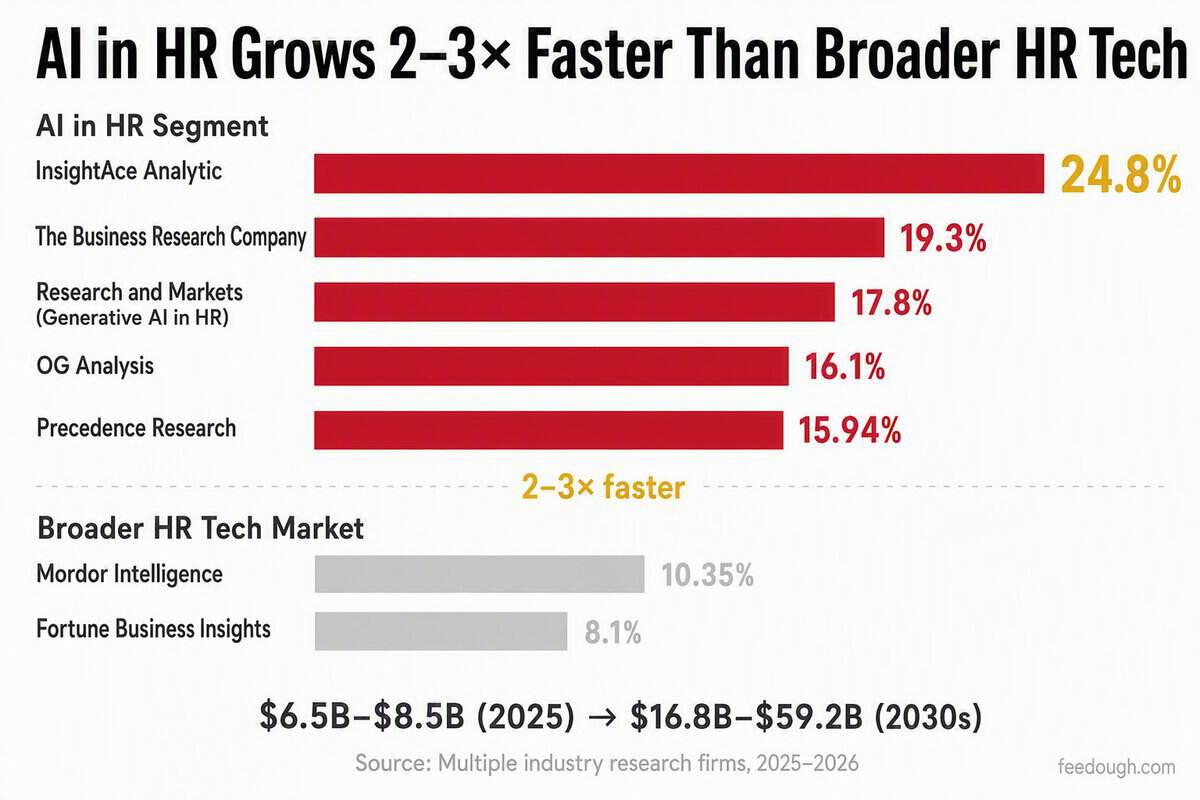
Across every major source, the AI-specific HR segment is expanding at 16% to 25% annually. The broader HR technology market barely clears 8%. The global HR tech market was valued at roughly $42 billion in 2025; the AI segment is small by comparison, but its growth trajectory dwarfs the parent market.
Market / Segment | Base Value | Projected Value | CAGR |
|---|---|---|---|
AI in HR — InsightAce Analytic | $6.53B (2025) | $59.22B (2035) | 24.8% |
AI in HR — The Business Research Company | $6.99B (2025) | $16.83B (2030) | 19.3% |
Generative AI in HR — Research and Markets | $0.75B (2025) | $1.7B (2030) | 17.8% |
AI in HR — OG Analysis | $8.5B (2025) | $32.5B (2034) | 16.1% |
AI in HR — Precedence Research | $8.16B (2025) | $30.77B (2034) | 15.94% |
HR Technology — Mordor Intelligence | $42.34B (2025) | $77.74B (2031) | 10.35% |
HR Technology — Fortune Business Insights | $43.42B (2025) | $86.08B (2034) | 8.1% |
North America held 45.8% of global HR tech revenue in 2025. Asia-Pacific is growing faster than any other region, at a 12.54% CAGR through 2031. India’s Digital India program and China’s labor-law modernization are the primary drivers.
AI in HR Adoption Rates by Company Size Statistics
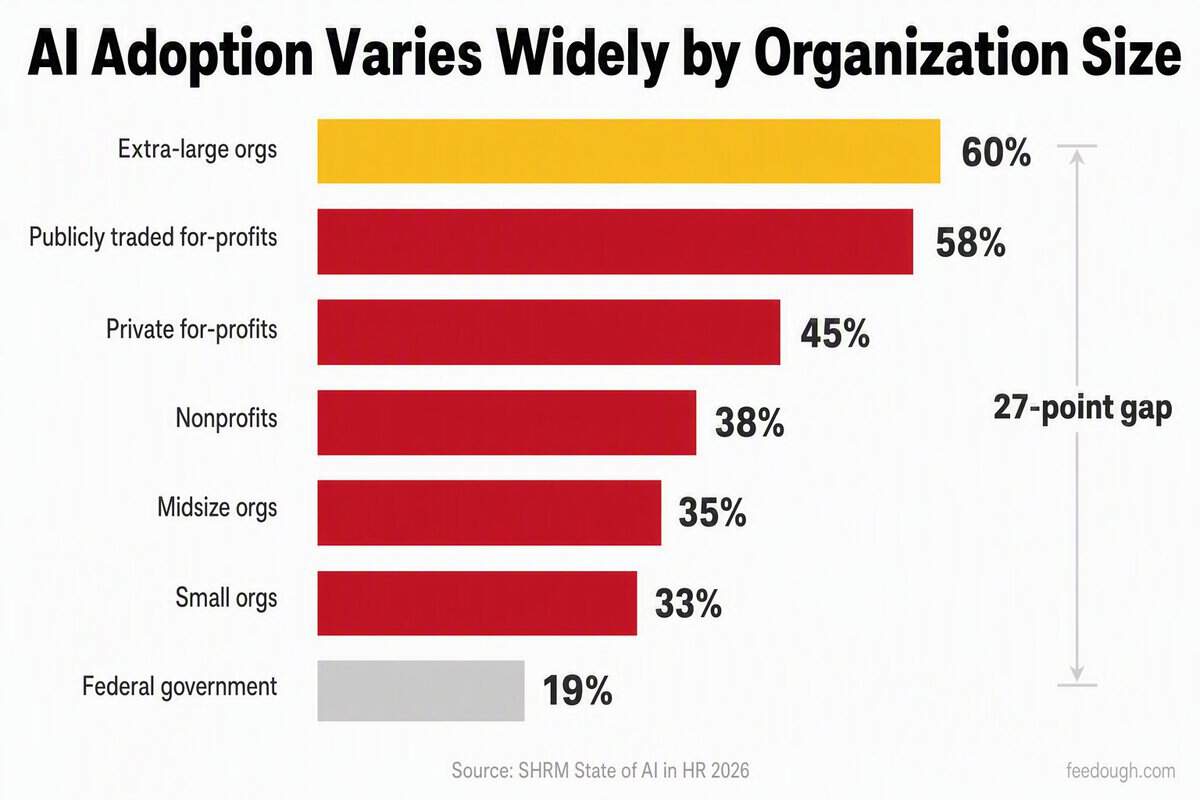
69% of companies use AI in hiring, but only 18% have deployed it broadly across the process, according to iCIMS and Aptitude Research’s 2026 report. SHRM’s State of AI in HR 2026 puts overall adoption at 39% of organizations in HR functions, up from 26% in 2024, with 62% using AI somewhere in their operations. AI in HR adoption rates vary sharply by organization size and type.
Organization Type | AI Adoption Rate | Source |
|---|---|---|
Extra-large organizations | 60% | SHRM State of AI in HR 2026 |
Publicly traded for-profits | 58% | SHRM 2025 Talent Trends |
Private for-profits | 45% | SHRM 2025 Talent Trends |
Nonprofits | 38% | SHRM 2025 Talent Trends |
Midsize organizations | 35% | SHRM State of AI in HR 2026 |
Small organizations | 33% | SHRM State of AI in HR 2026 |
Federal government | 19% | SHRM 2025 Talent Trends |
The 27-point gap between extra-large organizations at 60% and small organizations at 33% is structural. Large enterprises have the IT infrastructure, vendor relationships, and change management budgets that smaller firms lack. Among those that have deployed AI, Aptitude Research found that 44% apply it to just 1% to 25% of their workflow. Only 6% have automated more than three-quarters.
The business value gap is just as wide. Gartner found that 88% of HR leaders have not realized significant business value from AI as of October 2025, and only 6% of companies qualify as McKinsey AI high performers. SHRM’s 2026 data adds another layer: 56% of HR professionals do not formally measure the success of their AI investments.
Where AI is actually in production, it clusters around narrow, transactional tasks:
- 66% of organizations use AI for job-description writing
- 58% use it for resume screening
- 54% use it for candidate communication
- 35% have scaled scheduling automation to more than half their requisitions, the most widely adopted scaled AI recruiting application, according to Recruiting Tech Reviews’ State of AI Recruiting 2026 report
- 10% use it to make final hiring decisions
The trajectory points forward. Gartner’s May 2025 survey found that 82% of HR leaders plan to implement agentic AI within 12 months. But Gartner also predicts that 40% or more of those projects will be canceled by 2027. The gap between current shallow deployment and future ambitions is where competitive dynamics are being defined.
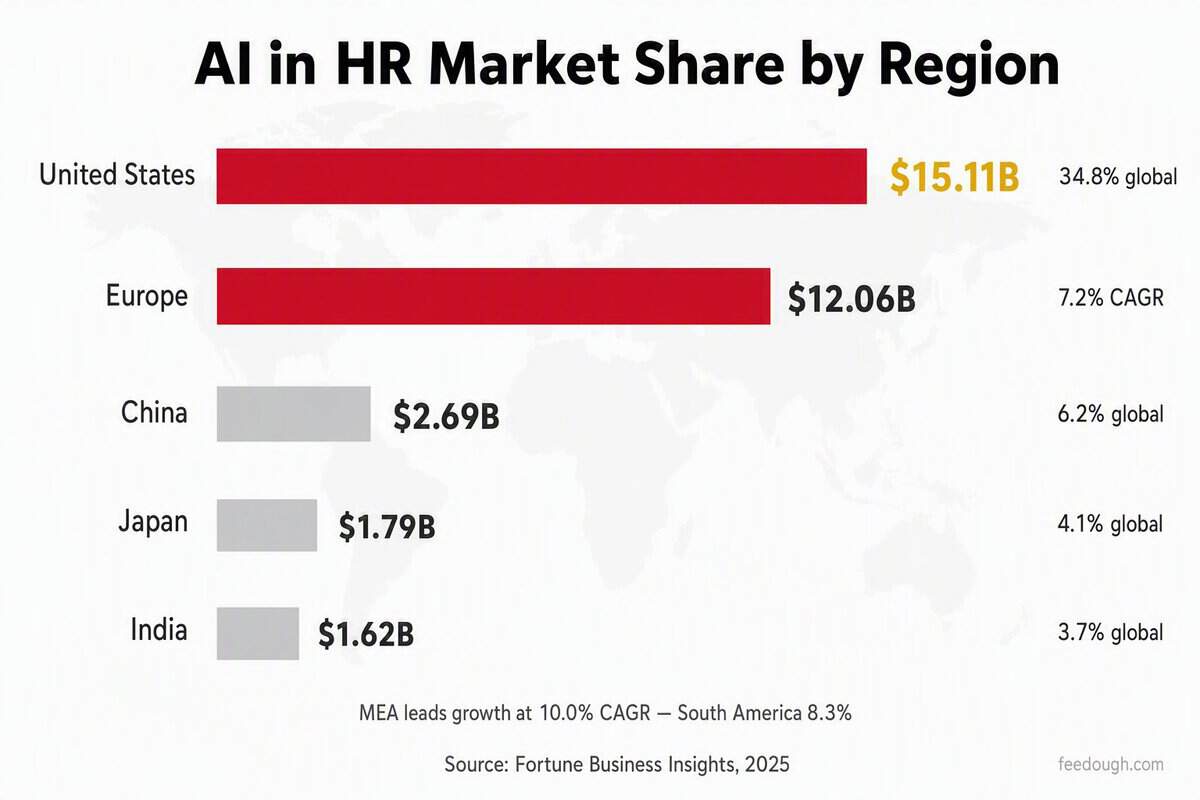
The United States generated $15.11 billion in HR technology revenue in 2025, roughly 34.8% of the global total. Europe’s entire regional market reached $12.06 billion, trailing the U.S. alone by more than $3 billion.
Region / Country | 2025 Value | Global Share | CAGR (2025–2034) |
|---|---|---|---|
United States | $15.11 billion | 34.8% | — |
Europe | $12.06 billion | — | 7.2% |
China | $2.69 billion | 6.2% | — |
Japan | $1.79 billion | 4.1% | — |
India | $1.62 billion | 3.7% | — |
Where these markets rank by size, they do not rank by growth:
- The Middle East and Africa region is projected to grow at 10.0% CAGR through 2034, the second-highest regional rate globally
- South America follows at 8.3% CAGR, outpacing Europe’s 7.2% growth rate despite starting from a much smaller base
- Within Asia-Pacific, India is the fastest-expanding sub-market at 8.12% CAGR through 2031, while China’s $2.69 billion market already exceeds Japan and India combined
The split is structural. Mature markets generate most of the revenue today, but the fastest growth sits where absolute spending remains a fraction of U.S. levels.
AI in Recruiting and Talent Acquisition Statistics
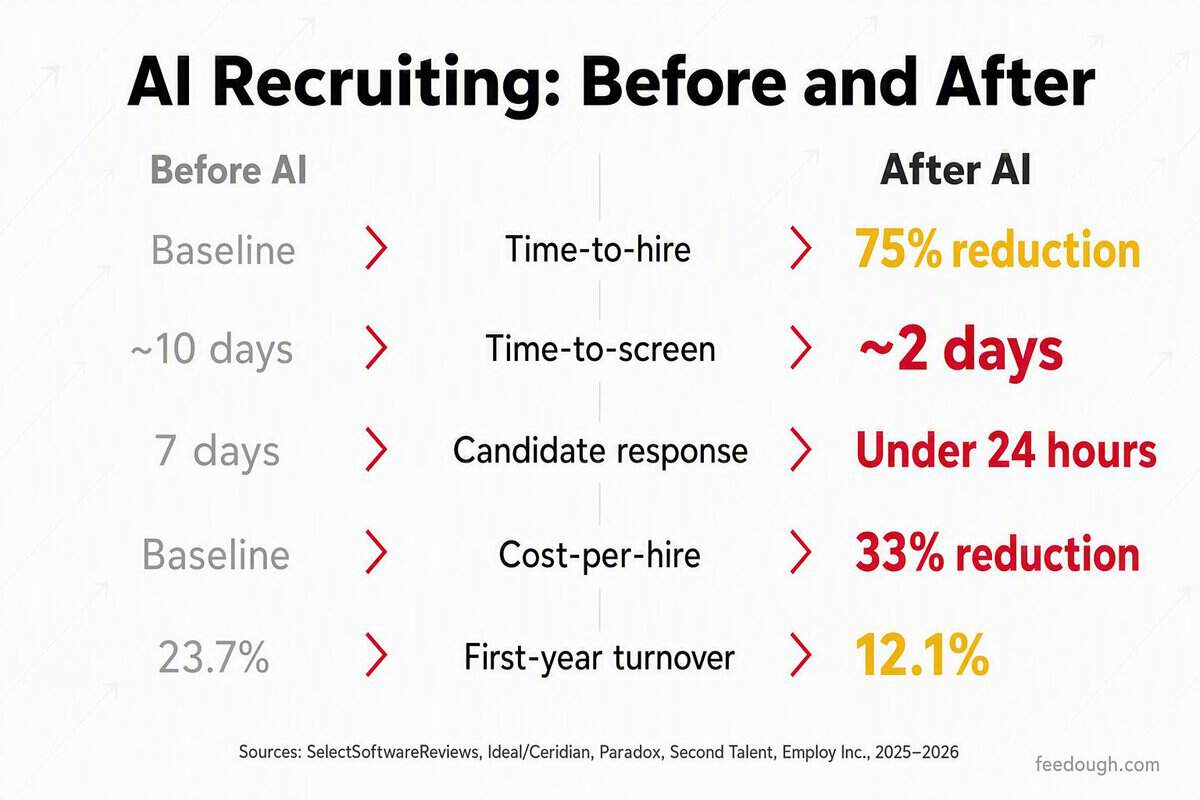
An unfilled position costs roughly $500 per day in lost productivity, according to SHRM. Multiply that across a pipeline of open roles and speed becomes a financial metric, not just an operational one. AI recruiting statistics from 2026 show that teams using these tools are cutting timelines by as much as 75%.
The improvements span cost, candidate experience, and retention. They appear consistently enough across industries and company sizes to quantify in before-and-after terms.
Recruiting Metric | Before AI | After AI | Source |
|---|---|---|---|
Time-to-hire | Baseline | 75% reduction | SelectSoftwareReviews, 2026 |
Time-to-screen | ~10 days | ~2 days | Ideal/Ceridian, 2025 |
Candidate response time | 7 days | Under 24 hours | Paradox, 2025 |
Cost-per-hire | Baseline | 33% reduction | Second Talent, 2025 |
First-year turnover | 23.7% | 12.1% | Employ Inc., 2025–2026 |
Speed is the proven win. Whether AI also improves the quality of who gets hired is the question the newer data begins to answer:
- 98% of hiring managers who use AI say it has improved the hiring process, according to SelectSoftwareReviews’ 2026 AI recruiting statistics
- 49% say AI has improved quality of hire, while only 1% say quality has declined, according to SelectSoftwareReviews
- AI recruiting tools deliver an average 340% ROI within 18 months of implementation, according to Second Talent’s 2025 research
- AI-based skill matching predicts job performance with 78% accuracy and retention likelihood with similar precision, according to Second Talent
- AI-driven candidate matching algorithms improve job fit accuracy by 47% compared to keyword searches, according to 2026 recruitment technology research
- Companies combining AI screening with human-led final interviews cut time-to-hire by 40% while improving first-year retention by 25%, according to PrideStaff’s 2026 research
Quality-of-hire takes years to measure reliably, which is why the data lags behind the speed gains. But the early signals suggest AI’s recruiting value extends beyond efficiency, particularly when human judgment handles the final decision.
AI in Employee Experience and Performance Management Statistics
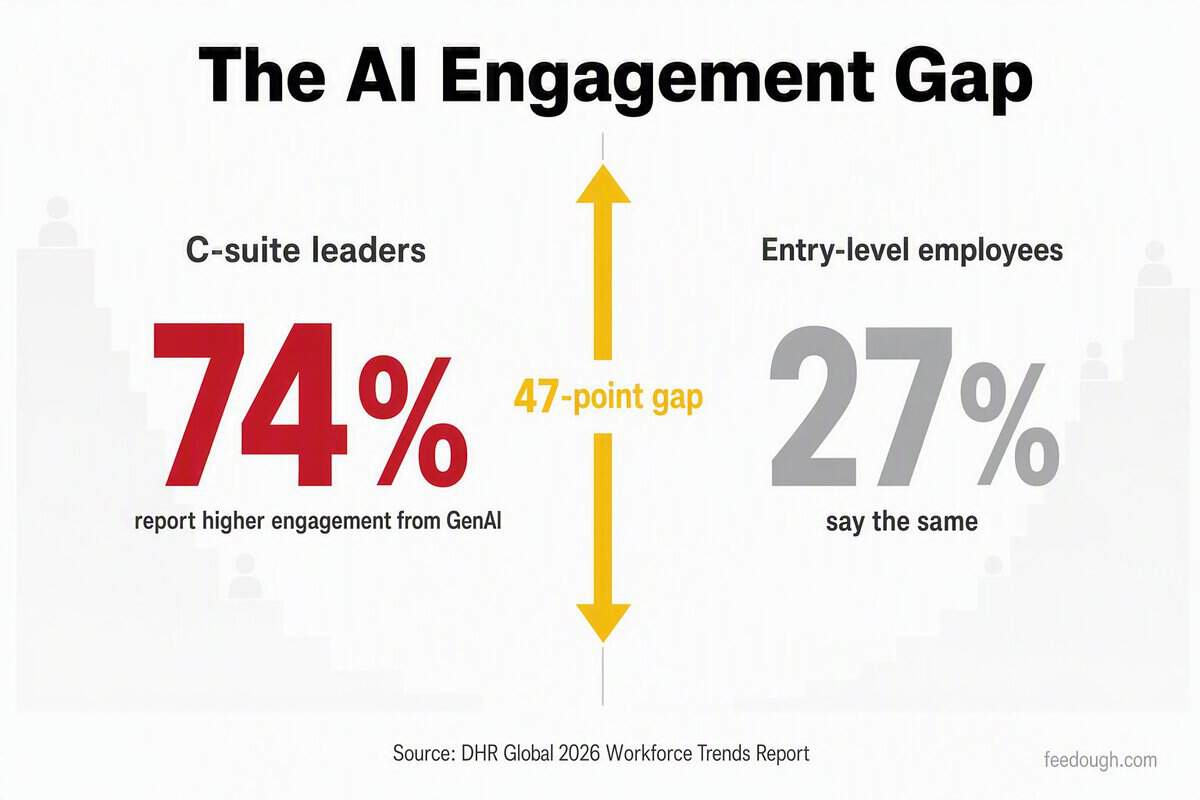
Employee engagement is six points higher at AI-adopting organizations and eight points higher among weekly users, according to Gallup’s H1 2026 survey. But those averages mask a divide. 74% of C-suite leaders report higher engagement from generative AI. Just 27% of entry-level employees say the same, according to DHR Global’s 2026 Workforce Trends Report.
AI Engagement Factor | Outcome | Source |
|---|---|---|
Manager actively supports AI use | 48% engagement | Gallup Q1 2026 |
No manager support | 30% engagement | Gallup Q1 2026 |
Clear AI integration plan | +15-point engagement lift | Gallup Q1 2026 |
All three conditions aligned | 53% engagement | Gallup Q1 2026 |
Highest productivity rating (conditions aligned) | 50% | Gallup H1 2026 |
Highest productivity rating (weekly use only) | 17% | Gallup H1 2026 |
Only 33% of employees feel well-prepared to use AI tools in their daily work. Just 31% say their organization has a clear adoption plan, according to Perceptyx’s 2026 benchmark covering 23 million employees. That gap explains why only 14% of organizations deploy AI in the employee experience practice area, according to SHRM’s State of AI in HR 2026. The conditions Gallup identifies as decisive are the same ones most teams have not built.
What employees say drives their engagement points to a different set of priorities:
- 71% cite professional development as the top engagement driver, according to DHR Global’s 2026 Workforce Trends Report
- 63% point to remote and hybrid work options
- 55% name access to generative AI tools
- 52% say burnout is directly dragging down their engagement, up from 34% in 2025
HR leaders see the potential: 90% recognize AI’s value in performance management, according to SHRM. But recognition without infrastructure produces awareness, not results. The organizations closing the engagement gap are the ones building the manager support systems and integration plans that make AI work for employees.
Future of AI in HR Workforce Statistics 2026
Gartner projects AI will manage half of all HR activities by 2026, according to Evanta’s 2026 Leadership Perspective Survey of 750 CHROs. Enterprise AI-agent deployment quadrupled to 42% in six months, according to KPMG. The curve is rising. The readiness is not.
Forward-Looking CHRO Priority | % Expecting Increase | Source |
|---|---|---|
Greater AI integration in workforce operations | 92% | SHRM 2026 CHRO Priorities (n=129) |
Increased AI adoption within HR processes | 87% | SHRM 2026 CHRO Priorities (n=129) |
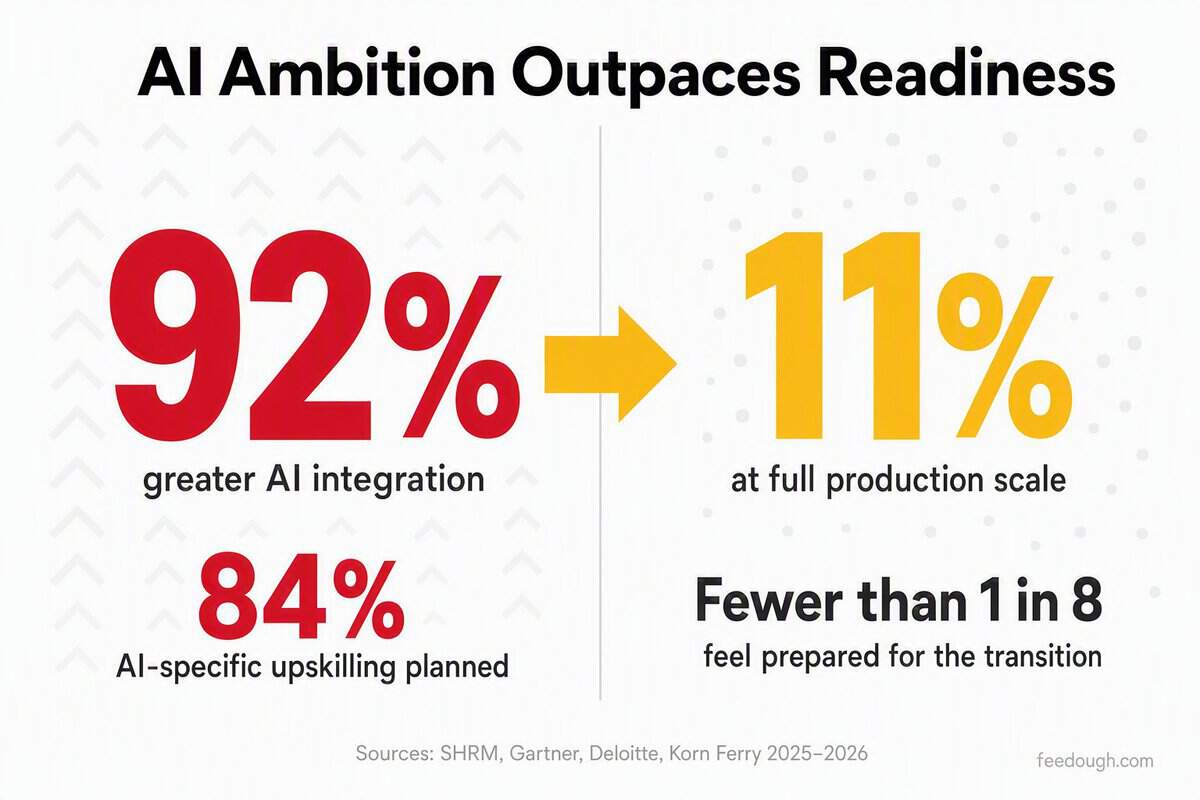
AI-specific upskilling | 84% | SHRM 2026 CHRO Priorities (n=129) |
Process and efficiency improvements as top AI goal | 75% | Evanta 2026 Leadership Survey (n=750) |
Reducing bias in AI hiring tools | 57% | SHRM 2026 CHRO Priorities (n=129) |
Deloitte’s 2025 Emerging Technology Trends study found only 11% of organizations operate autonomous AI agents at full production scale. Another 38% are running pilots, 30% are exploring options, and 42% are still developing their strategy. Technology departments lead deployment at 95%, followed by operations at 89% and risk management at 66%, according to KPMG’s Q3 2025 survey. HR departments are not tracked as a separate category, but the pattern is consistent: functions closest to the technology deploy first.
Gartner’s 2026 CHRO research found evolving the HR operating model delivers the highest predicted impact on AI productivity gains at 29%. It ranks as the top priority for CHROs harnessing AI. Fewer than 1 in 8 talent leaders feel prepared to manage the transition to autonomous AI agents, according to Korn Ferry’s 2026 TA Trends report. The 84% planning upskilling and the 57% prioritizing bias reduction reveal the same gap. Organizations are deploying technology faster than their workforce and governance structures can absorb.
Sources
- https://www.precedenceresearch.com/artificial-intelligence-in-hr-market (2025-07-14)
- https://www.insightaceanalytic.com/report/ai-in-human-resources-market/2750 (2026-02-01)
- https://www.mordorintelligence.com/industry-reports/hr-tech-market (2026-01)
- https://www.globenewswire.com/news-release/2026/07/10/3325372/28124/en/generative-ai-in-hr-market-set-to-hit-1-7-billion-by-2030-with-17-8-cagr-growth.html (2026-07-10)
- https://www.marketresearchfuture.com/reports/ai-recruitment-market-8289 (2026-08-04)
- https://www.futuremarketinsights.com/reports/payroll-and-hr-solutions-and-services-market (2026)
- https://www.shrm.org/in/topics-tools/research/state-of-ai-hr-2026/full-report (2025-12)
- https://www.pin.com/blog/ai-recruiting-adoption-by-company-size (2026-06-23)
- https://www.pin.com/blog/ai-adoption-recruiting-report (2025-10-16)
- https://www.gallup.com/workplace/704225/rising-adoption-spurs-workforce-changes.aspx (2026-03-12)
- https://www.hiretruffle.com/blog/best-ai-recruitment-statistics (2026-01-01)
- https://cs-recruiters.com/resources/industry-trends/the-role-of-ai-in-recruitment-2026-hr-guide (2026-06-06)
- https://www.fortunebusinessinsights.com/human-resource-hr-technology-market-105437 (2026-07-29)
- https://taleva.io/blog/ai-recruiting-statistics-2026 (2025-01-06)
- https://www.thehirehub.ai/blog/ai-recruitment-roi-calculator-guide (2026-04-17)
- https://www.selectsoftwarereviews.com/blog/ai-recruiting-statistics (2026-05-25)
- https://adai.news/resources/statistics/recruitment-ai-statistics-2026 (2026-03-01)
- https://www.pin.com/blog/state-of-talent-acquisition-2026 (2026-01-06)
- https://careertrainer.ai/en/reports/ai-in-recruitment-statistics (2026-01-01)
- https://www.dhrglobal.com/insights/workforce-trends-report-2026 (2026-01-01)
- https://huntscanlon.com/workforce-trends-2026-leaders-confront-burnout-disengagement-and-ai-driven-change (2026-01-01)
- https://www.gallup.com/workplace/712433/employee-engagement-remains-flat-adoption-accelerates.aspx (2026-07-01)
- https://blog.perceptyx.com/what-23-million-employees-say-about-engagement-in-2026 (2026-01-01)
- https://ekfrazo.com/resources/blogs/agentic-ai-in-enterprise-operations (2025)
- https://www.deloitte.com/us/en/insights/topics/technology-management/tech-trends/2026/agentic-ai-strategy.html (2025-06-25)
- https://www.kornferry.com/about-us/press/korn-ferry-research-unveils-top-talent-acquisition-trends-shaping-2026 (2025)
- https://kpmg.com/us/en/media/news/q3-ai-pulse.html (2025-09-18)
- https://www.gartner.com/en/human-resources/trends/top-priorities-for-hr-leaders (2025)
- https://www.pin.com/blog/full-cycle-recruiting-guide (2026)