
You picked the platform everyone recommended. Three months later, you’re paying transaction fees you never budgeted for, checkout drags on too many steps, and customers leave before buying.
That mistake costs real money. According to the Baymard Institute, 70.19% of online shoppers abandon their carts, with unexpected costs at checkout being the top reason. The platform you choose directly controls whether you keep those buyers.
I went through the six most recommended ecommerce builders this year and tested what actually matters — real costs, checkout experience, and whether they hold up when revenue is on the line.
Here are the 6 ecommerce website builders that are actually worth it in 2026.
The Rundown
- If Ecommerce Is Your Whole Point: Shopify, “You get purpose-built ecommerce with AI tools, Shop Pay’s high-converting checkout, and 13,000+ apps to scale.”
- Test a Store Concept Fast: Lovable, “Describe what you want and get a Shopify-ready storefront in minutes, ideal for testing before you commit.”
- Non-Developers Selling Online: Wix AI, “Answer a few questions and get a polished small-store site with multi-channel selling built in.”
- Developers Building From Code: Replit, “Spin up full-stack ecommerce with code access, Stripe sandbox, and GitHub export for complete ownership.”
- When Design Sets You Apart: Webflow, “Get pixel-level design control over every product page, perfect for brands where visual identity drives sales.”
- Your WordPress Ecommerce Shortcut: 10Web, “Generate a WooCommerce store from text and leverage the full WordPress plugin ecosystem from day one.”
The Best Website Builders For Ecommerce

Shopify
Pricing | Basic $39/mo, Grow $105/mo, Advanced $399/mo |
AI Tools Included | Sidekick AI assistant, AI store builder, Shopify Magic (all plans) |
Best For | Purpose-built ecommerce, not general websites |
Ease of Use | Gentle learning curve, no coding needed |
App Ecosystem | 13,000+ apps |
Other AI builders let you create a website. Shopify lets you run a business. That distinction matters more than any feature list.
I tested the AI store builder expecting a gimmick. You type a short business description and it generates a storefront in seconds. The results from users on Reddit have been described as “hit or miss,” and I’d agree. Sometimes it nails the layout. Sometimes you need to redo half of it. But you keep full control over every element, so the starting point still saves time even when the AI misses the mark.
What genuinely impressed me was Sidekick. This isn’t a chatbot bolted onto a dashboard. It handles analytics, generates product content, builds automation workflows from plain English, and even creates custom admin apps. Sidekick weekly active shops grew 385% year over year, and merchants built over 12,000 custom apps with it in Q1 2026 alone. That kind of adoption tells you something real is happening here.
Then there’s the Agentic Storefronts feature from the Winter 2026 update. Your products can now be discovered and purchased through ChatGPT, Gemini, and Copilot without customers ever visiting your site. AI-driven traffic to Shopify stores grew 8x year over year with orders from AI searches growing nearly 13x, according to Shopify’s Q1 2026 earnings reported by PYMNTS. No other ecommerce builder has this. Not Wix. Not Webflow. Nobody.
The checkout alone justifies the price. Shop Pay converts up to 50% better than guest checkout and up to 91% better on mobile. Shopify offers unlimited products across its plans, while Style Factory’s comparison confirms Wix caps at 50,000 products. For real ecommerce depth, there’s no contest.
The honest downsides. Transaction fees eat 60-80% of your total costs if you skip Shopify Payments. Apps stack up fast. A mid-size store averaging six paid apps runs about $120 per month on top of the subscription. Free themes are limited at just 24, compared to hundreds on Wix or Squarespace. And the platform sees roughly a 28% annual store closure rate, which suggests Shopify solves the building part but not the surviving part.
None of that changes my core assessment. If ecommerce is the entire point of your website, Shopify is the tool built for that job. Everything else is a website builder that happens to have a store feature.

Lovable
Pricing | Free plan available; Pro at $25/month |
Free Plan | 5 daily credits (30/month cap), no custom domain |
Ecommerce Path | Shopify integration for new stores only |
Native Cart/Inventory | None. Requires Shopify or Stripe backend |
Best For | Rapid prototyping and frontend store design |
I’ll be honest, I didn’t expect much when I started building a storefront with Lovable’s free plan. Five credits a day sounds generous until you realize removing a footer costs credits and adding authentication eats more. You get roughly one meaningful edit per day.
What impressed me was the speed. I described a store selling handmade candles, connected the Shopify integration with one click, and had a working storefront generated in about two and a half minutes. The layout looked clean. Product cards were in place. I genuinely didn’t expect that level of polish from a free tool.
One thing worth noting: you can drop in screenshots or reference images when prompting Lovable. Instead of describing a layout in words, you can show it exactly what you want visually. For beginners who struggle to translate ideas into text prompts, that ability alone makes the first build smoother.
But here’s the thing. Lovable builds the frontend. It does not run your store. There is no native product catalog, no cart, no inventory tracking, no order management. The actual ecommerce infrastructure has to come from Shopify or Stripe. That means the free plan gives you a design mockup, not a business you can operate.
There is another catch that caught me off guard. The Shopify integration only works for brand new Shopify stores. If you already have products listed and orders coming in, you cannot plug Lovable into that store. You would have to start fresh.
The credit system also worries me. Going through Trustpilot reviews, the same pattern keeps showing up. One user described getting stuck for weeks because the AI could not find a problem it created. Another said credit usage drains too fast during debugging loops. Trustpilot’s own AI summary of 847 reviews flagged that the AI “can occasionally struggle with complex tasks, generating recurring bugs and consuming excessive credits during repeated troubleshooting attempts.” That matches my experience. Every loop costs credits, and the AI sometimes breaks things while fixing them.
The free plan is genuinely useful for one thing: prototyping. If you want to quickly test a store concept before committing money to Shopify or hiring a designer, Lovable gets you there fast. Just do not mistake the prototype for the finished product.
Wix AI
Best For | Non-developers building small to mid-size ecommerce stores |
Starting Price | Free plan available; ecommerce plans from $11.75/month |
AI Features | Wix Harmony conversational builder, AI Custom Agent, 15+ AI tools |
Ecommerce | Inventory, multi-channel selling (eBay, Amazon, TikTok), abandoned cart recovery |
Rating | 4.8/5 from Cybernews (ranked #2 out of 37 builders tested) |
What surprised me most was the design quality. A Reddit user who tested 15+ AI builders put it bluntly in a detailed comparison post: “Wix’s AI always creates stunning designs. The AI understands good design better than any other platform I tested.” I found the same thing. The layouts Wix generates feel polished in a way most AI builders simply don’t match.
The setup process is dead simple. You answer a few questions about your business, pick some visual preferences, and Wix Harmony builds a multi-page site in minutes. Homepage, about page, contact forms, basic SEO scaffolding, all done. I had a publishable store in under 30 minutes.
For a small shop with under 20 SKUs, it works well. Inventory management, product listings, and multi-channel selling with platforms like eBay and Amazon are built right in. But here’s the honest part: serious ecommerce features like abandoned cart recovery are gated behind higher-tier plans or third-party apps that cost $10 to $50 per month each.
That’s where the pricing gets real. The Core plan starts around $29 per month, but once you stack apps for reviews, loyalty, and analytics, a functional Wix store realistically runs $70 to $150 per month. The advertised price rarely tells the full story.
The AI Custom Agent deserves a mention. It can re-engage inactive customers with personalized coupons and monitor inventory automatically. That kind of automation without code is rare in this price range.
One thing that bugged me: editing the AI-generated site triggers constant loading and refreshing. Every small tweak makes you wait. It’s not a dealbreaker, but it slows down your workflow noticeably.
If you’re launching a small store and want something that looks professional fast, Wix AI delivers. If you plan to scale past a few thousand dollars a month in online sales, you’ll eventually feel the walls closing in.
Replit
Pricing | Free / Core $20/mo / Pro $100/mo |
Best For | Developers building custom ecommerce from scratch |
Code Access | Full frontend, backend, database, GitHub export |
Payments | Stripe and PayPal, built-in sandbox |
Ease of Use | AI Agent handles most work; coding knowledge helps |
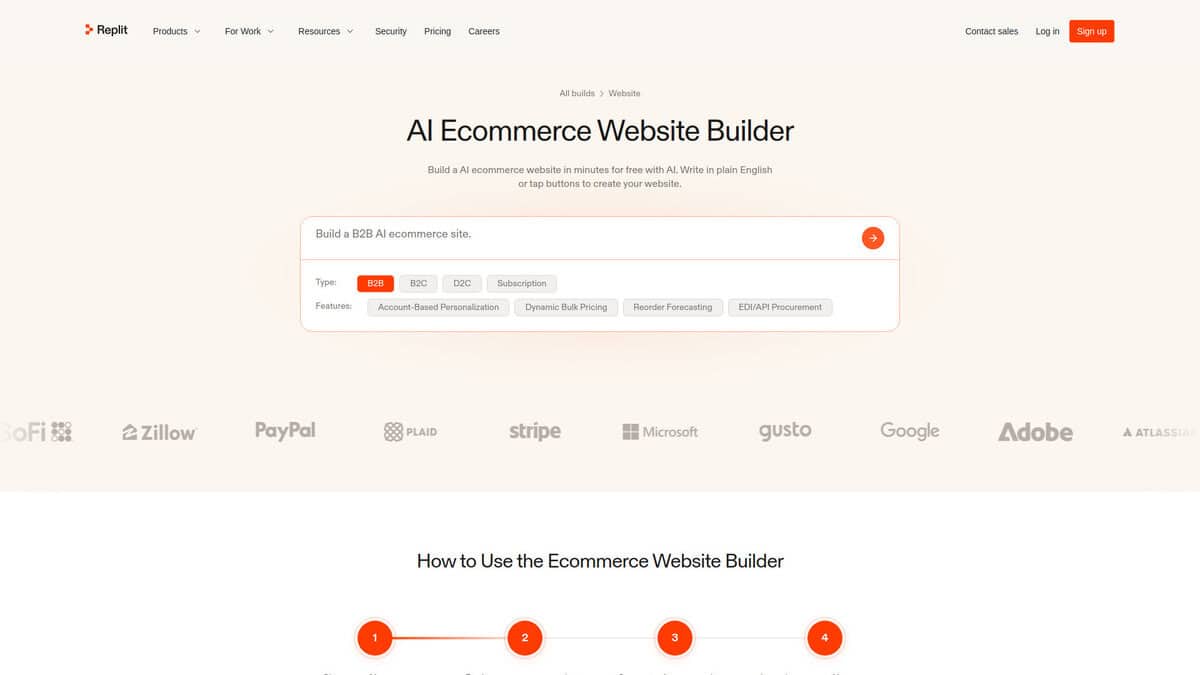
I didn’t expect much going in. Another AI builder promising the world. But Replit hit differently the moment I described a product catalog and watched it spin up a working storefront with checkout, database, and categories in about 15 minutes. That result matched what one independent reviewer found after testing 21 builders, calling it the best-looking AI website they’d ever seen. What makes it stand apart is the full-stack access. You’re not stuck inside a walled garden. Frontend, backend, PostgreSQL database, Stripe integration, all in one browser tab. If your store outgrows the platform, you export the code to GitHub and deploy it anywhere. That portability matters. The ecommerce-specific prompts are a nice touch too. You pick your model (B2C, B2B, subscription, D2C) and Replit generates the right architecture from the start instead of forcing you to retrofit a generic template. Stripe sandbox is built in, so you can test payment flows with fake money before going live. My main concern is pricing. Replit uses effort-based billing, which means your credits burn faster on complex builds. As Superblocks documented in their review, they burned through their entire free allocation in a single iteration, and many Reddit users report surprise charges climbing past $350 in a day. Budget carefully if you plan to iterate a lot. It also works best for simple catalogs. If you’re selling under 50 products with basic variations, you’re fine. Inventory management, multi-variant products, and shipping calculations will likely need manual code edits. The newer Agent 4 is roughly ten times faster than its predecessor, but it still lags behind quicker tools like Lovable for initial generation speed. The trade-off is that the output tends to feel more complete and production-ready, with automated browser testing that catches broken buttons before you do.
Webflow
Pricing | Starts at $29/month (Standard plan with 2% transaction fee) |
Free Plan | Free tier for design only, no ecommerce features |
Best For | Design-led brands with small to medium catalogs |
Ease of Use | Steep learning curve, requires design expertise |
Design Control | Full visual control over product pages, cart, and checkout |
The AI site builder caught my attention first. It scaffolds entire ecommerce layouts from text prompts. You type what you want, and it generates product grids, hero sections, and navigation. It’s not magic though. Derek Siu tested it on a personal trainer site and an ecommerce landing page. Output was functional but basic. No complex interactions like mega-menu hovers. Good for wireframing, not finished stores.
Once you move past the AI scaffolding, that’s where Webflow actually shines. You get pixel-level control over every element. Product pages, cart, checkout, all customizable. Shopify can’t match this kind of visual freedom. If brand aesthetics matter to you, this tool delivers.
Pricing is straightforward. The Standard plan starts at $29/month with a 2% transaction fee. The Plus plan at $74/month drops that fee entirely, and the Advanced plan at $212/month unlocks higher product limits and analytics. Keep in mind that workspace seats and add-ons can push the total cost higher.
Here’s the honest part. Webflow ecommerce works for simple stores. A dozen products, straightforward shipping. Fine. But Reddit users describe it as passable for occasional sales but feel updates have stalled. Subscriptions? Weak. Large catalogs? Painful. Complex promotional logic? Shopify territory entirely.
The design-versus-depth tradeoff is real. Webflow wins on design control but trails in ecommerce depth. Shopify has better inventory management, a massive app ecosystem, and years of ecommerce-specific iteration behind it. Webflow has cleaner code output and more visual flexibility.
If you’re a design-forward brand with a smaller catalog, I’d give Webflow serious consideration. The AI helps you start fast. The design tools let you finish beautifully. But you need Webflow expertise to actually get there, and you should know its ecommerce ceiling before committing.
10Web
Pricing | From $10/month (annual billing) |
Free Plan | 7-day trial, no credit card needed |
Best For | WordPress-based ecommerce stores |
Ease of Use | AI setup fast; Elementor needed for edits |
Hosting | Google Cloud, locked to 10Web |
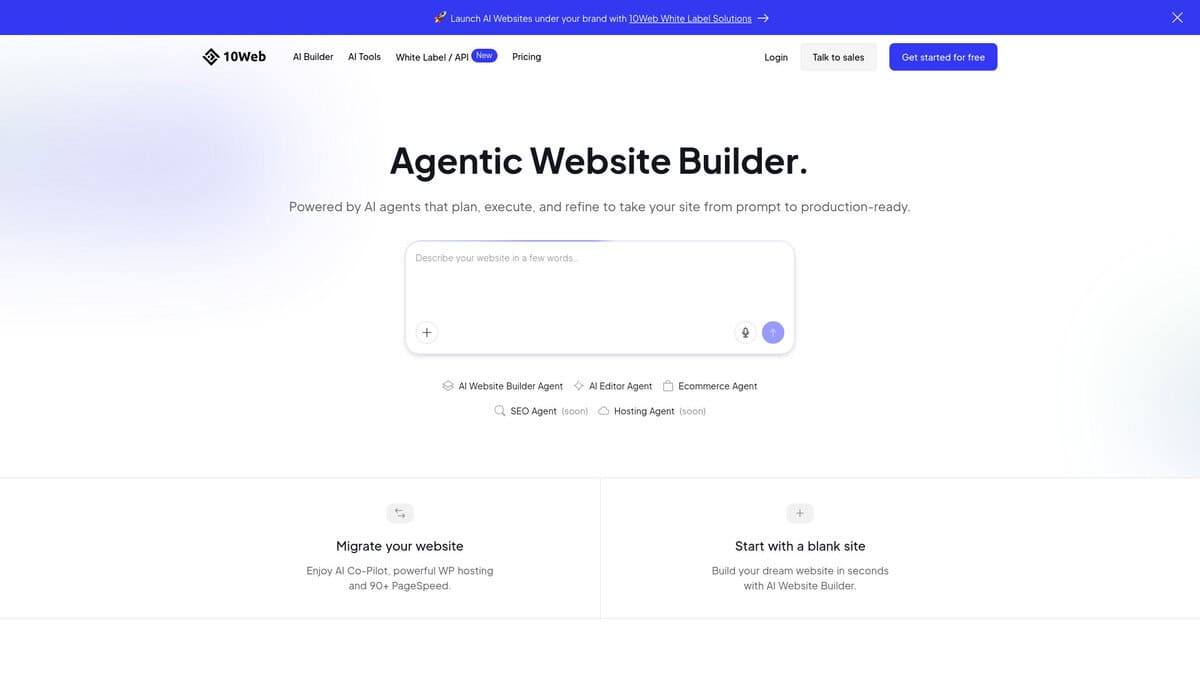
The AI builds a WooCommerce store from a text description. Product pages, cart, checkout, all pre-configured. You get the full WordPress plugin ecosystem, which is the main draw.
After generation though, you’re editing in Elementor. No ongoing AI conversation to refine things. The AI is a one-time builder, not a continuous assistant. If you expect ChatGPT-style back-and-forth tweaking, you’ll be disappointed.
Performance is decent but not great. I tested a generated store and got around 71/100 on mobile PageSpeed after adding common plugins like a contact form and reviews widget. A clean build scores 94, but real stores need those extras.
The pricing deserves a closer look. The base is $10/month, but WooCommerce extensions for abandoned cart recovery, reviews, and subscriptions push costs up significantly. Expect a fully-featured store to run well over $1,000 annually once you add essential plugins. Shopify charges $29/month for Basic but adds transaction fees on third-party gateways. 10Web has zero platform fees, which helps at higher volume.
You’re locked into 10Web’s hosting though. Leave and you’ll rebuild optimization yourself. For agencies building client stores or someone testing a product idea, that’s manageable. For anyone wanting a hands-off platform, WordPress’s maintenance burden is real.
I’d pick this if I were already comfortable with WordPress and wanted AI to handle the initial setup. The plugin flexibility is genuinely useful. But it’s a shortcut to getting started, not a shortcut to running a store.