
Most fintech startups aim for the broadest possible audience. The cred business model started by telling 97% of users they weren’t eligible.
It focused on the elite 3% of credit card holders in India: those with the highest credit scores. By June 2026, that narrow focus paid off. CRED processes more than 40% of India’s credit card bill payments, up from 6 million users in 2021.
In India’s $51.30 billion fintech market, CRED carved out a niche by focusing on trust over scale. The FY25 numbers tell the story: ₹2,735 crore operating revenue, 16% YoY growth, and operating losses down 51% to ₹298 crore.
So, how does a company that told most of India it wasn’t eligible become one of its fastest-growing fintechs? The cred business model explains why rejection turned out to be its best feature.
What is CRED?
The cred business model centers on a fintech startup that provides users with a platform to pay their credit dues, rent and other bills, all in one place while earning additional rewards for doing so on time. It provides users with an instant credit line and enables a safe space for P2P lending between high trust individuals at interest rates which are way more beneficial than the traditional lending sources.
The Idea Behind CRED Business Model
A brainchild of cred kunal shah, cred india was launched in April 2018, with the idea of capitalising on the industry of high trust individuals who would be rewarded for their responsible financial behaviour.
The idea behind the cred business model is to create a gated ecosystem of high trust credible individuals and eventually build ways for them to link and connect with one another. It is a credit-based ecosystem that provides a safe space for individual lenders and financial institutions to lend money to trustworthy individuals.
It uses the creditworthiness of individuals in the form of their credit scores as a measure to filter the community. Then to retain customers, it rewards them in the form of CRED coins if they make timely payments through the platform.
Who Are CRED’s Customers?
CRED targets to garner a significant share of wealthy, affluent, and trustworthy customers who own and use credit cards. The cred business model creates a gated community of loyal and credible individuals to eventually build mechanisms for them to connect and expand on many other possibilities in the future.
CRED’s Value Proposition
Famous for its excellent user experience, the cred business model stands out by providing the following value to its customers:
- The cred app is an all in one application for paying credit dues, rent and other bills in just five taps. It reduces the hassle of handling multiple credit cards by making the process tremendously simplified, easy and convenient.
- It provides users with an instant credit line and facilitates P2P lending at an interest rate of 9% to lenders, which is way more than what savings accounts and deposits usually offer.
- It records loan caps, analyses hidden costs and overall expenses of the users and tracks due dates and sends them timely reminders to make payments.
- If users make timely payments, it rewards them with CRED coins which they can redeem on the platform ‘Discover’ to avail discounts on different products offered by CRED partners.
- Users can also calculate their credit scores for free and use CRED’s help to maintain a good credit profile and make good financial decisions.
Most importantly, CRED is a niche community of high-trust creditworthy individuals. It works along the lines of the velvet rope effect, where people ‘pay together and can play together’. This creates a social network with a tremendous scope of connecting people with a realm of other possibilities!

How Does CRED Operate?
Once the user downloads the cred app and enters their mobile number, the app checks the cards connected to the registered phone number till the account gets configured. If the credit score is greater than 750, the person is allowed to use the app. If not, he is sent to the waiting list. After receiving access, CRED apps will have access to the mail identification for reading and scanning credit card receipts like due dates and service statements.
Key Activities
CRED provides a range of financial products and services. Its key activities include credit card payments, credit lines, peer-to-peer lending, and rent payments. It also operates an e-commerce marketplace, travel bookings, personal finance management, motor insurance, and tokenized payments.
CREDIT Payments
CREDIT Payments provides a unified interface to pay credit card bills and other dues through the app. On-time payments earn CRED coins redeemable for discounts across partner brands. The app analyses spending patterns and sends timely payment reminders. In September 2025, CRED launched a co-branded RuPay credit card with IndusInd Bank. It also introduced biometric authentication for UPI transactions up to ₹5,000 in March 2026.
CRED Stash
CRED Stash is an instant credit line offered at interest rates roughly one-third of typical credit card charges. It provides a credit limit of up to ₹5,00,000. The service eliminates the lengthy verification and application processes usually required for personal loans. It operates in partnership with banks like IDFC First Bank.
CRED Mint
CRED Mint is a peer-to-peer lending product launched with Liquiloans, an RBI-registered NBFC. Users can lend money and earn up to 9% per annum, well above savings account rates. Lenders can invest between ₹1,00,000 and ₹10,00,000. Funds flow through CRED Cash, a lending product for high-trust individuals. It reached ₹22,000 crore in assets under management by FY25.
RentPay
RentPay allows users to pay rent and recurring household expenses through the app. It sends reminders for timely payments. Each transaction earns rewards that can be redeemed on products across the CRED platform.
CRED Store
CRED Store is a marketplace with over 2,000 partner brands spanning health, travel, e-commerce, and more. Users spend their earned CRED coins here to access exclusive discounts and offers. Partner brands gain visibility and boost sales through their presence on the platform.
CRED Travel
CRED Travel lets users book flight tickets, hotels, and manage dining expenses through the app. Bookings earn CRED coins that can be used on the CRED Store.
CRED Money
CRED Money is a personal finance platform built on India’s Account Aggregator framework. Launched in July 2024, it lets users track and manage finances in one place. By September 2025, it expanded to include fixed deposits, gold investments, and portfolio management services. This turned CRED into a full wealth management platform. In April 2026, CRED invested in Tellme.
CRED Garage
CRED Garage, launched in November 2024, is a motor insurance platform. It allows users to insure their vehicles directly through the CRED app.
CardSync
CardSync is a tokenized payment solution launched in August 2025 through a partnership with Razorpay and Visa. It enables one-tap payments across online stores, removing the need to enter card details for each transaction.
Key Channels
CRED has a website and an app as key channels through which people can make use of the platform.
Key Partners
- CRED partners with over 2,000 brands that offer products on the platform at exclusive prices to its members.
- It has tie-ups with more than 34 banks. For instance, CRED Stash provides cheap credit in partnership with IDFC Bank. P2P lending is facilitated through Liquiloans, an RBI-registered NBFC.
- CRED processes payments through Axis Bank and participates in UPI via a tripartite agreement with the sponsor PSP (Axis Bank) and NPCI.
- In August 2025, CRED partnered with Razorpay and Visa to launch CardSync, a one-tap payment solution for online stores.
- In September 2025, it partnered with IndusInd Bank to launch a co-branded RuPay credit card.
- CRED holds regulatory authorizations from RBI, IRDAI, SEBI, and NPCI. Its March 2026 payment aggregator authorization from RBI allows it to onboard merchants directly.
Key Resources
Beyond partnerships, CRED’s growth relies on three core resources: its people, technology, and capital.
- Human Resources: CRED’s team has grown from about 1,600 employees in December 2022 to roughly 2,253 by September 2026. The expanded workforce supports the company’s growing product suite and operational demands. Source
- Technological Resources: The platform runs on cloud infrastructure with real-time monitoring and AI-driven analytics. These systems handle performance and security at scale.
- Financial Resources: CRED has raised $1.75 billion across 10 rounds. Its investors include Sequoia Capital, DST Global, General Catalyst, Coatue Management, Ribbit Capital, and Insight Partners. In June 2026, Meta invested $900 million, putting CRED’s valuation at $4.5 billion. Source
CRED Market Valuation and Funding
CRED’s valuation has followed an unusual arc. The company peaked at $6.4 billion during its 2022 Series F round. By May 2025, it had corrected to $3.5 billion in a $72 million Series G round led by Singapore’s GIC. Then in June 2026, Meta invested $900 million, pushing the post-money valuation back up to $4.5 billion.
The Meta deal is notable for its structure. Meta received a minority stake without access to CRED’s customer data. For CRED, the capital confirms what the cred business model’s scale already shows. The platform serves 17 million monthly members. It processes over 40% of India’s credit card bill payments.
The deal also triggered a leadership change. Kunal Shah stepped down as CEO to lead WhatsApp globally, replacing Will Cathcart. He will join Meta full-time at its Menlo Park campus. Miten Sampat was named interim CEO. Across 10 rounds, CRED has raised $1.75 billion in total.

The valuation recovery reflects more than one large investment. CRED is also planning a public listing in India within two years. Investors who marked the company down in 2025 are now backing a different story. They see growth paired with a path to the public markets.
CRED Revenue Model
CRED’s financials show rapid growth paired with strategic patience. The platform reported revenue of ₹2,735 crore in FY25, a 16% jump year-over-year. Operating losses fell 51% to ₹298 crore, while total losses narrowed 11.5% to ₹1,457 crore. Gross margins stood at roughly 70%, and the company is targeting full-year profitability in FY26.
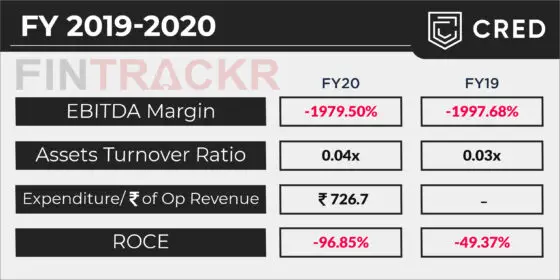
CRED’s ARPU of ₹2,000 ranks highest in India’s payments ecosystem. The platform is free to use, and only about one-third of its monthly transacting users currently generate revenue. Transaction frequency hit 14.4 per user per month, up 34%, and 45% of active members now use three or more products. Total payment value touched ₹8.5 lakh crore, up 23% year-over-year. Lending assets under management reached ₹22,000 crore. The team chose scale over revenue in early years, focusing on building a loyal, affluent base first.
Sources Of Revenue For CRED
Affiliate Income
CRED earns commissions by connecting its members with financial products: credit cards, personal loans, and insurance. When a user applies for a product through the platform, CRED gets a cut. This model works because the cred app already knows its users’ financial behavior, making recommendations feel personal rather than pushy.
Revenue From Advertisements
Brands pay CRED to reach its high-income audience. The platform runs targeted ads, sponsored content, and brand collaborations within the app. Unlike typical ad models, CRED’s ads often feel like curated experiences: think exclusive product drops or limited-time offers that match the user’s lifestyle.

Transaction Fees
Every time a user pays a credit card bill or makes a payment through CRED, the platform may charge a small fee to the biller or payment gateway. It’s a volume game. Small per-transaction margins add up when you’re processing billions in payments each month.
Revenue From Loans
CRED also offers direct lending through its own products or partner banks. The app provides personal loans and credit lines to eligible members. Interest income from these loans forms a growing part of the revenue pie, especially as more users trust the platform with their financial needs.
Costs Incurred
Growth isn’t cheap. CRED spends heavily on customer acquisition, technology development, and marketing. But the company cut marketing expenses by 36% and reduced customer acquisition costs by 40% in FY2024. The shift toward organic growth through referrals and product stickiness continued into FY2025.
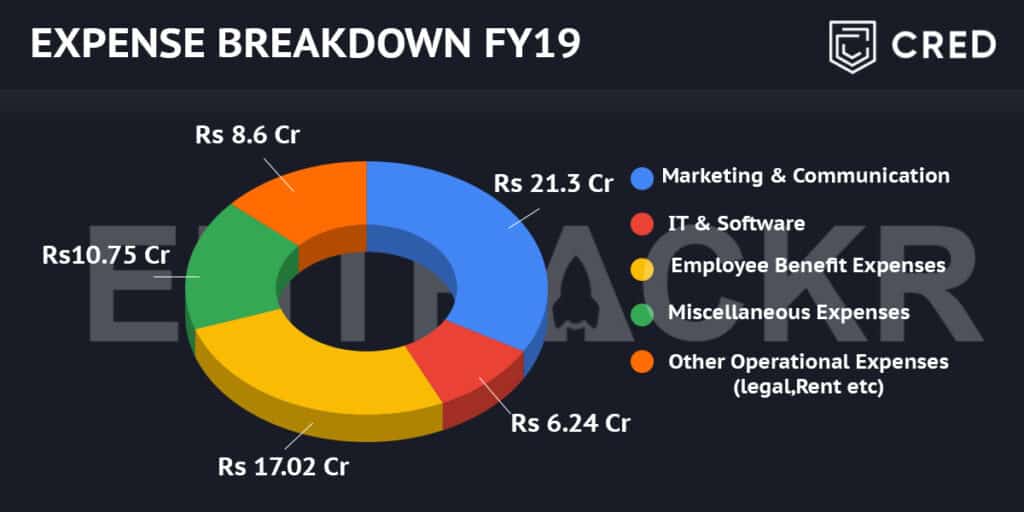
Research and development also consumes significant capital. CRED is building products like UPI payments, motor insurance via CRED Garage, and credit management tools. The strategy is to create multiple revenue streams while keeping the core experience free. 45% of active members use three or more products, and transaction frequency climbed 34% to 14.4 per user per month. The result is an average revenue per user of roughly ₹2,000.
The payoff shows up in the numbers. Operating losses fell 51% to ₹298 crore in FY2025, down from ₹609 crore the year before. Total losses narrowed 11.5% to ₹1,457 crore. For a company that once burned cash to acquire users, this trajectory signals that the cred business model is working.
Bottom-Line?
CRED has a creative way to market itself. It delivers cakes to users’ offices so others learn about it and create a buzz. This helps the company initiate a viral loop, generate more customers, and create a ‘brag-worthy proposition’.
As customers continue to pay their bills and use the platform, the company accumulates valuable financial data. With 1.26 crore monthly transacting users, CRED can personalise experiences or recommend financial products without selling data to third parties.
The core lesson of the cred business model is that building a gated community of high-trust individuals creates lasting value before chasing profits. Kunal Shah’s philosophy that startup ideas should follow demand produced a ‘brag-worthy proposition.’ This vision proved compelling enough that Meta invested $900 million, even as Shah stepped down to lead WhatsApp. Under interim CEO Miten Sampat, CRED is now targeting full-year profitability in FY26.
Go On, Tell Us What You Think!
Did we miss something? Come on! Tell us what you think of this article on CRED business model in the comments section.