
The dating app famous for making women send the first message is taking that rule apart. The Bumble business model dropped it in 2026, retired the swipe, and is rebuilding around AI matchmaking.
In the same stretch, FY2025 Bumble revenue fell 9.9% to $965.7 million, and the company began exploring a sale through Morgan Stanley at a Bumble valuation of about $388 million.
Bumble built its name on an idea: women message first. After Tinder had already made dating apps ordinary, that single rule set it apart. Its reversal in 2026 raises a hard question. What is a dating app worth when its defining idea stops working?
What is Bumble?
Bumble is a geolocation-based social app built around dating and friendships. Launched in 2014 by Whitney Wolfe Herd, a co-founder of Tinder, it began as a women-centric dating app. Kindness, integrity, equality, confidence, and respect lay at the foundation of the company.
Herd founded Bumble after her rift with Tinder. She sued its senior executives, alleging sexual harassment. She also said they took her co-founder title and plotted to push her out.
While she was still fighting those legal battles, Badoo’s founder and CEO, Andrey Andreev, approached her. The two partnered to create a safer dating space for women, and Bumble came into being.
Who Are Bumble’s Customers?
Bumble’s target demographic is young adults between 18 and 34 who are looking for meaningful personal and professional connections.
For years, women were the core customers, drawn to a dating space where they made the first move. In 2026, Bumble abandoned that signature rule after a trial showed more engagement and a survey found 66% of women prefer men to message first. Women remain central to the product, but the first-move restriction no longer defines who the app is built around.
The customer base has been shrinking. Total paying users fell from about 4.15 million in FY2024 to 3.67 million in FY2025, then to 3.16 million by Q2 2026. Bumble no longer discloses monthly active users. Ofcom data cited by the BBC shows Bumble’s UK monthly audience dropping from about 1.5 million in 2023 to 1.1 million in 2025, while Hinge held steady at about 1.5 million.
What Value Does Bumble Provide?
Bumble’s value proposition is that a dating app built around “an experience with women’s needs in mind” creates better outcomes for everyone, in Whitney Wolfe Herd’s words. For a decade, the women-message-first rule carried that idea. It ended in August 2026, so the value now sits around the conversation rather than in it: safety and verification tools, matches that expire so chats don’t stall, and a user base that is less male-heavy than rival apps.
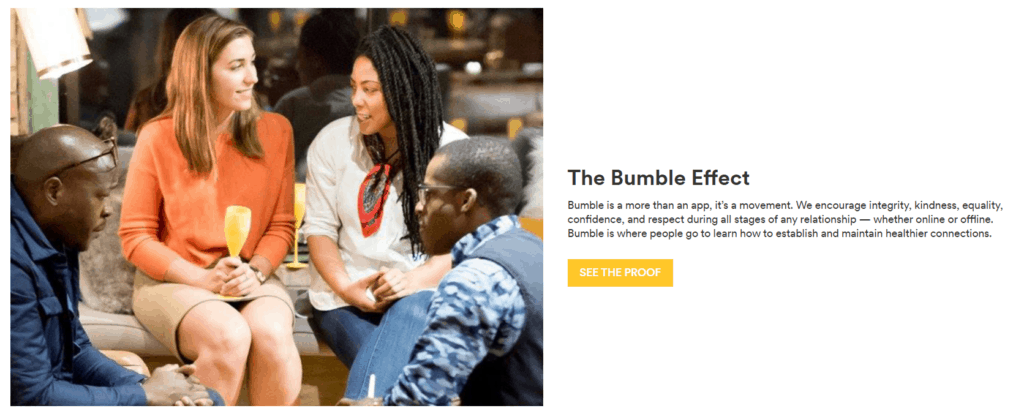
The offer has also narrowed. Bumble Bizz is no longer available, and friendship now lives in a separate BFF app. The next layer of value is Bee, an AI matchmaker inside a new experience called Dates. Bee holds a private onboarding chat, by text or voice, about a member’s values, relationship goals, communication style, and lifestyle. It then introduces a match with a note on why the two fit. Bumble is also testing life without the swipe in select markets. The bet is that people want fewer, better introductions rather than endless browsing.
What Value Does Bumble Provide to Women?
For women, the clearest value is protection from what dating apps are known for. Pew found that 56% of women under 50 who have used dating apps were sent unwanted sexually explicit messages or images, and 43% had someone keep contacting them after they said they weren’t interested. Bumble’s answer is a set of tools. Private Detector automatically blurs flagged images and lets the member view, delete, or block the sender. Block and Report tools and in-app voice and video calls keep a phone number private until the member is ready. On paid plans, Incognito Mode shows a profile only to people the member chooses first.
The second benefit is less pressure. Bumble’s own survey found that 66% of women prefer men to send the first message, with many saying it makes dating feel less stressful. More than half of the members it surveyed said the new 72-hour match window, up from 24 hours, improved their experience. Both figures are reported by Bumble itself.
What Value Does Bumble Provide to Men?
Men get something different: better odds and a cleaner pool. Estimates vary by source, but men make up roughly 54% to 62.5% of Bumble’s users, against about three-quarters of Tinder’s. That means more women per man than on the larger app. Men still outnumber women, so this is an edge rather than parity.
The other benefit is authenticity. Pew found that 63% of men under 50 who use dating apps think they have come across a scammer. Bumble’s Deception Detector uses machine learning to flag fake, spam, and scam accounts, backed by human moderators. In Bumble’s testing, it automatically blocked 95% of the accounts identified as spam or scams. ID verification adds a badge, and members can filter for verified profiles, so a man’s own profile can show that it is real.
How Does Bumble Operate?
Every Bumble account starts with a mobile number and a six-digit SMS code. Facebook or Apple ID can be linked as extra login methods, but a verified phone number is required either way. Members then build a profile with photos, prompt answers, and interests, and can verify it with a selfie check or government ID. Basic filters narrow who appears by age, distance, verification status, languages, and interests.
Profiles appear one at a time in the People tab. Swiping right shows interest, swiping left passes, and two right swipes make a match. Free accounts have a daily like allowance that refreshes after 24 hours, and paid plans remove the cap.
A match is not a chat yet. Under Bumble’s updated flow, both people get one opening message before the chat unlocks, and Opening Moves are gone. Matched members have 72 hours to send that message, and the other person then has 72 hours to reply. If neither writes, the match expires. A very short opener like “hi” triggers a prompt to make it more personal, but it can still be sent as it is.
BFF
Friendship used to be a mode inside the dating app. In the US, it is now a standalone BFF app that keeps one-on-one matching and adds a Groups tab for group chats, hangout planning, and an in-app calendar. Accounts are tied to a real phone number and a selfie check. Bizz, the professional-networking mode launched in 2017, is no longer available, so dating and friendship are what remain.
Additional Features
Matching, filtering, and messaging work without paying. The extras sit in Boost, Premium, and Premium+ plans, and some can also be bought separately.
- Extend: adds 72 hours to a match before it expires. Everyone gets one free Extend per day, and paid plans remove the limit.
- Rematch: restarts the 72-hour timer on an expired match. It is available on paid plans.
- SuperSwipe: flags extra interest and puts the sender’s profile at the front of the other person’s line, with a label.
- Spotlight: moves a profile to the front of the line for a set period so more people see it.
- Backtrack: undoes an accidental left swipe. A right swipe cannot be undone.
- Beeline: the “Liked You” queue, which shows who has already liked a profile so the member can match instantly. It is part of Premium.
- Notes: short pre-match messages, previously called Compliments, that react to a photo or prompt. A Note also counts as the opening message.
Most of these tools hang on the swipe, which Bumble is already testing without in select markets, so this list may not stay the same.
Bumble Revenue Model
Bumble works on a freemium business model: the basic service is free, and the extras cost money. Anyone above the age of 18 can create a profile and match with people nearby at no charge, and every new member makes the app more useful for the rest, which is how the free tier grows the network. Bumble’s own filings describe the model the same way: members use the service for free and pay for subscriptions and in-app purchases.
The company has stopped chasing a bigger free funnel. Since 2025, it has run what it calls a “quality reset”: raising its trust and authenticity standards and cutting performance marketing, so the member base is smaller but more engaged. In Whitney Wolfe Herd’s words, “We made a clear choice to prioritize quality over quantity.”
How Does Bumble Make Money?
Creating a profile and matching stay free. The money comes from paying members. Bumble App Revenue, which made up about 81% of the company’s $965.7 million in 2025, comes from subscription purchases and renewals plus in-app purchases. Most of the rest comes from Badoo and other apps. Bumble describes advertising and partnerships as not a significant part of its business.
Revenue is the number of paying users multiplied by what each one pays, and the two are moving in opposite directions. Total paying users fell from about 4.15 million in 2024 to 3.67 million in 2025, and to 3.16 million by the second quarter of 2026. Meanwhile, Bumble App revenue per paying user rose from $25.72 to $26.80 across 2025 and reached $27.55 in the second quarter of 2026. Higher revenue per payer has not made up for fewer payers. Revenue fell 9.9% in 2025, and the first half of 2026 brought in $422.9 million, against $495.3 million a year earlier.
Bumble Boost and Premium Subscriptions
Subscriptions are the core paid product, and they come in tiers. Boost is the entry tier and sells convenience: unlimited likes, Backtrack, unlimited Extends, Rematch, a weekly Spotlight, and five SuperSwipes a week. Premium adds control with Beeline, Advanced Filters, Incognito Mode, and Travel Mode. Premium+ goes further with photo insights and faster-tracked likes. Prices vary by region, age, and device. Spotlights, SuperSwipes, and Notes can also be bought on their own, without a subscription.
Sources of Expenses for Bumble
Bumble’s largest 2025 expense was not an operating cost. The company wrote down $1,039.0 million of goodwill and intangible assets, a non-cash impairment that drove a net loss of $906.6 million. Underneath it, the business generated $250.4 million in operating cash flow and $313.6 million in adjusted EBITDA, a 32.5% margin, per its full-year 2025 results. The real running costs break down as follows.
Cost of Revenue: This was the biggest recurring expense at $281.5 million, about 29% of revenue. It consists mainly of in-app purchase fees paid to the Apple App Store and Google Play. As more members pay through direct and alternative billing, the share is falling, and it was down to 26% of revenue by the second quarter of 2026.
Marketing Cost: Selling and marketing expense fell to $165.5 million from $261.2 million in 2024, the largest cut among the expense lines.
App Development: Product development expense rose to $121.5 million from $100.7 million as Bumble rebuilt its platform for the AI-led relaunch.
General and Administrative Costs: G&A expense was $138.1 million, up from $128.5 million, and includes legal and litigation costs. Restructuring added $14.6 million, tied to the 2025 workforce cuts, which affected about 30% of staff, and to shutting down the Fruitz and Official apps.
Debt: Bumble paid $42.4 million in net interest in 2025 on $588.5 million of debt. It took another $169.3 million impairment charge in the second quarter of 2026, which is why that quarter closed with a net loss of $127.9 million.
Bottom-Line?
The 2026 numbers tell a different story than Bumble’s growth years. Revenue fell 9.9% in FY2025 to $965.7 million, according to the fourth-quarter and full-year results. In Q1 2026, the split personality showed. Revenue dropped 14% to $212 million, while net earnings rose 165% to $53 million (first-quarter results). The most recent quarter continued the slide: Q2 2026 revenue fell 15% to $210.5 million.
For comparison, the company went public in February 2021 and raised $2.15 billion, at a Bumble valuation exceeding $7 billion. Bloomberg reported the IPO proceeds at the time.
By June 2026, Bumble’s shares had fallen 48% over 12 months, leaving a market value of about $388 million, and the company was exploring a sale, working with Morgan Stanley, according to three people familiar with the matter who cautioned that no deal is certain. Blackstone, which owns about 22% of Bumble, declined to comment.
A structural complication sits in the middle of any take-private. Per the FY2025 Form 10-K, pre-IPO common unitholders, including the sponsor and the founder, still own about 14.1% of the common units in the operating company, the legacy Up-C structure from the 2021 IPO. Founder Whitney Wolfe Herd has said the quality reset has “meaningfully improved the health of our ecosystem,” with a “fully reimagined Bumble experience on our rebuilt, AI-enabled platform later in 2026” (eonline). The open question is whether that relaunch or a sale comes first. We cannot call the Bumble business model a fully profitable venture.