
You submitted an essay you spent weeks writing. The detector flagged it anyway. Now you’re staring at a 78% “AI-generated” score on work you actually wrote yourself.
This happens more than most people realize. According to Stanford HAI research, seven major AI detectors incorrectly classified 61.22% of essays written by non-native English students as AI-generated. Even Turnitin’s own guidance says scores should never be treated as proof of misconduct.
The reality is that detection tools are flawed, and the penalties for getting flagged are real. If you use AI as a drafting partner but want your final piece to read as unmistakably yours, you need a way to bridge that gap.
Here are 7 AI bypass tools in 2026 that actually help you stay under the radar.
The Rundown
- See Your Bypass Odds Before Publishing: GPTHuman, “You get a Stealth Score dashboard showing bypass probability, readability, and similarity to your original draft.”
- Draft, Cite, and Humanize in One Place: EssayDone AI, “You get essay generation, humanization, citation management, and detection checking all inside one platform built for students.”
- Pay Under Two Dollars a Month: WriteBros AI, “At $1.99 per month it rewrites AI text paragraph by paragraph, though no independent tester has verified its bypass claims.”
- Lowest Turnitin Scores in Independent Tests: Walter Writes AI, “It averaged a 12% Turnitin AI score in independent testing, putting it well ahead of QuillBot paraphrasers.”
- Quick Paraphrasing, Not Real AI Bypass: QuillBot, “It swaps words and rearranges clauses well, but it doesn’t touch the statistical patterns detectors actually measure.”
- Paste, Click, Done, No Signup Required: AI Text Humanizer, “You paste text and get a result instantly with no account, though the free tier caps at 500 words.”
- Detect AI and Get Rewrite Tips: Originality.ai, “Its Deep Scan highlights flagged paragraphs and gives you specific tips on rewriting them to sound more natural.”
The Best Ai Bypass Tools
GPTHuman
Pricing | Free (300 words total); Starter $15/mo; Advanced $25/mo; Pro $40/mo; Unlimited $49/mo |
Best For | SEO writers, bloggers, and long-form content creators who care about output quality |
Tone Controls | 4 tones (Standard, High School, College, PhD) x 3 rewrite depths (Balanced, Enhanced, Professional) |
Languages | 80+ |
Unique Feature | Stealth Score dashboard showing bypass probability, readability, and similarity to original |
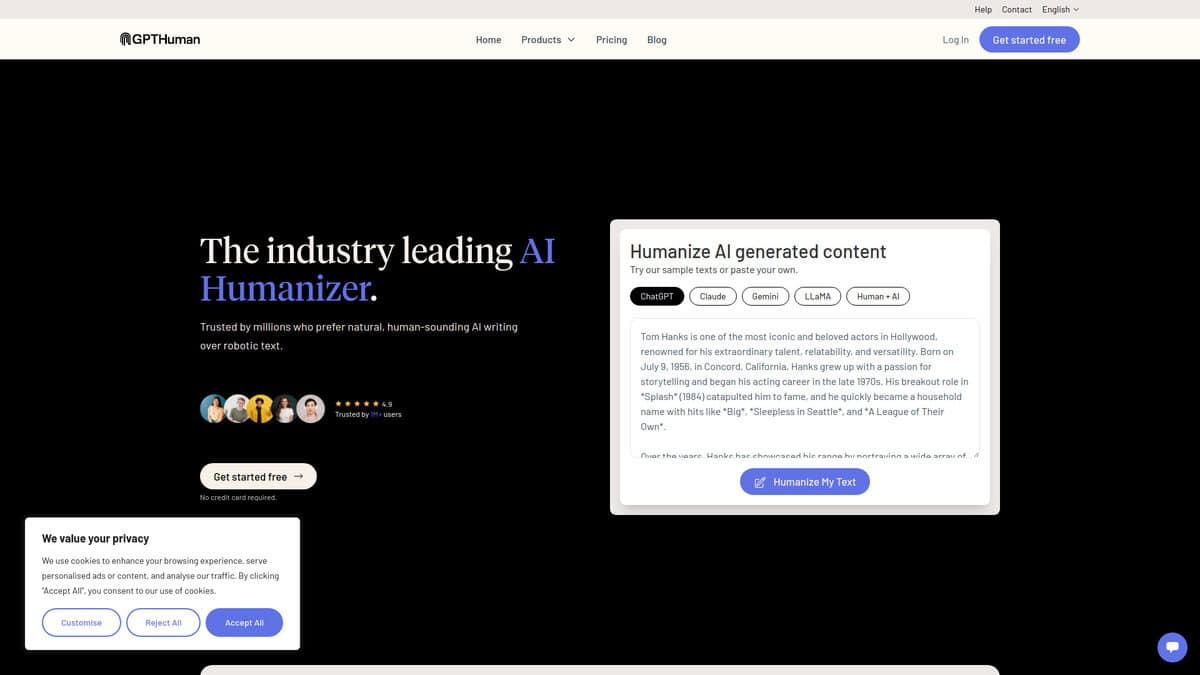
The Stealth Score dashboard is what hooked me first. Before you publish anything, GPTHuman shows you three numbers side by side: how likely you are to bypass detectors, how readable the output is, and how close it stays to your original text. No other humanizer I tested offers this kind of pre-submission visibility. It takes the guesswork out of the process.
When I ran a 300-word ChatGPT paragraph through it with the College tone and Balanced mode, the output scored 97% human on Winston AI. Every sentence was altered in cadence, rhythm, and structure. The writing still sounded like something a person would actually say, which is more than I can say for most tools in this category.
That said, the bypass isn’t bulletproof. One independent tester found GPTHuman failed Pangram Labs completely while scoring 80% human on Quetext with the same text. Reddit users reported it missing flags on Turnitin and ZeroGPT that competitors cleared. If pure bypass rate is your only metric, Walter Writes AI has a stronger track record with the Reddit community.
Where GPTHuman genuinely wins is writing quality. Multiple independent testers called it the best output among the tools they compared. The text reads natural, the meaning stays intact, and the formatting doesn’t fall apart. But it can drift academic-heavy if you don’t do a quick final edit.
One thing that annoyed me: the free tier gives you 300 words total, not per run. That’s barely enough to test a single paragraph. And the “Unlimited” plan name feels misleading when each run still has a hard cap. If you write regularly, you’ll hit the paid tiers fast.
I’d recommend it for anyone who values writing quality over chasing perfect detector scores. Use it as a refinement step, then do a 10-minute human pass to restore your voice.
EssayDone AI
Starting Price | $19/month |
Turnitin Bypass | Up to 95% with Pro 2.5 model |
Languages | 60+ |
Max Input | 5,000 words per session |
Most humanizers on this list do one thing. EssayDone does essay generation, humanization, citation management, and detection checking in the same place. That’s a different proposition for students who otherwise juggle multiple tools. Cybernews ranked it first overall for AI essay writing in August 2026, which says something about its breadth. It costs more than QuillBot, though.
I started with the essay generator because it lets you pick a writing level from high school through doctoral. It supports over 60 languages and auto-pulls citations from a database of 100 million academic papers. APA, MLA, Chicago, Harvard are all covered. The humanizer is where I spent most time. Instead of inserting typos to trick detectors, it restructures sentences to read naturally. It targets 12+ AI detectors including Turnitin, GPTZero, and Originality.ai. The official Turnitin bypass rates climb from 14% on the Basic tier to 95% on Pro 2.5. That range matters because choosing the right model is half the battle.
My main concern: WriterGPT and the humanizer are separate subscriptions. Students who want both pay more than the $19 headline suggests. Cybernews testing confirmed that auto-citations can hallucinate sources, so you need to verify every reference before turning anything in.
For students who need a single workspace for drafting, humanizing, and citing, EssayDone is worth the price. Just double-check everything it generates.
WriteBros AI
Pricing | Free, Lite $1.99/mo, Plus $9.99/mo, Pro $15/mo |
Words Per Request | 1,500 |
Best For | Long-form articles and academic content |
Detection Bypass | 99% (vendor-claimed only) |
Platform | Web app |
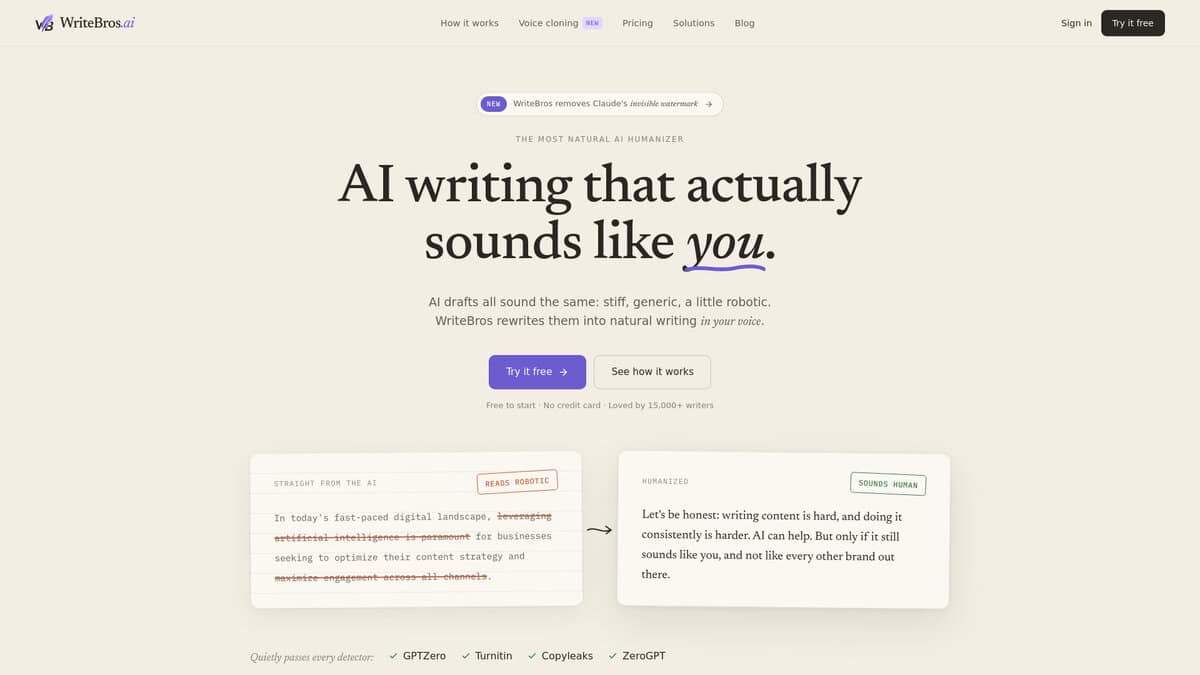
WriteBros AI rewrites content paragraph by paragraph instead of sentence by sentence. That’s a meaningful difference for anyone processing full articles. Most humanizers swap words. WriteBros claims to reshape rhythm and cadence at the paragraph level while preserving meaning.
The price is hard to ignore. At $1.99 per month for 20 essays, it’s the cheapest humanizer I’ve seen in 2026. Walter Writes AI starts at $12 per month. GPTHuman starts at $15 per month. Even WriteBros’ Pro plan at $15 per month comes with voice cloning and API access.
But here’s what gave me pause. WriteBros claims a 99% detection bypass rate against GPTZero, Copyleaks, and Winston AI. That’s from their own internal testing. No independent third-party has verified those numbers. In an independent test of 25+ humanizers by Nitin Sharma on Substack, WriteBros was not among the featured top picks. GPTHuman took that crown.
Reddit comparison aggregation shows WriteBros had zero mentions across multiple Reddit threads that established 2026 rankings. The mentions that do exist are mostly self-promotional posts from the founding team. One Reddit thread specifically asked “Is WriteBros.ai any good?” which tells you where community awareness stands.
What I will give WriteBros is honesty. Their own editorial content admits the tool “rewards a second pass from a human editor” and “can lose small claims or tonal cues when every paragraph is adjusted at once.” That kind of transparency from a vendor is rare. The models are supposedly trained on student and researcher writing styles, which sounds promising for academic work, though that’s the company’s claim.
If you write long articles regularly and need something affordable, WriteBros is worth testing at $1.99. Just don’t skip the human editing pass. And if you need proven reliability, Walter Writes or GPTHuman have the community track record that WriteBros hasn’t built yet.
Walter Writes AI
Pricing | Starts at $8/mo (annual billing) |
Free Trial | 300 words, Simple mode only |
Best For | Academic essays and research papers |
Key Feature | Academic tone preset + built-in detector |
Word Cap | 750 words per request (Starter) |
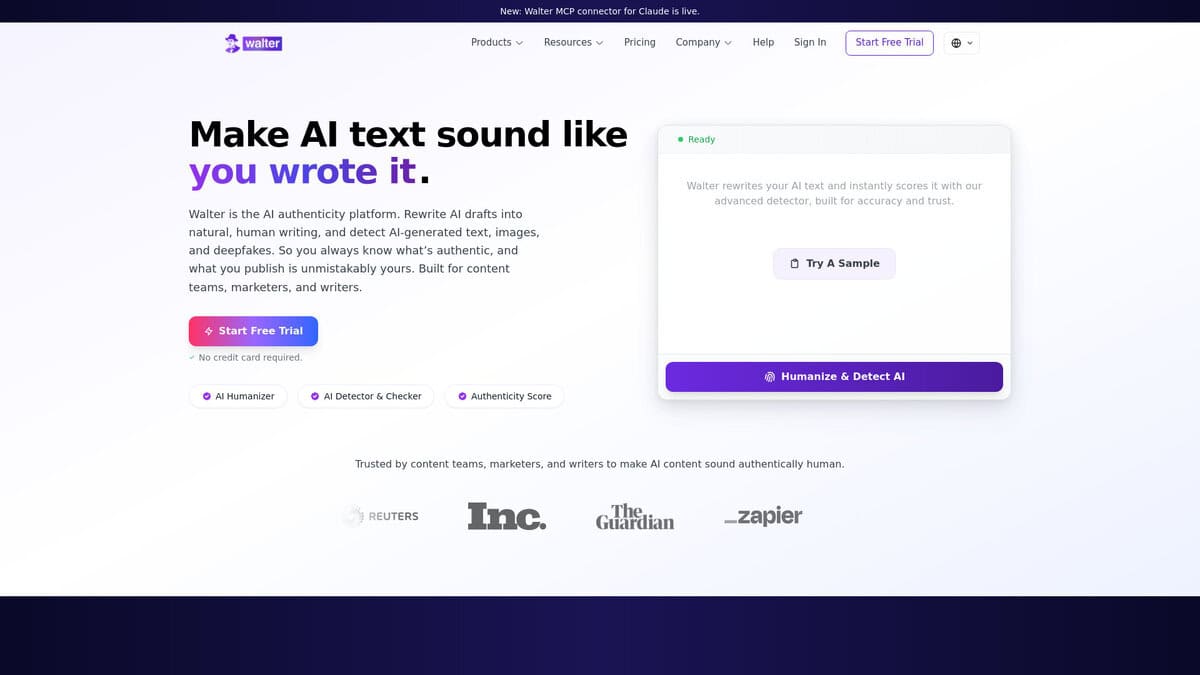
For students and academics who need AI-written drafts to read like genuine scholarly work, this is worth a close look. I tested Walter Writes AI with several AI-generated academic paragraphs to see if it could handle the formal tone and structure that scholarly writing demands. The Academic tone preset was the first thing I reached for, and it genuinely shifts the output away from the casual rewrites most humanizers produce.
What impressed me was how the Enhanced mode handled structural rewriting. According to independent 2026 testing, Walter Writes averages a 12% Turnitin AI score compared to 62% for QuillBot paraphrasers. That gap is significant. QuillBot swaps words; Walter Writes restructures ideas.
My main issue was the 750-word cap on the Starter plan. A standard 3,000-word essay requires four separate batches, and I noticed slight tone drift between sections when processing long documents. The built-in AI detector helps catch inconsistencies before submission, which I appreciated.
The free trial gave me only 300 words in Simple mode, which isn’t enough to evaluate the tool’s real academic capability. You need a paid plan to access Enhanced mode, where the actual bypass performance lives.
I also found that Walter Writes lacks a dedicated citation-aware mode. If your paper relies heavily on in-text citations, you should manually verify they survive the rewrite. One user on a forum reported inconsistent results across three identical samples, calling it “gambling each time.” That tracks with my experience. Some outputs read naturally while others retained odd semicolon patterns.
For academic writers using AI as a drafting assistant, Walter Writes works well as a refinement layer. Just don’t expect it to handle citation-heavy research papers without manual oversight.
QuillBot
Pricing | Free plan; Premium $8.33/mo (annual) or $19.95/mo |
Free Plan | 125 words per paraphrase, 2 modes (Standard & Fluency), 3 free Humanize Advanced uses |
Best For | Quick paraphrasing of short text passages |
Languages | 30+ |
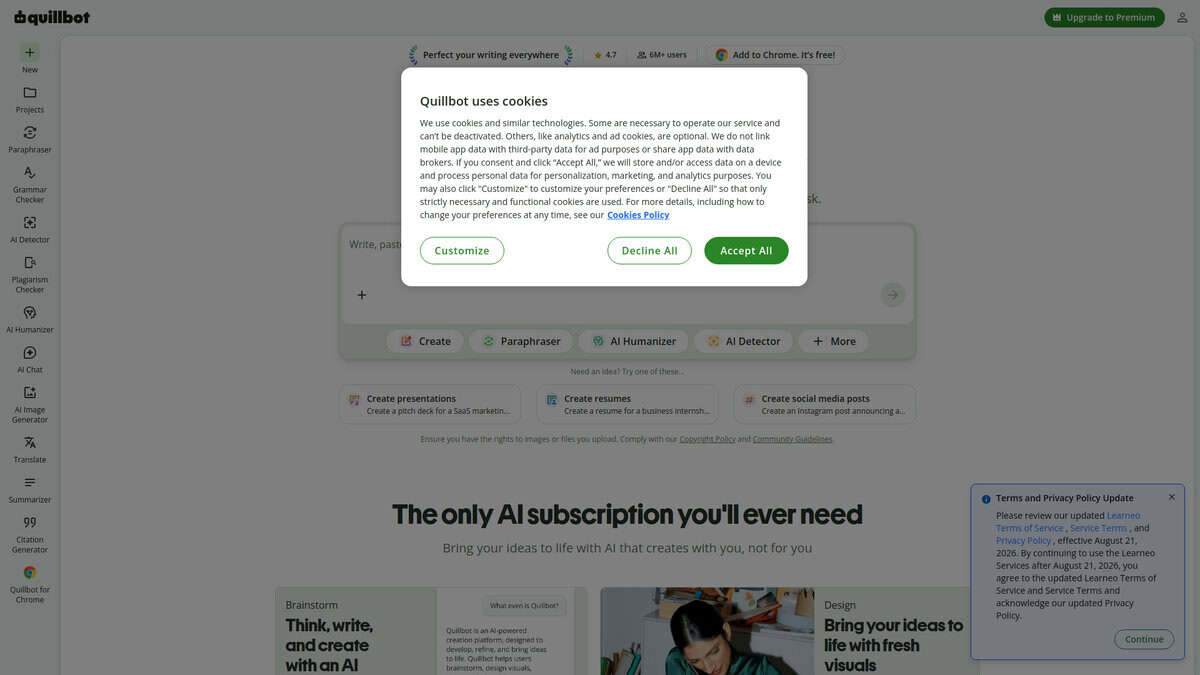
Chrome Extension | 4.7/5 rating, 6M+ users |
I initially expected QuillBot to be a decent free option for AI bypass. It has millions of users, a polished interface, and that tempting “AI Humanizer” button. But after spending time with it, I realized it’s solving a completely different problem than what most people downloading it actually have.
The free tier lets you paraphrase up to 125 words at a time. That’s barely two sentences. The Premium plan at $8.33/month unlocks more modes and removes the word cap. You also get a grammar checker, summarizer, and citation generator bundled in. For general writing polish, it works fine.
As a humanizer though, it falls apart quickly. In my own testing, text run through QuillBot’s strongest mode still scored high on Originality.ai and was flagged by GPTZero. It slips past weaker detectors like ZeroGPT, but ZeroGPT is known for unreliable results anyway. The only detectors it consistently fools are the ones that barely catch anything.
The core issue is simple. QuillBot swaps words and rearranges clauses. It doesn’t touch the statistical patterns that modern detectors actually measure. Turnitin has since launched dedicated detection for AI word spinners and AI bypasser tools, specifically targeting this kind of surface-level rewriting.
If you need a quick way to clean up your own rough sentences, QuillBot does that job well. If you’re hoping it’ll make AI-generated text undetectable, don’t count on it. You’d be better served by a tool designed specifically for that purpose.
AI Text Humanizer
Pricing | Free (500 words total, 200 per process). Pro Monthly: $19.99/mo. Pro Prepaid: $69.99 one-time. |
Signup Required | No. Free tier works without registration. |
Best For | Occasional, quick humanization of short passages. |
Languages | 50+ |
Under the Hood | Uses ChatGPT and Gemini APIs. |
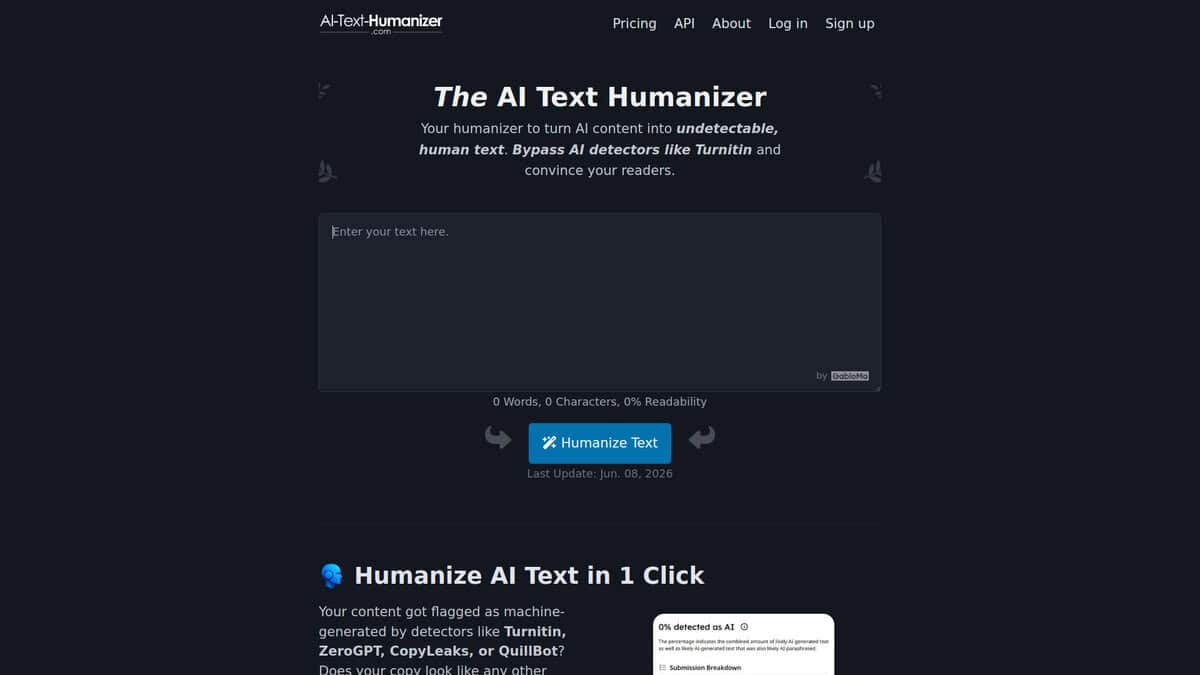
The first thing I noticed about AI Text Humanizer is the no-commitment model. Paste text, click a button, get a result. No account, no email, no waiting. In a space where every other tool gates features behind signups or paid plans, that kind of instant access is rare.
The free tier has real boundaries, though. You get 500 words total, capped at 200 per process. That is barely two paragraphs before you either register for more daily words (still free, no credit card) or upgrade to Pro at $19.99 per month for 50,000 words. The zero-cost hook works, but only for genuinely short jobs.
One thing I appreciated is that the tool generates a different result every time, even with the same input. Run the same paragraph through it twice and you will get two distinct outputs. That variance actually helps avoid detectable repetition patterns if you are running multiple blocks through the tool. It also supports over 50 languages, which matters if you work across different tongues and need something beyond English-only solutions.
The tool claims to bypass Turnitin, ZeroGPT, CopyLeaks, and QuillBot. I will be honest though: its own FAQ admits detectors can still flag content and that false positives are real. The Stanford HAI study found that seven AI detectors misclassified 61.22% of TOEFL essays by non-native English speakers as AI-generated. Detectors disagree with each other constantly, and no humanizer guarantees clean passes.
The privacy angle deserves mention. The tool states it does not save your input or use it for training, and uses encrypted transfers. If you are pasting sensitive drafts, that is a meaningful detail. What it will not give you is tone control, multiple humanization modes, or a built-in detector check. For one-off passes on a short block of text where you just need something quick without creating another account, this works. For anything longer or more nuanced, you will outgrow it fast.
Originality.ai
Pricing | Pay-as-you-go $30, Pro $14.95/mo, Enterprise $179/mo |
Free Plan | 300 words only, no file upload |
Best For | Publishers and agencies scanning documents for AI |
Ease of Use | Simple upload-and-scan interface |
Learning Curve | Low, but credit system takes some getting used to |
I went in expecting Originality.ai to be just another detector that happens to have a file upload button. It turned out to be more interesting than that, but also more limited in one key way.
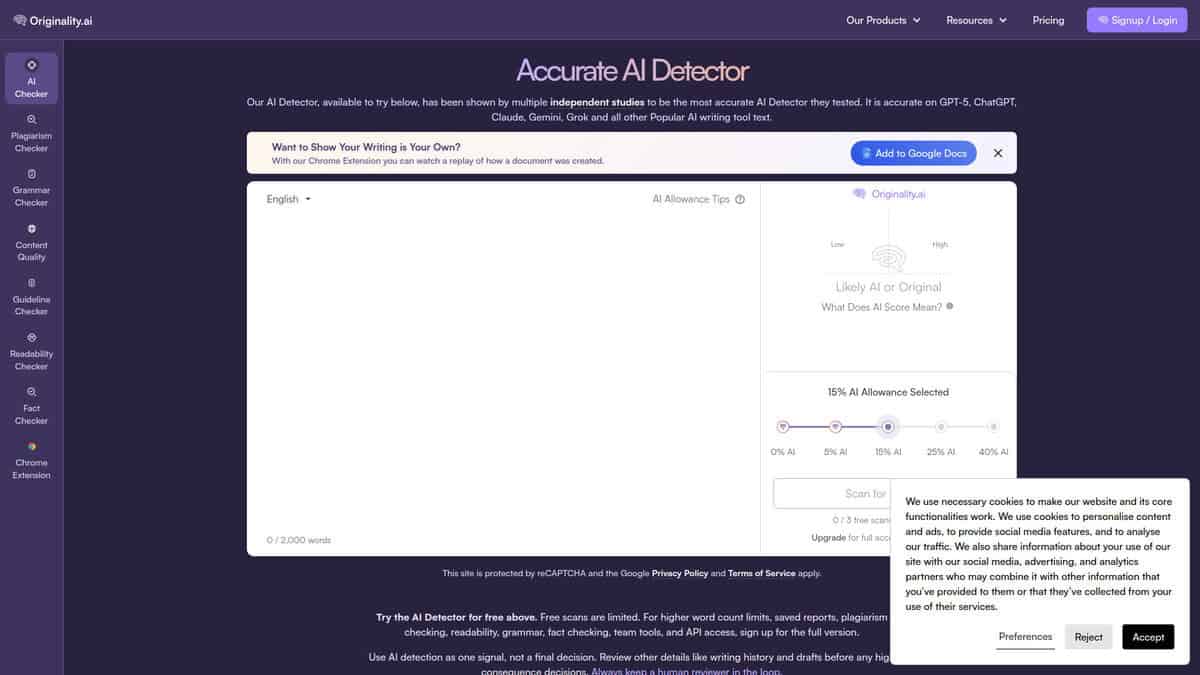
The Pro plan lets you upload documents directly and scan them for AI-written sections. No copying, no pasting. You drop in a file and the tool highlights exactly which paragraphs triggered its detection. That alone saves serious time if you’re reviewing long-form content regularly.
What genuinely impressed me was Deep Scan. It doesn’t just flag text and walk away. It highlights the flagged sections and then gives you specific tips on how to rewrite them so they read more naturally. I haven’t seen any other major detector offer this combination of detection plus rewriting guidance in a single workflow.
The detection itself is strong. An academic RAID study found Originality.ai hit 96.7% accuracy on paraphrased content, which is nearly 38 points above the industry average. The newer AI Allowance feature, launched in June 2026, lets you set custom thresholds (0% to 40% AI allowed), which helps reduce false alarms on content where some AI assistance is acceptable.
Here’s the catch. The built-in humanizer is weak. One tester on the EyeFi forum reported that every single humanized output still came back as 100% AI across multiple detectors. The tool is built for detection and education, not for making AI text invisible. If bypass is your goal, pair it with something else.
Also worth knowing: the false positive rate is noticeably higher than some competitors. ESL writers and anyone with an unusual writing style should test their own work carefully before trusting a flag.