You tap a few buttons, and hot food shows up at your door. Behind that simple act sits a much messier business story: the Deliveroo business model.
Deliveroo grew from a London startup into one of the most talked-about names in food delivery. It conquered a market, barely turned a profit, then sold to DoorDash for £2.9 billion. The takeover completed on 2 October 2025, and Deliveroo was delisted from the London Stock Exchange the next day.
Since then, the footprint has shrunk. In February 2026, DoorDash said it would wind down Deliveroo and Wolt operations in Qatar, Singapore, Japan and Uzbekistan. Deliveroo’s last day in Singapore and Qatar was 4 March 2026. It now serves seven markets, from the UK to Kuwait.
Which raises the question this article answers. How does a company like Deliveroo actually make money?
Deliveroo Business Model
Deliveroo was founded in 2013 by Will Shu and his childhood friend Greg Orlowski. Early on it looked much like the wave of food-delivery startups then entering the market. Those included unicorn startups such as Grubhub in the United States of America and Swiggy in India.
That peer map has since consolidated. Global food delivery now sits in three consolidated blocs rather than a field of independents. DoorDash owns Deliveroo and Wolt. Prosus owns Just Eat Takeaway, home to the old ordering service Just Eat. Uber Eats announced a $14.8bn offer for Delivery Hero in 2026. Matt Britzman of Hargreaves Lansdown says DoorDash bought Deliveroo to compete with Just Eat and Uber Eats in Europe.
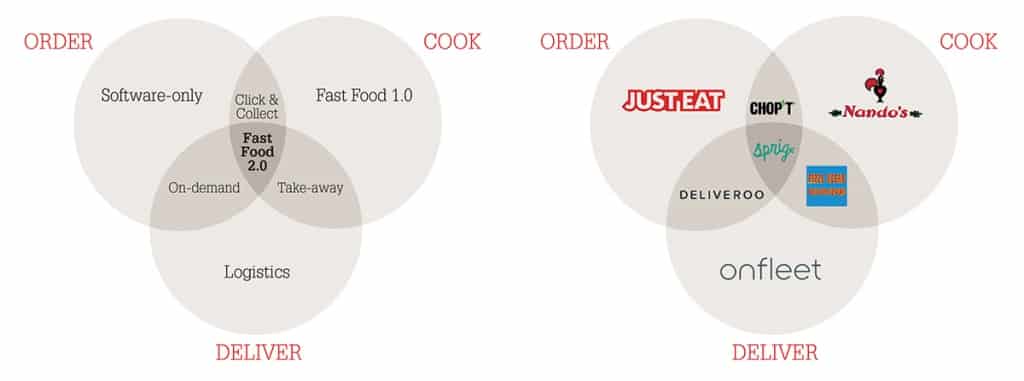
Deliveroo’s own approach has stayed the same. Ordering and delivery used to be separate jobs. Aggregators like Just Eat took the orders, while logistics firms handled the drop-off. Deliveroo merged the aggregator model with marketplace and logistics into one hyperlocal on-demand service.
Leadership has moved on too. Will Shu stepped down as CEO when the DoorDash deal completed in October 2025, after 13 years in the job. Miki Kuusi, Head of DoorDash International, now runs Deliveroo.
The business itself runs on a dual partnership model. It aims to solve two problems: bad restaurants and bad delivery. These partners are:
Restaurant Partners
Restaurant partners make up one side of Deliveroo’s dual partnership model. The platform counted around 172,000 restaurant partners in 2025, per app market data. That was a recovery from about 163,000 in 2024. It still sat below the roughly 183,000 of 2023, recorded in Deliveroo’s Wikipedia entry.
These partners are not all independent kitchens, though. BBC coverage in 2026 accused big chains of posing as independent restaurants on delivery apps. One independent owner described the gap as “small fish trying to swim with the sharks” (BBC reporting).
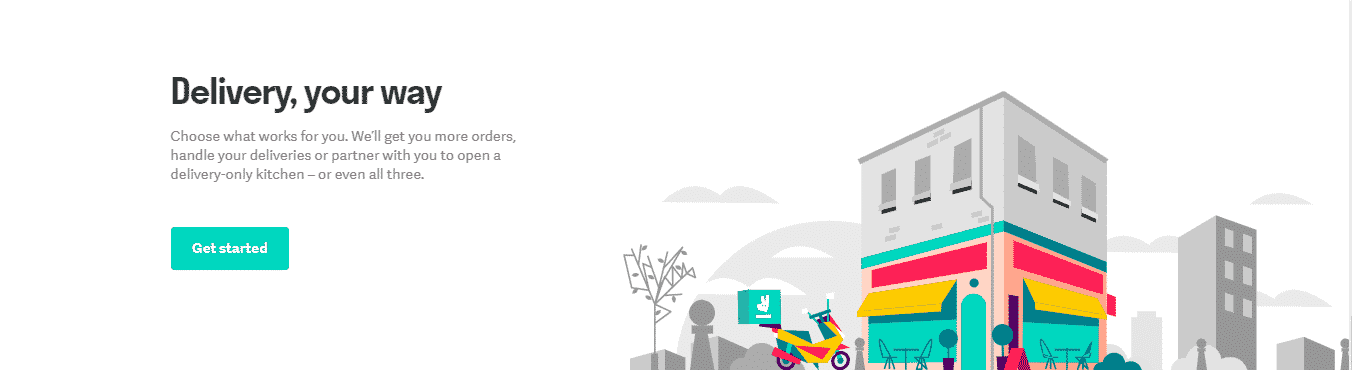
Deliveroo’s value proposition to restaurants of every size rests on six practical offers.
- Brand Promotion: Partner restaurants get promoted across Deliveroo’s app and growth programmes. That puts them in front of customers who might never visit otherwise.
- Support: Partners receive performance analytics to track how their business is doing, alongside 24×7 customer support and dedicated account management.
- Tech: Deliveroo supplies order and dispatch tools that staff can learn quickly, keeping mistakes down during a busy service.
- POS Integration: A Restaurant partner API connects Deliveroo to a restaurant’s point-of-sale system. That integration shows every Deliveroo order in the POS in real time, and Deliveroo’s developer documentation covers supported systems.
- Growth: The Editions program helps restaurants open delivery-only kitchens in new areas, guided by Deliveroo’s data on local food demand. Deliveroo advertises more than 20 Editions sites across the UK, with Editions kitchens in four countries. The wider market is shifting too: a January 2026 study in the Guardian found one in seven food-delivery businesses in England now runs as a dark kitchen.
- Perks: Restaurants can also claim partner perks such as free 4G internet, recruitment support, discounted packaging, and an employee benefits program.
Delivery Partners
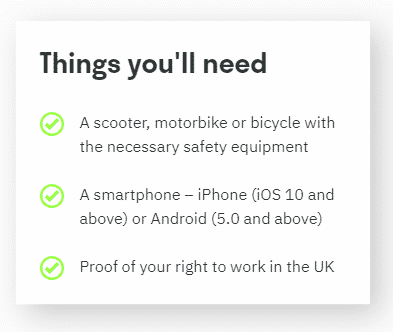
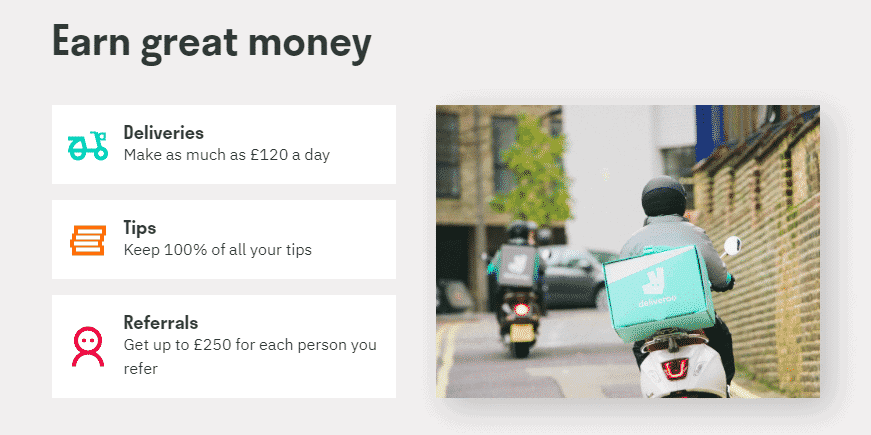
Deliveroo’s delivery side runs on a fleet of about 135,000 self-employed couriers as of 2025. They collect food from restaurants and bring it to customers by bicycle, motorbike or scooter. Every one of them is an independent contractor, not an employee. That distinction is the legal keystone of Deliveroo’s cost model.
UK Deliveroo driver earnings run from £7.71 to £13.89 per hour. That range comes from Indeed data compiled by Business of Apps. Riders keep whatever tips customers leave on the app. There is no guaranteed wage floor and no guaranteed hours.
The employment question has gone to the top of the UK courts. In 2023 the UK Supreme Court ruled that Deliveroo couriers are not workers. The case, Independent Workers Union of Great Britain v Central Arbitration Committee, turned on the unlimited right of substitution. A rider can send someone else to do the job. Riders also have no set workplace, no guaranteed earnings, and can start and stop whenever they want. That self-employment status keeps Deliveroo outside minimum wage and holiday pay rules.
That legal setup is already under pressure. The EU Platform Work Directive must be transposed by member states by 2 December 2026. The deadline creates fresh uncertainty for Deliveroo’s French, Belgian and Italian operations. In the UK, the Employment Rights Act 2025 phases in through 2026 and 2027. Self-employed platform riders stay largely outside its scope.
Rider relations remain contested. In May 2026 delivery riders struck in Milan, Bologna and Florence during a heatwave over pay and safety. The UK government also met Deliveroo, Uber Eats and Just Eat over couriers sub-letting their accounts. All three apps agreed to tighten verification checks.
What riders get from the arrangement:
- Flexible hours: Riders log in when they want and stop when they want. There is no shift schedule and no minimum commitment.
- Keeping tips: Riders keep all customer tips added in the app.
- Self-employment status: Riders fall outside minimum wage, holiday pay and pension protections. In return they control when and whether they work.
Deliveroo’s consumer base reached about 7.6 million users in 2025. The app began as a way to order from premium restaurants, but the selection has since widened well beyond that. Deliveroo also partners with grocery and everyday retail chains including Morrisons, Waitrose, Co-op, Sainsbury’s and Asda. Customers now order both restaurant meals and weekly groceries through the same app.
How Does Deliveroo Work?
Working towards its Deliveroo objectives of revolutionising the experience of doorstep delivered food for its consumers, Deliveroo works all of this out in a simple but dynamic model. Deliveroo has done thorough market research and has performed extensive data analysis operations to develop a food delivery platform which is easy to access for the consumers, restaurants and delivery riders.
The Deliveroo business model’s main operational channel is through its app and website platform. These platforms have been curated by a technology-driven innovation and expansion process and the ordering of food takes place in the following way:
- Consumers are provided with a wide choice of dishes from numerous cuisines which they look up on Deliveroo’s website or mobile phone application. They can select the locality they want to get food delivered to on the basis of the postal code and nearby restaurants are listed on the app.
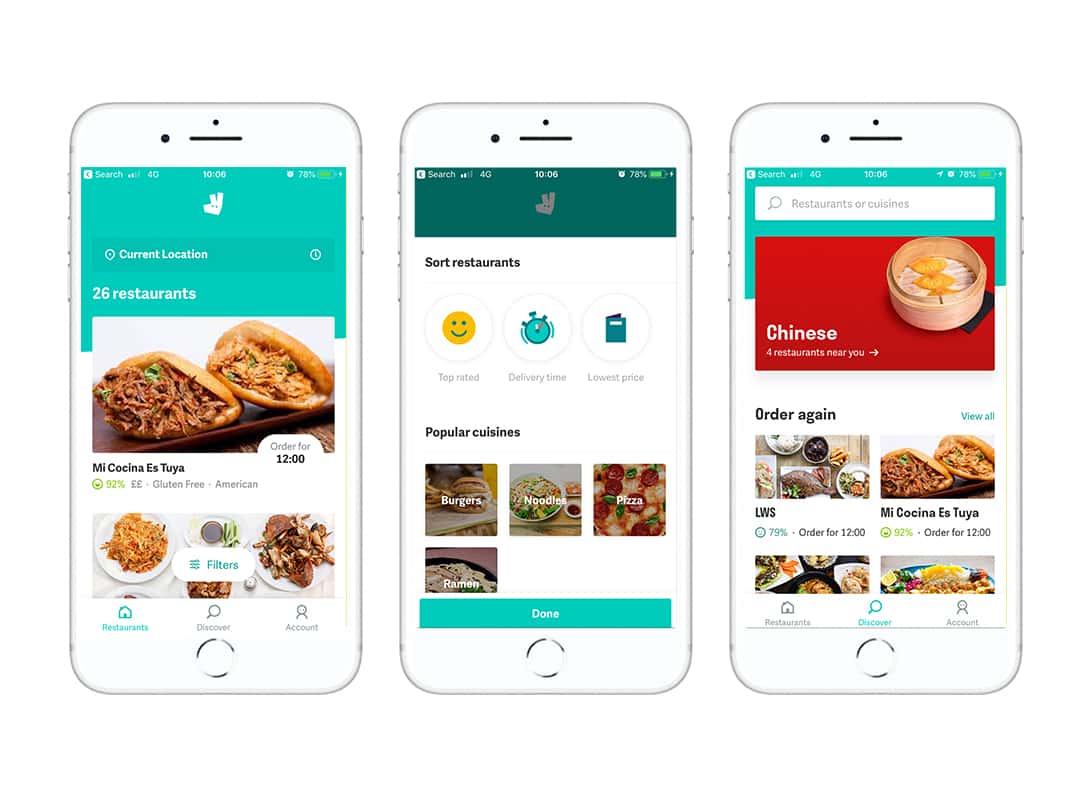
- After having chosen their food from the partner restaurants, consumers can place their order and proceed to checkout by completing the payment through highly secure payment gateways such as Credit cards, PayPal, Apple pay and much more. The process of ordering takes hardly a minute to complete through the app.

- With the completion of the order, the restaurants are notified about the food to be prepared with additional information, if fed by the consumer. At the same time, the people who place the order can track their food on the Google maps API linked to Deliveroo’s application.
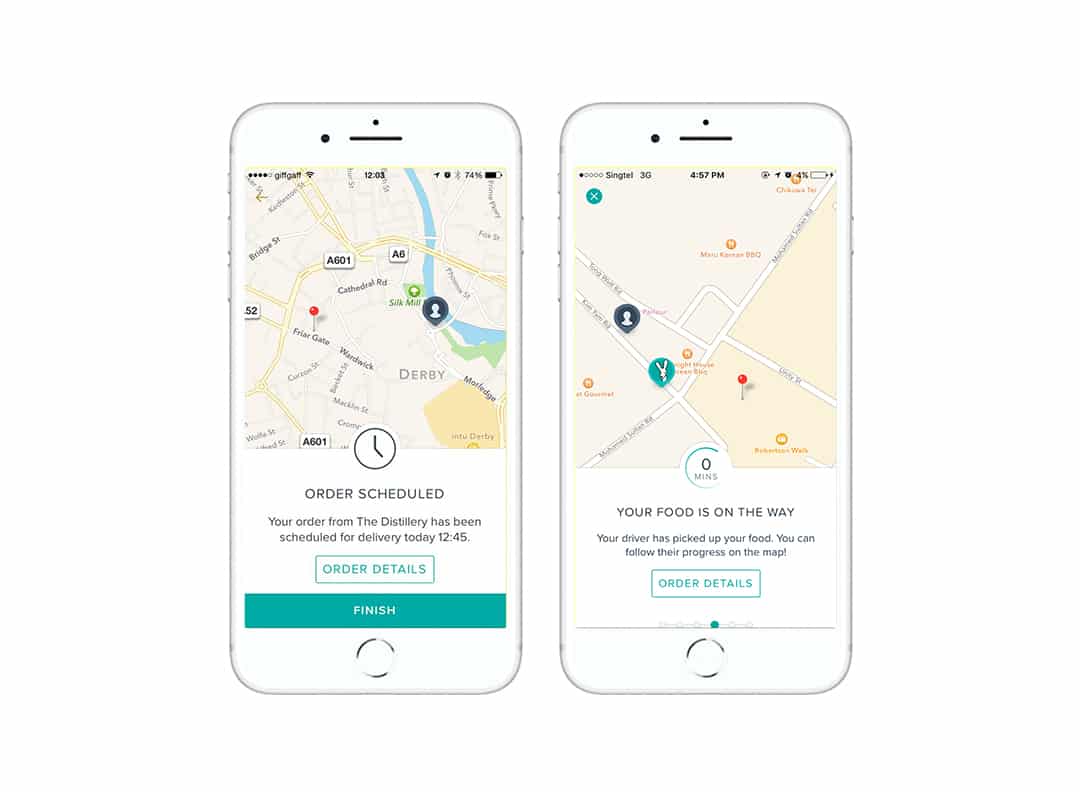
- Since Deliveroo focuses a lot on the timely delivery of this delicious food, the riders are stationed within a 2.2 km radius of the eateries they sign up for so that the collection and the dispatch are quite convenient. As soon as the order is placed by the customer, these riders are notified on their respective app to reach the pickup location. These riders make sure that hot and sizzling food is delivered to the consumers in less than 30 minutes without the quality of the food being hampered.
How Does Deliveroo Make Money?
Sources of revenue:
The Deliveroo business model takes a cut of every order placed through its app. The company’s own merchant terms set the Marketplace+ services fee at 35% of order value plus VAT. That fee applies where Deliveroo’s rider network is used. Deliverect’s 2025 restaurant guide puts average commissions at 25% to 35%. The Deliveroo commission for restaurants varies by contract, number of locations and region. CNBC has reported Deliveroo taking up to 35% plus VAT on some orders. Restaurants also pay for promotions and partner perks sold through the platform.
Consumers pay a delivery or service fee on top of the food price. The size of that fee varies by order. The Guardian reported the customer service fee as 5% of order value in 2022. That fee carried a 99p minimum and a £2.49 cap.
Those streams produced about £2.11bn in revenue in 2025, up 1.9% year on year. Gross transaction value reached £7.8bn over the same period, up 5.4%. In FY2024, Deliveroo’s net income was roughly £0.1m on revenue of £2.07bn. That follows years in the red. The company had only just reached break-even before DoorDash bought it.
Sources of Expenses
Riders are self-employed contractors paid per order, not an hourly wage from Deliveroo. Effective UK earnings run £7.71 to £13.89 per hour, according to Indeed data compiled by Business of Apps. There is no hourly floor, so this cost rises and falls with order volume.
Commission income has to cover the platform itself: development, maintenance, support and marketing. Other costs on Deliveroo’s books include:
- Application and website development charges
- Application and website maintenance charges
- Salaries and provisions to full-time employees
- Administrative costs
- Advertising and marketing costs
- Benefits provided to customers in the form of offers
- Returns and refunds
- Miscellaneous expenses
What makes Deliveroo Successful?
The Deliveroo business model is easier to judge against its market position. Just Eat Takeaway leads UK food delivery, and Deliveroo and Uber Eats are roughly level for second place. Lumina Intelligence counts the field differently. It puts Uber Eats at 27.2% of UK delivery occasions in 2024, ahead of Just Eat at 25.2%. The wider market is forecast to grow 3.1% in 2025, reaching £14.3bn. Deliveroo’s position in the on-demand platform economy rests on four principles.
- Accessibility & Convenience: Deliveroo treats the ordering path as one product, from browsing restaurant menus to the meal arriving at the door. It manages the chain itself rather than handing the customer between steps, so placing an order stays a few taps.
- Technology: Deliveroo’s dispatch system matches each order to a rider using restaurant, rider and customer locations. That shortens routes and speeds up pickups. The DoorDash integration case rests on combining DoorDash’s AI and data capabilities with Deliveroo’s local logistics knowledge and route optimisation. Big delivery mergers have a mixed record on execution.
- Affordability: The Deliveroo value proposition is restaurant food at roughly the price charged in the dining room. Fees and charges are shown upfront, so the total is clear before the order goes out. Menu prices stay under restaurant control, which keeps the platform’s own cut out of the food price.
- Brand Development: The brand arc runs from stock market flop to trade sale. Deliveroo listed on the London Stock Exchange in 2021 and saw shares fall 30% on the first day. Growth then slowed to 1.9% in 2025, with revenue at £2.11bn, as the company ground toward break-even. DoorDash bought it for £2.9bn in a deal completed in October 2025.
Future of Deliveroo
Deliveroo no longer trades as an independent company. DoorDash agreed a £2.9bn buyout in May 2025. The deal completed on 2 October 2025, and Deliveroo was delisted from the London Stock Exchange. The brand continues under US ownership.
DoorDash now concentrates Deliveroo in seven markets where it sees sustainable leadership. The list runs from the UK, France and Belgium to Ireland, Italy, Kuwait and the UAE. Miki Kuusi, Head of DoorDash International and CEO of Deliveroo, said the priority is an orderly transition. He framed that transition around those same geographies.
That focus meant retreat elsewhere. In February 2026, DoorDash announced it was winding down Deliveroo and Wolt operations in Qatar, Singapore, Japan and Uzbekistan. Deliveroo’s last day in Singapore and Qatar was 4 March 2026, ending roughly a decade of Singapore operations.
The wider market has consolidated around three blocs. DoorDash runs Deliveroo alongside Wolt. Prosus owns Just Eat Takeaway, and Uber Eats announced a $14.8bn offer for Delivery Hero in 2026. The era of standalone food delivery startups looks finished.
Analysts describe Deliveroo as DoorDash’s beachhead in the UK and Europe. The integration now turns on execution. Shared logistics, backend technology and customer support must work as one system, with DoorDash’s AI capabilities added in. Large delivery mergers have a history of stumbling on fragmented execution.
DoorDash will also have to decide how the Deliveroo business model, including Deliveroo’s dynamic pricing model, fits its own. Regulation adds a firm deadline. The EU Platform Work Directive’s 2 December 2026 transposition deadline lands on Deliveroo’s French, Belgian and Italian markets.
Go On, Tell Us What You Think!
Did we miss something? Come on! Tell us what you think about our article on Deliveroo business Model | How does Deliveroo work & make money? in the comments section.