
Most conversations around AI and affiliate marketing start and end with content creation. Write blog posts faster. Generate product reviews in bulk. Pump out email sequences on autopilot.
And sure, that’s part of it. But if you stop there, you’re barely scratching the surface. In 2026, the affiliate marketing industry is worth over $19 billion globally, and nearly 79.3% of affiliate marketers are already using AI in their workflows.
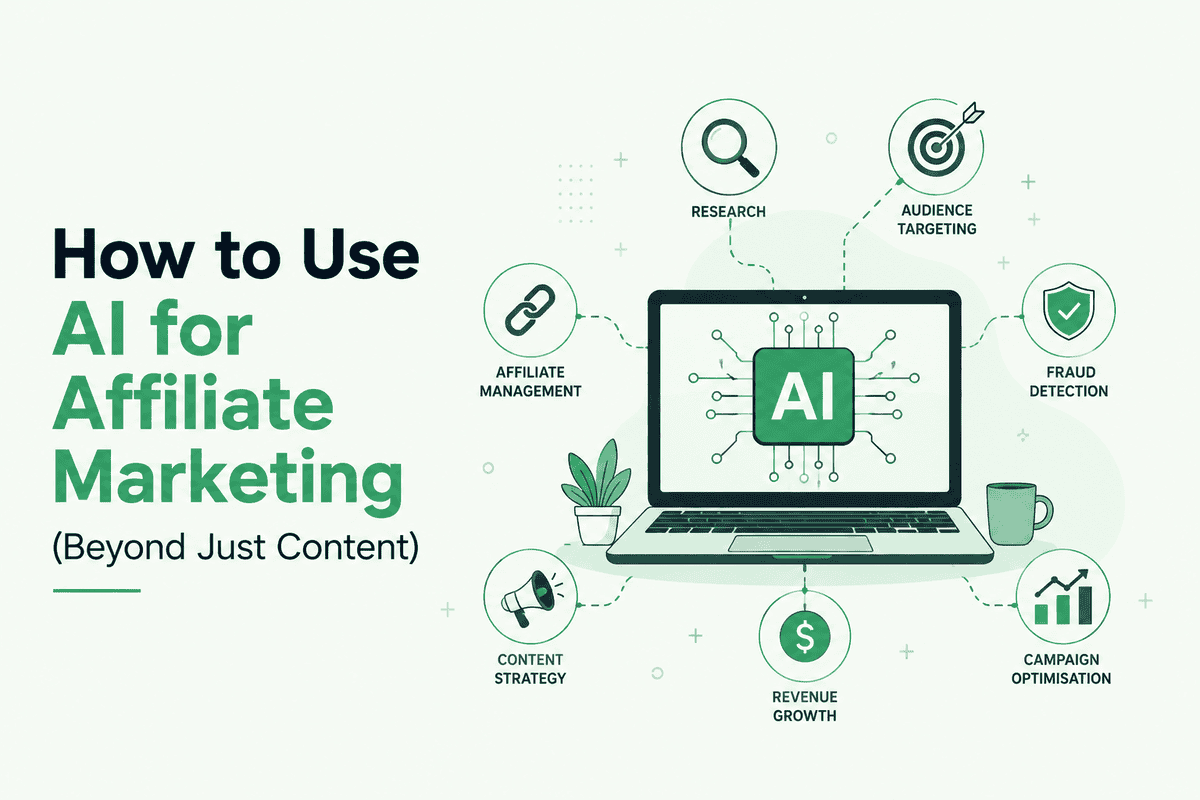
AI for affiliate marketing isn’t just changing how affiliates write. It’s changing how they find keywords, target audiences, detect fraud, optimise campaigns and scale operations that used to need entire teams.
This guide goes beyond the usual “use ChatGPT to write your blog posts” advice. We’ll break down how AI fits into every stage of affiliate marketing, from research to revenue.
What Is Affiliate Marketing & How Is It Different from Traditional Marketing?
Affiliate marketing is a performance-based model. You promote someone else’s product or service using a unique tracking link.
When a visitor clicks your link and takes an action (like making a purchase or signing up for a trial), you earn a commission. You don’t build the product, handle customer service, or manage inventory. Your job is to connect the right audience with the right offer.
Traditional marketing works differently. Brands pay upfront for ad placements, TV spots, billboards, or social media campaigns, regardless of whether those efforts actually convert into sales. The risk sits entirely on the advertiser’s side.
Here’s a quick comparison to make the distinction clearer:
Factor | Affiliate Marketing | Traditional Marketing |
|---|---|---|
Payment model | Performance-based (pay per sale, lead, or click) | Upfront cost (pay for placements regardless of results) |
Risk | Low for the brand, shared with the affiliate | High for the brand, no guaranteed returns |
Who creates the content? | Third-party publishers, bloggers, creators | In-house teams or hired agencies |
Tracking | Tracked via unique links, cookies, and attribution platforms | Often harder to attribute directly to sales |
Scalability | Highly scalable with more affiliates and content | Limited by budget and creative bandwidth |
Trust factor | Relies on publisher credibility and authentic reviews | Relies on brand reputation and ad messaging |
The Role of AI in Affiliate Marketing
AI for affiliate marketing goes far beyond writing articles. Here’s where AI is making a real difference:
- Content creation and repurposing: Drafting blog posts, reviews, email sequences and social media copy at scale, then repurposing a single piece across multiple formats.
- Keyword research and SEO: Identifying high-intent keywords, clustering topics, analysing SERP competitors and spotting content gaps in minutes instead of days.
- Audience targeting and personalisation: Segmenting visitors by behaviour, demographics and purchase intent to serve tailored offers and dynamic landing pages.
- Predictive analytics: Forecasting which products, partners, or content formats are most likely to convert based on historical data.
- Fraud detection: AI-driven fraud screening has cut invalid affiliate traffic from 11.2% in 2024 to 7.7% in 2026, based on network-level data from Impact, CJ, and Awin.
- Campaign optimisation: Real-time adjustments to bids, creatives, send times and channel allocation without manual intervention.
- Chatbots and conversational funnels: Routing social media traffic into automated DM sequences that qualify leads and deliver affiliate offers.
How to Use AI in Affiliate Marketing
Here are the key areas where you can put AI to work in your affiliate business. Some of these you might already be doing. Others might surprise you.
1. AI-Powered Content Creation
This is the most obvious use case of AI for affiliate marketing, so let’s get it out of the way. Tools like ChatGPT, Claude, and Jasper can draft product reviews, comparison posts, buyer’s guides, and roundups in a fraction of the time it would take to write from scratch.
But the keyword here is “draft.” The affiliates seeing real results aren’t publishing raw AI output. They use AI for the first 80% (research, structure, initial copy) and add the remaining 20% themselves: personal opinions, screenshots, real product testing, specific data points.
What AI is best at in content is repurposing. You can take a single 2,000-word blog post and turn it into:
- An email sequence promoting the same affiliate offer
- A YouTube script with a different angle
- A series of Instagram carousel slides
- Pinterest pin descriptions
- A Twitter/X thread summarising the key takeaways
2. Keyword Research and SEO Optimisation
AI-powered SEO tools have changed the game for affiliate marketers. Instead of manually going through keyword data, tools like Surfer SEO and Frase can do the job in minutes. Here’s what you get:
- Cluster related keywords by search intent, so you’re targeting topics instead of isolated phrases
- Analyse what top-ranking competitors are covering (and where they’re falling short)
- Suggest content structures, headings, and entities based on SERP data
- Score your drafts against real-time benchmarks so you know where you stand before you hit publish
Rather than targeting one keyword like “best project management software,” AI tools can map out a full topic cluster: comparison queries, feature-specific searches, pricing questions, and long-tail variations.
You build a content hub around that cluster, which signals topical authority to search engines.
3. Optimising for AI Search (AEO and GEO)
In 2026, Google isn’t the only search engine that matters. ChatGPT, Perplexity, and Gemini are all generating product recommendations and comparisons directly inside their chat interfaces.
Shopping-related queries on ChatGPT grew faster than any other query type between late 2024 and mid-2025.
This creates a new challenge. If a consumer gets their product recommendation from an AI chatbot instead of clicking through your review article, your affiliate link never fires. So you need to structure your content in a way that AI models are more likely to cite, reference or pull from.
That means clear, factual, well-structured content with definitive product recommendations. Think comparison tables, numbered rankings, and straightforward “best for X” statements rather than vague, wishy-washy conclusions.
4. Predictive Analytics and Audience Targeting
AI for affiliate marketing doesn’t just help you create content. It helps you figure out who to show it to.
Predictive analytics tools can analyse your audience’s browsing patterns, purchase history, and engagement signals to make smarter decisions about targeting. Here’s what that looks like in practice:
- Lead scoring in real time: AI evaluates incoming visitors and assigns a quality score based on behaviour, so you can focus on the leads most likely to convert.
- Traffic source analysis: Instead of guessing which channels bring the best results, AI identifies which traffic sources deliver the highest lifetime value.
- Smart routing: Visitors get matched to the offers they’re most likely to act on, based on their behaviour patterns and demographic signals.
- Revenue forecasting: Predict which products or programs will generate the most commissions next month, so you can allocate your time and budget accordingly.
5. Automating Campaign Management
Running an affiliate operation involves a lot of moving parts: tracking links across platforms, monitoring click-through rates, comparing EPC across programs, updating creatives, managing email sequences. It adds up fast. AI-powered automation tools can take over the repetitive stuff, like:
- Auto-generating weekly performance reports that highlight what’s working and what’s tanking
- Flagging underperforming campaigns before they eat through your budget
- Pulling competitor insights and SERP data without manual research
- Optimising email send times and personalising subject lines based on subscriber behaviour
- Triggering automated sequences when users take specific actions (clicks, sign-ups, cart abandonment)
6. AI Chatbots for Affiliate Funnels
If you drive traffic from social media (Instagram, WhatsApp, Facebook), AI chatbots like Manychat can turn casual engagement into affiliate conversions. Someone comments on your post, and the chatbot automatically sends them a DM with a relevant affiliate offer. It can answer basic questions, qualify leads based on their responses, and route them to the right product page.
These chatbot funnels work particularly well for creators and influencers who get high engagement but struggle to convert that attention into clicks. The chatbot bridges that gap by meeting users where they already are: in their DMs.
7. AI Call Agents and Pay-Per-Call
In high-ticket niches like insurance, legal services and home services, conversions happen over the phone, not through checkout pages. The pay-per-call model pays affiliates for driving qualified phone calls to a brand’s sales team, and commissions are higher than standard CPA offers.
The challenge has always been lead quality. Brands don’t want to pay for unqualified calls, and hiring people to screen leads is expensive and hard to scale. AI voice agents solve this.
Tools like Bland.ai and Synthflow can answer inbound calls around the clock, ask qualifying questions, handle basic objections and warm-transfer only the leads that meet the brand’s criteria.
This means you can run high-volume campaigns without a call centre. The AI filters out junk calls before a human ever picks up the phone, which protects your commissions and keeps brands happy with lead quality.
If you’re already running paid traffic in finance or legal verticals, adding a voice AI qualification layer is one of the highest-leverage moves you can make.
Benefits of Using AI for Affiliate Marketing
If you’re still on the fence about using AI for affiliate marketing, here’s what you stand to gain:
- Speed: Tasks that used to take hours (writing a review, researching keywords, building a content brief) now take minutes. You can publish more, test more, and iterate faster.
- Scale without hiring: A solo affiliate marketer can now produce the content volume and campaign management output that used to require a team of five or more. AI levels the playing field.
- Better targeting: AI analyses behavioural data at a depth that’s simply impossible to do manually. This translates into higher conversion rates and less wasted ad spend.
- Smarter decisions: Predictive analytics and real-time performance tracking replace gut instinct with data. You know what’s working before you’ve burned through your budget.
- Reduced fraud: AI-driven fraud detection systems are catching invalid traffic and fake conversions at a rate that has improved significantly year over year, protecting your commissions and your reputation.
- Content repurposing: One piece of content becomes five or six assets across different platforms. AI makes multi-channel distribution actually doable for small teams.
- Always-on optimisation: AI doesn’t clock out. Automated systems continuously optimise bids, email send times, and campaign allocations around the clock.
Best AI Tools for Affiliate Marketing in 2026
You don’t need to subscribe to every AI for affiliate marketing tool out there. The smart approach is to build a focused stack that covers your key needs: content, SEO, automation, and funnels.
Here’s a breakdown of the tools worth looking at:
Tool | Category | What It’s Best For |
|---|---|---|
ChatGPT / Claude | Content creation | Drafting blog posts, reviews, email sequences, YouTube scripts, and repurposing content across formats |
Surfer SEO | SEO optimisation | Keyword clustering, SERP analysis, content scoring, and on-page optimisation guidance |
Frase | SEO + content | Content briefs, topic research, and AI-assisted writing tailored for search rankings |
N8n | Workflow automation | Automated research-to-draft workflows, SERP extraction, and bulk content production |
Lindy | Operations automation | Performance reporting, CRM updates, partner tracking, and weekly campaign summaries |
Manychat | Chatbot funnels | Automated DM flows on Instagram and WhatsApp for lead capture and affiliate link delivery |
Systeme.io | Funnels + email | Building landing pages, email sequences, and hosting your own affiliate program |
Common Pitfalls to Avoid
AI can accelerate your affiliate business, but it can also get you into trouble if you’re not careful. Here are the mistakes that catch people out the most:
- Publishing raw AI content without editing: Google’s helpful content system doesn’t penalise AI content automatically, but it does penalise thin, generic, low-value content. If your AI-generated review reads like every other review on page one, it won’t rank. Always add your own insights, test results, or real experience.
- Chasing volume over depth: It’s tempting to publish 50 AI-generated articles a week. Don’t. Search engines and readers both reward depth. One well-researched, genuinely useful comparison post will outperform ten surface-level pieces every time.
- Ignoring FTC disclosure rules: In 2026, the FTC’s guidelines on affiliate disclosures are stricter than ever. AI can help you create content faster, but it can’t exempt you from clearly disclosing affiliate relationships. Make sure every piece of content with affiliate links includes a visible, honest disclosure.
- Over-automating without oversight: Automation is powerful, but it needs guardrails. If you set up automated email sequences, chatbot flows, or ad campaigns and never review them, you risk sending outdated offers, broken links, or tone-deaf messages. Build a weekly review process into your workflow.
- Relying on a single traffic source: If all your affiliate income depends on Google organic traffic, you’re one algorithm update away from losing everything. Use AI to diversify across email, social media, YouTube, and even AI search platforms like Perplexity and ChatGPT.
- Skipping fact-checking: AI tools can hallucinate. They can generate statistics that sound convincing but don’t actually exist, or reference products with outdated pricing. Always verify claims, pricing, and commission details before publishing.