What if there were a community dedicated just to the developers and inventors? A platform where you get to meet new tech enthusiasts and developers, see what they are working on, share what you are working on, share insights, showcase your previous work, share a new product/app you found on the internet, and reach your goals while helping and taking help from thousands of developers all over the world?
Well, that’s Product Hunt for you, and the Product Hunt Business Model behind it is what this guide explores.
What Is Product Hunt?
Product Hunt is a Y Combinator backed startup which lets you share and discover new products, meet other product developers, entrepreneurs, and enthusiasts, and geek out about everything related to tech.
The Product Hunt Business Model is a result of well-researched strategy which combines peer referrals with a forum-like community structure which lets you share your product or any other product you liked on the internet, ask questions, start a discussion, find similar products and makers of your niche, and post events and meetups.
How did Product Hunt become so popular, you ask? It starts with founder Ryan Hoover, who actively cultivated the community in 2013, moderated the product listings, and curated the best products for the email newsletters.
My favorite part about startup investing:
The opportunity to learn from smart people building for the future
— Ryan Hoover (@rrhoover) March 7, 2018
Hoover no longer runs the company. The Product Hunt acquisition left AngelList as the owner. The CEO seat has changed hands three times since he stepped back. Josh Buckley took over in October 2020. Ashley Higgins followed in August 2021. Rajiv Ayyangar, a former Tandem founder, became CEO in September 2023. Ayyangar’s tenure began weeks before Product Hunt laid off roughly 60% of its staff in October 2023.
Like Reddit, the community decides what’s useful and what’s not with its votes. The voting system has a dark side. Paid upvote services and review swapping have drawn criticism as a whole grubby ecosystem around launch day. Other social and professional features, like following users and asking for advice, still make it a handy tech resource. Community events keep running too, listed on Product Hunt’s Luma calendar.
Product Hunt Business Model
Product Hunt runs on similar lines to that of any other social networking website business model where the company owns or adds no content but at the same time plays a crucial role in managing it.
The main goal of the company is to keep the users engaged by maintaining the quality of the platform and adding more features which Product Hunt is doing very well.
Here are the essential elements of Product Hunt’s business model.
Products
Almost everything on product hunt revolves around the products; be it yours or someone else’s. A product is brought to the community by hunting it which can be either done by the maker or anyone else from the community. Hunting is an easy process where you link to the product website, add images and descriptions, and state your views about the product.
People get to upvote the product they like. Community members are also given an option to recommend the product to other members by stating its pros and cons.
Other than this, the platform also lists the best products of the day on its homepage to increase the engagement.
Community Forum
Beyond hunting and upvoting, the whole platform works like a community forum. People share new products, debate them in comment threads, and ask for recommendations on the Ask page. These discussions stay active. One recent thread asks members whether launching on Product Hunt is still worth it in 2026.
Recently, Product Hunt added Ask Product Hunt AI to this forum layer. It lets you query launches, products, comments, and makers in natural language instead of relying on keyword search. The team frames it as a feeder that surfaces products you would not otherwise find. It is still early, but it changes how you browse the community’s knowledge.
Ship
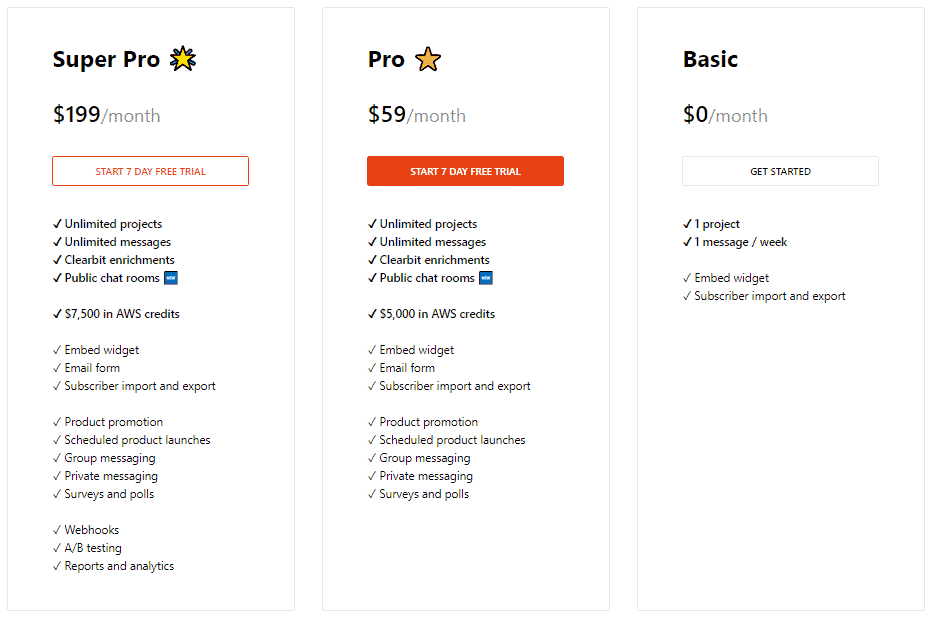
Ship was a toolkit Product Hunt launched in September 2017. It helped makers test their MVPs, Beta versions, and final products. It offered pre-launch landing pages, lead collection, surveys, and integrations with tools like Zapier and Slack. Paid subscribers also received perks like $7500 in AWS credits.
Product Hunt discontinued Ship around 2020-2021. Community members said founders preferred Carrd, Mailchimp, or ConvertKit instead. PH then offered free coming-soon teaser pages, but later dropped those too. Even now, some makers ask Product Hunt to bring Ship back.
Jobs
Product Hunt once ran a job board, but the company later shut it down. Members now ask in forum threads whether it will come back.
Hiring did not stop. It moved into community threads. In January 2026, Product Hunt ran a roundup. Companies like Cursor, ElevenLabs, Linear and Mistral AI posted roles. Job seekers shared their profiles in the comments.
Events
Events section is another strategy to make the platform feel more like a community. Moreover, many tech event organisers feel Product Hunt is a better option to promote an event as –
- It is free to host a PH meetup
- Even if they promote an event, they get better ROI as compared to promoting on other social networking websites.
- They get quality audience
Newsletter
Besides the daily product list on the website, Product Hunt also sends a daily newsletter with the featured list to hundreds of thousands of subscribers.
Live
Product Hunt Live is an AMA (ask me anything) for the entrepreneur community. It is a step ahead of usual listing where the founders come forward at the launch of their products to conduct a Q&A chat session with other members of the community.
How Product Hunt Makes Money?
Even though this startup was launched in 2013, Product Hunt didn’t earn a single penny until the end of 2017 as the Product Hunt Business Model was focused on building a community than making money out of it.
Monetization began with premium tools and promoted placements. Ship launched in September 2017, and Sip launched in 2018 before shutting down in 2019 (see Wikipedia’s timeline).
Today the revenue comes mainly from advertising and sponsorships sold through Product Hunt’s sponsor page. Momentum is a display campaign that runs after launch. The page also offers self-serve newsletter sponsorship and fully managed multi-channel campaigns. No prices are published.
Ship
Launched in September 2017, Ship was Product Hunt’s first real monetization play. It ran on a freemium SAAS model aimed at makers. The free tier gave you one project and a limited set of services. A paid subscription unlocked unlimited projects, AWS credits, and partner perks. What the toolkit included:
- Landing pages – you could build fully customizable landing pages on Product Hunt itself.
- Widgets – you could embed forms to collect emails, run surveys, or chat with visitors.
- Targeting – you could send targeted messages based on users’ survey and feedback answers.
Product Hunt discontinued Ship around 2020 to 2021. The freemium revenue line it opened in 2017 was gone.
Promoted Products
Like most product listing sites, Product Hunt lets makers pay for extra exposure. What it sells today looks quite different from a few years ago.
Product Hunt’s advertising page now lists three offerings:
- Momentum: a display campaign that runs in the days after your launch
- Self-serve newsletter sponsorship: one sponsored message sent to subscribers
- Managed campaigns: multi-channel promotions planned with Product Hunt’s team
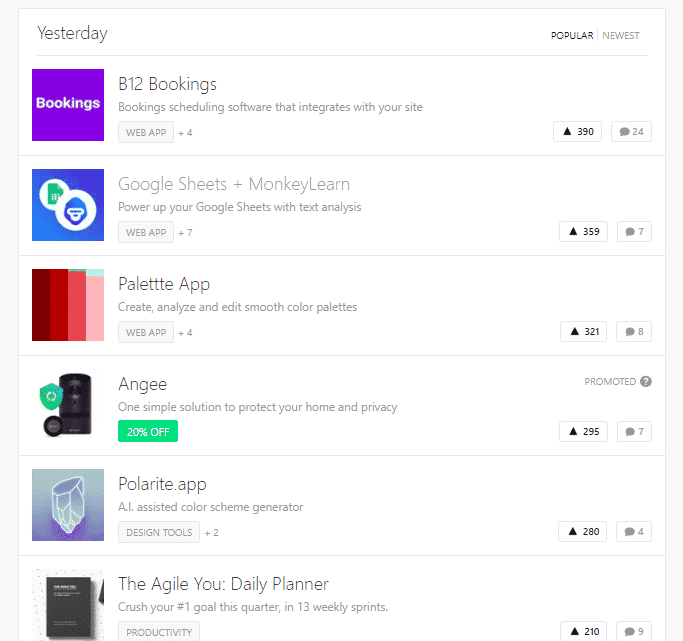
Promoted spots on the daily list still exist, just not as a single fixed slot. The August 4, 2026 leaderboard tagged more than ten products as Promoted, from 4th through 18th place. Product Hunt publishes no public price list for any of it.
Makers paying for a slot should set expectations carefully. Launch practitioners in 2026 say the lasting return is the “Featured on Product Hunt” badge and years of search visibility. Investors and journalists still scan the daily list, so the badge may matter more than the traffic spike.
Promoted Jobs
Promoted jobs once counted as another revenue source for Product Hunt. Big tech companies used to post open roles here. A 30-day job listing cost $299, and a limited set of companies could buy premium placements.
That product has been discontinued. Community members now recall the old job board and pitch ways to bring it back. The current sponsor page lists only display ads, newsletter sponsorships, and managed campaigns. The jobs line no longer earns Product Hunt anything.
Promoted Events
Promoted events was revenue never a big revenue earning source for Product Hunt, but it added to the profits. Event promoters could reach Product Hunt’s audience and offer attendee perks. The product no longer appears on Product Hunt’s advertising page. That page lists only display ads, newsletter sponsorship, and managed campaigns. It is now another discontinued line, alongside Ship and promoted jobs. Community events still run through Product Hunt’s Luma calendar.
Future Of Product Hunt
The Orbit Awards replace Product Hunt’s ten-year Golden Kitty Awards. CEO Rajiv Ayyangar announced them as quarterly, focused on “traction, not noise.” Verified reviews decide the picks, with detailed and founder reviews weighted more. The first category, AI Dictation, went to Wispr Flow, MacWhisper, Aqua Voice, Superwhisper and Willow Voice. Upcoming categories cover vibecoding tools, AI automation builders, AI meeting note-takers and coding agents.
The bigger bet: AI retrieval. A Product Hunt case study used Gauge to measure LLM citations. The result moved Product Hunt “from near zero AI citations to consistent inclusion across multiple models.” It now calls itself part of the AI retrieval layer, with platform-wide changes rolling out. For you as a maker, the pitch shifts from upvotes toward AI visibility.
The community remains the moat. AngelList bought Product Hunt for $20 million. Members run from big-tech engineers to indie developers helping each other without profit motive. The network effect compounds the advantage of the Product Hunt Business Model.
Semrush recorded 23.07 million visits in September 2026, up 265% from 6.33 million in August and 5.32 million in July. Average visits ran 8 minutes 21 seconds. Bounce rate was 82.58%, and 79.6% of traffic was direct. ChatGPT sent 52 thousand visits over six months. The community and the badge remain real assets. Old revenue lines have narrowed, and the bet is on AI discovery, not launch-day traffic.
Go On, Tell Us What You Think!
Did we miss something? Come on! Tell us what you think about our article on Product Hunt business model in the comments section.