
Your professor just posted the detection results. There it is, a bright red flag on the essay you wrote yourself.
That gut-punch moment is showing up on campuses everywhere this year. Over 60% of colleges now run AI detection software on submissions, but independent research from Thesify’s 2026 analysis shows accuracy drops to just 60-80% once any manual editing touches the text.
I’ve been testing these tools all year. You need to understand what they actually catch and where they fail before one flags your honest work.
Here are the 6 AI detectors every student in 2026 should know.
The Rundown
- Check Four Detectors at Once: Walter Writes AI, “Check your text against Turnitin, GPTZero, Originality.AI, and Copyleaks all in one scan.”
- Your Free Pre-Submission Check: GPTZero, “Scan up to 10,000 words monthly for free and record your writing process as proof.”
- Skip the Signup Entirely: ZeroGPT, “Paste your text and get an AI probability score in seconds, no account required.”
- Scan 2,000-Page Documents: Copyleaks, “Upload entire research papers in one go with three sensitivity modes to reduce false alarms.”
- See Your AI Heatmap: Proofademic, “Get sentence-by-sentence AI scores with a built-in plagiarism checker tuned for academic writing.”
- Record Your Writing Process: Originality.ai, “Use the Chrome extension to record your Google Docs session as proof you wrote it.”
The Best Ai Detectors For Students
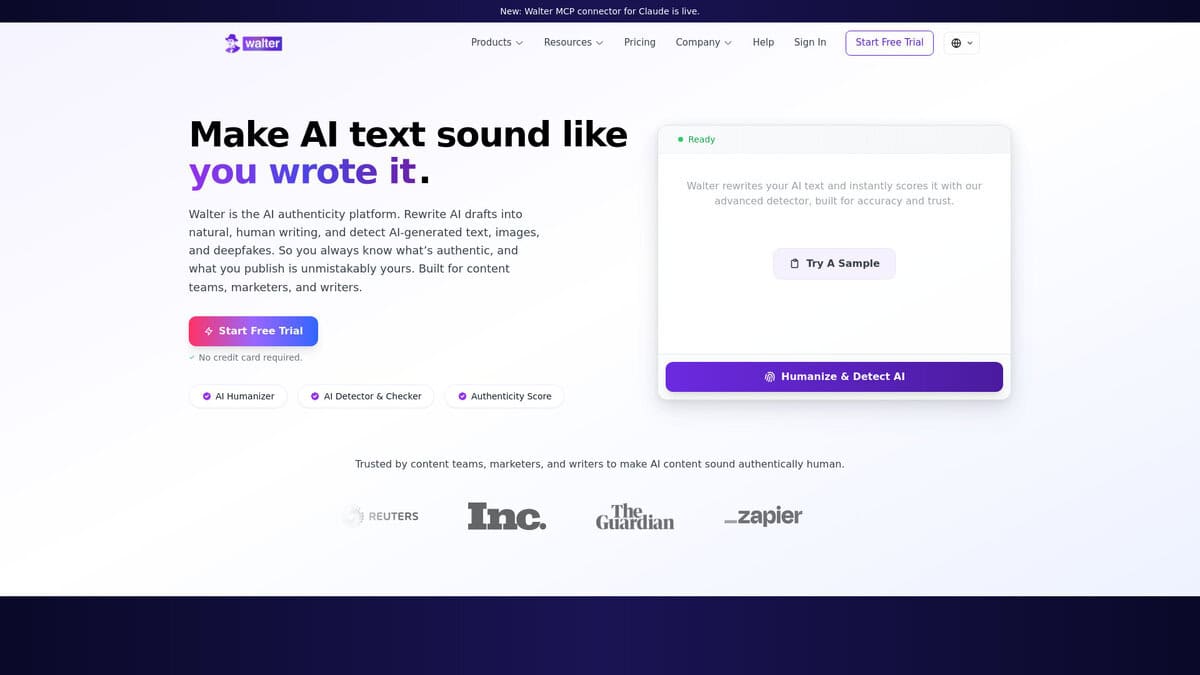
Walter Writes AI
Pricing | Free trial (300 words), Starter $8/month |
Built-in Detector | Yes, sentence-by-sentence scoring |
Platforms Checked | Turnitin, GPTZero, Originality.AI, Copyleaks |
Languages | 80+ |
Most AI detectors give you one percentage for the entire document. Walter Writes AI does something more useful. It highlights individual sentences and scores each one for its likelihood of being flagged. When I tested it, that granularity completely changed how I approached reviewing my work.
Instead of guessing which parts of a long essay might trigger a detector, I could see exactly where the tool thought the text sounded machine-like. It zeroes in on predictable phrasing, uniform structure, and repetitive cadences. Those are exactly the patterns Turnitin and GPTZero look for.
What also stood out is that it checks against four major detectors at once: Turnitin, GPTZero, Originality.AI, and Copyleaks. No pasting your work into separate tools and comparing conflicting results. One scan gives you a picture of where you stand across the platforms you are most likely to encounter.
A YouTube creator ran a live test and showed a ChatGPT-generated essay dropping from 100% flagged to 4% on GPTZero after Walter Writes processed it. That kind of drop points to real structural rewriting, not just synonym swaps.
The Starter plan at $8/month works for a student budget, and you can try it free with 300 words before committing. Keep in mind that Walter is designed to improve writing quality and provide detection awareness, not to guarantee zero flags across every scenario.
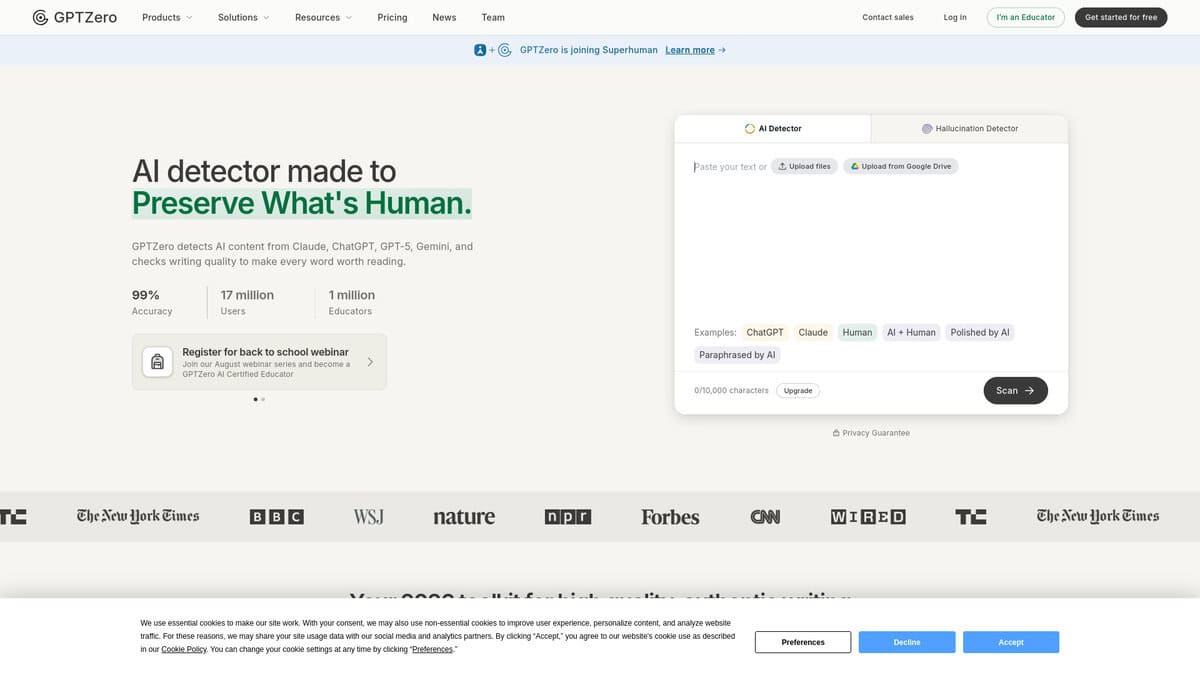
GPTZero
Pricing | Free plan available; paid starts at $8.33/mo (annual) |
Free Plan | 10,000 words/month, no credit card |
Best For | Student self-checks and educator screening |
Browser Extension | Yes, Chrome (Writing Replay included) |
Languages | English, Spanish, French, German, Portuguese |
I started testing GPTZero because it kept showing up in every student forum as the default recommendation. After spending time with it, I get why. The free tier hands you 10,000 words per month without asking for a card. That covers two or three essays comfortably.
Now, the accuracy reality check. The University of Chicago Booth School benchmark in February 2026 reported 99.5% accuracy with a 0.05% false-positive rate on clean, unedited text. That sounds perfect. But controlled lab tests and real classrooms are different worlds. A 2026 independent retest by MPGONE found accuracy had dropped to 79-85%, with the newest AI models frequently passing as human. That gap tells you everything.
Where GPTZero genuinely surprised me was the Origin Chrome extension. It records your Google Docs writing session and produces a video replay plus a PDF showing your typing patterns. If a professor ever flags your work, that document becomes your evidence. No other free detector offers something like this.
The false-positive problem is real though. A Stanford study found 61.3% of TOEFL essays by non-native speakers were wrongly flagged. GPTZero improved its model since then, but formal academic prose and Grammarly-polished sentences still trip it up. One Reddit student described spending three hours rewriting a discussion post because GPTZero kept marking their own writing as AI.
My honest take: use GPTZero as a quick pre-submission gut check, not as gospel. If the score worries you, install Origin before you start your next draft, not after you get accused.
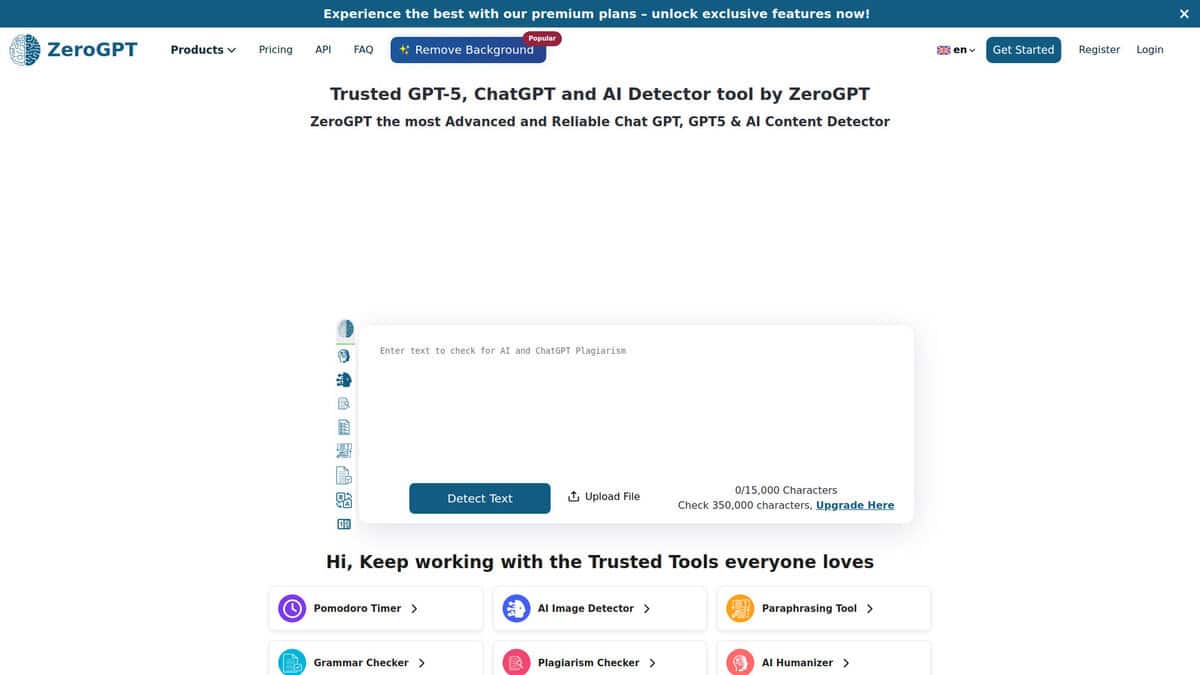
ZeroGPT
Best For | Quick no-signup AI detection |
Free Plan | Yes, unlimited scans (15,000 chars each) |
Sign-up Required | No |
Accuracy | ~75-80% (independent estimates) |
False Positive Rate | ~15-20% |
ZeroGPT is the closest thing I’ve found to a true “paste and go” AI detector. You land on the page, paste your text (up to 15,000 characters), hit Detect Text, and get a percentage score. No account creation, no email verification, no credit card prompt. In a world where every tool wants your data before letting you do anything, this felt refreshingly direct.
I tested it with a mix of my own writing, some deliberately AI-generated paragraphs, and a few student essays colleagues shared with me. Results were inconsistent. Some pieces I wrote entirely by hand came back flagged at 40-60% “AI generated.” That’s concerning when you consider the Stanford study showing ESL writers face significantly higher false positive rates across all detectors.
Here’s my honest take: ZeroGPT works as a smoke alarm, not a fire investigation. If you want to quickly check whether your writing might trigger flags before submission, it does the job. The frictionless access means you can run multiple drafts through it in minutes. But you should never treat its output as definitive proof of anything.
The false positive rate is real. A comprehensive peer-reviewed study testing 14 detection tools found that none achieved reliable accuracy, with ZeroGPT among those evaluated. The researchers concluded these tools should not be used for academic misconduct determinations.
If accuracy matters more than convenience, GPTZero requires a free account but generally produces fewer false positives. Copyleaks is more reliable still, though it comes with usage limits. ZeroGPT’s value is in its zero-friction access. Use it as one data point among several, never as the final word.
I keep coming back to this: the best use case is personal peace of mind before submitting work. Run your essay through ZeroGPT, see if anything looks alarming, then use that information to refine your writing. Just remember that a clean result doesn’t guarantee you’re safe, and a flagged result doesn’t mean you cheated.
Copyleaks
Best For | Long document and assignment scanning |
File Formats | DOCX, PDF, TXT, HTML |
Price | $13.99/mo (annual), $16.99/mo (monthly) |
Free Tier | Limited; 25K char cap on browser extension |
Sensitivity Modes | Extra Safe, Balanced, Extra Sensitive |
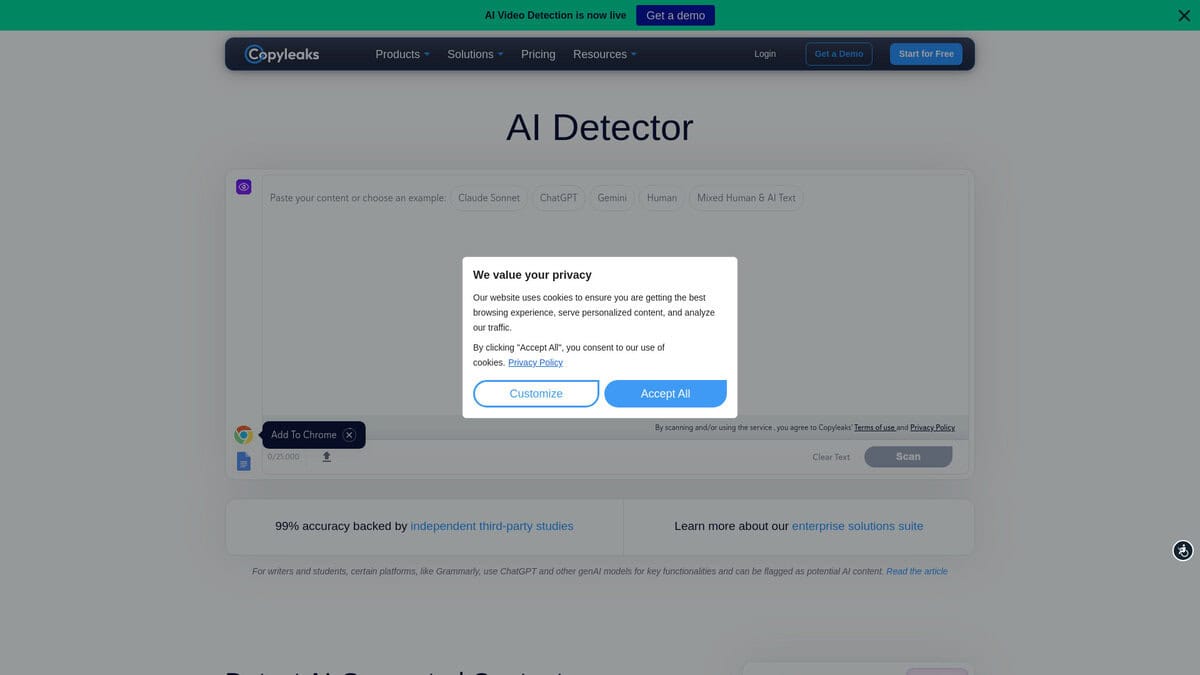
Most AI detectors I tested forced me to break long documents into chunks before scanning. Copyleaks didn’t. The web platform accepts up to 2,000 pages per scan with no character limit. I uploaded a 40-page research paper as a single PDF and got results without any workarounds.
What stood out was the three sensitivity modes. Extra Safe has a documented 0.009% false positive rate, which matters a lot if you’re scanning your own work before submission. I used Balanced mode for most of my testing and switched to Extra Safe when I wanted fewer false alarms on formal writing.
Then there’s AI Logic. Instead of just showing a percentage score, it highlights the exact sentences flagged as AI-generated and explains why. I found this genuinely useful for revising flagged sections rather than guessing which parts triggered the detector.
If you write in Google Docs, the add-on (over 860,000 installs on the Workspace Marketplace) lets you scan without exporting. Copyleaks also integrates natively with Canvas, Moodle, Blackboard, D2L, and Schoology. Since Instructure (Canvas’s parent company) acquired Copyleaks, that Canvas connection runs deep.
A June 2026 Springer study tested Copyleaks against GPTZero, Pangram, and Turnitin across four types of academic papers. It’s one of the few independent academic comparisons available. That said, it didn’t isolate long-document performance specifically, so I’d treat the 2,000-page claim with some caution.
Pricing on Copyleaks’ own site starts at $13.99/month on annual billing (1,200 credits, roughly 300,000 words per year). Monthly billing jumps to $16.99 but drops to just 100 credits. The gap is massive. The free tier caps at 25,000 characters on the browser extension, so it won’t handle long papers.
A Reddit tester ranked it fifth out of nine tools after three weeks of hands-on comparison. Solid, but not the top general pick. Copyleaks earns its spot here specifically for long-document scanning. If you regularly submit 30-page papers or longer, the unlimited per-scan capacity is the main reason to choose it over alternatives with stricter limits.
Proofademic
Pricing | Free trial, Essential $99/yr, Premium $165/yr |
Free Plan | 1,000 words per request, 3-day trial, no credit card |
Best For | Academic essays and research papers |
Key Feature | Sentence-level AI heatmap with probability scoring |
Extras | Plagiarism checker included in all plans |
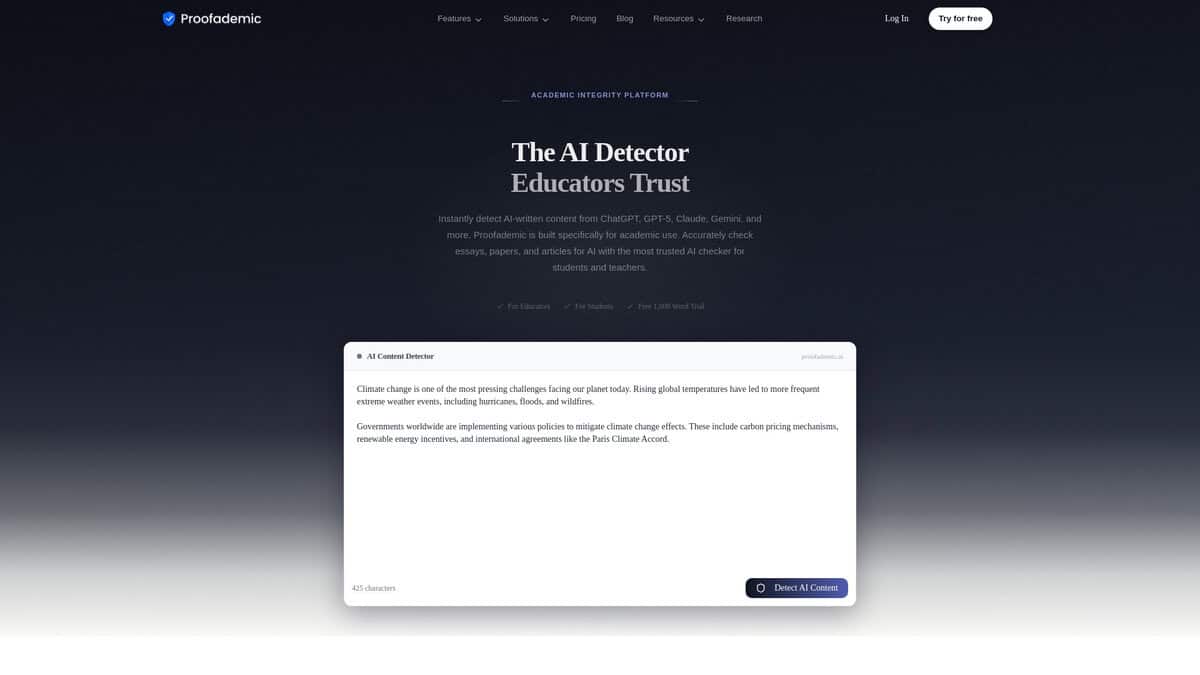
The sentence-level heatmap immediately stood out. Instead of just showing a percentage, Proofademic flags individual sentences with AI-like patterns. I found that useful for knowing exactly what might trigger a professor’s detector before submission.
On paraphrased AI content, Proofademic caught 50% probability while ZeroGPT only detected 20.5% in side-by-side testing. It’s noticeably more sensitive to edited AI text. ESL student essays came back correctly identified as human, which I think matters a lot for non-native speakers worried about false positives.
Though there’s a catch. When I tested it with my own writing, about 25% got flagged as potential AI. Proofademic is strict, which means very polished original work might trigger flags too. A Stanford study found that seven major AI detectors had a 61.3% false positive rate on non-native English writing, so this isn’t unique to Proofademic, but it’s worth knowing.
The plagiarism checker runs alongside AI detection in all plans, including free. It cross-references academic databases, which can help catch fabricated sources indirectly. But Proofademic doesn’t offer standalone citation verification. It treats fabricated citations as an AI signal rather than something I could check reference by reference. A 2023 Nature Scientific Reports study found that 55% of GPT-3.5 citations were fabricated, so this remains a real problem for students using AI to draft literature reviews.
For pre-submission checks, I’d pair Proofademic with GPTZero. Two detectors reduce false positive risk.
Originality.ai
Pricing | Pro: $12.95/month (annual), Pay-as-you-go: $30 for 3,000 credits |
Free Plan | Free Chrome extension; 50 signup credits only |
Best For | Detailed paragraph-level AI detection reports |
Ease of Use | Intuitive color-coded interface |
False Positive Rate | 2% native English, 8% non-native English |
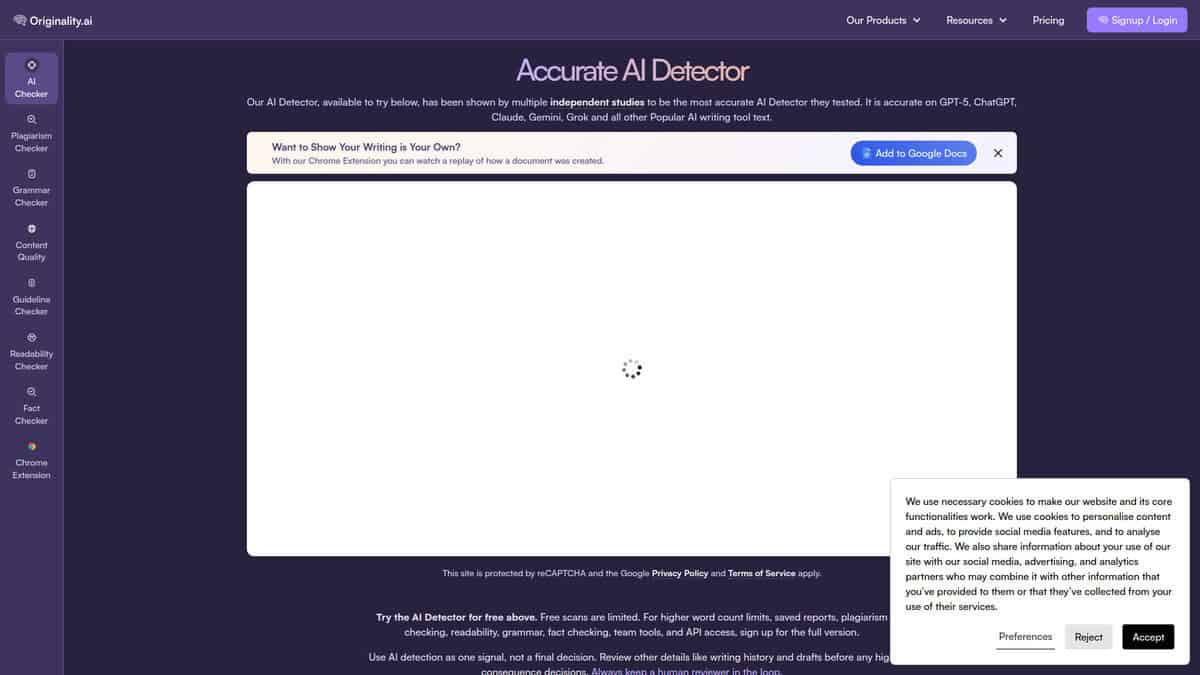
The first thing I noticed was the paragraph-level analysis. When I scanned a sample essay, the report didn’t just give me an overall AI score. It highlighted specific sentences in color, showing exactly which parts were flagged. That granularity is genuinely useful for students who need to know which sections might need revisions.
I kept coming back to the accuracy numbers. Independent tests show Originality.ai scoring between 80% and 90% on AI-generated content, depending on the model. According to a Digital Applied benchmark, it hit 84% on GPT-5.4 but dropped to 80% on Gemini 3.1. The company claims 99%+, but real-world results are more modest.
My main concern was the false positive rate, especially for non-native English speakers. Digital Applied found it flags non-native writing at 8%, four times higher than native English. If you’re an international student, that’s something to watch out for. The tool has also become more sensitive recently, sometimes flagging purely human text as AI.
Compared to GPTZero, Originality.ai offers more detailed reports but costs more and has a less generous free tier. Copyleaks has lower false positives but lacks the same paragraph breakdown. For students, the Chrome extension is a standout: it records your writing process in Google Docs, giving you proof of authorship if you’re ever wrongly accused.
The Academic model sounds appealing but it’s really for STEM assignments, not essays. For humanities papers, you’ll want the Lite model instead. The Deep Scan feature is unique too, explaining why content was flagged and suggesting rewrites. That’s something I haven’t seen elsewhere.
Pricing is straightforward but not student-friendly. There’s no discount, and the free tier is basically just a taste. If you write regularly, the $12.95/month Pro plan is the real entry point. The free Chrome extension though, that’s worth installing regardless.