One day you open your fitness app and learn it’s dying. The next day, you learn it’s perfectly fine.
On 1 October 2026, the Sweat Foundation’s announcement landed. Sweat Wallet and the SWEAT token will shut down on 30 December 2026. A crypto downturn, lost exchange listings, and slowing growth pushed the Foundation to call it quits.
But here’s the thing. Sweatcoin, the original step-counting app run by Sweatco Ltd in London, isn’t going anywhere. It confirmed operations will continue as normal.
Two apps. One name. One is dying while the other lives on. Before you can understand how does Sweatcoin work and pay you to move, you need to know which version you’re actually using.
What Is Sweatcoin?
Sweatcoin is an app that tracks your steps and pays you for them in a digital currency also called Sweatcoins.
Here’s the part that trips most people up. Sweatcoin is not the same as SWEAT. That’s the crypto token that launched on the NEAR blockchain in 2022. The app is run by SweatCo Ltd, a company incorporated in England. The SWEAT token was run by The Sweat Foundation, a separate entity registered in the British Virgin Islands. Two companies, two products, one confusing name.
On 1 October 2026, the Sweat Foundation announced its plan. Sweat Wallet and SWEAT in their current form will end on 30 December 2026. The token had brought more than 22 million people into Web3 before the shutdown. Sweatco Ltd confirmed that the original Sweatcoin app will continue operating as normal. If you use Sweatcoin to earn coins for walking, nothing changes for you.

So how does Sweatcoin work? It counts your outdoor steps. Walking in the park, a jog to catch your bus, strolling around with friends. Every verified step earns you Sweatcoins. Indoor movements don’t count, so the treadmill won’t help you.
Sweatcoins work like in-app currency. You can spend them on products, services, or charity donations in the app’s marketplace. The app is available for iOS and Android.
Here’s how the app works:
How Does Sweatcoin Work?
Once you download the app and finish registering, you can start walking to earn Sweatcoins. The app tracks your movement using GPS, phone data, and movement sensors. The accelerometer and gyroscope work together to verify each step you take outdoors.
Sweatcoins are units of exchange generated only through verified physical movement. The app filters out movement that doesn’t count as steps, so only outdoor walking earns you Sweatcoins. Daily earning caps vary by membership level and can change over time. The amount you earn may shift as the company adjusts its model. Indoor steps typically don’t count.
For years, you kept 95% of the Sweatcoins generated from your steps while Sweatcoin took a 5% commission. That 95:5 split was the standard structure, though current earning rates differ. Revenue now comes from brands paying to place offers in the marketplace plus premium subscriptions.
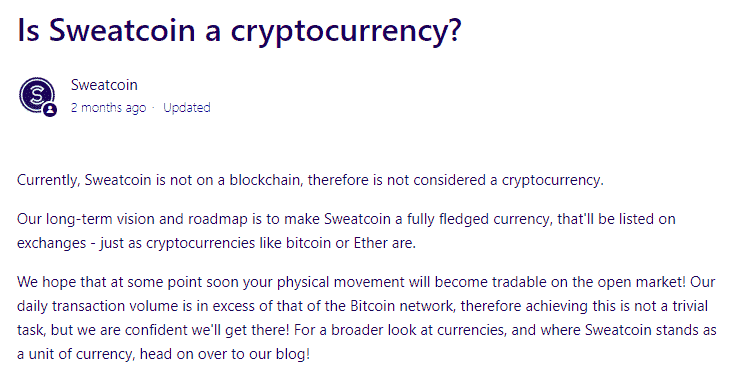
Here is where many people get confused. The Sweatcoins you earn inside the app are not a cryptoasset. They are not blockchain-based and do not trade on any crypto exchange. You also cannot redeem them for cash from SweatCo unless the company expressly agrees in writing. Think of them as loyalty points rather than cryptocurrency. The app currency exists only within Sweatcoin’s own system.
The SWEAT token that launched in 2022 was a completely different asset. It was built on the NEAR blockchain. A MiCA white paper notified to the Central Bank of Ireland governed it. The token did trade on exchanges. That token and the Sweat Wallet are now shutting down. The Sweatcoin app continues operating under SweatCo Ltd in London.
Sweatcoin’s business model uses competition psychology, network effect, discounts, and referrals to keep you engaged and coming back. The app is designed to make movement social and rewarding. The structure allows you to:
- Compete with other users, which spreads the app through your social circle while motivating you to walk more.
- Earn referral bonuses when friends sign up and start walking, which grows your network on the app.
- Spend Sweatcoins in the marketplace on products, gadgets, digital subscriptions, and exclusive offers from partner brands.
Using The Sweatcoins
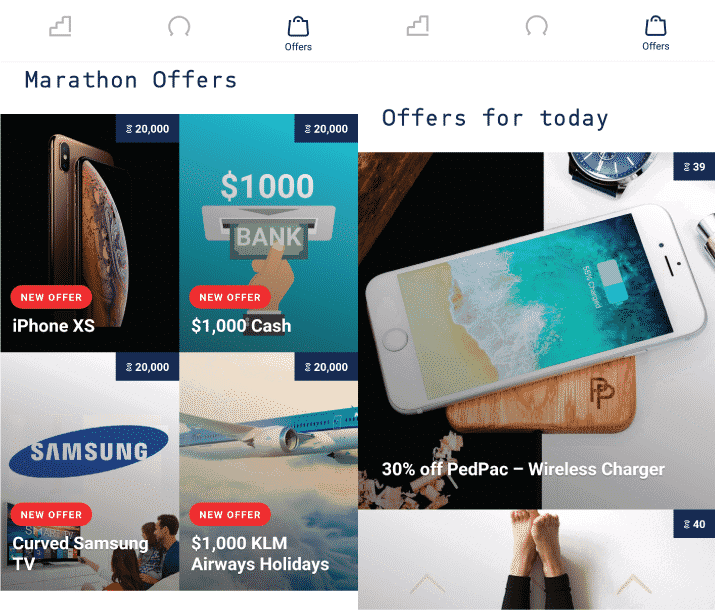
Once you’ve earned enough Sweatcoins, you can spend them in the Sweatcoin marketplace inside the app. The marketplace features products, discounts, free trials, and deals from partner brands. The selection changes over time as new offers rotate in.
Here’s the catch: you can’t turn Sweatcoins into cash, whether directly or through Sweatcoin PayPal, under normal terms. SweatCo’s terms state that Sweatcoins cannot be redeemed for cash unless the company expressly agrees in writing.
The value of what you get also isn’t fixed. Each offer carries its own price, and none tie back to a set exchange rate. What a Sweatcoin buys depends on the offer you choose.
Let’s look at how Sweatcoin supports itself and earns its revenue.
How Does Sweatcoin Make Money?
Sweatcoin is free for you to download. But the company behind it still needs money coming in. So how does Sweatcoin work and make money? Two ways. Brands pay Sweatcoin to place offers in the marketplace where you spend coins. Some users also pay for premium subscriptions. Early on, the company raised $5.7 million in seed funding from investors including Goodwater Capital and Greylock Partners.
The revenue numbers tell the real story. Per Business of Apps, revenue hit $10 million in 2025, down from $14 million in 2024. The peak was $22 million back in 2022. Downloads tell the same story: 60.2 million at that peak, down to 22.5 million in 2025. Registered users reached 150 million in 2024, but growth has slowed. The whole thing runs on a revenue model built around marketplace network effect.
Sweatcoin Plans
Sweatcoin limits how many coins you can earn each day, and that limit depends on your membership level. You start on a free tier with a daily cap. A paid Premium tier raises that cap so you accumulate faster. This is a well-defined business strategy that also controls how many users qualify for the top marketplace offers.
Here’s the thing: Sweatcoin doesn’t publish its current prices or exact daily caps on the official site. Those numbers aren’t listed publicly, and per SweatCo’s terms, caps vary by membership level and can change over time. Any specific figures you find elsewhere may already be outdated.
So you earn coins against a moving daily cap. What you can actually trade them for is the next question.
Revenue From Partnerships
So what can you actually trade them for? Offers on Sweatcoin come in two sizes: smaller daily offers and larger product offers.
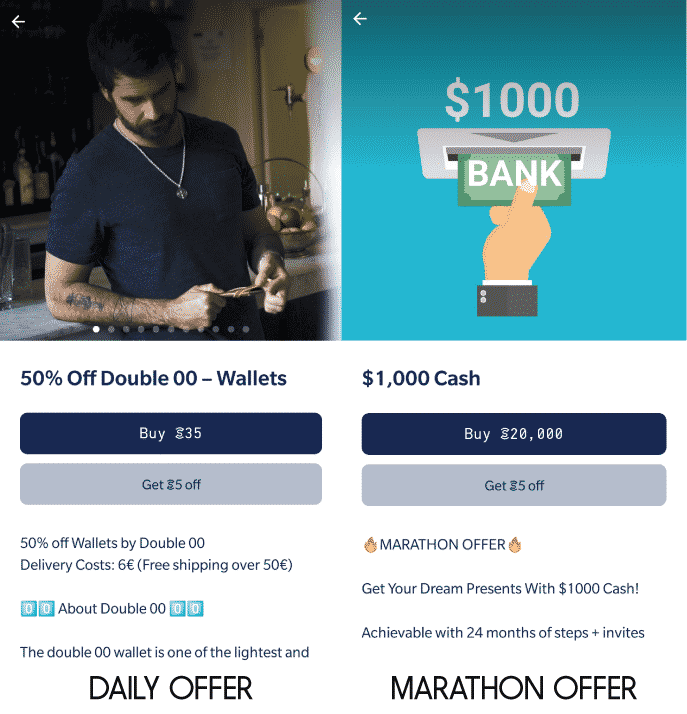
A daily offer might be a discount, a free trial, or a small perk from a partner brand. Larger offers put real products within reach. The specific items rotate, so today’s catalog won’t be next month’s.
Here’s the catch: you pay for these offers in Sweatcoins, not cash. And the brands behind them pay Sweatcoin to get featured in the app. Like Groupon’s business model, where the company partners with brands to put deals in front of users.
This is where Sweatcoin’s money comes from. According to Business of Apps, revenue comes from brands paying to place offers in the marketplace, plus premium subscriptions.
One thing worth correcting: you can’t cash out. Under SweatCo’s current terms and conditions, Sweatcoins cannot be redeemed for cash unless SweatCo expressly agrees to it in writing.
The two-tier structure also works as a retention tool. Small daily offers give you a reason to open the app each day. Larger products give you a reason to keep saving. When the app launched, observers framed the slow grind toward big-ticket items as a deliberate way to keep users engaged.
Revenue From Advertisements
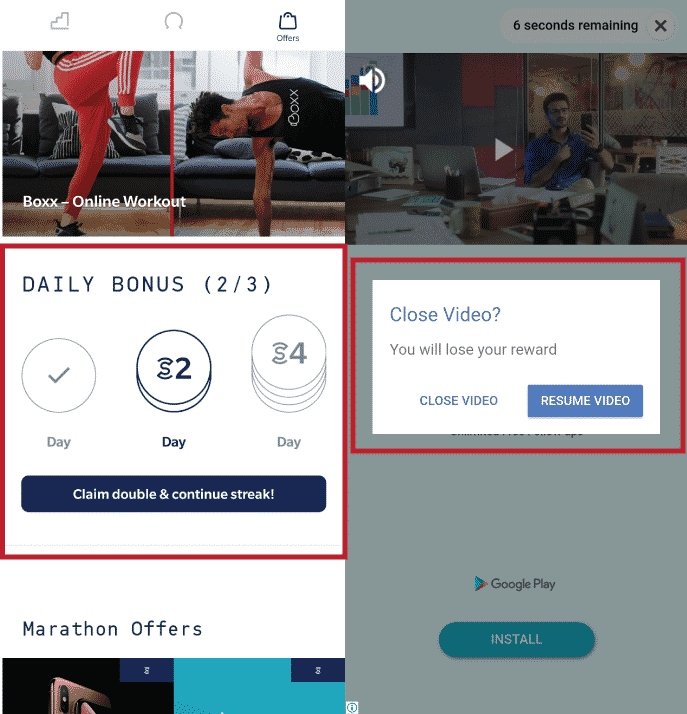
Besides the commission and fees from featuring partner brands, Sweatcoin also makes money through in-app advertisements. Just like many other applications, Sweatcoin has incorporated Google ads in its revenue model as a secondary revenue source.
The company offers an easy way to earn Sweatcoins to the users in the form of daily bonus. All they have to do is to watch an advertisement and they get compounded bonus every day.
Clever Approach Makes It Work
We have no intention of judging whether Sweatcoin, as a company, succeeded or failed. This is a look at the methods it used to position itself, and why it drew attention.
The core hook is still its best asset: you earn money just by walking. The idea is catchy, easy to explain, and bound to attract attention. Novelty on that scale spreads through word-of-mouth, which is how the app got its traction.
We always carried two reservations, though. The first is battery life. Constant GPS tracking is the price of a real step count. You can imagine what that does to your phone across a full day.
The second is privacy, and that one is at least checkable now. SweatCo Ltd is registered with the UK Information Commissioner’s Office as a data controller, registration ZA182331. Its privacy policy was last updated on 29 July 2026. Registration is no clean bill of health, but the data handling is on the record.
What we can no longer do is call these problems minor discrepancies. In April 2026, the SWEAT token layer was hit by an exploit. Roughly 13.71 billion SWEAT left foundation and top-holder accounts in about 30 seconds. That is close to 65% of supply, worth around $3.5M.
The team paused the contract, froze attacker accounts with help from exchanges, and shipped a patch. All user balances were restored. Even so, the Foundation later cited the cleanup cost as one of four pressures that made the token model uneconomic.
The market shows the same strain. SWEAT’s market cap fell to $32M in 2025, down from $98M in 2022. The token bottomed near $0.000177 in May 2026.
None of this broke the core loop. The app works as advertised: you walk, you track, you browse offers. The token got the headlines, but brand offers and subscriptions kept the app alive. Strip the token away, and the app still has a reason to exist.
For anyone asking how does Sweatcoin work, that is the part of the Sweatcoin story worth keeping. Novelty buys adoption fast, and move-to-earn products can look unstoppable for a while. Every one of them eventually meets the same bill. Tokens are cheap to create. The rewards they fund are not. When the money runs short, the token is what gets cut, and the business underneath carries on.
Go On, Tell Us What You Think!
Did we miss something? Come on! Tell us what you think about our article on How does Sweatcoin Work & make Money in the comments section.