
Feedough Logo

Blog

  • Who is a Solopreneur? – Characteristics & Types

    Who is a Solopreneur? – Characteristics & Types

    When starting a business, an individual has to make many key decisions. A business owner might choose to branch out, establish different departments and ultimately hire employees.

    Or they might go solo. 

    Solopreneurship at its core work on a very simple principle – grind and hustle alone. But what makes it different from entrepreneurship? What dimensions an individual must be aware of before venturing into this field? 

    Let’s find out.

    Who Is A Solopreneur?

    A solopreneur is an individual who owns, manages and runs a venture independently without the support of co-founders, partners, and employees, taking on greater than normal financial risks in order to do so.

    Solopreneurs prefers to work alone and handle all key business functions. They are responsible to:

    1. Develop the offering with independent R&D,
    2. Introduce the offering to the market,
    3. Advertise, market and build clientele,
    4. Manage the entire supply chain from sourcing to final delivery to the user, and
    5. Handle finances of the business

    An artist working independently is an example of solopreneur. Their responsibility ranges from building connections, sourcing the required materials, financing, marketing, to delivery of the end product. They may choose to hire independent contractors to achieve each task but all of the business functions are managed by them and them alone.

    What Are The Characteristics Of A Solopreneur?

    There is no strict criteria to become a solopreneur. All it takes is an individual to convert an idea into an offering without any external help, taking more than normal financial risk. 

    However, every solopreneur shares some common characteristics:

    • Business Ownership: They reside at the highest managerial level and do not report to anyone — they are their own boss. Moreover, they do not have cofounders, partners or shareholders to share profit from the business.
    • High Risk Taking: Solopreneurs take more than normal financial and emotional risks as they run the venture alone.
    • Versatility: They don’t have a team of specialists to help them in business operations. They are highly versatile individuals that handle a variety of tasks over the course of a day.
    • Accountability: They are accountable for everything they or their business does.
    • Resourcefulness: A solopreneur usually has limited resources. But because of that, they learn to find ways to get affordable resources to make their business happen.
    • Independence: A solopreneur is independent to take the decisions they deem fit for their venture.
    • Extroversion: They are the only face of their business. Hence they need to be extrovert to sell the same.
    • Strategist: They are the strategist who always think a few steps ahead, carefully planning the future of their venture and their growing role in the venture.

    What Are The Types Of Solopreneur?

    Solopreneurs are prevalent in every business domain and sector. Innovation and networking have opened up many career opportunities for them, which consequently diversified both their presence and function. 

    Following are the common types of solopreneurs in business ecosystem:

    • Freelancer: They are self-employed individuals that provide an offering. For example, an independent App Developer is a freelancer.
    • Professional: They provide independent professional services in the area of their expertise. For example, a Chartered Account is a professional.
    • Business Owner: They own and run their business or agency but work alone. For example, an individual owning their graphic designing firm is a Business Owner.
    • Consultant: They provide business advice and differ in their area/s of expertise. IT Consultants, Business Consultants, Travel Consultants are a few examples.
    • Infopreneur: Infopreneurs collect, organise and sell information as an offering to consumers in niche markets. They can be course creators, bloggers, speakers or coaches. 
    • Influencer: These individuals use their media presence across platforms like Facebook, Instagram, Twitter, Youtube, etc. to provide an offering to their followers. 

    There are many other business ideas to become a solo-preneur. A person can become a digital marketer, independent instructor or open up a small flowering shop of all things. New technologies and policies have paved the way more diversity and in coming years, more and more opportunities will be created.

    Solopreneur vs Entrepreneur

    The terms ‘solopreneur’ and ‘entrepreneur’ are often used interchangeably but they are some crucial differences that an individual must take into account before starting their own business:

    Criterion
    Solopreneur
    Entrepreneur
    Definition
    Solopreneurs run business alone without support of partners, co-founders and employees.
    Entrepreneurs run their own business with the  support of their partners, co-founder and employees.
    Business Functions
    They manage all aspects of their business from R&D, marketing, supply chain to sales.
    They diffuse business responsibilities to employees within different departments.
    Client Interaction
    They interact with clients directly.
    They interact with clients either directly or assign an employee in their place.
    Business Presence
    Their business generally have a local or online presence.
    Their business may branch out to other regions with an headquarter and multiple offices, each one operated by different set of employees.
    Funding
    Solopreneurs generally fund their business on their own (called bootstrapping).
    Entrepreneurs may bootstrap their business or seek financial support from external sources like VC firms, Angel Investors, etc.

    Advantages Of Solopreneurship

    Perhaps the biggest advantage of being a solopreneur is 100% business ownership. But that is not the only advantage. Listed below are a few benefits that come with solopreneurship:

    • Decision Adaptability: With no strings attached with shareholders or employees, a solopreneur has the flexibility to change and revamp business strategies, operations, target customers, etc.
    • Flexible Time: They do not have designated work hours and can allocate work-time as per their convenience.
    • Less Financial Liability: Since a solopreneur does not hire employees, they are not liable to pay salaries to anyone in the event of business failure.
    • Side Gig: They can run their business as a side gig while having a full-time job. 

    Disadvantages Of Solopreneurship

    Being a solopreneur is not an easy endeavor and comes with its own challenges and shortcomings. Following are the common disadvantages of solopreneurship:

    • Hustle every day: Lack of work hours often take a toll on a solopreneur’s daily schedule with work frequently extending to bed-time. 
    • Work during emergency: When a client demands an offering urgently, a solopreneur either has to lose them by denying their request or make last minute changes to their work schedule to meet the demand.
    • Poor financial management: They often mix personal and business finances (money used for the business) and budget poorly. 
    • No added benefits: They do not receive additional benefits like health insurance, rent allowance, travel allowance, etc., that are otherwise guaranteed by a company.
    • High risk: They may not be adept in one more or business functions like marketing, finance, etc., which increases the risk of business failure.

    Tips To Become A Successful Solopreneur

    Going solo may be an intimidating and challenging venture but not impossible. Following are some tips of becoming a successful solopreneur:

    • Understand business: Before deciding to become a solopreneur, it is important that an individual understands all the aspects of business. Understanding the business model, its functions, operations etc. are essential to succeed as a solopreneur.
    • Network, network, network: A solopreneur is alone responsible to build their clientele through extensive networking.
    • Be Tech-savvy: Technology is solopreneur’s best friend. With technical tools for SEO, Analytics, digital marketing, web designing, etc., a solopreneur can not only build a steady only online presence but also grow their existing business further.
    • Automate: By automating human capabilities wherever possible, a solopreneur increases business efficiency, and cuts down both time and costs.
    • Collaborate: At times, solopreneurs can collaborate with other like-minded individuals and businesses to gain additional clients and increase presence.

    Solo-entrepreneurship is ridden with risks and sacrifices. When venturing into this field, one must not only be passionate and confident but also willing to take risks that at any moment can take it all. But even with all its challenges, it is an exciting field with a plethora of opportunities and scope of learning.

    Go On, Tell Us What You Think!

    Did we miss something? Come on! Tell us what you think about our article in the comments section.
  • Limited Liability Partnership (LLP): Definition, Characteristics, & Examples

    Limited Liability Partnership (LLP): Definition, Characteristics, & Examples

    Having a traditional partnership firm is a common practice followed by a lot of people. People find this a lucrative option to avoid various laws and regulations, but taking the entire liability on your head is just not desirable. Instead of getting lured by high profits, considering future prospects is very important. Two people working together to make money without any legal agreement makes them stand at high risk.

    Is there any business structure that minimizes the risk but still functions as a corporate entity without much compliance?

    This situation is where LLP comes into practice.

    Wondering what exactly an LLP is, why people prefer it, how it functions?

    Let’s dive down into it.

    What is a limited liability partnership?

    A limited liability partnership (LLP) is a hybrid corporate entity with a company’s benefits of limited liability and a partnership’s flexibility. The partners have limited liability and are independent of the actions of other partners.

    The firm has a separate legal entity and can enter into agreements in its own name. The LLP can continue its existence irrespective of changes in partners and hold property in its own name. It has perpetual succession as that of a company, and its existence is not dependent on its partners.

    Let’s say,

    There is Mr. X, who wants to set up a new corporation. He is a person with a mind full of ideas and knowledge but has a lack of funds. He found his two friends who were satisfied with the idea and decided to contribute funds.

    So, they wished to start an entity, but they have their personal assets at stake in a partnership, so everyone tried to back out.

    Then they got to know about the LLP form of business structure. Mr. X got every type of benefit that they want, and the risk factor was reduced significantly.

    And this is the reason they selected the LLP business structure for their venture.

    Characteristics Of LLP

    An LLP has characteristics of both a general partnership and a company.

    • It’s a body corporate and legal entity separate from its members.
    • It has at least two designated members
    • It has a perpetual succession. It continues to exist even after the founding partners leave the organisation. All it requires is it to have at least two partners.
    • The members have a limited liability limited  to their agreed contribution in the LLP.
    • It has the  the organisational flexibility of a partnership.
    • Its accounting and filing requirements are similar to that of a company.

    Advantages and disadvantages Of LLP

    LLP as a business structure comes with its own set of advantages and disadvantages.

    Advantages

    Some of the advantages of forming an LLP are:

    • Separate legal entity:  This means that it can have assets in its name and sue and be sued. Moreover, one partner is not responsible or liable for other partner’s misconduct or negligence. The LLP is treated as separate from its partners.
    • LLP agreement:  The mutual rights and duties of partners among themselves and those of the LLP and its partners are governed by the agreement between partners or between the LLP and the partners. It ensures that the partners are free to decide their own set of provisions.
    • Flexibility:  Unlike a company, an LLP form of business structure provides flexibility without imposing detailed legal and procedural requirements. This saves a lot of cost in terms of services or consulting.
    • Limited liability: The partners’ liability is limited to the extent of their contribution to the LLP. The personal assets of the partner are protected from any liability of LLP.
    • Cost-saving: The registration and incorporation fees for an LLP are much lower, and limited legal compliances save a lot indirectly.

    Disadvantages

    Every coin has two sides. The easier it is to form an LLP, it also attracts various disadvantages as well.

    Some of the disadvantages are:

    • Venture capital funding restrictions: Usually, startups are incorporated as an LLP. But since the LLP structure requires no formation of a board of directors, it discourages investors.
    • Penalties: As a legal business structure, LLP is required to fulfil and comply with certain provisions, non-compliance of which may result in penalties.
    • Irregularities: Since there is greater flexibility while forming the agreement, this also calls various irregularities. Sometimes partners might benefit from this and might include provisions that are not in the firm’s interest.
    • Regular Returns:An LLP is required to mandatorily file an income tax return even if it has not carried out any significant transactions each year. The government needs to keep track of the number of LLPs functioning, which calls for this provision.
    • Huge documentation: An LLP must maintain hefty records of its names of partners, any changes thereof, fees and payment proof, etc.
    • Termination Risk: An LLP must have at least two members. If it falls short of two members at any time,  the LLP may have to be dissolved.

    LLP in USA v/s UK v/s India:

    India has borrowed this form of business structure from overseas countries such as the USA, the UK, Australia, and other gulf countries. In all these countries, an LLP is allowed to be formed as a separate legal entity.

    LLP In The UK

    The act applicable is the UK LLP Act,2000. Registration of LLP is with Companies House. LLP is to be registered with the suffix “Limited Liability Partnership” or “LLP/LLLP”. Foreign Nationals can be a partner in an LLP, and both the partners can be from any nationality.

    Tax liability is not subject to any corporate income tax, but the profits are distributed to the members who pay personal income tax on their income from the partnership. The Secretary of State has statutory powers to direct a limited liability partnership to change its name in certain circumstances.

    LLP In The USA:

    There is no separate law governing an LLP, but LLP provisions are added in the uniform partnership act in 1996. In the United States, each state has its own law governing their formation. Although found in many business fields, but in the US, LLP is a prevalent form of organization among professionals, particularly lawyers, accountants, and architects.

    In some US states, namely California, New York, Oregon, and Nevada, LLPs can only be formed for such professional uses. LLP profits are allocated among the partners for tax purposes, avoiding the problem of “double taxation” often found in corporations.

    LLP In India

    The limited liability partnership act, 2008 governs LLPs. It is the most preferred form because of the less regulation and procedures required to comply. Every LLP shall have a registered office. An incorporation document subscribed by at least two partners, also known as designated partners, shall have to be filed with the Registrar in a prescribed form.

    All the process related to registration and winding up comes under the ministry of corporate affairs who appoints a registrar of the companies. For the purpose of taxation, an LLP is treated as a partnership firm. The LLP Act has a mandatory requirement that one of the LLP partners must be an Indian.

    Examples of an LLP

    LLP is one of the most sought-after business structures found all over the world. Here are some examples to elaborate on the concept.

    Handoo and Handoo LLP

    This is the first LLP registered in India after the enactment of the LLP act 2008. It works in the field of legal consultancy. The partnership firm created history by registering its name as first LLP and its charismatic, enthusiastic work and a great contribution to the legal field.

    BDO USA LLP

    BDO USA, LLP is the United States Member Firm of BDO International, a global accounting network and the world’s fifth-largest accounting network. BDO delivers assurance, tax, and financial advisory services to clients throughout the country and worldwide.

    Recently BDO in the UK, German, and the US has won its largest-ever international audit client, replacing KPMG as auditor of software giant SAP.

    This shows how an LLP can function on a large scale.

    Go On, Tell Us What You Think!

    Did we miss something? Come on! Tell us what you think about our article on limited liability partnership (LLP) in the comments section.

  • What Is Cause Marketing? – Types & Examples

    What Is Cause Marketing? – Types & Examples

    The Internet has exposed us to different outlooks and ideas. Today’s society is more sensitive because of this diversification, and people are more conscious of their civic duties than they were ever before. In these times, responsible consumption is gaining momentum. Customers expect charity of their preferred brands.

    Research shows that, as of 2020, 40% of consumers opt for socially motivated enterprises and stay loyal to them. They are inclined to pay 6% more for products from such a company.

    Therefore, it is in the best interest of a brand to be diligent towards its corporate social responsibility, aka CSR. No wonder, cause marketing is gaining ground.

    What is Cause Marketing?

    Cause marketing is a form of corporate social responsibility wherein the business launches a marketing campaign that serves a twofold objective of generating returns and increasing social welfare.

    Corporate social responsibility is the directive establishing a company’s social accountability. Through CSR programmes, businesses engage in philanthropy and work for the betterment of society. Such programmes include anything done for a good cause, from monetary donation to volunteer work. Cause marketing falls under this broad category.

    In general terms, cause marketing refers to setting up a promotional campaign in line with a cause. Here, a company works to better society by simultaneously marketing its products.

    Cause marketing is often confused with cause-related marketing which relates to a business’ association with a non-profit.

    In cause-related marketing, the for-profit organisation donates a share of its revenue to the social organisation. In contrast, cause marketing strategies focus broadly on social and cultural matters like poverty, inequality and even non-inclusion.

    Nike’s You Can’t Stop Us campaign is an excellent paradigm. The one-and-a-half-minute video celebrates women in sports. The brand here illustrates sportsmanship and shows how the game’s spirit is past all boundaries, including gender.

    https://www.youtube.com/watch?v=WA4dDs0T7sM

    How Does Cause Marketing Work?

    Consumers prefer purchasing from socially conscious companies and are often ready to pay higher prices. Cause marketing adds to a brand’s trustworthiness and, thus, increases revenue.

    However, building credible campaigns isn’t a cakewalk. Especially with all the competition, companies don’t know what might backfire.

    A lucrative marketing campaign needs rigorous brainstorming. The marketing teams assess the market, plan a path and coordinate with other departments to develop an executable plan of action.

    • Identifying the right cause – Personal and professional branding form the basis of today’s business activities. Each company creates its identification and maintains it. To appeal to their customers, companies need to choose causes that align with their brand values.
    • Coupling donations with non-monetary contributions – Monetary contribution goes a long way in helping an organisation. However, to lend more ingenuity to their marketing campaign and save a few bucks, companies may offer some services to a non-profit or raise awareness around a cause. Video mailing services, sponsorships, volunteering or even a short film, serves the purpose.
    • Executing effectively – After figuring out the fundamentals, businesses ensure coordination between their organisation’s limbs. They together come up with a plan and see that everyone is on board with it, be it their employees or the non-profit they have partnered with. They come up with an effective PR strategy, as well. Billboards, social media posts and formalised associations carry hype to the right people.
    • Going digital – With an increase in online traffic, digital cause marketing is at an ever-rising height. Only 6% of millennials trust online advertisements, whereas 58% of them would instead buy from a brand with a cause. Thus, adding values to digital marketing campaigns can increase a brand’s revenue manifold.
    • Being patient – No success comes overnight. Big brands like Dove and The Coca-Cola Company have spent years acquiring the market. Companies have to work consistently and wait for results.

    Marketing is a creative field. Even the above layout leaves a lot of gaps for marketers to fill in. The great promotional campaigns are the most creative ones.

    Notable Examples of Cause Marketing

    Following are some of the marked cause marketing campaign examples of recent times.

    Marker’s Mark “Give Cozy, #Get Cozy” Truck Tour Campaign

    Marker’s Mark “Give Cozy, #Get Cozy” Truck Tour Campaign

    Around 15% of Americans have to stretch to accommodate a warm winter coat. Marker’s Mark partnered with a non-profit organisation, One Warm Coat, to 5000 cups of hot chocolate, 3500 gingerbread cookies and 20000 warm coats to people across the seven states. The event included multi-media campaigns, events and PR activities.

    Vistara’s #FlyTheNewFeeling

    Vistara is a joint venture by Tata Group and Singapore Airlines. It partnered with Salaam Baalak’s Trust to provide a memorable first-flight experience to street children. Kids aged between 7 to 12 years of age flew from Delhi to Mumbai in Vistara flights, and the two-minute short film went viral on social media.

    The Economist’s Pride and Prejudice

    The Economist held their Pride and Prejudice event where the world’s influential leaders talked about LGBTQIA+, diversity, and inclusion. This 24-hour conference spanning three countries – Hong Kong, London and New York, is the most outstanding cause marketing example.

    Importance of Cause Marketing

    In the last few decades, business conglomerates have emerged as immensely powerful organisations. But, with power comes responsibilities; and consumers these days are well-aware of the corporate capacity. They expect their preferred companies to be socially conscious and give back to society. They feel a sense of pride in consuming responsibly. Therefore, to secure more conversions and ensure consumer loyalty and retention, brands associate their values with a cause.

    A personal and professional branding is the key to grow through cut-throat competition. Faced with unnumbered choices, consumers prefer buying from companies whose values align with their beliefs. So, brands must focus on increasing awareness about themselves rather than just advertising their products.

    When a company markets the cause it is working with, it presents a powerful picture in front of consumers and its chances of success increase manifold.

    The first notable cause marketing campaign was organised in 1976 by Marriott Corporation and the March of Dimes. The idea has gained popularity since then and now, all brands, big and small, want to go for cause marketing. Not only do consumers expect it but with its low cost and high returns, cause marketing also appeals to the corporates. That is why brands like Dove and Gillette actively work towards a socially conscious image.

    Types of cause marketing

    From Unilever’s recycled toothbrush to Bajaj Almond’s 1 % revenue donation policy, cause marketing comes in various forms.

    • Message-focused campaigns – When business organisations raise awareness around a social topic or deliver a social message via their promotional articles or videos, it’s a message-focused campaign in play. Budweiser asked people to not drive after drinking in its #FriendsAreWaiting advertisement. The campaign portrayed the eminent beer brand as taking a firm stand and established its trustworthiness in the market.
    • Cause-related marketing – This type of marketing follows the “You give us, we give them” model. Cause-related marketing is more-or-less like business giving. When a firm X ties up with a non-profit Y and donates 2% of its revenue to the cause, it is cause-related marketing.
    • Transactional campaigns – This is where a company’s contribution to a cause is triggered by consumer action. For instance, to increase their social media engagement, a start-up may offer to donate one dollar each time a post is shared.
    • Non-transactional Campaigns – The type of marketing in which the help is not directly related to consumer action is called non-transactional campaign marketing. A company may sponsor events of the non-profit it has ties with. The association is not affected directly or indirectly by a consumer action, but these events act as promotions of the business.
    • Point-of-sale campaigns – Point-of-sale is where customers pay for goods and services; that is, the location where transactions occur following a purchase. Consumers are often asked to donate a small sum to the charity at the checkout counter. Online platforms like Swiggy also ask their customers to leave tips while placing the orders. This donation during checkout is an example of a point-of-sale campaign.
    • Volunteerism – Contributions don’t always have to be monetary. A company may support the cause of its choice by asking its employees to volunteer with an apt non-profit.
    • Digital engagement – Here, businesses spread awareness and raise funds for a non-profit’s ideals by campaigning on a digital platform.

    Although the above forms of cause marketing are widely seen, the field is open to ideas. One never knows when a marketer uses their creative cells and comes up with a completely different type of cause marketing.

    Is cause marketing effective?

    When the number of belief-driven consumers is on the rise, cause marketing is emerging as a viable source of returns.

    There is no shortage of choices. Consumers prefer to go along with the brands that share their ideas. That’s why we see big brands and their C-level employees taking stances, unlike in older days when they would go out of their ways to avoid speaking on an issue.

    Following are the benefits of cause marketing:

    • High conversion rate – Awareness-induced promotional campaigns lend more credibility to a brand than advertising does. While most millennials take no notice of online advertisements, 69% of Gen Z would prefer buying from a company contributing to a cause.
    • Loyalty – Loyal customers prove to be assets and the best marketers to a company. Therefore, marketing heads must ensure loyalty within their existing consumers and cause marketing is an effective trust-building tool.
    • Revenue growth – Around 71% of people are ready to pay more for a product if a part of the profit goes to charity. When consumers are socially conscious, this low-cost marketing form is the road to stable revenue generation
    • Making a difference – In the end, marketers must never lose sight of their main goal – value generation. The purpose here is to do social good while getting monetary returns, not the other way round.

    Go On, Tell Us What You Think!

    Did we miss something? Come on! Tell us what you think about our article on cause marketing in the comments section.

  • What Is Data Mining? – Definition, Techniques, & Applications

    What Is Data Mining? – Definition, Techniques, & Applications

    IT giants like Google, Facebook, and Twitter harvest their users’ data to feed their advanced AI algorithms. Their objective may be purely profit-driven and commercial, but the benefits a user draws from them in terms of experience and ease have scaled their businesses to exponential heights. 

    Whether a business wants to identify its target customer segments, increase its sales, enter a new market, or revamp its business strategy, data is vital. Naturally, extracting information and deriving valuable data insights is an essential stage in any business decision. It is where data mining comes into the picture.

    What Is Data Mining?

    Data mining is a process of discovering anomalies, patterns, and correlations within large raw data to extract useful information.

    In today’s world, data is everywhere. It is constantly being generated from tasks as simple as a click on a website. With data mining, a business can:

    • Boil down chunks of raw data into actionable insights,
    • Find hidden patterns and trends,
    • Create predictive models to forecast key events such as customer churn,
    • Automate analytical systems and cut cost on human capabilities, and
    • Expand itself into the Automation and Artificial Intelligence (AI) industry

    Since the key purpose is to discover and unearth hidden knowledge, data mining is also called Knowledge Discovery in Data (KDD).

    Consider Instagram – this social media giant tracks its users’ online activities to customise their feed with content similar to what they like, save and interact with. Every interaction on Instagram creates entries to the huge databases the organisation maintains, fueling its Artificial Intelligence algorithms to predict its customer’s behaviour. This frequently used strategy is the essence of data mining.

    How Data Mining Works?

    Data mining is not simply model creation – it involves a sequence of steps from defining the problem, gathering and preprocessing data, building and evaluating automated models, to the deployment of knowledge. 

    There is an old saying in Computer Science, “Garbage in, Garbage out” or ‘GIGO’. It means that nonsensical or flawed data input generates nonsense output called ‘garbage’. 

    When a business mines data, it has to ensure that the data goes through a series of well-defined stages to generate meaningful and actionable results.

    Cross-Industry Standard Process for Data Mining (CRISP-DM)

    Cross-Industry Standard Process for Data Mining (CRISP-DM) is a standard data mining model that systematically defines the key steps in any data mining project. The model involves the following steps:

    1. Business Understanding: The first phase in a data mining project starts with the definition of the problem statement. Once objectives are determined, the project team then assesses the project’s potential risks, costs, and technologies required. Finally, a complete project plan is developed that details the operations at each phase.
    2. Data Understanding: The team collects raw data and assesses its quality (whether data is clean or not). 
    3. Data Preparation: Data is prepared for the model. Raw data is not clean or formatted and may have critical errors that generate faulty insights. For example, empty or null values in database entries can cause potential errors and must be removed. In this phase, data is cleaned and preprocessed for the core model.
    4. Modelling: Project team develops a model that is best suited for the preprocessed data. Modelling depends on multiple criteria, including business problems, data being fed, algorithms’ efficiency, system requirements, etc. At its core, a model relies on data mining techniques like Classification, Clustering, Regression, etc.
    5. Evaluation: Next, the team evaluates the project against the defined set of goals and ascertains, whether it is production-ready or not.
    6. Deployment: Finally, the model is deployed and made accessible to the customers. According to the CRISP-DM guide, “Depending on the requirements, the deployment phase can be as simple as generating a report or as complex as implementing a repeatable data mining process across the enterprise”.

    Data Mining Techniques

    Data mining techniques vary across business problems and goals. Every business adopts different data mining techniques to solve different problems.

    Take Amazon, for example. Its powerful recommendation system collects its customers’ data to recommend products based on their interests, past purchases, etc. Simultaneously, Amazon monitors its customers’ purchase history and return activities to detect fraudulent purchases. It shows that based on different business problems (or use-cases), the same data can be used for different purposes.  

    To address the specific needs of a business, several data mining techniques have been developed:

    • Association Rule finds associations and relationships among data items. It comprises simple if/then statements. Following is an example of an association rule, “if a customer buys a mobile phone, they are 60% likely to buy a phone cover”. Retailers frequently use this rule in Market Basket Analysis to see if certain types of items are purchased together. 
    • Classification differentiates data into predefined classes. This technique works on the principle of ‘learning from history’; that is, a classification model first learns from already classified data (training phase) and classifies an unknown sample into a class (validation/testing phase). For example, determining customer churn is a classification problem with two possible classes – Churn/Not Churn.
    • Clustering divides a huge data set into different groups (or clusters) based on similarities within each cluster. It is an unsupervised classification counterpart – a supervised technique – that is, unlike classification, clustering does not have a training phase and works directly on unknown samples. For example, when target customer segments are not predefined, they can be found using the clustering technique.
    • Regression finds relationships between variables (i.e., columns in a database). For example, a company’s HR department can use regression to determine the probability of an employee’s attrition (scored between 0 and 1).
    • Prediction finds value from historical patterns and trends. Netflix’s recommendation system that customises user’s feed is a prime example of data mining’s predictive application.
    • Outlier Detection finds distortions, anomalies or outliers in data. Outlier detection is used in fraud detection, fault detection, etc.

    What Skills Are Required For Data Mining? 

     A data mining project calls for an array of soft skills and hard skills to create for successful application or deployment.

    The technical skills or the hard skills ensure that the tools and technologies are used correctly, and it includes the following:

    • Programming Languages: These include statistical software for data analysis. For example, R, Python, SQL, etc.
    • Business Intelligence Softwares: Business Intelligence software are special-purpose software designed to generate insights from data. They are typically used for data visualisation and descriptive analytics (deriving initial hunches from data)—for example, Tableau, PowerBI, Zoho Analytics, etc.
    • Machine Learning and Statistics: This represents the heart of data mining. Machine Learning is a subclass of Artificial Intelligence that defines any data mining model’s core functionality, be it classification, clustering, etc. Traditional statistics are often used in conjunction with Machine Learning to derive early insights and create final reports.
    • Software Engineering: This skill is used in project planning and various system analyses (for example, assessing whether the technology being used will become outdated).
    • Big Data Processing Frameworks: When data is huge (also called Big Data), traditional data mining and analytics frameworks do not render the required results. This is where the businesses opt for Big Data Processing Frameworks. Examples of big data processing frameworks include Hadoop, Spark, Storm, etc.
    • Database Management Systems (DBMS): These include relational and non-relational database systems for storing and retrieving datasets. Examples include SQL systems (MySQL, Oracle) and No-SQL systems (MongoDB, Firebase, Cassandra).

    Among the non-technical skills required to develop a successful data mining project, the following are the most significant:

    • Domain-Knowledge: This includes industry knowledge and experiences that make an individual fit to work on specific types of projects. 
    • Communication and Presentation: Creating final reports, presenting findings in clear and concise terms, and communicating results to the stakeholders are necessary for a successful project.

    Data Mining Applications

    Data mining is applied across multiple sectors, functions, and industries. Following are the most common data mining applications:

    • Fraud Detection: Financial institutions and credit-card companies are sensitive to fraudulent transactions like false insurance claims. With data mining, a business can identify hidden patterns to isolate and reject frauds.
    • Customer Segmentation: Companies use data mining to divide their target customer base into different segments (or clusters). 
    • Retail Industry: Retailers use Market Basket Analysis to find associations among the items their customers purchase.
    • Healthcare: Drug trials and biomedical research in fields like genetics heavily use automated data mining systems.
    • Intrusion Detection: Supervision of network traffic and flagging suspicious activities have been achieved by Intrusion Detection Systems (IDS) via analysing network data
    • Banking Systems: Leading banks like JP Morgan use data mining for credit scoring, fraud detection, predicting payment defaults, etc.
    • Other Applications: Data mining is used in many engineering branches for anomaly detection (detecting abnormalities). It also finds applications in Lie Detection, Criminal Investigation, Counter-Terrorism, etc.

    Privacy Concerns

    In 2018, Facebook came to the spotlight with a massive data breach scandal that compromised millions of its users’ personal information to a British Consulting firm called Cambridge Analytica. This scandal called into question the ethical practices of not only Facebook but other AI-driven companies.

    The Facebook-Cambridge Analytica scandal is a prime example of unethical data mining called data harvesting. 

    Data mining is a powerful technique but must be practised within ethical constraints. Hence, a business must ensure that its privacy policies are defined in all its stakeholders’ interests, including customers.

    Go On, Tell Us What You Think!

    Did we miss something?  Come on! Tell us what you think about our article on data mining in the comments section.

  • Needs Vs Wants – Understanding the Difference In Marketing

    Needs Vs Wants – Understanding the Difference In Marketing

    There are some things that are essential or are a necessity. And then there are things people would love to own or experience. People use two terms – needs and wants – interchangeably for both these things.

    But there’s a difference. One should clearly understand the difference between the two, irrespective of whether they are the customer or the marketer.

    What Is A Need?

    A need is a requirement arising out of a necessity that is essential for an individual to exist or live a healthy life.

    Consider it to be an essential element of life whose deficiency may lead to adverse outcomes. Needs are drivers of people’s actions. Almost all actions can be considered as originating in the quest for satisfying or actualising needs.

    The most basic needs examples include food, water, rest, clothing, shelter, health, and reproduction. Without them, an individual might not exist.

    But there are other needs that do arise from necessities but are not vital to survival. Such needs come in the later sections of the need hierarchy and include safety needs like protection from violence and theft, emotional stability; love and belonging needs like friendships and family bonds; esteem needs like self-respect; and self-actualisation needs like the fulfilment of full potential as a person.

    Need = Requirement

    Characteristics Of Needs

    • Needs are essential: They are necessary for survival or to prevent adverse outcomes.
    • They’re essentially universal: Usually, needs are common for everyone, like everyone requires food, water, air, etc.
    • They may be stimulated by external or internal factors: External factors like climate change and internal factors like disability might stimulate a new need within an individual.
    • Priorities may be deferred: Needs work in a hierarchy. Higher level needs only come into play after lower level and more important needs are fulfilled.
    • Needs are interrelated: Each fulfilled need gives rise to a new need till the individual reaches the self-actualisation level.

    What Is A Want?

    A want is a requirement arising out of the desire, aspiration, or motivation of an individual to get satisfaction.

    These are elements that an individual desires but could live without. Furthermore, these requirements might change frequently depending upon several factors like surroundings, perception, environment, culture, and even age.

    Some examples of wants include entertainment, travel, electronic devices, fashion, etc.

    Want = Desire

    Characteristics Of Wants

    • Wants are unlimited: Wants arise from experience and the available choices. Hence, they can be unlimited.
    • They arise from needs: Wants usually stem from basic needs. For example, a want to buy a specific brand shoe arises from the need to have shoes.
    • Wants compete with each other: Unlike needs, wants don’t work in a hierarchy. They compete with each other over the limited resources of the individual.
    • Wants are not universal: Different individuals may have different wants depending upon their experiences, available choices, and other factors.

    Needs vs Wants

    Needs
    Wants
    Meaning
    Needs are requirements that needs to be fulfilled in order to exist or thrive.
    Wants are requirements arising out of desires that are not necessary for survival or thriving.
    Nature
    Limited
    Unlimited
    Represents
    Necessity
    Desire, aspiration, or motivation.
    Flexibility
    May remain constant over time
    May change with time
    Non-fulfilment
    May result in extreme events like disease, death, or extinction.
    May result in sadness, regret, or disappointment.

    What Is Demand?

    When a need or a want is backed by buying power, they become demands. That is, when a customer requires resources and is ready to pay for it, they create a demand that requires a supply in the market.

    This demand is a combination of both needs and wants and is the chief driver of the economy.

    Need Vs Want Vs Demand In Marketing

    In marketing, a need is the consumer’s desire to get functional utility out of an offering. It’s the desire for the offering’s specific benefit that helps the consumer get the job done.

    On the other hand, a want is a desire for offerings or benefits that are not necessary.

    For example, food is a consumer need. However, a chicken burger is considered a consumer want, as it is not necessary in order to live.

    Every marketer starts their marketing journey by developing a product that fulfils the need of the customer. Once the need is satisfied, the offering gets features, benefits, and other add-ons to satisfy the wants.

    Every offering can be converted into satisfying a need and a want. For a shoe brand, developing shoes that satiate the need of having footwear receives the most priority, followed by satiating wants of building a good brand around that offering, positioning it as a casual or formal wear, etc.

    When needs and wants are combined to form an offering, they result in a supply good enough to fulfil demand.

    Go On, Tell Us What You Think!

    Did we miss something?  Come on! Tell us what you think about our article on needs vs wants in the comments section.

  • What is Unit Testing? – Meaning, Process, & Tools

    What is Unit Testing? – Meaning, Process, & Tools

    Companies carry out testing of their products to ensure that their products are giving the desired outputs. But to ensure this, the companies need to test each unit of the product individually because even a minor fault in the smallest unit of the product can result in wrong output. Therefore, unit testing is a vital part of a product’s testing process.

    Unit testing confirms that the product will behave in an intended manner. It also allows the testers to verify the accuracy of each section of the product.

    But what is unit testing, who performs it, and when and how is it performed?

    Let’s find out.

    What Is Unit Testing?

    Unit testing is an initial stage product testing technique where small units or components of the products are tested individually. The small unit can be an individual function, method, procedure, module, or object. This Individual testing guarantees that every unit of the product is performing expectedly.

    In unit testing, developers isolate and fix all product components’ defects at a very early phase of the product development life cycle (PDLC). It helps the testers and developers to save time as the bugs are identified at an early stage.

    Skipping or limiting unit tests can lead to increased defects and testing costs as it is difficult to remove the bugs at a later stage.

    When Is Unit Testing Done?

    Unit testing is the first testing stage of the product development life cycle (PDLC). It is generally carried out along with the development of the application.

    Who Performs Unit Testing?

    Primarily, unit test cases are written and performed by developers. But, in some exceptional cases, QA engineers replace developers.

    What Is The Process Of Unit Testing?

    Manual testing and automated testing are the two ways to perform the process of unit testing. But, most companies use automated testing because it requires fewer efforts than manual testing.

    The process of unit testing using an automated approach includes four significant steps, which are as follows:

    • Step 1 – The developers first design the code in the application only to test the function. They then wait for the application till it gets deployed, after which they remove the test code.
    • Step 2 – The developers then isolate the code to confirm the code’s dependencies and other units. When the code is isolated using this method, it is easy to identify and eliminate the dependencies.
    • Step 3 – Developers mostly use Unit test frameworks or unit testing tools to develop automated test cases.
    • Step 4 – During the execution of test cases, the unit test frameworks assist in flagging and report the failed test cases. Moreover, based on the test cases’ failures, the unit test frameworks help to halt the related testing.

    What Are The Different Unit Testing Tools?

    Many automated unit testing tools are available to help developers in unit testing. Out of which five major tools are:

    • Junit: Junit is an open-source (a publicly accessible) tool for the JAVA programming language. It operates efficiently for test-driven development. Junit is famous for providing an easy method to design codes.
    • Nunit: Nunit is an extensively used open-source tool for almost all .net languages. It allows testers to write scripts manually. It is entirely written in C# and belongs to the xUnit family.
    • Test NG: Test NG is another open-source tool exclusively designed for the JAVA programming language. This test automation tool is quite similar to Junit and Nunit. It provides provision for concurrent testing along with support for annotation.
    • JMockit: JMockit is an open-source code coverage tool with path and line metrics. It helps to mock Application Programming Interface (API) with recordings and verification syntax. JMockit tool provides Line Coverage, Data Coverage, and Path Coverage.
    • PHP unit: As the name suggests, it is a unit testing tool for the PHP programming language. This tool divides the code into small portions known as units to test them independently. It permits testers to use a pre-defined assertion method to make the system behave in a defined manner.

    Advantages And Disadvantages Of Unit Testing

    Unit testing comes with its own set of advantages and disadvantages. These are:

    Advantages

    1. It is easier to add new features in the product in unit testing because it allows the refactoring of code without problems or disruptions.
    2. Unit testing maintains the system’s documentation and allows the developers to learn the functionality provided by each unit.
    3. Unit testing helps to find out bugs and other issues in the product at a very early stage. Thus, problems can be fixed early without affecting the other parts of the code.
    4. This test simplifies the debugging process, and even if a test fails, the developer only needs to debug the latest changes made in the code.

    Disadvantages

    1. Unit testing cannot find all the program errors as each module is tested individually; later, several integration bugs may appear.
    2. Unit testing only tests the units’ functionality. So it cannot detect integration errors or broader system-level errors like functions performed across multiple units or non-functional test areas like performance.
    3. It is difficult to test the user interface (UI) using unit testing. It is good for testing business logic implementation but not for UI.
    4. Unit tests freeze the code structure, so it is difficult to change the code at a later stage.

    Difference Between Unit Testing And Integration Testing

    Unit testing
    Integration testing
    Unit testing is the first testing stage of the Product Development Life Cycle (PDLC)
    Integration testing is the second stage after unit testing and before system testing.
    In unit testing, small units or segments of the code are tested individually.
    In integration testing, testers integrate few small segments of the code to check whether they are working together or not.
    Developers or QA engineers carry out unit testing in the absence of developers.
    Only testers conduct integration testing.
    In unit testing, it is easier to detect bugs and issues.
    Comparatively, it is more difficult to find bugs and issues in integration testing.
    It is cheaper to maintain unit test cases.
    It is expensive to maintain integration test cases.

    What Comes After Unit Testing?

    The second testing phase of the product development life cycle (PDLC) after unit testing is Integration testing. In integration testing, testers combine several units or modules to test them. They try to find issues in the interaction between the integrated units. There are two more levels of testing after integration testing that are system testing and acceptance testing.

    Go On, Tell Us What You Think!

    Did we miss something? Come on! Tell us what you think about our article in the comments section.
  • Value Creation: How Is Customer Value Created & Measured?

    Value Creation: How Is Customer Value Created & Measured?

    Value is the spine of the business ecosystem. The customer is the centre of the system having all the necessary resources to make it sustain. And only the market players that provide value to the customer get to stay in this system.

    Precisely, the value is the barter businesses make in exchange for their existence. It’s the fundamental concept that drives the economy today.

    But what is value and what is value creation?

    Let’s find out.

    What Is Value?

    Customer value is the total benefit expressed in monetary terms a customer gets in exchange for the price paid for the market offering.

    In simplest terms, it is the degree of goodness derived from consumption. It’s the combination of functional utility and other benefits, including technical, economic, service, and social benefits, a customer receives from the offering bought. The customer compares these benefits with the costs incurred in getting those and considers the net benefit as its value.

    The higher the net benefit, the happier a customer becomes.

    What Is Value Creation?

    Value creation is the business process of developing value for the customer through the organisation’s purpose, strategy, and business model, taking into account all resources, capitals, and relationships.

    Precisely, it’s the process of how the business operates and uses its resources to provide utility and benefits to the customer.

    Value creation stands on three key pillars:

    • Organisation’s Purpose: What the business strives to achieve.
    • Business Model: How the business works and makes money.
    • Resources and Processes Utilisation: How the business uses available resources to develop the final offering and what all processes it uses to do the same.

    The concept of value creation aligns with the microeconomic concept of the product utility for the customers, be it to satisfy the final consumers (B2C) or enhance the profitability of other businesses (B2B).

    Why Is Value Creation Important?

    There’s a common misconception in the business world that the business exists to maximise its profits and the shareholders’ value. But little do people know that maximising profit is not a process but a result of the business providing high value to the customers.

    Value translates to profits. That is, value creation is a cycle where the business focuses on developing value for the customers while benefiting from the same in terms of higher revenues.

    Types Of Value Created

    While every customer defines the value they get differently, it’s still possible to categorise value into four types. In fact, customer value is the combination of these four types of values.

    • Functional Value:  It’s the offering’s functional utility – the value the consumer gets after getting their work done or problem solved.
    • Monetary Value: It’s the value the customer deduces after comparing the price paid with the offering’s perceived worth.
    • Social Value: It includes perceptual benefits acquired from the offering’s association with social class, social status, or a specific social group.
    • Psychological Value: It includes the psychological benefit a customer receives in terms of expressing themselves or feeling better.

    Take iPhone, for example. For an iPhone, the essential smartphone functions like calling, internet access, camera form the functional value. The pride of owning an iPhone forms the psychological value. Being a part of the Apple community comprises social value. And comparing all these benefits with the cost paid results in the monetary value an iPhone consumer gets.

    How is Value Created?

    Value is created whenever a business uses its resources to provide benefits to the customer. This happens during business processes, at every business department, and at every stage a customer interacts with the business.

    However, the value is reaped only when the offering is consumed. Take farming, for example. A farmer spends all his resources and takes months to grow fruits that can be regarded as good or bad with just one bite by the customer.

    It’s a similar case with other offerings.

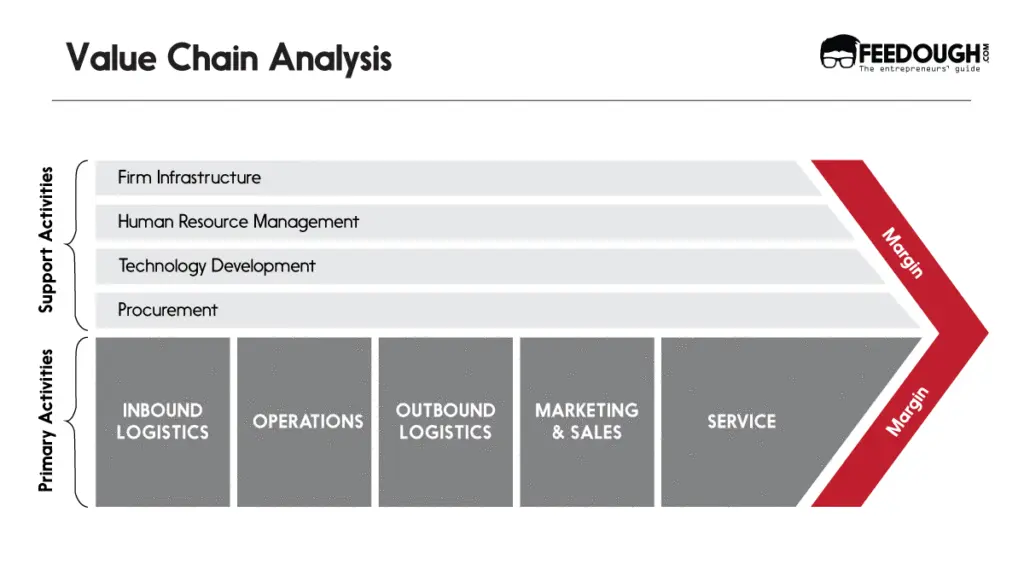
    Michael Porter has developed a comprehensive value chain indicating all the systems involved in value creation.

    Value Creation Chain

    value chain value creation

    The value creation chain revolves around the value creation process and includes the support activities that support the process.

    The value creation process is referred to as primary activities and the helping activities are referred to as support activities.

    Primary activities are the core processes involving everything from getting the raw materials, converting it into final offering, distributing it to point of sales, marketing and selling them, to providing services. It’s how a customer might see the business’s operations. It consists of the following:

    • Inbound logistics: It includes all the processes involved in getting, storing, and distributing inputs internally.
    • Operations: It includes all the processes involved in converting input into an output.
    • Outbound logistics: These are the activities involved in delivering the offering from business to customers.
    • Marketing and sales: These are the activities involved in communicating the brand message and persuading prospective customers to purchase the business’s offerings.
    • Service: It includes the activities involved in keeping the value intact even after a purchase has been made.

    Support activities include supporting functions that support the primary functions rather than being one of the delivery chain steps. They include activities business does to get resources, technology development, human resource management, and the firm’s overall infrastructure (that includes general management costs, planning, finance, accounting, legal, and government affairs). Generally, the business forms separate departments for such activities as well. These activities include:

    • Procurement (purchasing): It includes activities the business does to get the resources it needs to operate, that includes finding vendors, negotiating prices, etc.
    • Human Resource Management: In includes activities relating to recruiting, hiring, training, motivating, and retaining employees and other staff.
    • Technological Development: It includes activities relating to managing and processing information, maintaining technical excellence, etc.
    • Infrastructure: It includes processes that support daily business operations, like administration, clerical, financial, line management, etc.

    Value is created when a business sets its organisation’s purpose to serve customers, develops a business model to build on this purpose, and makes use of the available resources and processes to make this purpose a reality.

    However, how much value a business creates depends on certain value drivers.

    • Unsubstitutable: An offering that’s easily substitutable with other offerings from competitors provides little or no value to the customers as it is easily replaceable.
    • Unique: An offering that solves the problem differently or provides a unique solution may prove valuable to the customers. This way, even the business may capture value by being a monopoly.

    In plain terms, a business is valuable to the extent that it does something that others cannot.

    How Value Creation is Measured

    A customer always converts the benefits they get into monetary terms. But how can a business measure the same?

    Well, measuring the customer’s value is only possible if it is correlated to measurable variables like revenue or retention.

    • Revenue: In a normal market, value always translates into more revenue for the business. A business can always consider the profits earned as the customer’s value as the customer only pays over and above a standardised price when they’re getting more benefits than expected.
    • Retention: If a customer stays with the business over a period of time or repeats purchases, it’s a sign of value creation that can be translated into monetary terms by calculating customer lifetime value.

    Bottom-Line?

    Unlike what most people think, value creation is different from value capturing. Value creation targets customers. It’s doing work just to provide satisfaction to the customers. Value capturing, however, is the business capturing some of the value created. It is only possible if enough value is created for the customers.

    A business can sustain only if the customers believe they get something of value from it. Value leads to demand, results in revenue, and brings in profits.

    Value is what drives the business ecosystem.

    Go On, Tell Us What You Think!

    Did we miss something? Come on! Tell us what you think about our article on value creation in the comments section.

  • What Is Customer Value? (& Why Is It Important?)

    What Is Customer Value? (& Why Is It Important?)

    Every time a customer purchases a product, they compare the benefit received with the money paid for it. They call it the actual ‘worth’ of the product, relative to the price they paid. This worth of the product makes them stay, repeat purchase, refer the product to others, or do the opposite.

    Technically it’s not actually the worth of the product they bought; it’s the value they got from it that they translated into monetary terms. This value is customer value.

    What Is Customer Value?

    Customer value is the benefit expressed in monetary terms a customer gets in exchange for the price paid for the market offering.

    This definition of customer value stands on three key pillars

    • Customer value is the benefit: It’s the combination of all the tangible and intangible benefits, including technical, economic, service, and social benefits, a customer receives from the offering bought.
    • It is expressed in monetary terms: A customer always weighs the benefits received from the product and the costs incurred in obtaining them by converting the benefits into perceived monetary terms.
    • The benefit is compared with the price paid for the offering: The customer value is the net benefit received after subtracting all the costs that the customer incurs in obtaining those desired benefits.

    Generally, a customer also compares the net benefits received from one offering with its possible alternatives. It helps determine whether the customer feels they received enough value for the cost they incurred for the offering.

    Components Of Customer Values

    The value is always defined through the perception of the customer. It’s a result of four value types combined.

    • Functional Value:  It’s the value the consumer gets after getting their work done or problem solved. The bigger the problem is, the bigger the value served.
    • Social Value: It’s the quantification of perceptual benefits acquired from the offering’s association with social class, social status, or a specific social group.
    • Psychological Value: It’s the quantification of the psychological benefit a customer receives in terms of expressing themselves or feel better.
    • Monetary Value: It’s the value customer deduces after comparing the price paid with the offering’s perceived worth. It’s when all the non-monetary costs come into play.

    For example, consider person X is thirsty and person Y offered him a cola drink for a nominal price.

    The first value that person X may be looking for in this drink is the functional value that will quench his thirst. Is the quantity enough to quench his thirst? Was he able to get his problem solved?

    Second is the social value. Does buying person Y’s cola drink raised his social class, social status, or specific social group?

    Third, the psychological value. Does the psychological benefit of trying a new drink and being unique made person X feel better? Did he get any other psychological benefit that helped him express himself or feel better?

    The last is the monetary value. Does person X think that the benefits he got from person Y’s cola drink were worth the price he paid?

    Value vs Price

    Any market offering has two fundamental characteristics – value and price. Price is what the product costs to the customer, and value is what the product is worth to the customer. This worth is derived from the benefits the customer receives from the offering.

    During a purchase decision, the value should always outweigh the price, or the product will not sell. The price isn’t always the monetary cost. It also includes non-monetary costs like time, effort, energy, and inconvenience.

    The customer always compares the offering’s value and price with its competitive alternative before taking the final decision. Even for offerings with no close competitors, there’s a competitive alternative of customers doing the task themselves or building a product themselves rather than purchasing it.

    Hence, for a product to succeed in the market, it should fulfil the following equation:

    (Valuep -Pricep) > (Valuea -Pricea)

    That is, the net value (value – price) of the business’s market offering should always be more than the net value of the competitive offering.

    The Importance Of Customer Value

    If we go according to the definition, marketing is all about creating, communicating, and delivering value to customers.

    The customer is the king of the market. And today, the only way to fit in their shopping list is to provide benefits that weigh more than the costs incurred to obtain them.

    Business goals of earning profits, growth, and expansion are only possible if all the business activities contribute to value creation. A business will only succeed if the value it tends to provide equals or falls below the customer’s perceived value of the offering provided.

    How Is Value Created?

    A business succeeds in creating value when the customer perceives the offering’s benefits to be more than the involved costs.

    Every customer segment has a different definition and priority for benefits and costs. However, all the benefits can be categorised into four types:

    • Personal benefits
    • Product benefits
    • Service benefits
    • Image benefits

    All the costs can also be categorised into four types:

    • Monetary costs
    • Psychic costs
    • Energy costs
    • Time costs

    For a business to succeed in developing value, it needs to do thorough research on how the customers prioritise benefits and costs and give weight to the same. Once done, it needs to reduce the costs to a minimum and benefits to a maximum (giving attention to the most important costs and benefits) to increase the net benefit received from the offering.

    For example, if a customer prioritises costs as:

    1. Monetary costs
    2. Time costs
    3. Energy costs
    4. Psychic costs

    And benefits as:

    • Product benefits
    • Personal benefits
    • Service benefits
    • Image benefits

    To create most value for this customer, the business needs to focus on reducing (or increasing) the costs and providing as many functional benefits as it can.

    Once done, it can use the value drivers to influence the customers’ purchase decision.

    Drivers of Customer Value

    The customer perception of value can only be influenced and not controlled. The business can use certain drivers to influence it, though. These value drivers make the customer perceive the offering to be valuable. These are:

    • Product function: It’s the product’s functional qualities that help the customer get the task done. The business can add or subtract functions to increase the product value to the customer. If a customer gets more functions than expected, they perceive the product value to be more.
    • Price: Price is the monetary cost a customer incurs during the exchange transaction. It is a big influencer of the purchase decision and directly affects the perceived value.
    • Quality: It’s the degree to which the offering meets the consumer’s needs. The offering is a high-quality product if it equals or exceeds the user needs.
    • Positioning: It’s the unique space the offering occupies in the brains of the customers. It’s how a customer views a specific offering by associating emotions, traits, feelings, and sentiments with it.
    • Service: Service provided before, during, and after the purchase decision influence the value substantially.
    • Marketing and Branding: Marketing strategies and branding strategies help communicate the intended brand message and product features that influence its perceived value.
    • Existing relationships or previous experience: Customer’s existing relationship or previous experience with the brand influence their perceived value of the offering. A good experience results in a halo effect and makes them perceive the value to be more. A bad experience results in a horn effect and reduces the perceived value.
    • Personal bias from experience and upbringing: A customer’s personal bias also influences an offering’s value. A customer who can’t eat pork will always devalue a pork dish.

    Bottom-Line?

    Customer value is the lifeline of the business. Today, customers are so spoilt with choices that they decide what deserves their attention or money. The business can no longer control how the customer behaves; it can only influence the same using its various business activities.

    Hence, to ensure the business succeeds, the marketing team needs to outweigh offerings costs with the benefits provided in the priority the customer sets.

    Go On, Tell Us What You Think!

    Did we miss something? Come on! Tell us what you think about our article on customer value in the comments section.

  • Types Of Products (Consumer Products & Industrial Products)

    Types Of Products (Consumer Products & Industrial Products)

    A product is the offering a business provides to its customers in return for a monetary benefit. This offering can be a tangible item like a mobile phone or a doormat, or an intangible thing like a delivery service or cab service. Generally, anything that’s offered for sale is a product. Sometimes it’s the offering a customer buys in a store. Sometimes, it’s the customers themselves.

    A perfect product in the right market makes for a glorious combination for a business. The market consists of consumers and industries, and businesses can cater to either or both.

    But what are the types of products that one can find in the market? What do they mean? And finally, what do they consist of?

    Let us find out!

    The Two Types Of Products

    Technically, every product that exists today can be categorised into two types depending on who it is targeted at:

    • Consumer Products: These are finished products offered to the final customer who consumes them.
    • Industrial Products: These act as materials used in the production of other goods.

    Consumer products

    Consumer products are those that have direct utility to consumers. Individuals consume these products to satisfy their needs and wants. Some examples of consumer products are smart TVs, cheese, bread, toothbrush, and motorcycles.

    These products also involve services that directly satisfy consumers’ needs, like cab services or food delivery services.

    Consumer products are further classified into four broad categories based on the purchasing behavior of the customer:

    • Convenience products
    • Shopping products
    • Speciality products
    • Unsought products

    Convenience products

    Convenience products are inexpensive products that don’t require much effort from the customer to select and purchase them. They are usually produced in huge quantities as they already have a set demand.

    These products are easy to find, typically in grocery stores and major eCommerce websites, and don’t cost a lot. Additionally, customers use these products in small quantities since they can buy them frequently. 

    Products used daily by individuals, such as toiletries and medicines, are examples of convenience products.

    Convenience products are further classified as staple, impulse, or emergency products.

    • Staple products are those that the customer buys on a near-regular basis. They include goods like medicines, stationery, cigarettes, eggs, milk, etc., and services like cabs or carpooling services.
    • Impulse products, as the name suggests, are bought on impulse. These products aren’t what one would put on their grocery list, as they are essentially unplanned purchases. Take, for example, how individuals pick up a bar of snickers at the cash. Even a sudden decision to go sky-diving or colour hair purple and even the sudden urge to get a body massage after a long day at work are all necessarily impulse products.
    • Emergency products are suddenly considered a necessity due to an unprecedented situation; for example, a torch in the event of a power cut or an ointment in the event of an injury. Emergency products also include services like taking a taxi home after twisting an ankle or ordering food when the person has lots of work to do.

    Shopping products

    Shopping products are consumer products that the customer purchases less frequently and compare with other alternatives on quality, price, style, etc.

    Unlike convenience products, these products require individuals to make little effort to purchase them. It is because consumers engage in comparing features and prices before finally buying these products. Consequently, purchasing these products usually takes more time.

    Examples of shopping products are smartphones, laptops, or a dinner table. 

    These products can be classified as homogeneous or heterogeneous shopping products.

    • Homogeneous Shopping Products are similar in features, quality, and suitability. However, other qualitative and quantitative attributes like their brand loyalty, prices, and positioning become the point of comparison as they vary a little. Consider washing machines manufactured by two different companies. While they have similar features and are in the same price range, the consumer tends to compare the two’s prices or his prior experience with the brands before making a decision.
    • Heterogenous Shopping Products are those which vary significantly in style, suitability, quality, and pricing. An example of this would be clothing, wherein a consumer is likely to focus on the style they demand rather than the product’s price.

    Speciality products

    Speciality products are products with unique characteristics or images for which a significant group of customers is willing to make an extra effort.

    These types of products are usually desired but not needed, and they apply only to certain customers.

    Speciality products require special purchase efforts from the customers and often need considerable amounts of time to come to a decision. The sale of speciality products usually depends a lot on consumer loyalty. Hence, these businesses invest significant amounts of time into perfecting their goods and services and positioning them well to keep their customers coming back for more. 

    Usually, speciality products are less compared against other products as they have their fan-base. The effort, however, is put in terms of other factors – these products can be highly limited in quantity, highly-priced, or available only in select stores. 

    There is often a strong sense of loyalty seen in consumers who purchase such products. A consumer who favours one brand for its superior quality will travel to great lengths to acquire that brand’s product. Take Lamborghini, for example. A customer doesn’t spend time comparing it with other brands. Instead, they put in the effort to arrange funds and visit the store even if it is far off.

    Other examples would be Louis Vuitton bags, Swarovski crystals, and Louboutin shoes. One may also be particularly inclined towards visiting their favourite salon to experience their exclusive service.

    Unsought products

    There are some products that a customer never considers buying under normal conditions; that is, the customer does not normally think about them, at least not until they need them. For example, one seldom considers buying an oxygen cylinder, life insurance, or funeral service. These products are often unheard of, as they haven’t been marketed enough or are not necessarily considered a requirement in life. Another example of an unheard-of product is a new headphone model that is yet to be heard of by the consumer.

    Usually, unsought products are the hardest marketing task for a business. They require an extensive marketing campaign, high-budget advertising, and highly trained sales professionals.

    Industrial products

    Industrial products are products that are used to produce other goods. These products cannot be used directly, have to be processed, or are used for processing raw materials.

    Such goods and services usually include machinery, manufacturing plants, raw materials, technicians or engineers services, etc., targeted to businesses or industries who use them to produce other products. 

    Generally, industrial products have the following characteristics:

    • Rational Buying Power: Unlike consumer goods, purchasing industrial products involve more rational decisions than emotional ones. Customers buy such goods only when they need them. Usually, the quality and product matter more than positioning or other psychological drivers.
    • Complex Product Lines: Industrial products can be complex in nature as they tend to be technical and niche specific. 
    • Higher Purchase Value: Industrial products are usually pricey, owing to their complexity.
    • High Investment Level: Such products usually require substantial investment as they are used for mass or industrial production.
    • Inelastic Demand: The demand for industrial goods isn’t much affected by the changes in prices. 

    Industrial products are further classified into six types. These are:

    Raw materials

    Raw materials are products that are processed before being sold in the consumer market as finished products. Natural resources such as wood and agricultural products such as cotton and livestock like sheep for wool provide industries with raw materials.

    Take jute, for example. It’s a natural fibre derived from plants. This fibre is sent to a factory that processes it and eventually sells it in the consumer market as jute bags. Here, jute is the raw material which is the product that companies purchase from farmers to produce jute bags, among other products.

    Capital products

    Capital products include industrial products that are directly used for the production of other goods and services. This includes factories or buildings, land, and machines.

    These are industrial products that allow a business to function, for without a factory, a business can not produce a product for the consumer market. Services like DHL, which deliver products, require a warehouse to store parcels. Hence, a warehouse is an industrial product, and so is an office.

    Essential Equipment

    These are the utility products used to produce, process, or sell other products. These are essential products without which a business cannot run. Imagine a big factory with no conveyor belts. It would lead to chaos, with workers running around, shifting items from one place to another. A conveyor belt plays the integral role of transporting packages and other items from one piece of equipment to the next. This allows for the successful processing and production of products efficiently.  

    Engines, tractors, conveyor belts, and forklifts are just some of the few examples of major essential equipment.

    Component Materials

    These products are processed inputs that are used to make the final output. Component materials essentially become a part of the final product. Unlike raw materials that come through nature, a component material is an already processed input.

    An example of this is a paper sent to a publishing house used to make books or newspapers. Here, the paper has undergone the paper-making process previously, making it a component material.

    Accessory products

    These are products that lend a helping hand in the production process or the product’s selling process. They do not become a part of the final product but enable the manufacturing or selling of the product. 

    Small tools and even display racks are examples of these products.

    Services and supplies

    This involves the workforce in charge of maintaining, consulting, repairing, and cleaning, among other services. When an individual takes up the job of serving a business in any manner, the individual’s service becomes an industrial product.

    These individuals enable the smooth operations of industry and directly or indirectly contribute to other products’ production. A salesperson can also be an example of this, as he aids in selling a particular product.

    As for the supplies, these are the convenience products in the industry. They are frequently used and can be conveniently acquired. Examples of services and supplies include pens, glue, and A4 size papers used in an office setting, a cash register, and even small maintenance tools such as a screwdriver.

    Go On, Tell Us What You Think!

    Did we miss something? Come on! Tell us what you think about our article on types of products in the comments section.

  • Chief Executive Officer (CEO) – Definition, Roles, & Responsibilities

    Chief Executive Officer (CEO) – Definition, Roles, & Responsibilities

    Think about how one instantly associates Facebook with Mark Zuckerberg and Amazon with Jeff Bezos. They are their respective companies’ faces, and they approve every major decision that the company announces. Being the chief executive officer or the CEO, these individuals set the vision and lead the company.

    The CEO is the highest-ranking individual in a company making up the corporate ladder’s top rung. They are the highest-paid executives with the most responsible jobs. They hold immense power in making any decisions for the company and are equally accountable for such decisions.

    CEOs guide the other executives belonging to the C-level executive category. Here, C stands for “Chief”. In a business, the C-suite is considered to form the most influential group of individuals. These groups of executives lead several departments that form the vital organs of a business. The CEO leads these executives and evaluates their work.

    But who is a CEO and what are their responsibilities? What is the difference between a CEO and an owner?

    Let’s find out!

    Who is a CEO?

    A chief executive officer (CEO), also called a chief administrator or chief executive, is the highest-ranking chief-level executive in charge of managing the organisation’s overall operations, making top-level managerial and corporate decisions.

    The CEO is the face of the company who is the ultimate authority in making final decisions and setting the business’s aspirations and objectives. They hold one of the most powerful positions in a business and have an integral role in the success of the company. 

    He is accountable to and reports directly to the board of directors – a group of individuals elected to represent the company’s shareholders. It’s this board that elects and appoints the chief executive officer of the company.

    Roles of a CEO

    The CEO is the highest-ranking executive manager and decision-maker of the organisation. From deciding on a strategic direction of the business to being the intermediary between the board and the executives, the CEO has several roles in an organisation.

    • Leader: The CEO is essentially the leader of the company, leading the development of key short-term and long-term strategies and sets out to guide the executives who head the company’s different departments. In the process, they ensure that the company’s objectives are met. 
    • Visionary:  The CEO looks into the future for opportunities that the business can capitalise on. They set the vision that the company and its executives follow.
    • Information bearer: The CEO ensures that the staff and the board have sufficient knowledge about the company’s direction. He forms the interface between the board and the employees and between the organisation and the community.
    • Manager: A CEO oversees the operations of the business and also maps out plans and sees to it that they are implemented. Additionally, a CEO also manages the business’ human, physical and financial resources.
    • Decision-maker: CEOs play an integral role of deciding the course of action of the business. They also formulate policies and plan out how the business shall operate.

    Responsibilities of a CEO

    A CEO is essentially the face of a company, and hence, has several responsibilities. They include:

    • Deciding on strategic direction for the company: The CEO has a key role in deciding the company’s values, mission, vision, direction and overall strategy. It’s their responsibility to figure out how all the organisational keys fit together, leading to a smooth functioning in accordance with its overarching strategy. The CEO also takes vital decisions like deciding the offerings’ unique selling proposition and the brand’s value proposition.
    • Being the public face of the company: The CEO is synonymous with the company they work with. For example, Mark Zuckerberg equals Facebook for the majority of the people. Their actions can make or break the company.
    • Reporting to the board of directors: The CEO is always a part of the board, and they have to be accountable for the company’s actions to the board. 
    • Management of business resources: The CEO oversees every decision related to key business resources like the company’s budget, human resource management, etc. 
    • Public relations and community – CEOs ensure that their programs, missions and offerings are assigned a positive meaning to ensure that they remain attractive to stakeholders.
    • Finding growth opportunities: The CEO is a visionary who always look for opportunities to help the organisation grow and flourish. These opportunities include acquisitions, mergers, partnerships and other key business strategies.
    • Developing And Advising the board: The CEO assists in the selection and evaluation of the board members. He even advises the board on several key decisions.
    • Evaluation of key executives: The CEO monitors and evaluates the work of the other chief-level executives of the company. Such chief-level executives report to the CEO, and together they form judgments and, accordingly, make decisions for the business.
    • Evaluation of offerings –  A CEO keeps a check on the offerings that the company offers and ensures the quality design, promotion, marketing, delivery, and quality of programs.

    Average Salary of a CEO

    In 2020, the average salary of a CEO in the USA stood at $218,000.

    Additionally, the average annual bonus and benefits that a CEO ranges from $5,000 to $146,000.

    In India, the average base salary of a CEO is ₹30,03,722 per year.

    In the UK (London), the CEO’s average base salary is around £1,21,328, while in Australia, it is AU$204,000.

    Examples of famous CEOs

    Every registered company has a CEO representing it to the shareholders. Here are some examples of renowned CEOs that stand out of the crowd.

    Satya Nadella, CEO of Microsoft 

    Satya Nadella, chief executive officer Of Microsoft
    Source: NYTimes

    As the CEO of Microsoft, he directed the company towards forthcoming segments like cloud computing and augmented reality, away from its previous mobile strategy, which had been failing. He also oversaw Microsoft’s purchase of professional networking platform, LinkedIn in 2016

    He replaced billionaire Steve Ballmer as Microsoft CEO back in 2014, and since then, the company’s stock witnessed an increase of about 150%.

    Michael Dell, CEO of Dell Technologies

    Michael Dell, CEO Of Dell Technologies
    Source: Inc

    When Michael Dell returned to the post of CEO in 2007, he introduced the Inspiron 8000, which grew to become the most powerful notebook computer in the market.

    He also decided to expand from the company’s longtime dependence on their telephone and internet sales. He chose to sell their computers in national retailers like Wal-Mart, after which they moved into the enormous Chinese market.

    Such decisions made the company achieve new heights, and the sales of the company in 2008 topped a whopping $60 billion.

    Lei Jin, CEO of Xiaomi

    Lei Jin, CEO of Xiaomi
    Source: QZ

    Lei Jin co-founded Xiaomi, and it began to take off in just a few years after it started, the reason being its new affordable handset, which was a hit among Chine smartphone buyers.

    He also employed resourceful online marketing at a suitable timing, which led to the company’s great success in a considerably short amount of time. As of 2020, Xiaomi is the world’s third-largest smartphone company.

    CEO vs Owner

    One often uses the words owner and CEO interchangeably. These terms are, in fact, not the same.

    An owner owns all or majority of the shares of a business. If this individual has a partner with equity in the company, that individual would be referred to as the co-owner. 

    An owner is in charge of almost everything in the business, right from operations to marketing. The owner is usually the founder who starts a business, and later adds key executives to ensure the smooth operations of a business when the business begins to expand. It is often the owner who takes up the CEO’s formal title when the business begins to take off.

    The CEO of a company is an employee or executive who is in charge of the organisation’s strategic management. CEOs oversee all other employees working for them. If the company has a board of directors, which it usually has, the CEO is accountable to the board, and the CEO also provides the business with strategic guidance.

    Go On, Tell Us What You Think!

    Did we miss something? Come on! Tell us what you think about our article on chief executive officer in the comments section.