Feedough Logo

Blog

  • This Startup Makes Navigating Healthcare a Breeze – Watchdoq Healthcare Startup Review

    This Startup Makes Navigating Healthcare a Breeze – Watchdoq Healthcare Startup Review

    Navigating the healthcare landscape can often feel like traversing a labyrinth, fraught with obscure paths and hidden turns. Health-conscious individuals, in pursuit of credible healthcare information and support, frequently encounter a system shrouded in opacity. The pursuit of transparent healthcare reviews and cost comparisons remains a challenge that many face, leaving them yearning for a platform to illuminate the murky waters of medical decision-making.

    Enter Watchdoq, a beacon in the healthcare fog, offering not just reviews and ratings but a full spectrum of tools designed to empower informed decisions. Co-founded by Arnab M., Watchdoq transcends the traditional review site, fostering a community where experiences are shared, support is garnered, and healthcare becomes a collaborative journey. With a focus on authenticity, the platform employs advanced technologies like NLP and sentiment analysis to ensure the insights provided are genuine and unfiltered.

    The healthcare industry is vast and complex, but Watchdoq has managed to convert the possibility of a transparent healthcare system into an opportunity for better patient experiences. We did an interview to find out how they’re achieving this and what lies ahead for this innovative platform.

    What is Watchdoq Healthcare?

    Watchdoq Healthcare is a trusted platform designed to bring transparency to the healthcare sector. It serves health-conscious individuals who are in search of credible information about healthcare providers, including hospitals, doctors, and diagnostic centers. The primary issue that Watchdoq addresses is the lack of reliable healthcare information and support, which can be a barrier to making informed decisions.

    By providing a comprehensive review and ratings system, along with cost comparisons, Watchdoq enables users to gain insights into the quality of healthcare services. This empowers them with the knowledge to choose the best options for their medical needs. The platform stands out for its use of Natural Language Processing (NLP) and sentiment analysis to ensure that the reviews are genuine and reflect the true experiences of patients.

    Watchdoq’s value proposition lies in its ability to connect users and foster a supportive community. It’s not merely a repository of reviews; it’s a holistic solution that aids individuals in navigating the complexities of healthcare. The platform’s user-friendly interface and commitment to unfiltered insights set it apart from competitors, making it a go-to resource for anyone seeking guidance in their healthcare journey.

    With an impressive number of web search clicks and total impressions, Watchdoq has demonstrated its growing importance to a substantial user base. It prioritizes a patient-centric approach, ensuring that the healthcare community receives the support and information it needs to make the best possible decisions for their health and well-being.

    Watchdoq Healthcare Founders

    Arnab M. stands at the helm of Watchdoq Healthcare, a platform he co-founded with a vision to infuse transparency into the healthcare industry. His journey into entrepreneurship is rooted in personal encounters with the healthcare system’s complexities. It was during a friend’s medical ordeal in 2017 that the seeds for Watchdoq were sown. Arnab witnessed firsthand the daunting challenges and opaque practices that patients often face. These experiences ignited a determination to create a space where individuals could share their healthcare experiences honestly, aiding others in making informed decisions.

    The inception of Watchdoq was not without its trials. The early days were marked by a relentless pursuit to establish trust amongst users, who were wary of the authenticity of healthcare reviews. The startup’s initial phase involved a meticulous process of validation and learning, as the team worked tirelessly to gather credible data and refine their platform. They recognized the need for a user-friendly interface that could truly resonate with the community’s needs.

    Arnab’s background, coupled with his entrepreneurial spirit, equipped him to navigate the startup’s formative challenges. With a keen understanding of the healthcare sector’s nuances, he steered Watchdoq towards a path of innovation, harnessing technology to provide unfiltered insights into healthcare services.

    The story of Watchdoq is a narrative of resilience and adaptability, with Arnab and his team at its core. They embody the startup’s ethos of patient-centric care, demonstrating that with the right blend of technology and empathy, it’s possible to transform the healthcare experience. Their journey serves as an inspiring example for fellow entrepreneurs, showcasing the power of a clear vision and unwavering dedication in the face of industry challenges.

    Interview with Arnab M, Co-Founder of Watchdoq Healthcare

    I recently had the opportunity to sit down with Arnab M., the Co-Founder of Watchdoq Healthcare, to discuss the innovative approach his company is taking to transform the healthcare industry through transparency and patient empowerment. Here’s what he had to say:

    Q: What was the catalyst for starting Watchdoq, and how has your personal experience shaped the company’s mission?

    A: The idea for Watchdoq was born out of personal experiences with the healthcare system. A close friend’s medical emergency in 2017 revealed the difficulties in accessing transparent healthcare information and the hidden costs involved. These challenges led to the creation of Watchdoq, with the mission to provide a platform for sharing genuine healthcare experiences and helping others make informed decisions.

    Q: Can you tell us about the early challenges Watchdoq faced and how you overcame them?

    A: In the beginning, building trust with our users was a major hurdle. There was a lot of skepticism around the authenticity of healthcare reviews. We focused on creating a user-friendly platform and validating the data we collected. Through strategic partnerships and continuous engagement with our community, we were able to overcome these challenges and establish credibility.

    Q: How does Watchdoq stand out from other healthcare review platforms?

    A: Watchdoq is unique because we prioritize unedited, unbiased reviews. We use NLP and sentiment analysis to ensure the authenticity of the feedback shared on our platform. Moreover, we’re not just a review site; we’re building a complete healthcare ecosystem with a strong focus on community support and a wealth of health resources.

    Q: What are the future plans for Watchdoq, and how do you plan to sustain your growth?

    A: We’re constantly looking to enhance the user experience with new features, such as AI-driven recommendation tools. Our goal is to also expand our health resources and engage the community through interactive elements. To sustain growth, we will continue to innovate and adapt to the needs of our users.

    Q: With a significant number of users already, how do you plan to attract and serve even more customers?

    A: We plan to broaden our reach by covering more healthcare specialties and services. Our strategy includes refining our platform based on user feedback and enhancing our marketing efforts to attract a wider audience. Community engagement will remain a key focus to ensure we’re meeting the needs of our users.

    Q: What advice would you give to aspiring entrepreneurs looking to start their own business?

    A: My advice is to be resilient, adaptable, and passionate about your vision. It’s important to start small, validate your idea, and be open to learning from your users. Don’t fear failure; use it as a learning opportunity. Stay focused on creating value for your customers, and the success will follow.

    Arnab’s insights into the healthcare industry and his dedication to improving patient experiences through Watchdoq are a testament to the impact that a well-thought-out startup can have. His journey highlights the importance of resilience, adaptability, and user-centricity in the entrepreneurial world.

    Feedough’s Take on Watchdoq Healthcare

    Watchdoq Healthcare shines as a promising disruptor in the healthcare space, addressing the critical need for transparency and patient empowerment. Its innovative use of NLP and sentiment analysis to validate reviews is a significant step towards maintaining authenticity in patient feedback. The startup’s patient-first approach and community-building initiatives are commendable, signaling a future where healthcare decisions are more informed and less daunting.

    The challenge ahead for Watchdoq will be to maintain this trajectory of trust and to scale effectively while preserving the quality of insights offered. As the platform grows, it must continue to adapt to the evolving healthcare landscape and user needs.

    Expect Watchdoq to push boundaries further, potentially expanding into new markets or offering additional services that complement its core mission. The startup’s commitment to a transparent, user-friendly experience could very well set a new standard in healthcare reviews and information sharing. Watchdoq’s journey is one to watch, as it has the potential to fundamentally change how we interact with and perceive healthcare providers.

    Get Your Startup Reviewed By Feedough!

    Get discovered by over 500,000 monthly visitors. Explain your offering to over thousands of potential investors, customers, and top blogs.

    Startup reviews are custom written posts by our experienced team who’ll work closely with your team to create the best pitch possible. The review article will be posted and shared with thousands of our subscribers over emails, social media posts, and push notifications.

    Use this form to get in touch.

  • This Startup Streamlines B2B Sales with Smart AI Automation – PipeLime AI Startup Review

    This Startup Streamlines B2B Sales with Smart AI Automation – PipeLime AI Startup Review

    In the bustling world of B2B commerce, the art of connecting with potential clients is a relentless pursuit, often marred by outdated tactics and the humdrum of cold emailing. Businesses, whether they’re sprouting marketing agencies or established software developers, face the daunting task of transforming leads into loyal customers. But what if there was a way to reinvent this process, to streamline the journey from initial outreach to final handshake?

    Enter PipeLime AI, a startup that’s reimagining the sales funnel with a dash of artificial intelligence. They’ve crafted a solution that doesn’t just promise efficiency; it delivers a personalized touch at scale. The magic lies in their AI-driven approach, which meticulously gathers real-time leads, zeroes in on key decision-makers, and nurtures each prospect with a tailored company summary, all before penning that perfect, personalized email.

    Through our interview, we’ve peeled back the layers of this innovative enterprise, uncovering the drive and expertise that propels them forward. Their story is not just about a product; it’s a testament to the power of AI in revolutionizing business growth. Stay tuned as we delve into the insights from our conversation with the minds behind PipeLime AI.

    What is PipeLime AI?

    PipeLime AI is an enterprising venture that’s stepping up to transform the B2B landscape with its innovative AI-powered sales funnel automation. Tailored for businesses that engage in B2B transactions, from marketing agencies to software development firms, PipeLime AI is the answer to the often time-consuming and inefficient cold email outreach strategies that many companies grapple with.

    The problem at hand is clear: low conversion rates and the intensive demand on time that traditional sales strategies require. PipeLime AI addresses this head-on by deploying artificial intelligence to automate the process. It begins with the collection of real-time leads, pinpointing the key decision-makers, and ensuring that contact details are accurate. But the real game-changer is the personalized touch—each lead receives a company summary crafted just for them, followed by a bespoke email that speaks directly to their needs.

    The solution doesn’t just stop at initial contact; PipeLime AI’s system is designed to follow up with each lead, nurturing them until they’re ready to take the next step—be it scheduling a meeting, a call, a demo, or even making a purchase. It’s this end-to-end automation that sets PipeLime AI apart, offering businesses the chance to focus on closing deals rather than getting bogged down in the initial stages of the sales funnel.

    The unique selling proposition of PipeLime AI lies in this seamless integration of AI into the sales process, providing a level of personalization at scale that is rarely seen in the industry. It’s a solution that not only saves time but also enhances the quality of B2B interactions, ensuring that every lead is treated as a valuable potential client right from the first point of contact.

    PipeLime AI Founders

    Francisco Moreno del Campo stands at the helm of PipeLime AI as its Chief Operating Officer, a role he embraces with a blend of strategic acumen and operational expertise. His professional journey, punctuated by a series of entrepreneurial ventures, has culminated in the creation of a startup that’s set to redefine the B2B sales funnel landscape.

    Francisco Moreno del campo

    The founding team of PipeLime AI brings together a wealth of experience and a shared history of innovation. Each member boasts a track record of success, with the CTO having honed his programming skills on projects like Followr.ai, where he played a pivotal role as the main developer. The other founders, too, have left their mark on Followr.ai, infusing PipeLime AI with a spirit of collaborative entrepreneurship.

    In the nascent days of PipeLime AI, time was the currency most precious to the founders. Juggling multiple projects, they found themselves stretched thin, yet their commitment to this new venture never wavered. The team’s ability to manage their time effectively, a skill honed through experience, allowed them to nurture their startup without neglecting their other professional responsibilities.

    The genesis of PipeLime AI sprang from a frustration familiar to many in the B2B space—the inefficiencies of cold outreach. The founders, grappling with low conversion rates and the inability to scale without sacrificing personalization, saw a gap in the market. It was a eureka moment: why not harness the potential of artificial intelligence to automate and personalize the sales process at scale?

    This revelation was the spark that ignited PipeLime AI’s journey. The founders pooled their collective insights, drawing on their previous successes and challenges, to breathe life into a solution that could transform the tedious task of lead nurturing into an automated, yet deeply personalized, dialogue with potential clients.

    As you navigate the often unpredictable waters of entrepreneurship, the story of PipeLime AI’s founders serves as a reminder that perseverance, coupled with a strategic approach to time management, can lead to the birth of innovative solutions. Their shared vision for a smarter, AI-driven sales process is not just a testament to their expertise but also to their ability to identify and act on the needs of the market.

    Interview with Francisco, COO of PipeLime AI

    Having the opportunity to delve into the practical applications and the driving force behind PipeLime AI, I had the chance to sit down with Francisco Moreno del Campo, the COO of this forward-thinking startup. Our conversation shed light on the inner workings of their AI-driven solution and the vision that propels the team forward.

    Q: Could you tell us more about how PipeLime AI’s technology works in layman’s terms?

    A: At its core, PipeLime AI is like a highly skilled assistant that never sleeps. Our technology sifts through loads of data to find potential clients for any B2B business. It’s smart enough to pick out the right people to talk to, ensure their contact details are spot on, and then craft messages that are tailored just for them. It’s all about making sure that by the time you’re talking to a potential client, they’re already interested in what you have to offer.

    Q: What were the biggest hurdles in the early stages of developing PipeLime AI?

    A: Time was our biggest challenge. All of us founders were involved in other projects, so we had to be very disciplined with how we used our time. We had to make sure we were giving enough to get PipeLime AI off the ground while also maintaining our other commitments. It was a juggling act, but our experience with managing multiple projects helped us a lot.

    Q: How does PipeLime AI stand out from other sales automation tools on the market?

    A: What sets us apart is our AI’s ability to personalize at scale. Many tools can automate parts of the sales process, but they often lose that personal touch. Our AI is different. It makes sure every interaction feels one-to-one, which is crucial for building strong business relationships.

    Q: With no external funding, how did you manage to finance the initial phase of the startup?

    A: We’ve been very careful with our resources and have relied heavily on the skills within our team. We’ve managed to self-finance by being strategic about our spending and by reinvesting the profits from our other successful ventures. It’s been a bootstrapped effort, but it’s also given us a lot of control over the direction of PipeLime AI.

    Q: Looking ahead, what are the key milestones you aim to achieve with PipeLime AI in the next couple of years?

    A: Our immediate goal is to get our user base up to 10,000 by July 2024, and then to 40,000 by the end of that year. But it’s not just about numbers; we want PipeLime AI to become the go-to tool for B2B businesses looking to improve their sales process. In the long run, we’re aiming to be synonymous with AI-driven sales success.

    Q: What advice would you give to aspiring entrepreneurs who want to start their own business?

    A: My advice is simple: keep pushing forward. Challenges will come, but it’s your perseverance that will make the difference. If you’re committed and continue to put in the work, your chances of success increase significantly.

    Q: Can you share some insights into the impact of AI on business growth?

    A: Absolutely. AI is a game-changer. It’s expected to boost business growth by up to 300% in some industries by 2026. With AI, businesses can automate tasks, make better decisions, and offer more personalized services. It’s not just about cutting costs; it’s about doing things smarter and better, which is exactly what PipeLime AI is all about.

    This conversation with Francisco Moreno del Campo not only highlighted the innovative approach of PipeLime AI but also the practical mindset needed to navigate the startup ecosystem. With a clear focus on delivering value through AI-driven automation, PipeLime AI is poised to make a significant impact on the way B2B companies engage with their clients.

    Feedough’s Take on PipeLime AI

    PipeLime AI stands out with its practical application of AI in the B2B sales space, addressing a real pain point with a promising solution. The startup’s ability to personalize outreach at scale could be a game-changer, potentially increasing engagement and conversion rates. Their bootstrapped, skillful approach to growth is commendable, allowing for organic development and a clear strategic direction. Looking ahead, the challenge will be to maintain this personalization while scaling up user acquisition.

    If successful, PipeLime AI could disrupt traditional sales processes, setting a new standard for AI integration in business growth. Expect to see them make waves as they aim to hit their ambitious user base targets and become a leader in AI-driven sales tools.

    Get Your Startup Reviewed By Feedough!

    Get discovered by over 500,000 monthly visitors. Explain your offering to over thousands of potential investors, customers, and top blogs.

    Startup reviews are custom written posts by our experienced team who’ll work closely with your team to create the best pitch possible. The review article will be posted and shared with thousands of our subscribers over emails, social media posts, and push notifications.

    Use this form to get in touch.

  • This Startup’s AI Makes Hiring About Skills, Not Resumes – Potis AI Startup Review

    This Startup’s AI Makes Hiring About Skills, Not Resumes – Potis AI Startup Review

    In the bustling realm of talent acquisition, hiring managers and recruiters often find themselves sifting through a sea of embellished resumes, each promising more than the last. The quest for the true champions of skill amidst a horde of overstated qualifications is no small feat. Enter the realm of possibilities where the traditional vetting process is turned on its head. Imagine a tool that cuts through the fluff to reveal the true mettle of a candidate, a tool that transforms the hiring landscape from a game of chance to a science of precision.

    Potis AI, a nascent yet visionary startup, has seized this opportunity with both hands. They’ve crafted an AI assistant that doesn’t just evaluate; it simulates the very environment candidates will step into, challenging them to prove their worth in the most authentic way possible. Through their innovative work sample tests and interview simulations, Potis AI is redefining the hiring process, ensuring that skills and knowledge take center stage. Stay tuned as we delve deeper into this startup’s journey and how they’re reshaping the future of recruitment.

    What is Potis AI?

    Potis AI is a beacon for hiring managers and recruiters who are tired of sifting through exaggerated resumes. This startup understands the challenge of finding genuine talent in a market flooded with candidates who often overstate their abilities. They provide a solution that goes beyond the traditional interview process, offering a unique way to assess a candidate’s true potential.

    Their target audience consists of those at the forefront of talent acquisition, who are all too familiar with the time-consuming and sometimes futile task of verifying each applicant’s professed skills. Potis AI addresses this primary concern by creating an AI assistant that crafts work sample tests tailored to the job description. These tests are not pulled from a static library but are dynamically generated to mirror the real-life scenarios a candidate would face on the job.

    For example, when hiring a sales development representative (SDR), Potis AI enables hiring managers to observe how candidates handle objections and deliver value by engaging them in a simulated conversation with an AI buyer. Similarly, for a customer support role, the platform allows the evaluation of how candidates deal with challenging customer interactions.

    Unlike its competitors, Potis AI’s strength lies in its bespoke simulation scenarios, which offer a more accurate reflection of a candidate’s capabilities. This approach ensures that the hiring process is based on demonstrable skills, not just impressive resumes. With Potis AI, the focus shifts from who candidates claim to be on paper to how they perform in practice, a true game-changer in the recruitment industry.

    Potis AI Founders

    Vlad Tolm, the founder of Potis AI, is a man with a vision to transform the hiring landscape. He stands at the helm of this innovative startup, alongside a co-founder who is the technical maestro behind the scenes. Together, they form a duo with a clear division of labor: Vlad orchestrates the product, sales, and marketing symphony, while his partner ensures the technical composition is pitch-perfect.

    The genesis of Potis AI can be traced back to a time when access to GPT-4 API was akin to finding a golden ticket—guarded behind a waitlist that many hoped to breach. The tenacity of Vlad and his co-founder shone through as they made strategic contributions to OpenAI’s repository, a move that not only showcased their skill but also accelerated their access to the coveted API, fueling the early development of their platform.

    Vlad’s journey into the startup world was spurred by a belief that every individual possesses a unique superpower. His ambition is to cultivate a meritocratic workspace where job opportunities are granted based on tangible skills and knowledge, rather than the often misleading narratives spun on traditional resumes. It was this conviction that ignited the spark for Potis AI.

    As you navigate the early stages of your own entrepreneurial quest, consider the path Vlad and his co-founder took. They recognized a pain point in the recruitment process—the difficulty in distinguishing genuine talent from the exaggerated claims on resumes. With this insight, they set out to create a solution that would not just assess but immerse candidates in realistic job scenarios, thereby revealing their true capabilities.

    Their story is a testament to the belief that every challenge within an industry is an opportunity for innovation. As you chart your course, let the narrative of Potis AI remind you that each small step, even those that veer off the intended path, is a leap towards realizing your vision.

    Interview with Vlad Tolm, Founder of Potis AI

    Having the opportunity to speak with Vlad Tolm, the founder of Potis AI, provided a unique insight into the startup’s approach to revolutionizing the hiring process. The conversation shed light on how Potis AI is making strides in enabling hiring managers to evaluate candidates based on real-world skills and performance. Below is the transcript of our engaging dialogue.

    Q: Can you share with us the main challenges you faced when starting Potis AI?

    A: Certainly, one of the main hurdles was gaining access to the GPT-4 API, which was crucial for our platform’s development. We had to be proactive and get noticed by OpenAI, which we managed by contributing to their GitHub repository. Another challenge was creating a product that truly resonates with hiring managers and stands out in the market.

    Q: What sets Potis AI apart from other solutions in the recruitment tech space?

    A: Our platform is unique because we don’t just offer a series of standard tests. We generate customized scenarios that mirror the actual tasks a candidate would handle on the job. This tailored approach provides a more accurate assessment of a candidate’s abilities and performance.

    Q: How do you ensure that your AI assistant creates relevant and effective work sample tests?

    A: We’ve developed a system where the AI assistant analyses the job description and crafts a work sample test that’s as close to the real job scenario as possible. This ensures that the tests are relevant and that the candidates’ responses provide genuine insights into their capabilities.

    Q: What has been the most rewarding part of your journey with Potis AI so far?

    A: The most rewarding aspect has been seeing how our platform helps hiring managers make more informed decisions. It’s gratifying to know that we’re contributing to a fairer hiring process where skills and performance are valued over just what’s on paper.

    Q: Looking ahead, what are the future plans for Potis AI?

    A: We’re currently working on implementing full-fledged voice interviews. This will take our platform to the next level, allowing for an even more realistic simulation of the job interview process.

    Q: What advice would you give to aspiring entrepreneurs who want to make a mark in the tech industry?

    A: My advice is to be prepared for a reality that’s different from what you read in blogs or watch on YouTube. Every step you take, whether right or wrong, is a learning experience that moves you forward. Stay focused on your big dream and take small, daily steps towards it.

    Potis AI’s journey is a testament to the power of innovation and the importance of perseverance in the startup world. Vlad Tolm’s insights provide valuable lessons for anyone looking to disrupt traditional industries with cutting-edge technology.

    Feedough’s Take on Potis AI

    Potis AI exemplifies the kind of forward-thinking that can truly disrupt the talent acquisition space. By focusing on performance-based hiring, they’re addressing a critical pain point for recruiters and hiring managers alike. The startup’s potential to level the playing field and promote meritocracy in the job market is commendable.

    Their bespoke AI-driven simulations are a standout feature that could redefine the recruitment process, offering a predictive glimpse into a candidate’s real-world performance. This approach not only enhances the quality of hires but also streamlines the hiring process, saving valuable time and resources.

    Looking ahead, Potis AI’s trajectory seems promising. The challenge will be to maintain the accuracy and relevance of their simulations as job markets evolve. Continuous innovation and adaptation will be key to their sustained success. As they grow, it will be exciting to see how they scale their technology and potentially expand into different industry verticals. Expect Potis AI to become a significant player in the recruitment tech landscape.

    Get Your Startup Reviewed By Feedough!

    Get discovered by over 500,000 monthly visitors. Explain your offering to over thousands of potential investors, customers, and top blogs.

    Startup reviews are custom written posts by our experienced team who’ll work closely with your team to create the best pitch possible. The review article will be posted and shared with thousands of our subscribers over emails, social media posts, and push notifications.

    Use this form to get in touch.

  • This New Game Blurs the Line Between Humans and AI – Human or Not Startup Review

    This New Game Blurs the Line Between Humans and AI – Human or Not Startup Review

    In the rapidly evolving landscape of technology, the line between human and machine grows ever more blurred. Tech enthusiasts and casual conversationalists alike are finding themselves immersed in a world where digital chatterboxes can mimic the wit and unpredictability of human banter. But amidst this technological hustle, one startup is turning the AI conundrum into a playground of discovery. “Human or Not” invites players into a realm where guessing the nature of one’s interlocutor becomes a game as intriguing as it is revealing.

    With a keen eye on the pulse of AI development, “Human or Not” has crafted a niche for those hungry for interaction that’s both intellectually stimulating and delightfully uncertain. This startup has spun the possibility of AI deception into an opportunity for entertainment and education, capturing the fascination of a diverse audience. From gamers to scholars, the allure of unmasking an artificial intellect—or being fooled by one—resonates.

    By infusing the classic Turing test with a modern twist, “Human or Not” isn’t just a pastime; it’s a testament to our times. This game challenges perceptions, pushing players to question the very essence of conversational reality. We did an interview to find out how “Human or Not” is charting new territory in the digital dialogue dance.

    What is Human or Not?

    Human or Not is an intriguing platform that turns the age-old question “Am I speaking with a human or a machine?” into an entertaining game. It’s a space where tech enthusiasts, gamers, and the general public converge to test their ability to discern between AI-generated responses and those of a real person. The startup taps into the collective curiosity about artificial intelligence and its capabilities, offering a playful yet educational experience.

    The problem that Human or Not addresses is quite unique: the challenge of recognizing the subtle nuances that differentiate human communication from that of AI. In a world where AI is becoming increasingly sophisticated, this startup provides a solution that is as simple as it is effective. By engaging users in a game where they guess the nature of their conversational partner, Human or Not enhances their understanding of AI’s conversational skills.

    What sets Human or Not apart is its dual focus on entertainment and education. Unlike other platforms that may prioritize one over the other, Human or Not strikes a balance, making it a valuable tool for schools and universities while still keeping the experience light and enjoyable for casual users. It’s this blend of fun and learning that gives the startup its edge in the market.

    With the game’s daily user count reaching 13,000 and between 50,000 to 70,000 games played each day, it’s clear that Human or Not has struck a chord with its audience. This success is achieved organically, indicating a genuine interest and engagement from its user base. It’s a testament to the startup’s understanding of its audience’s desire for interactive and thought-provoking content.

    Human or Not Founders

    Oleg Nederev is the mastermind behind the innovative startup “Human or Not,” where he holds the reins as CEO. With a background steeped in development, Oleg has always been at the forefront of the tech wave, harnessing the raw potential of artificial intelligence to create something that’s not just a game, but a conversation starter about the future of human-AI interaction.

    The inception of “Human or Not” is a tale of curiosity meeting opportunity. In the early days, Oleg and his team faced the kind of growth that would be the envy of any startup—a surge of users that tested the limits of their platform. It was a litmus test for their resilience and a clear sign that they were onto something special. The game, still in its testing phase, was already capturing the imagination of users, eager to explore the nuances of AI communication.

    Driven by a passion for the ever-shifting AI landscape, Oleg saw the chance to challenge public perception and offer a unique blend of entertainment and insight. The concept for “Human or Not” sprang from a simple yet profound question: can we tell if we’re talking to a human or a machine? This question set the wheels in motion, leading to a game that’s as much about the joy of discovery as it is about understanding the complexities of AI.

    Navigating the startup world can be as challenging as it is thrilling, and Oleg’s journey with “Human or Not” is a reflection of that dynamic. From the adrenaline of the initial user influx to the steady task of refining the game and nurturing its growth, every step has been a learning curve. It’s a story that resonates with the spirit of innovation, a reminder that at the heart of every tech venture is a team of people driven by a shared vision to push boundaries and redefine what’s possible.

    Interview with Oleg Human, CEO of Human or Not

    Having recently discussed the intriguing concept behind “Human or Not,” I had the opportunity to delve deeper into the startup’s journey through an interview with Oleg Human, the CEO. Oleg, with his keen insight into the AI industry, shared his experiences and the vision that drives “Human or Not.”

    Q: What sparked the idea for “Human or Not,” and how did you move from concept to reality?

    A: The idea sprang from a fascination with AI’s rapid advancements. We wanted to create a space where anyone could engage with AI and understand its capabilities. Moving from concept to reality involved lots of prototyping and user feedback. It was crucial to ensure the game was not only fun but also a true reflection of AI’s conversational skills.

    Q: How did you manage the unexpected surge in users during the testing phase?

    A: It was a mix of excitement and rapid response. Our team worked around the clock to scale up our infrastructure and ensure a seamless experience for users. This challenge was a significant learning experience and highlighted the importance of being adaptable.

    Q: What strategies are you implementing to ensure the game remains relevant and engaging for your users?

    A: We focus on continuous improvement, integrating the latest AI developments, and listening to our community. We’re also exploring partnerships with educational institutions to incorporate “Human or Not” into learning environments.

    Q: Could you share some insights on how you plan to monetize the platform?

    A: While monetization is in the pipeline, our current priority is user experience and growth. We’re considering several models, including premium features and educational licenses, but we’ll decide based on what aligns best with our users’ interests.

    Q: What advice would you give to someone starting their own tech startup?

    A: Be prepared for a rollercoaster ride and stay focused on your vision. It’s vital to solve a real problem and be flexible enough to pivot when necessary. Engage with your users—they’re your most valuable resource for feedback and improvement.

    Q: How do you see “Human or Not” evolving in the next few years?

    A: We’re aiming to become a go-to platform for understanding and interacting with AI. We want to expand our user base, refine our technology, and continue providing an enjoyable and educational experience. The goal is to make “Human or Not” synonymous with AI communication.

    Oleg’s insights provide a window into the world of a tech startup navigating the exciting yet challenging terrain of AI. “Human or Not” stands as a testament to the power of innovation and the importance of bridging the gap between technology and the general public.

    Feedough’s Take on Human or Not

    “Human or Not” is a refreshing take on the AI conversation, cleverly packaged into an engaging game. Its success lies in its ability to make cutting-edge technology accessible and enjoyable, a crucial plus in a market where tech can often feel intimidating. The startup’s organic growth reflects its ability to resonate with users and suggests a promising future trajectory.

    As for suggestions, the challenge for “Human or Not” will be maintaining relevance in a fast-paced tech world. Staying ahead of AI advancements and continuously refining the user experience will be key. Partnerships with educational institutions could further disrupt learning, making complex AI concepts digestible.

    Looking ahead, we can expect “Human or Not” to continue blurring the lines between play and education, while potentially shaping the public’s understanding of AI. It’s the kind of startup that doesn’t just ride the wave of tech trends—it creates them.

    Get Your Startup Reviewed By Feedough!

    Get discovered by over 500,000 monthly visitors. Explain your offering to over thousands of potential investors, customers, and top blogs.

    Startup reviews are custom written posts by our experienced team who’ll work closely with your team to create the best pitch possible. The review article will be posted and shared with thousands of our subscribers over emails, social media posts, and push notifications.

    Use this form to get in touch.

  • This Startup Makes Work Feel Like Play with Smart Tech – 5day.io Startup Review

    This Startup Makes Work Feel Like Play with Smart Tech – 5day.io Startup Review

    In a bustling marketplace where the cacophony of clicking keyboards and ticking clocks blend into a symphony of deadlines and deliverables, professionals across the spectrum—from CXOs to accountants—are in a relentless pursuit of efficiency. They toil with a myriad of tools, hoping to stitch together a coherent workflow, yet often find themselves tangled in a web of spreadsheets, emails, and endless meetings. But what if there was a way to cut through this chaos with a single, streamlined solution?

    Enter 5day.io, a startup that has transformed the possibility of seamless work management into a tangible opportunity. With a laser focus on enhancing productivity and transparency, this platform is carving out a niche in the project management landscape by offering work intelligence that’s not just cost-effective, but also flexible and easy to integrate. It’s the brainchild of Jinal Shah, whose vision is to create an operational hub that brings clarity and efficiency to the modern workplace.

    Intrigued by the potential of this innovative tool, we conducted an interview to find out how 5day.io is redefining the way we approach our professional lives—one task at a time.

    What is 5day.io?

    5day.io is a modern work management tool that’s rapidly carving out a niche for itself in the crowded project management space. It’s tailored for those at the helm of companies and teams—CXOs, VPs, Heads, Directors, Managers, and Accountants—who grapple with the challenge of maintaining a clear view of project progress, accountability, and productivity.

    In a world where work often means juggling multiple platforms, 5day.io simplifies this by offering a single, integrated solution. The platform addresses the pain points of poor visibility and the lack of clarity in responsibilities by enabling enhanced productivity and transparency. It’s not just about tracking time; it’s about ensuring that every minute counts toward the successful completion of a project.

    The unique selling point of 5day.io lies in its customer-centric approach, offering work intelligence that’s not only cost-effective but also boasts fast-track approvals and seamless client onboarding. It’s designed to be flexible, integrating effortlessly with existing systems, and automating routine tasks to free up valuable time.

    For teams, 5day.io streamlines collaboration, making it easier to work together, regardless of location. This is particularly crucial in an era where remote and hybrid work models are becoming the norm. The platform’s intuitive design means that team members can quickly find their footing, reducing the learning curve and helping them focus on what they do best.

    At its core, 5day.io is about making work more human, balancing the scales between efficiency and enjoyment. It’s a tool that understands the modern worker’s need for a less nuanced, more transparent way to manage their workload. With 5day.io, businesses can move away from manual processes and embrace a more intelligent approach to work management.

    5day.io Founders

    Jinal Shah and Saumil Shah stand at the helm of 5day.io, beacons of
    innovation in the cluttered expanse of work management tools. With
    backgrounds steeped in the complexities of project management, their
    entrepreneurial journey is a testament to the relentless pursuit of simplicity
    and efficiency in a professional landscape riddled with convoluted
    processes.
    The genesis of 5day.io is rooted in the recognition of a universal struggle
    within the workplace: the search for a system that seamlessly integrates
    various aspects of project management, without the burden of juggling
    multiple platforms. Jinal, Saumil, and the founding team identified the
    chasm between the available tools and the actual needs of businesses
    aiming to navigate the modern workforce’s demands.
    In the early days, the challenge was formidable. The market was brimming
    with solutions, each offering a dizzying array of features. The founders of
    5day.io embarked on a mission to distill the essence of what truly mattered
    to professionals—clarity, accountability, and productivity. They envisioned a
    tool that would not only stand out for its intuitive design but also resonate
    with the ethos of customer delight.
    As you steer your company through the ever-shifting tides of the business
    world, it’s worth noting the resolve with which Jinal, Saumil, and the team
    approached the development of 5day.io. They have crafted a platform that
    is not just a tool but a partner in the quest for streamlined work
    management—a reflection of their commitment to empowering
    professionals to focus on what they do best, unencumbered by the chaos
    of disjointed workflows.

    Interview with Binit Kiran, Growth Manager of 5day.io

    Having had the opportunity to speak with Binit Kiran, the Growth Manager of 5day.io, I was able to gain further insight into the inner workings and aspirations of this emerging startup. Here’s what Binit had to say:

    Q: What was the primary motivation behind the inception of 5day.io?

    A: The main drive was to tackle the inefficiency that plagues many businesses when managing their projects and tasks. We saw a need for a tool that not only simplifies these processes but also enhances transparency and accountability, which is exactly what 5day.io aims to provide.

    Q: How does 5day.io stand out in the market, given the numerous project management tools available?

    A: We focus on customer satisfaction and work intelligence, offering a cost-effective and flexible solution that integrates easily and automates work. Our platform is designed to be intuitive, which means it’s easy for teams to adopt and use effectively.

    Q: What challenges did you face in the early stages of your startup, and how did you overcome them?

    A: The biggest challenge was entering a market with so many established players. We had to find the right balance of features and create a clear differentiation. We achieved this by focusing on what professionals truly need – a tool that facilitates clarity, accountability, and productivity.

    Q: What are the future plans for 5day.io?

    A: We’re looking to expand our offerings with project accounting and AI functionalities, as well as enhance our resource management features. Our goal is to continue evolving in a way that meets the changing needs of modern businesses.

    Q: Can you share some advice for aspiring entrepreneurs who want to start their own business?

    A: Identify a genuine problem and stay committed to solving it. It’s important to understand your target audience and to create a solution that truly addresses their needs. Also, be prepared for challenges and stay adaptable.

    Q: Are there any statistics or trends in the project management industry that you find particularly interesting?

    A: Yes, the task management software market is growing rapidly. It was valued at USD 3.24 billion in 2021 and is expected to reach USD 9.94 billion by 2030. This growth signifies a clear demand for tools that improve productivity and project oversight.

    This conversation with Binit Kiran highlighted the thoughtful approach 5day.io is taking to carve out its place in the project management ecosystem. With a clear focus on user experience and efficiency, 5day.io is poised to be a go-to tool for businesses looking to streamline their work processes.

    Feedough’s Take on 5day.io

    5day.io emerges as a beacon of innovation, adeptly addressing the complexities of modern work management. Its emphasis on clarity and efficiency is commendable, offering a refreshing departure from the fragmented solutions that dominate the market. The startup’s trajectory appears promising, with potential for significant disruption in how we approach productivity and collaboration. The integration of project accounting and AI, along with a commitment to customer experience, positions 5day.io to scale effectively and sustainably.

    While the road ahead may present challenges, the startup’s agility and customer-centric ethos suggest a bright future. Expect 5day.io to be a key player in the evolution of work management tools.

    Get Your Startup Reviewed By Feedough!

    Get discovered by over 500,000 monthly visitors. Explain your offering to over thousands of potential investors, customers, and top blogs.

    Startup reviews are custom written posts by our experienced team who’ll work closely with your team to create the best pitch possible. The review article will be posted and shared with thousands of our subscribers over emails, social media posts, and push notifications.

    Use this form to get in touch.

  • 12 Proven SEO Tips For Small Businesses

    12 Proven SEO Tips For Small Businesses

    Today, 98% of consumers use the internet to learn about a local business. However, with limited resources and so many other businesses, it can be challenging for you to stand out and get noticed by customers. By implementing effective SEO tips for small businesses and optimising your website well, you can greatly increase your chances of being discovered by potential customers when they search for products or services related to your business. 

    SEO, which stands for Search Engine Optimisation, involves optimising your website and online presence to improve traffic from Google and other search engines. In other words, SEO aims to attract the right audience to your website – individuals who could become customers, clients, or leads. For example, if someone is searching for “Best Bakery in Chicago,” and your website is properly optimised for this keyword, search engines are more likely to display your website on the search engine results page (SERP).  

     By implementing proper SEO strategies, you can cost-effectively market your small business and reach a broader audience. Whether you have a physical store or just sell things online, these tried-and-tested SEO tips will help you get noticed by the right people and grow your business. 

    Set Up Your Google My Business Profile

    Set Up Your Google My Business Profile

    Why Is Google My Business Important?

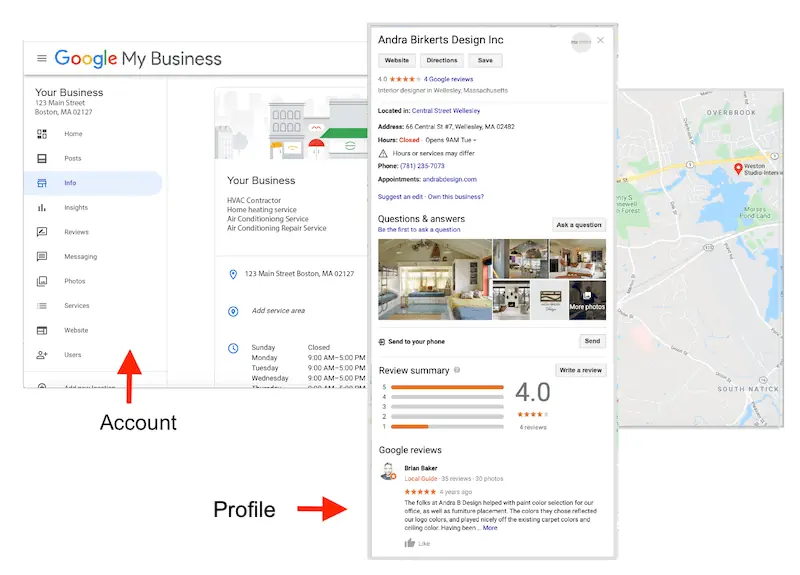
    The Google My Business Profile is a crucial component of SEO for your business. This free business listing feature provided by Google allows you to create a detailed profile with essential information about your products, services, location, and more. Your Google My Business Profile will appear on Google Search and Google Maps, which makes it easier for potential customers to discover and engage with your business.  

    Google Maps

    For example, suppose you search for “bakery in Chicago”, and you’ll find a list of bakeries alongside their ratings and contact information. A user will most likely click on the stores with a business profile and proper contact information.

    Additionally, having a Google My Business Profile provides potential customers with key information they need, including your address, phone number, website, and hours of operation. By making it easier for potential customers to obtain this information, your business can gain trust and build its reputation.

    How Do You Set Up Your Google My Business Profile?

    To set up your Google My Business Profile, follow these steps:

    1. Access your Google account by logging in or, if you don’t already have one, create one.
    2. Go to Google My Business website and click “Manage now.”
    3. Enter your business name. Make sure to use the official name that is legally registered.
    4. Select the category that best represents your business. This improves Google’s understanding of your company and targets the appropriate audience.
    5. Verify your business and optimise your profile with a business description, hours, photos, and other information. This will help potential customers understand your business better and improve your profile’s visibility in search results.

    Post Keyword Optimised Pages

    Keywords play a crucial role in SEO as they reflect the specific words and phrases users input when searching on Google. Keyword research refers to identifying and analysing particular words and phrases people use to search for information online. This process helps you to optimise your business website. 

    During keyword research, focus on identifying the specific words and phrases, also known as long-tail keywords, that your target audience commonly uses when searching search engines. When you optimise your pages for your target keywords, you make it easier for search engines to understand what your content is about, which can help improve your rankings and drive traffic to your site. 

    By conducting keyword research, you can gain valuable insights into the demand for specific keywords and the level of competition you face in organic search results. This information will guide your optimisation efforts and help you target relevant keywords with high search volume and lower competition. 

    Post keyword Optimised Pages

    For example, If you run a bakery in Chicago, you might enter “bakery in Chicago. And then click on “Search.”

    Keyword Research

    Once you enter the primary search term, you will receive a list of related keyword ideas.

    Why Is Keyword Optimisation Important?

    Keywords play a crucial role in SEO as they reflect the specific words and phrases users input when searching on Google. Keyword research refers to the process of identifying and analysing specific words and phrases that people use to search for information online. This process helps you to optimise your business website. 

    During keyword research, focus on identifying the specific words and phrases, also known as long-tail keywords, that your target audience commonly uses when searching search engines. When you optimise your pages for your target keywords, you make it easier for search engines to understand what your content is about, which can help improve your rankings and drive traffic to your site. 

     By conducting keyword research, you can gain valuable insights into the demand for specific keywords and the level of competition you face in organic search results. This information will guide your optimisation efforts and help you target relevant keywords with high search volume and lower competition. 

    How To Do Keyword Research?

    To do keyword research for your business, follow these steps:

    • Understand Your Audience: Take some time to understand your target audience and what they seek. Consider their demographics, preferences, and pain points. This will help you generate a list of relevant topics and themes for your audience.
    • Broaden Your Keyword List: To expand your list of keywords, use keyword research tools such as Ahrefs, SEMrush, etc. These tools provide insights into search volume (how many times a keyword is searched), competition (how many other websites optimise for the same keyword), and related keywords. This will help you generate a more extensive list of relevant keywords.
    • Analyse Keyword Metrics: When reviewing your keyword list, consider metrics like search volume and competition. You should look for keywords with decent search volume (enough people are searching for them) but lower competition (fewer websites optimise for them). This balance increases your chances of ranking well in search results.
    How to do keyword research?
    • Consider User Intent: User intent refers to the underlying reason behind a user’s search query. It is crucial to focus on keywords that match the intent of your target audience. Determine whether users are seeking information(Informatic), trying to make a purchase(commercial), or looking for specific services. This helps you align your keywords with the right content and optimise for relevant user queries.
    • Monitor and Refine: Keyword research is an ongoing process. Continuously monitor your website’s performance and monitor any changes in keyword trends or user behaviour. As new keywords emerge or your business goals evolve, update your strategy accordingly. Regularly refine and optimise your content and website to stay competitive in the search results.

    Track Your Website Rankings

    Track your Website Rankings

    To ensure the effectiveness of your SEO efforts, you need to know that your efforts are working by tracking your website ranking. Rank tracking refers to monitoring and evaluating the positions of your website’s pages in search engine result pages (SERPs) for specific keywords. By tracking your website’s rankings, you can assess your SEO efforts’ effectiveness and identify areas for improvement.

    Why Is Website Ranktracking important?

    Rank tracking is important for small businesses as it allows you to evaluate the effectiveness of your SEO strategies, stay competitive, identify new opportunities, and adapt to algorithm changes. By monitoring your website’s rankings in search engine result pages (SERPs), you can make data-driven decisions to optimise your SEO efforts, attract more organic traffic, and increase your online visibility.

    How To Track Your Website Rankings?

    You can install Google Analytics on your website to track your rankings. This provides valuable data on your website’s traffic, sources, and user behavior, allowing you to gain insights into your SEO efforts. However, it can’t tell you how well you rank for specific keywords. 

    Besides Google, other search engines like Bing shouldn’t be overlooked. Bing is a valuable traffic source, with over 1.2 billion people worldwide using Bing, and more than 900 million searches are made on Bing daily. 

    Additionally, tracking your website’s performance on Bing through Bing rank tracking software is also important as it is the second-largest search engine with a significant user base. By monitoring your rankings, you can optimise your website for both Google and Bing search engines, maximising your visibility and potential organic traffic. 

    If you notice changes in rankings, investigate the possible causes (e.g., algorithm updates, changes in competitor strategies), and adjust your SEO efforts as needed. 

    Post Content Related to Emerging Search Trends

    Post Content Related to Emerging Search Trends

    Emerging search trends are the latest patterns and developments in how people search for information online. Posting content based on the emerging search can help you gain more traffic to your business website. These trends can also help you stay updated and optimise your business website to improve your search engine rankings and visibility.

    Why Is Trendspotting Important?

    Analysing the latest search trends (trendspotting) gives you valuable data on the keywords people search for specific topics. This insight lets you optimise your website for niche keywords with less competition in search engine rankings. As a result, you can attract more targeted traffic from users actively seeking the precise information or product they require.

    How to Look out for emerging search trends?

    • Stay informed: Use Google Trends to monitor the popularity and search volume of keywords or topics relevant to your industry.
    • Analyse competitors: Watch your competitors’ online presence and strategies. Analyse their website content, keywords, and backlink profiles to identify any emerging trends they may be utilising.
    • Experiment and measure: Stay proactive by trying out new SEO strategies and monitoring their impact on your website’s visibility and organic traffic. Analyse the results to refine your tactics.
    • Engage in online communities: Join SEO-focused communities on social media platforms like Reddit, LinkedIn, and Twitter. Discussions with industry experts and peers can provide valuable insights into emerging trends.

    Use Siloing

    Use Siloing

    Siloing refers to a website structuring technique that you can use to improve search engine optimisation. It involves organising your content into distinct silos or categories, where each silo focuses on a specific topic or theme.

    By implementing siloing, you can create a logical structure that makes it easier for search engines to crawl and index your website’s content. This will improve your search engine rankings and increase your business’s organic traffic.

    Why Is Siloing Important?

    Firstly, siloing helps improve your website’s crawlability by creating a logical and organised structure. Search engines can easily understand and navigate through the content hierarchy, making it more likely that all pages on your website will be discovered and indexed.

    Secondly, it enhances the topical relevance of your content. By grouping related content within silos, search engines can better understand the context and relevance of your content. This can potentially lead to higher rankings for relevant search queries, as search engines perceive your website as a trusted and authoritative source on a specific topic.

    Moreover, implementing siloing improves the user experience by making it easier for visitors to navigate your website and find the information they seek. When your content is organised into distinct silos, users can easily find related content within the same silo, leading to longer session durations and increased engagement.

    How To Do Siloing?

    • Segment Your Topics: analyse your website’s content and identify the main topics or themes that your content covers. This will help you create distinct silos for each topic.
    • Research Relevant Keywords: Conduct keyword research to identify relevant keywords and phrases for each topic. This will help you optimise your content and ensure it aligns with the search intent of your target audience.
    • Organise Your Content: Group related content together under specific silos based on the identified topics. For example, if you have a small business that offers various services, you can create silos for each service category.
    • Implement Internal Linking: Ensure there are strong internal links within each silo, connecting related content together. Internal linking helps search engines understand the relationships between your content and improves the overall crawlability of your site.
    • Create a Silo Structure: Establish a logical hierarchy for your siloed content. This means organising your silos in a way that creates a clear and intuitive structure for both search engines and users.

    Keep Your Online Information Up-To-Date

    Content updation involves updating old content on your site to ensure that it is relevant, accurate, current, and SEO-friendly. Search engines like Google prioritise websites that consistently provide valuable and up-to-date information to their users. That’s why this practice is typically recommended every six months to maintain your website’s rank in the search engines.

    Keep your Online Information up to date
    Top 30 Small business ideas for beginners in 2024

    For example, this article, published on 18 October 2022 by DesignHill, on “Top 30 Small business ideas for beginners in 2024,” was updated on 17 January 2024, which helped it maintain its ranking on the search engine.

    Why Is Content Freshness Important?

    Keeping your online information updated, mainly through fresh content, is essential as it signals relevancy, improves search engine rankings, and enhances website visitors’ user experience.

    Regularly updating your website with fresh content signals to search engines like Google to make sure that your website is active and relevant. Search engines rank websites that provide users with the most valuable and relevant information, so regularly updating your website with fresh content can give you an edge against your competitors in the search results.

    How To Keep Your Online Information Up To Date?

    • Perform Keyword Research: Before updating your content, conduct thorough keyword research to identify relevant and high-performing keywords. Strategically incorporate these keywords into your updated content to enhance its search visibility and attract targeted organic traffic.
    • Add new facts and figures: Check if your existing statistics, facts, and figures have changed or have new sources. Update them.
    • Enhance Readability and User Experience: Break down your content into easily digestible paragraphs to improve its readability. Use subheadings, bullet points, and numbered lists to organise information effectively. Additionally, enrich the content with relevant images, videos, and infographics to make it visually appealing and engaging for readers.
    • Incorporate Internal and External Links: Integrate internal links within your content to enhance navigation and boost your website’s SEO. By linking to relevant pages on your website, you can provide additional information to readers and improve their browsing experience. Additionally, include external links to reputable sources that support your content, adding value to your readers and enhancing the credibility and authority of your page.

    Optimise Your Website For Mobile Devices

    Optimise your website for Mobile Devices

    Having a website optimised for mobile devices is crucial, considering most internet users now rely on their phones for browsing. With 57% of search traffic originating from mobile devices and 69% of smartphone users expressing a preference for making purchases on mobile sites over desktop sites, you need to prioritise mobile compatibility for a seamless user experience and maximised conversions. 

    Why Is A Responsive Website Important?

    Due to Google’s implementation of mobile-first indexing, your website should prioritise mobile optimisation. Google’s mobile-first indexing means that your website should load quickly on mobile devices, appear visually appealing on small screens, and provide a user-friendly experience that facilitates thumb-tapping actions. By focusing on these aspects, you can enhance your website’s mobile performance, improve its search visibility, and effectively cater to the growing number of mobile users.

    How Do You Optimise Your Website For Mobile Devices?

    • Responsive Design: A responsive design is highly recommended This approach ensures that your website adapts and displays correctly on various devices, including mobile screens. With responsive design, the same HTML file is served to all devices, and the CSS adjusts the rendering based on the device’s viewport dimensions.
    • Page Speed Optimisation: Page speed plays a crucial role in the mobile user experience. Optimise your website’s page load time by minimising code, leveraging browser caching, and reducing redirects. These optimisations can significantly improve your site’s loading speed on mobile devices.
    • Thumb-Friendly Navigation: Make sure your website’s navigation and buttons are easy to use with thumbs. Mobile users frequently rely on thumb actions for browsing and interacting with content, so it’s important to ensure that buttons are large enough and well-spaced.
    • Optimise Images: Compress images without compromising their quality to reduce the file size and improve loading times on mobile devices. Use image formats widely supported on mobile platforms, such as JPEG and PNG.

    Encourage Reviews And Respond To Reviews

    Encourage Reviews and Respond to Reviews

    It is common for people to rely on reviews when making decisions, whether it’s selecting a bakery or purchasing a toaster. Reviews assist consumers in making informed choices and provide valuable information about your business to Google, improving your site rankings.

    You can improve your online reputation and search engine rankings by actively encouraging customers to leave reviews and promptly responding to them.

    Why Is Social Validation Important?

    Reviews directly impact your Google ranking and people’s trust in your business. A higher number of reviews can positively influence your business, indicating credibility and reliability to potential customers.

    It’s important to reply to reviews, both positive and negative. Acknowledging and appreciating positive reviews can reinforce customer satisfaction and loyalty. Conversely, addressing negative reviews demonstrates your commitment to customer service and can help resolve any issues. Responding promptly and professionally to reviews shows potential customers that you value their opinions and are actively engaged with your online presence.

    How To Encourage And Respond To Reviews?

    1. Encouraging Reviews:
      • Provide direct links or buttons on your website, social media profiles, and email communications to make it simple and convenient for customers to leave reviews.
      • Request reviews from satisfied customers through personalised follow-up emails, asking for their feedback and inviting them to share their experiences.
      • Offer incentives, such as exclusive discounts or rewards, to motivate customers to leave reviews.
    2. Responding to Reviews:
      • Monitor review platforms, social media channels, and search engine listings to identify and respond to reviews promptly.
      • Respond to all positive and negative reviews in a timely manner to show your engagement and concern.
      • Show appreciation for positive reviews by thanking the customers for their feedback and mentioning specific aspects they appreciated.
      • Address negative reviews professionally, empathetically, and with a solutions-oriented approach. Apologise for any negative experiences and offer to resolve the issue privately or offline.

    Make Video Content

    Video marketing remains a staple in the digital landscape, used by over 90% of businesses. According to reports, 86% of video marketers have experienced increased web traffic due to video marketing. Furthermore, 82% of video marketers have found that videos help retain website visitors for extended periods. 

    Videos provide a versatile and accessible medium for creating content like Blogs, behind-the-scenes, How-to videos, testimonials, etc.  

    Why Is Video Content Important?

    Using video content to keep visitors on your page for extended periods can greatly reduce your bounce rate. As a result, search engines like Google and Bing are more likely to prioritise your website, improving your chances of ranking higher in search results.

    When shoppers engage with product videos, they are twice as likely to purchase those who don’t. Therefore, incorporating videos on your site boosts your SEO by attracting more visitors and helps convert those visitors into customers, further advancing your sales efforts.

    How To Make Video Content?

    1. Select the kind of video you want to create. It could be a tutorial, product review, or storytelling video.
    2. Choose a topic for your video that aligns with your audience’s interests and your goals. Consider what information or value you want to provide in your video.
    3. Select a video style that matches the message and tone you want to convey. This could be a vlog-style video, animated video, or screen recording.
    1. Write a script outlining the key points and structure of your video. A well-written script helps ensure your video is organised and conveys your message effectively.
    2. Create a storyboard to visualise the scenes and shots in your video. This can help you plan the visuals and sequence of your video content.
    3. Shoot your video footage using a camera or smartphone. Pay attention to lighting, sound quality, and framing to create visually appealing videos.

    Get External Links

    Get External Links

    External link building can improve your website’s search engine rankings. Part of this involves getting links to your website from other websites. These external links act as votes of confidence for your website, signalling to search engines that your content is valuable and trustworthy. In turn, this can positively impact your search engine rankings.

    Remember that the number and quality of external links pointing to your page are among the many factors that influence your rankings. If you can obtain links from reputable websites, your page is more likely to get an improvement in its rankings.

    External links from reputable and authoritative websites serve as endorsements for your content. When other websites link to your website, it signals to search engines that your content is trustworthy and valuable. This can help build credibility and trust with both search engines and users.

    Search engines consider external links as a ranking factor. When your website receives links from high-quality and relevant websites, it indicates to search engines that your content is valuable and deserves higher rankings.

    External links can drive referral traffic to your website. When users come across a link to your website on another reputable website, they are more likely to click on it and visit your site. This can result in increased organic traffic, which is valuable for small businesses looking to expand their online visibility and reach.

    • Outreach to relevant websites: Actively reach out to other websites in your industry and offer to contribute guest posts or collaborate on content. This helps expand your reach and increases the chances of earning backlinks to your website.
    • Encourage social sharing: Include social sharing buttons on your website to make it easy for visitors to share your content on social media. When your content is shared and circulated, it increases the chances of attracting external links.
    • Analyse and monitor your backlink profile: Regularly review your backlink profile to ensure that the external links pointing to your website are from reputable sources. Tools like Moz or Ahrefs can help you analyse your backlinks and identify any low-quality or spammy links that might harm your website’s authority.
    • Optimise internal linking: Internal links, such as linking between pages within your own website, can also contribute to your website authority. Ensure that your internal linking structure is logical and relevant, making it easy for search engines and users to navigate and find valuable content on your website.

    Conduct Regular SEO Audits

    Conduct regular SEO Audits

    While conducting an SEO audit is a straightforward process, many small businesses often overlook it. An SEO audit assesses your website’s search engine ranking and identifies areas for improvement to increase visibility. This analysis often uncovers opportunities to address technical issues, such as fixing broken links, enhancing page titles, and optimising meta descriptions with relevant keywords.

    Why is SEO Audit Important?

    Regularly conducting SEO audits is important for you as it helps identify improvement areas and optimises your websites for search engine visibility.

    SEO audits can uncover technical issues that may hinder your website performance, such as broken links, slow page load times, or duplicate content. Addressing these issues improves the user experience and increases the chances of higher search engine rankings.

    Regular audits help track the performance of your website over time. By monitoring key performance indicators such as organic traffic, bounce rate, and conversion rate, you can assess the effectiveness of their SEO efforts and make necessary adjustments.

    How To Conduct An SEO Audit?

    • Perform a crawl of your website: Using SEO tools like Ahrefs or SEMrush, run a crawl to identify any technical issues on your website, such as broken links, duplicate content, or slow page load times.
    • Check indexing: Ensure that all pages on your website are indexed by search engines. Use Google Search Console to check if any pages are missing from the index.
    • Analyse on-page elements: Evaluate your website’s on-page elements, including titles, meta descriptions, headers, and keyword usage. Optimise these elements to align with your target keywords and improve search engine visibility.
    • Evaluate website content: analyse your website content’s quality, relevance, and uniqueness. Optimise content by incorporating appropriate keywords, improving readability, and addressing any duplicate or thin content issues
    • Review backlinks: Assess the quality and quantity of backlinks pointing to your website. Identify any toxic or low-quality links that may harm your search engine rankings. Implement a backlink strategy to acquire high-quality, relevant backlinks.
  • 15 Proven Inventory Management Techniques

    15 Proven Inventory Management Techniques

    It’s essential to find the right balance of inventory in your business. Too little can cause problems, but too much can result in wasted resources and potential damage due to fluctuating demand. However, when you effectively manage your inventory, it ensures a seamless flow of goods, from sourcing raw materials all the way to selling finished products.

    And it’s not just you; many mammoth companies have suffered significant financial losses due to mismanaging their inventories. Ineffective inventory management can result in higher storage costs, working capital crunch, wastage of labour resources, increased idle time, and disruptions in the supply chain.

    So, how can you manage your inventory effectively? Here’s a guide exploring proven inventory management techniques to help you manage your inventory effectively.

    Demand Forecasting

    Demand forecasting refers to predicting the quantity of goods and services that consumers will demand at a future time. It uses various techniques, including data analysis and statistical models, to estimate customer demand based on historical data, market trends, economic conditions, and other relevant factors.

    It helps you optimise stock levels, reduce holding costs, and ensure a supply chain that quickly responds to your customer demands.

    For example, Let’s say you run a retail clothing store and you’re preparing for the upcoming holiday season. Demand forecasting helps you accurately predict which styles, sizes, and colours will be in high demand. By analysing historical sales data from previous holiday seasons, you can identify trends and patterns and align your stock with the projected demand. You’ll know how many units of each popular item to stock up on, ensuring you don’t disappoint customers with out-of-stock items. At the same time, you can avoid the burden of overstocking, which ties up your capital and takes up valuable storage space.

    How to do Demand Forecasting?

    1. Gather historical data: Collect and analyse your past sales, customer orders, and market information to discover patterns and trends in demand.
    2. Identify external factors: Consider factors like the economy, market trends, demographics, and your competitors’ actions. These can help you better understand the bigger picture and make more accurate forecasts.
    3. Choose a forecasting method: Select the right method for your business and data. You can use techniques like time series analysis, regression analysis, qualitative forecasting, or even machine learning algorithms.
    4. Put your chosen method into action: Use the method you selected to generate forecasts based on your historical data and external factors. This might involve running statistical models or applying algorithms.
    5. Evaluate and adjust as needed: Compare your forecasts to actual sales data to see how accurate they are. If you notice any differences, adjust your approach accordingly. This is a continuous process of monitoring and improving your forecasts.
    6. Collaborate with your stakeholders: Share your forecasts with your production teams, suppliers, and sales and marketing departments. Collaborating with them ensures everyone is on the same page and can optimise the supply chain to meet the forecasted demand.
    7. Regularly update your forecasts: Demand patterns can change, so it’s important to update your forecasts regularly with new data and market insights. This helps you make adjustments to your strategies, inventory levels, and production plans as needed.

    ABC Analysis

    ABC analysis is an inventory management technique that categorises inventory items based on their importance to the business. The analysis divides items into three categories—A, B, and C—based on their importance, with “A items” being high-value items that require close control, “B items” being moderately priced items with moderate control, and “C items” being numerous low-value items with minimal control.

    It offers you a systematic approach to prioritise your resources and efforts effectively, ensuring efficient inventory management with different levels of importance.

    For example, Let’s say you run a restaurant, it can be helpful to utilise ABC analysis to categorise your ingredients as A, B, and C items based on their importance to the menu and profitability. A items are high-value ingredients that are essential to your signature dishes. Focus on managing these items closely to ensure consistency and quality. The B items are moderately priced ingredients that are used in a variety of dishes on the menu. While these ingredients are important, they do not have the same impact as the A items. You need to ensure an adequate stock of these items but may not monitor them as closely or reorder them frequently. Finally, the C items are low-value ingredients that are used in limited quantities or in less popular menu items. These ingredients are often readily available and inexpensive. Maintain basic control of these items but don’t need to devote extensive resources to their management.

    By categorising ingredients as A, B, and C items based on their importance, you can allocate resources more effectively, minimise the chances of running out of crucial items, and streamline your overall inventory management.

    How to do ABC Analysis?

    1. Define categories: Determine the criteria you will use to assess the importance of each item in your inventory. Consider factors like sales volume, revenue generated, or profitability. Choose criteria that align with your company and industry.
    2. Gather data: Collect the necessary data about your inventory items, such as sales history, cost of goods sold, and profit margin.
    3. Sort the items: Arrange the items in descending order based on your chosen criteria. This will categorise them as A, B, and C items, with A items being the most important.
    4. Calculate percentages: Determine each category’s cumulative item and turnover percentages. The cumulative item percentage represents the proportion of the total value or quantity accounted for by each category. The turnover percentage indicates the proportion of sales or inventory turnover attributed to each category.
    5. Set up ABC analysis: Use a tool like Microsoft Excel to create an ABC analysis table or Pareto chart. These visuals will help you identify the impact and importance of each category at a glance.

    Just-in-Time (JIT) Inventory

    Just-in-Time (JIT) Inventory is a technique in inventory management where inventory is acquired or produced just in time to fulfil customer orders or demand. Instead of maintaining large stockpiles of inventory, JIT focuses on having the right amount of inventory at the right location and time.

    For example, Let’s say you have a manufacturing company. By using JIT Inventory practices, you can coordinate with suppliers to deliver raw materials just before they are needed on the production line. This minimises the need for extensive storage space and reduces the risk of excess inventory. By implementing JIT principles, you can operate with greater efficiency and responsiveness to your customer needs.

    How to Implement Just-in-Time (JIT) Inventory?

    1. Establish Clear Communication Channels: Encourage open communication channels with your suppliers to ensure timely delivery of materials or products. Establish strong partnerships and agreements to support JIT objectives.
    2. Implement Lean Manufacturing Principles: Streamline your production processes to eliminate waste, reduce lead times, and enhance efficiency. This involves improving workflow, reducing setup times, and optimising production schedules.
    3. Adopt Kanban System: Implement a Kanban system to signal when to produce or reorder inventory based on actual demand. This visual signalling system helps maintain optimal inventory levels and facilitates a pull-based production system.
    4. Monitor and Analyse Demand: Use accurate demand forecasting techniques to anticipate customer needs and adjust inventory levels accordingly. Regularly monitor sales trends and adjust production schedules in response to changes in demand.
    5. Optimise Supplier Relationships: Work closely with your suppliers to ensure prompt delivery of materials or products. Establish agreements for just-in-time deliveries and build strong partnerships to support efficient supply chain management.
    6. Continuous Improvement: Continuously evaluate and refine your processes to enhance efficiency, reduce waste, and improve responsiveness to customer demand. Encourage a culture of continuous improvement to drive ongoing enhancements in JIT practices.

    VED Analysis (Vital, Essential, Desirable)

    VED Analysis, which stands for Vital, Essential, Desirable, is an inventory management technique that classifies inventory items into three categories:

    Vital (V) items are critical to the organisation’s operations, and their unavailability could cause significant disruptions. These items are crucial and require careful management and attention to ensure availability.

    Essential (E) items are necessary for the organisation’s day-to-day operations but do not have the same criticality level as vital items. While their absence may not cause immediate disruptions, they are still important for the smooth functioning of the business.

    Desirable (D) items are those that are nice to have but not essential for the organisation’s operations. These items have a lower priority than vital and essential items and can be managed differently based on their demand and availability.

    For example, Imagine you’re managing inventory for a healthcare organisation. Using the VED Analysis technique, you categorise your medical supplies as follows:

    Vital (V) items: These are critical medical supplies needed for life-saving treatments, such as emergency medications, ventilators, and defibrillators. It’s crucial always to have an adequate stock of these items to handle emergencies and maintain patient safety.

    Essential (E) items: These are everyday medical supplies necessary for routine patient care, such as bandages, syringes, and disinfectants. While not life-threatening if unavailable, they are essential for providing quality healthcare services. You need to manage their inventory to meet regular demand and avoid shortages.

    Desirable (D) items: These are non-critical supplies that are nice to have but not essential for immediate patient care, like specialised equipment or certain drugs used less frequently. Manage these items considering their demand and cost, ensuring they don’t take up excessive resources.

    By categorising items into these three categories, you can allocate resources effectively, ensuring that essential items are prioritised in monitoring, stocking, and replenishment.

    How to implement VED analysis?

    1. Begin by identifying all your inventory items, including raw materials, work-in-progress, finished goods, and other items kept in stock.
    2. Categorise each item into one of the three VED categories: Vital, Essential, or Desirable. This classification is based on the item’s importance and its impact on your business operations.
    3. Prioritise your inventory management efforts accordingly. Focus on the Vital and Essential items by closely monitoring their stock levels, maintaining buffer stock, and ensuring timely procurement to prevent shortages and maintain uninterrupted operations.
    4. Adjust your approach for the Desirable items. Manage them based on their demand and cost implications, avoiding excessive stock holding and resource allocation.

    Material Requirements Planning (MRP)

    Material Requirements Planning (MRP) is an inventory management technique that involves manufacturers ordering inventory based on sales forecast considerations. MRP systems analyse the demand for finished products and current inventory levels to determine the quantity and timing of materials needed for production. This allows for efficient planning and scheduling, minimising inventory carrying costs, and ensuring materials are available when needed. Using this data and market demand, you can carefully place orders with material suppliers for new inventory. MRP systems can be software-based or performed manually.

    For instance, imagine you run a manufacturing company, and you utilise MRP to plan the production of a specific product. The MRP system gathers data on that product’s sales forecast, its components’ current inventory levels, and the lead time required to procure those components from suppliers.

    Based on this data, the MRP system calculates the precise quantity and timing of each component needed for production. It generates a detailed production schedule, outlining when each material should be ordered and when it should be used in the manufacturing process.

    Through this approach, you can optimise your inventory levels, preventing stockouts while also minimising excess inventory.

    How to implement Material Requirements Planning (MRP)?

    1. Gather the necessary data: Collect all the required data on sales forecasts, current inventory levels, and lead time needed to procure components from suppliers.
    2. Set up an MRP system: Choose an MRP system that suits your business, whether it’s a software-based solution or a manual approach. Implement the system and configure it according to your specific needs.
    3. Analyse your demand and inventory levels: Utilise the MRP system to analyse the demand for your finished products and evaluate your current inventory levels. This analysis will help you determine the exact quantity and timing of materials required for production.
    4. Determine your material requirements: Based on the demand and inventory analysis, you can identify the specific components and quantities needed for production. This information will be used to generate a materials requirement plan.
    5. Generate your production schedules: Utilise the MRP system to generate production schedules that specify when you should order materials and when they should be used in the production process. These schedules will ensure that materials are available when you need them, avoiding delays and disruptions.
    6. Place orders with your suppliers: Carefully place orders with your material suppliers based on the generated production schedules. This will ensure that materials are delivered on time and prevent any stockouts.

    Economic Order Quantity (EOQ) Model

    The Economic Order Quantity (EOQ) technique enables companies to determine the optimal quantity of inventory to order and when to place the order. With the EOQ model, you can set a reordering level and initiate restocking when your inventory reaches that level. Using the EOQ model, you can minimise both the costs associated with placing an order and the costs of carrying excess inventory. This model ensures that you order the right inventory quantity to optimise your operations.

    For example, Let’s say you run a retail store. The EOQ model can help you maintain the right balance of inventory. By calculating the optimal order quantity, you can avoid stockouts that lead to lost sales while also minimising the holding costs of excess inventory. This technique allows you to maintain a lean and efficient inventory system, improve customer satisfaction, and reduce costs. By ordering the right inventory quantity at the right time, you can optimise your operations and maximise profitability.

    How to implement Economic Order Quantity (EOQ) Model?

    1. Gather the Necessary Data: Start by gathering essential data related to your demand rates, ordering costs, and holding costs. Accurate and up-to-date information is important for precise calculations using the EOQ model.
    2. Apply the EOQ Formula: Utilise the EOQ formula to determine the optimal order quantity for your inventory. The formula is as follows:

    EOQ = √( (2 * Demand * Ordering Cost) / Holding Cost)

    Plugging in the relevant data values allows you to calculate the EOQ that minimises your total inventory costs. This calculation helps you strike the right balance between ordering too much or too little.

    1. Implement Reordering Policies: Develop clear reordering policies based on the EOQ calculations. Determine the appropriate reorder point, which indicates when you need to reorder inventory. Additionally, determine the reorder quantity to ensure a timely replenishment of your stock.

    Automating Inventory Management Systems

    Automating inventory management systems involves utilising technology and software solutions to streamline and optimise the processes related to inventory control and tracking. Automating these systems can reduce manual efforts, increase efficiency, and improve inventory management accuracy. It provides features and functionalities that facilitate various aspects of inventory management, such as inventory tracking, order management, demand forecasting, stock control, integration, and communication.

    Additionally, automated inventory management systems offer features for auto-replenishment, which allow for automatic order generation when inventory levels reach predetermined thresholds. With auto-replenishment, you can maintain optimal stock levels without manual intervention. The system continuously monitors inventory levels and triggers automatic purchase orders or production orders to replenish the stock.

    For example, Let’s say you have a clothing store, automating your inventory management system can provide various benefits. You can easily track your inventory levels across different channels, ensuring you never run out of stock or overstock items. The system automatically updates inventory as orders are fulfilled, preventing overselling or shipping out-of-stock items. With demand forecasting, you can anticipate popular clothing items and avoid excess stock or shortages. The system also has auto-replenishment features, generating purchase orders when inventory reaches predetermined thresholds. This ensures popular items remain in stock, minimising lost sales opportunities.

    Additionally, integrating your inventory management system with your e-commerce platform, point of sale, and accounting software facilitates smooth communication and data synchronisation.

    How to Automate Inventory Management Systems?

    1. Choose the right software: Select inventory management software that suits your business needs and size. Look for features like inventory tracking, order management, demand forecasting, and integration capabilities.
    2. Set up your inventory: Input your current inventory data into the software. Include item details, stock levels, supplier information, and other relevant data.
    3. Define replenishment triggers: Determine the thresholds at which the system should generate purchase orders or production orders to replenish stock. This can be based on minimum stock levels, historical sales data, or your specific requirements.
    4. Integrate with other systems: Connect your inventory management software with other tools you use, such as your e-commerce platform, point of sale, and accounting software. This allows for seamless communication and data synchronisation between different departments.
    5. Monitor and adjust: Review your inventory reports, demand forecasts, and reorder triggers regularly. Make necessary adjustments to optimise your inventory management processes. This may involve modifying trigger points, updating supplier information, or refining forecasting models.

    FIFO

    FIFO stands for First-In, First-Out, and it is a method used to manage and value inventory. It is based on the principle that the first inventory items purchased or produced are the first to be sold or used.

    Under the FIFO method, the cost of the oldest items in stock is assigned to those units when inventory is sold or used. This means that the inventory cost reflects the actual cost paid or incurred for the items acquired first. The FIFO method is frequently used when you sell goods that have a short shelf life and are prone to spoilage. Using the oldest inventory first helps ensure that items are sold or used before they become outdated or lose value.

    For example, if you own a grocery store and sell fresh produce, using the FIFO method would ensure that the first fruits and vegetables acquired are the first ones to be sold. This prevents any potential loss due to spoilage and helps maintain product freshness for your customers. You can minimise waste and maximise profits by prioritising the sale of older inventory. FIFO also accurately represents your costs and inventory values on financial statements, which is essential for effective financial reporting and analysis.

    How to implement FIFO?

    • Organise your inventory: Arrange your inventory in a way that allows you to identify and track the oldest items easily. Use labels or tags with clear date information.
    • Establish receiving procedures: When new inventory arrives, record the receipt dates and store it properly for easy access to older items.
    • Train your employees: Educate your staff about the importance of following FIFO and provide clear guidelines on identifying and selecting the oldest inventory for sale or use.
    • Monitor your stock regularly: Conduct periodic inventory counts and audits to accurately track inventory levels and identify any discrepancies or issues.
    • Rotate your inventory: When restocking shelves or fulfillment locations, ensure that older items are brought forward and placed in front of newer inventory. This will help ensure that older items are sold or used first.
    • Utilise inventory management software: Implement inventory management software that supports FIFO calculations and automates inventory tracking according to the FIFO method. This can streamline the process and minimise human errors.
    • Review and adjust as necessary: Regularly review inventory turnover rates, expiration dates, and customer demand patterns. Adjust reorder levels, supplier relationships, or forecasting models as needed.

    LIFO

    LIFO stands for Last-In, First-Out. It is a method used for inventory management where the most recently acquired goods are the first to be sold or used. With LIFO, the cost of the newest items in stock is assigned to those units when they are sold or used. This can result in a different valuation of inventory and costs compared to the FIFO (First-In, First-Out) method. LIFO is often used in industries where prices tend to rise over time, as it can help reduce taxable income by matching higher costs with revenues.

    For example, let’s say you run a clothing retail store. When you receive new shipments of clothing, place the most recent items on the sales floor while keeping the older items in the stockroom. As your customers make purchases, assign the cost of the most recently received clothing to those sales, even if older items are still in stock.

    By using LIFO in your inventory management, you can potentially increase the valuation of your inventory on the balance sheet, especially in industries where prices rise over time. This can reduce your taxable income by matching higher costs with revenues.

    How to implement LIFO?

    • Assess and evaluate your existing inventory management system: Before transitioning to LIFO, carefully review your current inventory management practices. Ensure that your accounting software or system can accommodate LIFO and that you have the necessary resources to make the transition smoothly.
    • Establish a tracking system: To implement LIFO, tracking the costs associated with each item in your inventory is essential. Maintain detailed records of the date of purchase, quantity acquired, and corresponding price for each item. This will enable you to accurately determine the cost of inventory on a first-in, last-out basis.
    • Communicate the change to your team: Ensure all employees involved in the inventory management process understand the shift to LIFO and its implications. Educate them on the importance of prioritising the sale or use of the most recently acquired items. This helps avoid confusion and ensures consistent implementation across your organisation.
    • Capture and record inventory transactions: As new inventory purchases are made, record the details of each transaction, including the date, quantity, and associated cost. These records will be crucial for calculating the cost of goods sold under the LIFO method. Additionally, accurately track sales or internal consumption of inventory, noting which specific units are being sold or used.
    • Calculate the cost of goods sold: To determine the cost of goods sold using LIFO, assign the costs based on the most recent inventory purchases. The cost assigned to goods sold will be the cost of the most recently acquired units. Make sure to update your inventory levels accordingly, subtracting the units sold or used from the most recent purchases.
    • Maintain detailed records and reconcile regularly: It’s important to keep accurate and up-to-date records of your inventory transactions and continuously reconcile them with your financial records. This ensures that your inventory levels and associated costs are properly reflected in your financial statements.
    • Review financial statements: Regularly review your financial statements to verify that the LIFO method accurately reflects the costs associated with your inventory over time. This analysis helps ensure the integrity of your financial reporting and provides valuable insights into the financial health of your business.

    Perpetual Inventory Management

    Perpetual inventory management refers to an inventory system that continuously tracks and updates inventory levels in real time. It involves the use of technology, such as computerised point-of-sale systems, to record inventory changes as they occur. With perpetual inventory management, every transaction of goods received or sold is immediately captured and updated in the inventory records.

    For example, Let’s say you run a retail store. By implementing perpetual inventory management, you use a computerised point-of-sale system. This system continuously updates your inventory levels in real-time based on sales transactions. The system deducts the quantity sold from your inventory records whenever a sale is made. If stock levels drop below a set threshold, the system automatically generates purchase orders to restock. You can monitor real-time inventory levels, track sales trends, and access reports on stock movement. At the end of the month, you conduct a physical count to verify the accuracy of your perpetual inventory records.

    The benefits of perpetual inventory management include greater accuracy and efficiency in inventory control. It gives you real-time visibility into your inventory, allowing you to make informed decisions regarding procurement, reordering, and sales. Maintaining accurate and up-to-date inventory records can minimise stockouts, optimise inventory levels, and improve overall operational efficiency.

    How to implement Perpetual Inventory Management?

    • Utilise Technology: Choose a computerised point-of-sale (POS) system or inventory management software that supports real-time tracking and updates. This system will help you keep track of your inventory in real-time.
    • Establish Baseline Inventory: Conduct a thorough physical inventory count to determine the accurate stock levels at the beginning of the implementation. This will provide you with a starting point for your inventory records.
    • Update Inventory in Real-Time: Record sales transactions using the POS system. The system will automatically subtract the quantity sold from your inventory records, ensuring that your inventory levels are always up-to-date.
    • Set Reorder Points: Determine the threshold at which you want to reorder each product. When the stock levels fall below this threshold, initiate an automatic reorder process to ensure you maintain sufficient stock.
    • Streamline Procurement: Develop efficient processes for receiving new stock and updating your inventory records. This may involve using barcode scanning or other methods to register incoming inventory accurately.
    • Monitor Inventory: Utilise the POS system or inventory management software to keep an eye on your real-time inventory levels. This will help you track sales trends, identify discrepancies, and generate reports on stock movement. Use this information to make informed decisions regarding stock adjustments and inventory management.
    • Periodic Physical Counts: Conduct regular physical inventory counts to verify the accuracy of your perpetual inventory records. Any discrepancies between your physical count and the system records should be investigated and resolved.

    Minimum Safety Stocks

    The minimum safety stock refers to a company’s inventory level to prevent running out of stock. It is the threshold at which a new order is placed before the existing inventory is depleted. It serves as a buffer stock to mitigate stockout risk and maintain business operations continuity.

     For example, if your organisation has a total inventory of 20,000 units, you would initiate a new order when your inventory reaches 18,000 units. As a result, the 2,000 units of inventory would constitute your minimum safety stock level.

    By maintaining a minimum safety stock level, you can reduce the risk of stockouts, ensure customer satisfaction, and maintain smooth operations.

    How to implement Minimum Safety Stocks?

    • Calculate the safety stock level: Determine the safety stock quantity by analysing factors like demand variability, lead time variability, and desired service level. You can utilise statistical methods or formulas to calculate the safety stock quantity.
    • Review historical data: Examine past sales patterns, demand fluctuations, and lead times to gain insights into your inventory requirements. Look for any seasonality or trends to help inform your safety stock calculations.
    • Set the reorder point: Determine the inventory level at which you should initiate a new order to replenish stock and maintain the minimum safety stock. Usually, you calculate the reorder point by adding the safety stock to the average demand during lead time. For example, if your safety stock is 100 units and the average demand during lead time is 50, your reorder point would be 150.
    • Implement a healthy inventory management system: Utilise suitable inventory management software or systems to accurately track inventory levels, monitor demand patterns, and generate reorder alerts when your inventory reaches the reorder point.
    • Regularly review and adjust safety stock levels: Continuously monitor and analyse demand patterns, lead times, and other factors impacting your inventory requirements. Adjust your safety stock levels accordingly to ensure optimal inventory management.

    Fast, Slow & Non-moving (FSN) Method

    The Fast, Slow, and Non-moving (FSN) method is an inventory management technique used to classify inventory items into three categories based on their movement. Here’s a breakdown of each category:

    Fast-moving (F): These goods sell quickly and have a high turnover rate. They are in high demand and often have a lower profit margin. Keeping a larger volume of fast-moving items in stock is generally recommended to meet customer demand.

    Slow-moving (S): These goods have a slower sales rate than fast-moving items. They may have a lower demand or longer shelf life. It is important to carefully monitor and manage slow-moving items to prevent excess inventory and minimise the risk of obsolescence.

    Non-moving (N): These are goods that have not had any sales within a defined period. They may be products that have become obsolete or experienced a decline in demand. Non-moving items tie up valuable storage space and tie up capital that could be used for more profitable items. Monitoring and addressing non-moving items is essential to optimise inventory management.

    For example, let’s say you have a retail store selling clothing items. You can apply the Fast, Slow, and Non-moving (FSN) method to manage your inventory effectively by:

    Fast-moving (F): Identify items like basic t-shirts, popular jeans, or trendy accessories that sell quickly and have a high turnover rate. These items are in high demand, so it’s important for you to keep a sufficient stock of them. For example, if you sell 100 units of basic t-shirts per week, classify them as fast-moving items.

    Slow-moving (S): Look for items like seasonal jackets, special occasion dresses, or niche accessories that have a slower sales rate than fast-moving items. These items may have a specific target market or lower demand, so managing their stock carefully is essential. For example, if you sell only 2-3 units of a particular specialty dress per month, classify it as a slow-moving item.

    Non-moving (N): Identify items like outdated fashion trends, products with low customer demand, or discontinued items. These items have not sold within a defined period and occupy valuable storage space. It’s important for you to address non-moving items promptly to free up space and prevent inventory holding costs. For example, if a specific style of shoes has not sold in the last six months, it would be considered a non-moving item that requires attention.

    By classifying items into these categories, you can understand the movement patterns of their inventory and make informed decisions about stocking levels, procurement, and inventory control.

    How to implement the Fast, Slow & Non-moving (FSN) Method?

    • Identify Your Inventory Items: Look at your inventory items and categorise them based on how well they’re selling and moving quickly. Sort items into fast-moving (F), slow-moving (S), or non-moving (N) categories based on their demand and sales history.
    • Plan Your Replenishment Strategies: Make sure you have enough stock of fast-moving items to meet customer demand and restock them regularly to prevent running out of stock. Develop strategies to boost sales of slow-moving items, such as promotions, and consider discounting or discontinuing non-moving items.
    • Monitor and Analyse Regularly: Keep a close eye on how your inventory items are performing, track their movement, and adjust your inventory management strategies as needed. Review and update the categorisation of items based on their sales patterns regularly.

    Reorder point formula

    The reorder point formula is used to calculate the point at which you should reorder inventory to avoid stockouts. It takes into account the lead time for order fulfilment and the average daily demand during that lead time. The formula is as follows:

    Reorder Point = (Lead Time Demand) + Safety Stock

    The Lead Time Demand is the average daily demand multiplied by the lead time, which is the time it takes for the supplier to deliver the ordered items.

    The Safety Stock is an additional amount of inventory kept to account for any unforeseen variations in demand or lead time. You can eliminate the uncertainty of reordering by establishing reorder points, ensuring they maintain optimal inventory levels without experiencing shortages or excess stock.

    For example, Let’s say you run a small retail store that sells electronic gadgets. You can use the reorder point formula to avoid stockouts and ensure you always have enough inventory on hand.

    First, you need to calculate the lead time demand. Let’s say the average daily demand for a specific gadget is 20 units and it takes your supplier 5 days to deliver an order. The lead time demand would be 20 units per day multiplied by 5 days, equaling 100 units.

    Next, you need to consider the safety stock. This is an additional buffer inventory that you keep to account for unexpected fluctuations in demand or possible delays in order fulfilment. Let’s say you decide to maintain a safety stock of 50 units.

    Using the reorder point formula: Reorder point = (Lead Time Demand) + Safety Stock

    Reorder Point = 100 units + 50 units

    Reorder Point = 150 units

    This means that when your inventory level reaches 150 units, it’s time to place a new order to replenish your stock. By maintaining a reorder point, you can effectively manage your inventory and avoid the risk of running out of popular products while also preventing the accumulation of excessive inventory that ties up your capital.

    How to implement the Reorder point formula?

    1. Determine your average daily demand: Calculate the average number of units you typically sell per day for the specific product.
    2. Calculate the lead time: Determine the lead time, which is when your supplier delivers the ordered items from the moment you place an order.
    3. Multiply your average daily demand by the lead time: Multiply your average daily demand by the lead time to calculate the lead time demand. This represents the expected demand during the lead time.
    4. Determine your safety stock: Consider factors like demand variability and supplier reliability to determine the appropriate level of safety stock, which acts as a buffer inventory for unexpected variations in demand or lead time.
    5. Apply the reorder point formula: Add the lead time demand to the safety stock to calculate your reorder point. The formula is:
      Reorder Point = Lead Time Demand + Safety Stock
    6. Monitor your inventory levels: Regularly review your inventory levels and compare them to the calculated reorder point. When your inventory level reaches or falls below the reorder point, it’s time to initiate a new order to replenish your stock.

    Batch tracking

    Batch tracking, also known as lot tracking, is a technique used in inventory management that involves the use of batch numbers to track and trace goods throughout the distribution chain. It allows you to monitor your raw materials, work-in-progress inventory, and finished goods effectively, minimising the storage of unusable items in your warehouse.

    For example, let’s consider that you have a manufacturing company that produces pharmaceutical products. You assign a unique batch number to each production run or lot by implementing batch tracking. This batch number captures important information such as the manufacturing date, location, and specific ingredients used in the production process.

    Each batch number is tracked and associated with the corresponding products throughout the distribution chain, from suppliers to end customers. This enables you to to quickly identify the specific batch in the event of quality issues, such as a product recall or customer complaints.

    Additionally, batch tracking helps you to ensure compliance with regulations and quality control standards. In industries like food, pharmaceuticals, and electronics, where safety and quality are critical, batch tracking plays an important role in maintaining product visibility and meeting regulatory requirements.

    How to implement Batch Tracking?

    1. Assign Batch Numbers: Start by assigning unique batch numbers to each production run or lot of products. These numbers should capture important information such as the manufacturing date, location, ingredients/components used, and other relevant details.
    2. Record Batch Information: Maintain a centralised database or system where you can record and track the batch information. This system should be easily accessible and allow for quick retrieval of batch-related data when needed.
    3. Track Movement: Track the movement of products with batch numbers along the distribution chain. Record when each batch is received from suppliers, processed in production, stored in inventory, and shipped to customers.
    4. Integrate with Inventory Management Systems: Ensure that your batch tracking system is fully integrated with your inventory management software. This integration enables seamless tracking of batch numbers as products move in and out of your inventory.
    5. Perform Quality Control Checks: Implement quality control checks at various stages of the production and distribution process to ensure that products within each batch meet the set standards and specifications.
    6. Conduct Regular Audits: Conduct regular audits to verify the accuracy and completeness of batch tracking data. This helps to identify any discrepancies or issues early on and ensures data integrity.

    Days sales in inventory (DSI)

    Days Sales in Inventory (DSI) is a metric used to measure the average number of days or time it takes for a company to convert its inventory into sales. It provides insights into how quickly your inventory is being sold and helps evaluate the efficiency of inventory management. Additionally, you can gain valuable insights concerning:

    • The effectiveness of your inventory management practices.
    • The level of demand for your inventory.
    • The amount of capital that is tied up in your inventory.

    Let’s say your cost of goods sold (COGS) over the past year was $500,000, and your average inventory holding for the year was $125,000. Using these figures, you can calculate your DSI as

    DSI = (Average Inventory / Cost of Goods Sold) x 365

    DSI = ($125,000 / $500,000) x 365

    DSI = 91.25 days

    This means that it takes you an average of 91.25 days to convert your inventory into sales. If the industry average for DSI is 60 days, your higher DSI of 91.25 suggests that your inventory turnover is slower than average. You may need to review your inventory management practices, such as evaluating stock levels or assessing the performance of slow-moving products.

    This way, you can aim to expedite inventory turnover, reduce carrying costs, and optimise your working capital.

    How to implement Days sales in inventory (DSI)?

    1. Gather the necessary data: You will need the average inventory value and the cost of goods sold (COGS) for a specific period.
    2. Calculate the average inventory value: Add the period’s beginning and ending inventory values and divide by 2 to obtain the average inventory value.
    3. Calculate DSI: Divide the average inventory value by the COGS and multiply by the number of days in the measurement period (usually 365 for annual statements).
      DSI = (Average Inventory / COGS) x 365 days
    4. Interpret the DSI: A lower DSI indicates that your inventory is being sold quickly, while a higher DSI suggests slower inventory turnover. Compare your DSI to industry benchmarks to assess the efficiency of your inventory management




  • How Does ChatGPT Work? [Complete Guide]

    How Does ChatGPT Work? [Complete Guide]

    Today, when AI is taking over the world, ChatGPT is the pioneer that made everyone believe in artificial intelligence’s true power and potential. You don’t just talk to it like a human-like friend anymore; you make it do advanced tasks like generate texts, answer questions, write code and even create images.

    But how can a machine do almost all the textual (and image) tasks a human can do? How does ChatGPT work? How was it built? Let’s dive into the technicalities of ChatGPT and understand its intricacies.

    What is ChatGPT?

    ChatGPT stands for “Chat Generative Pre-trained Transformer” and is an artificial intelligence-based system that uses natural language processing (NLP) to create both text and image conversation responses.

    chatgpt

    It is essentially an advanced chatbot that uses deep learning algorithms to understand and generate human-like responses. This means it can understand context, tone, and sentiment, making conversations more natural and personalised.

    But ChatGPT isn’t the base technology. It is a product of OpenAI built as a chatbot over the GPT-3 (Generative Pre-trained Transformer) model. The GPT model is the deep learning algorithm allowing ChatGPT to generate human-like responses. It stands for Generative Pre-trained Transformer –

    • Generative: It can generate text and images based on the given input. That is, it’s a generative AI that is capable of generating human-like responses.
    • Pre-trained: The model has been trained on a massive amount of text data to learn how language works. This training process took place using unsupervised learning techniques, meaning the model learns and improves on its own without being explicitly taught.
    • Transformer: A transformer is an advanced deep-learning architecture that uses attention mechanisms to understand the context of a given text input. This allows the model to generate coherent and relevant responses to the conversation. In simple terms, a transformer can understand relationships and connections between words in a sentence like us humans. It does so by paying attention to relevant words and ignoring irrelevant ones.

    ChatGPT Basics

    Before understanding and discussing how ChatGPT works, let’s get introduced to some of its basic terminologies and concepts.

    • Large Language Model (LLM): A large language model is a deep learning-based AI model that has been trained on massive amounts of text data, such as books, articles, and conversations. ChatGPT is a great example of an LLM. The primary purpose of these models is to generate human-like responses, usually in the form of text or images.
    • Natural Language Processing (NLP): NLP is a branch of artificial intelligence that focuses on enabling computers to understand, interpret, and generate human language. ChatGPT uses NLP techniques to process input text and generate coherent responses.
    • Predictive Text Model: A predictive text model is an AI model that uses contextual language processing to anticipate and generate text inputs based on previous words or phrases. Since ChatGPT is a transformer-based model, it uses predictive text modelling to generate relevant and logical responses in a conversation context. For example, when you start typing a sentence on your phone, the keyboard suggests words based on what you have already typed. This is an example of a predictive text model. Similarly, ChatGPT anticipates and generates text based on the conversation context.
    • Training: Training is a process in which an AI model learns patterns and relationships from a given dataset. In the case of ChatGPT, the model has been trained on massive amounts of text data to understand language patterns and generate human-like responses.
    • Training Data: Training data refers to the dataset used to train a machine learning or deep learning model. In the case of ChatGPT, the training data includes books, articles, and conversations from various sources.
    • Tokenisation: Tokenisation is breaking down a sentence or text into smaller units called tokens. In ChatGPT, tokenisation helps understand the structure and context of each input to generate more accurate responses. For example, it breaks down a sentence into individual words and punctuation marks, assigning each of them a unique token (in the form of a unique number). Then, the model uses these tokens to understand the relationships between words and generate an appropriate response.
    • Neural Network Development: A neural network is a computer system inspired by the structure and function of the human brain, used to process complex data and perform tasks like pattern recognition, prediction, and decision-making. In the case of ChatGPT, the neural network is responsible for learning from the training data and generating responses based on that knowledge. This process is known as Neural Network Development.
    • Reinforcement Learning From Human Feedback (RLHF): RLHF is a type of machine learning technique that uses human feedback to improve and refine the performance of an AI model. In ChatGPT, RLHF is used to finetune the responses generated by the model based on how humans interact with it. This helps in continuously improving the accuracy and naturalness of the responses.
    • Multimodal: Multimodal refers to the use of multiple modes or forms of communication, such as text, speech, images or videos. ChatGPT is a multimodal model as it can understand and generate responses using language (text) as well as other media like images.

    How ChatGPT Works?

    ChatGPT is a mixture of chat-like capabilities and an advanced deep-learning model, GPT.

    In simplest terms, here’s how the ChatGPT model works :

    1. It starts with an input text.
    2. The model then analyses the text, paying attention to relevant words and understanding the context.
    3. Based on this analysis, the model generates a coherent and human-like response. The interesting part? GPT doesn’t understand words per se; it converts the words into numbers (the process is called tokenising) and then predicts the next likely word based on those numbers. For example, if you type “I am feeling”, the model assigns a number to each word and predicts the next most likely word based on those numbers. In this case, it could generate something like “happy” or “excited”.
    4. The process of input-analysis-response continues until a specified length limit is reached.

    All this happens in real-time, making it seem like the model is having a genuine conversation with the user. The more input data and conversations the model has, the better it gets at generating human-like responses.

    But how did the GPT model achieve such impressive capabilities? It’s because of its dataset and architecture.

    How Was ChatGPT Trained?

    When it comes to LLM (large language models), the training process includes two main components: data and computation. In the case of ChatGPT, the model was trained on an enormous dataset of text data using supervised learning techniques.

    Now, there isn’t one dataset used to train the versions of GPT (3.5 or 4), but rather a combination of various sources such as books, articles, and websites. These include:

    • Common Crawl: A repository of web crawl data composed of over 25 billion web pages. This non-profit foundation collected petabytes of free data in over eight years.
    • WebText2: An extensive database of webpages extracted from outbound links on Reddit that received at least three upvotes.
    • Books1: A large collection of over 11,038 books, totalling approximately 74 million sentences and 1 billion words. The books cover various sub-genres such as romance, historical, adventure, and more.
    • Books2: A similar dataset to Books1 containing a random sampling of a small subset of all the public domain books available online, including both classic and modern literature.
    • Wikipedia: An online encyclopedia containing nearly 6 million articles and over 4.5 billion words in total.

    These large datasets are then fed into powerful computers using deep learning algorithms to train the GPT model. The training process involves going through the data multiple times and adjusting the model’s parameters and weights with each iteration until it can accurately generate human-like responses.

    But this isn’t all. The above datasets were used to train GPT 3, one of the early versions of the GPT model. The GPT 3 model wasn’t as conversational or human-like as GPT 3.5 – the model that pioneered ChatGPT. GPT 3.5 was finetuned for conversational use cases. OpenAI did this by releasing a specific dataset like Persona Chat that includes hundreds of thousands of human-to-human conversations.

    Besides Persona Chat, OpenAI also used the following datasets to finetune GPT 3.5 to become as human-like as possible:

    • Cornell Movie Dialogs Corpus: A dataset containing conversations from movies, including over 220,000 conversational exchanges between more than 10,000 pairs of movie characters.
    • DailyDialog Corpus: A dataset containing over 13,000 multi-turn dialogs with human-written summaries. The dataset was created to stimulate day-to-day dialogues that humans normally engage in. It contains different categories of emotions including no emotion, anger, disgust, fear, happiness, sadness, and surprise.
    • Ubuntu Dialogue Corpus: A dataset containing over 1 million multi-turn dialogues that were extracted from chat logs in Ubuntu forums.

    These datasets not only helped improve the conversational abilities of GPT 3.5 but also made it possible for ChatGPT to mimic a person’s personality based on their given persona information. This means that ChatGPT can generate responses that align with a specific persona, making the conversation more personal and realistic.

    How Does ChatGPT Think Like A Human?

    Training a model with large amounts of conversation data is not enough to make it human-like. ChatGPT uses deep neural networks and self-attention mechanisms to process the input text, allowing it to capture contextual dependencies and generate appropriate responses.

    ChatGPT also implements techniques such as beam search and top-k sampling in order to select the most likely response from a set of generated responses.

    All this is done using a process called tokenisation, which breaks down the input text into smaller chunks and assigns them a numerical value.

    Here’s a detailed example:

    Suppose you input the text: “Hi, how are you?”

    The tokeniser breaks it down into individual words and assigns them numerical values:

    • Hi: 101
    • ,: 102
    • how: 103
    • are: 104
    • you: 105

    These numerical values are then passed through the neural network for processing, where contextual dependencies between each word are captured.

    The model then generates a list of possible responses, and techniques like beam search or top-k sampling are used to select the most appropriate one.

    This process is repeated for each subsequent input, allowing ChatGPT to continuously learn and adapt its responses based on context and previous conversations.

    Initially, you got the responses from ChatGPT because of the pre-training (on vast amounts of data). But as you continue to interact with it, it uses RLHF (reinforcement learning with human feedback) to refine its responses and make them more personalised and realistic.

    To understand this better, let’s take the example of language translation.

    Initially, a machine translation system will give you direct word-to-word translations, which may not always make sense. But as it learns from human feedback and corrections, it starts to understand the nuances of language and produces more accurate translations.

    The same principle applies to conversation generation with ChatGPT – the more we interact with it, the more it learns and adapts its responses to match our style of language.

    When this process is done at scale, like what OpenAI did with ChatGPT by offering it for free to the public, the model gains a vast amount of human feedback and conversations to improve its responses continuously.

    This is why ChatGPT can provide such realistic and personalised conversation experiences – because it has been trained on real human interactions and constantly learns from them.

    How ChatGPT Learns From Human Input?

    RLHF (reinforcement learning with human feedback) usually works in two stages:

    1. Pre-training stage – Where ChatGPT is trained on a vast amount of data (text) to build its initial knowledge base and language understanding.
    2. Human-interaction stage – Where ChatGPT interacts with humans and receives feedback on its responses, allowing it to refine and improve its conversations over time.

    ChatGPT uses reinforcement learning techniques during the human interaction stage to analyse human feedback and adjust its response generation accordingly.

    It learns from both positive and negative feedback, making its responses more accurate and personalised with each interaction.

    This extra training involves three additional rounds:

    1. Supervised Finetuning (SFT)
    2. Reward Model
    3. Reinforcement Learning

    Supervised Finetuning (SFT)

    Supervised Finetuning (SFT) involves adapting a pre-trained language model to perform a specific task, such as responding accurately to user queries or maintaining a consistent tone. This is done by providing the model with a carefully curated dataset containing input prompts and desired output responses. The resulting SFT model serves as a starting point for subsequent stages of training.

    For example, imagine you have a pet that you want to teach to fetch a ball. At first, you show the pet how to do it by guiding them with a leash. This is like providing the language model with labelled data to teach it a specific task.

    Reward Model

    The reward model evaluates the quality of the generated responses produced by the SFT model. Humans are asked to compare the model’s outputs to determine preferable ones. These comparisons are converted into a numerical reward signal, which guides the model towards producing more desirable responses during the reinforcement learning stage.

    For example, after your pet attempts to fetch the ball, you give them a treat if they do it correctly. This is similar to the reward model, which evaluates the quality of the language model’s responses and provides feedback as rewards.

    Reinforcement Learning (RL)

    Reinforcement Learning (RL) aims to teach the model to make decisions that lead to favourable outcomes without explicitly specifying every possible scenario. By introducing the reward model, the RL algorithm adjusts the model’s parameters to increase the likelihood of receiving positive rewards when generating responses. This helps ensure that the model produces more accurate and appropriate responses.

    In the pet example, as your pet continues to practice, they learn to associate fetching the ball with receiving a treat. They adjust their behaviour to increase the likelihood of getting a treat. This is akin to reinforcement learning, where the language model adjusts its responses based on the feedback from the reward model.

    Even though this isn’t a proprietary concept, it has proven to be effective in training language models to generate high-quality responses. Several AI development services have utilised reinforcement learning techniques to improve their language processing models.

    What ChatGPT Can Do?

    ChatGPT is amongst the most advanced natural language processing tools available today. It can generate human-like textual output, and now that it is merged with DALL·E 3, it can also generate images based on the text input.

    Honestly, there’s no limit to what ChatGPT can do. Its capabilities are continuously expanding as researchers and developers work on improving its performance and integrating it with more advanced models and algorithms.

    Here are some potential use cases for ChatGPT:

    • Personal assistants: With the ability to understand context and generate human-like responses, ChatGPT can serve as virtual personal assistants that can assist with various tasks and answer questions.
    • Creative writing: ChatGPT can be used as a tool for writers to generate ideas or even entire pieces of content. It can also serve as a co-writer, providing suggestions and expanding on the writer’s ideas.
    • Language translation: With its ability to understand context and generate natural-sounding responses, ChatGPT can potentially be used for language translation tasks, making the translated text sound more natural and human-like.
    • Customer service: ChatGPT can be integrated into customer service chatbots to provide more personalised and human-like responses to customer inquiries and concerns.
    • Educational tools: With its ability to generate accurate and appropriate responses based on context, ChatGPT can potentially serve as a tool for educational purposes, such as virtual tutors or study aids.
    • Creative AI projects: ChatGPT can be used in various creative AI projects, such as generating art, music, or even video content based on text inputs.
    • Text-to-image generation: ChatGPT has native integration of DALL·E 3, a model that can generate images from text descriptions. This opens up possibilities for creating visual aids or illustrations based on written content.
    • Coding: ChatGPT can also be used to assist with coding tasks, such as generating code snippets or providing suggestions for completing lines of code.
  • How To Detect AI-Generated Content (5 Proven Ways)

    How To Detect AI-Generated Content (5 Proven Ways)

    <!– wp:paragraph –>

    Today, AI has become so advanced that it’s sometimes impossible to manually identify whether the content is written by humans or AI.

    <!– /wp:paragraph –>

    <!– wp:paragraph –>

    So, how can you be sure about the content’s authenticity, reliability, and credibility?

    <!– /wp:paragraph –>

    <!– wp:paragraph –>

    And it’s not just you; a recent study from Cornell University found that 40% of the times,  participants believed they were chatting with a real person instead of an AI chatbot.

    <!– /wp:paragraph –>

    <!– wp:paragraph –>

    This ambiguity often leads to fake news and disinformation.

    <!– /wp:paragraph –>

    <!– wp:paragraph –>

    So, how can we spot this AI-generated content? Here’s a guide exploring effective methods to help you identify AI-generated content accurately.

    <!– /wp:paragraph –>

    <!– wp:heading –>

    Proven Tips To Detect AI-Generated Content Manually

    <!– /wp:heading –>

    <!– wp:paragraph –>

    It’s no rocket science to detect AI-generated content. This is because a robot works in a uniform manner where it follows specific instructions. Once you read a few of the generated outputs, you’ll find the pattern yourself.

    <!– /wp:paragraph –>

    <!– wp:paragraph –>

    But if you’re new to this, here are some patterns you should look out for.

    <!– /wp:paragraph –>

    <!– wp:heading {“level”:3} –>

    Look Out For Transition Words

    <!– /wp:heading –>

    <!– wp:paragraph –>

    Transition words are those words or phrases that help you connect sentences, paragraphs, or ideas in a piece of writing. They act as bridges that helps you to understand the order of events and how they relate to one another.

    <!– /wp:paragraph –>

    <!– wp:paragraph –>

    You may use words like: Moreover, furthermore, in contrast, etc while writing.

    <!– /wp:paragraph –>

    <!– wp:paragraph –>

    However, AI-generated text often has an excessive or inappropriate use of these transitional words, making the text sound disjointed or robotic. It attempts to imitate the way you write by incorporating transition words. While they can mimic the structure and syntax, the placement or frequency of these transition words is unusual or forced.

    <!– /wp:paragraph –>

    <!– wp:paragraph –>

     You can expect to see these words, such as “Furthermore,” “Additionally,” “Moreover,” “Consequently,” and “Hence,” appear regularly in AI-generated content in order to connect ideas or emphasise points.

    <!– /wp:paragraph –>

    <!– wp:paragraph –>

    For example, this is AI-generated content:

    <!– /wp:paragraph –>

    <!– wp:image {“id”:46527,”sizeSlug”:”full”,”linkDestination”:”none”} –>

    AI-generated content

    <!– /wp:image –>

    <!– wp:paragraph –>

    In this example, you can observe the abundant use of transitional words like “In conclusion”,” “Moreover,” “However,” and “Ultimately” in every other paragraph. The frequent inclusion of these transitional words indicates the content’s more robotic or AI-generated nature.

    <!– /wp:paragraph –>

    <!– wp:heading {“level”:3} –>

    Look Out For A Robotic Writing Style

    <!– /wp:heading –>

    <!– wp:paragraph –>

    AI writers rely on artificial intelligence rather than human input, so they often lack a distinct human voice. As a result, there is a lack of personal opinion or emotion. Unlike when you’re writing something, where you would usually include casual phrases or questions to make it feel like a real conversation, AI-generated content tends to be more like a series of well-structured paragraphs. It misses out on the natural flow of conversation.

    <!– /wp:paragraph –>

    <!– wp:paragraph –>

    As humans, we add our emotions, experiences, and biases to our content, which makes it relatable and engaging. However, when AI generates content, it tends to have a robotic writing style that lacks these human elements.

    <!– /wp:paragraph –>

    <!– wp:paragraph –>

    <!– /wp:paragraph –>

    <!– wp:paragraph –>

    For example, let’s say you ask ChatGPT to write on the following: Who is a freelancer? Here’s the response it generates.

    <!– /wp:paragraph –>

    <!– wp:image {“id”:46528,”sizeSlug”:”full”,”linkDestination”:”none”} –>

    AI-generated content

    <!– /wp:image –>

    <!– wp:paragraph –>

    As you can observe, There is no distinct personality or unique voice in the AI-generated content. While the AI provides some pretty good information on who a freelancer is, it does not convey a particular tone or perspective and seems very monotone.

    <!– /wp:paragraph –>

    <!– wp:paragraph –>

    If you want to write content that makes it relatable to read, this is probably not the content you want to share with your audience. Now, let’s look at an example of content with some personality.

    <!– /wp:paragraph –>

    <!– wp:image {“id”:46529,”sizeSlug”:”full”,”linkDestination”:”none”} –>

    human written content

    <!– /wp:image –>

    <!– wp:paragraph –>

    Do you see the difference? The writer is now talking directly to the audience in second person narrative and has a persona to it. It uses relatable language and gives a personal touch, even in a technical context, going beyond just conveying facts.

    <!– /wp:paragraph –>

    <!– wp:heading {“level”:3} –>

    Look Out For Repetitive Language

    <!– /wp:heading –>

    <!– wp:paragraph –>

    Another way to spot AI-generated content manually is to look out for repetitive language. If you notice an excessive amount of keyword stuffing in an article, it’s likely that AI created it. Keyword stuffing is when you repeat a word or phrase so many times that it sounds unnatural.

    <!– /wp:paragraph –>

    <!– wp:paragraph –>

    Here’s why this happens: When people use prompts to generate AI output, they often include keywords within those prompts. This is done to help the AI model understand what kind of content is required. This generally results in instances where those keywords are repeated over and over throughout the text rather than creating a more varied and conversational tone.

    <!– /wp:paragraph –>

    <!– wp:paragraph –>

    For example, we asked ChatGPT, ‘What is AI?’ and this was the result:

    <!– /wp:paragraph –>

    <!– wp:image {“id”:46531,”sizeSlug”:”full”,”linkDestination”:”none”} –>

    AI-generated content

    <!– /wp:image –>

    <!– wp:paragraph –>

    It produced around 250 words, with the word AI being repeated 16 times, making the text sound unnatural and off-putting.

    <!– /wp:paragraph –>

    <!– wp:heading –>

    Look out for big vocabulary words

    <!– /wp:heading –>

    <!– wp:paragraph –>

    AI models have been trained on a vast amount of text, including complex and technical content. As a result, they have access to a wide range of vocabulary. So, when AI generates content, it tends to incorporate uncommon or overly sophisticated words that might catch your attention. Words like Utilised, implemented, leveraged, cutting-edge, and ascertained are often overused in AI-generated content.

    <!– /wp:paragraph –>

    <!– wp:paragraph –>

    While using big words might initially seem impressive, it can also make the AI-generated content feel disconnected from genuine human writing. We generally use simpler and more everyday language, like used, explained, and found in our writing, which makes it more relatable and easier to understand.

    <!– /wp:paragraph –>

    <!– wp:paragraph –>

    Here’s a list of the most commonly used words by AI:

    <!– /wp:paragraph –>

    <!– wp:list {“ordered”:true,”start”:1} –>

      1. <!– wp:list-item –>

      2.  Utilised

    <!– /wp:list-item –>

    <!– wp:list-item –>

      1.  Implemented

    <!– /wp:list-item –>

    <!– wp:list-item –>

      1.  Leveraged, cutting-edge,

    <!– /wp:list-item –>

    <!– wp:list-item –>

      1. Advancement in the realm

    <!– /wp:list-item –>

    <!– wp:list-item –>

      1. Aims to bridge

    <!– /wp:list-item –>

    <!– wp:list-item –>

      1. Aims to democratise

    <!– /wp:list-item –>

    <!– wp:list-item –>

      1. Breaking barriers

    <!– /wp:list-item –>

    <!– wp:list-item –>

      1. By harnessing the power

    <!– /wp:list-item –>

    <!– wp:list-item –>

      1. Continue to make significant strides

    <!– /wp:list-item –>

    <!– wp:list-item –>

      1. Continue to push the boundaries

    <!– /wp:list-item –>

    <!– wp:list-item –>

      1. Continues to progress rapidly

    <!– /wp:list-item –>

    <!– wp:list-item –>

      1. Exciting possibilities

    <!– /wp:list-item –>

    <!– wp:list-item –>

      1. Exciting times lie ahead as we unlock the potential of

    <!– /wp:list-item –>

    <!– wp:list-item –>

      1. Excitingly

    <!– /wp:list-item –>

    <!– wp:list-item –>

      1. Expanded its capabilities

    <!– /wp:list-item –>

    <!– wp:list-item –>

      1. Exploring new frontiers

    <!– /wp:list-item –>

    <!– wp:list-item –>

      1. Exploring this avenue

    <!– /wp:list-item –>

    <!– wp:list-item –>

      1. Groundbreaking advancement

    <!– /wp:list-item –>

    <!– wp:list-item –>

      1. Groundbreaking study

    <!– /wp:list-item –>

    <!– wp:list-item –>

      1. Groundbreaking technology

    <!– /wp:list-item –>

    <!– wp:list-item –>

      1. In conclusion

    <!– /wp:list-item –>

    <!– wp:list-item –>

      1. In the fast-paced world

    <!– /wp:list-item –>

    <!– wp:list-item –>

      1. Intrinsic differences

    <!– /wp:list-item –>

    <!– wp:list-item –>

      1. Let’s delve into the exciting details

    <!– /wp:list-item –>

    <!– wp:list-item –>

      1. Mind-boggling figure

    <!– /wp:list-item –>

    <!– wp:list-item –>

      1. More robust evaluation

    <!– /wp:list-item –>

    <!– wp:list-item –>

      1. Navigate the landscape

    <!– /wp:list-item –>

    <!– wp:list-item –>

      1. Notably

    <!– /wp:list-item –>

    <!– wp:list-item –>

      1. Opens up exciting possibilities

    <!– /wp:list-item –>

    <!– wp:list-item –>

      1. Paving the way for enhanced performance

    <!– /wp:list-item –>

    <!– wp:list-item –>

      1. Possibilities are endless

    <!– /wp:list-item –>

    <!– wp:list-item –>

      1. Potentially revolutionising the way

    <!– /wp:list-item –>

    <!– wp:list-item –>

      1. Rapidly developing

    <!– /wp:list-item –>

    <!– wp:list-item –>

      1. Redefine the future

    <!– /wp:list-item –>

    <!– wp:list-item –>

      1. Remarkable abilities

    <!– /wp:list-item –>

    <!– wp:list-item –>

      1. Remarkable breakthrough

    <!– /wp:list-item –>

    <!– wp:list-item –>

      1. Remarkable proficiency

    <!– /wp:list-item –>

    <!– wp:list-item –>

      1. Remarkable success

    <!– /wp:list-item –>

    <!– wp:list-item –>

      1. Remarkable tool

    <!– /wp:list-item –>

    <!– wp:list-item –>

      1. Remarkably

    <!– /wp:list-item –>

    <!– wp:list-item –>

      1. Renowned

    <!– /wp:list-item –>

    <!– wp:list-item –>

      1. Significant strides

    <!– /wp:list-item –>

    <!– wp:list-item –>

      1. The necessity of clear understanding

    <!– /wp:list-item –>

    <!– wp:list-item –>

      1. Typically

    <!– /wp:list-item –>

    <!– wp:list-item –>

      1. Transformative power

    <!– /wp:list-item –>

    <!– wp:list-item –>

      1. Truly exciting

    <!– /wp:list-item –>

    <!– wp:list-item –>

      1. Uncover hidden trends

    <!– /wp:list-item –>

    <!– wp:list-item –>

      1. Understanding of the capabilities

    <!– /wp:list-item –>

    <!– wp:list-item –>

      1. Unleashing the potential

    <!– /wp:list-item –>

    <!– wp:list-item –>

      1. Unlocking the power

    <!– /wp:list-item –>

    <!– wp:list-item –>

      1. Unraveling

    <!– /wp:list-item –>

    <!– wp:list-item –>

      1.  Welcome your thoughts

    <!– /wp:list-item –>

    <!– wp:list-item –>

      1. What sets this apart

    <!– /wp:list-item –>

    <!– wp:list-item –>

      1. What’s more

    <!– /wp:list-item –>

    <!– wp:list-item –>

      1. With the introduction

    <!– /wp:list-item –>

    <!– /wp:list –>

    <!– wp:heading –>

    Look out for wrongly stated data facts

    <!– /wp:heading –>

    <!– wp:paragraph –>

    AI models are usually not very good at properly citing their sources and often end up giving random citations or wrongly stated data facts. This means that AI-generated content might lack reliable and credible references to back up the information it provides. A lack of proper citations is a red flag indicating that AI-generated the content.

    <!– /wp:paragraph –>

    <!– wp:paragraph –>

    When you come across an article or any piece of content, take a moment to check if there are clear and legitimate citations within the text. As machines collect data from various sources, they sometimes make mistakes or are not always up-to-date. If the AI doesn’t know something but is required to give an output, it’ll predict numbers based on patterns (which aren’t accurate).

    <!– /wp:paragraph –>

    <!– wp:heading –>

    Use AI Content Detection Tools to detect AI-generated content

    <!– /wp:heading –>

    <!– wp:paragraph –>

    Now, it’s not always easy for you to spot AI-generated content. These AI bots have been trained on a massive amount of human writing, so they know how to mimic our writing style. So, it can be hard for you to tell the difference between AI-generated and human-written texts, even if you consider yourself an experienced eye.

    <!– /wp:paragraph –>

    <!– wp:paragraph –>

    That’s where AI detectors can help you out. These advanced tools are specifically designed to detect and identify AI-generated content by looking for specific patterns and characteristics.

    <!– /wp:paragraph –>

    <!– wp:paragraph –>

    You’ll find different AI detector tools designed for various purposes like: AI checker for teachers, content writers, etc, but the the right tool for you will depend on your specific goals and the context in which you’re working.

    <!– /wp:paragraph –>

    <!– wp:paragraph –>

    Here are a few AI detector tools to help you detect AI content accurately:

    <!– /wp:paragraph –>

    <!– wp:table {“hasFixedLayout”:true} –>

    Use Case
    AI Checker
    Overview
    Teachers
    GPTZero is an AI checker tool designed for teachers to identify AI-generated content and ensure the authenticity of student work. It also offers additional features like AI reports and classroom writing statistics.  
    Comprehensive
    Originality.ai is a comprehensive AI checker with 99% AI content detection accuracy and has a false positive rate of 2%.  
    Free AI checker tool
    Originality.ai is a comprehensive AI checker with 99% AI content detection accuracy and a false positive rate of 2%.  
    SEO Expert
    Content At Scale AI checker has been specifically trained to identify content created by advanced language models such as GPT4, GPT3.5, Bard, Claude, and various other LLMs. It has an accuracy rate of 98% and can help you create SEO-friendly content that is free from AI-generated text
    AI checker + Plagiarism checker
    It is an easy-to-use AI checker tool that helps you to identify whether the text is AI or human-generated. It also checks the content for plagiarism in more than 100 languages, ensuring that the content is not copied from any other source.

    <!– /wp:table –>

    <!– wp:heading –>

    FAQs

    <!– /wp:heading –>

    <!– wp:yoast/faq-block {“questions”:[{“id”:”faq-question-1709047722201″,”question”:[“How can I identify AI-generated writing?”],”answer”:[“Detecting AI writing can be done by looking out for certain patterns and inconsistencies. Since AI models are trained on data, they struggle to produce authentic human-like content. Some indicators of AI-generated writing include inconsistent tone and style and a lack of transitions or varying tones throughout the text. Additionally, if the content appears uniform or lacks personal opinions, it could be a sign of AI involvement.”],”jsonQuestion”:”How can I identify AI-generated writing?”,”jsonAnswer”:”Detecting AI writing can be done by looking out for certain patterns and inconsistencies. Since AI models are trained on data, they struggle to produce authentic human-like content. Some indicators of AI-generated writing include inconsistent tone and style and a lack of transitions or varying tones throughout the text. Additionally, if the content appears uniform or lacks personal opinions, it could be a sign of AI involvement.”},{“id”:”faq-question-1709047736405″,”question”:[“Is it easy to spot AI-generated content?”],”answer”:[“AI models can now replicate human-like writing to a great extent but once you read a few pieces of AI-generated writing, you’ll start to notice a pattern yourself. As AI models operate in a uniform manner, following specific instructions, they generate content with a robotic tone to them and lack the natural flow of conversation.”],”jsonQuestion”:”Is it easy to spot AI-generated content?”,”jsonAnswer”:”AI models can now replicate human-like writing to a great extent but once you read a few pieces of AI-generated writing, you’ll start to notice a pattern yourself. As AI models operate in a uniform manner, following specific instructions, they generate content with a robotic tone to them and lack the natural flow of conversation.”},{“id”:”faq-question-1709047750773″,”question”:[“Do AI content detectors work?”],”answer”:[“AI content detectors can be effective in helping you identify AI-generated content by recognising predictable patterns and characteristics associated with AI-generated content. These detectors are designed to analyse writing patterns, language syntax, and complexity levels to determine if a piece of text was generated by artificial intelligence.”],”jsonQuestion”:”Do AI content detectors work?”,”jsonAnswer”:”AI content detectors can be effective in helping you identify AI-generated content by recognising predictable patterns and characteristics associated with AI-generated content. These detectors are designed to analyse writing patterns, language syntax, and complexity levels to determine if a piece of text was generated by artificial intelligence.”}]} –>

    How can I identify AI-generated writing?

    Detecting AI writing can be done by looking out for certain patterns and inconsistencies. Since AI models are trained on data, they struggle to produce authentic human-like content. Some indicators of AI-generated writing include inconsistent tone and style and a lack of transitions or varying tones throughout the text. Additionally, if the content appears uniform or lacks personal opinions, it could be a sign of AI involvement.

    Is it easy to spot AI-generated content?

    AI models can now replicate human-like writing to a great extent but once you read a few pieces of AI-generated writing, you’ll start to notice a pattern yourself. As AI models operate in a uniform manner, following specific instructions, they generate content with a robotic tone to them and lack the natural flow of conversation.

    Do AI content detectors work?

    AI content detectors can be effective in helping you identify AI-generated content by recognising predictable patterns and characteristics associated with AI-generated content. These detectors are designed to analyse writing patterns, language syntax, and complexity levels to determine if a piece of text was generated by artificial intelligence.

    <!– /wp:yoast/faq-block –>

  • How Does Freelancing Work? [Detailed Guide]

    How Does Freelancing Work? [Detailed Guide]

    You may often wonder how your freelancer friend earns a living or how people can do freelance work full-time. Even if you want to get into freelancing yourself, there are some things you might want to know about how freelancing works.

    You’re not alone. Freelancing has indeed emerged as a popular career trend in recent years – thanks to the flexible working hours, location independence and the possibility of being your own boss.

    How does freelancing work

    But is it really that easy?

    Let’s dig a little deeper into how freelancing actually works.

    But for those who are completely unaware of freelancing, let’s start with the basics.

    What Is Freelancing?

    Freelancing is a type of work arrangement where an individual offers their services to (multiple) clients on a project basis rather than being employed by a company.

    These services can range from writing and graphic design to consulting and virtual assistance. Freelancers are essentially self-employed individuals who market their skills and services to multiple clients.

    As a freelancer, you are responsible for finding your own clients, setting your rates, managing your time and completing the projects on schedule.

    In other words, you run your mini-brand.

    Freelancing vs Traditional Employment

    The main difference between freelancing and traditional employment is the level of flexibility.

    As a freelancer, you typically work on a project basis for various clients, which means you have the freedom to choose your clients and projects.

    In contrast, traditional employment involves working for one employer on a fixed schedule and being paid a regular salary.

    Additionally, freelancers often have more control over their workload, work location and working hours.

    However, this also means that freelancers may not have the same level of job security and benefits as traditional employees.

    Basis of Comparison
    Freelancing
    Traditional Employment
    Definition
    Working independently on projects for various clients.
    Working as an employee for a single employer, often full-time.
    Work Schedule
    Flexible hours, chosen by the freelancer.
    Fixed hours, determined by the employer.
    Location
    Usually remote, can work from anywhere.
    Typically at the employer’s office or specified workplace.
    Job Security
    Less stable, depends on finding clients and projects.
    More stable, with a consistent salary and job duration.
    Income
    Variable, depends on the number and type of projects.
    Fixed, regular salary or wage.
    Benefits
    Generally, none provided; self-arranged (health insurance, etc.)
    Often includes benefits like health insurance, retirement plans.
    Tax Responsibility
    Freelancer handles their own taxes.
    Employer withholds taxes from the paycheck.
    Career Growth
    Self-driven, based on networking and skill development.
    Often structured, with clear paths for promotion and development.
    Work-Life Balance
    Potentially better, but depends on managing workload.
    Structured hours may help, but less control over workload.
    Accountability
    Directly to clients for deliverables and quality.
    To managers or supervisors, following company policies.
    Professional Development
    Self-motivated, must seek out own opportunities.
    Often supported by employer, with training and development opportunities.

    How Does Freelancing Work?

    A freelancer works like any other business owner. They have a specific set of skills and services that they offer to clients, and they are responsible for finding and managing those clients.

    Finding The Niche

    The first step to freelancing is identifying your marketable skills and services.

    This could be anything from digital marketing to web development or translation services.

    Once you have identified your skills, you find the demand for gigs related to those skills.

    For example, if you’re a writer, you may specialise in copywriting, content writing or technical writing. Even in these subdomains, you may find different niches such as academic writing or marketing copywriting.

    Once you have identified your niche and the type of services you offer, it’s time to build your portfolio.

    Building The Portfolio

    Your portfolio is the showcase of your work and clients, which helps potential clients understand your expertise and experience.

    You usually create a portfolio from your previous projects and clients.

    If you’re just starting, you can offer services to friends and family or take up small projects to build your portfolio.

    Many freelancers even offer their services for really low prices or for free in the beginning to gain experience and credibility.

    Once you have a well-established portfolio, it becomes easier to attract high-paying clients and establish yourself as an expert in your niche.

    Finding Clients

    One of the biggest challenges for freelancers is finding clients.

    There are various ways to find clients, such as using online platforms like Upwork, Fiverr or Freelancer, networking through social media and attending events related to your niche.

    Here are the five sources freelancers use to find clients:

    Networking

    Often, the best way to find clients is through networking.

    This involves building relationships and connecting with other professionals or potential clients in your industry.

    Freelancers usually attend industry events, join relevant online communities, and utilise social media platforms like LinkedIn and Twitter to network. They engage in conversations, share their work and expertise, and build a network of potential clients.

    Even if the network may not directly lead to a client, it can still bring in referrals or recommendations from others in your network.

    Online Freelancing Platforms

    Several dedicated platforms like Upwork, Fiverr and Freelancer connect freelancers with potential clients.

    These online platforms serve as a bridge connecting businesses or individuals in need of specific services with freelancers offering their expertise. You as a freelancer create a profile on these platforms and showcase your skills, experience, and rates.

    Clients on the other hand post their projects and requirements, and then freelancers can bid on them. Sometimes, clients may also directly reach out to freelancers based on their profiles and portfolios.

    Since these marketplaces work heavily on building their brand and getting clients, they can significantly help freelancers in finding new clients.

    Platform
    Niche/General
    Notable Features for Freelancers
    General with a focus on creative, digital marketing, and tech services.
    Offers services in more than 200 categories, enabling freelancers to sell a wide range of services starting at $5.
    General
    Provides a vast array of job categories from web development to customer service. Offers a work diary for hourly projects to ensure payment for logged hours.
    High-end (Top 3% of freelancers) in finance, design, project management, and software development.
    Focuses on connecting top-tier freelancers with enterprise and startup clients, offering high rates but requiring a rigorous screening process.
    Design
    Specializes in design work, allowing designers to participate in contests or work directly with clients on projects.

    Many freelancing platforms incorporate an escrow system to ensure the security of payments. They hold the client’s funds in escrow until the project is successfully completed, providing freelancers with assurance that they will be compensated for their work.

    Referrals

    Referrals are one of the most powerful ways for freelancers to find clients. When you provide excellent services and deliver high-quality work, satisfied clients are more likely to recommend you to others in need of similar services.

    Word-of-mouth referrals can bring in a steady stream of new clients and also establish your credibility in the freelance industry.

    It is important to maintain good relationships with your clients and provide exceptional services to increase the likelihood of receiving referrals.

    Cold Pitching

    Cold pitching involves reaching out directly to potential clients through emails or messages, even if they have not posted a job or project. This method requires research and personalisation as you need to tailor your pitch according to the needs of each potential client.

    Here’s how a usual freelancer’s cold pitching process might look like:

    1. Identify potential clients and their needs. You do this by researching their company or industry and understanding their pain points.
    2. Craft a personalized pitch that highlights how your skills and services can solve their specific problems.
    3. Send out the pitch through email or direct message, keeping it concise and professional.
    4. Follow up if you don’t receive a response after a few days, but avoid being too pushy or aggressive.

    While many freelancers prefer email outreach for cold pitching, some also utilize social media platforms like LinkedIn or Twitter to connect with potential clients.

    How Do Freelancers Get Paid?

    Freelancers can get paid in various ways, depending on their agreements with their clients. The way freelancers receive payment is determined by factors such as the nature of the work and the client’s preferences. Here are several payment options that freelancers commonly utilise:

    • Hourly Rate: Some freelancers charge clients based on an hourly rate, where they track the time spent on a project and bill accordingly. Hourly rates are often used for services that involve ongoing work or long-term projects, such as consulting or virtual assistance. For example, if you are a developer and charge $50 per hour, working on a project for 10 hours would earn you $500.
    • Project-based Fee: In this approach, freelancers quote a fixed price for the entire project based on their understanding of the workload and complexity. Project-based fees are common in creative industries such as graphic design or copywriting, where the deliverables are more tangible. For instance, you may charge $500 to design a logo for a client.
    • Retainer Fee: In some cases, clients may retain the services of a freelancer for an agreed-upon period. The freelancer commits to providing a set number of hours or services each month, and the client pays a retainer fee. This arrangement is beneficial if the client needs ongoing support or regular availability from the freelancer. For example, Certain freelance lawyers or legal consultants offer retainer services to clients in need of ongoing legal advice and support. The client pays a monthly retainer fee, and in return, they have access to a specified number of hours or services from the freelancer, such as contract review, legal research, or consultation.
    • Per-word or Per-page Rate: Many freelancers involved in writing, editing, or translation work charge clients based on the number of words written or pages edited. They have a specific rate for each word or page and calculate the total payment based on the volume of work. Let’s say a freelance editor charges $0.10 for each word and needs to edit an article of 1000 words. So, they’d be getting $100 after completing the project.
    • Commission: Certain freelancers, such as sales professionals or affiliate marketers, earn through a commission-based model. They receive a percentage of the sales they generate or the leads they bring in for a client. For example, if they generate a sale of $1000 and the agreed commission is 10%, they’ll receive $100 as commission based on this model.
    • Value-based Pricing: Some freelancers specialising in delivering high-impact results or solving specific problems may opt for value-based pricing. Instead of charging a fixed rate, they charge based on the value and benefits their work brings to the client’s business. For example, A freelance software developer who specialises in complex work may charge higher rates compared to other developers with similar experience who work fewer hours on more straightforward projects that are less important.

    How Do Freelancers Retain Their Clients?

    After the completion of the project, freelancers need to retain their current clients, as it is more cost-effective than constantly chasing after new clients and ensures future collaborations and client loyalty. Here are some strategies freelancers often use to retain their clients:

    • Follow-up and Feedback: After completing a project, freelancers reach out to their clients to gather feedback on their experience and the results they achieved. This shows a commitment to continual improvement and allows freelancers to address any concerns the client may have. By actively seeking feedback, freelancers demonstrate their dedication to delivering high-quality work and their commitment to client satisfaction.
    • Stay Connected: Maintaining regular contact with clients is essential for building a strong connection and retaining them for future collaboration. Freelancers usually check in periodically to see how their clients’ businesses are doing, offer assistance or insights, and remind them of their availability for any future projects.
    • Provide Value-Added Services: Beyond the initial project, freelancers sometimes offer additional services or suggestions demonstrating their expertise and providing ongoing value to the client. This could include sharing industry insights, recommending improvements or strategies, or offering discounts for future work.
    • Offering Incentives: Freelancers often provide incentives to reward client loyalty and incentivise them to keep working with them. These incentives may involve providing discounts for repeat business, offering referral bonuses, or granting exclusive access to special services.

    What Are The Challenges Of Being A Freelancer?

    While freelancing offers many benefits, such as a flexible work-life balance, the ability to choose clients and working hours, and the potential for unlimited income, it is important to consider that freelancing has its own challenges. Here are the major challenges of being a freelancer:

    Income Inconsistency

    Freelancers often experience inconsistency in their workload, which results in fluctuating income. At times, freelancers find themselves juggling multiple projects with a busy schedule and a steady income stream. Other times, however, they face periods with limited work opportunities. The irregularity of projects can lead to uncertainty and financial instability.

    Lack of benefits

    Unlike traditional employment, freelancers do not receive employer-based benefits like holiday pay, medical insurance, 401(k) contributions, and other common perks. Sick leave is non-existent, and insurance coverage needs to be acquired independently. Since freelancers don’t receive insurance and other benefits from clients, that’s why they need to look for affordable healthcare for self-employed individuals.

    As self-employed individuals, freelancers don’t have paid time off for illness or holidays either. It becomes necessary for them to create a contingency plan in case of sickness, personal emergencies, or when they need to take a vacation and cannot effectively serve their clients or meet deadlines.

    Not Getting Paid

    As a freelancer, there is always the risk of encountering non-payment from clients, which is a common occurrence in the freelance industry. It is not uncommon for freelancers to encounter clients who delay payment, make partial payments, or refuse to pay altogether.

     Dealing with non-paying clients requires freelancers to take on the role of debt collectors, which can be time-consuming and add additional stress to their workload.

    Isolation and Limited Collaboration

    Freelancing can be a solitary profession, lacking the daily interaction and collaborative opportunities found in traditional work environments. As a freelancer, there is a lack of daily interactions with managers, colleagues, and personnel that are usually found in a traditional employment setting. Working alone may lead to feelings of isolation and a lack of professional support and networking.

    Freelancers mitigate this isolation by actively engaging in networking activities, joining professional associations, and fostering social connections. Social media platforms such as Twitter, LinkedIn, and Facebook offer valuable tools for connecting with others and overcoming the sense of isolation that freelancers may experience.

    Work-Life Imbalance:

    The flexibility that freelancing offers can also make it difficult to maintain a healthy work-life balance. Since freelancers choose their own work hours, it also means that they don’t have a predefined schedule or structure to ensure a healthy work-life balance.

     Without the structure of a regular work schedule, it can be tempting to overwork or be constantly available to clients, leading to burnout and strained personal relationships. That’s why it becomes crucial for freelancers to establish a well-defined schedule to prevent themselves from constantly working and maintain a proper work-life balance.

    Administrative Responsibilities

    Freelancers typically have to manage various administrative tasks themselves, including invoicing, contract negotiations, and handling client relationships. This can be time-consuming and take away time from revenue-generating activities.

    Moreover, freelancers often need to build their own resources and create a virtual library specific to their field of practice. This involves investing in resources such as databases, treaties, registration books, and computer research tools, which can be costly. Unlike traditional legal firms and employers, freelancers no longer have access to support staff like help desk personnel and network managers.

    Uncertain Job Security

     Freelancers face a higher level of job insecurity compared to employees. Projects may come to an abrupt end, clients may choose not to continue working with them, or competition for freelance work may increase. It becomes important for freelancers to continually market themselves, diversify their client base, and adapt to evolving industry trends.

    Tax consequences

    In freelancing, freelancers face the challenge of managing personal and professional tax complexities independently. Unlike traditional employment, where the company takes care of tax deductions automatically, as a freelancer, you are responsible for handling all the “money stuff” yourself.

    As an independent contractor, freelancers are subjected to an additional self-employment tax. Therefore, they are responsible for paying estimated taxes every quarter if their tax liability for the year exceeds $1,000. That’s why freelancers need to keep meticulous records of all their expenses to ensure accurate reporting and maximise tax deductions.

    FAQs

    How do freelancers communicate with their clients?

    Freelancers usually communicate with clients through email, phone calls, video conferencing, or project management tools. Clear and timely communication is essential to establish expectations, clarify project details, and maintain a positive working relationship.

    How do freelancers manage their time and workload?

    Freelancers need effective time management skills to balance multiple projects and meet deadlines. Tools such as project management software, to-do lists, and time-tracking apps help freelancers to stay organised and manage their workload efficiently.

    How do freelancers determine their rates?

    Freelancers can determine their rates by considering factors such as their skills and expertise, market demand for their services, the complexity of the project, and their overhead costs. Researching industry standards and taking into account the value they offer helps them to set competitive rate