
Feedough Logo

Blog

  • Who is an Entrepreneur? – Characteristics & Types

    Who is an Entrepreneur? – Characteristics & Types

    You might have heard everyone around you talking about entrepreneurship and starting their own businesses. You might have yourself considered opening one.

    Entrepreneurship is the “cool” thing to pursue in this age. Yet so many people are confused over what or who an entrepreneur is.

    What does it really take to become one?

    Is it just a businessman? Or is it a conceptualist or an “ideator”?

    Can one become an entrepreneur without innovation?

    Are some people born entrepreneurs or can someone be developed to become one?

    Can someone call himself an entrepreneur if he does not own a company but is a leader and innovator in his own space?

    The opinions are so divided and the questions so varied that we decided we had to do something about it. It was time to put an end to all this confusion and crisply explain what entrepreneur means and how to differentiate it from self-employed and other similar entities.

    Who Is An Entrepreneur?

    An entrepreneur is an innovative initiator who takes the responsibility to translate ideas into commercially viable innovation, entities, or businesses, taking on greater than normal financial risks in order to do so.

    This definition of entrepreneur stands on five pillar key phrases. These are –

    • He is innovative: An entrepreneur is someone who is a source of new ideas, offerings, businesses, or initiatives. 
    • He is an initiator: An entrepreneur is the beginning of an initiative, a project, or a business. He’s the one who decides to build upon an idea and turn it into something bigger than just a mental construct.
    • He takes the responsibilities: The entrepreneur is the backbone of a venture. He’s the one who takes the responsibility of its success or failure from the start and the one who handles the venture’s growth direction and speed.
    • He finds and builds value: An entrepreneur is someone who not only ideates, but the one who converts the mental construct into a valuable innovation, entity, or business. He finds the apt direction for the idea to grow and builds it till it transforms into something valuable.
    • He takes more than normal risks: The entrepreneur has the highest stake in the venture, both mentally and financially. He’s the one who’s ultimately responsible for the success or failure of the venture. This makes his job riskier than normal jobs.

    But contrary to the common belief, one doesn’t have to be associated with a startup to be an entrepreneur. There are entrepreneurs, known as intrapreneurs, within companies who help the company develop new offerings, plans, models, etc. There are infopreneurs who are innovative initiators of information-based offerings who find opportunities and build a venture by bridging knowledge deficiency among the target audience.

    No matter who they are or what they’re associated with, these entrepreneurs possess some identical yet distinct characteristics.

    Entrepreneur Characteristics

    Entrepreneurial spirit is a phrase often used by many but not understood by most. This spirit is the set of entrepreneurial traits that most famous entrepreneurs like Mark Zuckerberg, Jeff Besos, etc. possess.

    Here are some of these entrepreneur characteristics –

    • Self-Motivation: Entrepreneurs are highly self-motivated individuals with an inherent burning desire to innovate and create. They have tremendous faith in themselves and their ideas which keeps them going in spite of all the obstacles. 
    • Decisiveness: Entrepreneurs need to make very hard decisions quickly that affect them and their venture’s fate. All of the workers, employees, and other stakeholders depend on their decisions. Hence, they can’t afford to be indecisive. 
    • Risk Tolerance: Entrepreneurship involves higher than normal risk-taking, which often results in failure and losses too. An entrepreneur accepts risks in return of success.
    • Creativity: Entrepreneurs are creative enough to see business opportunities where others don’t.
    • Optimism: Optimism and positivity help the entrepreneur go ahead in his path of high risks and tough obstacles. 
    • Future Orientation: An entrepreneur always thinks of the future before making any decision. All his decisions are oriented towards a big long-term gain rather than small short-term gains.
    • Independent: Entrepreneurs think outside the box and are not swayed by others who don’t agree with their ideologies. 
    • Flexibility: Entrepreneurs are flexible enough to try and do most of the tasks they can. They are also flexible to pivot and change their goals as and when required. 
    • Adventurous Mindset: Entrepreneurs choose this profession because of their adventurous mindset – that make it enticing for them to bet big to gain big.

    Types Of Entrepreneurs

    Entrepreneurship is a mindset found in small businesses, big companies, startups, social entities, and web-entities alike. Here are the five types of entrepreneurs that exist today –

    Small Business Entrepreneurs

    These are usual business owners who innovate and take more than normal risks. Often times, these entrepreneurs don’t disrupt the entire industry, but they do make a name for themselves and their businesses.

    That being said, they are definitely different from usual business owners considering their innovative mindset and risk-taking attitude.

    Entrepreneur vs Businessman

    A businessman is an individual who runs a business, undertaking an unoriginal idea which might not involve more than normal risks.

    Entrepreneurs, on the other hand, ideate and work on innovative concepts which involve more than normal business and financial risks.

    Entrepreneur
    Businessman
    Definition
    An entrepreneur is an innovative initiator who acts upon opportunities and takes the responsibility to translate ideas into commercially viable innovation, entities, or businesses, taking on greater than normal financial risks in order to do so.  
    A businessman is an individual who runs a business, undertaking an unoriginal idea which might not involve more than normal risks.  
    Market position
    Market leader
    Market player
    Risk undertaking
    High risks
    Low risks
    Purpose of business
    To solve a problem better / change the world / disrupt an industry / make a difference in the world
    To earn profits

    Scalable Startup Entrepreneurs

    A startup is a business structure powered by disruptive innovation, high scalability, and extreme uncertainty.

    Entrepreneurs behind startups are true disruptors that often change the traditional industries. These entrepreneurs are highly innovative but often bear a very high financial risk as they’re accountable to investors for millions of dollars invested.

    Large Company Entrepreneurs

    Also called intrapreneurs, these entrepreneurs actually perform the job of an entrepreneur within a company.

    Precisely –

    An intrapreneur is an employee with entrepreneurship skills who is given the responsibility and authority to use those skills to develop a new product without incurring the risks associated with it.

    That is, if the product fails, the company will take care of it.

    Intrapreneurs are half entrepreneurs – they do innovate and develop new offerings, businesses, initiatives, etc. but they get salaries in return, and they don’t bear all the risks of failures.

    Social Entrepreneurs

    Social entrepreneurs are individuals who innovate and develop an offering, entity, or business to help solve a social problem.

    They are driven by a social objective and are not money-minded.

    Infopreneurs

    Infopreneurs are entrepreneurs who solve the problem with the information they have rather than developing a product or service.

    Most people know them as bloggers, vloggers, journalists, etc. But not all bloggers and vloggers are infopreneurs. An infopreneur is someone who innovates and starts a new information-focused venture, taking more than normal business and financial risks.

    Go On, Tell Us What You Think!

    Did we miss something?  Come on! Tell us what you think about our article on what is an entrepreneur? in the comments section.

  • DealDash Business Model | Is DealDash a Scam?

    DealDash Business Model | Is DealDash a Scam?

    Auctions have been in existence since the 500BC and we’ve seen many new business models built around it; be it eBay auctions or a marketplace like Amazon where sellers bid different prices for the same product. Running an auction-based business model requires a lot of research and adherence to legalities or your business model will be labeled as a scam. DealDash runs one of such auction-based business models where it auctions products which eventually is bought by the customers at a comparatively lesser price than its actual price. The business model runs on a penny (bidding fee) auction strategy and offers the bids for as less as 20 cents. But before moving on to discuss the DealDash business model or whether DealDash is a scam or not, let us first discuss what exactly is a penny auction strategy.

    What is Penny Auction?

    Penny auction (also known as bidding fee auction) involves participants to pay a non-refundable fee to buy a bid. That is, you pay a non-refundable fee for every incremental bid you place in the auction. Each of the bid carries equal weight and marginally increases the price of the item by a small amount, say a penny, and extends the time of the auction by few seconds. The rest of the rules of the auction remains the same and the auction ends if no one bids more than the current bid in a predetermined period of time (10-20 seconds).

    This strategy involves auctioneer to get paid for each bid and also the final price the item is sold for.

    DealDash Business Model

    DealDash Business Model is a perfect example of bidding fee auction business model where people get what they want for lesser prices without the business owner making losses.

    What is DealDash?

    DealDash is a penny auction website started in 2009 which lets you bid for a exhibited product and offers the product to you at the price you bid for if you’re the final bidder. The website runs on one of the most simple yet interesting business models.

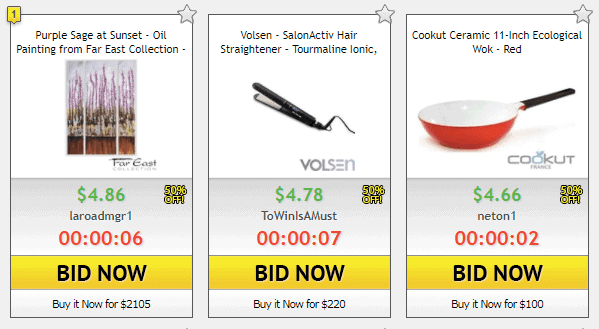
    dealdash auctions

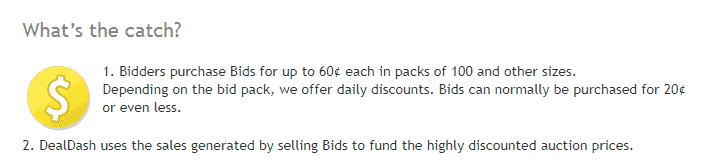
    A bid is offered at a cost ranging from 14¢ to 60¢ depending upon the offers and discounts. These bids make you eligible to take part in an auction. However, these bids are non-refundable and if you’ve used a bid once for a product, you’ll have to use another to bid to participate again in the auction. This explains the revenue model of DealDash.

    How DealDash Works & Makes Money?

    DealDash, just like any other penny auction website, makes most of its money by selling bids. The bids are sold in packs of 100s and other sizes and the more you bid, the more money the company makes. In addition to the value of the bids, the company also receives the final price at which the product is sold.

    dealdash scam business model

    Suppose there’s an auction for a t-shirt (actual cost – $10) at DealDash. Just like any other auction, this too will start at $0 and will go on to as high as bids take it to. Let’s assume that you won the T-shirt with your bid of $5. Dealdash will get $5 from you along with the total value of the bids (from all the bidders) for this T-shirt. If the cost of one bid was 20¢ and every bid increased the price of the t-shirt by 1¢, the total amount of bids on that t-shirt comes out to be 500 and the total revenue generated by the company from that t-shirt amounts to $5 + $100(500*20¢) which is way more than the original cost of the T-shirt. This also explains why the company offers free shipping.

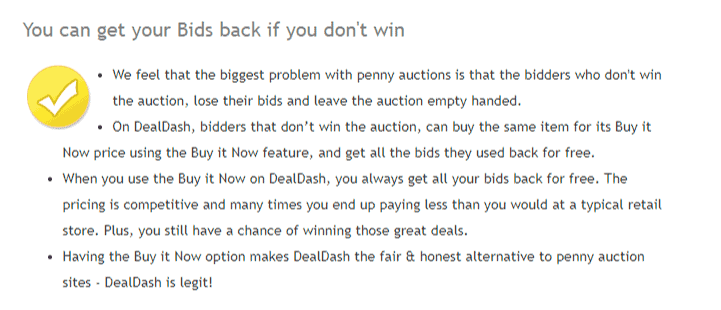
    However, unlike other penny auction websites, DealDash also offers you an option of getting your used bids back if you choose to buy the product at the original price. This is what separates

    Is DealDash A Scam?

    DealDash has received a lot of criticism and has been often compared to gambling as people lose money on bidding. Nonetheless, all of these terms and conditions are specified on the website and the people are well aware of the risk of losing money.

    To get away with this criticism, the website also has an option of ‘buy it now’ where they give an option to the not so fortunate bidder to make use of his lost money and buy the auctioned product at the original market price and get back his lost bids.

    Is DealDash A Scam? No. There are no proven reports of bidding computers or other shill bidding practices being used by the website.

    The website is often given a tag of being a scam after a not so fortunate bidder loses a lot of money in bidding. One should limit himself while bidding on these websites and the results will be a healthy and not so scammy looking auction.

    Go On, Tell Us What You Think!

    Did we miss something?  Come on! Tell us what you think about our article on DealDash business model | DealDash scam in the comments section.

  • Who Is An Infopreneur? [Ultimate Guide]

    Who Is An Infopreneur? [Ultimate Guide]

    We are surrounded by entrepreneurs. Some sell great products, some provide unique services, some come up with an incredible idea, and some build upon an existing idea. Every kind of entrepreneurship has its own risks and conditions.

    But there is a new type of entrepreneurship finding its way in the startup world. Unlike other entrepreneurship styles, this entrepreneurship requires less monetary investment and risks and more time, perseverance, and energy. These entrepreneurs are commonly known as infopreneurs who capitalize on the data consumption needs, wants and desires of the target market.

    Who Is An Infopreneur?

    An infopreneur is an entrepreneur who makes money by collecting, organizing and selling information mainly in a niche market (online and offline). The term infopreneur is a portmanteau of the words information and entrepreneur.

    In simple terms – an infopreneur is an entrepreneur who makes money through information by recognizing knowledge inadequacy state.

    By investigating the history of infopreneurship, it was found that the term infopreneur was registered as a trademark by Harold F. Weitzen on February 1, 1984, who published a book, “Infopreneurs: Turning Data Into Dollars” on 1988 which became the first book on infopreneurship. Videos, audiotapes, CDs, talk shows etc. were the offline approaches used by infopreneurs in the ’80s and ’90s. However, Infopreneurship became a rising trend with the advent of the internet as anyone with a computer and an internet connection could start a business by issuing valid knowledge and information regarding a particular niche.

    Infopreneurs changed the face of entrepreneurship as they proved that it is possible to set up a business without having to hire staffs or equipment or invest tremendous amounts of capital and even have involvement of very low financial risks.

    Types Of Infopreneurs

    In general, there are 7 types of infopreneurs. These are –

    • Course Creators: These infopreneurs create full-fledged courses and sell it either on their own websites or through online marketplaces like Udemy.
    • Authors: These types of infopreneurs put down their expertise, experience, and insight in a book or an e-book and make money by selling those.
    • Niche Bloggers: Usually, bloggers don’t sell anything. They share their thoughts, expertise, experience, and insight on a publically available platform and make money either through advertisements or by partnering with brands they advocate.
    • Niche Podcasters: Niche podcasters are similar to bloggers, the only difference being the platform. Podcasters share their information in the form of audio.
    • Niche Vloggers: Vloggers are bloggers who share their information in the form of videos.
    • Speakers: A speaker is an expert in his own field who influences others through his speech. His business model includes charging money to speak in an event.
    • Coaches: Coaches are people who help others to unlock their personal potentials. They provide their services both online and offline.
    • Consultants: A consultant is an expert who gives sells his professional advice to businesses and individuals.
    • Thought Leaders: A thought leader is a niche expert who people look up to when it comes to making decisions related to that niche. They operate through many channels which even include social media.

    How To Become An Infopreneur?

    Becoming an infopreneur is one way of turning passion into profit. One of the best advantages of being an infopreneur is that there is no need to be at a specific place to work. It, however, requires the entrepreneur to have more than average knowledge on the niche he wishes to start a business in.

    Here are the steps involved in becoming an entrepreneur –

    ChooseThe Niche

    It is best to first decide what you’re good at and will the target market benefit with your knowledge about it. Choosing a niche is probably the most important aspect of being an infopreneur.

    If you want to start something in the online world, it becomes easier to research and validate your idea hypothesis as you can make use of tools like Google Trends, Google Adwords, Market Samurai, Buzz Sumo, etc.

    In the offline world, however, there can be difficulties to determine if there’s a need for what you have to offer. But you can always provide your services for free initially to validate your need hypothesis and build your audience.

    Choose The Channel

    Once this hypothesis is validated, decide on what format the product has to be released. Books, e-books, videos, podcasts, tutorials, webinars etc are some ways that infopreneurs can use to sell their products and ideas online.

    Build A Personal Brand

    While the offering occupies the first position in the priority list, building a personal brand doesn’t fall much behind. It is absolutely necessary to let the customers know about the infopreneur.

    Build associations, create more than communication channels, and develop an identity by assigning brand colours, creating channel logos, etc.

    A website, being the cornerstone of the business, will cement the infopreneurship firmly on the market by making the product go live and giving the product a brand name and value. Having a textual, audio, or video blog along with the website will help to reach more customers as a blog gives more specific and personalized information about the business and is indeed an integral part to decide whether the business will succeed or fail.

    Develop A Revenue Model

    Until this step, there is no possible way of making a profit from the website and thus it is important to monetize the website so that revenue can be generated from it. The most popular revenue models are consultation charges, affiliate marketing, Google Adsense, and referral fees.

    Many infopreneurs eventually become influencers in their own niche and often charge for providing consultation services.

    Affiliate marketing is promoting a third-party product on the website which will earn a commission for every sale made through the link on the website.

    Google Adsense uses its advanced technology to decide the content of the webpage and then delivers ads that are contextually relevant to the audience. The infopreneur will be paid for every single click on the ads. Getting income from referring people from the website is another way to earn money from the website.

    Infopreneurs’ Success Stories

    There are a lot of entrepreneurs who have been successful and their success stories have been an inspiration to thousands. Among them are a handful of infopreneurs who managed to stand out from the crowd with their unique and innovative ideas.

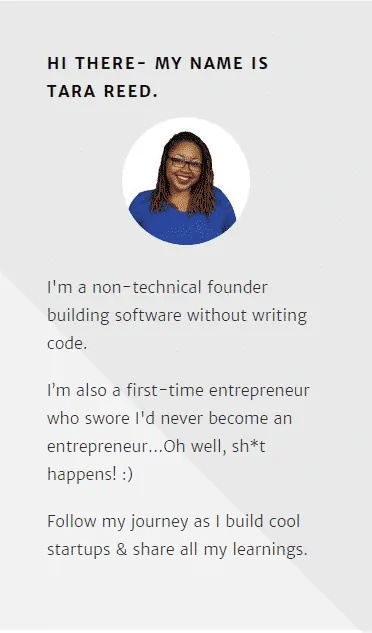
    Tara Reed, Founder and CEO of Apps Without Code

    tara reed infopreneur

    “When people ask me for advice, I tell them: Get going. Chances are, you’ll have something wrong, but you won’t know until you test those assumptions with actions”

    Tara Reed is one of the most successful infopreneurs. She is the founder and CEO of Apps Without Code, a startup school that tutors non-technical founders how to launch their apps without coding. Her story is not a rag to riches story but it is worth mentioning as she is one of the most successful infopreneurs ever.

    She found that while people browse Amazon for E-books or Netflix for movies, there is no place where art lovers can get recommendations. This led to her launching Kollecto, a personalized art recommendation app, which she created without using code. When the Youtube videos about her experiences gained over a hundred thousand views, she became the founder and CEO of Apps Without Code. Apps Without Code is a startup school that provides coaching, webinars and is, in fact, a rigorous boot camp. It helps entrepreneurs, as well as future infopreneurs, turn their ideas into feasible businesses.

    Stephanie Chandler, Author and Founder-CEO of Stephanie Chandler Enterprises, LLC

    Stephanie Chandler infopreneur

    Stephanie Chandler is known as the woman who used her knowledge of creating small businesses into a large content empire. After opening a bookstore in 2003, she discovered her passion for teaching other entrepreneurs on how to run successful businesses. This prompted her to launch BusinessInfoGuide.com, an educational blog and directory of resources for entrepreneurs. She then began to create and sell books like ‘Own Your Niche’ and ‘The Nonfiction Book Marketing Plan’. It was through the profits she generated by selling the books, that she founded Stephanie Chandler Enterprises, LLC which was the parent company to her business ventures including the publishing house, Authority Publishing as well as various other ventures like the ‘Nonfiction Writers Conference, an annual online event, the ‘NonfictionAuthors Association’, a marketing community for authors and BusinessInfoGuide.com.

    Her book ‘Own Your Niche’ was recognized with the ‘Best Business Book Award’ at the Global Ebook Awards in 2012. She was named in the Top 100 Small Business Influencers by Small Business Trends in 2012.

    Go On, Tell Us What You Think!

    Did we miss something?  Come on! Tell us what you think of this article on infopreneurs in the comments section.

  • What Is Revenue? Revenue vs Income vs Profit vs Sales

    What Is Revenue? Revenue vs Income vs Profit vs Sales

    The ultimate motive of every business is to reap benefits in monetary form by performing certain primary business operations like selling the offering, investments, etc. This monetary benefit is referred to as revenue and is essential for the business to keep it going in the long run.

    But what is revenue and what are its components? Let’s find out.

    What is Revenue?

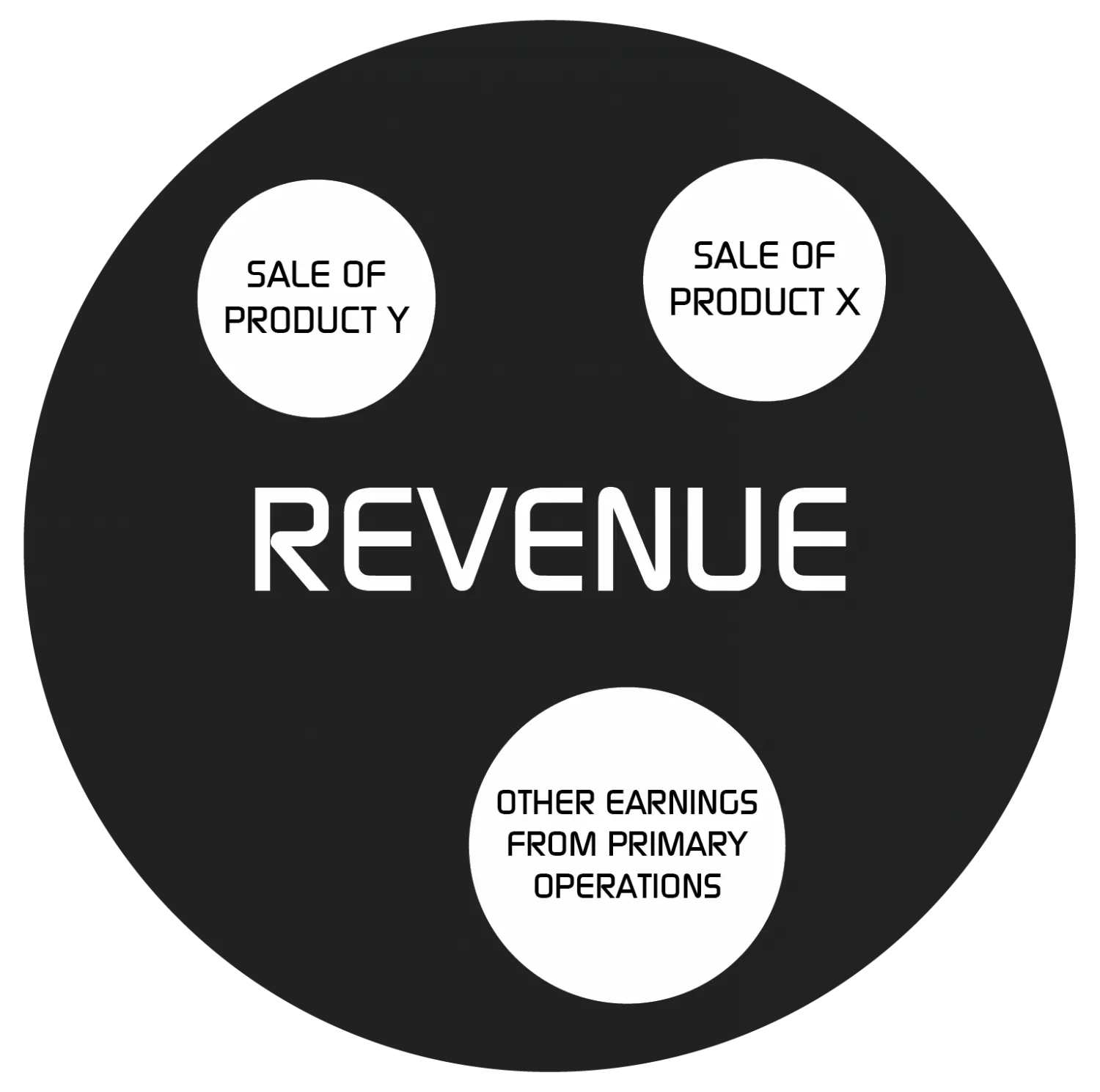
    Revenue is the total earnings generated by a business through its primary operations like the sale of offerings, interests, rents, etc., less any returns or discounts.

    For example, a chocolate seller will generate revenue through the sale of chocolates, a hairdresser will earn revenue by selling their services, and a bank will generate its revenue in the form of interest on the loans to borrowers.

    Revenue does not include income in the form of interests on investments, capital gains, sale of assets or other miscellaneous earnings which are not from the primary operations of the business.

    It can be classified into gross revenue and net revenue.

    What is Gross Revenue?

    The term revenue without any prefix refers to the gross revenue of the business. Gross revenue is the revenue earned before subtracting the costs and expenses incurred to earn it (directly related selling expense). These costs and expenses include overhead, commissions, cost of production, taxes, wages, freight, etc.

    What is Net Revenue?

    Net revenue is the revenue earned after subtracting the costs and expenses incurred to earn it (directly related selling expense). These costs and expenses include overhead, commissions, cost of production, taxes, wages, freight, etc.

    Net revenue = gross revenue – directly related selling expenses.

    What is a Revenue Model?

    A revenue model is a conceptual structure that states and explains the revenue earning strategy of the business.

    Revenue vs Income

    REVENUE vs INCOME

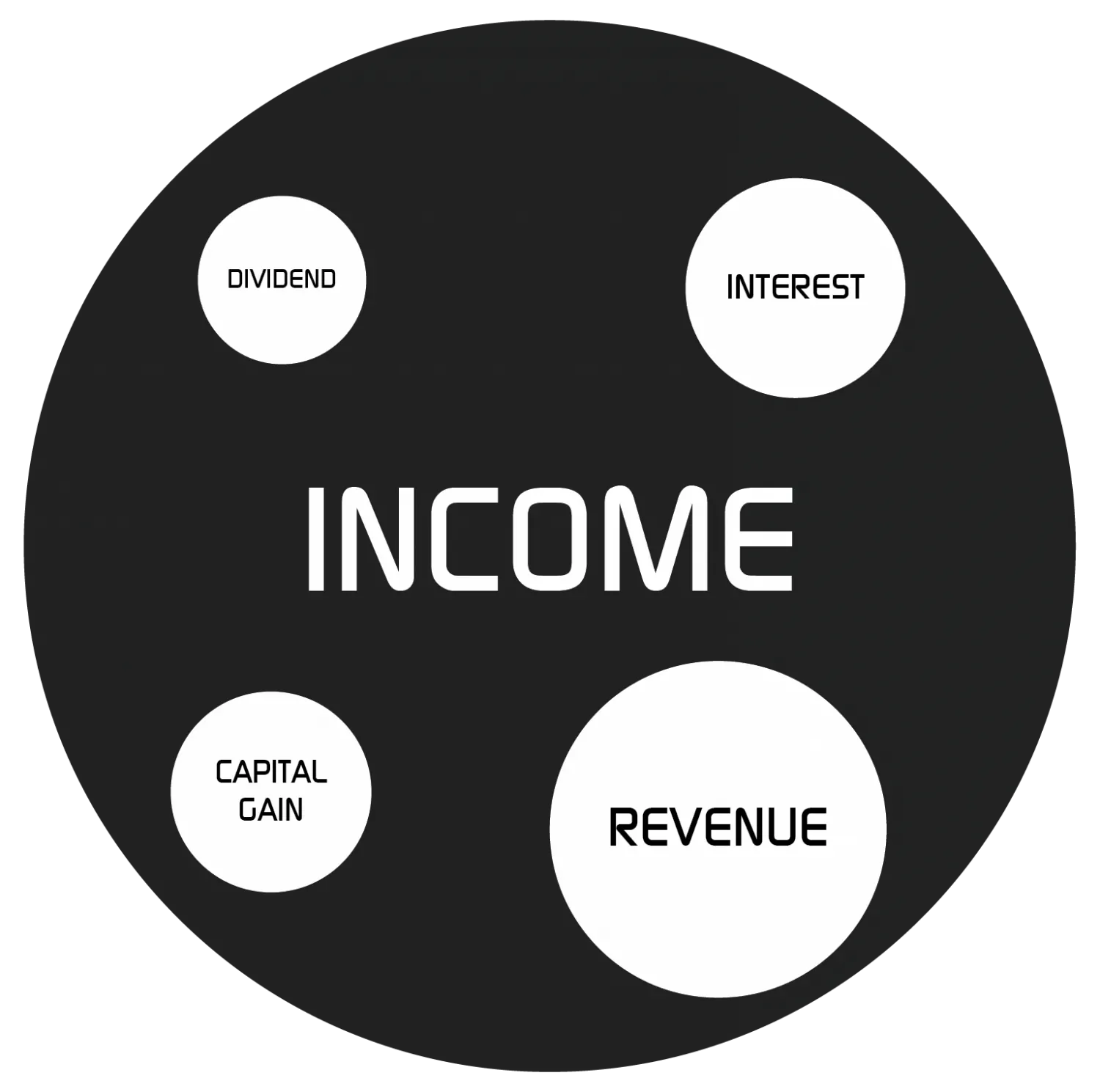
    Even though many use revenue and income interchangeably in the business world, there is a big difference between the two. Income refers to earnings from all the sources combined. Revenue is a subset of income which includes earnings only from the primary operations of the business.

    While revenue includes earning generated only through the sale of goods and/or services associated with the company’s primary operations, income also includes earning from other operations like

    • Interest on investments,
    • Dividends,
    • Sale of assets, etc.

    Revenue vs Sales

    REVENUE VS SALES

    Sales are a subset of revenue and can be defined as the economic price paid by the customers for a product or service offered by the business. While sales are a source of revenue, a company may include other revenue sources like interest on loans, rent on the property, etc. as well.

    Revenue is the money generated by the business through its primary operations which usually include sales but isn’t limited just to sales. Sales usually are less than or equal to the revenue but in cases where there are returns and discounts involved, the sales can be more than the actual revenue earned.

    Revenue vs Profit

    Revenue is the top line of the income statement whereas the profit is the bottom line. While revenue includes the gross earning from primary operations (without any deductions), profit is the resultant income after accounting for expenses, expenditures, taxes and additional income and costs in the revenue.

    Profit = Revenue + Other income – Total expenses

    Go On, Tell Us What You Think!

    Did we miss something?  Come on! Tell us what you think about our article on what is revenue in the comments section.

  • What Is A Revenue Model? – Components & Types

    What Is A Revenue Model? – Components & Types

    Entrepreneurs spend months designing and planning how their business model will work and create value in the market.

    This business model is made up of components – the value created; the operating model, which specifies how the business works and operates; and the revenue model, which specifies how the business makes money and how much does it spends in doing so.

    While the operational blueprint is important for the business, a blueprint of the revenue model is equally important as it decides the feasibility and long-term projections of the business by stating its money-making process.

    But what is revenue model and why is it important?

    Let’s find out.

    What is a Revenue Model?

    A revenue model is a conceptual structure that states and explains the revenue earning strategy of the business. It includes the offerings of value, the revenue generation techniques, the revenue sources, and the target consumer of the product offered.

    Revenue can be generated from a myriad of sources, can be in the form of commission, markup, arbitrage, rent, bids, etc. and can include recurring payments or just a one-time payment. A revenue model is that part of the business model that includes every aspect of the revenue generation strategy of the business.

    A revenue model is how a business makes money.

    A revenue model is important for the company’s long-term business projections as it gives an overview of the company’s current and future potential to earn profits.

    Importance Of A Defined Revenue Model

    The revenue model is just like a fuel system to a car. While the engine or the operating model is a necessity, a car cannot move for long if its fuel system is damaged.

    Hence, a well-defined revenue model is important for any business to –

    • Operate and expand
    • Remain in the market for long
    • Make profits

    Components of a revenue model

    Revenue model forms an integral part of the business model covering the financial aspect of the business. It has two major components –

    • Revenue streams: This includes all the direct and indirect streams that brings in revenue to the business.
    • Cost structure: It includes all the fixed and variable expenses that the business incurs to do its operations and generate revenue.

    In simple terms, a revenue model elaborates on how the business makes money and how much does it spends to make so, indicating the profits it makes or intends to make.

    Types of Revenue Models

    With the advent of the internet, the revenue models of many companies now include countless income sources from the digital world. Nevertheless, all of the income sources, whether online or offline, can be confined to 10 types of revenue models on the basis of revenue source

    Markup

    Markup is the most common and oldest revenue model seen among the businesses. It involves setting up the selling price of the good by adding profits and overhead charges to its cost price. This revenue model is common among retailers, wholesalers, etc. who act as middlemen and buy the products from manufacturers/other parties before selling it to others.

    However, manufacturers also use markup model to earn money by selling the good at a price which includes profits over and above the cost involved in manufacturing it.

    Arbitrage

    Arbitrage revenue model makes use of the price difference in two different markets of the same good. It involves buying security, currency, and/or commodity in one market and simultaneously selling the same in another market at a higher price and making profits from the temporary price difference.

    Licensing

    Licencing revenue model is common among inventors, creators, and intellectual property owners which grant a license to use their name, products or services at a predetermined or recurring cost. The revenue model is common among many software companies and legally protected intellectual property (patents, trademarks, copyrights) owners which grant a license limited by time, territory, distribution, volume, etc. to anyone who fulfils their requirements and pays for it.

    Commission

    A commission revenue earning model is a type of transactional revenue model where a party charges commission for every transaction/action it mediates between two parties or any lead it provides to the other party. It is one of the most common revenue earning strategy among the online marketplaces and aggregators where they provide a platform for selling items digitally and charge a commission as a percentage or fixed price on every item sold.

    Affiliates, brokers, and auctioneers are also seen working on a commission-based revenue model.

    Rent/Lease

    Rent/Lease revenue model is common where a physical asset is involved. This revenue earning strategy involves recurring (rent) or one time (lease) payment for temporary use of the asset.

    Subscription

    A subscription model is a great example of recurring revenue strategy. This is a common strategy among SAAS, entertainment services, and online hosting companies like NetflixYoutube etc. where they provide the specified service for a pre-determined periodic cost.

    Advertising

    An advertising revenue model is usually adopted by media houses and information providers which usually earn money by including advertisements in the content provided. This revenue model is widespread in both offline and online businesses and the company makes money by charging the advertiser: per size of the space offered, thousand impressions or per click on the advertisement.

    Fee-for-service

    Unlike other service-based models, a fee-for-service model charges the customers for the type of and times the service is provided. This is pay-as-you-go or pay-per-usage revenue model where the customer pays only for the services he actually used. This revenue model is common in telecom and cloud-based services industries.

    Interest

    An interest-based revenue strategy or an investment based revenue strategy is common among banks. Banks usually generate revenue in the form of interest on their offerings (loans).

    Donation

    Many companies provide their products and services free of cost and rely totally on donations paid to them by their customers. These companies hardly make any profits as donations usually cover only their operating costs. Wikipedia is one such company which relies on donations.

    Symmetric Vs Asymmetric Revenue Models

    Symmetric Revenue Model

    symmetric revenue model

    In symmetric revenue models, the user of the business’s offering is also the customer who pays for it. Generally, this model involves a single sided flow of offering and money – offering from the business to the customer and money from the customer to the business.

    For example, a retailer charges a markup on every good sold to the customer, or an agent charges brokerage for every deal made on behalf of the client. The flow of this revenue model is simple and direct where only two parties are involved – business and the customer.

    Asymmetric Revenue Model

    asymmetric revenue model

    In asymmetric revenue models, the user of the business’s offering is not the customer who pays for it. This company uses a two-fold revenue model where it monetises the data provided by its offering’s users and sells the same to another customer segment.

    For example, Facebook users don’t pay for the service they use. But the company earns its revenue from advertisements where the data of the users is provided to the advertisers to target ad in a better way.

    Go On, Tell Us What You Think!

    Did we miss something?  Come on! Tell us what you think about our article on revenue model in the comments section.

  • Marketing Environment: Explanation, Components, & Importance

    Marketing Environment: Explanation, Components, & Importance

    Several internal and external factors affect a business’s marketing activities. While some of the factors are in the control of the business, most of these are not, and the business has to adapt itself to avoid being affected by changes in these factors. These external and internal factors group together to form a marketing environment in which the business operates.

    What Is Marketing Environment?

    The marketing environment is the combination of external and internal factors and forces that affect the company’s ability to establish a relationship and serve its customers.

    The marketing environment of a business consists of an internal and an external environment.

    • The internal environment is company-specific and includes owners, workers, machines, materials etc.
    • The external environment is further divided into two components: micro & macro.
      • The micro or task environment is also specific to the business but is external. It consists of factors engaged in producing, distributing, and promoting the offering.
      • The macro or the broad environment includes larger societal forces which affect society as a whole. It is made up of six components: demographic, economic, physical, technological, political-legal, and social-cultural environment.

    “A company’s marketing environment consists of the actors and forces outside of marketing that affect marketing management ability to build and maintain successful relationships with target customers”. – Philip Kotler

    What Are The Components Of Marketing Environment?

    The marketing environment is made up of the internal and external environment of the business. While the internal environment can be controlled, the business has less or no control over the external environment.

    Internal Environment

    The internal environment of the business includes all the forces and factors inside the organisation which affect its marketing operations. These components can be grouped under the Five Ms of the business, which are:

    • Men: The people of the organisation, including both skilled and unskilled workers.
    • Minutes: Time taken for the processes of the business to complete.
    • Machinery: Equipment required by the business to facilitate or complete the processes.
    • Materials: The factors of production or supplies required by the business to complete the processes or production.
    • Money: Money is the financial resource used to purchase machinery, materials, and pay the employees.

    The internal environment is under the control of the marketer and can be changed with the changing external environment. Nevertheless, the internal marketing environment is as important for the business as the external marketing environment. This environment includes the sales department, the marketing department, the manufacturing unit, the human resource department, etc.

    External Environment

    The external environment constitutes factors and forces which are external to the business and over which the marketer has little or no control. The external environment is of two types:

    • Micro marketing environment
    • Macro marketing environment

    Micro Environment

    The micro-component of the external environment is also known as the task environment. It comprises external forces and factors that are directly related to the business. These include suppliers, market intermediaries, customers, partners, competitors and the public.

    • Suppliers include all the parties which provide resources needed by the organisation.
    • Market intermediaries include parties involved in distributing the product or service of the organisation.
    • Partners are all the separate entities like advertising agencies, market research organisations, banking and insurance companies, transportation companies, brokers, etc., which conduct business with the organisation.
    • Customers comprise the target group of the organisation.
    • Competitors are the players in the same market who targets similar customers as the organisation.
    • The public comprises any other group with an actual or potential interest or affects the company’s ability to serve its customers.

    Macro Environment

    The macro component of the marketing environment is also known as the broad environment. It constitutes the external factors and forces which affect the industry as a whole but don’t have a direct effect on the business. The macro-environment can be divided into six parts.

    Demographic Environment

    The demographic environment is made up of the people who constitute the market. It is characterised as the factual investigation and segregation of the population according to their size, density, location, age, gender, race, and occupation.

    Economic Environment

    The economic environment constitutes factors that influence customers’ purchasing power and spending patterns. These factors include the GDP, GNP, interest rates, inflation, income distribution, government funding and subsidies, and other major economic variables.

    Physical Environment

    The physical environment includes the natural environment in which the business operates. This includes climatic conditions, environmental change, accessibility to water and raw materials, natural disasters, pollution etc.

    Technological Environment

    The technological environment constitutes innovation, research and development in technology, technological alternatives, innovation inducements, also technological barriers to smooth operation. Technology is one of the biggest sources of threats and opportunities for the organisation, and it is very dynamic.

    The political & Legal environment includes laws and government policies prevailing in the country. It also includes other pressure groups and agencies which influence or limit the working of the industry and/or the business in society.

    Social-Cultural Environment

    The social-cultural aspect of the macro-environment is made up of the lifestyle, values, culture, prejudice and beliefs of the people. This differs in different regions.

    Importance of Marketing Environment

    Every business, no matter how big or small, operates within the marketing environment. Its present and future existence, profits, image, and positioning depend on its internal and external environment. The business environment is one of the most dynamic aspects of the business. In order to operate and stay in the market for a long, one has to understand and analyse the marketing environment and its components properly.

    Essential for planning

    An understanding of the external and internal environment is essential for planning for the future. A marketer needs to be fully aware of the current scenario, dynamism, and future predictions of the marketing environment if he wants his plans to succeed.

    Understanding Customers

    Thorough knowledge of the marketing environment helps marketers acknowledge and predict what the customer actually wants. An in-depth analysis of the marketing environment reduces (and even removes) the noise between the marketer and customers and helps the marketer to understand consumer behaviour better.

    Breaking into new markets and capitalising on new trends requires a lot of insight into the marketing environment. The marketer needs to research every aspect of the environment to create a foolproof plan.

    Threats and Opportunities

    Sound knowledge of the market environment often gives a first-mover advantage to the marketer as he makes sure that his business is safe from future threats and taps future opportunities.

    Understanding the Competitors

    Every niche has different players fighting for the same spot. A better understanding of the marketing environment allows the marketer to understand more about the competition and about what advantages the competitors have over his business and vice versa.

    Features Of Marketing Environment

    The marketing environment surrounding a business possesses the following five features:

    • Specific and general forces: The marketing environment is made up of both specific and general forces. Specific forces such as customers and investors directly affect the business’s working, while general forces like social, legal, technological, or political factors indirectly affect the business’s working.
    • Complex: The marketing environment is a complex interaction of several elements, factors, conditions, and forces that affect the business’s ability to establish a relationship and serve its customers.
    • Dynamic: The environment surrounding a business is very dynamic as its constituents do not remain stable and change over time. Moreover, while marketers can control some of the marketing environment elements, several elements are out of the marketer’s control.
    • Uncertain: Forces that rule the marketing environment are highly uncertain, and it becomes tough for a marketer to predict market forces to develop marketing strategies and plans.
    • Relative: Marketing environments are also relative in nature. A specific product might have a good demand in the USA but not in India because of the different marketing environments in the two countries.
  • Exit Strategy: Everything You Need To Know

    Exit Strategy: Everything You Need To Know

    Just like you, every stakeholder in your business expects a greater return from their investment. Everyone is looking to reap certain benefits when they plan to move out of the business or after a certain time period. An exit strategy is how you see your business after you are no more a part of it. It makes clear the future benefits one will reap when he exits the business.

    What Is An Exit Strategy?

    An exit strategy is a contingency plan where the business owner, the investors and the other stakeholders decide how and when they will liquidate their position in the financial asset (the business).

    Every investment is done to reap greater benefits. The exit strategy is a plan to reap those benefits when you retire from the business and decide what will happen to your hard work when you move out; Who will run the business? Who will own the shares?

    Is Exit Strategy Important?

    Most of the entrepreneurs we’ve met till now are so busy planning and growing their business that they never even imagine themselves exiting their business, and then there are those who build their business only to offer them for acquisition to a bigger company. This has led to one of the biggest questions of the startup process – Is an exit strategy important for your startup?

    You should realise that there are many parties involved in a business which includes you, the investors, the employees, and the partners. While an exit strategy may not be a priority for you, the investors who block their money by investing in your business always look for the most benefitting strategy to exit. Hence, if you’re planning to raise money to expand your business you should always include an exit strategy in your pitch deck that’ll appeal the investors but at the same time be beneficial for you and your business.

    Is exit strategy important? Yes. But a well-crafted, long-term strategy which benefits every stakeholder of the business.

    How To Plan An Exit Strategy?

    Planning an exit strategy requires a lot of time, effort and clear objectives on your side. In order to draft a perfect strategy, you need to ask yourself these 2 questions-

    When Do You Want To Exit?

    Even though most of the entrepreneurs aspire for early and a big exit, it is not often viable unless your business model and product have a huge potential and a great market share. It is often presumed that entrepreneurs who plan for early exits undertake risky and short-term decisions which not only backfire on the business but also is a huge turn-off for the investors. Hence, it is advised to look for a long-term (>5 years) exit plan with the right research and better decisions and wise investments which will benefit the business, you, and the investors.

    How Do You Want To Exit?

    This differs for different businesses. Your exit strategy hugely depends on your business type, size, and people involved. While the easiest way to exit a business is by selling the business to a bigger company, exiting by offering an IPO is the most profitable (but difficult) strategy. Many businesses which run on patented and one of a kind model or have invented or created some out of the box technique may exit by licensing the same to someone who pays them royalty over time.

    Many entrepreneurs also plan a two-tiered exit plan where they offer to buy back the investors shares at a premium after a certain period of time and then exit themselves in a different way.

    Types of Exit Strategies

    There is the perception that if it’s always available, it’s less attractive.

    An exit strategy should be planned in such a way that everyone exits at the right time and with most profit. It should be planned after conducting thorough research on exit strategies of similar companies and should be supported by the current and projected stats of your business. Exit strategies can be categorized into 5 types.

    Asset-Based (Merger & Acquisition)

    Your company is your biggest asset. This exit strategy focus on growing this asset to a level where it is most favourable to be acquired by a bigger company. The strategy is also called merger and acquisition as the bigger companies often acquire your company to merge your offerings with their own offerings and expand by offering a better product, breaking into a new market, or getting a competitive edge over others. Most of the times, it’s the competitor which acquire the company to get a better hold of the market.

    The asset-based exit strategy is the most common exit strategies among startups. The strategy is preferred if there are many prospective buyers of the business as it creates an atmosphere of a bidding war and the company could be sold for a lot more than its worth.

    Dividend-Based

    This strategy is preferred when there is less competition and the company is expected to earn enough profit which can be distributed as dividend among the shareholders. Dividend based exit strategy requires an in-depth analysis of current and future expenses and revenues of the business and also requires the investors and entrepreneurs to be on the same page to avoid conflict in the future.

    Royalty-based

    This is the best exit strategy for the inventors and the creators. This strategy involves licensing your patented or unique technique or technology to other businesses who pay you the royalty for using it over time.

    Stock Buyback

    This strategy involves buying back investors shares at a premium after a certain period of time. This exit strategy is directed towards getting more investors on board. However, you have to be certain about your startup’s success and future profits before pitching this idea to the investors. One of the major reasons investors say no to a startup is because entrepreneurs offer them an unresearched and unviable exit strategy such as stock buyback.

    IPO

    An IPO is the most complex exit strategy and is not advisable for small businesses as it involves convincing both the investor and the investment bank about the potential of the company. Another reason why an IPO is considered the hardest aspect of startup funding process is that it involves a lot of rules and regulations to be followed by the stakeholders.

    Even though this is the most profitable plan, most of the investors are not convinced by IPO as an exit strategy unless you present to them a proven and experienced team and a detailed plan on how you’re planning to offer an IPO.

    Go On, Tell Us What You Think!

    Did we miss something?  Come on! Tell us what you think about our article on Exit strategies in the comments section.

  • The Importance Of Marketing In Today’s World

    The Importance Of Marketing In Today’s World

    While the brain of a business is the finance department, body the product offered, the heart is the marketing department of the business which pumps oxygen and the necessary nutrients to every other body part. Unlike the old times, marketing no more deals only in the communication of the product to the consumers. The activity is now found in every aspect of the business. One should not turn a blind eye to the importance of marketing as marketing fuels both the external and internal activities of the business today.

    Today, large and small-scale, global and local, innovative and traditional, public and private, everyone is competing for the same market. Companies have realized the power of holistic approach to marketing to create and maintain a desirable demand, reputation, and competition. The role of marketing is too diverse to be summarised in one small article. Nevertheless, we’ve come up with few arguments to state the importance of marketing in today’s world.

    Creating A Brand

    According to Stephen King of the WPP Group:

    “A product is something that is made in a factory, a brand is something that is bought by a customer. A product can be copied by a competitor, a brand is unique. A product can be quickly outdated, a successful brand is timeless”

    The brand is the company’s most valuable asset and the sole responsibility to create a brand lies on the shoulder of the marketing department of the organization. The market is full of similar products and the only thing which makes the company stand out is its brand. Today, Brand is not just a combination of name, symbol, and design, it is the business-consumer relationship, the consumers’ perception, and the consumers’ opinion about the company and its products. Along with the symbolic value, a brand also carries an awareness value which eventually leads to brand loyalty and more sales if taken care of properly.

    Product Development

    One of the most important aspects of product development is to search for a perfect market for the product, get consumer insights, and develop a perfect proposition to make it stand out of the rest. The  4p’s of marketing play a huge role in the product development.

    Communication

    Competition is everywhere and sometimes it’s only the good communication strategy which makes the brand stands out of the rest. New communication avenues like internet, smart devices, and social media, have opened the doors to new and more targeted communication strategies which eventually lead to more conversions.

    In this competitive environment, a product without communication is a dead product. Communication infuses life in it and triggers sales.

    Building Relationships

    A relationship is built on trust, understanding, and pride. Marketing plays a very significant role in building a relationship between the customers and the organization. It works along with the product team to deliver what’s promised at the time of and after the sale has taken place. The relationship, once built, makes the customers more brand loyal and gives them the confidence to repeat sales and buy more products under the same brand. The relationship further narrows down the marketing funnel by removing the top two stages (awareness & interest) and making the business activities more fruitful.

    Maintaining The Company’s Reputation

    The success and the life-span of the company are positively correlated to the company’s reputation which usually is correlated to the brand equity of the business. A majority of the activities of the marketers are directed towards building the brand equity of the business.

    Company’s reputation is built when it successfully fulfils the expectations of its customers, when it acts like a responsible member of the society, and when the customers feel proud of using its products. Marketers by using effective communication, CSR, PR, and branding strategies, make sure that the company’s reputation is maintained.

    Tackling The Competition

    Competition has reached an all-time high to a point where the only difference in most of the cases is not a product feature but how it is communicated to the user. New communication avenues are being explored along with new markets. Marketing plays a vital role in tackling the competition by not only deciding which feature will sell but also planning strategies on how to portray it better than the other players.

    Customers are more informed as they were a few years ago. Deception and short-term sales strategies not only backfire on the product but also the brand. This has led to more burden on the shoulders of the marketers.

    Go On, Tell Us What You Think!

    Did we miss something?  Come on! Tell us what you think of this article on the importance of marketing in the comments section.

  • What Makes Something Go Viral? The Psychology Of Virality

    What Makes Something Go Viral? The Psychology Of Virality

    The internet is a tough place if you don’t know its rules.

    Is there anyone who wants to languish in utter oblivion? I guess not.

    Most content creators put in a lot of effort for everything they make but only a few are able to reach the levels of craze and virality we all crave.

    Who would not want their song to be the next Gangnam Style or Despacito? Who would not want their meme to be shared by hundreds of pages on Facebook? Who would not want to be the next Justin Bieber?

    Well…in this case, maybe not everyone.

    But we cannot ignore the fact he is a huge star and he began his career with YouTube and it skyrocketed as the numbers of views on his videos shot through the roof.

    Today everyone on the internet wants their content to become viral.

    But what does it mean? More importantly, HOW do you get things viral?

    It’s not magic.

    If virality experts are to be believed, there is a method to the madness, which we call the science of virality.

    What Virality Experts Have to Say

    The science of virality has been used by many entrepreneurs to build great viral products. Not just one or two, but many.

    So if you want to know these “secrets”, read on.

    Kevin Allocca

    Kevin Alloca virality
    Source: theconference.se

    Kevin Allocca, YouTube Head of Culture and Trends at Google, has great insights as to what makes videos viral. As per Allocca, although a very tiny percentage of videos end up becoming viral or reach more than a million views, those which do have 3 things in common:

    • Tastemakers,
    • Communities of participation, and/or
    • Unexpectedness.

    Tastemakers are influential people who introduce average people to interesting things and help bring these things to the limelight. When a tastemaker or a group of tastemakers start sharing things on the internet, the process is accelerated and communities start forming around this “phenomenon”. That is where communities of participation come into the picture. Communities are responsible for the rapid propagation of content and even addition to it. In a world that is inundated with more content than anyone can hope to ever consume, virality is possible by only those creations which are unique and unexpected. Things which stand out get the attention that is necessary for virality.

    Emerson Spartz

    Emerson Spartz virality
    Source: Youtube

    Emerson Spartz, founder of sites like MuggleNet, Dose and OMGFacts and a virality expert in his own right, says that the content has to connect with people, through emotion, nostalgia or humor, for them to share with others. Things which do not connect with people emotionally, will not go viral. Getting people worked up about something helps in getting tons of shares too.

    According to Spartz, virality depends on Virality Coefficient (number of people one is sharing content with) and Cycle Time (how long it takes one to share content with someone else). The higher the viral coefficient and shorter the cycle time, the faster virality is achieved. Cycle times are shortened when sharing something makes you look cool in front of others. Every time someone shares something on the internet, this is one factor that definitely weighs on his mind. Virality is also impacted by how relevant or popular the topic of the content is at that particular time.

    Spartz also argues that originality is not necessary for virality, instead the focus should be to figure out what works and then spread that in clusters that have not been reached yet with that content. He infers, from his research that lists, short paragraphs and sentences and pictures work the best if you intend to make the content viral.

    Jonah Berger

    Jonah Berger viralty
    Source: Fast Company

    If you scourge the internet for the science of virality, you will find the name of Wharton marketing professor and author of Contagious: Why Things Catch On, Jonah Berger all over. He is an authority on the subject of virality and he attributes 6 main reasons for the success of viral videos which he has given the acronym of STEPPS.

    1. Social Currency – People share content that makes them look good or rather cool in front of others. After all, no matter what we might say, all of us care about what others think of us.
    2. Triggers – Trigger is a stimulus that keeps people sharing your content. You might be hungry when you share a food porn video. Your hunger is the trigger here.
    3. Emotion – “When we care, we share”. People tend to share stuff that is emotionally arousing. Content with positive emotions is shared much more than that with negative emotions.
    4. Public – If something is popular already, chances are it will shared further. If the participation in that thing can be made public, even better. If you are not sure how to feel about your Mayor or his performance but there is a popular opinion doing the rounds, chances are you will end up propagating that opinion further. We all like to be part of a community and feel accepted.
    5. Practical Value – Practical, useful stuff gets instantly shared. That is why “How to” videos work so well.
    6. Stories – People love stories, especially if they are emotionally arousing. If you can tell a compelling story through your content, people will recognize and share it.

    Berger says all viral content will have five traits in common: Surprising, Interesting, Intense, Positive and Actionable. The most shareable content will evoke strong positive emotions and offer practical, actionable advice. As an emotion, awe works the best. Although anger and anxiety work well too, awe is a more shareable emotion than them.

    Matthew Inman

    matt inman virality
    Source: Outside Magazine

    Founder of the webcomic The Oatmeal, Matthew Inman, shares his experience in creating viral content. According to him, easily relatable and digestible content is what makes the base for virality. Put that in a visual form that is useful to your audience and keep it preferably short and voila, you have a winner!

    Seth Godin

    Seth Godin
    Source: CreativeLive Blog

    According to American author and entrepreneur/marketer Seth Godin, only those ideas which are “remarkable” can spread. They can be remarkable in terms of look, value proposition, marketing etc. but they need to stand out from whatever has come before. Instead of making average products for the average buyer, who according to Godin, have become experts at ignoring advertisements thrown at them, companies should target innovators and early adopters. These are the folks he calls Otaku or those who have insane passion for the products they love. Otakus can drive for miles to get the coffee they love or stand in queues for hours to get their hands on their favorite phone before anyone else. These are the people who become not just customers but rather promoters of a brand or product they truly love. They are the ones who help make things go viral.

    Elon University

    While a study by Elon University says there is no magical recipe for viral videos, the most viral ones share certain characteristics between them such as short runtime, a short length of the title, an element of surprise, irony or laughter and musical qualities.

    Upworthy

    Upworthy, as a company and website, has mastered the art of virality. It managed to get the same number of followers in a period of a few months that its competitors took years for. So it made sense to study what they think made them so successful. According to the folks at Upworthy, it is the perfect framing of content that gets it clicks from people. Truly viral content will have high shares per view and high clicks per share. The best platform for viral content is Facebook and thus the content on any site should be easily shareable on it.

    If one cannot create amazing content, one should find it and share it. What makes great content? Great content will have an emotional story arc and an inspiring meaningful message. People love good guys winning over bad guys. People love great production value but a great story even more. People love surprises. People love raw, honest moments. Speak to the audience in as human as way as possible and then frame the content with a headline that has a curiosity gap. Do you now get why you see headlines like “2 guys met at a bar. You won’t believe what happened next”? While you might think of these as click-bait, the creators end up getting thousands of views and shares and laughing all the way to the bank. But your content does not have to be deceptive. You can actually help people learn new stuff.

    Josh Elman

    Josh Elman virality
    Source: squarespace.com

    Josh Elman believes virality is of different types and there are different methods of virality for different products or ideas. Every product cannot be approached in the same way. If you want to make things viral, you must know which category it belongs to so as to engineer its features in that manner.

    1. Word-of-mouth Virality – When your product is so good that people themselves talk about it with others and make it go viral. For such products, make the product features easy to describe.
    2. Incentivized word-of-mouth Virality – It is similar to word-of-mouth but you also provide a little incentive to people for referring your product to friends and family. It helps the company and the customers equally. You get new customers and customers get discounts or incentives.
    3. Demonstration Virality – When you use it, you show it off. That is demonstration virality for you. Products like Instagram, Pinterest and even Uber have benefitted from this.
    4. Infectious Virality – This type of virality works when you get more people to use the product you already use and thus are able to build a community around it. It ends up becoming a great deal for both the parties. It is similar to word-of-mouth but here you are referring the product for your benefit too. You spread infectious virality through invitations. That is how most social networks like Facebook, Twitter and LinkedIn came to the forefront in their initial days.
    5. Outbreak Virality – Some things are so fun that they have to be shared with the next person. That is how they gain ultra-fast virality. That is why memes go viral, that is why the cute cat video got viral and that is how Pokemon Go got viral too.

    What Feedough Has to Say

    We think, as clichéd as it may sound, that content is king. When you make extraordinary content, the world takes notice of it. Great content strikes an emotional chord with the intended audience and gets them to share it with others.

    What Works

    1. Positive Emotions (humour, awe, wonder) – Negative emotions like anger work extremely well for virality but something that makes us laugh or gape in awe has even higher chances of getting shared.
    2. Uniqueness or Quirkiness – Let your content stand out. Sometimes even egregiously bad content becomes viral too, thanks to how uniquely bad it is.
    3. Element of Surprise – Shock them, surprise them, jolt them out of slumber. Be controversial. There is just too much material on the internet for you to be noticed by being normal and boring.
    4. Current Trends – Current, trending topics get shared much more than old content. People are constantly searching for latest trends on the internet. So you should aim to land on those searches.
    5. Visuals (Lots of Them) – The more visual it is, the less text it has, the better.
    6. Lists – Of course they work. We all love top 10s and top 20s. Countdowns even more. YouTube channels like Watchmojo have built their existence around such lists.
    7. Memes (We LOVE them) – Memes spread like wildfire. Yes, there are too many of them on the internet but the beauty of it is that every month, you get a new trending meme, which would be fresh, quirky and shared all over social media. With so many blogs, pages and groups sharing them, you can have multiple cycles of viral content and very effectively reach more people than ever possible earlier.

    What DOES NOT Work

    1. Loooong paragraphs – Most of us have an attention span of a 5-year old. Need we say more?
    2. No Heart – Emotions drive virality. Make people inspired, happy, amazed or even angry but do not make content no one would care about. If your audience goes “Meh!”, it sounds the death knell for your content.
    3. Sleep-inducing material – Keep people entertained. The more fun they have, the more they will share.
    4. Endless Self-Promotion – Unless you are a Kardashian, refrain from excessive self-promotion. People like it when your content addresses them and their problems, instead of you blabbering about yourself till eternity.
    5. Complexity – Keep it simple, silly! Content which gets shared the most can be consumed on the go without stressing the grey matter of the brain too much. Of course, sometimes, complex content can get you viral too if you can generate enough awe. But in such cases too, although the topic can be complex, your handling should not.

    For a product marketer, the main challenge would be to get more people to use your product. The adoption of any product is dependent on how effectively it solves a problem. In case of online content, that problem is making your consumer look good in front of others. Your aim as a marketer or content creator should be to develop content that does exactly that while standing out from the rest of the content available on the internet. Another problem that lies in front of marketers is the continuous evolution of what works and what does not. Viralogists keep pointing out what makes content tick and go viral, yet very few are able to make it so. Everyone seems to apply the best practices of virality yet end up achieving poor results. That is because when everyone is applying the same rules, the very principle that it has to be unique and surprising vanishes in thin air. As we have said before, there is no magic formula to making something viral. Human beings and their behavior and emotions are very difficult to understand even for fellow human beings. As long as your content can make you truly connect with other human beings, irrespective of how that happens, you will continue to have the opportunity to make it viral.

    Go On, Tell Us What You Think!

    Did we miss something?  Come on! Tell us what you think of this article on The Science of Why Things Go Viral in the comments section.

  • Lean Canvas: Everything You Should Know

    Lean Canvas: Everything You Should Know

    Entrepreneurs spend most of their time designing and drafting a well-researched and thorough business plan which isn’t necessary at the ideation stage or the introduction stage of their product. One of the major drawbacks of developing a business plan is that it is hardly read (twice) by anyone which leaves the scope of it being edited to zero. Steve Blank refers to a business plan as:

    “a document investors make you write, that they don’t read”

    The lean canvas is a new and efficient approach to developing a single-page business plan that helps you to deconstruct your business idea into key assumptions to analyse it better.

    What Is A Lean Canvas?

    Lean canvas, designed by Ash Maurya, is a single-page business plan template that helps you to break down your idea into its basic assumptions to make it more readable and easily editable.

    It has been adapted from Alex Osterwalder’s Business Model Canvas and replaces complex business plans with a concise and portable single-page document.

    The business model canvas applies the methods and techniques used by Skype and Apple to attain product success in the market whereas the lean canvas is more target-specific and integrates both small and large businesses effectively. The lean canvas is designed specifically for startups; it pivots on addressing wider customer problems and solutions and through a unique value proposition, it delivers them to customer segments.

    Difference Between Business Model Canvas And Lean Canvas

    lean canvas

    The business model canvas was created to solve the issue of business plans being uninterruptedly outdated as soon as they are in the initial stages of development. Hence, it can be said that it was developed for the companies which had a physical presence in the market to ease the planning and successful execution of the next phases. However, when startups which didn’t have a legit physical presence used the business model canvas, they weren’t able to fill all the boxes and the canvas remained partially complete.

    The lean canvas is acclimatised for startups at the beginning of their existence, unlike the business model canvas which is applicable to existing businesses as well. The canvas uses the same 9 blocks technique except the blocks have been renamed to suit perfectly the needs of a lean startup. It provides the founders with an opportunity to record the business model of their startup which will then be updated constantly as time goes on. The lean canvas is always entrepreneurs-focused and is equally useful for every person involved in introducing a new product or idea to the market.

    Unlike the business model canvas, the lean canvas has a problem-solution fit approach to eliminate what’s not needed in the business plan.

    This approach of lean canvas became useful for new startups. Since startups often have no products to test the demand in the market, it doesn’t pay much attention to customer segments. This is often interpreted as to its drawback.

    Ash Maurya’s Lean Canvas Template

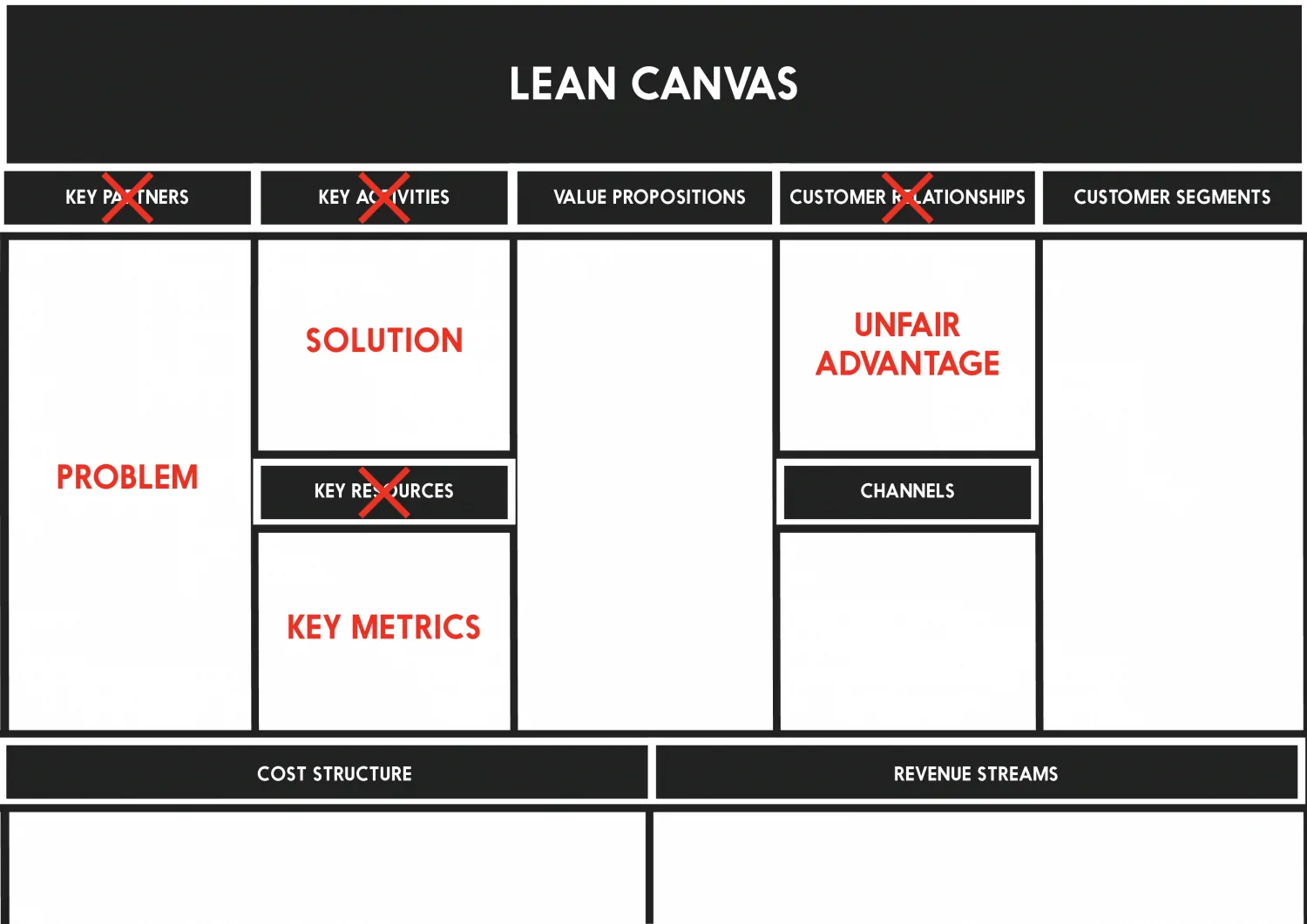
    On comparing this template with the Osterwalder’s Business Model Canvas Template, it is seen that Ash Maurya took out four boxes and replaced them with new boxes in the Lean Canvas.

    Key Activities, as well as Key Resources, have been removed because these boxes were more “outside-in” focused. They are called “outside-in” because they help outsiders to understand what the startup did.
    Ash Maurya was an advocate of starting every product with a direct customer relationship. He felt it seemed better captured by the existing Channels box and thus replaced the Customer Relationships box in Lean Canvas.

    Quite a few products were successful by having the right partners in the company. However, most products do not fall into this category. Over time, partners can become censorious in rearranging the data to increase the efficiency of the business model of the company. Then it was found that the risk here isn’t the lack of partners but can rather be traced back to inefficiencies in Cost Structure and Distribution Channels and thus Key Partners was removed from Lean Canvas.

    Structure of Lean Canvas

    lean canvas

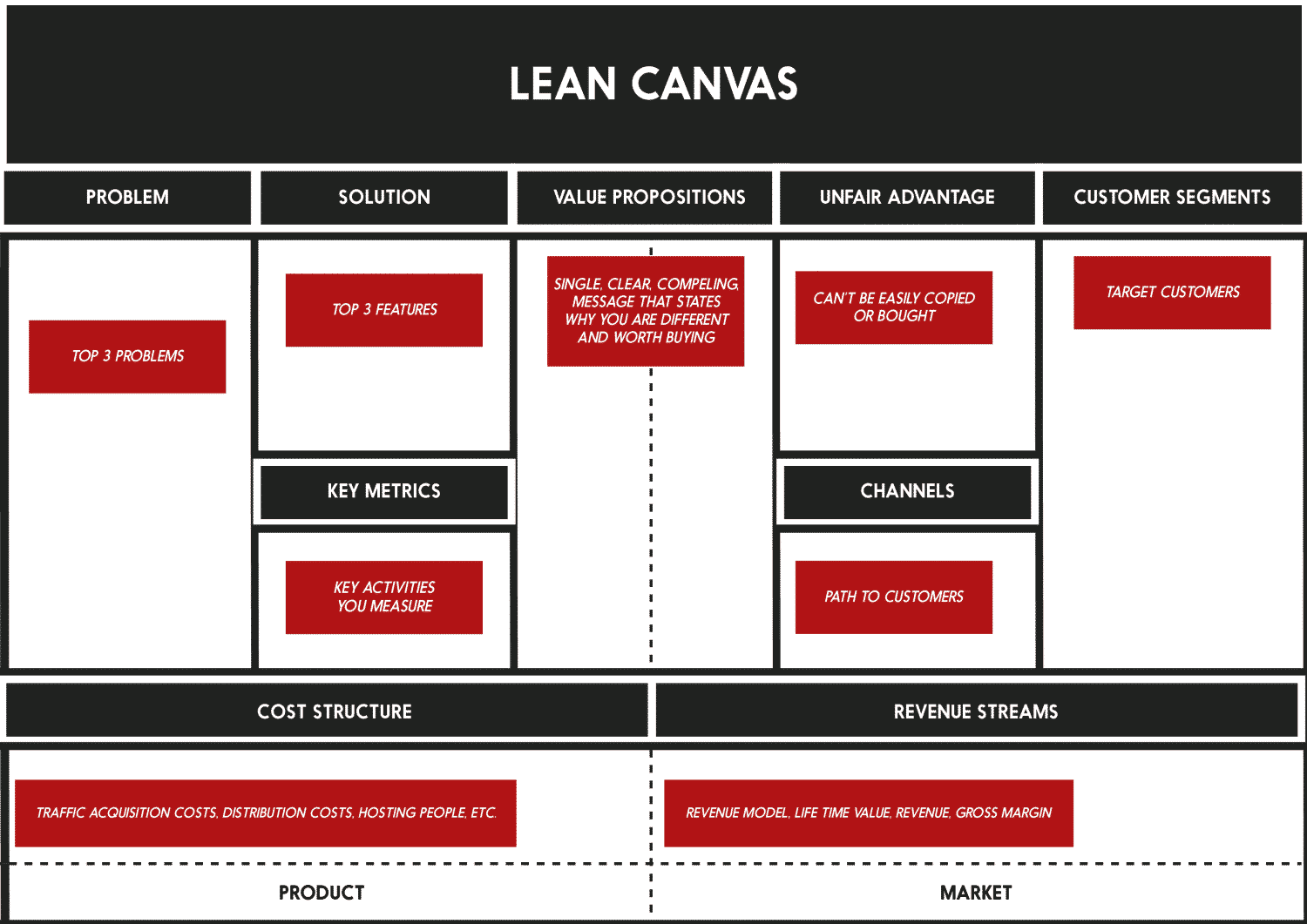
    Each component of the Lean Canvas has been briefly explained below in the order they are charted.

    Problem

    The problem box in Lean Canvas was created to list one to three high-priority problems that need solving. The wrong products are built when several businesses fail to apply good effort, time and fiscal resources. It is thus crucial in understanding the problem first.

    Customer Segments

    It has been observed that if the target is to attract more than one range of customers, for example, engineers and accountants, it is better to create a canvas for each one. The Problem box and CS can be seen as linked with each other intrinsically, i.e. You can’t think of any problems without a Customer Segment, and vice versa.

    Unique Value Proposition

    Unique Value Proposition is situated in the middle of the Lean Canvas. A promise of value to be delivered to the customers is called a value proposition. This should be the main reason a prospective buyer has to buy from you. Thinking and understanding why your product is dissimilar and why should your Customer Segments want to buy or invest in your company and your product is the best way to understand unique value proposition.

    Solution

    A cordial solution has to be found once the problem has been recognised. This is the reason why the Minimum Viable Product concept within a Solution box was introduced in the Lean Canvas. The jackpot has been finding the solution to the problem. What is needed to be done is ‘Get Out The Building’ — a phrase created by the godfather of Lean Startup, Steve Blanks. What Blanks meant is that the solution cannot be found in the office building but out there in the streets. The best way to understand the phrase is by interviewing your CS, asking them questions and taking those learning into account.

    Key Metrics

    It is better for a Startup to pivot on one metric and develop on it.  The metrics should include the range of services or products you like to provide. Since the wrong one could be disastrous to the startup, it is therefore critical that the right metric is identified. Irrespective of industry or size, every business will have some key metrics that are used to monitor performance.

    Channels

    Channels are the best way for you to reach out to your Customer Segment. It is essential to focus on learning about the channels than not to think about scale in the initial stages. Channels, which are free as well as paid, can be used to reach your customer directly. Some examples of Channels are social, trade shows, email, CPC ads, radio & TV, blogs, webinars, articles etc.

    Cost Structure

    The entire variable cost, as well as the fixed costs, is to be listed here. Questions regarding Cost Structure are to be thought out here. How much will it cost to build a page? What is the amount required to run your company in a month? What will be the cost to interview your customer segment? How much do market research papers cost? etc. A rough break-even point can then be calculated from these costs and potential revenue streams.

    Revenue Streams

    The model type decides how you rate your business. It is common for startups to lower their cost or even offer it for free in the beginning to gain attraction. The key is it actually delays or even avoids getting checked for validity. It has been seen that getting people to sign up for something for free is a lot different than asking them to pay as they are more interested in free products.

    Unfair Advantage

    Ash Maurya said, “You may initially have to leave this box blank but the reason it’s here is to have you really think about how you can both make yourself different and make your difference matter”. A startup should always have the capability to recognise whether or not it has an unfair advantage over others. Unfair advantage can come in different forms like getting expert endorsements, a dream team, insider information, existing customers etc.

    Go On, Tell Us What You Think!

    Did we miss something?  Come on! Tell us what you think of this article on lean canvas in the comments section.