Feedough Logo

Blog

  • Social Shopping: A Quick Guide To Social Commerce

    Social Shopping: A Quick Guide To Social Commerce

    Social networks influence most of your habits and you have become such dependent on the social media that you prefer anything which involves social networking over those which don’t. Social shopping is one such social network integrated shared shopping experience.

    What is Social Shopping?

    Social shopping is what we get when e-commerce meets social networking.

    Social shopping is when social networking aspects like friends, groups, comments, recommendations, discussions, votes, influencers, etc. are combined with the shopping experience. It is the use of technology to mimic the offline shopping experience like discussions with friends before buying, taking group discounts, recommending products or services to someone, etc.

    Startups and even big e-commerce players have succeeded in creating varied social shopping experiences for their customers. These include:

    Group Shopping

    Groupon developed its business model to make group shopping and group discounts a new trend in the e-commerce marketplace. This led to the origin of many other group buying websites like BuyWithMe, LivingSocial, etc. These companies used the power of crowdsourcing to create a better shopping experience for the users.

    This social shopping category was transformed into the daily deals marketplace which helps users discover and save on things to do, see, eat and buy.

    Communities

    Shopping communities bring like-minded people together. These communities are made by the people for the people. They recommend products, help others choosing the products, find deals for the members, and are a one-stop solution for every shopping fanatic. Shopping communities dominate the social shopping sphere. They include groups on social websites like Facebook, Pinterest, etc. or specifically designed websites like Polyvore, Opensky, etc.

    E-commerce Integration In Social Networks

    The focus of social media websites like Facebook, Instagram, and Snapchat, etc. have shifted from like to buy. Many new features are introduced to make it easier to shop on these platforms.

    facebook social shopping ad
    Source: advertisemint.com

    Facebook has recently launched a new feature ‘products in the video/image’ which directly links to the e-commerce store of the advertiser and makes it easy for people to buy, share, ask for a recommendation from friends, save for later, etc.

    The stories feature in Snapchat and Instagram lets user swipe up to get redirected to the e-commerce store of the buyer.

    instagram swipe up
    Source: Adweek

    Facebook has even launched a social marketplace for its users to buy and sell on its platform.

    Recommendation Engines

    Review systems on e-commerce websites, influencer blogs, comparison websites etc. connect verified buyers to the prospective customers. These influencers and reviewers post about their experiences and give a recommendation on whether to buy or not to buy the specific product. Customers often look for these recommendation engines before buying.

    Mobile Payments and Bill Splitting

    To mimic the real offline shopping experience, many e-commerce platforms have partnered with mobile payments solutions companies like Venmo to provide bill splitting and mobile payment options to the customers.

    Social Shopping = Social Networking + Shopping

    Social shopping, also known as collaborative shopping, is an experience which possesses the following features:

    Networked Shopping

    Social shopping connects you to people with similar interests. These can be your friends, family, or any stranger with similar interests.

    Participant. Not an audience.

    You actively participate in the social shopping experience and everything revolves around you.

    Personification Of Brands

    Brands have personified themselves to become a part of the social networking ecosystem. Facebook and Instagram pages, Snapchat and Youtube channels, etc. require the brands to act like actual humans, have a definite face, voice, and tonality. The brands become part of the user’s network and vice versa.

    Why Is Social Shopping On A Rise?

    Even before the inception of the internet, people used to prefer social networking while shopping. The social aspect made shopping easier and more enjoyable. This social networking aspect, however, was taken away with the launch of online shopping websites which relied on traditional ‘consumer is the audience’ approach.

    Today, with the rise of social media platforms, it’s possible to mimic the offline social-shopping experience. Brands try to make your shopping experience as user-friendly and as sociable as possible. In addition, they have become a bigger part of your life than they were before. You can talk to the brands, have experiences with them and they even recommend you things to shop.

    “Shoppers will always want a better experience that is easily accessible, and Facebook and Twitter can offer the platform to do this. The foundation for social shopping to succeed is already there – Facebook is already testing it with Facebook Marketplace – it’s up to the boldest retailer to take note, provide a strong customer service and implement a strategy that integrates social media into the overall online offering.” – Naji El-Arifi, head of innovation at global e-commerce consultancy Salmon

    Time and attention are among your most scarce assets and with the availability of such a huge amount of information and resources, you direct them to the places which you think deserve the most. Social shopping makes use of consumer psychology and attracts your attention by including the social networking features which you feel are most needed in your shopping experience.

    • Every customer wished he could talk to the verified buyers of the product before making the purchase. This led to the addition of recommendation/review engines on the website.
    • Facebook launched its marketplace just because its users desired for an online store where they can easily contact their friends while shopping.
    • Groupon developed its business model just to make use of crowdsourcing for group discounts.
    • Influencer marketing is a huge deal today. They influence the purchase decisions of millions.

    According to a research, Seventy-four percent of consumers rely on their social networks to make purchase decisions and 56% of the consumers who follow brands on social media sites visit them to view products and images to inspire their purchases. The online social network has more effect on the consumer’s purchase process than the offline network has had. Social shopping is the new revolution every consumer was waiting for.

    Social Shopping & Social Commerce. Is There A Difference?

    Social shopping and social commerce are two different names given to the same social shopping experience. Nevertheless, you use social commerce to refer to the business model of the organization and social shopping to refer to the experience of the consumer.

    Go On, Tell Us What You Think!

    Did we miss something?  Come on! Tell us what you think about this article on social shopping in the comments section.

  • Vision Statement: The Complete Guide

    Vision Statement: The Complete Guide

    The success of a business lies within its business model but the heart of that success lies in the vision statement. No business is able to achieve success without it. Having a vision statement lets the business stand out among the rest of companies in the same line of business.

    A vision statement is quite often confused with a mission statement. While some companies offer either of one, others offer a single message that joins the elements of both. While both statements communicate the company’s values and purpose, a mission statement pivots on current operations and a vision statement for the future.

    What Is A Vision Statement?

    A vision statement is what your company aspire to be. It is a description of your organisation’s vision and what it wants to achieve or accomplish in future. The vision statement serves as a guide to all the current and future course of action.

    It is the framework of a business’s objectives which basically sums up the future the founders have thought of. It is also called ‘the picture drawn about the future of the company’. A vision statement is not just limited to businesses but also to governmental or non-governmental organizations. It can be for the whole company or just a division of the company.

    Vision statement communicates the business’s overall goals in a clear manner and can discharge as a tool for strategic decision-making across the firm. Phil Shawe, CEO and co-founder of TransPerfect, a translation services company says:

    “A vision statement, no matter how big or small the company, should serve as a description of the company’s overarching aspirations, it encompasses the big picture and envisions where the company is heading long term.”

    Unlike operational goals which change or get updated year-to-year, changes are made to the vision statement very rarely as the chances of a business deviating from its initial goals are very less. Even though vision statements usually have a character limit, they can vary from short sentences to many pages. They can also be written formally and mentioned in official documents.

    All productive vision statements explain the fundamental ideas that give the business a purpose, regardless of the discrete details and differentiation. Vision statements are one of the best tools to motivate the employees of any business.

    Purpose Of A Vision Statement

    Even though the main purpose of the vision statement is to guide the future course of action and to motivate the existing employees, a vision statement has other functions within a company as well. It-

    • attracts potential employees by showcasing the goals of the company
    • serves as a base for a wider strategic plan
    • differentiates businesses having similar goals. For example, the revenue stream is a common goal for all businesses, and vision statements quintessentially describe the sources of revenue rather than list the sources of revenue under the long-term vision.

    A vision statement shows the path for business planning rather than tell how to get there. This is one reason why having a vision statement is important especially for small businesses.

    How To Write A Vision Statement

    A creative mind and a long-sighted vision are the major requirements to write a vision statement. More than being catchy and precise, a vision statement should be something each and every person in the firm could understand and should be able to follow.

     “The best way to begin is to reflect on some of the most significant events or ideas that have impacted the company.” – Linsi Brownson, founder and creative director of the business strategy group Spark Collaborative

    Whatever the vision statement is, it should be written in the present tense in the clear and concise language since it is supposed to be remembered and repeated. More than creating a vision statement, it is important to know how to communicate the vision statement with the employees.

    Vision Statement Examples

    The following are some examples of vision statements of popular companies:

    Amazon

    “Our vision is to be earth’s most customer-centric company; to build a place where people can come to find and discover anything they might want to buy online.”

    Facebook

    “People use Facebook to stay connected with friends and family, to discover what’s going on in the world, and to share and express what matters to them.”

    IKEA

    “Our vision is to create a better every-day life for many people.”

    McDonald’s

    “To be the best quick service restaurant experience. Being the best means providing outstanding quality, service, cleanliness, and value so that we make every customer in every restaurant smile.”

    Epson

    “Epson is committed to the relentlessness pursuit of innovation in compact, energy-saving, high-precision technologies, and through the formation of group-wide platforms will become a community of robust businesses, creating, producing, and providing products and services that emotionally engage customers worldwide.”

    Mazda

    “To create new value, excite and delight our customers through the best automotive products and services.”

    Some Inspiring Vision Statements

    While each and every vision statement promotes the future of the company, there are quite a few which as really inspiring.

    Wikipedia

    Imagine a world in which every single person is given free access to the sum of all human knowledge.

    Human Rights Campaign

    “Equality for everyone”

    WWF

    “We seek to save a planet, a world of life. Reconciling the needs of human beings and the needs of others that share the Earth”

    CVS

    “To improve the quality of human life.”

    Special Olympics

    “To transform communities by inspiring people throughout the world to open their minds, accept and include people with intellectual disabilities and thereby anyone who is perceived as different.”

    Writing and executing vision statements is a challenge to the businesses. There can be conflicts inside the company regarding the vision statements as they might not be justifying the future goals of the entire company and rather just a few sections only. With proper communications and initiatives, vision statement can be carried out in an effective manner.

    Go On, Tell Us What You Think!

    Did we miss something?  Come on! Tell us what you think about our article on vision statements in the comments section.

  • What Is Micromanagement? Who Is A Micromanager?

    What Is Micromanagement? Who Is A Micromanager?

    Directing the efforts of the team towards a definite purpose or a goal involves the use of many managerial styles and strategies. These styles involve setting up a vision, mentoring, directing or setting high goals by being an expert.

    One such managerial style is the micromanagement style where the manager micromanages every aspect of their subordinates’ work.

    What Is Micromanagement?

    Micromanagement is a management style characterised by excessive control and attention to detail to the works of subordinates or employees. It is a state where the manager closely observes and controls everything a subordinate or an employee does in the organisation.

    Usually, micromanagement is said to be a characteristic of a directive manager and is considered to have a negative connotation. Nevertheless, it is one of the most common management styles found in organisations all over the world.

    Who Is A Micromanager?

    A micromanager is someone who lacks trust and micromanages every activity of their subordinate or employee. They are an autocratic manager who:

    • Strongly believes in a top-down decision-making process
    • Gets too involved in the work of their subordinates
    • Is hardly satisfied with the subordinates’ outputs
    • Wants the subordinates to follow “do it as I say approach”
    • Asks for frequent updates on the task
    • Give a lot of attention to the details
    • Finds correcting others fun

    Signs Of Micromanagement

    Checking that the subordinates and employees are doing the right thing and making sure that the work is getting done is an important task of every manager. But paying attention to even irrelevant details and making sure the work is getting done every time and at every place is one of the signs of micromanagement. The other signs of micromanagement are:

    • Focusing more on details rather than the end product
    • Pushing aside the qualification and experience of others
    • Failing to delegate most of the work
    • Getting too involved in the work of the subordinates or employees
    • Demotivating the team over petty issues
    • Finding it fun to correct others

    Effects Of Micromanagement

    Applying the same level of scrutiny, intensity and forcing the subordinates to follow the do-as-I-say approach harms productivity and demotivates the employees. In fact, micromanagement is one of the key reasons why employee resigns from the organisation. There are many negative effects of micromanagement:

    • Low employee morale
    • High employee turnover
    • Employees tend to depend more on the manager
    • Less productivity
    • Less creativity in the organisation
    • Employees lose the trust in the manager
    • Job dissatisfaction among employees
    • Low scope of learning for employees

    Examples Of Micromanagement

    There are many situations in the life of a manager where they have to micromanage. However, an excess of micromanagement leads to its negative effects. Here are the following examples of micromanagement:

    Asking employees to take permission for everything

    It’s important for the manager to know what’s going on in the organisation but asking the employees to take permission before every step is a sign of micromanagement.

    Constantly asking for updates on work even when the deadline isn’t near

    Micromanagers pay too much attention to detail and give very little autonomy to their subordinates. They want the work to be done in a way they would have done it.

    Overseeing every work

    Micromanagers make themselves the beginning, centre, and end of every interaction. They want every work to be overseen by them which, most of the time, hamper the productivity of the team as they have to wait for hours to get the manager’s approval.

    How To Avoid Micromanagement?

    Even though it is hard for many but there are ways to avoid micromanaging. These include:

    • Proper delegation of tasks
    • Focusing on the end result rather than the minute details
    • Believing in the qualification and experience of the team
    • Develop a solid line of communication with the team
    • Ignore some minor employee errors
    • Develop a work policy or work procedure manual

    Industries Where Micromanagement Is Suited

    Micromanagement is advantageous in some short-term situations like crises and emergencies, and also in many industries like mining, manufacturing plants, military, etc. where close supervision is important for the well-being of the organisation and the employees.

    Go On, Tell Us What You Think!

    Did we miss something?  Come on! Tell us what you think about our article in the comments section.

  • How Does Groupon Make Money? Groupon Business Model

    How Does Groupon Make Money? Groupon Business Model

    Groupon, the fastest company to reach $1 billion valuation milestone, is the pioneer of online deals revolution. The company has well positioned itself as a hyperlocal online platform where users discover and save on things to do, see, eat and buy which makes it fairly easy to guess that Groupon makes money as a middleman by connecting connects local businesses to customers.

    But there are many layers attached to it.

    The company has been in business since 2008 and the well renowned Groupon business model has changed substantially since then.

    What is Groupon?

    Groupon is a hyperlocal online platform which connects customers to local businesses by offering them deals at low prices.

    The company was started by Andrew Mason with an aim to provide group discounts (hence the name Groupon, group + coupon) but soon changed its operating model to be an e-commerce marketplace that enables local businesses and customers to discover and engage with each other.

    Groupon Business Model

    Groupon business model has substantially developed over time. The company is a marketplace, just like Amazon or Alibaba, but at the same time it operates differently from a usual marketplace.

    Intrigued?

    Groupon is the marketplace of deals. The products and services listed on the website are offered at huge discounts and are referred to as deals and the company capitalizes on the scarcity principle to sell them.

    groupon business model scarcity

    How Does Groupon Work?

    Groupon’s operating model is pretty simple. It sells deals and discount coupons to customers and earns revenue as commissions for every customer referred to the merchant.

    how does groupon work

    How Does Groupon Work For The Customers?

    Groupon is a free deals marketplace which lets customers explore and save on products and services offered by the local businesses. The platform also enhances users’ experience by using targetted advertisements and personalized emails which lets them save more on their purchases.

    groupon subscribe

    Customers purchase these deals and discounts in the form of electronic coupons which can be redeemed at the merchant’s website or servicing area.

    Groupon’s target audience includes early adopters with highly affluent and disposable income and urban women with a college degree.

    How Does Groupon Work For The Sellers?

    Groupon brings more customers to the merchants and charges them commissions for the same.

    Merchants benefit from partnering with Groupon as not only do they get more customers, but stats say that around 78% of the customers referred by Groupon are likely to visit the merchant again.

    The company has worked with over 1 million merchants till date.

    Groupon Revenue Model

    Groupon has a well-designed revenue model where it earns money from merchants in the form of commissions by providing them customer and marketing tools.

    How Does Groupon Make Money?

    Groupon makes most of its revenue by marketing and promoting businesses on its website. The platform acts as a middleman between potential customers and the merchants and charge commission on every customer referred to the business.

    But this commission revenue model isn’t as simple as it seems.

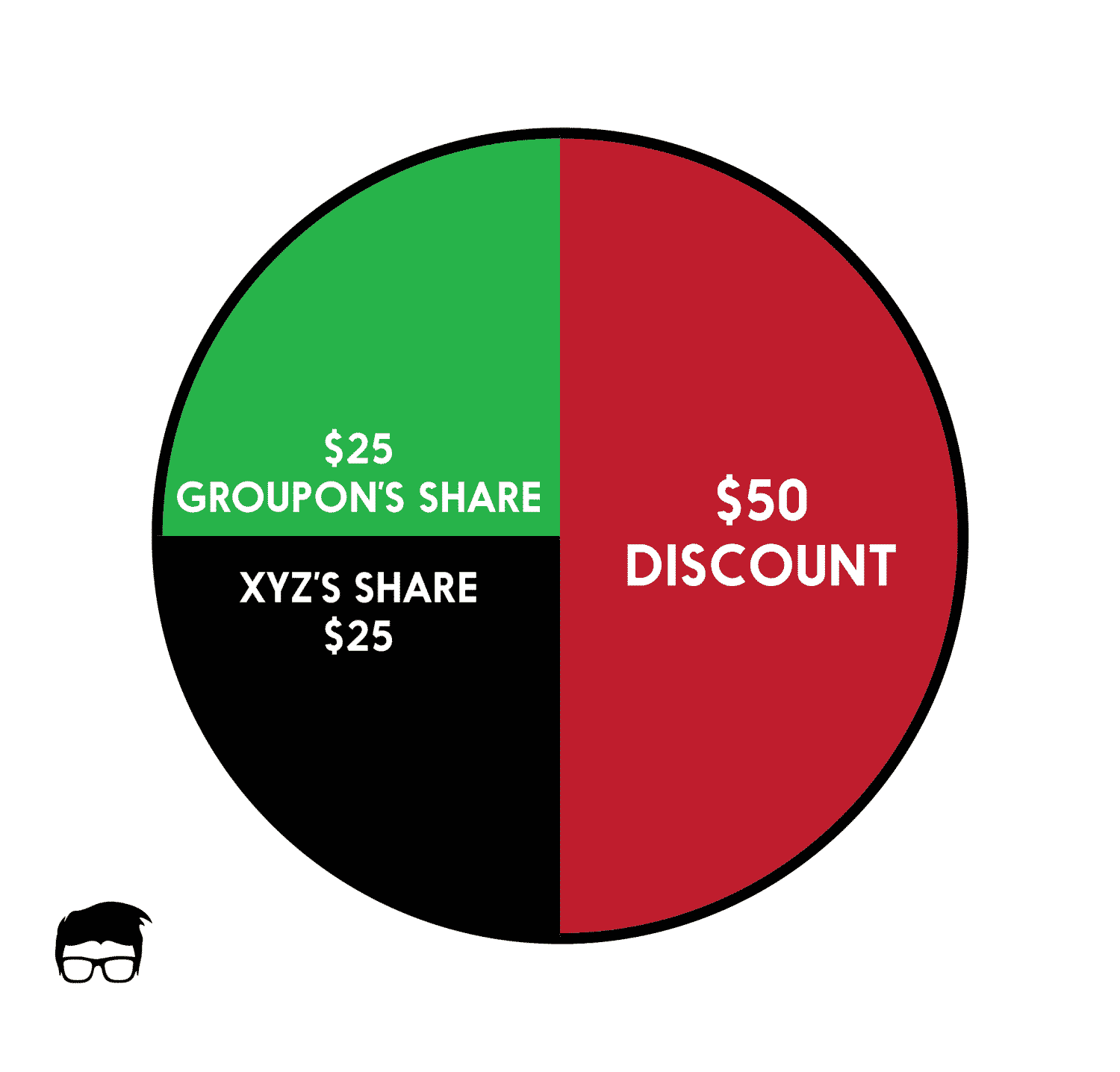
    Suppose a merchant ‘XYZ’ runs a campaign on Groupon to offer his $100 service at 50% off and signs a 50-50% revenue sharing contract with the company. This means for every deal sold on Groupon, XYZ earns $25 dollars and Groupon earns $25.

    groupon revenue model

    But Groupon only shares the revenue of the deals redeemed at the merchant’s store and not the total amount of deals sold. That is – if out of 100 deals sold by Groupon, only 70 were redeemed:

    XYZ earns: 70*25= $1750

    Groupon earns: (70*25) + (30*50) = $3250

    The revenue sharing percentage depends on the negotiations and the marketing tools utilized by the merchant. These tools include product promotion, advertisements, deal of the day listings, etc.

    Sources Of Expenses For Groupon

    Cost Of Acquisition (Merchants)

    This is one of the most expensive tasks for Groupon as the company signs a different contract with different merchants. This is also one of the business aspects where economies of scale don’t work. Every new market is tapped separately by the company.

    Marketing Costs (Cost of acquisition of customers)

    Everyone would agree that the ultimate source of income for Groupon is the customers referred to the merchants. The marketing costs include costs to acquire such customers. These are email marketing costs, referral bonuses, advertisements, etc.

    groupon marketing costs

    General & Administrative

    This includes compensation to the employees of administrative departments and other legal and accounting expenses.

    Is Groupon’s Business Model Sustainable?

    Groupon business model has evolved from a model which utilized economies of scale and economies of networking where the discount was only available if a certain number of people signed up for it to a marketplace where deals are bought and sold.

    This new business model is a win-win model for the company as well as the merchant where the merchant gets more customers which tend to visit again (~78%) and Groupon gets more customers by providing more and better deals.

    Go On, Tell Us What You Think!

    Did we miss something?  Come on! Tell us what you think about our article on Groupon Business Model | How does Groupon make money? in the comments section.

  • MoSCoW Method Explained

    MoSCoW Method Explained

    Businesses which considers customers’ requirements and priorities when they manufacture and deliver their products fare better than the ones which don’t. Businesses which understands and prioritizes these priorities according to their importance and order of execution fare even better.

    When the businesses have listed the priorities and requirements, the next step is to list them in the order it has to be executed. MoSCoW method is one such method of prioritization of requirements.

    What is MoSCoW method?

    MoSCoW method, developed by Dai Clegg, is one of the broadly used prioritization technique used in product management, software development, project management, and business analysis. It is widely used to approach a common stand with stakeholders. MoSCoW analysis shows priority on the significance, stakeholders place on the carriage of each requirement. This method was first used colossally with the agile project delivery framework Dynamic Systems Development Method (DSDM).

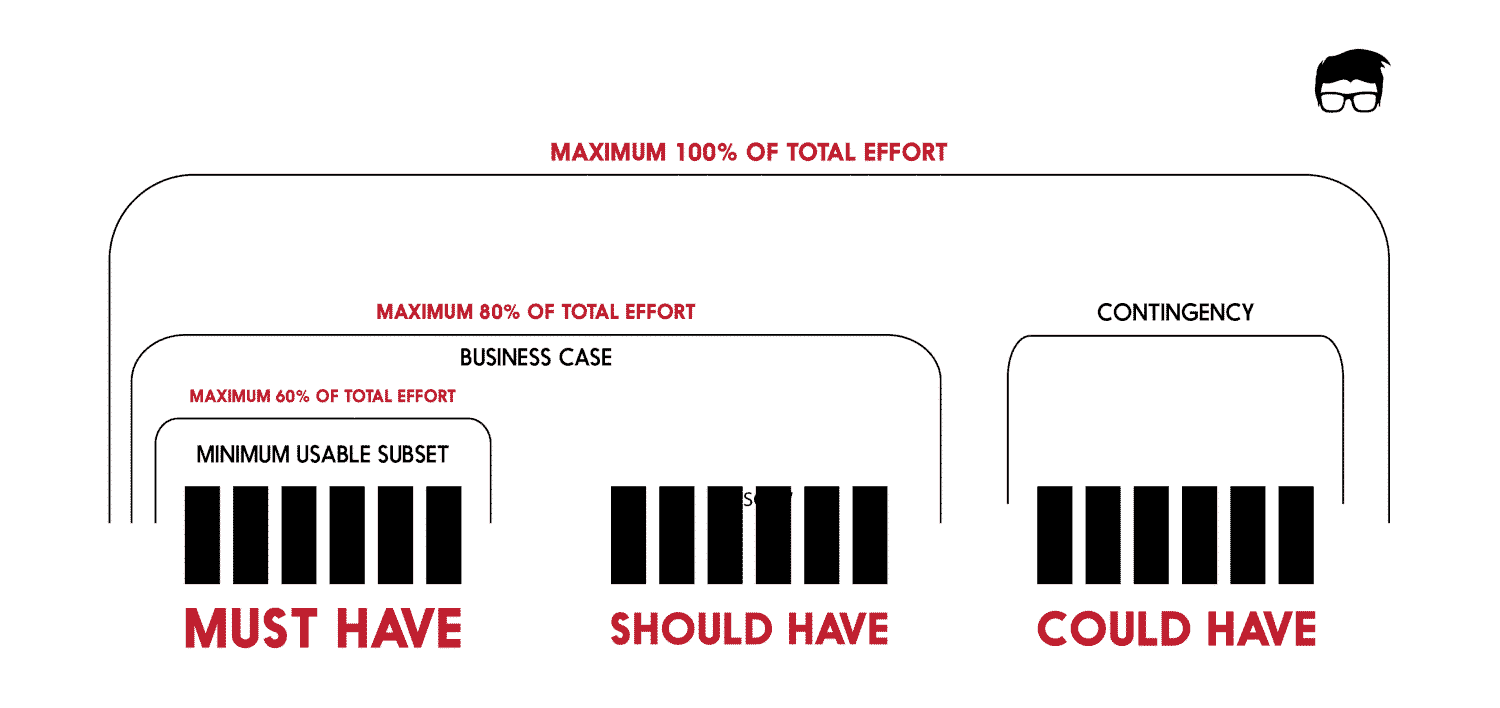
    MoSCoW is usually used with timeboxing. Timeboxing is a project planning technique where a time limit is fixed for the focus to be on the most important requirements. MoSCoW is an acronym derived from the first letter of each of four prioritization categories, MUST haveSHOULD haveCOULD have, and WON’T have, with the interstitial Os, which apparently means nothing, added to make the word pronounceable. While all the requirements are equally important, they are prioritized in a special way to convey the best and most sudden business benefits early. The developers, in the beginning, will try to deliver all the Must have, Should have and Could have, but the Should and Could requirements are the first to be removed if the delivery timescale is intimidated.

    moscow method

    MUST have

    MUST have is considered as an acronym for the Minimum Usable SubseT. The Must requirements are essential to the delivery timebox and are non-negotiable. If even one of the requirements is not delivered in the given time frame, the business is considered as failed. With the mutual agreement of all the stakeholders, the requirements can also be downgraded from Must have.

    The factors that differentiate the Minimum Usable Subset of requirements are as follows:

    • Not possible to deliver on target date without this.
    • If it were not delivered on the target date, then there is no point in deploying the solution on the intended date.
    • Legally not true or possible without it.
    • Unsafe and insecure without it.
    • Impossible to deliver the business case without it.

    SHOULD have

    Unlike MUST have, SHOULD have requirements are not important to be delivered in the current delivery timebox, though they are essential just like the others. Should have requirements are always kept aside from the current delivery timebox so that they can be used for a future delivery timebox. By examining the number or value of people affected, the difference between a SHOULD have and a COULD have could be understood.

    The factors that differentiate the SHOULD have of requirements are as follows:

    • Essential but not crucial.
    • Unpleasant to leave out, but the solution is still feasible.
    • Need some kind of workaround to bypass.

    Leaving out the SHOULD have requirements change the entire viewpoint of the business. Hence, these requirements are best to be not left out.

    COULD have

    With a little development cost, the COULD have requirements could improve the customer satisfaction or user experience, though they are wanted but not important. These requirements are usually included if and only if time and resources permit. Though they set the business product apart from the rest, their exclusion won’t reduce the viability of the product.

    The factors that differentiate the SHOULD have of requirements are as follows:

    • Essential or desirable but less important than the rest.
    • Don’t create much impact if left out.

    WON’T have

    The least critical requirements as said by the stakeholders of the businesses are WON’T have. Hence, they are not incorporated into the next delivery timebox’s schedule but rather dropped or reconsidered for a later timebox.  They are advantageous items recognized as impractical to include within the restriction of the business. What happens when a WON’T have requirement is included is that product launched by the business will miss its delivery date or the budget won’t be amicable. Usually, the WON’T list of the previous timebox begins the COULD and SHOULD item lists of the next timebox.

    The MoSCoW method has shown promise for a lot of businesses. While its effectiveness has been on the top for many a business, there are quite some instances where it had its own drawbacks.

    Effectiveness of MoSCoW model

    The main reason for its effectiveness is the fact that everyone working in the business contributes to the priority making decisions. While it is quick and easy to complete, the major advantage is that a certain percentage of resources can be allotted to each of the four haves. It gives prioritization in a quick and instinctive way. By eliminating resources in the WON’T category allows the business to allot more resources to plan for the COULD and SHOULD categories.  Once the MUST category is cleared, the remaining resources can be transferred to the rest of the categories. Precise productive analysis for projects that are still in development is possible with this method.

    Having a time constraint always for any project can sometimes become a drawback. If there is no effective cooperation within the business, this method can be inaccurate. Under a qualified priority structure, the successes, as well as failures, can be analyzed properly.

    It is always crucial to obtain and convey a well-defined set of requirements in a prioritized manner. MoSCoW method can be accomplished quickly and maintain the required level of prioritization diversity always.

    Go On, Tell Us What You Think!

    Did we miss something?  Come on! Tell us what you think of this article on MoSCoW Method in the comments section.

  • 6 Management Styles And Where They Suit Most

    6 Management Styles And Where They Suit Most

    Management is what directs the efforts of the group towards a definite purpose. It is an integral part of every organization irrespective of its niche as management is what leads to the fulfillment of the goals effectively and efficiently.

    “Management is an art of getting things done through and with the people in formally organized groups. It is an art of creating an environment in which people can perform and individuals and can co-operate towards attainment of group goals” – Harold Koontz

    In his book The Practice of Management, Peter Drucker described the primary goal of a manager as “to make people productive”. However, different managers fulfill this role in different styles.

    Directive Management Style

    Also called autocratic or coercive management style, the directive management style is characterized by a top-down decision-making process that often ignores subordinates’ inputs, creativity, learning, and growth. A directive manager closely controls and directs the employees and follows the “do it the way I say” approach.

    Employees working with a directive manager are often unhappy and start to lose their creativity after some time.

    Objective of Directive Management Style

    The main objective of the directive management style is to get immediate compliance of the subordinates and to get the task done in a traditional/usual way.

    Characteristics of a Directive/Coercive/Autocratic Manager

    • Do As I Say Approach: Directive manager dictates everything related to the work; what is to be done and how is it to be done and expects it to be done in the way he has directed.
    • Negative Motivation: An autocratic manager often creates an environment of negative motivation where failure or a mistake is not tolerated but punished.
    • Close Watch On Employees: A directive manager micromanages the day, tasks, and the team.
    • Self Praise: A coercive manager often uses self-praise to make the team follow his footsteps.

    Advantages

    • Full Control: The manager is in full control of the work happening in the organization which avoids conflicts and mistakes to a considerable level.
    • More Discipline: There is more discipline in the organization as the manager micromanages everyone and everything.

    Disadvantages

    • Employees Don’t Have A Say: A directive manager treats himself as the king and expects everyone to obey his orders. Most of the times, this attitude of the manager annoys employees as they don’t have a say in the decision or even in the work they do.
    • Very Less Learning: The scope of learning for employees is very low as everything is dictated to them.
    • Low Employee Morale: Negative motivation, strict orders, less learning opportunities lessen the employees’ morale.
    • More Employee Turnover: A directive management style may not suit every organization and may lead to huge employee turnover.

    When To Use Directive Management Style?

    Emergency

    Autocratic management style is most recommended at the time of emergencies and unforeseen events where close supervision is necessary for the survival or progress of the organization.

    High-Risk Fields

    High-risk fields like mines, manufacturing plants, military, etc. where micromanagement is essential to avoid injury or other dangerous outcomes.

    When Not To Use Directive Management Style?

    Highly Skilled Employees

    Highly skilled employees don’t like to be dictated. They often protest against directive managers which results in low organizational harmony.

    Employees Are Underdeveloped

    Underdeveloped employees look for opportunities to learn and since autocratic management style supports less learning, this management style isn’t recommended for instances where employees have zero or very little experience.

    Authoritative Management Style

    As the name suggests, an authoritative manager is someone who can be trusted and has command over his subordinates because he can be relied upon.

    The authoritative management style is also referred to as the visionary management style as it aims at getting the work done by providing them a long-term vision and a direction to head to.

    Objective Of Authoritative Management Style

    The main objective of the authoritative manager is to mobilize the team towards a common vision and focus on the end goals. The subordinates are free to choose any means.

    Characteristics Of An Authoritative/Visionary Manager

    • Sets The Vision: The authoritative manager sets the vision of the company and mobilizes the team to focus on the end goals. He often takes a step back after making things clear to the employees. This not only helps employees learn new things but also opens many new doors to tap the untapped creativity of the employees. The visionary manager also helps the employees when in need.
    • Has Firm But Fair Stance: He takes a firm but fair stance when setting up the goals and dealing with his subordinates.
    • Uses Positive Motivation Techniques: A visionary manager helps his team whenever they need his help. He also uses positive motivation techniques like persuasion and constructive feedback to motivate his subordinates and team members.
    • Has a High Level Of Credibility: An authoritative manager is someone who can be relied upon. He is very credible which makes him command the respect and cooperation of his subordinates in following him.

    Advantages

    • Clarity: Since the vision, the goals, and the directions to achieve the same are already discussed in the beginning, the subordinates work with much clarity to take the routes they want.
    • Freedom To The Employees: The back foot strategy of the authoritative manager gives much more freedom to the employees which boost up their morale.
    • Learning Opportunities: Since the routes to achieve the goals are decided by the employees themselves, this management style results in many learning opportunities for them.
    • More Creative Approach: Setting up a clear goal and giving employees the freedom to choose the routes results in may creative and untapped ways to achieve the same which eventually benefits the organization.

    Disadvantages

    • Some Employees May Take Non-Beneficial Routes: Giving employees the freedom to choose the routes they want to may result in some employees taking routes that are not beneficial for the company or sometimes which may lead to losses.

    When To Use Authoritative Management Style?

    When Clear Vision And Goals Are Required

    Opting for the authoritative management style is suggested when the organization doesn’t have a clear vision and requires a credible manager to set goals for everyone.

    The Manager Is Credible

    The authoritative style suits the managers who are credible and have huge convincing power.

    When Not To Use Authoritative Management Style?

    When Subordinates Are Underdeveloped

    This style isn’t suggested when the subordinates are new to the industry and require a certain amount of superior intervention and guidance.

    When The Manager Isn’t Credible

    If the manager lacks credibility he will not be able to convince the employees and this style will not work.

    Affiliative Management Style

    The affiliative style aims at creating harmony among the people working within the organization. It is the “people first” style.

    Objective Of Affiliate Management Style

    The main objective of an affiliative management style is to maintain organizational harmony.

    Characteristics Of An Affiliative Manager

    • People First: An affiliative manager always prioritizes people and their happiness over the work.
    • Harmony In the Organization: He aims to create a harmonious relationship in the workplace among everyone working in the organization.

    Advantages

    • Happy employees: Since employee contentment is given a priority over other things by an affiliative manager, employees feel more happy being guided by this type of manager.
    • Fewer Conflicts: This management style put more focus on conflict management.
    • More Freedom: This management style is characterized by flexibility and employees are given more freedom to do the tasks their own way.

    Disadvantages

    • Performance is affected: The affiliative style focuses more on organizational harmony than on organizational tasks which often affect the overall performance.

    When To Use Affiliative Management Style?

    When There’s Less Team Spirit Among Employees

    This management style is most suited to teams where there’s less team spirit and the manager feels affiliative style is important to maintain organizational harmony and future progress.

    If Tasks Performed Doesn’t Require High-Quality Performance

    An affiliative style is preferred in the organization where the tasks performed by the employees are routine and do not require some top-notch or different approach.

    When Not To Use Affiliative Management Style?

    Output Driven Industries

    Industries where the future of the organization largely depends on the output and performance of the employees.

    When High Performance Is Required

    In times of crisis or emergency where the organization becomes hugely dependent on the output to survive in the market.

    Democratic Management Style

    Also referred to as the participative management style, democratic style focuses more on consensus and building commitment among the employees.

    Objective

    As the name suggests, the democratic management style supports democracy and its principles and aims at doing the task with the consensus of the employees.

    Characteristics Of A Democratic/Participatory Manager

    • Encourages Participation Of Everyone: A democratic manager encourages the participation of every employee, listens to everyone and puts an emphasis on democratic judgment.
    • Motivates Positively: The participatory manager motivates the subordinates by listening to everyone, giving positive feedback, and by rewarding the team for their efforts.

    Advantages

    • Builds A Well Connected Team: This management style builds cooperation among the team members who are encouraged to work together.
    • Motivates The Employees: Participatory style motivates the employees better than other management styles as they get to participate in the decision-making process.
    • Team Feels Satisfied With The Decisions: Since the decisions are made by the team for the team, the employees feel more satisfied as compared to when the manager takes decisions themselves.

    Disadvantages

    • Slow Progress: The democratic style requires a manager to listen to every employee before making the final decision.
    • Manager Has Less Say In Decision Making: Since the decisions are made according to the consensus of the employees, the manager often has to take the decision against his own will.

    When To Use Democratic Management Style?

    When The Decision Making Requires Brainstorming

    There are many decisions that require a second thought or suggestions from others. Democratic management style suits best to workplaces where managers have to make such decisions.

    When Subordinates Are Experienced

    Participatory management style suits best to the organization where the employees are experienced and can give good inputs during the decision making process.

    When Not To Use Democratic Management Style?

    Inexperienced Employees

    This style is not suited to organizations where the employees are undertrained or inexperienced.

    When Decisions Are To Be Made Instantaneously

    The participation of every employee requires a lot of time and can cause a huge lag in the decision-making process. This style is not suited when decisions are required to be made by the managers instantaneously.

    Pacesetting Management Style

    Pacesetting managers are high achievers in a certain market/niche and use their experience to get the most out of the highly-motivated workforce.

    Objective

    The objective of this management style is to combine the prior experience of the pacesetter and the high motivation and energy of the team to accomplish the task with high engagement and motivation.

    Characteristics Of A Pacesetter Manager

    • High Achiever: A pacesetter is a high achiever in his own niche and uses his experience to guide the team.
    • Works At A Great Pace: The pacesetter prefers to work at a great pace from the start. The team under him performs with high energy, engagement, and motivation.
    • Prefers To Do Many Tasks Himself: He often sets an example by doing many tasks himself.
    • Motivates By Setting High Standards Of Excellence: He motivates his subordinates my setting high standards of excellence and those who can’t match it are assigned to different tasks.

    Advantages

    • High Energy And Excitement In The Team: Employees often like to work with some renowned figures. This motivates them to perform better.
    • More Motivation: Setting up high standards of excellence motivates the employees to outperform themselves.

    Disadvantages

    • Impossibly High Standards: Managers sometimes set impossibly high standards that demotivates the employees.
    • Too Much Pressure: The never-ending expectation of outperforming themselves often pressurizes the employees.

    When To Use Pacesetting Management Style?

    When The Manager Is An Expert In his Niche

    The Pacesetting style works only when the manager is an expert in his field who can set the pace for the employees.

    When The Employees Are Experienced Enough

    Inexperienced employees can never match the goals set by the pacesetters and this style will prove to be futile when used with inexperienced employees.

    When Not To Use Pacesetting Management Style?

    When Employees Require Coaching

    This style is not suited to organizations where employees are not experts and require guidance to do the tasks.

    When The Manager Is Not An Expert

    A manager has to be an expert in his niche to adopt this management style.

    Coaching Management Style

    Also referred to mentorship management style, the coaching style involves coaching and guiding the subordinates to complete the tasks.

    Objective

    The coaching style aims at long-term professional growth of the employees by providing them mentorship and learning opportunities.

    Characteristics of An Mentor/Coach Manager

    • Mentors Employees: He has a great willingness to help and mentor his subordinates and provide them with learning opportunities for their long-term professional growth.
    • Is Expert & Highly Experienced: He is an expert in his field and uses his expertise to help employees succeed in their life.

    Advantages

    • More Motivated Employees: Since the ambitions of employees are also kept in the mind while mentoring them, they feel more motivated and satisfied.
    • Better Senior Subordinate Bond: This management style strengthens the senior-subordinate bond as seniors help the subordinates in their long-term professional growth.

    Disadvantages

    • Requires Highly Skilled Managers: Mentorship management style requires the managers to be highly skilled and expert in their niche.

    When To Use Mentorship Management Style?

    When Employees Need Motivation

    This management style suits best to the organization where employees require more motivation to complete the tasks.

    When Not To Use Mentorship Management Style?

    When The Manager Isn’t An Expert In His Niche

    An inexperienced manager proves out to be a bad mentor.

    Go On, Tell Us What You Think!

    Did we miss something?  Come on! Tell us what you think about our article in the comments section.

  • Top 13 Myths Of Product Management

    Top 13 Myths Of Product Management

    Product Management is a relatively new role and many people are still trying to figure out what it is and what product managers do. The good thing is people all over the world have increasingly started viewing the role as critical to a company’s success. Yet for all its glory in the recent past, there are too many misconceptions out there surrounding Product Management. The myths are aplenty and we are here to debunk some of them.

    Myths & Misconceptions About Product Management

    #1 Product Managers are Project Managers

    Reality – Some product managers have project management as a part of their job but most organizations have a separate role of Project Manager who deals with the timelines of the project. Product managers are more responsible for identifying customer pain points and then building solutions for them with the help of engineering and UX designers than the project timelines.

    #2 Product Managers are in Marketing

    Reality – There are marketing profiles called Product Manager as well and many Product Managers play a significant role in the marketing of the product but when it comes to most modern companies, especially technology companies, Product Management is different from Product Marketing. Product marketers decide how to market the product to get users to the product but product managers decide what happens when the users are using that product. Product marketers decide which features they should focus on for the branding of the product but the product managers decide which features should be built into the product in the first place.

    #3 Product Managers and UX Designers do pretty much the same thing

    Reality – Ahh! Companies wouldn’t be paying salaries to two different people had it been so, right?

    While UX designers are more worried about interaction design, product managers have to take care of everything related to the product, from engineering to the user feedback. While both UX designers and product managers have to have a sense of design, UX designers go much deeper into it. However, how design fits into the larger picture is the product manager’s domain.

    #4 Product Management is a technical role

    Reality – Some people assume product managers are technical people. So they will not understand the other aspects of the product and it is okay to exclude them from the more strategic discussions. Some people also assume that product managers are technical people, so they can replace the engineering managers if the need arises. They understand the system design, database structure etc. very easily and can get into the nitty-gritties of it.

    None of these is true. While product managers who come from an engineering background might be comfortable with the engineering, many come from other backgrounds like UX or even liberal arts as well. So while understanding technology is very important, the engineering is best left to those who understand it the most. They should also be involved with every strategic decision regarding the product. While the profile may look like they belong to engineering, they are more at the intersection of all teams.

    #5 Product Managers just write the requirements/specifications

    Reality – Product managers cannot get away with just delivering specifications. They have to see everything to completion. Many product managers fail in this regard.

    #6 Product Managers only arrange meetings

    RealityProduct management is not just about setting up meetings with all the teams and then letting them decide what to do and what not to do. He needs to have a much more active participation in the process. At the end of the day, the product manager is the voice of the customer. He has to make the best decision for the customer’s sake after taking all viewpoints into account.

    #7 The customer is always right – Product Managers build exactly what the customer wants

    Reality – The customer is usually right, not always. Yes, the product manager is the voice of the customer but there are hidden needs and deeper goals that he has to unearth. Product managers love customer research but the question they should ask themselves is if the customer research can be made so perfect that it can figure out what the customer himself does not know yet. Maybe testing of user behaviour with an MVP can help.

    #8 Product Managers are the boss

    Reality – Product managers have no formal authority over any team and hence no one is obligated to do what he says. A great product manager earns the respect of various teams and even without actual authority, is able to get the best out of everyone as he can make them see the bigger picture. A great product manager also knows his limits and knows not to step on the toes of the designers or engineers. While the product manager should speak up if the goals do not align, he should never try to control or micro-manage anyone. Empowerment is the key.

    #9 One cannot become a Product Manager straight out of college

    Reality – A product manager may be a “manager” but this does not mean you need years of experience to become one. Companies like Google, Facebook, Uber, LinkedIn etc. recruit product managers right out of college. One just needs to have the drive, passion, intellect and customer focus to be successful as a product manager.

    #10 Ideation is more important than execution

    Reality – Coming up with ideas might seem like the most important part of the job but the execution of those ideas matters more. Product managers need to be able to make the broad ideas tangible and actionable by understanding all the steps that are required to turn an idea into reality and then iron out the sharp edges.

    11.  Product Managers set the dates and stick to them without exceptions

    Reality – The product managers do not set the dates. The engineering team does. He cannot ask them to build things faster, instead, he will need to prioritize and make trade-offs to make sure that the external deadlines are hit. A product manager also has to facilitate the entire development process for the engineers by getting rid of unnecessary roadblocks.

    #12 Product Managers spend all their time with the development team

    Reality – Great product managers spend more time with the customers than with others. As they say, if you have to cut a tree in five minutes, spend three minutes in sharpening your ax. While the engineering and design teams help in making the product, the true success of a product lies in its ability to delight the customer. So understanding one’s target customers and their needs is of paramount importance.

    #13 Product Managers can add any feature to the product if it is “cool”

    Reality – Cramming unnecessary features into a product serves no purpose. Just because a feature looks attractive does not mean it will serve a purpose for the end-user. If there is no need for a feature, adding it only wastes everyone’s time and adds to the frustration of both the development team and the customers.

    Go On, Tell Us What You Think!

    Did we miss something?  Come on! Tell us what you think about our article on Top 13 Myths of Product Management in the comments section.
  • What Is Sonic Branding?

    What Is Sonic Branding?

    Can you sing this for me?

    “ba da ba ba ba, I’m lovin’ it” 

    What? Does it sound like…

    McDonald’s?

    ‘I’m lovin’ it’ is not only the longest-running slogan of any brand but a perfect example of an excellent use of sonic branding.

    What is Sonic Branding?

    Sonic branding (audio branding, sound branding, or acoustic branding) is the sound of your brand.

    It is the use of sound to reinforce your brand identity like these for PlayStation, these for Windows, this for Nokiathis for Intel, and this for McDonald’s.

    Sonic branding is about building a relationship between the product and its target market through the latter’s ears, fulfilling the role that a national anthem plays to a country or a hymn plays to a religion. – Daniel Jackson, managing director of Cutting Edge Commercial.

    Even though these sound like mere mnemonics, jingles or sound effects, they carry huge emotional and exclusive value and connect with the brand as much as their visual equivalents do (even more).

    Your sonic branding connects to your brand, just like the “Happy Birthday to You” song connects to birthdays and “We Wish You a Merry Christmas” to Christmas.

    Psychology Of Sonic Branding

    Sound is as important as visuals, even more.

    3 new startups launch every second. That’s three new visual brands every second. However, sonic branding, being one of the most untapped aspects of branding, can make you stand out.

    But does it really matter?

    “The Intel bong is one of the most powerful assets we have. We’re always looking for ways to showcase the amazing experiences that Intel enables, and the Intel bong sound helps keep our messaging consistent.” – Yogiraj Graham, Director of Production for Intel Global Production Labs.

    Studies have shown that the ultimate decisions are made by our brain’s non-rational (limbic system) part. The very same part is aroused by music or sound.

    There are many advantages of having sonic branding. These include:

    More Attention

    With such a vast amount of information available, attention is your most scarce asset. Adding a complementing sound to reinforce your brand identity can help you get more attention from your target audience.

    Triggers Emotion

    Sound triggers emotions better than visuals do. Try watching a horror movie without the sound, and you won’t feel scared. However, just listening to it without the visuals may scare you.

    Enhanced brand recall

    According to studies, listening to music or sound that correlates with the message improves the audience’s verbal memory, leading to better brand recall.

    Clearer Message

    Music is directly related to emotions. Different sounds and chords represent different emotions. For example – trumpets and drum rolls denote heroism, tabla denotes something Indian, djembe denotes something African, strings can be used to represent both happiness and sadness.

    The use of the right sound for your brand can help you communicate your brand message better and more creatively.

    Any guesses as to what this sonic branding denotes?

  • VRIO Framework Explained

    VRIO Framework Explained

    There are thousands of firms competing with each other extensively. These companies use different kinds of tools like PEST analysis, BCG Matrix, Porter’s 5 Forces and Value Chain analysis to analyse the internal and external environment. A vision statement is the first step in the basic strategic process of any firm. It is followed by objectives, internal & external analysis, strategic choices and strategic implementation. These processes help the firms to understand their business enterprise and identify opportunities and shortcomings in their firm.

    What is VRIO Framework?

    VRIO Framework is a business analysis framework tool used to analyse the internal resources and capabilities of the firm. The development of this framework tool started in 1991 by Jay B Barney in his work ‘Firm Resources and Sustained Competitive Advantage’. In this book, he pinpointed four factors that contribute to a firm’s resources to become a source of sustained competitive advantage. Originally this framework was called VRIN. He improved VRIN framework in 1995 in this later work, ‘Looking Inside for Competitive Advantage’ and named it VRIO.

    Irrespective of the business model, VRIO is used as a framework to evaluate the capabilities and resources of the firms like financial, human, material and non-material resources and capabilities. Each word in VRIO denotes the four framework questions asked about a resource or capability to determine its competitive potential:

    vrio

    The Question Of Value

    Looking at the resources of the firm, the question to be asked first is if the resources are efficient enough to exploit a hole or weakness and alleviate a threat in the marketplace. These resources are termed as valuable resources and are a strength of the firm. Resources are also said to be valuable if they help the firms to grow perceived customer value. This is achieved by increasing differentiation and decreasing the price of the product. If the resources can’t exploit any weakness or help with the survival of the firm, it is considered as a weakness. While many resources are valuable in every industry, there are resources which are a strength for one industry while at the same time, a weakness for another.

    Demographic change, technological change, economic climate, cultural change, legal and political conditions and specific international events are some resources which can be exploited efficiently. The threat of suppliers, the threat of substitutes, the threat of buyers, the threat of rivalry and the threat of entry are some threats which the above resources can alleviate. By looking into the value chain of a firm, valuable resources, as well as capabilities, can be identified where each business creates its services and products step-by-step. The choices a firm make with respect to the value chain makes it an important tool in identifying the resources and capabilities.

     The Question Of Rarity

    Resources and capabilities that are unique and obtained by only a few firms are said to be rare. Getting a rare resource is quite difficult for a firm but it is extremely valuable when it gets one. Having rarity in a firm leads to a competitive advantage over other firms. There are two conditions to be satisfied for rarity to hold a competitive advantage in a firm. The resources and capabilities must be really hard to find and they should last longer while their supply is always short.

    When a situation arises where more than one firm has the same resource or capabilities and use them in a similar way, it leads to competitive parity. There is no competitive advantage since the rarity factor does not exist in these cases. Losing valuable resources and capabilities would damage a firm because they are crucial for staying in the market

     The Question Of Imitability

    Some resources, as well as capabilities of one particular firm, can be imitated by other firms which lead to lack of originality of the original product. Firms with rare resources and capabilities that are hard to imitate by other firms gain a competitive advantage in the marketplace. It can also gain a competitive advantage by utilising its rare resources to neutralise any threats or exploit any opportunity.

    When this competitive advantage is discovered by other firms, the response by them is in two different ways. Either they will ignore the competitive advantage of the rival firm and its gains to operate normally or they will try to discover and duplicate the strategy used by the rival firm. The level of imitations by other firms depends on the cost factor also. If the cost of acquiring the resources is less or negligible, the firms will try to imitate the competitive advantage to gain competitive parity.

    Imitations can be done in two major ways. Direct duplication occurs when a firm can directly imitate the resources or capabilities of a rival firm while the firms try to substitute for the resources or capabilities if the cost of imitation is high.

    The three reasons why resources and capabilities are hard to imitate are

    • Historical conditions: Resources and capabilities were developed from historical events or milestones in the historical timeline and over a longer period which are usually costly to imitate.
    • Causal ambiguity: Firms that imitate the resources and capabilities can’t identify or tell the elements that lead to the cause of competitive advantage.
    • Social Complexity: The resources and capabilities involved in the firm are based on the firm’s culture or interpersonal relationships.

    The Question Of Organisation

    Organising the firm to exploit the resources and capabilities is the last step in the VRIO framework. The company’s formal reporting structure, management control systems and compensation policies are a few factors which decide the organising of the firms. Who reports to who is denoted by formal reporting. Management control systems denote both formal and informal ways to always ensure the manager’s decisions align with the firm’s strategies. While a formal control system consists of reporting activities and budgeting, informal controls include the firm’s traditions and let employees check on each other. Compensation policies let firms give incentives to their employees to motivate them and make them work harder. Stock increases, bonuses as well as salary increase are some monetary incentives while extra holidays or bigger offices are some non-monetary incentives.

    Firms with valuable, rare and expensive to imitate resources and capabilities can suffer competitive disadvantage without a correct way of organisation. The firms should arrange its policies, processes, organisational structure, management systems, and traditions to fully realise their potential to achieve sustained competitive advantage.

    How Does VRIO Analysis Help Firms?

    VRIO analysis is complimentary to PESTEL analysis which assesses macro-environment. The following analytical statements are taken into consideration by the firms, after which it gets an idea about the position of their firm.

    If the resource is not valuable, then it should be outsourced as it is of no use to the firm.

    If the resource is valuable but not rare, then the firm is in competitive conformity. It means that even though the firm is performing badly, it is still better than its competition.

    If the resource is valuable and rare and not expensive to imitate it, then the firm has a temporary competitive advantage. But, if in the future, other firms try to imitate, then the competitive advantage is lost.

    If the resource is valuable, rare and is expensive to imitate it but the firm is not able to organise them, the resource becomes expensive for the firm.

    If the firm can manage the advantages and are able to organise the firm and change the temporary competitive advantage, it becomes a permanent competitive advantage.

    The advantage of a VRIO analysis is its simplicity and clarity. Almost every firm uses VRIO analysis in combination with other analytical techniques to help evaluate business resources and capabilities in a more detailed view. For financial resources, there are many detailed financial indicators that assess the financial condition or performance of the firm from different perspectives. In the same way, human resources, information or property are other detailed indicators of their performance, quality or efficiency.

    vrio

    Go On, Tell Us What You Think!

    Did we miss something?  Come on! Tell us what you think about our article on VRIO Framework in the comments section.

  • The Roles And Responsibilities Of A Product Manager

    The Roles And Responsibilities Of A Product Manager

    You know what a Product Manager is. Many consider Product Management the dream job for the current crop of graduates. But have you ever wondered what a Product Manager actually does?

    If you go around asking students about the responsibilities of a Product Manager, you will get pretty vague responses. Can they be blamed when even the industry remains unclear on what the product manager really does? At the end of the day, it is a pretty ambiguous role.

    If I had to answer this question in just one sentence, it would be that a Product Manager helps his company decide what products or features to make and how to make them. But I am sure you wouldn’t be here reading this if you were content with this.

    So let us see how a typical day would look like for a Product Manager.

    (Mind you this role is as uncertain as it is ambiguous. So no two days would be the same. Also, Product Management is much more hands-on in startups than in large companies.)

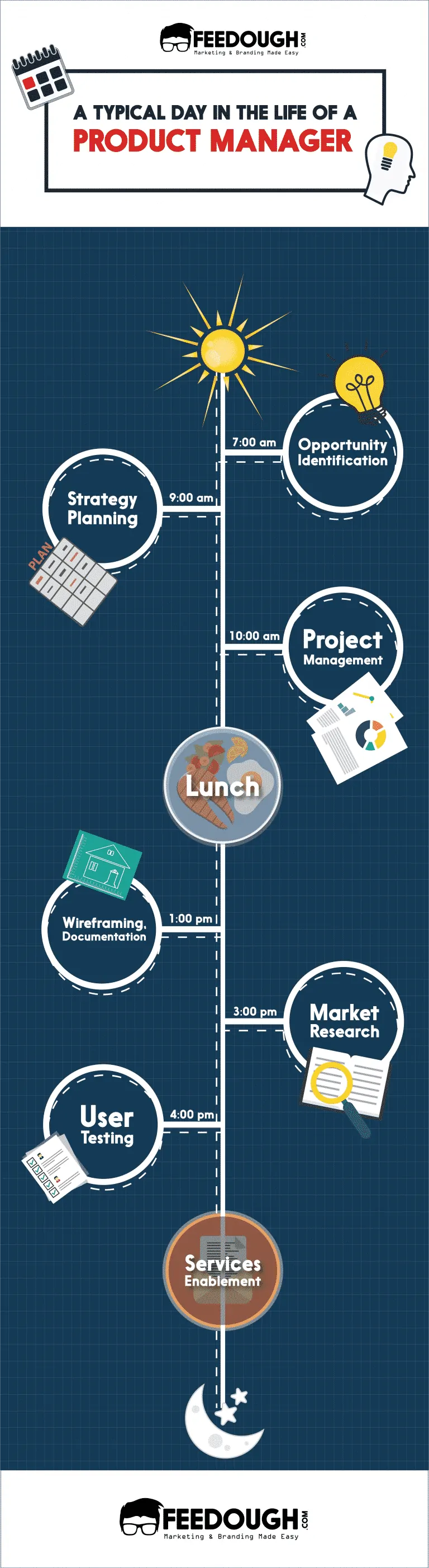
    Typical Day in the Life of a Product Manager

    PRODUCT MANAGER DAY

    7:00 am: Wakes up and checks the latest news in the world. Follows the major technology blogs for the latest posts relevant to the industry he is working in. Prepares the to-do list for the day. Gets ready for work.

    9:00 am: Reaches office. Attends meeting with the engineering team for updates on the work-in-progress and if they are facing any obstacles. Members of other teams such as UX are also present to voice their concerns if any.

    10:00 am: Checks e-mails and participates in more meetings with various teams. The meetings can be related to roadmapping for a new product or even scrapping a feature that is not doing too well. Checks KPIs and product metrics to see how the product is performing.

    12:00 pm: Lunch

    1:00 pm: Makes wireframes for the new app. Discusses the app functionality with the engineering manager to figure how to proceed with the development.

    3:00 pm: Analyses data related to the features that were introduced recently. Decides on which tests can be further used to know more about user behavior.

    4:00 pm: Meets customers for personal interviews and focus groups to get feedback about the product.

    5:00 pm: Meets with the Marketing team to decide how to lower user acquisition costs and if the marketing budget would have to be increased. Discusses the itinerary of the launch event for the new features.

    6:00 pm: Leaves office for home. Reaches home and spends 1-2 hours on online courses which shall help him learn about new technology or skills for his role.

    Throughout the day, the Product Manager had to shoulder various responsibilities. When you own a product, you deal with all its aspects to bring the best possible version to the market.

    If it was not clear already, here are the responsibilities of a Product Manager in more detail:

    Responsibilities of a Product Manager

    Opportunity Identification

    The Product Manager has to identify the opportunities that exist in the industry he operates in. A Product Manager is the company’s expert in the domain in which it exists and has to know as much as he can about the competition and the existing and upcoming trends.

    Strategy Planning

    Needless to say, both the long-term and short-term vision for the product is the Product Manager’s responsibility.

    Wireframing

    While no one expects a Product Manager to be a UI master, most ideas are communicated better in rough sketches than in words and thus making low fidelity wireframes frequently is something that a Product Manager has to be comfortable in.

    Cross-Functional Communication and Collaboration

    An exceptional product leader facilitates cross-functional communication and collaboration. He is aware of what is going on in various teams of the organization and maintains friendly relationships with everyone. He knows that great products don’t get made in silos.

    Lots and Lots of Documentation

    A Product Manager is responsible for tons of documents including the Business Requirements Document (BRD), Functional Specifications Document (FSD), Product Requirements Document (PRD) etc. Of course, these will vary from company to company.

    Project Management

    A Product Manager has to be very organized and detailed. He gathers information from different teams and passes it to the appropriate stakeholders. A good Product Manager knows teams have to know who is doing what and when to work better and he makes sure that goal is achieved.

    Market Research

    A Product Manager has to be comfortable with market research to know if a market exists for his product and if yes, what the behavioral characteristics of his target audience are. He has to make a detailed analysis of his target personas.

    Data Analysis

    Data is very crucial for a Product Manager. He can make good decisions only if he is able to understand the data in front of him. While most organizations have Data Scientists and Business Analysts to take care of the huge amount of data generated every day, Product Managers are expected to know some SQL and Excel to run basic data analysis by themselves.

    User Testing

    A Product Manager is the customer’s advocate in the company. It is his job to understand the customer and his needs. He has to find time to meet customers every now and then to understand what they want and get their feedback on the current solutions being provided to them. An MVP can help with product validation.

    Product Delivery

    No product is perfect. Perfection requires an endless development phase. Unfortunately, the real world is bound by timelines. A Product Manager prioritizes what features need to be incorporated into the product and what is to be chucked. He has to maintain the balance between getting the product right and getting it out to the customers in time.

    Sales and Services Enablement

    A Product Manager is the CEO of his product. So making sure that the sales and services people in his company thoroughly understand the product and thus are able to do their job better is his responsibility.

    I hope you might have got some clarity on what a Product Manager does. If you want to truly succeed as a Product Manager, always remember that your job is to facilitate the entire process and not dictate terms. Only when you earn the respect of the different teams, especially engineering, can you truly achieve what you set out to do. There is plenty of knowledge to be leveraged both within and outside the company. Use that to move ahead with your vision but also remember to get yourself into the fray and not be content with only talking.

    Go On, Tell Us What You Think!

    Did we miss something?  Come on! Tell us what you think of this article on Roles And Responsibilities Of A Product Manager in the comments section.