
Feedough Logo

Blog

  • How to Split Equity Among Cofounders – A Guide

    How to Split Equity Among Cofounders – A Guide

    So you’ve got an idea to start a company, and maybe your best friend is coming along for the ride.

    One problem: Who gets what equity?

    We know that there are no easy answers to the cofounder equity split because every business has different needs, goals and circumstances. However, based on our experience advising startups — particularly companies with multiple cofounders — here are some best practices when it comes to splitting equity among cofounders.

    But first, you need to understand what cofounder equity is and what all it constitutes.

    What Is Cofounder Equity?

    Cofounder equity is the ownership stake each cofounder has in a business. It’s generally expressed as a percentage of the company and represents how much of the pie each person brings to the table.

    This allocation will be on paper only on day one, but after you get funding or generate revenue, these equity stakes will convert into cold hard cash through a capital call or sale.

    In short, this is how you split up the value of your business among the people who helped create it.

    The Purpose of Allocating Cofounder Equity

    The primary reason to allocate cofounder equity is to appropriately reward what each person in the founding team brings to the table. Whether that’s money, time and energy, relationships or expertise in a certain area, equity allocation is the key to avoiding disputes down the road.

    Equity acts as both an incentive and a safety net if things don’t go according to plan. Without it, founders would have no financial motivation to stick around when times get tough (or flee if things are looking up). And quite simply, the greater the equity stake a founder has in a company, the deeper their interests will be tied to its success.

    Equal Equity Split – Or Not?

    Not every member of a founding team brings the same material benefits to the table. For example, one cofounder may be bringing a product and two years of hard work to the table, while another member might only bring an idea and two months of planning.

    This is why it’s we find founders wary of splitting equity equally at first. They could come up with reasons like:

    • I came up with the startup idea.
    • I’m the one who has to bring in revenue to pay the bills.
    • This is my baby, and I should have more equity.

    All of these statements can be argued to be valid and could be used as reasons for getting a bigger slice of the pie. But the problem with this approach is that the founder doesn’t think long term when using such arguments.

    A caveat is that there does need to be some balance at the beginning. If everything is skewed too far one way or another, it can cause problems down the road.

    For example, if one cofounder has 90 percent of the equity and the other 10 percent, then it’s very likely that founder number two will feel they are being “used.” Not a good way to start a company.

    So, how should you split up equity? There are a number of ways, but there are some important aspects about startups that you should understand first.

    1. A startup isn’t built in a day: If you’ve been working for five months before your cofounder joined, it doesn’t make much difference as a company takes five to ten years to build and provide value. You need committed cofounders that will only stick if you fairly split equity.
    2. Different skill sets are needed at different stages: Founders bring different skills to the table, and each one is essential at a certain stage of your startup’s development. For example, you may do well with only an idea in the early days but need more help as soon as you’re ready to start building it out. So, you might need to rethink about keeping a larger stake just because you got the idea.
    3. Cofounders are not employees: Cofounders aren’t employees and you should avoid treating them like one. The equity isn’t divided based on how many hours they work but on what value they bring to the company. You should not divide equity considering the founder as an employee. The person could be vital for marketing, or they could bring in the required early capital without which you can’t even start.
    4. You would need motivated partners: The more stake one gets, the more incentive they have to stick around. It’s a great way to keep cofounders motivated.

    How To Split Cofounder Equity?

    The best time to think about splitting equity among cofounders is before the team forms, but how you do it can vary based on many variables, including the company stage, the structure of your business and each founder’s role. However, there are some important factors that you should consider, like :

    • The stage of your company,
    • The relative benefits and contributions each founder bring to the table,
    • Founder salary,
    • Options pool.

    But before you start discussing the equity split with your cofounder(s), know that it’s often better to err on the side of caution and split equity equally until there is reason to do otherwise. This way, everyone has buy-in, avoids any resentment and also makes it easier for you to raise money from investors.

    The Company Stage

    The early stages of a company can be tumultuous, and it’s difficult to predict who will make a good contribution. Things change from week to week, and it’s not uncommon for one cofounder to take a lead role in one area, while another is more able to handle the day-to-day tasks.

    Consequently, it can make sense to split the equity equally based on this fluidity of roles at the early stages – as when you’re just getting started, every cofounder needs to wear many hats and shoulder a variety of responsibilities.

    Later on, however, as your company progresses through its development cycle, the equity might get split unequally depending on the contributions of each cofounder.

    So, the equity split may be different for partners joining at different stages of your startup.

    Founder Contributions

    It can be difficult to judge how much equity a cofounder should receive if their role isn’t clearly defined. It’s best to wait until after you start working together or have a clear idea of each founder’s responsibilities before deciding on a fair, equitable split.

    You want to think about the value that each cofounder brings to the table. To do that, consider the following questions about each of your partners:

    • What is their role in the company?
    • How much time will they be able to contribute to the startup’s vision, mission and goals?
    • How much did they invest monetarily in the startup?
    • Did they contribute any IP to the startup?
    • What non-monetary value do they provide to the startup?
    • Do they have any expertise that could help build a successful business?
    • Have they worked with startups before or are they newbies?
    • Do they charge a salary?
    • Do they have any other commitments that could affect their availability and time spent on your company?

    Besides this, a person might deserve equal or larger equity share if –

    • They are the one who executes the idea into an actual business.
    • Brings in the customers during the initial and growth stages.
    • Contribute priority resources to the startup.

    Besides the non-monetary investments, the amount of money that each founder invests is another vital factor. If all goes well, this initial investment will translate into a large chunk of capital down the road and could be critical in supporting the company and paying its bills.

    If you’re not sure exactly how to figure out who should get what, it’s possible to set up a simple spreadsheet and list the contributions of each cofounder.

    Founder
    Cash Contribution
    Non-Cash Contribution
    John
    $10,000
    Key developer
    Matt
    $50,000
    Big name, Marketing
    Jane
    0
    Code IP, key developer

    But contributions should translate to actual growth, be it in product development, sales, number of customers, capital, user base, or subscribers.

    For example, Dr Dre charged a huge chunk of Beats total stake (33%) for his contributions as a marketer as he was the key to the company’s success, even though he was not behind the disruptive technology.

    You should carefully consider who brings what to the table and, if necessary, make adjustments to the equity split accordingly.

    If one cofounder brings a lot of money to the table but is not committed to their time and effort, compare their monetary investment with efforts of other active partners and use this information when allocating equity.

    But always think long term. A marketing founder’s expertise may not be needed during the product development stage, but it would be a huge plus later on.

    Remember – do not give away equity for nothing – no matter if the cofounder is your best friend, because it will cost you money and control in the long run.

    Founder Salary

    Sometimes, founders who are unable to work full-time due to financial commitments need some compensation from the company to make up the difference. In this case, they might draw a salary based on market rates for people with their skills and experience, but usually at a fraction of what they would normally ask for.

    Since startups have limited cash in their beginning stages, the salary often comes at the cost of equity shares.

    However, founder salaries don’t play and should not play a big role in how equity is split. This is because no one gets paid to be a founder. They get paid for the jobs they perform. If you plan to reduce your cofounder’s equity substantially just because he is taking a salary, he might lose his motivation as a founder and come up with excuses for not doing his job like an employee.

    The Options Pool

    An options pool is a group of shares that are set aside for other employees who, in the future, could become valuable to the company.

    It’s good practice to split up your options pool evenly among all cofounders – especially if you’re still early on in your startup’s development. So, usually, founders don’t divide a hundred percent of the equity share amongst themselves.

    It’s more common to build up the options pool over time and award people with equity when they join your company or become essential to its growth.

    For example, if you only have three cofounders and you give each 20% of the company’s shares, then an ideal options pool would be around 20% of the company.

    Factors That Should Not Affect The Equity Split

    While the equity you give to your cofounder may be impacted by other factors, such as their level of commitment and expertise, it should not be influenced by:

    • Time spent on a project.
    • Loyalty or friendship with one founder.
    • Severance packages from previous jobs.
    • Family connections.
    • A founder’s personal financial situation.

    The reason is that those things are irrelevant when it comes to the level of contribution, time spent or risk taken.

    Cofounders are like puzzle pieces. Each one adds value to the team and makes it complete. People who don’t fit in the puzzle should not be given equity, to begin with.

    The Documentation Required To Split Cofounders Equity

    Oral communication isn’t enough when it comes to splitting equity. You will need to document the agreement in written form with an agreement. This is also known as a Shareholders Agreement.

    A shareholders agreement is a contract that stipulates how shares will be split between cofounders and who will be responsible for what.

    This agreement should include information like:

    • The number of shares issued
    • A capitalisation table
    • The percentage of equity each founder holds.
    • Founder vesting details
    • Share transfer policies and restrictions
    • Pre-emptive rights for shareholders
    • Details on payments in the event of a company sale.

    The terms of a Shareholders Agreement can be changed in the future, but it needs to be done fairly and transparently.

    In most jurisdictions, this is the only legally binding agreement required from you as a founder.

    Bottom-Line?

    When it comes to cofounder equity split, don’t let the personal side of it affect your decisions. Split your cofounders’ equity fairly and evenly – regardless of how long they’ve been there, their career history or any other factor that is not relevant to what they bring to the table.

    Moreover, don’t let the greed of ‘getting it all’ dominate your decision-making. You will end up damaging your startup and lose against the competition if you do so.

    You should focus on the long term benefits of your startup and build a healthy relationship with your cofounders. The division of equity will be for the best if you assume nothing, communicate clearly and never forget it’s a team effort.

    Go On, Tell Us What You Think!

    Did we miss something?  Come on! Tell us what you think of this article on cofounder equity split in the comments section.
  • What Is Price Mix? – Strategies, Objectives, & Examples

    What Is Price Mix? – Strategies, Objectives, & Examples

    A brilliant product in the correct location with excellent advertising cannot make a sale conceivable unless it is properly priced. Thus, price is one of the most influential factors that affect the buyer’s decision. It’s that one variable that can change a company’s status overnight and immediately affect revenues and profits. For instance, according to McKinsey, a 1% increase in price can bring about an 8% increase in operating profits.

    However, pricing decisions inconsistent with a company’s competitive strategy can be dangerous, and that is why companies must address their price mix with much caution and attention. So, without further ado, let’s delve right into the most crucial element of the marketing mix – price mix.

    What Is Price Mix?

    Price mix is the combination of different ‘price-related variables’ determined by a producer to fix the price of the product or service he offers. These variables include the cost of making the product, the factors that influence the pricing decisions, the various pricing strategy, the pricing objectives, etc.

    Simplistically, price is the amount of money customers have to pay to obtain a product. That is, it is the economic value of a product expressed in monetary terms. A well-chosen price can help the firm attain its financial objectives, adapt to the market realities, and conform to other elements of the marketing mix (product quality, distribution issues, promotion challenges).

    The product’s price stipulates the product’s future, customer acceptability and is an instrument against the competitors. Thus, it should be weighed above other marketing elements since it is the only marketing mix component that generates revenue while other elements create cost.

    The Importance of Price Mix

    Price mix greatly influences a business’s growth and survival, prosperity and profitability, and brand image.

    So, prices must be given full regard, as they significantly impact the company’s remaining activities.

    For the following reasons, pricing is of essential importance.

    It Regulates Demand

    The price set by a producer directly affects the level of demand. Too high or low a price can put the development of the product at risk.

    Under the law of demand, the price and quantity demand of a normal good is inversely proportionate, that is, the higher the price of a good, the fewer people will demand that good and vice-versa.

    Usually, customers respond to high prices by switching to alternate options like substituting the product when the prices go up. For instance, if the train travel prices go up significantly, the customers may explore the idea of bus travel.

    It Is A Determinant Of Profitability

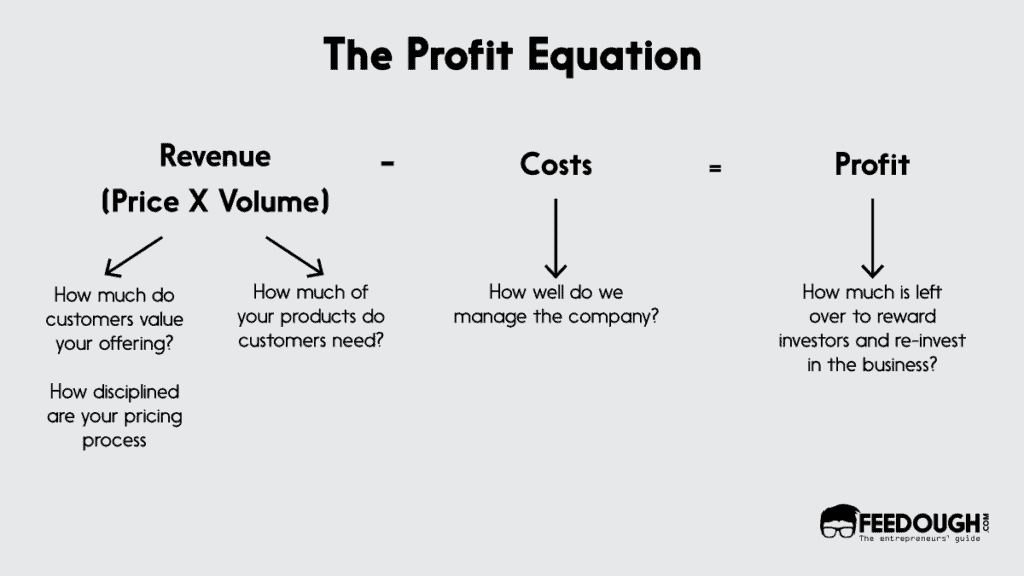
    Profit is the company’s ultimate goal, and the price of any commercial undertaking directly influences profits. In fact, price is the foundation for profit generation.

    profit equation price mix

    It is clearly evident from the profit equation that price is the only variable that has a multiplier effect on profit. Thus, the impact of price rises or falls is immediately reflected in the increase or decrease in product profits. 

    It’s An Integral Part Of Sales Promotion

    It has been noted that even a slight price decrease leads to larger sales volume in the case of goods whose demand is price sensitive. However, marketers shouldn’t modify prices constantly as it may result in customers predicting price reductions. Instead, they should use short-term price reductions such as short-term discounts to enhance their sales.

    It’s A Trigger Of First Impression

    At the moment of purchase, the consumer attaches emphasis to the price of the good instead of its value. While a company’s overall marketing strategy may be excellent, many customers first see an item’s price tag even before developing an interest in the product. It’s a fact that many buyers are more likely to reject a product if it is costly. Thus, an effective pricing strategy solves this problem.

    It’s The Most Adjustable Aspect Of The Marketing Mix

    Prices can be adjusted quickly in comparison to other elements of the marketing mix.

    For instance, changing the product design, distribution system, or advertisement would take a long time. However, price is quite flexible so that an organisation can react rapidly to changes in the market.

    It’s A Means Of Comparison

    Any company which sells high, medium, and low-priced goods must decide whether or not its pricing is equal or below or more than its competitors. Any seller should possess this knowledge as they can overcome competition to some extent by setting a reasonable price and thus, providing value for money.

    Thus, prices represent corporate goals and policies and have a significant role in influencing marketing performance. It’s not only the cornerstone for profit generation but is also utilised to offset deficiencies in other marketing mix aspects.

    Factors Affecting The Pricing Decision

    A series of internal and external elements characterise the pricing decisions of any organisation. The factors under the company’s control are known as the internal factors, while the factors that affect price decisions but cannot be fully controlled by the enterprise are external factors.

    Internal Factors

    These include the pricing decisions based on marketing objectives, marketing mix strategies, and costs.

    Costs

    Simply put, the cost is the amount of money spent to produce a good or product. In general, at least in the long run, every seller wants to cover all their costs. They also try to gain a profit margin that goes beyond costs. They aim to keep the cost of producing a good or delivering a service lower than the price paid by the customer.

    Two sorts of costs exist in general:

    • Fixed Costs: It refers to the costs which are not affected by production or sales levels. It is also referred to as overhead costs. For example, the salary paid and the rent given.
    • Variable Costs: Variable costs are called costs that fluctuate directly with the level of sales or production. For instance, raw material, labour, and electricity expenses are linked directly to the production and sale of items.

    Pricing Objectives

    A company must know what it plans to achieve before setting the price of a good. The clearer a firm is regarding its targets, the easier it is to set the prices. Thus, affecting the prices are these key marketing goals:

    • Profit Maximisation: Given how various pricing levels affect profit, a company’s overall aim can be to maximise profits. However, there is a difference in maximising profit in the short and the long term. In the short run, maximising profits implies charging higher prices for the products. But to maximise its overall profit in the long run, it would choose a lower price per unit to acquire a higher market share and make more profit from higher sales.
    • Revenue/Sales Maximisation: A corporation may concentrate less on profit and increase revenues by increasing sales to improve market share and reduce long-term costs.
    • Return on Investment (ROI): As a marketing goal, a company may set the price according to the requirement that all products accomplish a specified percentage return on the company’s total marketing costs.
    • Quality Leader: An enterprise may wish to use price to provide quality products/services and become the quality leader. To achieve this, a company may set high prices to cover higher performance and hefty R&D costs. For example, when Tata and Honda competed with European luxury cars, the price was high.
    • Market Share: The pricing selection may differ if the company aims to hold a new market or retain a particular percentage of a current market. For new items, the price is reduced to capture a significant part of the market, and it gradually increases as and when the product becomes accepted by the target audience. In cases where there is a high amount of market competition for such items, companies might use pricing decisions to ensure that they keep market shares.

    Marketing Mix Strategy

    It is always crucial that the pricing decisions are coordinated with a consistent and effective marketing strategy since the product design, distribution, quality and amount of advertising, product differentiation, credit facility, and customer services provided are all influenced by the pricing decisions.

    External Factors

    External factors may include:

    The Extent Of Competition In The Market

    Any company needs to assess the nature and level of competition while choosing the product pricing. Usually, the price is set at the highest level if there is less competition. In contrast, it is fixed at the lowest levels when there’s free competition.

    The Market And Demand

    To understand how the market is affected by variations in price, it’s essential to understand the concept of “price elasticity of demand.” It determines how the quantity demanded of a good response to a change in price. Demand is considered elastic if a relatively small change in price leads to a significant change in the quantity demanded. Here, the price elasticity is numerically greater than one. The demand is called inelastic when a substantial change in price doesn’t significantly impact the quantity demanded. In such a case, the price elasticity is numerically less than one.

    At times, the government intervenes and regulates commodity prices to defend the public interest from unfair practices regarding price-fixing. For instance, in order to prevent smoking, the government sets high tobacco tariffs.

    The Pricing Strategies

    An effective pricing strategy compatible with other marketing aspects is crucial to help a business establish pricing that maximises revenue and produces a solid profit. This strategy depends on the goals of the company and a wide range of environmental and competition dynamics. Below, listed are some of the vital pricing strategies that companies use.

    Cost-Based Pricing

    This price strategy is designed to measure all the costs involved in producing, distributing, and selling a product and then pricing the product accordingly. This approach is often seen as an inexpensive method since the company tries to bring the consumer the maximum value.

    This strategy is advantageous for companies that compete on prices and strive for optimum production efficiency. For instance, companies like Ryanair and Walmart can establish lower prices by consistently reducing costs wherever feasible.

    Value-based Pricing

    The most highly specialised pricing method by consultants is value-based pricing (VBP), where the pricing is based on the customer’s assessment of the product, that is, the rate at which customers are willing to pay. Here, the marketers ignore the cost of production and the market prices of the product.

    Usually, companies that offer unique or highly valuable products with great features are better positioned to take advantage of the value pricing model. For instance, Starbucks has such a strong connection with their consumers that individuals flock to the local Starbucks for their caffeine needs, despite the many choices available at half the price.

    Price Skimming

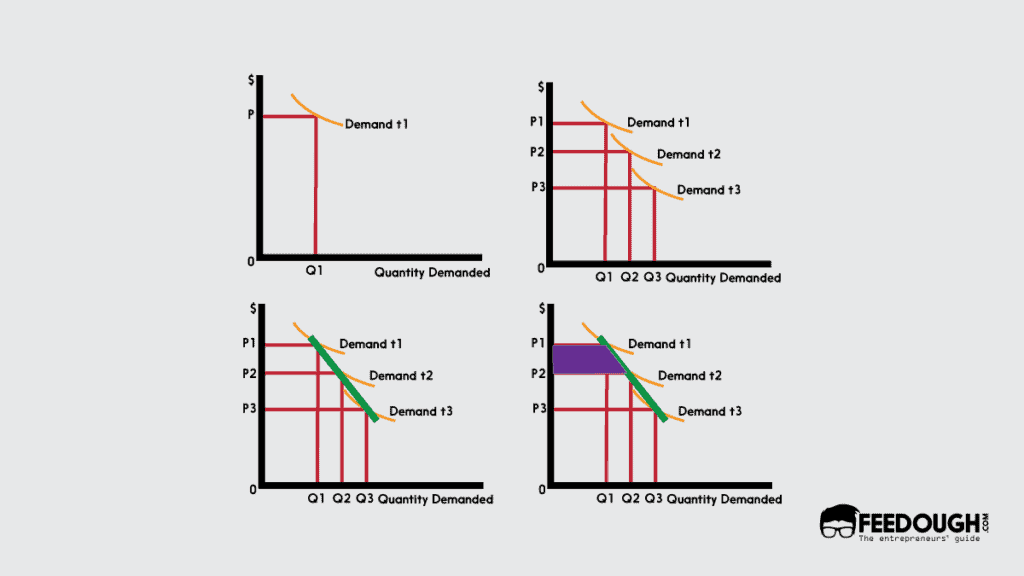
    Under this strategy,  a marketer initially sets a relatively high price for a product or service and gradually decreases the price. The idea behind the plan is to charge relatively high prices to recover the product development costs early and before competitors enter the market.

    An excellent example of a price skimming strategy would be companies that sell electronic products like Apple iPhone and Sony PlayStation 3. Initially, the Playstation 3 was released in the US market at $599; however, the brand progressively dropped its price to less than $200.

    Price skimming

    These are the graphical representations of price skimming. Also, price skimming is sometimes known as riding down the demand curve.

    Psychological Pricing

    Psychological pricing is based on the hypothesis of the psychological impact of specific prices on the customers. Here, the price is set at a little less than a round number price, such as $19,99. Thus, the prices charged are also known as “odd prices.”

    The strategy is to make modest pricing modifications to make the customer think that the item costs are lesser. For instance, during an end-of-year sale, a product is priced at $199, and customers view this price as closer to $100 than $200.

    Penetration Pricing

    In this strategy, new products are priced at a lower level than the target market expectations. The aim is to make products and services more sensitive to consumers and convince them to try them out. If this strategy is implemented efficiently, it can increase market share and sales volume and discourage competition in the long run.

    For instance, a satellite tv company may offer a low price and then increase the price as its client base expands or an online news website offering one-month free service for a subscription-based service.

    Competitor-Based Pricing

    Under this pricing strategy, a company set a price compared to its rivals. It can set the price of its product equal to or higher or lower than the price fixed by the competitors.

    • When a company sets its price equal to the other competitor’s prices, it’s known as the going rate pricing. Generally, the price of agricultural items is set in this way.
    • Sometimes, the price is fixed at a level that is below the price of rivals. This strategy is intended chiefly to attract price-sensitive clients by removing competition from the markets.
    • Companies also set their product price above the price set by their rivals. It fosters the increase of the product’s market image or goodwill.

    Premium Pricing

    The approach of this strategy is to set a high price for attracting status-aware consumers (sometimes this strategy is referred to as prestige pricing). It is mainly done to improve and strengthen the luxury image of a product.

    For example, Harrods, first-class airlines, and Porsche usually use this pricing strategy.

    However, the companies that use this strategy seldom sell products at a discount as they feel it would harm the brand’s image. Instead, they provide gift packages that bring value to customers.

    Bundle Pricing

    This strategy involves the sale of numerous items as a single integrated product at a lower price. It goes by the name of a package deal or a buy one get one free discount.

    For instance, this method is used in the software sector and the fast-food industry, where several goods may be bundled together. Even hotels provide packages that include lodging, meals, and activities for a special price.

    Cost Plus Pricing

    The simplest way of pricing is cost-plus or markup pricing, where a standard markup is added to the cost of the product. This markup is based on the amount of profit (return) the firm aims to generate.

    There are significant differences in markups across various products. Popular markups (on price, not on cost) are 9% on baby food, 14% on tobacco items, 27% on dry food, 50% on greeting cards.

    Cost plus pricing: p = AFC + AVC + X/Q

    Therefore, cost-plus pricing equals the average variable cost plus average fixed cost plus the markup over costs on each output unit.

    For instance, the cost of a product is $100. If a company aims to sell it at 20% profit, the cost-plus price would be $100 plus 100/100 x 20.

    Price Mix Examples

    Let’s understand how companies use different variables of price mix to establish their hold in the market.

    Uniqlo, a Japanese clothing brand, is renowned worldwide for its low price and good quality products. Most of the products at Uniqlo are priced under $200. For instance, the price of jeans is $25 while that of a T-shirt is $15. Thus, the pricing objective of the brand is sales-oriented, aiming to increase market share.

    Furthermore, the brand pays attention to quality and doesn’t go bogus on fashion trends like its competitors. Thus, in addition to its sales maximisation objective, the brand also aims to become a quality leader.

    Moreover, Uniqlo’s pricing for the T-shirt always ends at 99. Thus, it follows a psychological pricing strategy along with temporary discounts.

    Another example is Dove, a personal care brand that employs a competitive pricing strategy since it operates in a competitive environment. It distinguishes itself from its rivals by focusing on quality. For instance, Dove Damage Therapy Shampoo (700 ml) cost $11.70, versus Pantene Shampoo (700ml) cost $10.90.

    Also, Dove charges $7.50 for a Dove Beauty Moisture Body Wash bottle and $13.90 for a bundle of two bottles. Thus, it also implements the bundle pricing strategy.

    Pricing Mistakes that A Seller should Avoid

    An effective price strategy helps businesses improve sales and establish a loyal customer base. However, the wrong price strategy can make companies struggle with customer service and profitability. Thus, given the importance of pricing, it’s significant to steer clear of the following pricing errors.

    • Pricing too low: Enlight’s research has shown that overly low prices set by sellers account for 33% of pricing errors. So, even though low prices might attract more customers, it often implies that the product might be of poor quality.
    • Not practising customer segmentation: Often, companies use the same approach for a lot of their customer base. Thus, by neglecting the fact that the value offered differs in different market segments for any product or service, a company creates a negative image in customers’ mindsets.
    • Pricing too high: Companies think they’ll generate attractive returns on each transaction if they price their products excessively high. However, customers are very aware of the value they receive for their money and quit buying after they have concluded that things are overpriced. So,if the price is greater than customers’ perceived value, the sales cost increases, discount increases, sales cycles get extended, and thus, it generates insufficient profits.
    • Not focusing on the customer experience: The value perceived by the customer is more important than what a company believes is the best deal. Thus, a seller’s biggest mistake is adopting a rigorous approach to cover their costs and totally neglecting their clients’ perspectives. 
    • Changing prices without forecasting competitors’ reactions: A company must consider the predicted competitive movements before setting the price. It is crucial to consider expected competitive price changes and objectively evaluate competition product and service quality when determining price modifications.

    Go On, Tell Us What You Think!

    Did we miss something? Come on! Tell us what you think of this article on price mix in the comments section.
  • What Is Subliminal Advertising? How Does It Work?

    What Is Subliminal Advertising? How Does It Work?

    One of the most controversial and debated forms of marketing is subliminal advertising. The idea that a company can influence your buying habits, without you even knowing it, is fascinating yet scary at the same time. But is such a thing possible? And if so, how could it work?

    Here’s a guide.

    What Is Subliminal Advertising?

    Subliminal advertising is a marketing technique that involves exposing individuals to subtle messages that are embedded within other things. This might be an image, a section of the text, or even video/audio. These messages are designed to affect the mind – consciously or subconsciously changing the customers’ buying habits, beliefs about certain products, etc.

    Its goal is to influence without the target audience even knowing they are being influenced. In fact, they won’t realise these messages have any effect on them at all.

    In simple terms, subliminal advertising leaves the viewers with a message in their heads that they did not consciously acquire from the advertisement.

    For example, a simple image of a group of happy friends, with a Coca-Cola logo, in a cinema outlet before the movie starts or during the interval is subliminal advertising. Although individuals would think it to be an ad to increase brand awareness, its message is to make them want to drink coca-cola during their time at that place.

    The rational explanation for this is simple: the subconscious mind is extremely more powerful than the conscious one. In the above example, the subconscious mind can process the Coca-Cola logo, assuming that Coca-Cola would be a great beverage for movie intervals.

    How Does Subliminal Advertising Work?

    Subliminal advertising works around subliminal messages or communication. These messages are not directly broadcast to an individual, instead, they are embedded within another message(s).

    Subliminal messages aim to affect the mindset of an individual, without them even realising it. A simple example of this is in television advertisements.

    Often, companies will use certain images or symbols in their adverts that associate with the product they are trying to sell. For example, a company selling a weight loss product might have an advertisement where a young, slim girl is eating a grape, and the healthy juice colour makes people subconsciously associate a healthier lifestyle with drinking this product. This technique relies on how your brain automatically associates images with products.

    A real-life example of such a subliminal message is SFX magazine’s font style in its Jennifer Garner issue. SFX magazine is a popular magazine that covers a variety of science fiction movies and TV shows. In this special issue, SFX decided to have an interview with actress Jennifer Garner. And they tactically hid the bottom of the letter ‘F; that suggested the real title to be SEX. This was a ‘subliminal’ message to the reader, suggesting a more sexual theme behind the interview.

    Subliminal Advertising SFX magazine
    ad

    Unlike other marketing techniques such as direct or indirect advertising, the viewer/listener does not see subliminal messages unless they know what they’re looking for. They think it’s just another part of the advert and of no interest. But this is the key – the messages are actually designed to influence them unconsciously.

    Importance Of Subliminal Advertising

    Advertisers prioritise the relationship of a product with its utility and economic worth. However, when it comes to subliminal advertising, this is not the case. Subliminal advertising is about building a relationship with each customer by creating an emotional connection with their unique experiences and daily lives.

    There are three main reasons why marketers use subliminal advertising-

    • It serves as an effective stimulator: Although people may say they make decisions rationally, in reality, emotion plays a major role in most purchases. Subliminal advertising taps into this by stimulating the emotions of the viewer.
    • It sets a lasting impression: Subliminal advertising can be likened to planting seeds in your subconscious mind. The advertisement makes an impact without you realising it, which goes on to influence future decisions regarding purchases.
    • It can be persuasive enough to change buying patterns: Subliminal messages are known to be persuasive enough to bring about a change in buying habits. It can make people realise they want something new, sending them out to buy it.

    Advantages Of Subliminal Advertising

    The advantages and benefits of using subliminal messaging as a form of advertising are endless. Outlined below is a list of the main advantages:

    • Subconscious connect: Subliminal messages appeal to the subconscious mind of a person who is being targeted. It compels them to buy a product without giving much thought to its advantages and disadvantages.
    • Better ROI: Subliminal advertising is also known to have a better return on investment than other indirect advertising forms. It can create an emotional bond between the product and its consumers, which ensures future purchases. It sets a lasting impression about specific products or services in customer’s subconscious minds, with them making future decisions based on the same
    • Easier to process: Subliminal messages are easier to process in comparison to direct forms of advertising that come with a lot of information. People who watch or listen to subliminal messages have an increased ability to recall when compared to those viewing straightforward advertisements. This is because their brains work at a higher level, making it easier to process the messages.
    • It resonates with consumers: Subliminal messages are able to resonate with people more than any other type of message because they are designed to tap into human emotions.
    • Creates an impact: Subliminal advertising is able to create a massive impression on its viewers without them even realising it. This is possible as people often have a threshold for how much they can pay attention to. When the messages are being sent below this threshold, they cannot be processed in a conscious manner and reach the subconscious instead.

    Disadvantages Of Subliminal Advertising

    Although subliminal messaging can be advantageous for an organisation, it does come with some disadvantages that must not be ignored. The following points highlight some of the disadvantages:

    • Customers may feel cheated: Subliminal advertising is often seen as a deceptive practice because it is not made known to consumers. Those targeted by this type of advertising may feel cheated because they do not know why they have a certain opinion about a product, so they may lose trust in the brand.
    • Messages may backfire: The messages being sent out in a subliminal manner may have the opposite effect to what was expected. For example, a car manufacturer may send a message saying something is fast in a bid to make their product look good. However, this backfires when the car is revealed to be slow, leading to customers feeling cheated and dissatisfied with the car
    • It cannot always be controlled: Although subliminal messaging can reach an individual’s subconscious mind, it cannot be targeted as easily compared to other forms of advertising due to its indirect nature. This means it may not reach all individuals who are supposed to receive the message, thus having an impact on the overall results.
    • No outright persuasion: Subliminal messaging does not always directly affect consumers, so it cannot be used to force them into making a purchase. This means organisations must find other ways of persuading customers to buy their products and services after being influenced by subliminal messages.
    • It could be misunderstood: Subliminal messages are often very open to interpretation, meaning that what you intend them to convey may not necessarily come across as intended. The effectiveness of these messages will depend on how well they are used, which is why marketers must be careful with the messages they send out.

    Bottom Line

    Subliminal advertising is becoming more popular among marketers today because of its ability to create an impact on consumers without them being aware of it. If used correctly, subliminal messaging can be a powerful tool for marketers who want to attract consumers to their products and services.

    But it is still impossible to say whether or not subliminal advertising is effective. This is because there hasn’t been any conclusive evidence to prove that these messages are enough to bring in the desired results. More research needs to be done before marketers can have a more solid opinion about whether this type of marketing is beneficial for them or not.

    But one thing is clear: subliminal advertising has a lot of potential. The power to influence a person’s subconscious mind makes it a powerful tool for marketers who want to reach their customers in the most effective way possible.

    Go On, Tell Us What You Think!

    Did we miss something?  Come on! Tell us what you think of this article on subliminal advertising in the comments section.
  • What Is Cryptocurrency? How Does It Work?

    What Is Cryptocurrency? How Does It Work?

    You must have heard people talking about some confusing words like blockchain, decentralisation, cryptocurrency, cryptography and many more. Well, these words are not so random anymore. They are the pillars of the future of finance. For instance, blockchain has completely revolutionised the financial sector by introducing decentralisation as well as security and transparency.

    But when did it all begin? What was the starting point of blockchain? Who invented it? The answer to all these questions is Bitcoin. Bitcoin marked the beginning of the decentralised financial system when a pseudonymous user named Satoshi Nakamoto created Bitcoin in 2009. But, Bitcoin isn’t a blockchain. Bitcoin is a cryptocurrency based on a blockchain.

    Confused?

    Let’s decode all these terms one by one.

    What Is Cryptocurrency?

    Cryptocurrency is a decentralised, transparent and peer-to-peer based digital currency secured by cryptography that operates on blockchain technology.

    In simple terms, it is a digital currency in which encryption techniques are used to regulate the generation of currency units and verify the transfer of funds, operating independently of a central bank.

    Precisely, cryptocurrency is digital money that eliminates an intermediary or a central authority. In fact, the main idea behind the concept of cryptocurrencies and blockchain was to introduce decentralisation in the financial ecosystem.

    Decentralisation means that no central authority, like the government or central banks, regulates the operation of cryptocurrencies. This makes all cryptocurrencies censorship-resistant and immune to any kind of third-party manipulation.

    It all began in 2009 when a pseudonymous person (or group) named Satoshi Nakamoto came up with Bitcoin. Bitcoin was the first cryptocurrency ever, and this is when the concept of blockchain and cryptocurrencies came to life. Blockchain is a decentralised digital ledger that stores and records transactions in a sequence of blocks that are chained together.

    What Is Cryptocurrency?

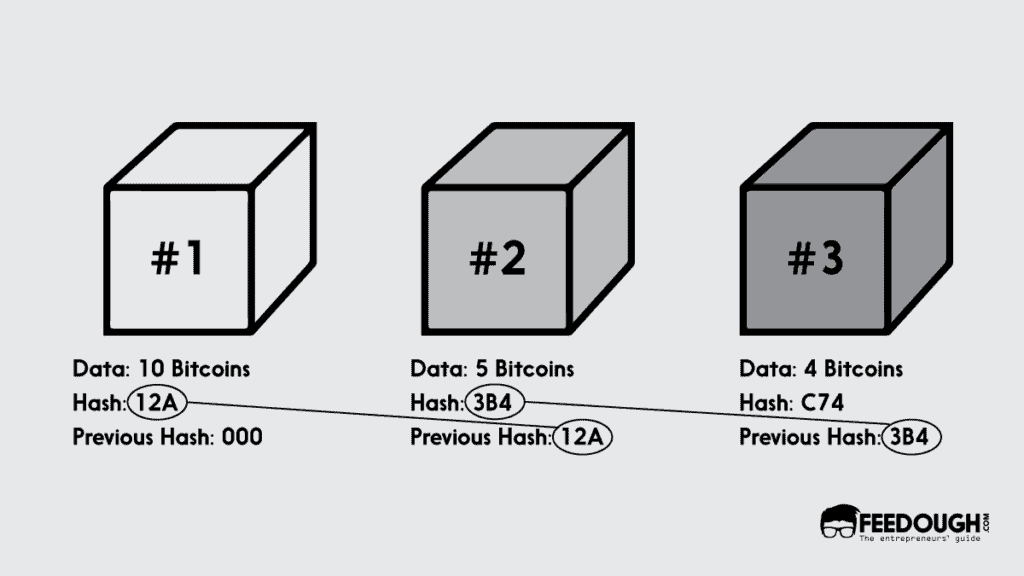
    Each block is connected to its previous block in a blockchain as each block contains the hash values of current transactions and the transactions stored in the last block.

    Every new transaction after verification gets added to a new block which is then linked to all other blocks making up the chain. The whole process makes it almost impossible to change or alter any information that has already been recorded.

    Consider blockchain to be similar to the game of Jenga. Every block is a Jenga piece that can be moved or played with, but once you tamper with a piece from the bottom, it makes it harder for the following blocks to sustain.

    In this way, blockchain technology is built in such a manner that as more records are added to it, it gets increasingly difficult to make changes as there would be a lot of records that would need to be altered.

    If anyone tries to change the information in one block, they will have to update all the blocks after it because the hash values change as soon as the data is edited. So, each block in a blockchain is permanent, and all the users can see every transaction in a public blockchain along with its time-stamp. 

    This makes blockchain technology secure and incorruptible over time.

    How Does Cryptocurrency Work?

    The concept of cryptocurrencies works on three pillars: blockchain, cryptography and crypto mining. Let’s take a look at these terms one by one.

    Cryptography

    Cryptocurrency is a portmanteau of two words – crypto and currency. The word crypto comes from cryptography, which is the main concept behind the working of cryptocurrencies.

    Cryptography is a method of securing information so that only the intended recipient can understand it. Cryptocurrencies use two keys called the private key and the public key.

    The public key can be considered your bank account number, which can be shared with others to enable crypto transfers to your wallet.

    The private key can be thought of as a card pin that shouldn’t be shared with anyone. The private key is used to secure and access one’s crypto holdings and sign transactions.

    What happens behind the scenes is that an algorithm is used to encrypt the user information. This algorithm takes the public key as input to encrypt the information and requires the private key to decrypt the same information. That is why the private key must be kept secret so that only the intended user can decode the required information. 

    Crypto Mining

    One of the most basic questions that come to mind while understanding cryptocurrency and blockchain is, who enters new blocks to a blockchain? Or, why can’t one reverse or change a blockchain transaction? The answer to these questions is crypto mining.

    Crypto mining is a phenomenon that helps in maintaining the blockchain by attaching more transactions in the blockchain and rewarding the miner with cryptocurrencies for the same. This process encourages miners to maintain the blockchain by minting more and more cryptocurrencies and allowing new coins into circulation.

    Crypto mining is a two-fold process. First, the miner verifies the transaction in question to ensure that everything is in order and the sender has authorised the transaction using their private key. The second step involves creating a new block in the blockchain and attaching it with the previous block.

    There are various ways of mining cryptocurrencies. Two of the most popular ways are:

    • Proof of work: in the proof of work system, the miner needs to solve a computational mathematical equation or a cryptographic puzzle. Whoever first solves this puzzle gets the reward for mining the cryptocurrency. What happens behind the scenes is that miners try to come up with a hash less than or equal to the target hash. This is the hash that links the current block with the previous block in the blockchain.
    • Proof of stake: instead of getting the miners to compete with each other, proof of stake works on a consensus-based algorithm in which a node is randomly chosen to validate the data in the next block. But the process is not completely random. First, a node is required to deposit a certain amount (or stake) into the network. The higher the amount deposited, the higher are the chances of a node becoming a validator. Then the validator verifies all the transactions and then adds them to the blockchain. As a reward, the validator receives the fees associated with each transaction.

    Although proof of work and proof of stake are the most popular ways of crypto mining, there are tons of other ways like proof of coverage or proof of space. As new blockchains come into existence, the developers try to find different ways to mine cryptocurrency and maintain the blockchain to improve energy and time consumption.

    Some of the essential terms related to crypto include:

    • Crypto assets: this is a blanket term that refers to all the assets that operate on a public ledger and utilise cryptography. The difference between cryptoassets and cryptocurrency is that cryptoassets are not limited to just cryptocurrencies. They also include various utility tokens, platform tokens, and tokenised securities. For example, Bitcoin BTC is a cryptocurrency. On the other hand, utility tokens like LOOM that provide access to a blockchain-based service are considered cryptoassets.
    • Cryptocurrency: this refers to a form of digital or virtual currency that is decentralised and uses cryptography to secure the transactions and control the creation of new units. All cryptocurrencies are crypto assets, but not all crypto assets are cryptocurrencies. This is because some crypto assets like LINK has a different use case than to challenge the traditional financial system.
    • Crypto tokens: this category includes assets like fungible tokens, non-fungible tokens (or NFTs) and DeFi tokens. Crypto tokens are crypto assets that are not native to any particular blockchain. Although Ethereum is the most utilised blockchain to mint tokens, several other blockchains support them.
    • Cryptocurrency miner or mining rig: these are computers or servers that are specially designed to solve complex mathematical problems in order to generate cryptocurrency.
    • Cryptocurrency wallet: this refers to a digital wallet that is used for storing and transferring decentralized cryptocurrencies from one user to another. Using these wallets, users can also send and receive coins or tokens.
    • Cryptocurrency Exchange: this is a platform where cryptocurrencies can be bought, traded or sold against fiat currencies or other cryptocurrencies. Most of these exchanges also offer crypto wallets that allow users to hold their digital currencies securely.

    Types Of Cryptocurrency

    There are various types of cryptocurrency based on their use cases including:

    • Payment cryptocurrencies: These cryptocurrencies are designed to make payment solutions faster and more secure by replacing the traditional banking systems. For example, currencies like Bitcoin or DAI are designed to serve as an alternative to traditional cash. They are generally pegged to traditional assets to provide price exposure and stability to established values while giving the benefits of transparency and decentralisation.
    • Infrastructure cryptocurrencies: These cryptocurrencies are used to maintain and use applications of a particular blockchain. For example, Ether is an infrastructure cryptocurrency as users are required to purchase it to use any decentralised application running on the Ethereum blockchain.  
    • Financial cryptocurrencies: The main application of financial cryptocurrency is to manage or exchange other crypto assets. For example, they may be used to help users trade on exchanges, crowdfund money, lend or market cryptocurrency and speculate on the outcome of certain events. Examples of such cryptocurrencies include Compound, Balancer, Curve or Gnosis.
    • Service cryptocurrencies: These cryptocurrencies are used to manage and record data from different industries and link them to blockchain. For example, a cryptocurrency called Dentacoin provides various services related to the healthcare industry. Other examples of service cryptocurrencies include Chainlink, Filecoin, Orchid, etc. 
    • Media and entertainment cryptocurrencies: Media and entertainment cryptocurrencies are used to reward users for content or games and are even utilised in various decentralised applications that utilise virtual reality to operate.

    How To Invest In Cryptocurrency?

    Investing in cryptocurrency is becoming increasingly popular as many people have earned huge profits through buying and selling cryptocurrency using speculation.

    There are two ways through which a user can invest in cryptocurrencies. They can either use a crypto brokerage firm or a crypto exchange:

    Cryptocurrency Brokerage

    A crypto brokerage is a firm or an individual that acts as a mediator and facilitates the buying and selling for the user. This is a good option for someone who is just a beginner in crypto trading and wants to explore and study the market.

    To trade using a crypto brokerage, the user must sign up to make an account with any brokerage of his/her choice like Coinbase, Gemini and eToro. After that, the user can fund the account and then choose a cryptocurrency like Bitcoin or Ethereum to begin investing.

    Cryptocurrency Exchange

    A crypto exchange allows a user to directly trade with other buyers and sellers by eliminating the intermediary. Using a crypto exchange, the user can trade cryptocurrencies for other decentralised and digital currencies or fiat currencies based on current market prices. Crypto exchanges are a perfect platform for advanced users and traders who trade in crypto through speculations. Some examples of popular crypto exchanges include Binance, Kraken or Coinbase.  

    Why Invest In Crypto?

    There are quite a few advantages that make it attractive for investors as well as for traders. While trading and investing are not the only two applications of cryptocurrency, they are so far the most popular ones. Many people use speculation as a technique to invest money in crypto and make huge profits. Some of the major benefits of investing in cryptocurrency are:

    • Low transaction costs: Cryptocurrencies work on a decentralised blockchain system. This means that there are no intermediaries such as banks or brokers and hence there are no additional transaction costs except for the blockchain network’s fees. Furthermore, there are no requirements for any kind of paperwork or identity proof. The whole process is smooth, easy and extremely fast.
    • Globalised access: Unlike with banks or centralised authorities, there are no restrictions as to who can use cryptocurrencies. Anyone with an internet connection and funds to transfer can invest and trade in crypto. However, there are some countries that ban the use of crypto for their citizens but blockchain or crypto as a system doesn’t restrict access to any user whatsoever.
    • Immutable transactions: Unlike in traditional financial systems, the transactions made through crypto coins are immutable. This means that once a transaction is added to a blockchain, it cannot be reversed or tampered with at all. Thus, the records of all the transactions are accessible by all the members forever. Also, there is no way for anyone to reverse a crypto transaction once it is made.
    • Secure network: Cryptocurrency is based on an extremely secure technique called cryptography. While traditional currencies could be stolen or destroyed, it is challenging to steal crypto since one needs the public as well as the private key of a user to access the crypto stored in a wallet. Although there have been reports of hackers figuring out users’ private key and hacking into their wallets, the process is extremely difficult, making crypto much more secure than fiat currencies.
    • Self-controlled and self-managed: Since cryptocurrency completely eliminates the need for an intermediary, it is potentially free from the whims and control of a third party. For example, banks have the authority to close your accounts while the government has the authority to print money or lower government expenditure or increase and decrease interest rates as per their discretion. But, with cryptocurrency, the value of various coins are decided solely on the basis of demand and supply. No one has any authority over anyone’s funds and everyone is a part of the community.

    Cryptocurrency Risks And Challenges

    While cryptocurrency and blockchain have many advantages and use-cases, users also face certain challenges and risks while using crypto. Most of the risks stem from the fact that cryptocurrencies are not regulated, thus there is no one to look after the users and their security.

    Some major risks and challenges include:

    • Regulatory and compliance risks: In a cryptocurrency system, anyone can create multiple accounts while being completely anonymous. There are no regulatory rules or guidelines which the users are supposed to follow and this creates potential risks of illegitimate activities such as money laundering or drug trafficking. This is the reason why some countries like China have banned the use of cryptocurrencies. 
    • Trading costs and illiquidity: When compared with the traditional centralised currencies, cryptocurrencies are generally less liquid and more volatile. This is because the supply and value of cryptocurrencies are only determined by the value placed on them by the users through their transactions. Furthermore, some crypto exchanges continuously manipulate prices by trading against their users. This further makes the cryptocurrencies illiquid and increases trading costs. 
    • Cyber threats: The biggest advantage of cryptocurrencies is that they do not rely on any traditional financial institution. This lack of regulation is what imposes the threat of cyber attacks. Furthermore, as cryptocurrencies are completely based on code, there is a potential risk of hackers breaking into crypto exchanges and crypto-wallets. The cyber threats are extremely serious and may lead to huge losses with little recovery potential at the user’s end. For example, suppose somehow a hacker gets access to a user’s private key. In that case, they can easily gain access to the user’s wallet and even impersonate all of the user’s transactions and transfers.
    • Energy costs: Another challenge in the use of cryptocurrencies is the energy costs while mining crypto coins. The proof of work required while mining cryptocurrencies consumes a lot of energy depending on the system’s hardware performance. Since almost all the cryptocurrencies require proof of work, this also impacts the environment as more electricity means increased carbon emission and thus increased global warming.  

    FAQs on Cryptocurrencies

    How many cryptocurrencies are there?

    As of 2021, more than 6,800 cryptocurrencies have been identified. Some of the most popular ones include Bitcoin, Ethereum, Litecoin, Cardano, PolkaDot, Stellar, etc.

    Is cryptocurrency the same as digital currency?

    No, a digital currency is not the same as a cryptocurrency. Digital currency is simply the electronic form of fiat currency issued by the central authority. Their use has recently increased so as to achieve contactless transactions. But, these currencies are still centralised, stable and not at all transparent.

    Does cryptocurrency have an infinite supply?

    This statement is partially true. First of all, not all cryptocurrencies have an infinite supply. For example, Bitcoin has a limited supply of 21 million coins. And of these almost 90% of coins have already been mined. Thus, after all 21 million coins are mined, the miners will receive their rewards through fees of transactions.

    Now, some crypto coins such as Ethereum have an infinite supply. But, these could lead to huge inflation. So, the developers have tackled this issue by fixing the number of coins to be generated every year. Thus, the supply is unlimited only in the long run. In the short run, for example in a year, only 18 million Ether coins can be mined.

    How are cryptocurrencies assigned value?

    The answer to this question is simple. Cryptocurrencies have value because people become them to have value. Just like other currencies, crypto does not have an inherent or intrinsic value. For instance, take the example of fiat currencies. Suppose the government or the central authority of any country declares that a certain currency no longer holds any value. In that case, people will stop using that currency and it will immediately lose all value. The same is the case with cryptocurrencies. The users themselves decide the value of crypto coins by believing that they can be used as a currency and store value. Thus, the value of almost all the crypto coins is decided by the forces of demand and supply.

    Go On, Tell Us What You Think!

    Did we miss something? Come on! Tell us what you think about our article on what is cryptocurrency? in the comments section.
  • What Is PESTLE Analysis? – Factors, Importance & Examples

    What Is PESTLE Analysis? – Factors, Importance & Examples

    When it comes to business success, not everything is in the hands of the business. Many external factors affect business growth or decline. These factors are called environmental factors or “external” factors. Therefore, companies need to ensure their success by understanding these important external factors and taking them into account in order to achieve better results than their competitors.

    PESTLE analysis comes in handy to understand these external factors. It helps business owners assess the situation of their industry at large, as well as specific opportunities and threats that might come with it.

    Here’s a guide explaining PESTLE analysis, its factors, importance and examples.

    What is PESTLE Analysis?

    PESTLE analysis stands for Political, Economic, Social, Technological, Legal and Environmental analysis. It’s a strategic framework used by companies to assess the impact of external factors on their business.

    Also referred to as PESTEL analysis, it helps in understanding the key forces that affect a business’s environment and performance at large. As such, it can be used during strategising to evaluate potential opportunities or threats in the current macro-environment.

    pestle analysis

    PESTLE Analysis Factors

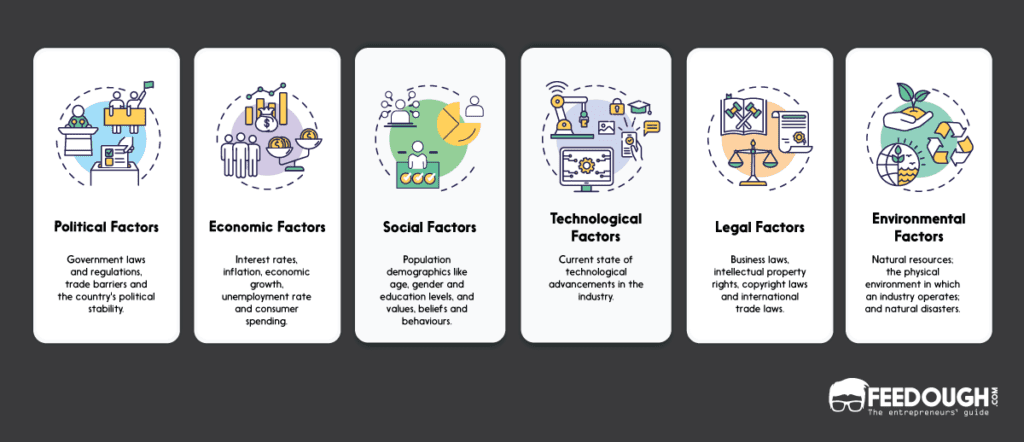
    PESTLE analysis is divided into six sections:

    Political Factors

    Political factors constitute the political factors that affect a business, including the government’s policies for its citizens and businesses. These may include rules, laws, taxes, tariffs or other restrictions imposed on companies by various government departments. Taxation policies, foreign trade regulations, political stability etc., are some other considerations in political components.

    For example, a new import policy banning imports from a specific country may affect the company’s business. Another example is demonetisation in India, which affected businesses operating in this country during 2016-2017.

    Economic Factors

    Economic components comprise the factors that determine the financial health of a nation, including GDP growth rates, inflation, unemployment, etc. It’s also about the employment rate and job security. The economy’s financial position and stability at a given time directly influence the economy’s saving, investment, and employment levels.

    For example, if the economy is doing well, people will be more willing to spend money on discretionary items. Wage rate, unemployment, economy’s growth rate, credit availability, cost of living are some other economic factors that businesses need to consider.

    Social Factors

    Social components of PESTLE analysis incorporate demographics, including population and lifestyle. It also covers the social trends and values of society at a given time. Moreover, it considers the social behaviour and habits of the consumer.

    For example, if people in that region or locality are more inclined towards organic foods, then demand for such products will be higher there compared to other areas. Social changes, population growth rate, employment level etc., are some other considerations under social components.

    Technological Factors

    Technological components encompass the factors affecting the degree of technology and innovation in a country. They include the technological advancement of the society, cost-effectiveness of technology, R&D investments in a country etc.

    For example, a speedy internet facility will increase demand for video streaming services, threatening TV broadcasters catering to the same media segment. Availability of fast transport facilities will improve access to remote locations and boost sales from that region. Technological advancements, infrastructure for research and development, availability of skilled labour force together determine technological components.

    Legal factors refer to the laws and regulations passed by the government for businesses operating in that region or locality. These include environmental protection acts, anti-bribery laws etc., that affect the business operations.

    For example, a new law prohibiting businesses from using plastic bags to pack their products will affect the packaging and distribution expenses of companies dealing with such products.

    Environmental Factors

    Environmental components, also referred to as geographical factors, include all factors affecting nature and ecology. Specific industries like insurance, farming, tourism, adventure sports etc., have to analyse ecological trends closely to operate effectively.

    For example, severe pollution of rivers and lakes due to dumping of untreated industrial effluents will directly impact related businesses. Availability of natural resources also affects a business’s operation in a given locality or country.

    The Importance of PESTLE Analysis

    PESTLE analysis gives the businessman a chance to view the business prospects through the lens of the entire economy. It helps comprehend the business position taking into account all the macroeconomic forces. It works as a:

    1. Evaluation framework- PESTLE analysis helps a company weigh its performance by looking into the broad political, economic, social, technological, legal, and environmental factors influencing it. It helps a business gauge the favourable conditions in its launch stage, entry-stage into a new market or during its lifecycle.
    2. Mapping technique: The analytical framework gives a bird-eye view of the company’s present stance and a sneak peeks into the future trends. These insights also help the business to make decisions concerning the near future and plan its course of action for the long term.
    3. Strategic planning tool: The study of PESTLE elements makes the corporations aware of the environment they are operating in. Better know-how of this environment gives them a competitive edge over other players and helps in strategic decision-making.

    Case Uses Of PESTLE Analysis

    PESTLE analysis finds its practical application in the following:

    1. Workforce planning: Developing the workforce requires the alignment of business and personal goals. PESTLE analysis helps identify the key issues that prevent it and helps create a long-term committed workforce.
    2. Strategic business planning: Valuable insights from the PESTLE analysis immensely aid business planning. They indicate the areas of focus and direct the course of future actions by its top management. It helps address weaknesses and harness the strengths of the company systematically.
    3. Marketing groundwork: Evaluation of PESTLE factors helps understand critical market trends in the external environment. It helps to plot the marketing groundwork for the product by fulfilling the most key marketing objectives.
    4. Product development: PESTLE analysis gives better awareness about the product through consumer inputs. This response helps the firm in developing the product through constant improvements and advancements.
    5. Organisational revamp: The exploration of the macroeconomic PESTLE factors helps in identifying the reason for organisational revamp. It gives insights into potential challenges to such a revamp and allows businesses to take corrective action in advance.

    Advantages of PESTLE Analysis

    PESTLE analysis is a robust tool that provides several important benefits to the corporate world. They include:

    1. Saving costs: A commitment of time and effort is the only cost incurred in PESTLE analysis. No monetary prices are spent on it, making it one of the best cost-effective analytical frameworks in use.
    2. Gaining cognisance: PESTLE analysis gives a better understanding and awareness of the product-launch environment by investigating its factors. It keeps businesses firm footed as they are conscious of the environment and can modify the product according to the changing trends.
    3. Avoiding threats: PESTLE analysis is a multi-dimensional approach to inspect the political, economic, social, technological, legal and environmental domains. Regular analysis keeps the businessman aware of the potential threats and avoids such possibilities by corrective actions. For example, complying with necessary labour norms in advance to avoid legal sanctions.
    4. Tapping opportunities: The systematic framework explains how the firms can utilise the changing PESTLE factors to their advantage. For example, the government’s seed fund is a boon for startups.

    Disadvantages of PESTLE Analysis

    Although PESTLE analysis is an effective way to understand the business environment, it comes with certain limitations. They are:

    • Time-taking: It takes time to find reliable sources, gather data, classify the data, make sense, bring out the highlights and formulate a report. An enormous amount of time to tackle each PESTLE factor and then draw insights from the same makes it undesirable.
    • Inconsistent: Top-level personnel feeds on the data to carry out the PESTLE analysis. Each of them has a different set of beliefs and perceptions which guide their thoughts. Therefore, conclusions made by each may be different and inconsistent in respect to others: which makes decision-making tough.
    • Unreliable: The PESTLE factors are dynamic and frequently change, making the analysis unpredictable at any time. In addition, most of the data required for the study is not readily available, which again adds to the downside of PESTLE analysis.
    • Complexity of analysis: The framework gives results through a multi-dimensional examination process that requires expertise and experience to hone skills in this field. It can be daunting for beginners who lack these traits or professionals not having specific knowledge in the organisation.

    Examples of PESTLE Analysis

    Organisations across the globe are doing their level best in producing the optimum output suiting their target audience’s preferences, using PESTLE analysis. Here are case examples of the same.

    Coca-Cola

    It is the leading global player in the beverage industry with almost $40 billion in revenue and dominates 50% of the carbonated beverage market. It projects itself to ‘Refresh the world. Make a difference.’

    Let’s look into how Coca-Cola works and understand its PESTLE components and their impact on the firm in the past.

    Political factors

    • Coca-Cola ban in Sri Lanka in 2013 for three months owing to trade sanctions.
    • Countries of Cuba and North Korea prohibit the sale and purchase of Coca-Cola due to the prevailing political conditions.
    • The trade war between US and China in 2020 impacted the price of Coca-Cola canned products due to a tariff-rise on aluminium and steel.

    Economic factors

    • In 2019, an increase in the price of its canned products due to a hike in tariffs increased its revenues by 8% in the third quarter.
    • In 2018, the new trade agreement between the US, Mexico and Canada for free and fair trade; shifted the demand to low-calorie drinks. It increased the retail value of its products, namely Diet Coke and Zero Sugar, by 8%.

    Social factors

    • In 2014, the #shareacoke campaign helped the rand to connect with people and amplified its social media presence
    • Online Coca Cola store enabled personalisation of names in the bottles and connected on a personal level with its consumers

    Technological factors

    • Coca-Cola leverages social media networking to stay in touch with the trends.
    • Its innovation finds a way through online gaming portals where consumers play games online and relate with the brand personally.
    • Customisable drink dispensers
    • The quantity of caffeine found in its product has posed questions in the past in many countries.
    • The corporate ethics of Coca-Cola have been at stake due to alleged numeral suits of racial discrimination filed against the company in the past.
    • Mislabeling of products has also been a cause of serious concern in the past.

    Environmental factors

    It is reported as the largest consumer of freshwater globally and is taking steps like intelligent farming methods to tackle the issue. 

    Nike

    With a whopping revenue of $42.3 billion, Nike is a global leader in the sports equipment and apparel industry. It accounts for 37% of the market share and aims to ‘bring inspiration and innovation to every athlete in the world.’

    Let’s look into how Nike makes it happen and understand its PESTLE components and their impact on the firm in the past.

    Political factors

    • The company has its business spread worldwide; therefore, trade policies of imported goods, trade regulations with the US, change of governments, embargos etc., exert direct influence on the business.

    Economic factors

    • Nike operates at lower profits in countries with excessive import duties and low purchasing power.
    • Nike has dealings overseas, which makes it susceptible to fluctuations in exchange rates in different countries.

    Social factors

    • Nike has faced criticism over sweatshops or strikes by the workers on account of salary and work environment in the past.
    • Changing customer preferences and fast fashion cause dramatic shifts in its operations.

    Technological factors

    • Nike makes significant investments in research and development facilities to offer top-of-the-line products.
    • Nike has infused capital in various laboratories and expertise for biomechanics, exercise psychology, engineering etc.
    • Labour laws of different nations relating to safe and healthy working conditions have led to lawsuits against the firm in the past.
    • Aggressive advertisement campaigns by the firm have also come under legal scrutiny.

    Environmental factors

    • Nike ranks as one of the most environment-friendly companies.
    • It has conducted research and development for waste reduction, reused waste material for production, and adopted eco-friendly manufacturing practices.

    Go On, Tell Us What You Think!

    Did we miss something? Come on! Tell us what you think about our article on PESTLE analysis in the comments section.
  • How To Validate Your Business Idea: A Guide

    How To Validate Your Business Idea: A Guide

    They say good things come to those who wait. But if you’re like most people, you just want the good things now.

    No one wants to spend several years and thousands of dollars on a business that no one cares about or will buy. Nowadays, it seems like there’s no room for error. This means your idea better be perfect before you start putting time and effort into it because there’s no room for trial and error.

    In essence, you have to validate your business idea before you move forward. But what does that mean? It simply means asking the tough questions early on in the process so you can save yourself a lot of time, energy and money.

    But it isn’t easy to validate a business idea. Most people don’t even know what it means to validate an idea, and others aren’t sure how to do it.

    So here’s a guide explaining everything you need to know to validate your business idea before you convert it into a full-fledged business.

    What Is Idea Validation?

    Idea validation is a process of finding out whether or not your business idea has any potential.

    It helps you filter good ideas from those that aren’t worth the effort.

    To put it simply, validation is a way of telling apart those bad ideas that just don’t work and those that will take off, bringing in profits as soon as they hit the market.

    It involves developing a proof of concept that validates the feasibility of the idea using three proofs:

    • Proof of demand: You need to be sure that your prospective business offering has a demand in the market. That is – there is a problem that your target audience needs a solution for.
    • Proof of utility: This is the solution-centric proof where you try to validate if your solution actually gets the job done, solves the problem, and provides the target customer with the gains in the way they expected.
    • Proof of product: This is a product-centric proof where you validate whether the product you plan to build is feasible enough to be turned into a real product and what all resources would you require for the same.

    All three proofs are equally important. The more proof you have for your business idea, the better it is. And to get them, you need to follow these four steps –

    1. Develop A Hypothesis
    2. Go Out & Research
    3. Fill The Value Proposition Canvas
    4. Test Your Product

    Develop Hypotheses

    A hypothesis is a statement about something that we don’t know yet but want to find out.

    It is based on assumptions and observations and is usually tested against the available evidence. So, a hypothesis should always include some unknowns, like a problem or a pain point. The best thing about a hypothesis is that it gives you a starting point – a direction for your research. 

    This first step of business idea validation involves you developing a hypothesis of your business idea based on your understanding of the problem you intend to solve.

    Make assumptions relating to:

    • Target customers
    • Problem
    • Solution
    • Value proposition
    • Business Model

    Now, a good hypothesis is testable and precise and often written as a statement like “We believe that…” 

    The most important part of a hypothesis is that it should be testable. You need to figure out what you’re going to test and how you’ll measure the results of your hypothesis. So make a list of the questions that will help you test your hypothesis, and keep them handy, as they will come in handy while testing it.

    For example, instead of a hypothesis statement like “We believe that the majority of young adults between 20-25 don’t have enough savings to last for 1 year” try something like this – “We believe that there are more than 3 million young adults between 20-25 years of age who don’t have enough savings to last for a year.”

    The second thing about hypotheses is that they should be precise. In other words, you shouldn’t be able to test if they’re true or false because that’s not what a hypothesis is for. You should be able to test if they are true, false or inconclusive. As such, your hypothesis need to be specific and quantifiable. For example, “Most people believe that having an online presence is an essential part of a business” is a vague statement. But “We estimate that 1 in 5 young adults between 20-25 years believe that having an online presence is an essential part of a business” is precise and quantitative.

    This step also involves developing a solution hypothesis along with a value proposition and business model. 

    You usually write such hypotheses like:

    I believe [target audience] will [do this action/use this solution] for [this reason] because it [helps them with value proposition/ provide them with value proposition].

    A good example for such a hypothesis would be – “I believe that parents of 8-10-year-olds will purchase an online parenting tool because it helps them track their kids better and is cheaper than other brands.”

    Once done, you’re ready to go out and validate these hypotheses.

    Go Out & Research

    Market research involves identifying the market, understanding the customers’ problems, needs, and wants through customer interviews, surveys, focus groups, usability testing, etc.

    This step involves you using facts, statistics, and asking questions from the target audience to understand their real needs, wants, pains and benefits. 

    Customer survey before starting up isn’t easy but it’s the spine of your business idea validation. This is where you’ll be able to figure out who your target customers are, what they need, how you can help them, etc. 

    You can survey your audience by doing face-to-face interviews or online through various online tools like Survey Monkey, Google Forms, etc. We suggest you go for face-to-face surveys, be it online or offline. This way, you can also –

    • Analyse their reactions to your questions,
    • Analyse their body language,
    • Ask counter questions, and
    • Understand their problems better

    Your survey should have some pre-drafted questions along with open-ended questions. Open-ended questions are questions that require more than a single answer. For example, “How do you feel about your kids’ safety?” or “What do you think about buying an online parenting tool?” are open-ended questions that will give you more detailed answers than closed-ended questions like “Are you satisfied with the safety of your kids?” or “Would you buy an online parenting tool?”. 

    A good format for a startup customer survey is to have 5-7 persona identifier questions in the beginning, followed by 4-5 open-ended questions that can validate your hypotheses relating to market, demand, and utility.

    For our parenting tool example, we’d start our questionnaire with 5-7 demographic questions (age, gender, location, occupation, etc.) followed by 4-5 open-ended questions like – “What problems do you face while parenting?” “Do you use any parenting tools? Why?” “How many times have you tried to track your kids online?” “How much do you think a parenting tool that helps you track your kids should cost?” “Would you pay for such parenting tool monthly, or would you prefer a one-time payment? Why?”

    Unlike what most people think, you would not get direct answers. This is where your skills in observing and understanding customer behaviour come to play.

    For example, for our question about “What problems do you face while parenting?”, we’ll try to find cues relating to kid tracking. If they don’t speak of such a problem. Maybe the problem is not a priority for them.

    Once you have your answers, compare them with your hypotheses and validate your assumptions. The validated results go into your value proposition canvas.

    Understand And Fill The Value Proposition Canvas

    A value proposition canvas is a visual representation of how a product or service will meet the needs of customers by focusing on –

    • The job that needs to be done.
    • The problem that stops the target customer from completing the job
    • The benefits that the target customer gets by completing the job.

    It has two segments:

    • Customer profile – to observe the target audience, and
    • Value map – to design the value proposition of the offering.

    First, start with filling up the customer profile. This segment has three sub-parts – 

    • Customer Job:  It is the job that needs to be done. These could be tasks they want to complete, problems they want to solve, and needs they are trying to satiate. For example, in the case of an online parenting tool, the job would be to help parents track their kids.
    • Pains:  It constitutes the problems that prevent the target customer from completing the job. For example, if parents want to track their kids, they might have problems like not knowing where their kids are or not knowing who they interact with when they’re out of the home. 
    • Gains: It is the benefits that the target customer gets by completing the job. For example, parents will better understand their kids’ location and see when and with whom they’re interacting.

    Next, fill up the value map. This segment also has three sub-parts: 

    • Products and services: It is the product or service you offer to the target audience to help them get their functional, social, or emotional job done. This is what you offer to your customers. For example, in the online parenting tool case, the offering is the tracking application for kids.
    • Pain relievers: It answers how your offering relieves the pain the target audience feels while getting the job done. For example, in the online parenting tool case, the pain relievers are –  
      • it helps parents track their kids.
      • it saves time for parents.
      • it gives parents a better overview of their kids.
    • Gain creators: It answers how your product or service makes it possible for your customers to gain gains. In the online parenting tool case, the gain creators are:
      • It relieves parents’ fear of losing their child,
      • It lets them focus on other important things as they can always track their kids using an app.

    After your market research results, you need to fill up this value proposition canvas starting with the customer job and then moving to the pain relievers and gain creators. Once done, fill up the value map with your offering that focuses solely on getting the job done, relieving pain, and creating gains. This process will take you a step further from your hypotheses to a partially-validated idea.

    Find The Product Proof

    Market research provides you with demand proof. Value proposition canvas helps you find out the utility proof. The next thing you need is product proof, and you get this by building a prototype and an MVP. 

    A prototype is a mock-up of the product or service that will be built. It is an early version of the product or service. The prototype validates –

    • The design of the product, and
    • Manufacturing requirements.

    It helps you determine whether the product is viable enough to be manufactured and manufactured at scale.

    An MVP is a minimum viable product. It is the smallest version of the product or service that can be built and validated. 

    The MVP validates – 

    • The minimum number of users it needs to be successful.
    • The minimum features required to get the job done.

    If the product or service does not work as expected, you can iterate on the design or features until you have a product that works.

    Once you have all these proofs, you can go to the next step: Build The Product. This time, it would be different from bringing your product to the market then making alterations according to the demands. Now that you have all the proofs, the product that you’ll launch will be built right the first time, and it will be your best product.

    Go On, Tell Us What You Think!

    Did we miss something?  Come on! Tell us what you think of this article on how to validate your business idea in the comments section.
  • What Is Place Mix? – Components & Examples

    What Is Place Mix? – Components & Examples

    It’s one thing to have a fantastic product at a reasonable price. But, it means moot if the customers are unable to locate your product conveniently. So, until manufacturers have a proper channel and strategy to make the product available for purchase in the consumer market, they will not be able to drive sales and profit.

    This is where the concept of place in the marketing mix comes into the picture.

    Place mix is the fourth ‘P’ in the marketing mix, and is highly significant, as marketing objectives can only be realised when items readily reach the customer. Even though it is pretty straightforward, in practice, it covers many areas and domains, including channel distribution, its types, distribution strategies, transport, storage, and inventory management.

    What Is Place Mix?

    Place mix or distribution mix is an arrangement of channels, both physical and non-physical, through which the product is made available to customers for purchase.

    It is the set of decisions a company undertakes to make the product accessible to its target customers conveniently in the most cost-efficient manner.

    In layman terms, the place is all about decisions regarding the distribution channels and physical movement of goods. It’s about making available the right product with the right approach, in the right spot, at the right time, in the right form, and to the right customers.

    Thus, it aims to reduce the gap between the producers and the customers by concentrating on the location of the business, the destination market, connecting both, and transporting them at the end of the day.

    The Importance Of Place Mix

    The place mix accounts for a significant area in the marketing mix and is vital to the overall business strategy. It is focused on ensuring that everything falls into its right place and all the processes flow smoothly.

    Introducing an inappropriate place mix has the potential of affecting business adversely by:

    • Increasing complexity and cost of operations
    • Reducing flexibility and agility
    • Increasing operating costs significantly

    Businesses may charge distorted prices from the customers due to less competition in certain areas, sparse distribution coverage, etc

    These problems can become a serious concern for businesses with limited budgets and resources. Thus, it is crucial to consider the right channel of distribution before it’s too late.

    Place Mix Components

    The place mix is made up of two major components that can help a company meet its distribution goals and business targets. They are:

    • Physical Distribution
    • Channels Of Distribution

    Physical Distribution

    Physical distribution (P.D.) is a set of activities concerned with the efficient physical movement of goods from the producer to the consumer. It is an important aspect of marketing and a significant part of the place mix. It includes the four major activities like order-processing, transportation, warehousing and inventory control. 

    Order-Processing

    It is the first step in any distribution process. Receiving the order, packaging it, and shipping it is all part of the procedure. 

    So, once a customer orders a product, it is isolated from the bulk stock and labelled for that specific customer. Following that, the goods are packed and dispatched.

    The most important fact to note is that there’s a direct relationship between the time taken in order processing and the customer’s satisfaction. This is because each customer expects that their order is implemented without delay and as per the order’s specifications.

    Transportation

    As part of physical distribution, transportation is crucial for the company as it facilitates the movement of goods from one place to another. Transportation decisions include the mode of transportation to be utilised, whether to own or hire vehicles, how to schedule delivery, and who will shoulder the expense of transportation.

    The several forms of transportation are roadways, railways, waterways, airways, and pipelines. The various factors that influence the choice of a particular mode of transportation are the cost of transportation, availability of the mode of transportation, speed, reliability, frequency, safety, and suitability of the mode to transport the product. A company usually chooses a combination of the mode of transportation. 

    It is vital to remember that the mode of transportation chosen impacts the condition of the goods and their pricing, which in turn has an impact on customer satisfaction.

    Warehousing

    Warehouses are the locations where items are stored for a period of time. Thus, goods are temporarily kept in warehouses and released as and when they are needed. Warehouses are required as there’s a significant time gap between production and distribution, and some commodities are seasonal in nature. 

    The warehouses undertake various tasks in addition to storing items, such as marketing and assembling them. Thus, there are two kinds of warehouses: storage warehouses and distribution warehouses. Storage warehouses aid in the storage of goods for long and medium periods of time to ensure supply and demand are in sync. Whereas distribution warehouses make it easier to assemble products and resell them promptly. 

    Inventory Control

    The term “inventory control” relates to the efficient management of products stored in warehouses. Inventories serve as a reservoir for commodities held in expectation of a sale. Also, it has a cost and can affect the entire business. Thus, it must be effectively handled and regulated. There should be no inventory that is either too small as it would result in stock out, resulting in lost sales or too large as it would entail hefty investments. As a result, a balance must be maintained.

    Channels Of Distribution

    Channels of distribution refer to the various essential linkages between manufacturers and intermediaries and end-users involved in the firm’s distribution network.

    It’s the network of individuals and institutions that helps to establish frequent contact with the customers and offer the required information about the items to the customers.

    In addition to this, a distribution channel assists in financing by providing credit and helps in after-sales services. Thus, it’s that one entity that undertakes all risks related to the performance of the distribution function. 

    Types of Channels of Distribution

    The distribution channels can be divided into four categories: direct, indirect, dual and reverse. However, direct and indirect distribution channels are most commonly used. In addition, indirect channels are categorised into one-level, two-level and three-level according to the number of intermediaries between manufacturers and customers.

    Direct Channel or Zero-Level Channel

    It is one of the oldest forms of selling. Here, the manufacturer directly sells to the end customer with no intermediaries involved; thus, it is also called a zero-level channel.

    Since the manufacturer has one-to-one interaction with its customers, and it has complete control of the product, its image, and its user experience at all phases. Generally, manufacturers who offer perishable, expensive, and geographically focussed goods employ this distribution channel, such as consulting organisations, bakers, and jewellers.

    This distribution channel can take various forms. The most frequently used are: 

    Direct mail

    It is one of the most common direct distribution strategies. It covers a variety of mails, such as envelope mailers, newspapers, sales letters, catalogues, brochures, postcards, and so on. Under this, direct mails are sent to the consumer’s address.

    Online sale

    It is a part of the global internet network, also referred to as I-marketing, web-marketing, e-marketing or e-commerce. Under this, an enterprise sells its items via the internet and quickly receives its bill. It has emerged as one of the most popular modes of sales and has swept off the requirement for intermediaries.

    Personal selling

    Personal selling is when the manufacturer and the customer has personal communication regarding the sale product or service. 

    Indirect Channels 

    In this method, intermediaries are involved to ensure that the goods are available in the consumer market. It is the most effective means of distribution and is used to promote apparel, machines, automobiles, furnishings etc. 

    However, before getting into the various types of indirect distribution, let’s understand the primary job of each intermediary. 

    • Agents: An agent is a direct market representative of a company to the user. An agent does not own the product and normally earns money from commissions and fees paid for his services. Their job is to make selling and buying arrangements between manufacturers and retailers, and other wholesalers. For example, for each booking made with an airline or hotel operator, travel agents are paid a commission of roughly 15%.
    • Wholesalers: A wholesaler is a commercial intermediary, who primarily sells for business purposes to retailers, other traders and industrial, institutional and commercial users. They seldom sell to an end consumer directly. Wholesalers buy items in bulk from a manufacturer and store them in storage facilities. Wholesalers have their warehouse, transportation and contemporary means of communication. 
    • Retailers: A retailer is an individual who buys a range of commodities from several wholesalers in small quantities and sells them to the end consumer. The retailer is the last link in the distribution chain between the producer and the consumer.

    Now, let’s discuss the tiers of distribution within an indirect channel that depends on the number of intermediaries involved in the distribution process. 

    One-level channel

    Here, only one intermediary (retailer) is involved; thus, it’s called a one-level channel. So, the manufacturers sell their products to retailers who sell them to customers. 

    Manufacturers of shopping goods like toys, apparel or furniture utilise this kind of distribution channel.

    Two-level channel

    Here, two intermediaries (wholesalers and retailers) are involved; thus, it is called a two-level channel. The wholesalers usually buy in bulk from the manufacture, divide the items into smaller proportions, and then sell them to the retailers. The retailers then sell the products to their final purchasers. 

    This channel is used for consumer goods that have customer demand from a wide range, and the purchase frequency is high.

    Three-level channel

    Since three intermediaries (agent, wholesaler and retailer) are involved in this channel, it is called a three-level channel. Here, the producer deals with an agent, and then the wholesaler buys from an agent and sells them to retailers who sell it to the end-user.

    The three-level channel is used in international marketing, where marketers deal with local wholesalers in the world market. Due to differences in language and customs, companies hire local agents to deal with local wholesalers and thus sell their products.

    Dual Channels

    In this type of channel, a manufacturer may utilise a combination of both direct and indirect distribution channels; that is, the marketing arrangements are made such that manufacturers simultaneously employ more than one channel to reach end-users. 

    An example of dual distribution is business format franchising where franchisors licence certain units to franchisees to operate while at the same time owning and operating specific units themselves.

    Reverse Channels

    In the first three types, the product reaches the end-user. However, the direction changes in the reverse distribution channel; that is, it goes in the reverse direction – from consumer to intermediary to the manufacturer. 

    One example is when consumers sell waste to companies for recycling. Like, Goodwill uses the reverse distribution channel when it resales the donated products. 

    Factors Affecting Channels Of Distribution

    Choosing the right distribution channel is crucial as both the price and promotion strategy depend on the selected chosen channel. For instance, the pathway from the production to the customer also contains various costs that influence goods prices and profitability. Thus, a manufacturer should consider the following factors while selecting a channel of distribution.

    Nature Of Product 

    For perishable items such as foods or vegetables, short or direct channels are required as their delivery can be delayed if a manufacturer chooses a long channel with numerous intermediaries. In the case of most consumer goods, a long channel including agents, wholesalers and retailers is utilised as many people buy them more frequently and in smaller quantities. On the other hand, a smaller number of purchasers buy industrial items in larger numbers less regularly. Thus, these items require short distribution channels.

    Nature Of Market

    The number of consumers and their geographical concentration determines the choice of the channel structure. For instance, while catering to the consumer market, intermediaries like retailers are vital, whereas retailers can be eliminated in the business market. 

    Also, fewer customers need a short channel of distribution while numerous customers require a long distribution channel.  Meanwhile, customer dispersion also plays an important role. If the target audience is scattered over a broad range, then a long channel structure is necessary; if not, then a short channel structure.

    Nature Of Company

    When selecting a distribution channel, a corporation must look within itself and comprehend itself. For instance, the company impacts the market size, size of its major accounts and its ability to establish cooperation between intermediaries. Thus, a prominent business can have a shorter channel. Also, a financially strong corporation can negotiate and set up an entirely new distribution channel. However, a company that isn’t financially stable has to be satisfied with the existing distribution channel as it takes enormous sums of money to build a new distribution channel. As far as control is concerned, a corporation that wants to control the channel will want to have a shorter channel because it will make better coordination, communication and control easier.

    Intermediaries Consideration

    The manufacturer must select the intermediaries that offer the most outstanding marketing services such as storage, shipping, credit and packing. This is because if there are proper intermediaries with the required experience, connections, financial power and accuracy, they can guarantee the success of new products. 

    Environment Consideration

    Each organisation should comply with legal rules and its activities should not contravene the law. So, while choosing a distribution channel, every corporation should pay attention to government rules and regulations. Also, any distribution channel should not conflict with social standards and values; thus, the distribution channel should be amicable with the social environment. Additionally, the economic conditions also affect the selection of the channels of distribution. When the economy is robust, a corporation can use the long distribution channel with various intermediaries. However, the corporation should choose the quickest and cheapest means of distribution if there are many fluctuations in the economy.

    Distribution Strategy 

    A distribution strategy is about selecting the right channels that result in the most convenient flow of products to customers. Thus, it is important for a manufacturer to form contacts with potential intermediaries and identify their requirements for marketing. Then, the best channel structure should be chosen among them to benefit both parties.

    A company employs different strategies for different types of products. The following are the three strategies that most companies use:

    Intensive Distribution

    This strategy is also known as mass distribution as it guarantees that the product or service will be distributed as widely as possible. Clearly, this is the most popular way by which large companies or manufacturers can reach customers nationwide or even globally. For example, essential supplies or regular products or items like chocolates or mint, are effectively supplied under this distribution method. 

    Selective Distribution

    Under this strategy, a product is sold at a select number of outlets. Simply put, it’s a technique employed for the sale of high-quality products only by retailers. In comparison to intensive distribution, it is easier to form consumer relationships with this distribution technique.

    Some of the prestigious cosmetics and skincare brands, such as Estee Lauder, Jurlique and Clinique, insist on the training of salespeople to utilise the range of products. Only trained clinicians can sell their items by the manufacturer.

    Exclusive Distribution

    This technique limits the distribution of your products to only one retailer; that is, a manufacturer works with an intermediary or one type of intermediary in an exclusive distribution method. 

    The exclusive advantage is that the manufacturer maintains more control over the distribution process. This works well with speciality products that the retailer can portray as prestigious because they are the only supplier and the only retailer. For instance, expensive brands like Gucci makes use of this strategy.

    Place Mix Examples

    Ranked as the number 1 brand in 2016, Apple Inc. is the world’s largest information technology corporation with the highest revenue per employee as compared to other leading technology companies. One of the contributing factors that led to this immense success was the company’s unique distribution approach that meets clients’ needs while also increasing brand awareness on a global scale. 

    For instance, Apple came up with the notion of having its own retail shops, or Apple stores, to sell its products exclusively. The main factor in these stores is that the staff is more helpful because Apple’s operating system is highly complex, and it may not function as any regular operating system. As a result, consumers require assistance in fully comprehending the product. That is why, in an Apple store, there are more “advisors” than “sellers.”

    Apple also introduced the idea of trade partners to sustain the distribution chain. Ingram Micro is one of Apple’s trade partners, and it handles distribution in several countries. The fundamental strategy is maintaining fewer trade partners is that gives the advantage of less distribution hassle, allowing it to focus more on R&D.

    Subsequently, the trade partners then sell through handpicked, authorised retailers who are allowed to sell Apple products. Thus, the distribution channel is niche due to the premium model of the product, and the product is supplied only to premium retailers who can satisfy the company’s aims.

    Another crucial sales channel for the company is ecommerce, as well as its own portal from which it offers a variety of products. Most ecommerce portals have a separate page linked on the home page itself for Apple and its products, which shows the power of the company.

    Go On, Tell Us What You Think!

    Did we miss something?  Come on! Tell us what you think about our article on what is place mix in the comments section.
  • What Is Organisational Behaviour? – Importance, Objectives & Examples

    What Is Organisational Behaviour? – Importance, Objectives & Examples

    Modern businesses are diverse and bring together people from various social and economic backgrounds. They are also characterised by varied workforces. Some of these employees may come from different cultures, ethnicities and nationalities.

    Therefore it is essential to understand the behavioural patterns of the employees and how they affect the functioning of the organisation, and this is where organisational behaviour comes in.

    What Is Organisational Behaviour?

    Organisational behaviour is the study of individual and group behaviour in the workplace and their impact on productivity and profitability.

    In simple words, organisational behaviour:

    • Studies individual and group human behaviour: Organisational behaviour closely analyses the personal characteristics, education history, economic and cultural background etc., of an individual to determine their behaviour in specific situations. It aims to get a grasp of the intellectual and emotional quotient of people to understand their reactions.
    • Studies the behaviour within an organisation: Organisational behaviour studies how employees interact with each other while working and how people’s attributes influence their work environment behaviour within an organisation. It digs deeper into an individual’s social position and monitors their behavioural patterns while working with a group of people.
    • Studies human behaviour’s impact on productivity and productivity: Organisational behaviour studies the impact of personality traits, culture, education, background, etc., of the organisation’s employees on the productivity of the organisation. It also studies how organisations influence behavioural patterns of employees to bring about a change in people’s attitudes, values, and behaviours for an increase in organisational productivity.

    The Three Levels Of Organisational Behaviour

    OB focuses on studying three key levels of human behaviour within an organisation. These levels are:

    • Individual Level: This level of organisational behaviour focuses on studying employees’ values, attitudes, perceptions and personal traits to determine their behavioural patterns in the workplace. Human psychology forms the basis of individual-level analysis.
    • Group Level: The group-level or team-level analysis studies the behaviour of employees while working in groups. Factors like communication, leadership, initiative, group dynamics, conflicts, power etc., are studied at this level. It determines how people individually and collectively interact in a group. Sociology and social psychology form the basis of team-level analysis.
    • Organisation-level: This level deals with analysing the organisational structure, culture and climate within an organisation. It studies how organisations differ based on their organisational structure, work environment, human resource policies etc. Sociology and political science form the basis of organisation system-level analysis.

    The Elements Of Organisational Behaviour

    The key elements of organisational behaviour include people, structure, technology, and the environment.

    • People: They form the internal and social system of the organisation. People include the employees, the organisation’s stakeholders (those affected by the actions of an organisation), and groups. The groups can be big or small, formal or informal, official or unofficial.
    • Structure: It is the formal and informal set of rules and practices that govern how work gets done in an organisation. It also includes policies, procedures, guidelines, hierarchies, communication networks, etc.
    • Technology: It constitutes the tools employed in an organisation for achieving its objectives, including the machines, work processes, software, tools, gadgets, etc.
    • Environment: It can be defined as the social factors outside an organisation that affect its employees. It includes cultural, economic, technological, political and legal factors.

    The Importance Of Organisational Behaviour

    Organisational behaviour’s importance lies in the fact that it helps organisations to

    • Discover and understand human behaviour,
    • Properly motivate their employees to perform better,
    • Create a conducive work environment to bring about higher employee productivity,
    • Ensure effective communication along with its elements,
    • Maintain ethical workplace practices, and
    • Build positive relationships among employees for cooperation.

    It also empowers organisations acting as a:

    • Conflict resolution mechanism: It gives the managers an upper hand and brings them to the depth of the workplace behaviour and what could lead to possible conflicts. These issues are taken care of effectively by either preventing them or addressing them timely.
    • Relation building technique: It helps the managers and supervisors understand the relationship between employees and workplace behaviour. This builds stronger relationships through communication, developing trust, and building effective teamwork due to higher cooperation among employees.
    • Policy framing tool: Policymakers get an insight into the aspirations of their employees and formulate welfare policies accordingly. They can meet the expectations of the stakeholders by close study of organisational behaviour.
    • Vigilance strategy: The study of organisational behaviour helps to keep a check on any malpractices or work-related corruption. Thus, it promotes the right kind of business ethics and integrity within an organisation.

    Five Models Of Organisational Behaviour

    The approach of organisational behaviour will help us comprehend it works better.

    Autocratic Model

    The term ‘autocratic’ means authoritarian. Therefore the autocratic model of organisational behaviour gets its roots from the formal level of authorities in an organisation.

    In an organisation with the autocratic model, human resources work and coordinate under the hierarchy of authorities. Therefore the people at top management levels command the workers at lower levels and exercise control over their actions.

    The model majorly benefits the organisation’s performance because top levels of management have the acumen and expertise to decide strategically for the success of the organisation.

    However, the employees are bound to take commands and have no space for creativity which dissatisfies them to work efficiently.

    Custodial Model

    The term custodial in essence means responsibility, hence the custodial model of organisational behaviour gets its roots from fulfilling responsibilities towards the employees in the firm.
    An organisation with the custodial model is built around providing economic security to its workers in order to retain the best talent for the firm. Health benefits, generous payoffs and bonuses, occasional informal meets, etc. are some ways to keep the employees hooked to the organisation.

    The model majorly benefits the company as the generous compensation retains the skilled people in the organisation, thus contributing to its success. Besides retention, the employees are also highly motivated which further translates to consistently high performance.

    But at the same time, these benefits also lure the low-performing staff. And this acts as a hindrance to the highly competitive and motivating environment in the organisation.

    Supportive Mode

    The term supportive means encouraging. Therefore the supportive model of organisational behaviour gets its roots from encouraging employees through a healthy work environment.

    An organisation with a supportive model is built around striving leadership and morale. The company provides strong motivation to the employees by making them feel valued. A healthy work environment, cordial manager-employee relations, encouraging employee ideas, etc. are some ways to ensure this.

    The organisation benefits by adopting this model because the employees get a chance to contribute more than their regular day-to-day roles. 

    Collegial Model

    The term collegial means shared responsibility. Therefore the collegial model of organisational behaviour gets its roots by promoting teamwork among colleagues.

    An organisation with a collegial model creates an equitable work environment where there are no titles instead, everybody works together to get the best results. The top-level management fosters this teamwork and ensures good team performance rather than individual capabilities.

    The model comes extremely helpful in the changing competitive landscape. This is so because a team is a pool of diverse talents and skills and readily adapts to change.

    System Model 

    The term system means a structure. Therefore the system model of organisational behaviour gets its roots from the overall organisational structure and environment therein.

    An organisation with the system model strives to strike a balance between the goals of the individuals and the goals of the organisation. The model makes both the managers and employees stakeholders in the organisation and serves their interests while catering to the overall objective of the firm.

    Good compensation, a healthy work environment, adding value to the community, good communication channels, backing a social cause, etc. are some ways to operate in a system model.

    Characteristics Of Organisational Behaviour

    Organisational behaviour is the systematic study of individual behaviour within an organisation. It also deals with understanding human behaviour in the context of organisational processes and practices, job satisfaction and involvement, etc.

    According to experts, organisational behaviour has six distinct characteristics. These are:

    • It is a behavioural approach: It is a behavioural approach that deals with human behaviour in relation to the work environment. It concentrates on individual behaviours in organisations, including individuals’ attitudes and opinions towards their managers, co-workers etc.
    • It is a cause and effect relationship- Organisational behaviour study predicts the human actions and understands what causes the behaviour and its consequent effect on the organisation. These projections assess the efficiency, time for production cycle etc.
    • It is an art as well as science- Organisational behaviour is a science as it involves systematic knowledge and prediction of human behaviour. It is also an art as it uses soft skills, understanding, and communication to predict and control behaviour.
    • It is interdisciplinary- Organisational behaviour draws its know-how from diverse disciplines like sociology, anthropology, human resource management, psychology etc. Understanding different people of different ages, languages, incomes and regional and religious groups requires diverse knowledge.
    • It is goal-oriented: The main objective of this behavioural approach is to deal with the behaviour of an individual in relation to the organisation’s goals, objectives and desired outcomes. This means that it does not focus on individual behaviours themselves but rather the fact that these behaviours are linked to achieving certain organisational goals like job satisfaction, higher efficiency, better management etc., that benefit both individuals and the organisation. The company may also use it as a metric to track the company’s performance.
    • It is a branch of social science: It is a social science that deals with the interaction of people in their organisation. It uses analysis, observation and measurement to study the same. 

    Objectives Of Organisational Behaviour

    The main objective of organisational behaviour is to ensure organisational effectiveness by understanding and predicting human behaviour. This objective is further divided into four sub-objectives –

    • Ascertain:  It aims to determine and explain how individuals absorb a situation and respond to it. This study determines the factors that make an individual act in a certain way. This helps the company to analyse the risky situations along with their probabilities, effects and possible outcomes.
    • Comprehend: OB follows the behaviours and deduces why people behave in a particular way. It reveals an individual’s work ethic and commitment towards the organisation.
    • Forsee: It predicts behaviour and explains how individuals will respond to specific situations. These projections are made based on inherent behaviour and past trends. It helps the company figure out the future capabilities of its employees and create contextual job design and work environment policies that can help increase productivity.
    • Command: OB also aims to control and influence individual and group behaviour. The learning aims to influence a positive impact on the business. It tries to control the behaviour to bring the desired results.

    Besides these key objectives, several companies have specific goals they wish to accomplish by studying organisational behaviour. These include:

    1. Determining the motivation level of the employees
    2. Studying the impact of factors like overload, stress and conflict on individuals
    3. Creating a congenial environment for the employees to work in.
    4. Finding out the reason for low productivity and devising ways to improve the same
    5. Measuring employee satisfaction and absence levels
    6. Developing different training programs for employees based on their roles and responsibilities

    All these studies aim to bring about behavioural change in the employees so that it benefits them and the organisation. This will ensure better services to customers, business growth, personal growth of employees, and profitability.

    Challenges To Organisation Behaviour

    Organisational behaviour helps the company evolve by directly impacting the conduct of its workers. However, there are many challenges that it faces. These are:

    • Workforce diversity: A workplace is diverse, run by cooperating with people belonging to different cultural, regional, ethnic and gender groups. However, it makes it difficult for the top management to acknowledge the needs of all the groups and bring them on the same page for decisions.
    • Worker rights: Protecting worker rights pose a challenge to organisational behaviour. It is the duty and responsibility of the company to provide a safe, healthy and congenial work environment for its employees where they can perform without any fear of exploitation. However, it becomes difficult when workers form unions and demand collective bargaining. It becomes even more difficult to manage the company’s own interests along with that of its employees.
    • Innovation and evolving technologies: With the advent of new business models and technologies, the company has to constantly update its policies, design work environment and work on new strategies to keep up with changing industry trends. It is difficult for organisational behaviour experts to keep abreast with these changes and make sure that it benefits both the employees as well as the organisation.
    • Globalisation Response: The entire world has become a global village. The organisation’s success is dependent upon its ability to stay competitive in the market and benefit from international trade. This calls for organisational behaviour experts to have a sound understanding of international business practices, cultures, and languages to bring about the desired changes within the company and enable better customer service.
    • Government Policies: Dynamic economy causes the government to change its policies and regulations frequently. These amendments usually have a direct impact on the working conditions of the employees. For example, compensation regulations, fixing the number of working hours etc., directly impact employee productivity and should be assumed diligently. 

    Examples Of Companies With Remarkable Organisational Structure

    Organisations that have their organisational structure to the best possible levels are able to use their employees’ potentials to the fullest. They can achieve success through improved customer service and product quality. Some of them are:

    Adobe

    Adobe topped as the company with the happiest employees in 2021 among 70,000 US companies because of its most refined corporate culture.

    • It places a great sense of corporate responsibility with its staff. It gives every employee a great deal of freedom and responsibility for efficient and creative job performance.
    • Employees are at the centre of their well-being program; therefore, Adobe offers excellent flexibility in location, leaves, etc., which suits their employees best.
    • Their continuous and committed investment in developing their workers through different leadership programs and certifications also contributes to their performance.

    Google

    Google’s committed workforce of 1,00,000 employees experiences a new life at work every day. It credits to the top-of-the-line work environment provided.

    • It attributes to the fun work environment, which even makes long work hours enjoyable for employees. They prioritise innovation and encourage creativity to set the trends constantly.
    • The company communicates its core values clearly and provides an open communication policy for its workers through its flat organisational structure.
    • It rewards employees by providing financial assistance through various personal amenities and offers easy mobility within the organisation to explore different career options.

    Go On, Tell Us What You Think!

    Did we miss something?  Come on! Tell us what you think of this article on organisational behaviour in the comments section.
  • 12 Popular Project Management Techniques & Methodologies

    12 Popular Project Management Techniques & Methodologies

    Managing a project is complex and requires extensive organisational and managerial skills. Communication, collaboration, planning, and execution, all fall on project managers.

    If you’re a new project manager, you might not be familiar with the different project management techniques and methodologies available to overcome different types of challenges.

    Having a good understanding of them will give you visibility into what type of technique is appropriate for your project at any given time.

    Here, we discuss 12 such project management techniques:

    SWOT

    SWOT is an acronym for Strengths, Weaknesses, Opportunities and Threats. Project managers use this method to identify the strong points in a project; where there are opportunities to exploit; areas that need improvement; and threats that must be neutralised or averted (if possible).

    This analysis involves internal and external factors. The goal of analysing SWOT is to explore a project’s environment, assess its potential and define how the success of the project can be ensured.

    When To Use SWOT Analysis?

    SWOT is an essential part of project initiation. It is also used to evaluate the current status of a project and re-plan and execute it with increased efficiency. This project management technique helps in:

    • Evaluating internal and external factors that can affect a project.
    • Identifying opportunities for strategically positioning the product or service offering.
    • Ascertaining which areas must be strengthened to take advantage of identified opportunities.
    • Pinpointing weaknesses that may result in failure to take advantage of opportunities, if these decisions are implemented without considering SWOT.
    • Exploring how well-aligned projects are to achieve their vision, mission, strategic objectives and business goals.

    How To Conduct A SWOT Analysis?

    SWOT Analysis
    • Strengths refer to those aspects of a project that are going well.
    • Weaknesses refer to those areas of the project or organisation that need improvement.
    • Opportunities refer to external factors that present advantages for the project.
    • Threats refer to external factors that pose challenges for the project.

    The following matrix can be used to structure SWOT analysis

    This matrix indicates which factors require more planning and resource allocation, so you can focus on them first. It gives an indication of what needs attention first at any time during the life cycle of a project.

    Critical Path Method (CPM)

    The critical path method is used to understand the duration required by the longest sequence of events in a project network without any slack time. This means it helps determine how long it will take to complete the entire project if tasks are started on time.

    This project management technique is used in projects with interdependent activities that lead to a final product or service delivery. Not all activities will have dependencies, while some may be dependent on others

    The successful construction of the critical path depends on planning and scheduling properly, assessing risks accurately, managing resources efficiently, and putting in place an effective communications plan

    When To Use CPM?

    CPM helps determine the earliest date when an entire project can be completed by identifying the longest sequence of events without any slack time (float). This information is useful for resource allocation and cost estimation purposes. It also helps identify whether certain tasks must be finished before moving on to others.

    How To Use CPM?

    Critical Path Method (CPM)

    CPM can be used to plan, schedule and monitor a project. There are several steps involved in the process, as follows:

    1. Identify all activities required to complete a project.
    2. Distinguish between dependent and independent activities as well as those that cannot start until others have been completed.
    3. Maintain a network diagram to depict the sequence of events with estimated durations for each task
    4. Estimate activity completion time and expected time of the project’s completion.
    5. Plot the diagram to show the sequence and duration of events from start to finish.

    This project management method helps in determining which tasks have a direct effect on the final delivery date. If any tasks take more time than planned, it affects the entire project.

    Program Evaluation and Review Technique (PERT)

    PERT or Programme Evaluation and Review Technique is a project planning, scheduling, and control method that uses a network diagram to depict the tasks required to be accomplished, identifying the relationships among these.

    The diagram has three components:

    • Tasks required to be accomplished
    • Nodes, which are points where three or more activities meet
    • Times at which each task begins and ends

    Rather than considering a project’s start and end, this project management approach is event-oriented. It requires you to outline the tasks (the critical ones) and then assesses the time needed to accomplish them. Here, you find the following for each task:

    • Optimistic Time (O): The minimum possible time required to finish a task (that is, when everything proceeds better than expected)
    • Most likely Time (M): The optimum time needed to complete a task (that is, when everything proceeds as expected)
    • Pessimistic Time (P): The maximum possible time required to finish a task (that is when everything goes wrong)

    When To Use PERT?

    PERT is useful in projects that are not linear (consecutive) but have non-sequential activities. It helps understand how much time each task will take to complete, which tasks must be completed before moving ahead with others. It also helps identify the critical paths and manages risk using event trees.

    How To Use PERT?

    Program Evaluation and Review Technique (PERT)

    PERT has three steps, as follows:

    • Identify the tasks required to complete a project and their interrelationships
    • Plot these on a network diagram showing when each task must start and end. Include an estimate of the time it will take to complete each task.
    • Draw a graph that shows all paths from beginning to end, including the earliest path (Critical Path), which is likely to be the shortest

    If you deviate from this path, it will cause a delay in project delivery. PERT can also identify alternatives or dependencies if an activity is delayed and help determine the consequences.

    Work Breakdown Structure

    Work Breakdown Structure is a list of all individual tasks that together complete the project. It provides detailed information about each activity required to complete the project, including what will be done, who will do it and when they will do it. This project management technique also includes a time estimate for each activity

    A WBS is often displayed with a tree diagram — a top-down list that shows the project at progressively lower levels of detail. It visually represents the project in its entirety and how it decomposes into smaller components or activities required to complete it, making it easy to identify tasks, assign

    When To Use WBS?

    A typical WBS is developed during the planning phase of project management and used as a reference throughout the project lifecycle. A WBS provides the organisation with a valuable structure to plan and manage its projects when properly designed and maintained. It also makes it easy to track project progress and identify any delayed or missing activities that may affect overall project delivery.

    How To Develop A WBS?

    Work Breakdown Structure

    WBS requires careful analysis of all project deliverables in order to identify each activity required to complete them.

    It is a tree-like tool that helps you break down the deliverables and project’s scope into smaller doable tasks. Here, each deliverable is divided into manageable sections, and each section is divided into smaller tasks so that the work is completely broken down into simple activities.

    You can develop a WBS in five steps:

    • Identify the boundaries of the project
    • Gather the requirements, details and descriptions for each task required to complete the project
    • Break these down into sub-tasks
    • Identify the resources each task will require
    • Assign timeframes for performing tasks

    Another way to develop a WBS is to go with a phase-oriented approach. That is, you divide the work into different phases and then further divide each phase until you can list the exact deliverables.

    Work Breakdown Structure

    Gantt Chart

    A Gantt chart is a bar chart that shows the start and finish dates for each task and the percentage of time the task has been completed. As such, it provides an at-a-glance understanding of how tasks are progressing against deadlines and milestones.

    When To Use Gantt Chart?

    Gantt charts are bar diagrams that illustrate project schedules. Each bar represents a distinct activity, and its length represents the activity duration.

    Thus, a Gantt chart tells you about:

    • The activities needed to be done to complete the project
    • Duration of each activity
    • Scheduled timeline of each activity
    • How much activities overlap
    • The start and end date of the project

    How To Develop A Gantt Chart?

    Gantt Chart

    Gantt charts are most suitable when the project is not in its early planning stages. Since Gantt charts allow you to track project progress, they’re best used after you’ve established a baseline for how long it takes to complete activities and tasks.

    You can develop a Gantt chart in four steps:

    • Identify project milestones and important tasks
    • Figure out the time it takes to complete each task
    • Place the activities on a timeline according to their start and end dates
    • Determine overlap, if any, between certain tasks (this will help identify resource requirements)

    Kanban

    Kanban is a Japanese word meaning ‘visual signal’. In project management, Kanban is a lean management framework that supports the effective flow of work items to delivery. It is a simple visualisation tool that helps manage workflow and reduce delays by making information visible at a glance.

    Kanban boards are used in project management to visualise workflow, make work-item progress transparent, and improve the efficiency of production throughput. In Kanban systems, each work item is represented as a card containing the item’s details and moves from one step to another in the workflow.

    Kanban cards are placed on a board or any other place where they can be visualised.

    When To Use Kanban?

    Kanban boards are used when the project has dynamic work items that require regular tracking and monitoring to meet deadlines.

    Also, if your team is distributed across multiple locations, you would need a Kanban board to keep everyone on track at all times.

    How To Develop A Kanban Board?

    Kanban

    You can create a Kanban board using sticky notes or index cards. For example, to represent different workflow stages, you might use red for development, green for testing and blue for deployment.

    Here are some tips to optimise your Kanban experience

    • Use just enough columns to represent all the steps in your workflow
    • Give each column a specific purpose, such as Backlog, In progress etc.
    • Use cards to represent work items
    • Limit the number of cards that can stack in any column by placing limits on the workflow stage

    RACI

    RACI is an acronym used in project management to describe the role of various individuals involved in projects. RACI stands for:

    • R = Responsible – The person performing the task decides how the task is completed and will be accountable for its completion.
    • A = Accountable – The person whose signature or stamp is required so that work product or deliverable is approved.
    • C = Consulted – The person who provides input and/or recommendations on a particular issue or task.
    • I = Informed – The person has been communicated to about the status of a given issue but is not actively involved in it.

    RACI Matrix helps you determine which member should be responsible for a given task, accountable for its completion, consulted in decisions and kept in the loop. This project management technique identifies the members that must be involved in a task and those who do not need to know about it.

    An expanded version of RACI is RACI-VS, where V and S respectively stand for:

    • Verify – The person who affirms the quality of work.
    • Sign off – The person who authorises handing over the deliverables and back the verification.

    When To Use RACI Matrix?

    RACI matrix is useful when you have multiple stakeholders involved in a project, and each team member has their own specific role and duty.

    How To Create A RACI Matrix?

    Create a table in Excel and add the names of all the project team members. Identify the role each member plays in a particular task; we will use ‘R’ for responsible, ‘A’ for accountable, and so on.

    • For each task, assign the name of the role to be responsible for it in the appropriate column
    • Add another column adjacent to it, enter ‘X’ if no one is responsible. If more than one person has the same role (i.e. they can both be responsible), add their names in this column separated by a comma. Once you’re done, identify the number of people involved in each column
    • Finally, tally the results and compare them against your original assumptions to ensure that you’ve assigned tasks accurately.
    Person 1
    Person 2
    Person 3
    Person 4
    Person 5
    Task A
    C
    A
    I
    R
    I
    Task B
    A
    R
    R
    C
    I
    Task C
    I
    C
    C
    R
    A
    Task D
    C
    I
    A
    I
    R
    Task E
    R
    C
    I
    A
    C

    Stakeholder Matrix

    A stakeholder is any person directly or indirectly affected by the project. They may be the organisation’s senior managers, project sponsors, business partners, third-party vendors, or even the end-users.

    A stakeholder matrix captures identifying information on key stakeholders and their respective roles.

    This project management method helps you determine which stakeholders to engage with during the course of a project and when to do it.

    When To Use A Stakeholder Matrix?

    Before you start working on the project, it is important to identify stakeholders who will have a direct or indirect impact. Use the Stakeholder matrix when you anticipate that there could be a delay in completing the project if only some key people are engaged at later stages of the process.

    How To Create A Stakeholder Matrix?

    Stakeholder Matrix

    Stakeholder matrices are divided into four quadrants where you map each stakeholder according to their level of power and interest in the project. This way, you can assess their importance and impact on the project and make your decision wisely.

    • First quadrant (high interest, high power): They are the key players, and you need to manage closely with them.
    • Second quadrant (low interest, high power): You need to keep them satisfied
    • Third quadrant (low interest, low power): You don’t need to put much effort here. Just monitoring will do.
    • Fourth quadrant (high interest, low power): You need to keep them informed of the developments for ideal project execution.

    For instance, in a business project, the executive board and SMEs usually fall in the first quadrant while customers, sponsors, and regulators fall in the second one. Helpdesk and system administrators fall in the third quadrant while suppliers, developers, testers, and trainers belong to the fourth one.

    Fishbone diagram

    Fishbone diagram, also known as Ishikawa diagram or cause and effect diagram, is a problem-solving tool used in quality management. It encourages brainstorming to find the root cause of a particular issue.

    It can be used in any industry where goals are set for continuous improvement within the organisation. However, it is most popularly used by manufacturing companies because it helps them find and eliminate the root cause of defects and errors.

    When To Use A Fishbone Diagram?

    You can use the Ishikawa diagram to isolate the root cause leading to a particular effect. For example, if you’re dealing with a customer complaint where the product returns increased over time, you’ll first need to find the root cause. Then you’ll need to find out how this could be prevented in future.

    How To Create A Fishbone Diagram?

    Fishbone diagram
    • Draw a fish with the head pointing towards the problem or effect that needs to be addressed
    • Add sub-heads along the spine that further explain where the problem originates from
    • List key factors under each sub-head
    • Visualise how these factors are connected to one another to find the root cause of the problem.

    Risk Map

    A risk map is a diagram that maps out all possible risks due to factors within and outside the project. This tool allows you to map potential risks based on their impact and likelihood. Here, you assess the probability of different risks and their effects on the project and then lay them down on the risk chart.

    When To Use Risk Map?

    Risk maps can be used at any time during project execution, but it is most useful when the project plan is being drawn because it allows you to identify and assess risks beforehand. This way, you can take steps to avoid the risk or mitigate it, depending on its impact on your project.

    How To Create Risk Map?

    You can make a risk map by plotting risks on two axes:

    • Their likelihood of occurring (X-axis)
    • Their impact on the project (Y-axis)
    Risk Map

    One of the main features of risk maps is risk tolerance lines. These lines represent an organisation’s risk tolerance capacity: how much risk it is willing and able to take at a given point. The risks below this line are not a problem, but one needs to plan effectively for the ones above it. 

    Risk Map with Risk Tolerance Line

    Decision Tree

    A decision tree is a decision-making tool that allows you to map out all possible consequences of a decision. It is a branch of a tree with each branch representing a potential consequence and its sub-branches representing the subsequent effects of the decisions made at branches.

    When To Use A Decision Tree?

    You can use decision trees to visualise how one course of action leads to another, and how the decisions taken at one stage influence future events. You can also use this project management technique to reveal hidden patterns in decision making and make better choices by showing the consequences of each choice.

    How To Create A Decision Tree?

    Decision Tree
    • Draw a tree with the problem or decision at the root
    • Decision paths become the main branches of the tree
    • Each branch represents the consequences of that particular decision
    • Sub-branches represent additional consequences based on decisions taken in previous stages
    • Finally, at the end, you need to compare each branch and sub-branch for better decision making.

    Radar Chart

    Radar charts or web charts are a visual data representation tool. They have a disc-shaped appearance and show interrelated quantitative values distributed along several axes. In this way, they can easily convey complex information to the viewer, who will see different pieces of information without being confused by how their data is organised on paper.

    When To Use A Radar Chart?

    Radar charts are helpful if you have a number of factors that influence the project, and you need to show how they’re related. For example, if four areas affect your project’s success and you want to see how these areas interact with each other, then a radar chart is perfect for this purpose.

    You may also use this project management technique to compare risks, progress status, and budget overdue among different projects.

    How To Create A Radar Chart?

    It involves a regular polygon whose vertices represent an activity. The points on a line from the centre to a vertex represent the magnitude of the parameter. The closer a point is to the centre, the less the magnitude is.

    For instance, if you want to record and compare progress on six project tasks, you may draw the following radar chart.

    Task
    Progress Status (Proportion of the activity completed)
    A
    20%
    B
    30%
    C
    80%
    D
    60%
    E
    20%
    Radar Chart

    Go On, Tell Us What You Think!

    Did we miss something?  Come on! Tell us what you think of this article on Project management techniques in the comments section.
  • What is Foot Traffic? How To Measure It?

    What is Foot Traffic? How To Measure It?

    One may likely have heard that location is everything. When it comes to choosing a company site, though, there are numerous factors to consider. This choice is influenced by elements such as foot traffic, walkability, neighbourhood demographics, and community data.

    Foot traffic is an essential metric for determining the location of a firm, store, or service area based on the number of people who walk or drive by daily. This means that one must consider how accessible their place is and how it promotes itself via visibility and high foot traffic.

    Before deciding to open a store, a company’s research group studies the foot traffic in the area at various times of the day and week. It is a crucial metric for traders since people walking around a certain location usually affects sales levels. In other words, the greater the number of pedestrians, the more probable it is that a firm will sell.

    But what is foot traffic exactly, why is it important, and how to measure foot traffic? Here’s a guide. 

    What Is Foot Traffic?

    Foot traffic refers to the number of people who walk into or around a given area at a specific time.

    It is a metric used by business owners and retail store owners to evaluate or measure the effectiveness and value of a commercial facility.

    Before opening a shop or establishing a store, research groups measure foot traffic for the area, which is necessary to determine whether the location is profitable.

    They also measure foot traffic during peak hours to determine what time of day or week foot traffic is the highest. This helps determine if shoppers will be able to purchase specific items and how much footfall impacts sales.

    The Importance Of Foot Traffic

    It is important to measure foot traffic because it can be a predictor of the success of a business.

    As foot traffic increases, so does the demand for products and services. When footfall is low, profits suffer as shoppers eventually seek retail spaces with a greater population of potential buyers. This metric also makes it easier to find areas that will best suit the needs of a business.

    Besides this, measuring foot traffic is important as it helps:

    Measure And Enhance Marketing Efforts

    Tracking foot traffic and footfall is necessary to enhance the effectiveness of a marketing strategy.

    The foot traffic can inform a company about its target audience – primarily, how many people buy their products or services as opposed to those who just browse. This information can be used by marketers to better focus their advertising and promotions on only those interested in their products.

    Moreover, it can also help measure marketing campaign components and answer questions like whether social media ads and Google ads drive more store visits or whether the displays resonate with customers.

    This metric also helps determine in which areas a business can best spend in advertising to increase traffic.

    Understand The Local Economy And Demographics

    Foot traffic provides insight into the local economy and demographics. By tracking footfall, it is possible to see how many people walk by a store during a week or month, then compare it with the same period in the previous year.

    If foot traffic has increased or decreased, it can provide information on how well or poorly the economy is doing at that moment. For example, footfall may have fallen during a recession since people are less likely to buy items they do not need, so merchants see reduced demand for their products. But foot traffic increases towards the end of recovery since consumers become more willing to spend.

    Likewise, foot traffic can determine the demographic makeup in a certain area. By determining how many people walk by an establishment, it is possible to understand the age and gender demographics in that place based on footfall patterns.

    Improve Understanding Of Customer Behaviour

    Measuring foot traffic also helps in gaining insights into customer behaviour. Such analysis help businesses understand shoppers interest, demands, and habits.

    For example, foot-traffic can indicate how many people are willing to spend on specific products or services. It helps in planning marketing and pricing strategies. Moreover, merchants also learn about the products they should stock more of and which products they can reduce by putting them on sale or giving discounts.

    Further, foot traffic allows in finding out how shoppers move in and around a store. For example, footfall shows which areas in the retail space are most popular with customers and where foot traffic is slowest. This helps proprietors decide where to place items or displays so that they get maximum exposure to customers.

    Foot traffic analysis also helps determine foot-draggers, i.e., those who spend little time at a store while browsing but do not buy anything. These customers can be considered less valuable than footfall since they contribute to foot traffic but not sales.

    Gain Insights Into External Factors

    By observing footfall traffic in a retail location, merchants also gain insight into external factors that impact their business.

    For example, foot traffic may have increased because of the construction of new developments in an area. Likewise, foot traffic can be reduced when roadblocks or accidents occur in the immediate vicinity since commuters use footpaths to reach their destinations.

    Get Information About Perceived Value

    Foot traffic helps in understanding the value that customers think the products or services offer. For example, footfall can help businesses see if window displays and promotions lure people to enter stores even if they do not purchase anything

    If foot traffic has increased due to promotional campaigns, but revenue has also gone up, then foot traffic must have driven potential customers to visit the store. But footfall may not always translate into revenue if foot-draggers enter a business without buying anything or if foot traffic is low but revenue has increased because of higher ticket prices.

    Factors Affecting Foot Traffic

    Several factors influence retail footfall. Some are under the control of the business, while others are not. A foot traffic analysis helps businesses address the factors that can impact footfall, including both internal and external ones.

    Here are some of them:

    Weather

    The weather may impact anything from the consumers’ moods to the items they wish to buy. As a result, one should be aware of how varied weather conditions impact their location. For instance, if businesses know that cold weather keeps their consumers at home, they might develop a cold-weather marketing campaign to entice them to get out.

    Location

    The store’s city, neighbourhood, and block can impact both the amount of foot traffic and the type of visitors it attracts. A retail store in a tourist area will attract a different type of customer than a shop in the business sector. It’s critical to investigate a location’s pedestrian profile and traffic potential, as this information will help decide where to set up shop and what types of initiatives to implement in terms of product and marketing strategy. 

    Economy

    The economy’s status has a direct influence on people’s willingness and capacity to purchase. Footfall is likely to increase when the economy is doing well and consumer confidence is high. During a financial downturn, however, the opposite can occur.

    Type Of Business

    The nature of the business also determines the number and type of visitors the business receives. A kids clothes store should not expect to attract the same number of customers as a major supermarket. Knowing the typical visitor count for the industry or the vertical can assist in evaluating the performance of the businesses.

    Seasonality

    Seasonality also has a direct impact on foot traffic. Businesses witness increased retail visits during school breaks and holidays like Halloween, Memorial Day, and Christmas.

    How Is Foot Traffic Measured?

    There are several foot-traffic analysis methods. Some businesses may use nothing but footfall counters and manual counting to collect the data. Others opt for more complex techniques like mobile tracking devices, heat sensors, and video surveillance.

    Some types of foot traffic methods are:

    • Manual Counting: The simplest and least costly foot-traffic counters, manual footfall counters, require someone to manually count and record visitors’ footfalls during a given time. The information collected is limited, and the method is extremely labour-intensive.
    • Clicker Counting: Clicker counters are foot traffic devices that use manual handheld clickers to count footfall. Each clicker is assigned a single shopper, and it counts the number of clicks that come from within the store’s location. The information collected can be further analysed in terms of footfall per hour or footfall per transaction.
    • Security and camera system: Security foot traffic footfall measures consist of traditional motion-activated security cameras and foot traffic counters. These methods collect footfall data from within a particular range or field of view. The system processes that footfall information, and it generates hotspot reports that allow location managers to determine how many customers visit specific areas of their store.
    • Thermal Sensor: Thermal sensors count and quantify foot movement by sensing the light produced by human heat. These sensors, which can be installed on either the top or side of a doorway, function by recording the heat signature of a person’s head as they go through. Thermal sensors, unlike other systems, do not collect any information that may be used to individually identify guests, making them an excellent choice for businesses that wish to safeguard their customers’ privacy.
    • Break Beams: Break beams footfall counters count foot traffic by sending two invisible infrared light beams across the entrance of retail space. The beams interrupt each other when the shopper passes through, triggering footfall counting software to process the information.
    • Parking Detection: Parking foot traffic footfall counting devices use technology that detects and determines the number of occupied parking spaces at any given time to measure foot traffic.
    • WiFi: By allowing customers to join the business’s WiFi network, a business may utilise WiFi technology to count and analyse foot traffic. But the fact that WiFi solutions can only count people who join the location’s network is a significant disadvantage.
    • Bluetooth Beacons: Bluetooth Beacons operate by emitting radio signals that mobile devices may detect. Because it can only count visitors who have enabled Bluetooth on their mobile devices, it may not be the most accurate people counter.
    • Mobile Tracking Device: Mobile footfall tracking units automatically track the location of every mobile device that enters or exits business premises through GPS monitoring, controlling foot traffic data without relying on fixed counters.

    Bottom-Line?

    Foot traffic is becoming increasingly important to the retail, shopping centre and mall managers. With the advent of digital tracking, these counters can track a large number of people with a minimal likelihood of error. It’s important to remember that the numbers themselves aren’t as important as their changes over time. By closely monitoring foot traffic in the business location, one can make informed decisions about its layout, location, marketing, and customer service to improve their return on investment.