
Feedough Logo

Blog

  • What Is Corporate Identity? – Importance, Elements, & Examples

    What Is Corporate Identity? – Importance, Elements, & Examples

    Imagining someone without a name, personality, or distinct behaviour is hard. It’s human nature to associate certain identification attributes to a person or a thing and call them its identity. Hence, every human creation has its own identity, unique or not.

    It’s the similar case with corporations as well.

    Corporations are given names, personalities, and are even humanized to help the target audience identify it, relate to it, and differentiate it in the market. This unique identity of a corporation is the corporate identity.

    But what is corporate identity, what are the elements of corporate identity, and why is it important for a company?

    Let’s find out.

    What is Corporate Identity?

    Corporate identity is how a company presents itself to the public (including both internal and external audiences). It is how the company looks, behaves, and communicates.

    It helps the company to get recognized and differentiated in the market space and among its internal stakeholders (including all the employees, investors, and partners of the company) and external stakeholders ( including the customers, consumers, media, etc.)

    Elements of Corporate Identity

    There are 3 major elements of corporate identity –

    • Corporate communication,
    • Corporate design, and
    • Corporate behaviour.

    Corporate Communications

    Corporate communications is how the company interacts and passes on all the information to the internal and external audiences to develop a favourable point of view and a uniform image of the company on all channels.

    In simple terms – it is what the corporate communicates.

    It includes:

    • Internal communication: It includes policies & procedures, team communications, internal newsletters, and everything that relates to communication with the internal audience.
    • Paid Communication: It consists of the communication messages released through paid media like advertisements, sponsorships, events, etc.
    • Media relations: All earned-media communication, like public relations, news, etc. come under media relations.
    • Investor relations: It includes all messages communicated to the investors in the company.

    Corporate design

    The corporate design showcases the visual identity of the corporate. It includes all the visual assets of the company like name, logo, brand colours, brand visuals, tagline, etc. that help differentiate the company from others visually.

    Major components of the corporate design are:

    • Logos: It is the original mark that represents the company or its products. It acts as an instant recognition for a company.
    • Colours: Brand colours include a palette of official colours that represent the brand. Generally, only these colours are used in brand assets.
    • Fonts: Usually, a corporate has a list of approved typography that are used in its communication messages.
    • Website: A website is how the corporate represents itself in the digital world. It’s just like a brand outlet but in the digital world.
    • Internal Design: The interior of the office is also a part of corporate identity. It reveals a lot about the company, like the way the organization works, its work-culture, etc.

    Corporate Behavior

    In the truest sense, corporate behaviour is the behaviour of the company. It includes the ethical code of conduct and corporate social responsibility, which brings out the core values and the company’s philosophy.

    Technically, corporate behaviour is how the company acts as a single body in different situations triggered by political, economic, social, technological, legal, and environmental factors.

    Most of the times, corporate behaviour is triggered by social media responsibility. For example, Starbucks aims to hire 10000 refugees globally by 2022 to fulfil its social responsibility. 

    Corporate Identity vs Brand Identity

    Unlike popular belief, corporate identity and brand identity are not the same.

    • Brand Identity speaks of a specific product’s quality, ethics, and focus. It gives rise to a brand image off a specific offering.
    • Corporate Identity speaks of the company’s ethics, values, and focus, which created the product. It gives rise to a corporate image of the parent company.

    For example- Unilever has many brands under it, including Dove. Dove’s identity is the brand identity, and Unilever’s is the corporate identity.

    Importance of Corporate Identity

    A strong identity is important to shape people’s thoughts and opinions positively about the company.

    Here are some points to highlight the importance of corporate identity:

    • Helps to Differentiate: A well planned corporate strategy helps the business to differentiate itself in the market it is in.
    • Creates Awareness: A corporate identity communicates the company’s promise to both internal and external audiences.
    • Elevates Market Presence: A strong corporate identity showcases the company to be more trustable, which boosts its market presence.
    • Builds Reputation: A consistent corporate identity, along with good service increases the trust of the customers in the company, building its reputation over time.
    • Builds Customer Loyalty: Maintaining a consistent corporate identity following the company’s values, principals, and objectives helps the customers to connect and develop loyalty towards the business. 

    Examples of Corporate Identity

    Here are two of the best examples of corporate identity.

    Apple

    Apple’s exclusivity formula is the key element of its corporate identity. Apple’s slogan “think different” emphasizes on this formula. It makes sure to send the same corporate message with all its offerings.

    This makes it stand out of other players in the market.

    Apart from this, Apple also works for the community by providing educational programs to more than 3.6 million suppliers since 2008, among other things. This helps Apple in maintaining its strong corporate identity through the proper use of corporate identity elements.

    Starbucks

    Starbucks’ high-quality, premium, and tasty coffee is known throughout the world. But that’s not the only thing which makes the company famous. It is the consistent atmosphere that it creates within its stores, the consistent corporate promise, and the consistent brand design that makes it more trustable and reputable.

    Starbucks also takes its social responsibility very seriously. It has been helping farmers, providing employment to refugees, among other efforts.

    This way, Starbucks has become one of the most relevant chains of coffeehouses in the world.

    Bottom-Line?

    In today’s everchanging market, it has become crucial to have a clear and strong corporate identity. It not only helps in differentiating but also in creating a long-lasting impression on the people. Therefore, build a corporate identity first, before stepping out in the market.

    Go On, Tell Us What You Think!

    Did we miss something?  Come on! Tell us what you think about our article in the comments section.

  • What Is An Accredited Investor?

    What Is An Accredited Investor?

    If you are aware of crowdfunding, hedge funds, venture funds, private placements, then you must’ve come across the term accredited investors. These investors hold most of the cards when it comes to making investments in complex offerings and unregistered securities and takes on more risk than the retail investor.

    But what exactly is an accredited investor? How do they get verified? How are they different from non-accredited investors?

    Let’s find out.

    What is an Accredited Investor?

    Accredited investors are those investors who are legally allowed by the SEC to trade in unregistered securities. Such investors often include-

    • Financial Institutions such as brokerage firms
    • High net-worth individuals
    • Registered Investment Advisors
    • Banks
    • Trusts

    Generally, these investors can deal in investment opportunities that are not available to non-accredited investors like private placements or unregistered securities as they offer varied advantages such as privacy, discretion, faster turnaround time and lower all-in cost.

    What Does An Accredited Investor Do?

    Accredited investors are allowed to go for the riskiest of the investment options (investments relating to Regulation D offerings) that are currently available in the market. Some of these investment opportunities are-

    • Venture Capital Funds /Angel investments– Investments in startups, emerging companies with high growth potential.
    • Hedge Funds– Pool of money to invest in more complex products such as derivatives.
    • Real Estate Crowdfunding– Raising capital for real estate investments through crowdfunding.
    • Real Estate Syndications- Pooling of intellectual and financial resources to purchase and manage a property.

    How To Become An Accredited Investor?

    accredited investor

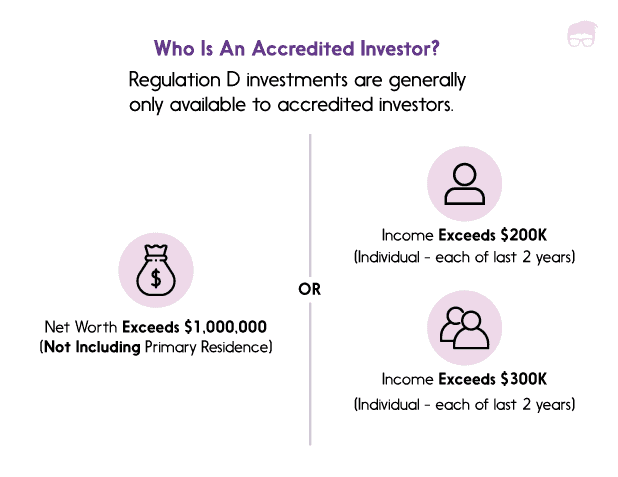
    There are some requirements set out by SEC in Rule 501 of Regulation D to determine the status of an individual claiming to be an accredited investor. An individual must satisfy at least one of these requirements-

    • (S)he must have a net worth of at least $1 million, excluding the value of the primary residence.
    • (S)he must have an income of $200,000 per annum for the last 2 years and also expects to earn the same or higher in the current year. If married, the annual income should be $300,000 jointly. For all 3 years, the method for calculating the income should be the same, either single or joint.

    Business entities, however, can be considered as accredited investors if their assets exceed a value of over $5 million or in which all of the equity owners are accredited investors.

    However, there is no certification or process, per se, to verify the status of a potential investor. The authorized financial regulator does not review the credentials of every individual claiming to be an accredited investor. Instead, the companies that offer the unregistered securities perform the due diligence by asking for some documents such as-

    • Tax Returns
    • Bank Statements
    • W-2
    • Pay stubs
    • Balance Sheet
    • Letter from CPA or attorney

    Why Is Accreditation Necessary?

    The regulatory authority aims at protecting the interests of companies as well as the investors by maintaining fair and efficient markets. So the question is why these income restraints are justified in the market scenario, which is supposedly equivalent to all.

    The reason is that accredited investors have a safety net to fall back on and withstand the risk of losing a substantial amount of money. The high-income criterion helps ensure that these investors have efficient funds to absorb the losses incurred.

    Since private offerings and complex investments such as angel investments, hedge funds are quite risky, they pose a significant amount of risk to investors. If these ventures fail, then the losses to bear would be quite heavy. In order to pre-empt the losses and protect the interests of investors with little knowledge, experience and no buffer to rely on, this particular class of investment deals are offered to accredited investors only.

    Accredited Investor vs Non- Accredited Investor

    Roughly 9.86% of the American households meet the requirements set by the SEC for being an accredited investor. Rest are the non-accredited investors who do not meet those requirements.

    Unlike accredited investors, non-accredited investors can’t invest in Regulation D investments like real estate crowdfunding and real estate syndication, and there are a lot of regulations against them investing in angel rounds of startups, VC firms, and hedge funds.

    Pros And Cons Of An Accredited Investor

    While being an accredited investor comes with its own perks like specialized investment opportunities, it also has its own cons.

    Here are some of the advantages and disadvantages of being one –

    Advantages

    • Higher Returns – Accredited investors have access to private placements that offer a higher return on investment as compared to what is offered in the public capital market.
    • Higher Yield- Accredited investors don’t have to depend upon dividend-paying stocks, bonds, REITs for higher yields. They can invest in private placements that offer higher yields.
    • Diversification of Portfolio– As the stock market is quite volatile, the public capital market does not offer many options for the diversification of the portfolio. Accredited investors have access to such assets that are non-correlated to the market.

    Disadvantages

    • Higher Risk – The investments options like private placements, hedge funds, venture capital funds and angel investments are much more complex and risky. And because of inappropriate regulatory protection, these investors are exposed to a lot of scams.
    • Illiquidity – Private offerings demand long term commitment which can often extend up to 5 years in case of real estate deals with no option of selling in the secondary market.
    • Higher Fees – Private offerings demand excessive fees. This results in limiting their returns.

    Go On, Tell Us What You Think!

    Did we miss something?  Come on! Tell us what you think about our article in the comments section.
  • Why Won’t An Investor Invest In Your Startup?

    Why Won’t An Investor Invest In Your Startup?

    While TV shows portray the startup investments to be fun and games, it’s the total opposite in reality. Sometimes, scoring an investment proves out to be more difficult than actually starting up. And often, not being able to score an investment ends up a startup.

    Statistically speaking, only 0.91% of the startups get their funding from angel investors, and only 0.05% succeed in getting Venture Capital funding.

    But what makes it so hard for startups to get investments? What do these startups or entrepreneurs lack?

    Well, here are 13 reasons explaining why investors won’t invest in your startup.

    Your Company Doesn’t Match Their Portfolio Or Interests

    If you don’t already know, let me break this to you – investors won’t usually invest in a startup they can’t associate themselves with.

    Most of the time, founders fail to even get meetings with the investors just because of the same reason.

    Angel investors have their interest segments, and venture capitalist firms have their portfolios. You need to make sure you’re approaching the right investor who’ll be interested in the niche you operate in.

    You go for investors who – 

    • Have invested in a startup of a similar niche before.
    • Belong to a similar niche or has some experience in the same.
    • Have profited from previous investment in a startup of a similar niche.

    You may try not to spend much time on wooing investors who – 

    • Got burned by a previous investment in a startup of a similar niche.
    • Doesn’t belong or have experience in the identical niche, or
    • Hasn’t investment in a similar niche

    You Have Come For An Investment A Bit Too Early

    A usual startup witness six stages in its lifetime –

    1. Ideation
    2. Testing
    3. Traction
    4. Refinement
    5. Scaling
    6. Establishment

    Every stage witnesses its own type of investor –

    • Family and friends at the ideation stage
    • Credit or crowdfunding during the testing stage
    • Angel investors during traction and refinement
    • Venture capitalists during scaling
    • Corporates when established.

    If you reach out to big investors during your startup’s initial stages (without any traction), chances are that they’ll turn you down.

    Your Numbers Aren’t Enough

    Sometimes, the investors’ expectations are different from the actual business numbers, which results in them turn down the deal.

    Sometime, this happens because the businesses choose the wrong investor to pitch to. Suppose your startup has a worth of $1M. Now, this may seem huge. But for a venture capital fund of $1 billion, it may be too small for an investment.

    Another reason could be them weighing the years of your existing with the traction you’ve received. If you’re asking $1M for 3 years old business that has just witnessed 30k transaction in 3 years. You could be turned down because your numbers don’t back up your valuation and

    The Cash Flow Is A Problem

    Not all startups witness a positive cash flow in the beginning. However, investors do look for proper planning, management, organisation, and a road-map to convert the negative cash flow to positive.

    Why, you ask?

    Because 82% of the businesses that fail cite poor cash management as a factor behind their failure.

    You could have a company with a revenue of $10M, but maybe your business model is such that your company can’t get cash flow positive until you reach $200M in revenue. This will require a lot of money, faith, and risk for an investor to carry you which (s)he might not be ready to take.

    There’s No Barrier To Entry

    Investors do look for a unique selling proposition – an idea or an execution that is proprietary. They prefer patents, exclusive contracts, and other barriers to entry.

    Investors look for long term benefits. If they invest in a business, they look for whether the company has the potential to remain the leader or a major market-share-holder for a long term till their exit.

    They Have Already Invested In A Similar Business

    It’s rare for an investor to invest in two similar businesses in the same segment. If you own a T-shirt retail company and approach an investor who has invested in a similar company. There are high chances that (s)he’ll say no – precisely because (s)he’s backing your competitor already.

    They Don’t See Transparency In The Pitch

    Startup investors invest in the eligibility, motivation, and the honesty of the team. If they feel that you’re hiding vital information or misreporting stats relating to –

    • Manufacturing
    • Marketing
    • Finance
    • Team experience
    • Competition
    • Existing traction and numbers

    They Don’t Feel That You Know Your Key Performance Indicators (KPIs)

    The investors look for founders who truly understand their businesses’ financials and key metrics that demonstrate how effectively their company is achieving key business objectives. You might find it hard to get investment if you don’t understand your top priorities and critical metrics that represent those priorities.

    Investors may turn down your offer if they don’t get substantial evidence of you understanding your KPIs and providing insights on your plans to improve them.

    Your TAM Is Too Small

    The total addressable market denotes the maximum growth opportunity for a startup. While many founders try to scale down TAM to make it less ambiguous, many scales it down to a level that the market looks to be too small to start a business in.

    If the investor believes that your TAM is too small for his investment to produce fruitful results, he might turn down the offer.

    You Don’t Have A Deep Understanding Of Your Competition

    “How are you different from XYZ.”

    “I’ve seen a similar company operating in your niche. Why are you special?”

    These and other similar questions often come into play during the pitch. If the investors aren’t convinced with your competitive advantage, differentiated value proposition, and unique product-market fit, they might turn your offer down.

    You Don’t Have Skill, Education, Or Experience To Back Your Idea Up

    Investors look for a team with proven skill, education, or experience to back their idea up. If you’re an entrepreneur with a proven history of a successful startup before, you might get preference over other entrepreneurs with no such experience.

    Moreover, investors also prefer if you select your team based on their qualification and experience rather than their relationship with you.

    You Don’t Have The Right Business Model Or Business Plan

    A business plan explains your vision and goals and how you plan to achieve those goals – all expressed quantitatively. A business model, on the other hand, is how you operate and make money.

    If any of these fails to impress the investors, they may reject your fundraising proposal.

    They Think That You’re Uncoachable

    Most investors invest as they see the value they can provide to the startup. If they believe that you are too adamant about changing or are being uncoachable, they may turn down your offer.

    They predict this during your pitch. If you don’t listen to what they have to say during your pitch, they might feel that you won’t listen to them afterwards as well.

    Go On, Tell Us What You Think!

    Did we miss something?  Come on! Tell us what you think about our article on Why Won’t An Investor Invest In Your Startup? in the comments section.

  • What Is TAM SAM SOM? How To Calculate It?

    What Is TAM SAM SOM? How To Calculate It?

    Developing a product without proper market analysis is a gamble. Any experienced or skilled marketer will always analyse the market and choose the right target segment before developing the product, marketing it, and developing the pricing and sales strategies.

    Those who don’t do this drill may end up in a market –

    • Which isn’t right for the offering,
    • With not large enough market size to grow, or
    • Which is dominated by existing players with no space for new players to penetrate into.

    Hence, to ensure that the market is right and big enough for the business, it is crucial to understand what is TAM, SAM, and SOM and how to calculate them.

    What Is TAM?

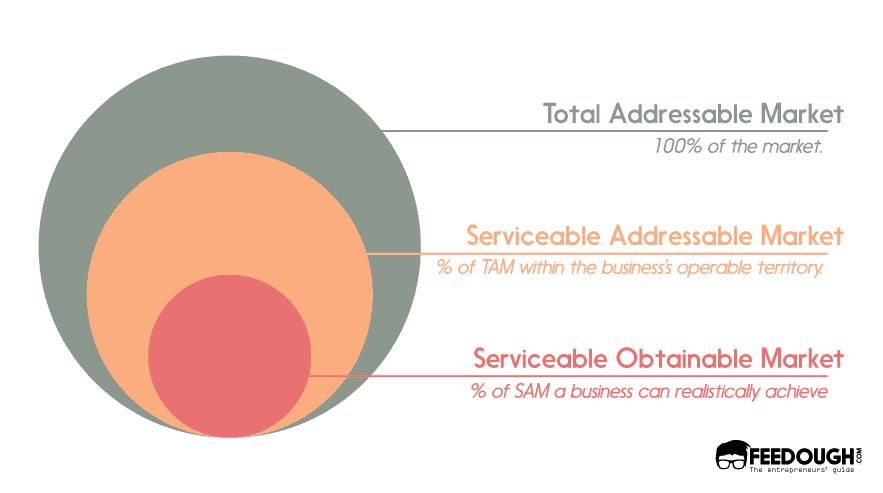
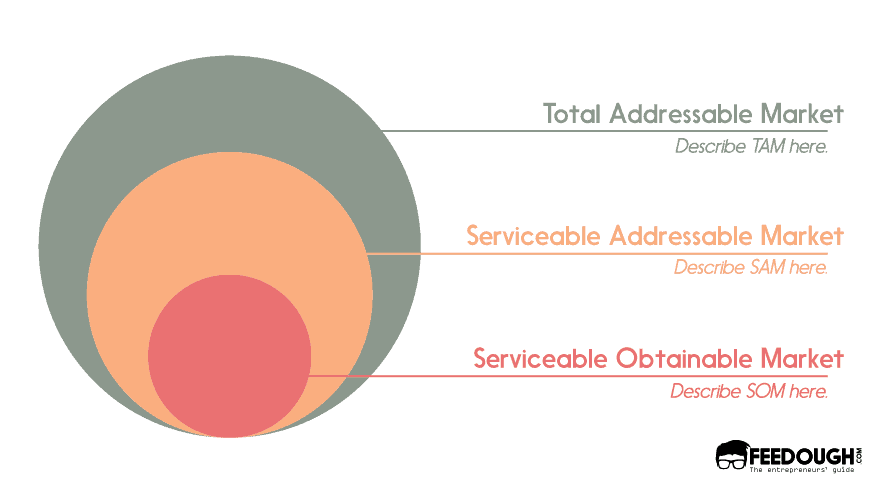
    TAM or Total Addressable Market refers to the total market demand or revenue opportunity that exists within the market for the offering.

    TAM = 100% of the market.

    In simple terms, TAM comprises everyone who could buy the offering or the maximum amount of revenue a business can earn by selling their offering.

    TAM is a significant number. It isn’t restrained by constraints other than the offering. It doesn’t consider competition, business limitations, geographic limitations, or any factor that may stop the business from reaching and selling to the market.

    For example, for Uber, the total addressable market was the global taxi market. 

    Why Is Calculating TAM Important?

    The total addressable market (also called total available market) helps a business identify how big the opportunity is and how much revenue can be made with the offering if 100% of the market share were achieved.

    This helps determine –

    • Market’s potential for growth,
    • Business concept’s viability, and
    • Effort and funding that might be required to operate in the market.

    How To Calculate TAM?

    While the equation to calculate TAM seem simple…

    Average Revenue * Number Of Customers For The Entire Segment Of The Targeted Market

    …the actual process of getting these numbers is difficult, tedious, and/or expensive. It includes the following approaches –

    • External Research: It involves getting the information from professional data that has already been collected. This approach is expensive but saves a lot of time of the businesses.
    • Top-Down Approach: Top-down approach starts from the top of the macro data set and filters the data to find the perfect market subset. That is –starting with the total population and then apply the demographic, geographic, and economic assumptions to eliminate the irrelevant segments. For example – to find the TAM of an Android accounting mobile application, the data of total accounting smartphone app users is taken and then chipped away to remove iOS users. The data is then multiplied by the average cost of an accounting app to get to the TAM.
    • Bottom-Up Approach: Being a total opposite of the top-down approach, this approach focuses on building the TAM using the subsets of information available. Suppose a mineral water company that has a 20% share of the total market of the USA had revenue of $1B in a recent year. Using this information, the 100% market of the mineral water company in the USA comes out to be $5 billion.
    • Value Theory: Top-down and bottom-up approach try to find the total addressable market of an existing market. However, in cases of startups that disrupt (like flying cars) and develop their own market, the value theory approach kicks in. This approach assesses how much a customer would be willing to pay for an offering or the improvement of a product. This price is then multiplied with the size of the market of the closest possible niche (cars in case of flying cars).

    What Is SAM?

    SAM or Serviceable Available Market is the portion of the total available market that the business can actually acquire. It is the total sales volume of a particular offering that can be sold by all the vendors within the specific operable territory.

    SAM = [the] % of TAM that is within the business’s operable territory.

    It takes into account all the factors limiting the reach to the total market, like –

    • Geographical restrictions
    • Demographic restrictions
    • Resources restrictions
    • Regulatory restrictions
    • Cultural restrictions
    • Behavioural restrictions

    For Uber, the serviceable available market in the start was limited to the taxi market in the USA and users who used a smartphone.

    Why Is Calculating SAM Important?

    Serviceable available market (also called serviceable addressable market) is a realistic picture of the market that can actually be tapped after considering the limiting factors that cannot be changed. 

    For example, if a business manufactures a mobile application that helps parents find their kids, the SAM would not be the total number of smartphone users, it’ll be parents of 5-12-year-old kids, who use Android smartphones running on the latest version (Here we assumed that the application is specific to just Android smartphones).

    How To Calculate SAM?

    SAM starts with the calculation of TAM. Once TAM is calculated, it is filtered down by adding conditions and equations. Suppose a business plans to launch an offering focused on football players in the USA. Considering that there are 20 million football players in the USA, and the cost of the offering to be $50, the TAM comes out to be $900 million.

    However, if the business is focusing just on California (having just 500,000 football players), the SAM would come out to be just 0.05% of TAM, that is $25 million.

    What Is SOM?

    SOM or Serviceable Obtainable Market is the portion of the serviceable addressable market that can be realistically achieved within the short term.

    SOM = [the] % of SAM the business can realistically achieve in short-to-medium term.

    In simple terms, SOM, also called Share of Market, is the realistic fraction of the actual customer market that the business can acquire during the first few years of operation. It considers the competitive, financial, niche, and resources-based restrictions while predicting realistic reach during the initial years of operation.

    SOM factors in –

    • The offering’s limitations
    • The targeting limitations
    • Marketing plans
    • Distribution channels
    • Competitive limitations
    • Limitations relating to finance and other resources

    Why Is Calculating SOM Important?

    SOM is of vital importance to both the founders and the investors as it –

    • Helps business set realistic short-term and medium-term objectives and goals,
    • Helps investors and founders understand the potential of the market, and
    • Helps the founders make most of their limited resources initially.

    How To Calculate SOM?

    SOM represents the realistic value of what can be achieved. To get to this realistic value, the following factors are taken into consideration –

    • Market share of competitors
    • The value proposition of the offering
    • Performance of offering’s pre-releases

    Performance of offering’s pre-releases gives a hint to how quickly is the offering able to grab business in the market. This, when compared with other factors, give a value, which, when compared with SAM, gives the value of SOM.

    For example, suppose a business ‘XY’ wants to launch a sports products brand and has a SAM of $10M. After some research on the existing players, XY finds out that one player takes the majority of the offline market share because of its well-defined distribution channels. However, it doesn’t operate online, which is an opportunity of $2M divided among 4 players, including XY.

    After releasing the MVP, XY calculates that it’ll be able to grab 50% of the online market within 3 years. This makes the SOM of this business be $1M, which is 10% of SAM.

    Example Of TAM SAM SOM

    TAM is the total number of fishes in the sea.

    SAM is the total number of fishes within the casting range of the dock one fishes from.

    SOM is the number of fishes one can reasonably catch considering the amount of time, energy, and baits (resources) they can allocate to fishing.

    TAM SAM SOM

    TAM, SAM, and SOM can be easily understood with the example of the initial days of Facebook.

    Facebook was launched with a motive to become a one-stop social media channel for everyone who uses the internet. Its TAM were global internet users.

    However, during its initial years, the company’s operations were limited to the USA, which formed its SAM.

    When the company started, it spent its initial days in attracting college students and other student communities from the universities of the USA, which formed its SOM.

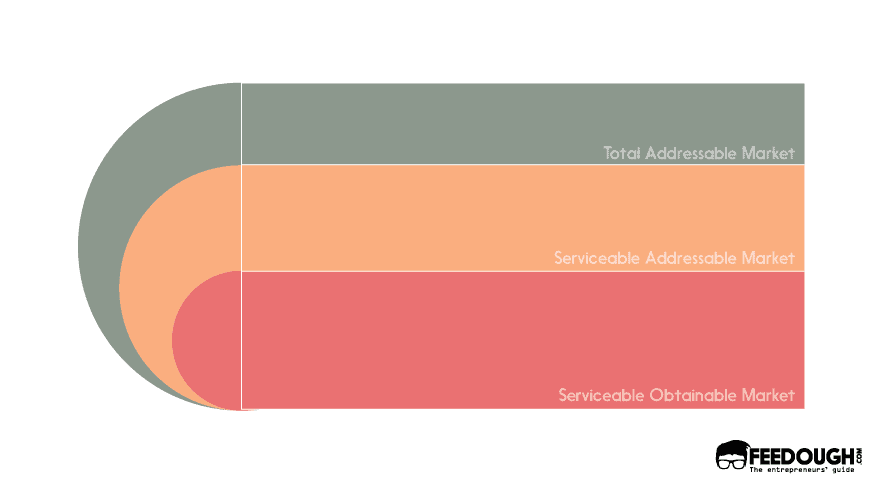
    TAM SAM SOM Template

    Here’s a TAM SAM SOM template to help businesses present their market analysis better.

    Go On, Tell Us What You Think!

    Did we miss something? Come on! Tell us what you think about our article on TAM SAM SOM in the comments section.

  • The 12 Functions Of Marketing

    The 12 Functions Of Marketing

    Every business survives on the money of its consumers. Marketing is the way to reach those consumers.

    Marketing is not just about putting up posters on the streets, telecasting a 30-second video for introducing a product or giving out goods or services at low/no cost. It focuses on developing relations with the consumers by identifying their needs and wants, and then developing products and services that meet their expectations.

    In the words of Philip Kotler –

    Marketing is a social and managerial process by which individuals and groups obtain what they want and need through creating, offering and exchanging products of value with others.

    It isn’t a one-sided affair. It requires an uninterrupted interaction between the business and the customer. Thus, the importance of marketing cannot be ignored in the business context.

    To better understand the concept, let’s delve into the functions of marketing.

    The 12 Functions of Marketing

    Marketing is vast. It starts before the offering is actually produced and often runs for as long as the offering stays, even after the sale has taken place.

    Marketing functions can be divided into the following 12 parts:

    1. Identifying needs & wants of the customer
    2. Developing a marketing plan
    3. Product Development
    4. Pricing
    5. Standardisation & Grading
    6. Packaging & Labeling
    7. Branding
    8. Distribution
    9. Transportation
    10. Warehousing
    11. Promotion
    12. Providing Customer Support

    Identifying Needs And Wants Of Customer

    Satisfying the customer’s needs and wants is critical to any business’s survival. Thus, the business needs to be familiar with the customer’s needs in the first place to meet their expectations. For this, market research needs to be conducted to gather information about the target consumers’ preferences.

    Questions regarding what the consumers want, quantity and price, time and place, etc. must be answered while conducting the market research. After analysing this information, all the major decisions concerning the offering can be taken to ensure their reliability.

    Developing Business Plans

    Once the business has all the information needed about the market and the customers, it needs to develop a strategy that helps the company achieve its objective while considering the marketing environment. The company needs to plan how much it will produce, how it will distribute and how it will promote its products. All of this is decided, and a timeline is prepared according to which further steps are taken by the business.

    Product Development

    Every business produces a product or provides a service to satisfy the customer’s needs. Through the market research conducted, the business becomes familiar with the needs and wants of the customer. It then develops its product or service according to the preferences of its majority target customers.

    This function also includes designing the product to make it easier for the consumer to handle it. Cost and durability are other factors that must be considered while designing a product. Product Development is not a one-time process. Rather it’s a continuous process. This means that even after the product has reached the market, the producer needs to develop it regularly to keep it up-to-date with the needs of the consumers.

    Pricing

    Product pricing is one of the most significant and complicated functions of marketing. Choosing a high price might lead to lower demand for the product and a low price might lead the company to run out of business. Thus, the marketer should set the price after doing considerable research and considering factors like cost of production, competitors’ price, market conditions, type of target customer, extra expenses incurred, profit margin, etc.

    The business must understand that the price of a product largely determines how much customer share they will earn; therefore, changing the price frequently can adversely impact the company’s revenue.

    Standardisation & Grading

    Standardisation is defined as fixing up a standard for the product with respect to the size, weight, quantity, quality, design, colour, etc. and sticking to it. This helps in ensuring uniformity in the product produced. Consumers get attracted to the standardised product because of the consistency in quality, and standardisation also leads to reduced costs for the business, thus benefitting both parties.

    Grading is defined as classifying the products based on their size, quality, quantity and other characteristics. It is mostly done for agricultural products and is a sub-function of standardisation. Grading eliminates the need to convince the consumer of the product’s quality on the seller’s part. It also allows the seller to charge higher prices for better-quality products.

    Packaging & Labelling

    Packaging is defined as an activity undertaken to protect the product from the harms of the external environment. It aims at avoiding breakage, spoilage, damage or destruction of the goods during transit or storage.

    Labelling is defined as the process of designing and developing the label of the product so as to give out relevant information to consumers regarding the product. It helps easily identify the product and can help the brand stand out in the market.

    The package and the label are the first things that a consumer comes in contact with. Therefore, it needs to be given considerable importance when finalising the marketing plan.

    Branding

    Branding is the process of giving a particular name, symbol or design to a product or a range of products to make it easily distinguishable from the other products in the market. Brand of a business can also help in communicating its values to the consumers. It is responsible for shaping the consumer’s perception of the business.

    Distribution

    Distribution entails all decisions that are related to the process of making the goods or services available to the consumers. Even if after producing premium quality products at the lowest prices, the manufacturer cannot make them available to the ultimate consumer, all the efforts put into design and develop the product are wasted.

    Factors like distribution channels, inventory, order processing, and others are considered to create time and place utility. Distribution ensures that the right product is available at the right time at the right place to the right consumer.

    Transportation

    The goods are not necessarily consumed at the place of their production. The product’s parts might be manufactured at one place, they may be assembled at another place, sold at a different place and then ultimately consumed at a distance of thousand miles from the place of production. Transportation helps businesses in bridging this gap and making the goods available to its consumers.

    The physical movement of goods from the place of production to the consumer is transportation. It is an important function of marketing as it determines the reach of any business. Local and National boundaries are required to be considered while making decisions regarding transportation, and the mode of transportation is accordingly chosen.

    Warehousing

    The products manufactured are not immediately sold to the consumers on the day of production. To solve this problem, the marketing function of warehousing provides a space to store goods until they are ready to be sold. The goods manufactured need to be stored at a safe place to avoid them from getting ruined. Warehousing ensures that the products are stored correctly by providing place utility and making available the goods as and when required.

    Warehousing is also responsible for maintaining price stability of the products. If the product is available in the market in bulk, the price may fall and if the product faces a shortage in the market, its price might shoot up. Thus, warehousing ensures that the right amount of goods are available in the market.

    Promotion

    Once the product is in the market, the consumers need to be aware of its presence to buy it and enable the business to earn revenue. The promotion function is responsible for making the consumers aware of the goods produced, their features and characteristics, their prices and other necessary information.

    This can be done through advertising, personal selling, sales promotion, sponsorship of events and other such activities that assist in publicising the product. Promotion is done while considering the budget of the company. This function aims to inform the existing and potential customers so that they buy the product and generate higher revenue.

    Providing Customer Support

    Communication between the customer and the business does not end once the product is sold. In today’s world, where the customer is considered a king, customer support services are even more important than selling the product itself.

    For any business, retaining its customers is essential to maintain an image in the market as well as to incite new customers to buy their product. Customer support services ensure that the customer is happy with the product during its life cycle and is not facing any problems with it. Some examples of customer support services include consumer helpline, maintenance services, technical support, credit facilities and other after-sale services.

    Go On, Tell Us What You Think!

    Did we miss something? Come on! Tell us what you think about our article on functions of marketing in the comments section.

  • Co-branding – Definition, Importance, Types, & Examples

    Co-branding – Definition, Importance, Types, & Examples

    Amid the increasing competition, every brand today looks for fresh and exciting marketing strategies that make its offering stand out.

    And what’s better than associating the offering with more than one brand to increase its brand appeal and attract more customers?

    Co-branding is one such strategy wherein two or more brands strategically partner to form exactly a fresh and exciting marketing strategy. It is often seen as a win-win approach because all partner brands have a chance to portray their strengths and imbibe the strengths of others.

    But what is co-branding, why is it needed, and what are its types? Here is a comprehensive guide explaining co-branding, its importance, benefits, disadvantages, and examples.

    What Is Co-Branding?

    Co-branding is the strategic partnership between two or more companies to associate more than one brand name with an offering to create marketing synergy.

    The two notable points in the definition are:

    • Strategic partnership: Strategic partnership refers to the process where brands partner to derive profit out of the combined effort. This profit may include – better appeal, increased customer reach, publicity, conversions, etc.
    • Creating marketing synergy: The principle of marketing synergy states – ‘the whole must be greater than its parts’. This means that co-brands pool their resources, creativity, and existing brand images to develop an offering that is greater than the sum of its parts.

    Why Do Brands Cobrand?

    Co-branding helps gain market share, boost revenue streams, build customer awareness and reduce individual risks. Along with this, co-branding is important for the following reasons:

    Combine Strengths To Push Growth

    Co-branding helps partner brands strategically infuse the best of their brand with the other. When brands collaborate strategically, they can cherry-pick the finest creativity aspects and innovation aspects to form an alliance.

    Ultimately, partner brands can pitch in the best of their selling points and create a more valued marketing strategy.

    Form Better Acceptance And Receptivity

    Oftentimes, brand loyal customers rarely try the offerings offered by a different brand. This makes co-branding important to reach out to them and increases the chances of acceptance and receptivity.

    Co-branding helps brands merge their personalities into one. This increases the acceptance and receptivity rates among the customers of one brand to try the new co-branded offering and even the other offerings offered by the second brand they didn’t know about before.

    Build Innovation And Value Addition

    Co-branding is important to keep up with the innovation pace in the business industry. Customers are constantly looking for better brands with more valuable solutions and innovative brand personalities.

    Through co-branding, partner brands can get the required dose of innovation and value-addition.

    Take RedBull and GoPro, for example.

    GoPro and RedBull marketed their brands with one of the biggest co-brand stunts – Stratos. Stratos was an event where an astronomer jumped from the surface of the Earth wearing GoPro cameras all over his spacesuit. This co-brand stunt reached out to audiences and portrayed that the brands stand for challenges, innovation, and modernity instead of simple cameras and energy drinks.

    Establish Credibility

    Co-branding is important for smaller brands to team up with other respected brands and consequently raise authority and trustworthiness. This is because partner brands get the chance to highlight and reflect on each other’s assets, thereby strengthening their position in a given industry.

    Types Of Co-Branding

    Co-branding isn’t a one-size-fits-all process. Companies get into different co-branding contracts depending upon the industry they operate it, the type of offering, and the branding goals.

    Ingredient Co-Branding

    Ingredient co-branding is when brands collaborate based on compatible ingredients amongst them. The focus is to look for a matching element, combine the brand personalities and market the offering as something that solves the problem better.

    Example – Dell + Intel Co-brand

    Intel often gets into cobranding contracts with several computer manufacturers to offer its expertise in CPUs. One such contract is with Dell.

    • Dell makes laptops that need fast processors.
    • Intel makes compact and fast processors that are used in laptops.

    Therefore, both their products are perfectly compatible and match the other.

    Example – Betty Crocker’s Brownie Mix + Hershey’s Chocolate Syrup

    The matching ingredient in Betty Crocker’s brownie – Hershey’s chocolate syrup co-brand is:

    • Betty Crocker makes chocolate brownie mixes
    • Hershey’s makes chocolate syrup that goes well with chocolates-flavoured baked goods

    Therefore, they collaborated on a matching element of their products that would strategically market them as better value.

    National To Local Co-Branding

    National to local co-branding is when national brands collaborate with local brands. The focus here is for the national brand to reach a local audience, and the local brand can reach a national audience. Since both those customer bases are extreme, the only way to reach them together is through national to local co-branding.

    Example – Local Businesses With Groupon

    A perfect example of national-to-local co-branding is local businesses getting into a contract with websites like Groupon to provide special offerings to the wider audience.

    Composite Co-Branding

    Composite co-branding includes well-known and well-established brands collaborating strategically to build a stronger marketing plan. Composite co-branding focuses more on value addition and retaining existing customers instead of acquiring new ones.

    Example – BMW-Louis Vuitton Co-Brand

    BMW and Louis Vuitton collaborated to make an exclusive range of travel companions for their i-8 model. The collaboration was based on the personality and positioning of both brands as:

    • Innovative
    • Luxurious
    • Expensive
    • Sleek

    Example – Kanye West + Adidas co-brand

    Kanye West and Adidas collaborated to create ‘Adidas Yeezy’ a premium range of sneakers, shirts, jackets, track pants, etc. From $600 for track pants to $3000 for jackets, Adidas Yeezy is known to be the most influential co-brand today. This is because the values and positioning of both comply well with each other.

    Co-Branding Benefits

    Co-branding results in a win-win situation for the partners where they make use of each other strengths and share the risks to get the most out of their investments.

    Lower Risks

    Brands constantly develop strategies to reduce their marketing costs. A huge bonus of co-branding is that it helps split the marketing costs amongst partner brands. Therefore, with half the budget, brands can receive double the return on investment.  

    The less investment also lowers the risks associated with a new business offering, such as:

    • Competition risks
    • Operational risks

    Moreover, the risks are shared with the partners equally.

    Co-branding helps signal advantageous information to the audience. Partner brands can create a more all-rounding marketing strategy when they combine their resources. The experiences, creative personnel, and marketing channels of partner brands help work with a wider set of resources.  

    Broad Customer Base

    Co-branding helps target a larger customer base. When two well-aligned brands come together, each can target the other’s market.

    Therefore co-branding widens the reach and visibility of a brand to a market that they may once not have had access to. Ultimately this also increases the chances of generating more sales for each partner brand.

    Alignment Of The Best Features Of All

    Co-branding combines the best strengths of all partner brands. The charisma and glamour that a brand gains for itself can be extended to other brands. Each partner brand can offer its best feature and in return, gain the others’ best features to emerge holistically stronger.

    Co-Branding Disadvantages

    Despite the growth of co-branding, it is not an ultimate marketing strategy. This is because it has its share of disadvantages –

    Agreement Fallouts

    Co-branding involves complex agreements. Brands may try to manipulate these agreements toward their side. In such cases, if the partner brands find out, there might be a fallout instead of a synergy.

    The reasons for such disagreements include:

    • Investment amounts
    • Profit percentage
    • Authority disputes
    • Company objective disputes

    Confused Brand Messages

    In certain situations, co-branding may create more confusion than coherence. Such situations arise both –

    • When the brands’ ideals align with each other
    • When the brands’ ideals don’t align with each other

    Varied brand ideals

    Co-brands with varied brand personalities often fail to create a unified business offering for the audience. This usually happens because such brands don’t strategically fit into one another like a puzzle piece.

    A perfect example of such co-branding failure is the Target + Neiman Marcus collection. Target wanted to increase its sales during the time period between the black Friday sale and the Christmas Sale. To do this, it collaborated with Neiman Marcus to release a holiday collection of offerings.

    But the Target Neiman Marcus co-brand failed miserably because the brand personalities of both brands didn’t match. Target is an affordable retail store for clothing, electronics, and lifestyle products. Neiman Marcus, on the other hand, is a luxury clothing brand. Target customers didn’t like Neiman’s expensive, overtly fashionable clothing, and Neiman customers didn’t like the idea of going into a regular retail store for their luxurious clothing.

    Same Brand Ideals

    A co-brand between identical brand personalities can also confuse customers. The reason is that brands in the same industry have competitive audiences instead of cooperative.

    A co-branded product offered by Adidas and Nike might confuse the audience.

    Reputation Imbalance

    Unequal reputation levels amongst partner brands may pull the other down.

    Example – Lego + Shell Co-brand

    The Lego-Shell co-brand was a reputation disaster because Shell is associated with exploiting natural resources, and Lego stands for safe, creative, and innovative toys for children. Due to the negative reputation of Shell in light with the creative child brand Lego, the co-branding strategy backfired.

    Examples Of Co-Branding

    To understand the nitty-gritty of a co-brand, here are some examples of the famous co-brands:

    Spotify And Uber

    Spotify and Uber created a co-brand by allowing users to listen to their exclusive Spotify playlists in their Uber rides. Uber is a growing brand in the transport niche, and Spotify is a growing brand in the music-streaming niche. Uber and Spotify could target very different yet compatible audiences through a co-branding strategy.

    The aspects used to strategically align the two brands were:

    Uber

    • Moderately well-established
    • Cater to 16-24-year olds
    • Well-established in the U.S. market
    • Stands for modern and easy solutions

    Spotify

    • Moderately well-established
    • Cater to 18-25-year olds
    • Well-established in the U.S. market
    • Stands innovative, and modern solutions

    Therefore, the strategic collaboration helped make more personalised experiences for a Uber rider through Spotify.

    Taco Bell And Doritos

    The Taco bell Doritos co-branded Doritos Locos Tacos is one of the most successful food co-brands. The co-brand strategy was carried out through a new product – Doritos Locos Tacos. This was a Taco-Bell shell made out of Nacho Cheese Doritos snack chips. Within the first 10 weeks of this co-brand launch, 100 million products were sold!

    Taco Bell-Doritos used the specific matching ingredients of their brand to create an ingredient co-brand. This was possible since the following aspects of both brands are so well-aligned:

    • Food niche – crunchy snack food
    • Packaged and mobile product
    • Well-established in the U.S. market

    UNICEF And Target

    UNICEF partnered with the apparel brand Target to promote UNICEF kid power. Target was strategically selected to sell Kid Power products. This is because Kid Power aimed to reach more parents and children in America, and Target was already catering to most parents and children in America.

    The co-brand was done through a new product – a mobile application for the buyers of Kid Power merchandise from Target. Through the application, children could go on UNICEF missions to help and learn about various cultures.

    Even though UNICEF and Target don’t look like partner brands, they created a successful national-to-local co-brand. This co-brand product was successful because of the strategy more than personality.

    Go On, Tell Us What You Think!

    Did we miss something?  Come on! Tell us what you think about our article on co-branding in the comments section.

  • What Is Angel Investor?

    What Is Angel Investor?

    If you’re an entrepreneur or anyone who follows startups, you must have heard the terms angel investors and angel investing quite a few times now. You must identify an angel investor as someone who invests in startups and might even know that high net worth individuals like Jeff Bezos and Marissa Mayer count themselves as angel investors too.

    But what exactly is an angel investor, and how is it different from a venture capitalist or any other startup investor.

    Let’s find out.

    What Is Angel Investor?

    Angel investors (also called seed funders, private funders, and angel funders) are high net-worth individuals who invest in early-stage startups, usually in exchange for ownership equity in the company.

    Such investors are often the primary source of investment for the startups during their early stages when –

    • The concept is ready, but the business is yet to start or when the business is just recently started,
    • The business is yet to gain real customer traction or has less customer traction, and/or
    • The final product needs investment to be developed or developed at scale.

    Since startups involve high risks, banks don’t offer them loans, and they’re left with approaching high net-worth investors to take funding in exchange for ownership equity or interest on investment. This is the reason why such investors are called angels – people who help founders when no one else does.

    What Does An Angel Investor Do?

    Angel investors are investors in real sense. They invest in growing businesses just to make the most out of their investments when they exit. They provide high potential startups with –

    • Monetary investments,
    • Non-monetary help in terms of better deals because of their network,
    • More exposure and publicity by associating their name with the startup, and
    • More investment opportunities by associating their name with the startup.

    How Do Angel Investors Work?

    Angel investors are peculiar when it comes to working. They differ from venture capitalists as they work alone, and from corporate investors as they are more open to entrepreneurs taking their own decisions.

    • Source Of Funds: Angel investors usually invest their own personal capital at their own discretion. But there are times when the funds are sourced from a company, a business, a trust, or an investment fund, etc. Moreover, there isn’t a minimum or maximum investment for an angel investor. One can be considered as an angel investor even if (s)he invests $100 in a startup.
    • Type Of Investment: Angel investors usually invest in exchange for equity only when it’s possible to calculate the startup’s valuation. In scenarios when it’s too early to get the valuation of the startup, they invest in the form of convertible notes or debts.
    • Involvement In Business Activities: Angel investors may or may not participate in the business decision and activities depending on their nature, discretion, and the contract with the startup founders.
    • Money And Contract: Since there’s a high risk of losing the investment, angel investors invest comparatively less and take higher equity ownership when compared to other investors like venture capitalists that invest during the later stages of the startup.

    How Much Do Angel Investors Invest?

    Generally, angel investors invest anywhere between $25,000 to $100,000. But there are cases when this investment extends to over a million as well. How much money angel investors invest in a startup usually depends on –

    • The industry the business operates in
    • The growth potential
    • The stage of the business

    If the startup is just in the conceptualisation stage and requires investment to convert the concept into an actual business, the investment made is small as it is based just on the entrepreneur’s and his/her team’s calibre, not on the proven validity and viability of the idea.

    However, if the idea is validated and the startup takes the investment to grow, the investment made is more significant. It might even involve less dilution of the existing shares of the founders.

    But,

    Since angel investors take more than usual risks, they look for equity ownership percentage of 25% or more in return for their investment in a company. 

    What Are The Different Types Of Angel Investors?

    Depending upon the startup requirements, the stage of the business, and the network of the founder(s), investors that invest during the angel round can be divided into five types.

    The Family Investor

    The family investor is a supportive family member that knows the founder and believes in him and his idea. The motivation to invest comes from the willingness to support a family member.

    The investment and the contract depend on the financial standing of the family investor and his/her relationship with the founder.

    The Relationship Investor

    Relationship investor is anyone who the founder has known for a while. (S)he can be a co-worker from the previous company, an ex-boss, a family friend, or a business friend the founder has known for a while.

    These investors are motivated to invest in the business both because of the willingness to support and to earn some return on investment.

    The Domain Investor

    These are the domain experts that have worked in the domain for some time now and have even invested in startups dealing in the said domain.

    The domain investors are also called the idea investors as their investment is solely motivated by the concept, and there is very little emotion around the table. They get the motivation from their experience of judging whether the team and the idea can bring in a good return on investment or not.

    The Once Removed Investor

    These people usually come on board because of their relationship with the existing investor of the startup. In most cases, they don’t know the startup founder or have experience in the domain, but they invest in the idea anyway because they trust in the people who advised them to.

    Usually, the domain investor and/or the relationship investor bring in the once-removed investor on board.

    The “Archangel” Investor

    Also called super angels, these are the well-known angel investors who have invested in several ventures and have achieved fame and fortune as commercial successes.

    The archangel investor is the influencer investor who often also provides advice on business opportunities to a group of angel investors that follows him/her.

    Pros And Cons Of Angel Investors

    Just like other types of startup investments, angel funding comes with its own advantages and disadvantages –

    Pro: Angel Investors Invest In Risky Businesses: Angel investors invest in businesses that fail to get money from debt financing.

    Con: Angel Investors Take A Higher Equity Percentage: The investors take higher equity ownership in return for the risk they take by funding the business.

    Pro: The Money Isn’t Loan: Generally, there is no obligation for the startup founder to return the money invested by the angel investor.

    Con: Founders Have To Share Their Control Over The Business: Since the angel investor owns a share of the business, the founders have to include him while taking decisions regarding the business.

    Pro: Founders Get Non-Monetary Assistance As Well: Angel funders have vast experience and a good network. They prove to be beneficial for the startup founders in helping them connect with potential clients, partners, and other stakeholders. They also attract other investors on board just by associating themselves with the startup.

    Con: Expectations From The Startups Increase: Since the money is at stake, the expectations from the startup increases, which increases the pressure the founders operate in.

    Go On, Tell Us What You Think!

    Did we miss something? Come on! Tell us what you think about our article on what is angel investor in the comments section.

  • What Is A Customer? Types Of Customers Explained

    What Is A Customer? Types Of Customers Explained

    A business operates in a highly dynamic business environment. If today’s business environment be compared with the environment a thousand years ago, almost everything has changed except two parties – the sellers and the customers.

    Earlier, when the resources were not fully used and modes of communication were not that developed, sellers used to rule the market. They used to develop an offering, market it, and the demand was generated.

    Today, however, it’s the other way round. It’s the customer who rules the market and who decides the fate of the sellers.

    But what is a customer? Is customer same as consumer? What are the types of customers?

    Let’s find out.

    Customer Definition

    A customer is the recipient of an offering or offerings obtained from a seller via a financial transaction or an exchange of something of value.

    Elaborating this definition of customer leads us to the following key-phrases –

    • Recipient of an offering: A customer can be a business or an individual who receives the offering. He can consume the offering, sell it again, or use it to develop a different offering.
    • Via a financial transaction or exchange of something of value: The term customer is used only when the seller gets something of value in return for his offering. It could be monetary or non-monetary. If nothing is offered in return, the receiver is termed as giftee and not a customer.

    A simple definition of customer would be –

    An individual or a business that purchases an offering via exchange of something of value.

    Customer vs. Consumer

    Even though used synonymously, the terms customer and consumer differ considerably.

    Customer
    Consumer
    An individual or a business that purchases an offering via a financial transaction or an exchange of something of value.
    An individual or a business who is the end-user of the offering purchased by the customer.

    For example, John purchased candy for his daughter. Here, even though John is the customer, the actual consumer of this offering is his daughter.

    Importance Of Customer

    Customers are the building blocks of any business. If a business does not have customers, then it might not as well exist. All businesses aim at increasing their profits by attracting more and more customers because they are the sole source of revenue to them. Their importance can be highlighted using the following points:

    1. Lifeblood Of Business: Customers are responsible for the demand for any product or service. If there is no demand for a product, the producers of such products or the providers of such services will have no reason to do business.
    2. Source Of Revenue: Customers buy a product or a service and pay a price for it in monetary terms. This price that they pay is the revenue for the business, which is necessary for running a business. Revenue is also necessary to cover up the costs of running the business and earn a little extra (profit).
    3. Helps Business Achieve Its Goal: The primary objective of a business is to survive in the market, earn profit and grow over the years. Customers help the business in achieving these goals by contributing to profit and acquiring new customers by recommending products or services to them.
    4. Sole Reason For Business Growth: Customers help in growing the business not only by providing money in the form of profits but also by helping the business attract more customers.
    5. Responsible For Development Of The Offering: Every growing business continuously strives to develop its product. Customers help it to achieve this objective by providing feedback in the form of survey responses, changes in demand, etc. according to which the product or the service is moulded to meet their needs.

    Types Of Customers

    Every customer has a different objective with which it approaches the business. Understanding the different types of customers and their particular needs can be helpful to the business. Thus, customers can be divided into different types on the following basis:

    • Customer Objective
    • Brand Loyalty
    • Sales Generated
    • Origin of the Customer
    • Behaviour & Personality

    On The Basis Of Customer Objective

    Every customer has a different objective of buying a good or a service or interacting with the seller. Therefore, customers can be divided into the following types on the basis of their objectives:

    1. Price Buyers: These customers are interested in buying goods or services only at the lowest possible price. They don’t care about the quality of the product but only the money that they will be taking out of their pockets in exchange for the product or service.
    2. Relationship Buyers: Relationship buyers are concerned about the relationship with the seller. They want to build trust between the two of them and are looking for relationships where they can depend on each other.
    3. Value Buyers: These type of customers are concerned about the value that the product or service adds in their life. This could be through better efficiency, lower costs, better quality, etc. They can be convinced to buy a particular product or a service by telling them how exactly the seller’s product adds value to their portfolio as compared to other sellers’ products.
    4. Poker Players: Poker players are looking for something and display something else. They act as if they care more about the quality when in reality they are after the price of the product or the relationship that can be developed between them and the seller.

    On The Basis Of Brand Loyalty

    Brand loyalty is a hard feat to achieve. But any business that succeeds in acquiring it can guarantee years of success to itself. Customers can be divided into the following three types on the basis of the brand loyalty they possess or display:

    1. Loyal Customers: These customers belong to the most loyal breed of customers. They won’t switch the product or service they presently use in any case. Selling at even zero price or providing the best quality product in the market, they will buy the product from only one seller forever.
    2. Disloyal: Disloyal customers are self-centred. They are not loyal to any seller. They are just looking for products that fulfil their needs. They can be convinced to buy a product by offering them the maximum value.
    3. Partly Disloyal: These kinds of customers agree to buy any product if it is offered to them at a price lower than the one they are currently paying. They don’t care about the quality or the product value but how much money do they need to give to the seller.

    On The Basis Of Sales Funnel Stage

    Different types of customers support the business through its sales funnel in different ways. They can be thus, divided into:

    1. Potential Customers: Potential customers are not yet the customers of the business but they fall within the target market and there are high chances that they might become a customer someday.
    2. New Customer: New customers are customers that have recently made their first purchase from the business.
    3. Regular Customer: Regular customers make purchases from the brand repeatedly or often. They are well-versed about the brand and its offering and act as a good source of word of mouth marketing.

    On The Basis Of Origin Of The Customer

    Customers approaching a seller might originate from inside as well as outside the organisation. Therefore, they can be divided into the following two types:

    1. Internal Customer: Internal customers are the employees that work within the organisation but act as customers for the product.
    2. External Customers: They exist outside the organisation and depend on the business for consuming or reproducing a good or service.

    On The Basis Of Customer Behaviour

    Every customer has a different personality which directs their customer behaviour. They can be divided into the following four types on the basis of their behaviour and personality:

    1. Directors: This type of customer is demanding, authoritative and likes to take charge in every situation. They are in search of the best deal possible which often includes demanding the best quality product at the lowest price possible. They are aware of what they want and when they want it. They often come out as intimidating but all they are looking for is facts and short and relevant talk.
    • Analysts: Analysts look for more than what is being presented. They do thorough research and analysis before making a decision. They are the ones who can even go through a hundred-page manual just to make sure that their decision is well informed and not taken in haste.
    • Relators: They look for a group which they can fit in or relate to. They have a huge network wherein they know someone who knows someone who further knows someone, thus forming an inexhaustive network from where they can get whatever they want. The only thing that they demand in the market is to be included, either by asking them for their opinion or by taking their inputs while making decisions. This group of customers can help in spreading positive information about the product or service through their extended network.
    • Socialisers: Socialisers do not just look for a one-time purchase of a product or a service. They are outgoing, love to make friends, socialise and despise small talk. They will buy a particular product or a service based on how much do they like the seller. Facts, Figures, Long Descriptions don’t attract them, and neither does loyalty, they look after their own self interest and it is important to build relationships with them to ensure their continuous support.

    Go On, Tell Us What You Think!

    Did we miss something? Come on! Tell us what you think about our article on types of customers in the comments section.

  • What Is Marketing? – Principles, Types & Scope

    What Is Marketing? – Principles, Types & Scope

    Contrary to what most people think, marketing isn’t just about communicating and informing about the brand and its offering, but everything that’s involved in developing the offering, promoting it, selling it, and making the customer buy it (and rebuy it).

    It doesn’t revolve around the product. Marketing revolves around the customers. This process focuses on exploring, creating, and developing an offering that fulfils the needs, wants, and demands of the customers while helping the business make sustain and gain. 

    But what exactly is marketing, and why is it important? 

    Let’s find out.

    Marketing Definition

    Marketing is a process or a set of processes used to understand the target audience better, develop a valuable offering, communicate and deliver value to satisfy the needs, wants, and desires of the target audience at a profit.

    In simple terms, marketing is an umbrella that includes –

    • Identifying the unfulfilled needs, wants, and desires of the target market,
    • Developing a valuable offering that satisfies the unmet needs,
    • Communicating the value to the target audience,
    • Delivering value to meet the needs, wants, and desires of the customers, and
    • Earning a profit.

    simple definition of marketing would be, as Kotler puts it, “meeting the needs of your customer at a profit.” Thus, marketing involves everything that a business requires to meet the needs of its customers, and that too, at a profit.

    Besides this, other institutes and renowned personalities define marketing as – 

    The activity, set of institutions, and processes for creating, communicating, delivering, and exchanging offerings that have value for customers, clients, partners, and society at large.

    American Marketing Association (AMA)

    The science and art of exploring, creating, and delivering value to satisfy the needs of a target market at a profit.

    Dr Philip Kotler

    The management process responsible for identifying, anticipating and satisfying customer requirements profitably. 

    Chartered Institute of Marketing (CIM)

    What Is The Purpose Of Marketing?

    Contrary to what most people believe, the purpose of marketing isn’t limited to selling the offering. Considering there are seven functions of marketing ranging from product development to pricing to selling, marketing pertains to all aspects of the business and works on fulfilling the three core purposes of the business – 

    1. Identification of the goals and needs of the customers,
    2. Development of offerings that provide value to the customers, and
    3. Communication and sale of the product to earn profit.

    What Is The Importance Of Marketing?

    Marketing is essential because it helps the business consider the customer as its focal point and develop a sustainable business that provides value to society.

    It is the heart of the business which collects information from the outside, filter it, and convert it into specialized strategies which help the business fulfil the customer requirements while making profits.

    Marketing is important because it flows among all the departments of the business including product development, distribution methods, sales, and advertising, and makes the business follow a holistic approach – 

    • It enquires: It is through market research that business understands the actual needs, wants, and desires of the customers. 
    • It builds: Marketing helps the business produce what is actually needed in the market. 
    • It informs and engages: Communicating about the brand and the offering is a huge role that marketing plays.
    • It sells: Marketing is important because it helps the company to sell its offerings. It helps the company to make money by attracting customers, making them buy the offering, and reaching the set end goals.
    • It sustains: Marketing makes sure the company and its offering sustain for the long run by adapting to the changes in the business environment.
    • It builds identity: Marketing builds identity. 
    • It grows: Marketing is an essential function to ensure the smooth growth of the business. It helps the business expand its customer base, increase sales, and build a brand.

    What Are The Objectives Of Marketing?

    The main objective of marketing is to fulfil customers’ demands while making profits. Besides this, the other five objectives of marketing are – 

    1. Customer Satisfaction: Satisfying the needs, wants, and demands of the customers.
    2. Profitability: Earning profit for the business to support sustainable growth. 
    3. Demand Creation: Develop demand for the offerings by communicating about it to the target audience.
    4. Brand Development: Building a brand out of the company and/or the offering and differentiating it from other players in the market.
    5. Create Goodwill And Public Image: Building up a public image of the brand and increasing its equity by providing offerings with a consistent brand promise.

    The Four Principles Of Marketing

    Since marketing is the sum total of all the activities involved in the transfer of the goods from the seller to the buyer, it relies on four basic principles. These principles, also called the 4 Ps or the marketing mix, are – 

    • Product: It is the offering that the company sells or intends to sell.
    • Price: It is how much the company charges from the customer for the offering.
    • Place: It refers to the point of sale – the place where the offering is offered for sale.
    • Promotion: It encompasses all the marketing communication strategies to communicate and persuade the customer to buy the offering.

    These four principles form the pillars marketing stands on. These principles give way to the core functions of the marketing too – 

    • Developing an offering that the market needs
    • Pricing the offering by predicting the perfect balance of product value and the customer’s paying capacity, to maximise profits.
    • Using the right distribution channels to distribute the offering
    • Communicate about the brand, brand message, offering, and offering’s USP to increase sales.

    Nature Of Marketing

    Marketing is considered to be holistic in nature. While there is usually a focus on a particular goal, marketing tries to make use of a 360-degree approach to fulfil the goal.

    • Managerial Function: Marketing is a process that requires officials to manage product, place, price, and promotion of the business in a holistic manner.
    • Economic Function: Earning profit and developing a sustainable business is a crucial objective of marketing.
    • Social Process: Marketing is a social process that results in the parties obtaining what they need through the creation and exchange of offerings and values.
    • Consumer-Oriented: Marketing revolves around fulfilling the needs, wants, and demands of the customers and earning profits in the process of doing so.
    • Both Art and Science: It is science as it requires the marketer to understand customer behaviour and art as it involves using this knowledge along with skills to create the demand for the offering.
    • Goal-Oriented: Marketing revolves fulfilling the goals of the business by aligning it with the customers’ goals.
    • Interactive Activity: Marketing involves the marketer to actively interact with the audience at all stages of the business.
    • Dynamic Process: It makes sure that the business keeps at pace with the changing business environment, trends, and demands of the customers.
    • Creates Utility: Marketing aims at providing utility to the customer through four different means – offering (kind of product or service), time (whenever needed), place (distribution availability), and possession (ownership).

    Types Of MarketingScope Based On Entities Marketed

    Most people mistake types of marketing strategies to be types of marketing.

    They both differ.

    Types of marketing strategies refer to the ‘how’ of marketing – how an offering is marketed. Types of marketing, however, focuses on the ‘what’ of marketing – what is marketed.

    Marketing isn’t limited to just physical goods. Today, even human, places, and experiences are marketed.

    • Product Marketing: Tangible offerings manufactured in bulk and requiring proper marketing to make it available to the right customer at the right time. Example – mobile phones, televisions, etc..
    • Service Marketing: Intangible activities that can’t be separated by the provider. Example – hotels, airlines, barbers, etc. 
    • Event Marketing: Time based events like trade shows, artistic performances, etc.
    • Experience Marketing: An orchestrated mix of services and goods which leads to an experience. Example – amusement park experience, foreign trip experience, etc.
    • Person Marketing: A person known for his skills, profession, art, experience, etc. Example – Ronaldo, Michael Jackson, etc.
    • Place Marketing: Places, cities, states, and countries with an aim to attract potential investors and/or tourists. Example – Hawaii.
    • Property Marketing: Intangible rights of ownership of the real estate, stocks, securities, debentures, etc.
    • Organisation Marketing: Corporations and not for profit organisations like schools, colleges, universities, NGOs, etc.
    • Information Marketing: Information related to healthcare, technology, science, media, law, tax, market, finance, accounting, etc. offered by books, schools, universities, websites, media houses, etc. 
    • Idea Marketing: The basic ideas that result in the entity, offering, etc.

    Scope Of Marketing

    When compared to other functions of the business, marketing’s scope seems to be a bit more vast. It flows within almost all of the business activities and present at all stages of the customer buying cycle.

    Even a separate type of marketing, known as digital marketing, has evolved to expand the scope of marketing over the internet.

    • Market Research: Researching consumer demands and consumer behaviour.
    • Product Planning and Development: Planning and developing the offering according to what’s needed in the market.
    • Product Pricing: Pricing the offering according to the product value and the buyer’s paying capacity to maximise profits.
    • Distribution: Distributing the offering, so it is available wherever and whenever the customer demands it.
    • Promotion: Communicating the right message that results in demand creation.
    • Sales: Offering incentives that increase sales.
    • After-Sales: Providing after-sales support to the customer to maintain a good brand image in the market.

    Marketing Vs Sales

    While sales and marketing have the same goal – generate revenue and increase the profits of the company, there’s a big difference between them.

    Marketing is an umbrella that includes all the activities that result in meeting the needs, wants, or demands of the customers at a profit. 

    Sales, on the other hand, is a process that results in a transaction between two or more parties in which the buyer(s) receive the offering and seller(s) get something of value in return which is usually money.

    In simple terms, sales is a subset of marketing. 

    Marketing
    Sales
    Definition
    Systematic planning, implementation, and control of business activities to fulfil the needs of the customer at a profit.
    A transaction between two or more parties where the buyer receives the offering and the seller gets something of value in return.
    Approach
    Broader approach that involves identifying, anticipating, and satisfying customers’ requirements with the purpose to make profits.
    Narrow approach to make the customer’s demand match what the company offers.
    Focus
    On fulfilling the customers’ need and making profit out of it.
    Fulfil sales volume goals.
    Strategy Used
    Pull
    Push
    Horizon
    Long Term
    Short Term

    Marketing Vs Advertising

    Advertising is the subset of marketing which focuses only on the promotion aspect of the business. It is the action of calling public attention to an idea, good, or service through paid announcements by an identified sponsor.

    Moreover, marketing’s promotion aspect includes activities like public relations and sales promotion, that are not limited to advertising.

    Marketing
    Advertising
    Definition
    Systematic planning, implementation, and control of business activities to fulfil the needs of the customer at a profit.
    A paid communication message intended to inform people about something or to influence them to buy or try something.
    Approach
    Broader approach using more than just promotion.
    Offering oriented promotion backed by a goal to increase awareness or increase sales, etc.
    Focus
    On developing a customer relationship.
    On fulfilling offering related goals.
    Strategy
    Holistic strategy
    Promotion strategy

    Go On, Tell Us What You Think!

    Did we miss something?  Come on! Tell us what you think about our article on marketing definition in the comments section.

  • What Is Serial Entrepreneur? – Characteristics & Examples

    What Is Serial Entrepreneur? – Characteristics & Examples

    We hear the term “entrepreneur” a lot every day. But not many know what it means and even if they do, they usually confuse it with businessperson.

    An entrepreneur can be defined as an individual who converts opportunities into commercially viable ventures, bearing more than normal risks.

    But not all entrepreneurs are the same. While most entrepreneurs usually start only one business in their lifetime, there is a category of people who are a bit different from the 580 million entrepreneurs all over the world.

    Meet serial entrepreneurs, the entrepreneurs who start up multiple ventures, taking considerably higher risks than a normal entrepreneur.

    What Is Serial Entrepreneur?

    A serial entrepreneur is an individual who continuously takes initiatives to convert opportunities into multiple new ventures throughout their career, taking on greater than normal financial risks in order to do so.

    In simple terms, a serial entrepreneur acts upon more than one opportunity and starts multiple business venture throughout their career.

    What Makes An Entrepreneur A Serial Entrepreneur?

    You might ask –

    “How many companies should I have started to be called a serial entrepreneur?”

    You do not become a serial entrepreneur by creating an X or Y number of ventures. If you’ve started more than one venture taking more than normal financial risks, you’re a serial entrepreneur. It can be one after the other or simultaneously.

    Serial entrepreneurship is an individual’s mentality and drive to start new ventures, independent of whether they succeeded in the past or will succeed in the future.

    While a typical entrepreneur might start a company and stick with it until the end, a serial entrepreneur does the same but does not stop at a single startup or venture. They instead look to start something else after that – sometimes selling the existing company at the first opportunity and starting a new one using the obtained capital.

    How they handle the different ventures depends and varies upon the individual and their ability to handle operations of entirely different businesses at the same time. They may or may run it individually by themselves or appoint someone to take care of the businesses’ operations – the latter frees them to focus on starting a new business – but serial entrepreneurs are always on the lookout to start new startups and businesses and that is what defines them as one.

    Here’s a serial entrepreneurship example to help form a better understanding of who a serial entrepreneur is.

    Ash owns and runs a construction company and soon after, he uses the profits of this company to start an HVAC company that operates independently but also helps his construction company by providing heating and cooling equipment. After a few years, Ash looks to bring his idea of connecting freelancers and employers and launches an app. The app is a success and shortly afterwards, Ash sells the app company to another company. He is now looking to start a “budget-oriented” smartphone brand.

    Ash had created three companies of which he still owns and runs two. But that is not what makes him a serial entrepreneur. It is the fact that Ash looks to start a new business and takes more than normal financial risks, even though he has no obligations to do so, is what makes him a good example of a serial entrepreneur.

    “The drive to start something new”

    This is one of the few defining characteristics that “most” serial entrepreneurs exhibit.

    Characteristics of Serial Entrepreneurs

    Serial entrepreneurs stand out, be it personally or professionally. They love to take risks, are highly optimist, and have a long-term vision. Here are a few characteristics a serial entrepreneur possesses.

    Risk Takers

    Serial entrepreneurs are mega risk-takers. They face a larger risk of losing financially by starting multiple ventures. In some cases, existing projects might interfere with the new ones too.

    Great Managers

    Serial entrepreneurs usually avoid the risk of handling multiple ventures by setting concrete goals and having good time management. They take time to prioritize and work on the important bits first and then onto the less important ones.

    Visionaries

    Serial entrepreneurs can be seen as walking think tanks. They usually are at the bleeding edge of things, helping churn out successful ideas and projects one after the other. Serial entrepreneurs usually do not delve on the past but instead, look forward to what they can do in the coming future. They are constantly on the lookout for ways to start their new venture and ideas that might help them find the next new thing to work on.

    Multi-Taskers

    Most serial entrepreneurs are creative multi-taskers who can juggle between many different operations, projects and goals at the same time or in short notice. Apart from that, serial entrepreneurs have good discipline to not let their multitasking affect the state of affairs negatively. They look to get their ideas off the whiteboards and onto the real world and hence are willing to do everything that is required.

    Team Players

    Many serial entrepreneurs work solo or in tandem with one other person. But, in general, end they all are good at bringing together and managing people (if not at the beginning, they become good leaders soon after). You cannot grow multiple businesses if you are not able to lead and manage yourself as well as a group of people. Serial entrepreneurs can effectively find, lead and assign the right roles to right people in every new venture that they create. Not doing so directly means the downfall of the company that they built.

    Disinterested In Making Money

    Serial entrepreneurs tend to focus more on developing newer ideas and bringing it to fruition rather than on the monetary goals. While financial success is necessary for any company, serial entrepreneurs do not make it their main goal. Instead, they are more interested in putting together a working team and make their ideas and projects come to life. Serial entrepreneurs are driven by the thrill induced by starting new businesses and making it work.

    Serial Entrepreneur Example

    Elon Musk – Real-life Serial Entrepreneur

    Elon Musk launched his first company, Zip2 Corporation in 1995. Zip2 was to function as a city guide and was soon bought by Compaq Computer Corporation in 1999 for $341 million (stock and cash).

    But Elon did not stop there.

    With the acquired capital, Elon founded X.com – an online financial service and payments company. X.com took off quite well and went onto to become PayPal that we know today. In 2002, eBay acquired PayPal for $1.5 billion in stocks, which made Elon’s net worth increase to $1 billion since he held 11% of PayPal stocks at the time. Also, a few months earlier to the PayPal purchase, Musk had already started a new company – Space Exploration Technologies Company (SpaceX). The very next year, in 2003, Elon started Tesla Motors, which has gone to become the most valuable automobile manufacturers in the world in 2020. In 2017, Elon Musk launched The Boring Company, a company devoted to tunnelling and boring.

    In short, Elon Musk has helped co-found the companies PayPal, Tesla, SpaceX and The Boring Company one after the other while also working on bringing other projects and ideas such as – Starlink the low latency satellite-based internet service and Hyperloop the fast transportation system – to life. While Elon still manages most of the companies he helped launch, he also sold a few and most importantly, he has always been starting new companies and businesses one after the other, making him a serial entrepreneur in the truest sense.

    Bottom-Line?

    Serial entrepreneurship is the act of coming up with new ideas and launching businesses, one after the other. Serial entrepreneurship can be generally observed in small scale business environments since starting companies related to the previous one allows for vertical integration of the said companies – it helps complement their previous businesses and ventures.

    Serial entrepreneurs may or may not – stick till the end or remain in charge of their startups but one thing is for sure – serial entrepreneurs are always on the lookout for new ideas and opportunities to launch a new company or startup.

    Go On, Tell Us What You Think!

    Did we miss something? Come on! Tell us what you think about our article in the comments section.