Feedough Logo

Blog

  • What Is Social Entrepreneurship? – Types & Examples

    What Is Social Entrepreneurship? – Types & Examples

    Entrepreneurship is all about finding opportunities, converting them into a business, and taking risks while doing so. While many entrepreneurs find their motivation in money, challenges, creativity, or ego, some do find their motivation in solving the social problems a society might have.

    Such special entrepreneurs are social entrepreneurs.

    But what is social entrepreneurship, and what’s so social about it?

    Who Is A Social Entrepreneur?

    A social entrepreneur is an innovative initiator who decides to build a business dedicated to solving social, cultural, or environmental issues, taking on greater than normal financial risks in order to do so.

    Precisely, social entrepreneurship, also referred to as altruistic entrepreneurship, is the practice of doing business aimed at resolving social market failures and creating opportunities to add social value systematically.

    In simple terms, it involves running a business with an aim to benefit society rather than merely maximising individual profits.

    According to experts, social entrepreneurship is a type of entrepreneurship where entrepreneurs:

    • Combine commerce with a social issue; like what Elon Musk did by building accessible solutions to renewable energy with his ventures – SpaceX and Tesla,
    • Innovate for social impact; like Tom Szaky who made it possible to recycle anything with his venture Terracycle,
    • Act as a catalyst for social impact; like Greta Thunberg, who made the world realise the importance of taking immediate action against climate change.

    But unlike what most people think, social entrepreneurs’ businesses are not always not-for-profit. They can be for-profit while prioritising positive social impact.

    Social Entrepreneurship vs Commercial Entrepreneurship

    Social entrepreneurship differs from commercial entrepreneurship on a fundamental level. The purpose behind social entrepreneurship is to create social value for the public good. In contrast, commercial entrepreneurship focuses just on creating profitable operations resulting in a private gain or economic value.

    In simple terms, social entrepreneurship is mission-driven while commercial entrepreneurship is market-driven.

    The outcome of social entrepreneurship is measured in terms of value created for society, which is often intangible. However, commercial entrepreneurship measures success in monetary and tangible terms.

    Generally, a problem for the commercial entrepreneur is an opportunity for the social entrepreneur.

    Characteristics Of Social Entrepreneurs

    Social entrepreneurs possess characteristics similar to usual entrepreneurs but prioritise social impact and development more than other entrepreneurship motivations. Some traits that social entrepreneurs possess are:

    • Deep Empathy: Social entrepreneurs have deep empathy for social issues that requires a solution. They find this empathy as their motivation to convert the problem into a business opportunity and fix what’s wrong with society.
    • Cooperative Strategy: Generally, social entrepreneurs employ cooperative strategies rather than competitive owing to their social mission of entrepreneurs, poor working capital and market orientation.
    • Social Commitment: Social entrepreneurs are committed to serving society at large. They believe in making a change while earning money to support the change. 
    • Innovative Mindset: Such entrepreneurs come up with innovative ideas that help to solve a social problem better.
    • Changemaker Attitude: Altruistic entrepreneurs are real changemakers who change the way people do things or look at social problems.
    • Future Orientation: These entrepreneurs believe the future is in our hands and take steps to develop a better future for society.
    • Decisiveness: Social entrepreneurs are firm with their decisions to bring a social change with their solutions. This decisiveness helps them convince the world to agree to their point of view.
    • Pragmatism: Data and facts drive these entrepreneurs. They are practical humans who make the world give attention to what deserves the most.
    • Persistence: Social entrepreneurship isn’t easy. Such entrepreneurs have to compete with money-motivated entrepreneurs and have to be persistent to win over them.
    • Risk Tolerance: Entrepreneurship comes with its own set of risks. Adding a social aspect to it add to more risks to the journey of a social entrepreneur.
    • Market Failure: Usually, social entrepreneurship rises when there is a social-market failure, i.e., the commercial market forces do not fulfil a social need. 

    Types of Social Entrepreneurship

    Social entrepreneurship isn’t a one-size-fits-all practice. It’s an umbrella term that constitutes different types of businesses that have a social impact in one way or the other.

    According to research, social entrepreneurship can be categorised into three types. These are:

    • Social Bricoleur
    • Social Constructionists
    • Social Engineers

    Social Bricoleur

    This is a highly localised social entrepreneurship where the entrepreneur addresses local concerns, partly driven by first-hand exposure to problems. For example, an entrepreneur developing solutions to solve the dirty drinking water problem in his city.

    Such social entrepreneurship is scattered throughout the world but is highly local and is often characterised by limited resource pool and a local, tacit (domain-specific) mission.

    Social Constructionists

    Social Constructionists identify social gaps and convert them into opportunities by being more alert than others.

    Such entrepreneurs have a broader market focus and focus on a problem as a whole, more than just a local concern. They look for developing an application for a local concern, that is expandable to solve problems occurring in different contexts and geographies.

    Unlike social bricoleur, this entrepreneurship is resource-driven and is scalable. It focuses on developing a solution that’s applicable even in other countries.

    An example of such entrepreneurship is Robinhood Army in India. The organisation aims to solve the problem of hunger and education among children who can’t afford the same. Started as a local mission, the solution has now found its application in other Asian countries.

    Social Engineers

    Social engineers are the entrepreneurs with the most resources who deconstruct and reconstruct society’s engines to achieve broader social aims. They challenge existing institutions’ current solutions and aim to reconstruct the system to solve such problems.

    These entrepreneurs focus on large-scale issues with mass appeal in various settings and understood by people. But they come up with a solution that’s less self-evident.

    Such entrepreneurs require substantial capital, often political capital, to develop a solution to the masses’ legitimate problem.

    An example of such a social engineer is Muhammad Yunus. He is a Bangladeshi social entrepreneur who put efforts to solve the country-wide problem of poverty in Bangladesh. He didn’t work on a solution that would work from community-to-community. Instead, He brought in the concept of Grameen Bank and microcredit and microfinance to the country to tackle the issues of prejudice against women in the lending system, corruption within the lending system, and cronyism.

    Benefits Of Social Entrepreneurship

    Social entrepreneurs drive social transformations and bring a positive impact on the world. Social entrepreneurship benefits the world as it:

    • Implements A Societal Change: Social entrepreneurship results in bringing a social change in the world for good.
    • Enhances Quality Of Life: It improves the quality of life by solving social, cultural, and environmental problems.
    • Is A Positivity Magnet: Social entrepreneurship is a light of hope that makes people believe that not all businesses are money-centric.
    • Earned Support: Such organisations get support from customers, government, and society and even prove to be a better business than certain commercial organisations.

    Social Entrepreneurship Examples

    When it comes to social entrepreneurship, people often confuse commercial entrepreneurs who do some social good with actual social entrepreneurs. But not all big entrepreneurs are socially inclined.

    Here’s a list of some famous social entrepreneurs who made the world recognise their work:

    Bill Drayton

    Bill is the one who brought, defined, and promoted the term social entrepreneurship to the masses. He is the founder of Ashoka: Innovators for the Public, an organisation dedicated to finding and helping social entrepreneurs worldwide.

    The organisation has sponsored over 2,100 fellows in 73 different countries till now.

    Muhammad Yunus

    Muhammad Yunus brought a social revolution in Bangladesh by targeting and working on solving the problem of poverty in the country.

    He founded Grameen Bank, propagating microcredit and microfinance concepts, and providing such loans to entrepreneurs too poor to qualify for traditional bank loans.

    He was awarded the Nobel Peace Prize for the same.

    Elon Musk

    One of the richest men on earth, Elon Musk, brought a social revolution in the automobile industry by developing electric cars under his brand Tesla. The brand also caters to the solar power market and aims to solve other social problems like fossil fuel consumption and pollution.

    Scott Harrison

    Scott Harrison is the founder and the brains behind a nonprofit organisation charity:water. His main aim is to address the global water crisis issue and help people living without access to clean water.

    Bill Gates

    Even though he started as a commercial entrepreneur, Bill Gates soon shifted his focus to social entrepreneurship and founded the Bill & Melinda Gates Foundation. This foundation works with an aim to enhance healthcare and reduce extreme poverty across the globe.

    It’s the largest private foundation in the world holding $46.8 billion in assets, controlled by its three trustees: Bill Gates, Melinda Gates, and Warren Buffett.

    Go On, Tell Us What You Think!

    Did we miss something? Come on! Tell us what you think about our article on social entrepreneurship in the comments section.
  • What is A Revenue Stream? – Definition, Types, & Examples

    What is A Revenue Stream? – Definition, Types, & Examples

    Businesses tend to have several sources of revenue. Take Apple Inc., for example; the company generates its revenue from iPhones, iPads, MacBooks and other devices while also offering services like Apple TV+ and Apple Music. These sources of revenue are revenue streams of Apple.

    Businesses prefer to have more than one revenue stream as depending on just one revenue source may prove risky.

    But what exactly is a revenue stream? And what are the types of revenue streams that a business can opt?

    Let us find out!

    What is Revenue Stream?

    Revenue streams are the different sources through which a business earns its revenue. 

    A business takes into account all the different activities it performs in the market to generate revenue. These various sources of revenue are its revenue streams.

    Types of revenue streams

    Generally, revenue streams are categorised into two types – operating and non-operating revenue.

    Operating Revenue

    Operating revenue is the revenue that a business earns from its core business activities. For example, a bakery would earn its operating revenue by selling cakes and other food items it sells.

    The revenue earned through such sources is sales revenue or service revenue.

    Here are some of the ways through which a business generates operating revenue:

    • Transaction-based revenue: The revenue generated through a one-time payment made by a customer on the purchase of goods. For example, if a furniture store sells a chair to a customer, it’s a transaction-based revenue.
    • Usage fee or Service Revenue: Here, a business provides its customer with a particular service. For example, a lodging service; the customer pays for each additional night that they opt to keep a room occupied.
    • Project Revenue: Some businesses earn their revenue by taking up small-scale or large-scale projects. For example, a construction business that makes revenue for every project it signs for.
    • Recurring Revenue: It’s the revenue generated by businesses through on-going payments made by customers. Examples include streaming services like Netflix, satellite television service providers etc. Recurring revenue is also prevalent in businesses whose core activities include renting, lending assets, brokering, advertising and licensing content to third parties, etc.

    Non-operating Revenue

    Non-operating revenue is any revenue generated from sources other than the business’ core activities. It includes the income derived from the gains or losses from a business’ investments or through other non-core sources. 

    • Interest Revenue: It includes the income generated through investments of a business.
    • Dividend revenue: Businesses also earn dividends by holding stocks of other companies.
    • Rent revenue: Renting out space, buildings, and equipment may allow a company to generate non-operating revenue.

    Examples of revenue streams

    • Revenue streams of Apple Inc: 
      • iPhone
      • Mac
      • iPad
      • Wearables, home and accessories 
      • Services like Apple TV+, Apple Music, App Store, etc.
    • Revenue streams of Microsoft:
      • More personal computing: Windows operating system, Surface device, and gaming products.
      • Intelligent cloud: Microsoft Azure, SQL Server, Windows Server, GitHub, Enterprise Services, etc.
      • Productivity and business processes: Microsoft’s Office, Microsoft Dynamics and LinkedIn
    • Revenue streams of Philips:
      • Healthcare: imaging systems, healthcare informatics, etc.
      • Consumer lifestyle: domestic appliances, personal care, etc.
      • Lighting: road lighting, office lighting, decorative lighting, etc.

    Importance of revenue streams

    In a business, the knowledge of revenue streams:

    • Helps estimate sales: Helps understand the nature of the revenue, and hence, their predictability. It further allows the business to estimate sales and income earned through a stream.
    • Helps understand how the revenue generation source is performing: Analysing a revenue generation source may provide the business with valuable insight into how a revenue stream is performing and whether the stream is profitable for the business. Here, it is integral to analyse its pricing and projected life cycle as well thoroughly. 
    • Helps understand whether or not a business can achieve its objectives: Revenue is doubtlessly the key performance indicator (KPI) of a business. A KPI is essentially a value that shows how effectively a company has achieved its key business objectives.
    • Helps prepare strategies: Revenue streams allow businesses to analyse their revenues and accordingly prepare strategies to ensure growth in revenues generated.
    • Helps track unusual movements and trends: Analysing revenue streams allows financial analysts to figure out patterns witnessed in cash inflows. It further enables them to note unusual movements and changes in the trends of revenues and identify the causes behind the same.
    • Helps an analyst develop different forecasting models: To extract the necessary information, a financial analyst is required to develop different forecasting models for different revenue streams. For example, a forecast model for a recurring revenue would have a uniform structure, whereas for a project revenue, the analyst would have to continuously modify the model depending on the project’s situation (would have to take into account the risk-factors, project renewal, etc.).

    Go On, Tell Us What You Think!

    Did we miss something? Come on! Tell us what you think about our article in the comments section.

  • What Is Personal Selling? – Features, Types, & Examples

    What Is Personal Selling? – Features, Types, & Examples

    Sales isn’t easy. With the increased competition, a salesperson might have to meet the prospective clients one-to-one, explain the features and persuade them to purchase the offering through an individual-to-individual interaction.

    This sales technique is personal selling, and it’s an efficient way of increasing sales using in-person interaction.

    What Is Personal Selling?

    Personal selling is a personalised sales method that employs person-to-person interaction between a sales representative and prospective customers to influence the customer’s purchase decision.

    Precisely, it’s a promotional technique where a salesperson:

    • Uses person to person communication: Personal selling involves direct contact of the salesperson and the customer.
    • To sell an offering: The purpose of personal selling is to motivate and persuade the customer to purchase the intended offering a detailed explanation or demonstration of the product. 
    • Using a personalised sales strategy: This strategy involves the salesperson to understand the needs and wants of the customers, develop personalised connections, communicate the value of the offering in a way that persuades the customer to buy the offering.

    Today, personal selling is considered a business-to-business selling technique but is also used in trade and retail sales.

    With the advent of the internet and other communications methods, personal sales isn’t limited to just face-to-face meetings. Salespersons now use video calls, phone calls, IM, and even emails, along with in-person interactions to develop a relationship with prospective customers.

    Objective Of Personal Selling

    • Build brand and product awareness by educating customers on the company’s offerings and their benefits.
    • Increase sales by identifying and persuading the prospects to buy a business’s offering.
    • Building close long-term relationships with the customers by enforcing person-to-person two-way communication.
    • Supporting the customers of complex, technical, or high-priced items by providing detailed technical information.
    • Stimulating the offering’s demand by helping the customers throughout their decision-making process and guiding them towards the business’s offering.
    • Reinforcing the brand by building long term relationships with the customers over time by meeting them and helping them in their decision-making process.

    Features Of Personal Selling

    Personal selling differentiates itself from other sales and promotional techniques by possessing the following characteristics:

    • Human contact: It involves person-to-person interaction where a seller interacts directly with the prospective customer and executes a personalised sales strategy according to the customer’s needs, wants, and expectations.
    • Development of relationship: Personal selling involves developing a relationship between the seller and the buyer where trust is established, and the prospective buyer can rely on the salesperson. Moreover, this technique even results in the salesperson becoming a part of the buying process.
    • Two-way flow of information: Unlike mass marketing, personal selling is characterised by a two-way flow of information. The prospective buyers get their chance to ask questions and clear their doubts directly from the seller before purchasing.
    • Quick communication: Since personal selling involves person-to-person interaction, the communication flow is really quick.
    • Flexibility: It involves the salesperson to tailor the sales pitch according to the prospective audience’s persona and requirements, making this sales tool flexible.
    • Satisfaction: The process of personal selling requires the salesperson to understand the customer’s needs and satisfy the same by offering the customer the opportunity to buy something he has to offer.
    • Persuasion: Personal selling isn’t just about informing prospective customers about the company’s offerings. It also involves using the power of persuasion to make customers accept the seller’s point of view or convince the customer to take a particular action.

    Importance Of Personal Selling

    Personal selling is an essential sales tool in selling complex and technical offerings that require human contact, personalisation, persuasion, and quick communication.

    Usually, high priced items use personal selling as it helps the business inform and persuade the customer using personalised selling methods to gain more trust.

    It is also considered an important promotional tool in B2B sales as such sales involve fewer prospects and high transaction costs.

    Types Of Personal Selling

    Generally, personal selling can be categorised into three types based on the sales activity and salesperson involved. These are:

    • Order Takers: Order takers receive requests and queries from the customers. In simple terms, the customer approaches these salespersons. They usually hold positions like retail sales assistant or telemarketer and focus mainly on determining customer needs and pointing to inventory that meets such needs.
    • Order Getters: Order getters reach out to new prospects and persuade them to make a direct purchase. These are in-field salespersons who bring in new clients to the business.
    • Order Creators: Order creators don’t close the deal, but persuade the customers to promote the business’s offering, leading to sales eventually. For example, a pharmaceutical company reaching out to a doctor to persuade him to prescribe the company’s medicine.

    Personal Selling Advantages And Disadvantages

    Personal selling, just like other elements of the promotion mix, comes with its own set of advantages and disadvantages.

    Advantages

    • Conveys more information: Personal selling helps the business convey more information than any other form of promotion. It is all about understanding the customers’ needs, finding an opportunity in it, and capitalising on it by developing a relationship with them while convincing them to try the company’s product.
    • Creates more impact: It’s more impactful as the salesperson assist the customer throughout the buying process, answering questions, and solving doubts. 
    • Supports two-way communication: Unlike other promotional tools like advertising or public relations, personal selling allows the customers to communicate with the business and clear their doubts before making the purchase. 
    • Boosts relationship with the customer: Personal sales last long, include interpersonal relationships, and capitalises on trust between the salesperson and the customer.

    Disadvantages

    • Expensive: Since personal selling person-to-person contact, it is substantially more expensive than other forms of sales tools as a human can approach only a few prospects in a specified time period.
    • Labour extensive: Personal sales require a lot of effort from the salespersons’ side, and it may take considerable time and resources to convert a prospect to a final customer.
    • Limited reach: Since personal sales is a one-to-one promotional tool, its reach is limited compared to other tools like advertising or public relations.

    Personal Selling Examples

    Personal selling is one of the most traditional sales methods used by businesses. The sales history started with personal sales where salesperson conducted face-to-face interactions with prospective customers, inquiring about their needs and wants, and suggesting their business’s offering to the customers.

    Today, one can witness personal sales in:

    • Retail Stores: Retail stores like Walmart, Ikea, etc. employ a sales staff that help customers choose the best product according to their own needs and wants. 
    • Door-to-Door Sales: Some B2C businesses (like Gillette) and B2B businesses (like PayTM) employ sales staff that visit prospective customers homes and offices to educate them about the company’s offerings and persuade them to use or buy the same.
    • B2B Outreach: B2B salespersons often outreach prospective clients online or offline and use person-to-person communication to close sales.

    How Personal Selling Works?

    The personal selling process involves a business to hire skilled sales staff that can approach prospects, understand their pain points, and satisfy their needs by making them buy or try the business’s offerings.

    These salespersons receive specialised training to develop an apt sales funnel, have a fruitful interaction with prospective customers, gain trust, develop relationships, and eventually, conduct sales.

    Personal Selling Process

    Salespersons follow a specific personal selling process to make the sales happen. This process involves eight steps. These are:

    1. Prospecting: The first step involves the salesperson to generate prospects, i.e. target customers belongs to the market segment the business targets. Sales representatives use several techniques to generate such prospects, like cold calling, cold emailingsocial selling, referrals, etc.
    2. Qualifying leads: Once prospects are found, salespersons classify them as qualified or unqualified based on whether the prospect will be interested in trying or buying the offering. This is done by filtering clients who can afford the product, need the product, and are looking to make a purchase soon.
    3. Pre-approach: This includes everything a salesperson does before he reaches out to the prospective customer. This involves researching the prospect and using this data to prepare and plan the sales pitch.
    4. Approach: This is the first time the sales representative approaches the client and holds a one-to-one conversation. The salesperson uses this approach to learn more about the customer’s needs and understand their pain points to make a strategy on how to present the business’s offering to them.
    5. Sales presentation: The salesperson uses the information collected during the approach phase and mends it to make a sales presentation that’s personal to the client. This presentation is usually made during a face-to-face or a person-to-person meeting where the sales representative demonstrates how the offering works and how it caters to the customer’s pain points.
    6. Handling objections: Once the sales presentation is completed, the customer usually comes up with questions, doubts, and concerns. This phase involves the sales representative to handle such concerns and win the customer’s trust by answering questions and directing him in the right way.
    7. Closing Sales: Once the objections are settled, the customer moves on to purchase the offering. The salesperson helps the client with every step to closing the deal.
    8. Following up: After the sales, the salesperson makes sure that the customer is satisfied with his purchase, and to do that, the salesperson takes periodic follow-ups with the client.

    Go On, Tell Us What You Think!

    Did we miss something? Come on! Tell us what you think about our article in the comments section.

  • The Past, Present, And Future Of Women Entrepreneurship

    The Past, Present, And Future Of Women Entrepreneurship

    Women entrepreneurs are gaining more and more acceptance and support today. This is because society has finally begun to acknowledge the many challenges women entrepreneurs face to make their presence felt in the entrepreneurial world. 

    While today we see a broader outlook on women in business, it has not always been the case. In the past, women have often been the victims of intense gender prejudice and biases. However, the scene is gradually changing today.

    As times changed and society experienced a shift in its mindset, women were finally given a chance to display their potential.

    Such a shift did not come easily, and for it to happen, women had to go out of their ways and present a side of them that was previously unknown to the world. It took courage to put a brave front and leave a lasting impression in a space that had been dominated by men.

    But what did the past look like for women entrepreneurs? How does their present look? What does the future hold for women entrepreneurs?

    Let’s find out!

    The Past

    Contrary to what one might believe, women have crossed the threshold of the entrepreneurial world as far back as the 1700s. Take the example of Eliza Lucas Pinckney, who made high-quality blue indigo dye in 1739. It was a success and was soon ranked the second-highest South Carolina export crop.

    However, women entrepreneurs did have to face several barriers, some of which have been discussed below.

    Social-cultural barriers

    True, it wasn’t commonplace for a woman to be involved in anything outside her family. Still, a few women managed to set foot into this highly exclusive world of entrepreneurship when there existed several antagonistic forces. These forces dissuaded women from coming anywhere near the labour market, let alone gaining support for their business endeavours.

    Education levels among women had been low in the past. This did not allow women at that time to discover their true potential, leaving it untapped.

    Economic and Legal barriers

    There even existed laws that brought about widespread discrimination when it came to lending financial assistance to women in business. State laws that required women to have their husbands co-sign for all the loans they took only made matters worse.

    As one could imagine, back then, women who were in urgent need for a job for being the sole providers were not welcome in the job market. There existed no business regulations that supported a woman’s decision to work. Owing to this disadvantage, women were compelled to be self-employed. 

    In 1988, Congress passed the Women’s Business Ownership act, which greatly aided women in business. It promoted equality and discouraged all sorts of discrimination that robbed women of opportunities and access to the business world.

    Amidst circumstances set against women, they did manage to break the glass ceiling and slowly gain wider acceptance and access to the entrepreneurial world. As years passed and their efforts paid off, women were seen to have contributed significantly to the economy through their businesses.

    Women grew to revolutionise several industries. We see how Coco Chanel revolutionised the fashion industry in the early 1900s, while Ruth Handler gave little girls Barbie’s gift in 1959.

    The cosmetics industry, too, witnessed numerous women entrepreneurs come up with the next big idea. In 1912, Elizabeth Arden first introduced the concept of eye make up to American women. Later, in 1946, Estée Lauder founded her eponymous cosmetics company, and through the means of her ingenious marketing techniques, spread the company’s name globally.

    Brownie Wise is known to be the woman behind Tupperware’s success, and her marketing tactics are still employed by companies worldwide. 

    Such women worked hard towards obliterating prevailing biases that were used against them.

    The women of the past did expedite women empowerment by simply representing the female population. They had been forced to contend with several stumbling blocks in their most intense forms. By proving those who held strong gender biases wrong, they cleared the way for other women to create a mark in the entrepreneurial world.

    The Present

    Today, we witness several women-led businesses mushrooming, which is, doubtlessly, a great sign. It has been estimated that over the last 20 years, the number of women in business has shot up by 114%! Through this incredible statistic, we understand how fast women are making their presence felt in the entrepreneurial world.

    Research published by the Mastercard Index of Women Entrepreneurs 2019 shows that the USA is witnessing an increasing trend in the participation of women in the labour force, access to financial support and access to knowledge assets. This placed the USA on the top spot for Female Entrepreneurship. 

    More and more industries each day witness women making a mark. Be it fashion or technology, media or publishing, women are indeed giving their male counterparts a run for their money.

    Melanie Perkins, the CEO and co-founder of Canva, Susan Wojcicki, the CEO of YouTube, Indra Nooyi, the former CEO of Pepsi, and Arianna Huffington, the founder of The Huffington Post are just a few of the endless list of examples of successful female entrepreneurs that we have today.

    The present does indeed seem a lot kinder to women than the past. 

    In Africa, we see more women entrepreneurs than male ones. This is mostly because entrepreneurship is more of a necessity than a choice for African women. 

    While women are proudly wearing their businesses like a badge of honour, we mustn’t ignore the challenges women entrepreneurs face today. 

    Developed countries like the USA may have made a lot of progress with regards to women entrepreneurship. Still, we witness that in Asian developing countries, there exist relatively low levels of representation of women entrepreneurs. 

    Economic barriers:

    Cultural and gender biases and sexism cause investors to refuse funding women-led businesses. 

    A study revealed that today, only 25% of women entrepreneurs found investors for their startups, and 8% these female entrepreneurs received only partial funding.

    Women in tech-startups are not taken seriously due to women’s pre-existing notions not being good enough in that sector. For this reason, investors hesitate to invest in tech-related startups led by women.

    Socio-cultural barriers:

    Women are expected to perform several roles in a household- she is the wife, the mother, and the daughter in law who takes good care of the house and the family.

    In some cultures, women are not allowed to step out of the house to earn. While in others, women are expected to take full responsibility of their children. Owing to this, women prefer jobs over businesses as they provide them with benefits like child healthcare and paid maternity leaves.

    Low levels of literacy among women in developing countries and lower training opportunities, too, add to the challenges potential women entrepreneurs face.

    Legal barriers:

    Laws regulating the private sphere of a female’s life like those regarding marriage, property and inheritance can obstruct a woman’s claim to assets that she can use as collaterals against a loan. For example, in Kenya, we see that land is titled mainly only in the name of the man of the house. This robs the woman of the opportunity of securing a loan against the land without the man’s approval.

    Additionally, it has also been studied that 83% of economies in Sub-Saharan Africa, 65% of economies in Latin America, 72% of economies in East Asia and the Pacific region have no legal means to protect women from gender- based discrimination when it comes to access to credit.

    In order to overcome these obstacles, women are supporting each other. They are increasingly making the most of the resources they have at hand, and are bringing to the table new ideas to do so. Women entrepreneurs continue to transform the entrepreneurial landscape, and in the process, they are opening doors to new opportunities for several other women as well.

    The Future:

    The future does indeed look bright for women in the entrepreneurial industry.

    Hillary Clinton once said, “Women are the largest untapped reservoir of talent in the world.”

    We do see women entering the entrepreneurial market in the present, but we cannot ignore the fact that not all women – like those in developing nations – are given a chance to step out of their routine duties and discover their potential.

    By taking steps towards shaping policies and eliminating conventional social norms that are unfairly discriminatory towards women, we will be able to ensure the women of the next generation a brighter future.

    Additionally, taking essential steps like expanding accessibility to women’s financial aid and creating a more inclusive environment for women is essential. In doing so, we are likely to witness a boost in the number of women entering this predominantly male industry.

    While women continue to take bold steps towards moulding their own futures and in the process, contributing to society and the economy, the society too needs to take a stand against forces that may prevent women from progressing. It is integral to believe in their potential of bringing to the table valuable solutions to the pressing problems that we as a society face.

    Bottom-Line?

    The positive trend of women in business is definitely an encouraging one. Women entrepreneurs’ journey from the past to the present has set forth women in a completely different light – they are bold risk-takers and great decision-makers; hence, completely capable of engaging in successful entrepreneurial endeavours.

    Breaking through the glass ceiling has been an arduous task for many women. But through it all, women continue to represent women, bringing more women and their transformative ideas to the field.

    I would only wish for this trend to continue and hope that more women are presented with equal opportunities as their male counterparts. Together, both genders could work wonders by engendering ideas that would transform economies like never before!

    Go On, Tell Us What You Think!

    Did we miss something? Come on! Tell us what you think about our article on women entrepreneurship past, present, and future in the comments section.

  • Seed Funding Explained: What It Is & How It Works

    Seed Funding Explained: What It Is & How It Works

    Startups are a lot like plants. An entrepreneur sows a seed in the form of a startup idea, takes care of it and nurtures it with internal and external aid till the startup grows, reaps fruits, and sustains itself.

    Startup aid usually comes in the form of funding and capital investment. And the first investment that’s required to plant the startup seed is seed funding.  

    What Is Seed Funding?

    Seed funding, also called seed money or seed capital, is the initial investment a startup requires to start its operations or to launch itself as a full-fledged business.

    This investment is made in the infancy or early stages of the startup called the seed stage when the:

    • The initial planning stage ends,
    • The problem and solution hypotheses are validated,
    • The startup gets real customer traction, and
    • The founders are ready to convert the concept into a full-fledged business.

    Purpose Of Seed Funding

    Technically, seed funding aims to help the founders get the business up and running as it is structured in the business model canvas and business plan.

    Before seed funding, the startup is in its infancy stage and available to the end-users in the form of MVP, beta version, or a limited users version.

    A startup uses seed capital to convert the proven concept into a full-fledged running business, and this to cover the initial essential startup expenses like:

    • Business setting-up expenses: Trademark registration, domain and server fees, etc.
    • Operating expenses: Rent, equipment, payroll, R&D, marketing, sales, etc.
    • Startup-specific expenses: Business model development, business planning, etc.

    In some cases, startups raise seed money internally using the personal savings of the founders and partners. However, in other cases, it requires aid from external investors who pitch in money in return for something.

    Sources Of Seed Funding

    Generally, most startups arrange seed money internally by using their savings. However, when this money is not enough, entrepreneurs get help from external investors who contribute money to the startup in return for some benefit and along with specific terms and conditions.

    These external sources of seed funding constitute:

    • Friends, Family, And Fools: They are closely related to the founders and believe in them and the team. They invest in people rather than the idea. Usually, this funding is considered a loan that needs to be repaid on future dates with or without interest. 
    • Angel Investors: High-net-worth individuals provide seed money to a startup usually in exchange for convertible debt or ownership equity. These investors their own money.
    • Venture Capital Firms: A venture capital firm is a fund including investments by various professional investors, that is used to provide seed money to a startup in exchange for convertible debt or ownership equity. VCs invest other investors’ money.
    • Incubators: Incubators are collaborative programs designed to help a startup develop during its initial stages until it can sustain itself in the market. These are usually not-for-profit programs consisting of investors and mentors who provide resources to the startups until they become a self-sustaining business. 
    • Accelerators: Accelerators are for-profit organisations that help new startups by providing structured guidance, mentorship, access to investors and other support. These are just like incubators but for grown-up startups.
    • Crowdfunds: Crowdfunding is when a startup raises small amounts of money from a large number of people and providing them with equity, debt interest, or rewards in return.

    How Does Seed Funding Work?

    Seed money can be raised both internally and externally depending upon factors like:

    When raised from outside, seed funding round works just like other startup funding rounds. The investment ranges from $100,000 to $5 million and includes three types of contracts. These are:

    • Equity Funding: Investors invest in return for an ownership stake in the business. Since the seed stage is an early stage to predict the startup’s future, such investors take a lot of equity for the amount invested.
    • Debt Funding: Investors invest the money as debt that needs to be repaid along with interest after a specific time.
    • Convertible Debt: In cases when startup valuation isn’t possible, investors invest using convertible debt where the invested money can be converted into equity at a later stage when the startup valuation is possible. If not, it is to be treated as debt and repaid after a specific time period.

    When Do Startups Raise Seed Fund?

    Generally, the right time for a startup to reach out to investors is when they have a compelling proposition as to why an investor should invest in the business.

    Since the seed stage doesn’t involve many monetary transactions to back the startup’s claim. The right time to reach out to investors is considered when:

    • The startup idea and problem-solution hypothesis is validated.
    • It’s proven that the opportunity is sufficiently large to sustain startup’s growth for the long term.
    • The whole team is on board. Seed money is generally not used to get a new CTO or CEO on board.
    • The startup has received real customer traction and now plans to roll out its offering to the masses.

    How Much Do Startups Raise In Seed Round?

    Every startup’s requirement is different. Some settle for a seed investment of $10,000 or less while some might require $2-3 million just to get the business started. All it takes is a thorough calculation of how much money the startup requires to:

    • Be profitable enough to never raise money again, or
    • To reach the next fundable milestone, which usually comes after 12 to 18 months.

    How Are Startups Valued During The Seed Round?

    Startup valuation during a seed funding round is hard. This is why most investors find out alternate ways like convertible notes, SAFE, and KISS to invest first and find the valuation afterwards.

    However, some startup investors do find methods to value a startup at the seed stage. These methods include:

    • Berkus method: In this method, various qualitative elements like a sound idea, prototype, etc., are given weightage to decide on the final valuation of a startup.
    • Discounted cash flow method: A technical approach to determine the startup’s value by estimating its future cash flows, and then discounting them at a specific discount rate to obtain the present value.
    • Similar companies’ valuation: This approach requires the parties to look at comparable companies that have raised money and at what valuation they sign the deal.

    What Is Pre-Seed Funding?

    Pre-seed funding comes before the seed stage when the startup raises or arranges money to validate its problem-solution hypotheses, propositions, and demand.

    This is the money required to set the base for the business operations to start and ensure that the founders’ business is a viable one. The base is formed by:

    • Bringing key stakeholders on board,
    • Registering patents and trademarks, and
    • Conducting the required research and analysis.

    Pre-seed vs. Seed Funding

    Pre-Seed Funding
    Seed Funding
    Purpose
    It’s the funding required by the startup to validate hypotheses related to problem-solution-fit, propositions, demand, and to set base for the business to start.
    It’s the funding required by the startup to start its operations and launch itself as a full-fledged business.
    Funding Amount
    Within $100 – $250k range
    Less than $5 million.

    Seed Funding FAQs

    How Much Equity Is Given Up During The Seed Stage?

    Equity dilution depends upon the decided valuation and the amount of money raised. Usually, a seed round witnesses a dilution of 10% to 20% of the founder’s equity.

    This can also go up to 25%.

    How long does it take to raise seed funding?

    Usually, it takes around three to six months to open and close a seed round of funding.

    Go On, Tell Us What You Think!

    Did we miss something? Come on! Tell us what you think about our article on seed funding in the comments section.

  • What Is Loss Leader Pricing? – Characteristics & Examples

    What Is Loss Leader Pricing? – Characteristics & Examples

    High competition has made it hard for businesses to sustain and thrive in the market for long. Besides marketing strategies, businesses today develop various predatory pricing strategies to attract more customers and increase sales.

    Sometimes, such pricing strategies can become so aggressive that the businesses even price their goods below the cost price to get more customers.

    But even this strategy, if properly executed, often results in profits to such businesses.

    It’s the loss leader pricing strategy, and big brands like Walmart, Amazon, McDonald’s, etc. widely use it to build their empires.

    But what is loss leader and how does it turn out to be profitable?

    What Is Loss Leader?

    A loss leader or loss leader pricing is a pricing strategy where a business sells an offering at a loss to lure more customers and sell them additional profitable offerings.

    Take the example of a grocery store to understand this strategy better. To increase the footfall, the store owner priced essentials like milk and meat at a lower price and marketed it everywhere. However, he placed these goods at the back of the store that forced customers to map the entire store just to purchase essential goods.

    It is expected that, along the way, the customer might pick up one or two more products.

    These additional purchases cover up the losses made on essential goods and help to increase the overall sales.

    Why Is Loss Leader Pricing Used?

    Loss leader pricing is usually used to:

    • Attract more customers: Lower price is a predatory strategy to attract new customers to the brand or business.
    • Minimise losses: Businesses use this strategy to sell their perishable goods, fashionable goods, and other goods that might lose their value after a certain time period. This strategy helps such businesses minimise the loss they would have incurred if the goods went unsold.

    This strategy is referred to as a penetration pricing strategy when used to attract customers to a new business or a new offering.

    Characteristics of Loss Leader Pricing

    The main characteristics of the this strategy are:

    • No profit margin: The product put up as a loss leader is always priced below or equal to the product’s actual cost, leaving no margin for profits.
    • Limited Stock: The products sold as loss leaders are usually kept in limited numbers to discourage the customers from buying the products in large quantities.
    • Utility Value: This pricing strategy is always used for products that have an established demand. This forms a pull-strategy that pulls the customer to the product paving the way for other push strategies like upselling and cross-selling.

    Advantages & Disadvantages of Loss Leader Strategy

    The loss leader strategy comes with its own set of advantages and disadvantages.

    Advantages

    The main advantages of loss leader pricing are:

    • Enter New Markets Easily: In the initial days of operating a business, it is difficult to get new customers as they are always sceptical when trying out new products. In this case, loss leader strategies are used to make people buy and try out new products.
    • Builds a Customer Base: By selling products at a low price, a business attracts more customers and expand its customer base.
    • Increase in Sales: Loss leader is a clever strategy in which the product, sold at a loss, is just a means to increase the traffic of customers and make them purchase additional products, thereby, increasing the overall sales and compensating for the loss made on the cheaper products.

    Disadvantages

    The major shortcomings of this pricing strategy are:

    • Risk of Loss: There is a pretty good chance that the strategy won’t work. In that case, the number of customers and profit margins will not increase.
    • Cherry-Picking: Cherry-pickers are those customers who solely purchase loss leaders. They don’t purchase any additional products, thereby defeating the whole purpose of implementing loss leader pricing strategies.
    • Negative Quality Perception: If the product’s price is too low, the customer might presume the product to be of poor quality. This will harm the brand image, and the strategy will not work.
    • Legal Implications: In many US states, the use of the loss leader strategy is against the law as it is considered predatory.

    Examples Of Loss Leader Pricing

    Here are a few great examples of loss leader pricing.

    Gaming Consoles

    Video game consoles like Xbox and PlayStation may seem expensive. But in reality, these are usually sold as loss leaders. The console-making companies know that once the console is sold, the customer will buy games for it, where they make most profits.

    In this way, the company uses consoles as loss leaders to promote the sale of profitable video games.

    Gillette

    Gillette is one of the most famous examples of a company that uses loss leader strategies.

    It sells its mechanical razor at a low price to attract new customers. The company knows that the customers will have to buy replacement blades and here they make most of the profits. This strategy allowed Gillette to sell its other products such as after-shave, deodorant, etc.

    The company has been using this strategy for a long time and has become a leading brand in the razor industry.

    Amazon Kindle

    Amazon is yet another company that used this pricing strategy with its Kindle. They kept the prices of Kindle low and made money by selling ebooks. Since Kindle won’t work without ebooks, Amazon can easily sell them at higher profit margins.

    Amazon uses this on many products to attract more customers and suggest complementary products to increase its profit margin.

    Go On, Tell Us What You Think!

    Did we miss something? Come on! Tell us what you think about our article in the comments section.

  • Challenges Women Entrepreneurs Face

    Challenges Women Entrepreneurs Face

    Entrepreneurship as a women profession might have been a distant dream in the past. But today, things look a lot different than they did a few decades ago.

    Today, women entrepreneurs are making it big in the entrepreneurial world. The USA boasts about housing 12.3 million businesses that are owned by women.

    But even today, men essentially dominate the world of entrepreneurship.  

    However, with the positive trend of inclusivity that we witness now, more and more women are making their way into this profession. 

    But making a mark doesn’t come as easy to women in this world as it does to men. Gender discrimination, prejudices, social stigma, etc., work against women of all ages and backgrounds. And these hurdles only intensify when we bring in intersectional experiences – that is – when race, nationality, and other social categories interweave with one’s gender.

    To shed light on women’s problems as entrepreneurs, Women’s Entrepreneurship Day is celebrated on the 19th of November.

    But what challenges does women entrepreneurs face and why is hard for a women entrepreneur to succeed in a business venture?

    Let’s find out.

    Lack of Financial Support

    Finance is an essential component to start any business.

    Due to existing cultural and gender biases, women find it difficult to secure funding from investors to start a business. A survey reported that only 25% of female entrepreneurs found investors for their business. Furthermore, 8% of these female entrepreneurs received only partial funding. According to a study, there is a $1.68 trillion investment gap between startups led by men and women.

    Additionally, sexism plays a significant role in how venture capitalists choose what they would fund and what they would not. 

    Katherine Hays, the co-founder and CEO of Vivoom, claims that while VCs are comfortable investing in what she calls “girl stuff” – like renting dresses and selling baby wipes, they seem to underestimate women when it comes to tech-related startups.

    As they cannot wholly rely on outside financing to start a business, they are compelled to fund their ventures. Bootstrap financing forces women to struggle with a tight budget, which essentially restricts growth to some extent.

    Initiatives like the Gender Lens Investment Initiative are actively working towards promoting gender lens investing.  Gender Lens Investing refers to the practice of investing in women with the sole motive of women empowerment.

    Multiple Societal Responsibilities

    Women entrepreneurs often find themselves in a dilemma where they have to choose between business and family. This is a typical case of role conflict.

    Society demands from women that they be good mothers and good wives. This often pushes women back inside their houses as choosing work over family seems dishonourable to society.

    In such cases, the woman’s business takes a back seat. 

    Entrepreneurship demands time and commitment, but a woman’s familial roles don’t allow her the same. A woman’s earnings from a business reflect how women spend significantly less time on their business than men. 

    As a result, women earn lesser than men from self-employment.

    Another factor is insecurity.

    According to a study by HBR, women are less willing to take risks than men, mostly due to societal pressure, prejudice, and perception. As a result, most women prefer jobs over starting their business ventures. 

    This risk-averse personality poses as a challenge in running a successful business or a startup.

    Social Stigma

    Throughout human history, women have been assigned a status inferior to men in society. 

    Their capabilities are questioned in the business world, which only bogs their confidence down.

    The mindset held by most men in the entrepreneurial world underestimates women. It is often assumed that, as compared to men, women lack regulatory and administrative requirements. They also believe that women cannot develop a business mindset by keeping their emotions aside.

    Moreover, when women demonstrate leadership qualities, they are perceived negatively. Some might take them as “bossy”, others might call them “aggressive”. This is because society expects women to behave in a certain way – graceful, polite, obedient. Any behaviour other than that expected from them is looked at as unacceptable. These women, sadly, are considered as undeserving of their respect. All of these factors might result in women losing their confidence.

    The patriarchal society doesn’t accept women in leadership roles. To some, working under women is considered disgraceful and simply outrageous.

    Lack of Acknowledgment and Networking

    Another challenge that women face in the entrepreneurship world is that they often remain unacknowledged, or simply put, the industry does not take them seriously.

    This exclusive environment and lack of respect for time and efforts that women put into their businesses often lead to female entrepreneurs doubting themselves. Eventually, it hinders them from reaching their full potential.

    Additionally, as a result of this exclusionary environment, women’s business networks are often smaller than men. This results from a fear of judgment, backed by self-doubt which hinders women from openly discussing their businesses, and consequently, missing out on opportunities to get people involved in their businesses.

    To tackle this isolation environment, women take the aid of group networking, which are essentially women entrepreneurship groups that provide women with mentors and peers to guide them along with their endeavours.

    Bottom-Line?

    More and more women are casting off their chains and entering a world dominated by men. Women entrepreneurs like Cher Wang, co-founder, CEO and Chairwoman of HTC and Whitney Wolfe Herd, founder and CEO of Bumble are great examples of women making a mark in the entrepreneurial world.

    While it brings us delight to know that women finally realise their potential, it is also integral for society to play its part in encouraging women. There is a need for women’s representation in such leadership roles. 

    The first step towards this would require the world to move beyond its biases and let women come forth and display their potential. This will inspire more and more girls to unlock their potential and break existing stigmas, eventually clearing the way for more women to transmute their vision into reality.

    Go On, Tell Us What You Think!

    Did we miss something? Come on! Tell us what you think about our article on women entrepreneur challenges in the comments section.

  • What Is Cash Cow? – Meaning, Importance, & Examples

    What Is Cash Cow? – Meaning, Importance, & Examples

    Today, the economy houses several matured markets. These markets have a sustainable demand but do not see significant growth or innovation any longer. Take the printer market, for example. It witnesses slow growth but has a steady demand.

    A dominant player in the printer market is HP or the Hewlett-Packard company. This company owns 42% of the global market share and has been ruling this market for over 20 years. The printing division alone earned the company a revenue of 17.64 billion U.S. dollars in 2020, making it one of its most important business segments.

    All these characteristics that HP’s printing division show essentially point towards it being a cash cow.

    But what is a cash cow?

    Let us find out!

    What is a Cash Cow?

    A cash cow is a business division or product with a significant market share in a mature market that guarantees substantially high returns on investment.

    In simple terms, these offerings belong to markets that see less growth but have a substantial market share that generates enough revenue to support the company’s other business activities.

    For example, Kellogg’s Corn Flakes has found for itself a centre spot in the cereal industry, making it the market leader of a mature market. The money generated from this division is high enough to support other innovations by the company.

    Importance of Cash Cow

    Cash cows are known to be a company’s most valuable and competitive product or business divisions as they contribute to a significant chunk of a firm’s operating profits. These profits are a result of low investment and high revenue gains from such products.

    The profit generated by these offerings is more than what is required to maintain the business. Hence, these profits are used to finance other activities carried out by the firm.

    A firm could use the profits generated by a cash cow for the following:

    • Funding research and development
    • Investing in other products manufactured by the firm
    • Bear administrative costs of the firm
    • Pay dividends to the shareholders of the firm
    • Reduce the debt burden of the firm
    • Grow its market share

    Thus, by this means, a cash cow enables a firm to flourish, making it an essential element to the firm.

    Cash Cow in BCG matrix

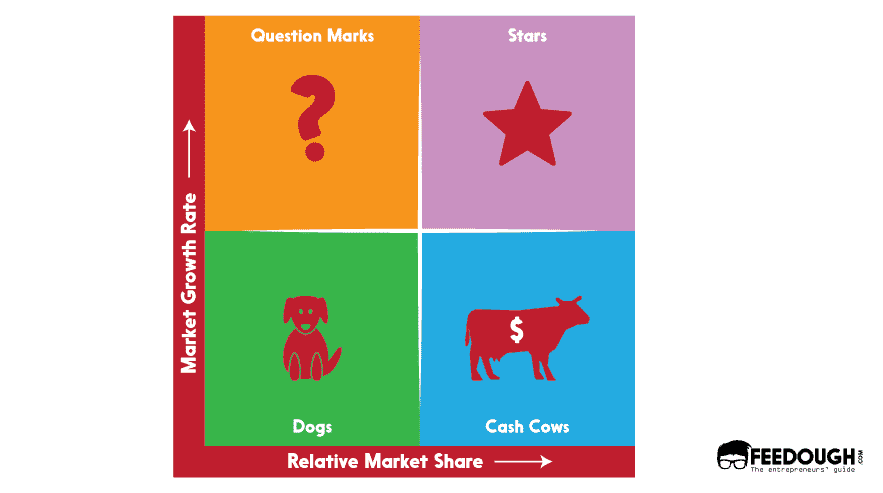
    The concept of cash cows was first propagated by a model developed by the Boston Consulting Group. The model was the BCG matrix, and firms still use it to planning long-term product strategies.

    A BCG matrix divides the product portfolio into four types and assigns cash cows a spot wherein the growth rate is low, and the relative market share is high.

    BCG-MATRIX

    Hence, to be a cash-cow, a product or division should have the following characteristics:

    • Low market growth rate: These products belong to a sluggish market, meaning the market growth for the concerned product is essentially slow. Firms are required to consider replacing them, as they belong to a market that is slowly witnessing a downward trend in its growth rate. Just like how a cow is milked, these products are “milked” as the firm refuses to invest too much in a product that belongs to a market with low growth rate.
    • High market share: A cash cow product is considered a product that is well-established in the market. These products are typically manufactured by brands that people have have grown to trust over several years.

    Examples of Cash Cows

    Below listed are a few examples of cash cows:

    Apple’s iPhone, iPad and iMac

    The Apple products bring in most of Apple’s overall revenue. The iPhone accounts for 61.65% of its revenue, while the iPad and iMacs account for 8.39% and 11.27% of Apple’s total revenue respectively.

    All three of these products belong to a market that witnesses slow growth.

    The aforementioned products have made a mark on their respective industries, and hence hold a big chunk of the market share in these industries. It can, therefore, be deduced that these products are cash cows for Apple Inc.

    Microsoft’s personal computing (Windows)

    Microsoft has been the dominant player in personal computing after it released Windows in 1983.

    Today, Windows accounts for only a small part of Microsoft’s business, while it generates a steady revenue for the company.

    Hence, Windows is a cash cow for Microsoft.

    Printing division of HP

    HP’s printing division has dominated the market for about 20 years.

    It’s printing division has brought the company substantial revenues. Thus, it is no doubt that the printing division has been HP’s greatest profit generator over the years, making it the company’s cash cow.

    Strategies that Aid Cash Cow Products

    A cash cow is integral to a firm as it allows the firm to finance its operations. Hence, the firm needs to adopt strategies to aid the firm milk promised profits from such offerings. Some of these strategies have been listed below:

    • Marketing the product: Some cash cows don’t require a lot of marketing since they are well-established. However, if it’s not the case, firms should spend enough on the sales and promotion of such offerings.
    • Creating a budget: It is almost impossible for a product to sustain itself, and so, a firm is required to set out a budget to make the product still relevant in the market. This would require the firm to keep a check on the market demand of its cash cow and gather feedback to make amends if required.
    • Prioritising the cash cow: A cash cow generates the largest profits without the firm having to invest much. Most firms aim for larger profits, and hence, maximising its sales should be prioritised.
    • Product development: Product development in the case of cash cows refers to improvising the already existing product to make it relevant in the market.

    Go On, Tell Us What You Think!

    Did we miss something? Come on! Tell us what you think about our article in the comments section.

  • Good & Bad Advertising Slogans (And How To Differentiate Between Them)

    Good & Bad Advertising Slogans (And How To Differentiate Between Them)

    I’m lovin’ it- The moment you hear this phrase, a picture of burgers, fries, and soft-drinks pops into your head, indicating that McDonald’s did a fantastic job while crafting its advertising slogan. 

    In this modern era of the competitive market, you get to see many catchphrases every day. From Disney to Bira, every brand use advertising slogans. However, only a few manage to build awareness around the brand or offering and grab attention to leave a long-lasting expression in the minds of their target audience

    Before digging deep into the guide to create advertising slogans, you should first know about advertising slogans basics.

    What Is An Advertising Slogan?

    Advertising slogans are brief and catchy phrases used by companies in marketing and advertising campaigns to draw their target audience’s attention to the advertised offering.

    In other words, they are memorable catchphrases of only a few words in length that the company boasts audibly to promote its brand or an offering.

    Some of the best advertising slogans that left a remarkable key brand message in consumers’ minds are : 

    • Dollar Shave Club: “Shave Time. Shave Money.”
    • MasterCard: “There are some things money can’t buy. For everything else, there’s MasterCard.”
    • M&M: “Melts in Your Mouth, Not in Your Hands”
    • De Beers: “A Diamond Is Forever”
    • Meow Mix: “Tastes So Good, Cats Ask for It By Name”
    • Verizon: “Can You Hear Me Now? Good.”
    • The U.S. Marine Corps: “Semper Fi”
    • Ronseal: “It Does Exactly What It Says on the Tin.”
    • The Mosaic Company: “We Help the World Grow the Food It Needs”
    • Pitney Bowes: “We Power Transactions That Drive Commerce”
    • Nike: “Just Do It.”
    • Apple: “Think Different.”
    • L’Oréal Paris: “Because You’re Worth It.”
    • California Milk Processor Board: “Got Milk?”
    • BMW: “Designed for Driving Pleasure.”
    • Tesco: “Every Little Helps”
    • Bounty: “The Quicker Picker Upper”
    • Lay’s: “Betcha Can’t Eat Just One.”
    • Audi: “Advancement Through Technology”
    • Dunkin’ Donuts: “America Runs on Dunkin’”
    • McDonald’s: “I’m Lovin’ It”
    • The New York Times: “All the News That’s Fit to Print”
    • General Electric: “Imagination at Work.”
    • State Farm: “Like a Good Neighbor, State Farm is There”
    • Maybelline: “Maybe she’s born with it. Maybe it’s Maybelline.”
    • The U.S. Marine Corps: “The Few. The Proud. The Marines”

    Good Advertising Slogans Vs Bad Advertising Slogans

    Advertising slogans can either be good or bad depending upon the image of the brand they project in front of the target audience and the commitments they give to their customers. 

    What Makes Advertising Slogans Good?

    Following are some of the characteristics that represent a great slogan : 

    • It stands out: It is crucial to have a distinctive and unique ad slogan if you want people to identify your brand without relying certainly on the products.
    • It is memorable: Besides having only a few words of length in the catchphrase, it is also essential for an ad slogan to be memorable so that people can easily recognise it in a second or two when they hear it.
    • It inculcates a sense of positivity about the brand: A good ad slogan is a slogan that leaves a positive impression in the mind of a person. For example, McDonald’s slogan, “I’m lovin’ it” helps the audience develop a positive attitude towards the brand.
    • It maintains a healthy relationship with customers: Advertising slogans, if crafted perfectly, can eventually build a healthy relationship between the customers and the Business.
    • It increases the demand for the products: An ad slogan aims to highlight a product’s qualities. Hence it is beneficial to have an ad slogan to increase your product’s demand in the market.

    Famous Slogans

    Now that you know what makes a slogan good, below are some examples of good advertising slogans : 

    L’Oreal – “Because you’re worth it” (1971)

    Written in 1973, when a wave of feminism was taking over, “Because you’re worth it”, this phrase left a remarkable impression on women, and boosted their self-confidence. Even today, 80% of women recognise and respond to these powerful four words, which shows that the slogan is memorable and proves that it is good enough to show what the brand stands for.

    KFC – “It’s Finger-Lickin’ Good” (1950)

    Written by the restaurant manager himself, this slogan proves that not only slogans penned by professional writers turn out to be successful. Anyone with a great amount of research of the brand and the target audience can craft it too. 

    The phrase describes the image of what the brand wants to project in your mind about the product. That is why it is one of the most successful slogans.

    Coca Cola – “Open Happiness” (2009)

    The soft-drinks company focused on creating a positive impact through its phrase – “Open Happiness”, which stands for optimism, positivity, and inspiration, thereby making a good slogan.

    M&M’s – “Melts in Your Mouth, Not in Your Hands” (1954)

    One of the sweetest slogans of all time created decades ago, yet incredibly well received. This slogan managed to be catchy despite its relatively bigger size because it describes the product and its unique strategy.

    De Beers – “A Diamond is Forever” (1948)

    Written by a woman, these four simple words represent timelessness and strength. The phrase was also declared as “Slogan of the Century” by Advertising Age as it represents the essence of a diamond. Hence, it marked its presence in one of the best slogans.

    What makes advertising slogans bad? 

    Although most advertising slogans set the positioning of a brand and connect with the audience in a memorable way, some refuse to leave a positive impression in the audience’s mind due to bad timing and other faults.

    Some examples of slogans that didn’t work well are: 

    Sunglass Shack – “Sitting On Faces Since 2001” (2001)

    Despite it being humorous and short, this phrase is only liked by a few. It undoubtedly makes you giggle. However, it leaves a negative impression in consumers’ minds, which is why it didn’t turn out to be great.

    Electrolux – “Nothing Sucks Like Electrolux” (1960)

    Like Sunglass Shack, this slogan is also not liked by many. This phrase is considered a double entendre by some as it conveys its work. However, some consumers mistake the phrase for demeaning its brand.

    Reebok – “Cheat On Your Girlfriend, Not On Your Workout” (2012)

    Reebok received heavy criticism after it launched this ad slogan. Customers considered this phrase to be offensive as it shows dishonesty and disrespectful attitude towards women. 

    SEGA – “The More You Play With It, The Harder It Gets” (1990)

    The SEGA genesis ran a risk of promoting itself through weirdly mature advertisements, including this ad slogan. People never looked at SEGA the same way after hearing these advertisements. 

    BiC – “Look Like A Girl, Act Like A Lady, Think Like A Man, Work Like A Boss.” (2012)

    This ad slogan caused outrage on national women’s day. Not only did they fail to create a positive impact on consumers’ minds but also received heavy criticism by feminists and other activists.

    Go On, Tell Us What You Think!

    Did we miss something? Come on! Tell us what you think about our article on famous slogans in the comments section.

  • Is A Degree In Entrepreneurship Worth It?

    Is A Degree In Entrepreneurship Worth It?

    Entrepreneurship may be a calling for many of us who would love to jump into the world of entrepreneurship without any training and then learn and mature in entrepreneurship with years.

    However, in a world where more and more people opt to become entrepreneurs, entrepreneurship is no more a ‘calling’ where you can rely on your instincts to succeed.

    You must have that extra edge to beat the competition or stand out in a flooded market.

    So how do you get that edge?

    10+ years back, when I started my first venture, I vividly remember – multi-tasking and working around the clock to meet the demands of running a business.

    With no mentorship or formal studies to support my endeavor, I struggled.

    However, things today are different.

    Unlike earlier times, when entrepreneurship was never a subject in colleges – today, there is no dearth of options for colleges where you can pursue a degree in entrepreneurship.

    As per a list published on the prestigious Saint Louis University, more than 200 colleges and universities offer a degree in entrepreneurship.

    Now before I address the question – is a degree in entrepreneurship worth it? How about we discuss the advantages and disadvantages of an entrepreneurship degree.

    Advantages And Disadvantages Of Entrepreneurship Degree

    The most significant advantage of joining an entrepreneurship course in a formal university setting is that it helps you learn from the professionals who can teach you various aspects of entrepreneurship – including but not limited to marketing, finance, psychology and leadership.

    As you compete for VC funding, an entrepreneurship degree may add an edge to your case or argument for why you should get funded.

    Also, a degree in entrepreneurship may give you a leg-up compared to others trying to build a successful business using the same idea.

    The disadvantages of an entrepreneurship degree are primarily two-fold and somewhat obvious – time and money.

    If you join a university course, you will need to invest a considerable amount of time attending classes and doing class-work and so forth to earn your degree.

    You will have to carefully weigh whether such an investment of your time is worth its while based on your circumstances.

    The other disadvantage of an entrepreneurship degree is the cost – which is a complaint you could apply to many other university courses.

    A full-time course from a reputed university is likely to cost you tens of thousands of dollars. You’ll need to evaluate whether that investment of money is worth it and it might pinch your pocket (hard) – especially when several avenues are available online for learning virtually anything.

    You will probably be able to find online courses that teach you marketing, finance, international business principles and so forth. These online courses will be orders of magnitude cheaper than courses from traditional universities.

    There are also several books and YouTube lectures to which you can refer.

    For example, Danny Kahneman’s books are a great way to learn about his wonderful insights into human psychology and the various heuristics and biases we are susceptible to.

    You can always read online – Wikipedia, to cite one source – about the halo effect or the peak-end rule or confirmation bias or availability heuristics.

    These concepts all describe our decision making patterns under different imperfect conditions. As an entrepreneur, you will be meeting investors, clients and making hiring decisions.

    Being aware of the halo effect or confirmation bias will serve you well in various situations.

    You can watch Robert Sapolsky’s excellent lectures on Human Behavioural Biology on YouTube. You can watch Danny Kahneman’s video on YouTube given as part of the Talks at Google series.

    How A Degree In Entrepreneurship Can Make A Difference

    Well! I listed the advantages and disadvantages of a degree in entrepreneurship before I decide whether I find the idea of getting a degree in entrepreneurship useful or not.

    Having spent years learning the tricks of running a business, I would not mind going back to the college to get a degree and learn from the experts.

    I write this because the time and money I would spend in getting the degree might save me the time and money I will lose making the mistakes as an entrepreneur.

    To a world fascinated with famous entrepreneurs who never completed their college degrees – the prominent examples are Bill Gates, Steve Jobs, and Mark Zuckerberg. I want to list a fact: 8 out of 10 startups fail.

    If there is a formal course that can help you be a part of 20% of startups that do not fail, why wouldn’t you want to take the chance of upgrading your skillset with a formal degree?

    Also, there is a Jeff Bezos and a Larry Page who went to college for every Bill Gates or steve jobs and did formal education.

    So you can make either argument – that college degrees are essential for entrepreneurial success and that college degrees are not at all necessary to succeed as an entrepreneur – some examples support either view.

    But whether you are an early mover or decide to quit your regular job to try entrepreneurship, a degree in entrepreneurship will help you make sure you have all your bases covered in terms of what it takes to run a successful business.

    According to a survey, some 24 million Americans were considering abandoning their full-time jobs favoring self-employment.

    A Degree In Entrepreneurship Is Not Only About Succeeding, It Is Also About Training You To Prepare For Failure

    As an entrepreneur, you need not be a one-trick pony.

    Entrepreneurs can have second lives – think of Steve Jobs.

    Jobs said that getting fired from Apple was the best thing that ever happened to him.

    Because a degree in entrepreneurship will cover all kinds of topics that have an enduring value and are applicable in a range of businesses, your degree will keep being valuable when you move from one entrepreneurial idea to another.

    It’s just a fact of life that most startups fail – about 70 percent close shop in the first five years.

    That happens for a few reasons, such as lack of product-market fit or issues among multiple founders or some marketing or finance challenges.

    If an idea fails, or a startup fails, the professional entrepreneur will often move on to the next idea.

    Serial entrepreneurs love to move on to the next startup idea even when their present startup idea is going great – it’s the thrill of starting a company and seeing it succeed on traditional business metrics that fires some entrepreneurs up.

    If you start a business just based on an idea and meet some challenges, you may have to close the company down.

    If and when that happens, you may react in one of two different ways – you may think of that event as kind of an ultimate judgment of who you are, or you may be able to take it in your stride as just a small business failure.

    Nobody is going to succeed all the time – even the best companies occasionally fail. Remember Amazon’s Fire phone or Microsoft’s attempt at smartphones with the acquisition of Nokia?

    Does anyone recall Google’s attempt to enter Facebook’s turf with Google+?

    Microsoft’s attempt to put up a challenge to Google in search has been mostly a failure.

    Google Glass was ahead of its time and another failure.

    If companies of Google and Microsoft’s stature can fall flat occasionally, the average entrepreneurs will also more than likely fail.

    Entrepreneurs need to keep in mind that their chances of success are only about 10 percent. Less than 50 percent of businesses last till their fifth year.

    Only 33 percent of startups last till their tenth year of operation.

    What Does A Degree In Entrepreneurship Typically Contain?

    So, what do they teach in Entrepreneurship School?

    Well, usually, Entrepreneurship is part of the business school at most universities where there are courses on offer in Entrepreneurship.

    You learn more about real-world skills than theoretical stuff, such as business models you might learn about in an MBA curriculum.

    Typical entrepreneurship curricula cover these aspects:

    • Business Models
    • Venture Capital
    • Raising Entrepreneurial Capital
    • Entrepreneurial Marketing
    • Entrepreneurial Leadership
    • Entrepreneurial Finance
    • Finance for Emerging Enterprises
    • Corporate Entrepreneurship
    • Global Supply Chains and Operations
    • International Business Principles
    • International Entrepreneurship
    • Entrepreneurship in the European Union
    • Technology Entrepreneurship
    • Marketing and Business Performance
    • Professional Selling and Communications
    • Management of Innovation and New Technology
    • Market Research
    • New Product Development
    • Sustainable Product Design and Marketing
    • Social Entrepreneurship and Social Change
    • Social Entrepreneurship in Action
    • Emerging Enterprise Law

    What Are The Differences Between A Business Degree And A Degree In Entrepreneurship?

    I get this asked a lot – is a business degree the same as a degree in entrepreneurship?

    It’s worth pointing out the differences between business degrees, which have been around forever, and degrees in entrepreneurship, which are relatively newer degree offerings.

    Here’s one essential difference between what business schools teach and what entrepreneurship education teaches.

    With a business degree or business education, you learn how to succeed as a manager within an existing organization. With an entrepreneurship degree, you learn more about starting new ventures.

    Because business education has been around for so long, their specializations and curricula are well-defined.

    You pursue a master’s degree in business administration (MBA) and specialize in marketing, finance, sales, or human resources. You major in a few disciplines and you also learn some associated subjects, including IT topics.

    As part of the MBA curriculum, you acquire a thorough grounding and in-depth knowledge in your chosen subjects in which you are majoring.

    Once you have finished your MBA degree, you join traditional companies and have a career progression in your chosen field of specialization.

    You may eventually become a senior manager in your discipline with enough skills and dedication – a Director for Sales or Director, Finance or Director, HR, or some such designation.

    A career track after pursuing an MBA degree is well-defined and is more suited for those who want to follow an employee’s journey.

    It’s not the case with a degree in Entrepreneurship.

    B-Schools have placement cells.

    Students pursue MBA degrees as they offer job assurance and a career with steady jobs with excellent pay.

    MBA degrees from top B-schools are much desired because those degrees ensure that companies will compete to hire the MBA degree holder.

    Degrees in Entrepreneurship come with neither placement nor a nice career track. The career track after a degree in Entrepreneurship is the opposite of ‘well-defined.’

    The essential difference from an MBA degree is that you choose what to make of your Entrepreneurship education and training. It is up to you to make what you will of what skills and knowledge you acquire.

    What (Entrepreneurship) Dreams May Become Real – With A Degree In Entrepreneurship

    It’s the best of times – for entrepreneurs and entrepreneurship. VC funds are willing to spend money on worthy ideas.

    Angel investors are willing to provide seed funding to entrepreneurs who have just an idea and perhaps a business plan but not much financial heft.

    What are the skills you need to succeed as an entrepreneur?

    It’s a set of skills ranging across different disciplines – psychology, economics, technology and behavioral biology.

    Humans behave in imperfect ways – you can nudge them in specific directions via smart marketing.

    Marketers are learning to incorporate lessons learned by psychologists. Advertisers may use various heuristics – you create a sense of scarcity to appeal to people’s FOMO, to give one example.

    So the skills you need to succeed as an entrepreneur are relatively clear-cut – it is up to you whether you acquire those skills through life itself or in an Entrepreneurship course.

    What are these skills?

    You need to be a good communicator as you need to persuade others to buy into your business idea or to purchase your app or SaaS software.

    Above all, you need to persuade the angel investors and VCs – that takes a good understanding of human psychology.

    Of course, you need to cultivate productive relationships with several stakeholders – clients, partners, financiers, employees and others.

    A degree in entrepreneurship gets you these skills and is worth every penny and time you will spend getting one.

    Go On, Tell Us What You Think!

    Did we miss something? Come on! Tell us what you think about our article on degree in entrepreneurship in the comments section.